Mothers, Sisters, Daughters

Érıu/Éıre of the Tuatha Dé Danann, queen of Ireland, (as depicted by Richard J King) is at the centre of various representations of republican women. Along the top are Ann Devlin, Betsy Gray, Mary Ann McCracken, Countess Markievicz, Nora Connolly?, and Winifred Carney. Suffragettes, the modern IRA, and Cumman Na mBan are depicted, as are Máıre Drumm at the Falls Curfew, Tom McElwee’s sisters carrying his coffin, and Molly Childers and Mary Spring Rice running guns on the Asgard. There is also an unusual ‘four provinces’ in the corners.

The wide shot (below) shows the James Connolly mural below and the 1916 centenary board above – also seen in South Link: Ag fíorú na poblachta/“Realising the republic”.

Rockmount Street, west Belfast.

Click image to enlarge
Copyright © 2022 Paddy Duffy
T01336 T01337 [T01335]

Unbowed, Unbroken

A succession of Irish rebels is shown in this new mural in Andersonstown, west Belfast. It begins (top left) with the rebellion of 1798 and then to the Easter Rising of 1916 at the GPO in Dublin. In the lower left, a pious Padraıg Pearse awaits his execution with rosary beads in hand. There are then shown female figures from Cumann Na mBán and the IRA (see previously: United Irishwomen, Do You Care? and Mothering Sunday In Beechmount), and then Maıréad Farrell in Armagh Women’s Prison (for the original, see Prison Walls). In the bottom right corner there is a blanketman. The busts of Bobby Sands and Joe McDonnell float above the GPO and the last verse of Sands’s The Rhythm Of Time form the epigraph: “It lights the dark of this prison cell, it thunders forth its might, it is the undauntable thought, my friend, the thought that says, “I’m right”.

On the side wall, “Ag fíorú na poblachta” means “Realising the republic”. It celebrates the centenary (“Céad Blıaın 1916 – 2016”) of the Easter Rising and shows a copy of the proclamation of the republic and an Easter lily. The next wall over (see below) shows portraits of the seven signatories to the Proclamation: Joseph Plunkett, Sean Mac Dıarmada, Thomas Clarke, James Connolly, Patrick Pearse, Eamonn Ceannt, and Thomas McDonagh.

Click image to enlarge
Copyright © 2022 Paddy Duffy
T01283 [T01282] T01284

Tragedy At Ballykissane

One of the first casualties of the Easter Rising, on the evening of Good Friday, was Belfast-born Charles Monahan (Charlie Monahan, Cathal Ó Monacháın/Ó Muıneacháın), who died along with Con Keating and Daniel Sheehan in a motor accident in Kerry, when their car – which only had one headlamp – was driven off a pier. His body was not found until October 30th. The driver, Tommy McInerney – shown here studying a map – survived. This mural is in the Markets; Monahan is also claimed by east Belfast and a 2006 mural to him was painted on Mountpottinger Road (Visual History).

“Born in Riley[‘s] Place in the Market area of Belfast, Charles was one of many people who left Belfast to take part in the events leading up to the Easter Rising. Charles[‘s] role was to meet up with 3 other vols and help guide Roger Casement (top left) land a ship full of weapons. On the 21st April, 1916, the driver took the wrong road and drove off the pier into the Laune at Ballykissane. Charles, 37, drowned along with two of his comrades.”

Click image to enlarge
Copyright © 2022 Paddy Duffy
T01268

Mac Dıarmada

This board to Seán Mac Dıarmada in Ardoyne details his exploits leading up to and including the 1916 uprising and his earlier connection with the local area.

Painted by Rısteard ÓMurchú.

Previously: Mac Dıarmada also appears in the Bone Staır Na Gaeılge mural.

Click image to enlarge
Copyright © 2022 Paddy Duffy
T01171

The Evolution Of Our Revolution

A history of nationalism/republicanism from left to right: a pair of Easter lilies, four generations of rifles, and then a switch to a ballot paper with a check in favour of “unity” and a road named “Unity Way”: “From bullet to ballot: the evolution of our revolution. 1916 – 2016”

This mural is on the north side of Hugo Street – the south side remains exclusively éırígí.

Hugo Street, west Belfast

Click image to enlarge
Copyright © 2022 Paddy Duffy
T01144

O’Neill-Allsopp Memorial Flute Band

Jim O’Neill was killed in February 1976 during an IRA arson attack on a furniture warehouse on the Antrim Road near the New Lodge – Gerry Fitt’s house next door might have been the ultimate target (Belfast Child); Robert Allsopp appears to have accidentally shot himself in March 1975 (Irish Peace Process). Both were members of Na Fıanna. The flute band (Fb) is named in their memory. The emblem in the centre of the mural was previously a pair of crossed Sunburst flags (see X05242).

For the main mural, see M08532.

Click image to enlarge
Copyright © 2022 Paddy Duffy
T01043

Her Old Tradition Of Nationhood

“Saoradh salute the men and women of violence,” namely the signatories to the 1916 Proclamation, the women of the 1970s IRA, and modern “dissidents” with home-made weapons.

The plaque on the left is to the IRA’s Pearse Jordan, next to the centenary celebration of the Proclamation, Ag Fíorú Na Poblachta. The board was been moved to this Falls Road location from Ardoyne; it replaces an anti-RUC/PSNI mural.

Hugo Street, west Belfast

Click image to enlarge
Copyright © 2022 Paddy Duffy
T01003

The Mainspring

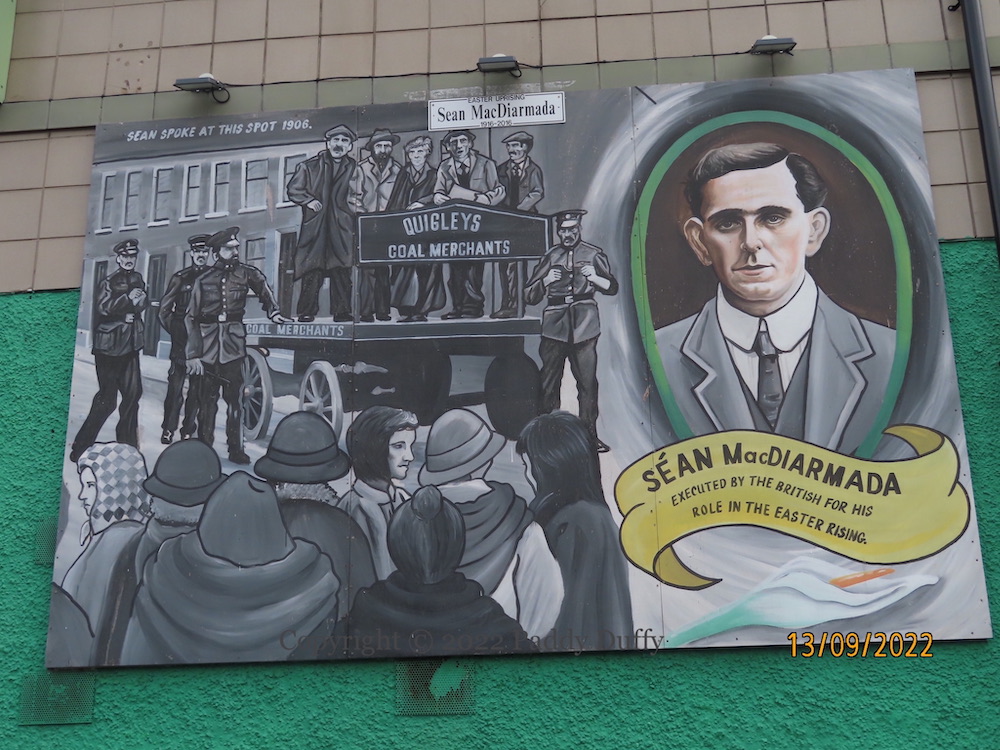
Seán Mac Dıarmada was born in Leitrim, left for Glasgow at age 15, but after two years returned to Belfast in 1905 (working on the trams) and – according to the new mural above – spoke from the back of a coal lorry in Clonard Street, outside the Clonard branch of the Ancient Order Of Hibernians. Mac Dıarmada was for a short time an AOH member, before moving on to the Irish Republican Brotherhood and Irish Volunteers, which led to his participation in the 1916 Easter Rising and execution on May 12th of that year.

The title of this post is historian F.X. Martin’s assessment of Mac Dıarmada, quoted in a pamphlet on Mac Dıarmada from the National Library Of Ireland, which includes reproductions of letters from and about Mac Dıarmada. The NLI made more letters available today (2016-02-08). (See also this Irish Times write-up).

Previously: A 2013 Mac Dıarmada mural in Ardoyne.

Click image to enlarge
Copyright © 2022 Paddy Duffy
T00826 [T00825]

We Bleed That The Nation May Live

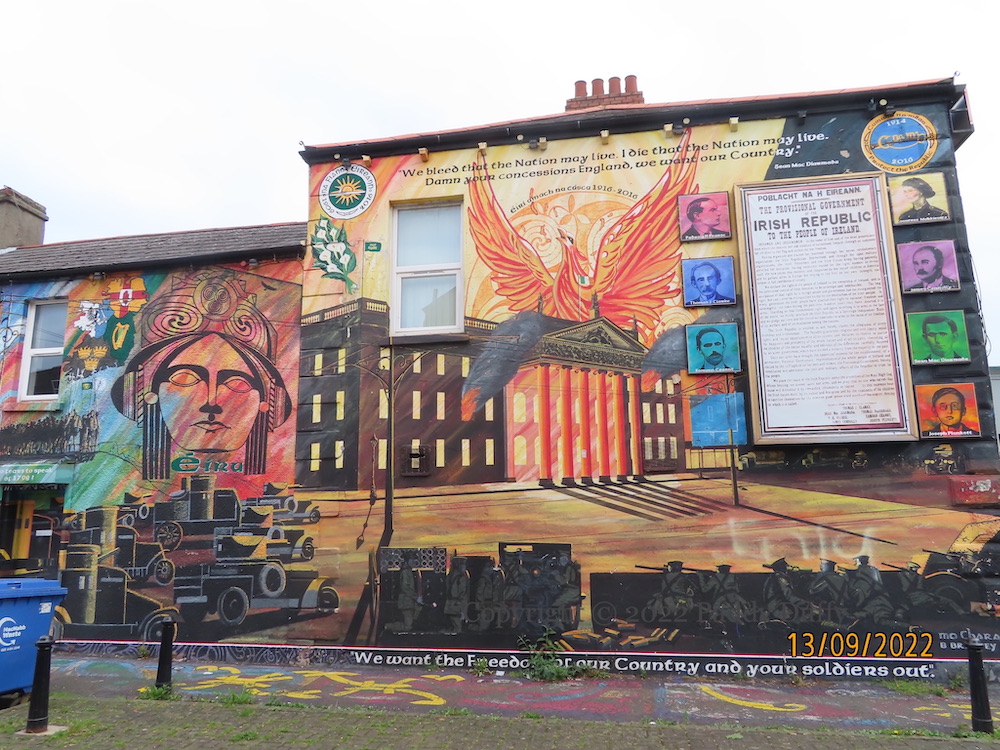
Arrayed against the forces of the British Army (which are shown in armoured cars and in sniping positions in the foreground of the mural, along the whole length of the wall) are various symbols of Irish nationalism: Oliver Sheppard‘s 1911 statue of Cú Chulaınn dying; the pikemen of the 1798 Rebellion (featured yesterday: Éırí Amach 1798); the four provinces of Ireland; Érıu the mythological queen of Ireland/Éıre as designed by Richard J King/Rísteard Ó Cíonga; Easter lilies; the emblems of Na Fıanna Éıreann and Cumann Na mBan on either side of a quote from (The Mainspring) Sean MacDiarmada “We bleed that the nation may live; I die that the nation may live. Damn your concessions, England: we want our country”; a phoenix rising from the flames of the burning Dublin GPO (inspired by Norman Teeling’s 1998 painting The GPO Burns In Dublin); the GPO flying an ‘Irish Republic’ flag; portraits of signatories and other rebels — (left) Padraig H. Pearse, Thomas J Clarke, Eamonn Ceannt, Thomas MacDonagh, (right) Countess Markievicz, James Connolly, Sean MacDiarmada, Thomas Plunkett; the declaration of independence, placed over the advertising box of AA Accountants – see the in-progress shot below. For more work-in-progess images, see yesterday’s post, Éırí Amach 1798. At the very bottom is a quote from the mother of Gerard ‘Mo Chara’ Kelly, Harriet Kelly: “We want the freedom of our country and your soldiers out.”

McQuillan Street, west Belfast

Click image to enlarge
Copyright © 2022 Paddy Duffy
T00821 [T00822] T00823

The Women Of 1916

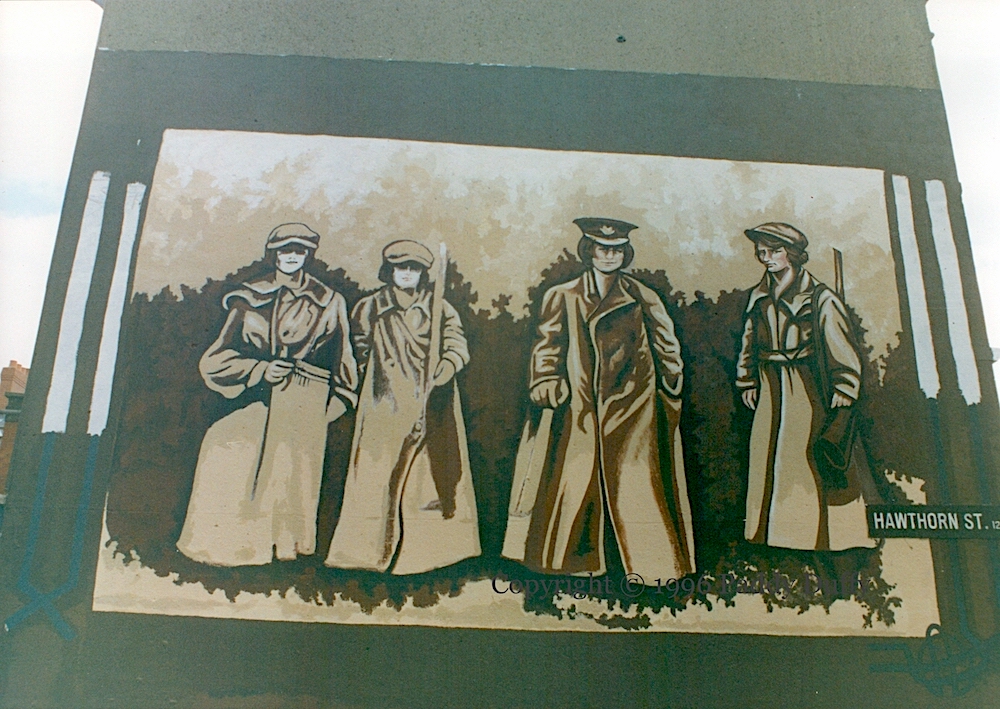
Text would later be added along the bottom reading, “This mural is dedicated to the Women of Cumann Na mBan, Óglaıgh Na hÉıreann & Sınn Féın.” Image “from R[uth] Taillon’s book The Women Of 1916.” Taillon is a Canadian who moved to Belfast in 1980 and has been doing work with the women’s movement in the north and on women’s history – see NVTv.

Hawthorn Street, west Belfast. There was also a mural on the low wall to the left – see The Soldiers Of Cumann Na mBan.

Click image to enlarge
Copyright © 1996 Paddy Duffy
T00193