Guiding Light

“This site housed the former Mid Donegall Road Bonfire for over two decades, until the expansion and development of the surrounding area including the City Hospital meant that it was no longer viable for a bonfire to remain on this site. Greater Village Regeneration Trust, through its work with The Health Trust, who own the site, and the local community, including the local bonfire builders wanted to have something on the site that could benefit the whole community and agreement was given for it to be transformed into the garden that is here today. Local Artist Johnny [sic] McKerr worked alongside Greater Village Regeneration Trust and the local community and this artwork was designed to depict and celebrate the heritage, history and culture which the people of this area are extremely proud of.”

The info board includes a photograph of the bonfire spilling out towards the car-park for the City. The other image is a photograph from the Peter Moloney Collection, used without permission, and photoshopped to add “DRL” – Donegall Road Loyalists.

According to Eddie Kelly of the GVRT, Carrickfergus castle is included because “This is where King William landed, and the annual bonfire is a symbol of a beacon lit across the coast to guide him” (Belfast Live).

Painted by JMK/Jonny McKerr (tw) at Coolfin St on Donegall Rd.

Click image to enlarge
Copyright © 2022 Paddy Duffy
T01108

The Great Sacrifice

Here are the four boards on Lindsay Street, south Belfast, from east to west.

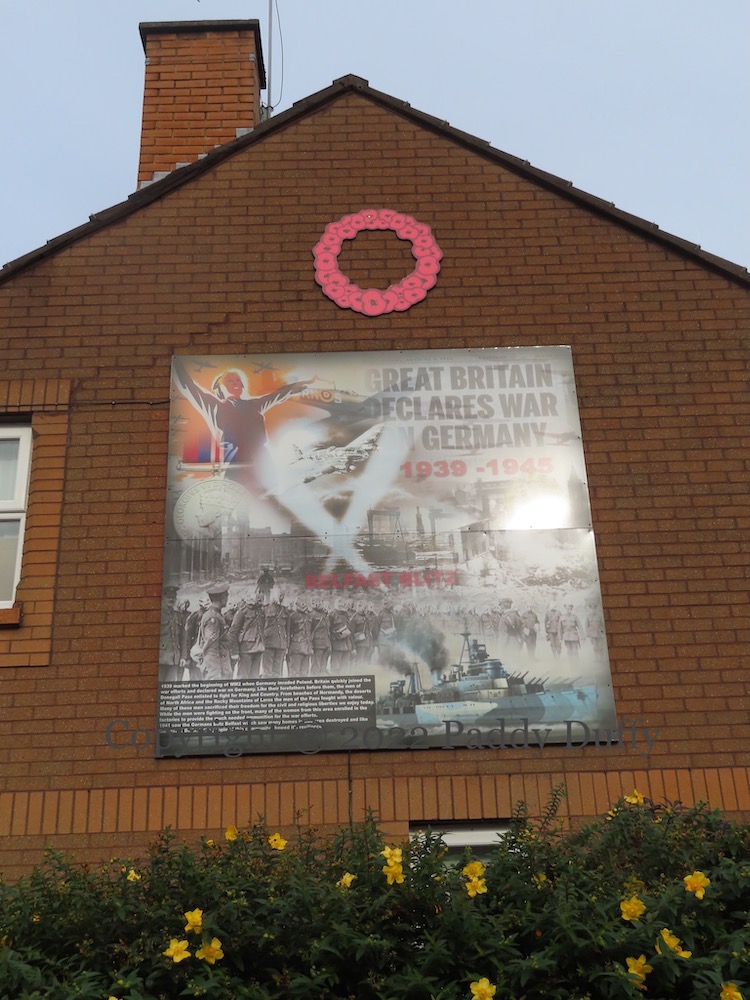
Above: “Great Britain declares war on Germany 1939-1945. 1939 marked the beginning of WW2 when Germany invaded Poland. Britain quickly joined the war efforts and declared war on Germany. Like their forefathers before them, the men of Donegall Pass enlisted to fight for King and Country. From beaches of Normandy, the deserts of North Africa and the Rocky Mountains of Leros the men of the Pass fought with valour. Many of these men sacrificed their freedom for the civil and religious liberties we enjoy today. While the men were fighting on the front, many of the women from this area enrolled in the factories to provide the much needed ammunition for the war efforts. 1941 saw the Germans Blitz Belfast which saw many homes in this area destroyed and like the rest of Belfast, the people of this community shows it’s [sic] resilience.”

“The war is over. Armistice Day 1918. 11th month, 11th day, 11th, hour.” “But in their eyes shall shine the holy glimmers of goodbyes … Their flower the tenderness of patient minds, and each slow dusk a drawing down of blinds.” Lines from Wilfred Owens’ (1893-1918) ‘Anthem For Doomed Youth‘ on a new board in Lindsay Street.

The text at the bottom reads: “The last three months of WWI became known as the hundred days. Realising they were defeated an armistice was signed by the Germans. Germany finally surrendered and WWI ended on November 11th 1918. The terms of the agreement called for the end of fighting along the entire Western Front to begin a precisely 11 am that morning. Records show that the last British soldier killed in WWI was Private George Edwin Allison of the 5th Royal Irish Lancers. He was killed at Mons at 09:30 am, just 90 minutes before the ceasefire.”

Computer-generated board in Lindsay Street showing a map of the northern end of the Western Front and images of soldiers marching, on horseback, and in the trenches: Donegall Pass remembers 1914-1918 – the great sacrifice. Lest we forget. Here are commemorated the many local men who during the Great War of 1914-1918 gave the most that man can give: life itself for God for King and Country.

“It is needful that we knit together as one man, each strengthening the other, and not holding back of counting the cost” – Ulster [Unionist] Council Resolution 1912.” “Ulster’s solemn league and covenant. Ulster Day 28th September 1912.” The Council met on September 23rd and 471,000 people signed the covenant (figures here) on or around the 28th – Ulster Day – led by Sir Edward Carson.

Click image to enlarge
Copyright © 2022 Paddy Duffy
T01103 T01104 T01105 T01106

Donegall Pass UVF

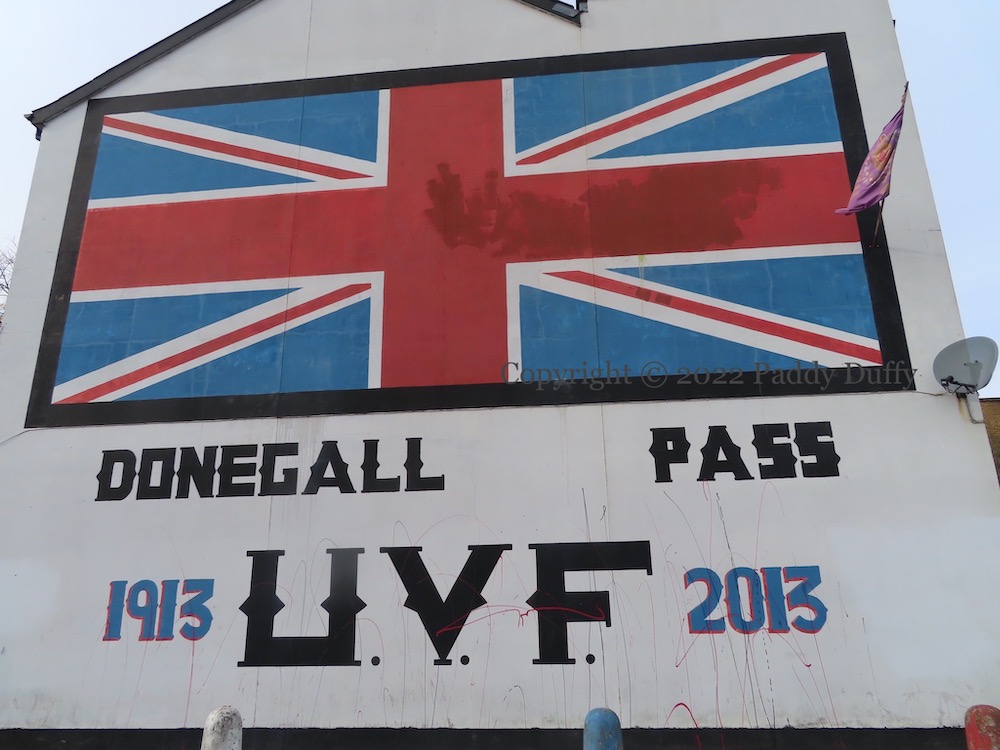
Visible from the Ormeau Road, this large union flag greets visitors to Donegall Pass in the south of the city. It asserts the presence of the UVF and connects the original Ulster Volunteer Force of 1913 to the present-day group one hundred years later: the aim of the original UVF was to resist the impending rule by Catholics under Home Rule.

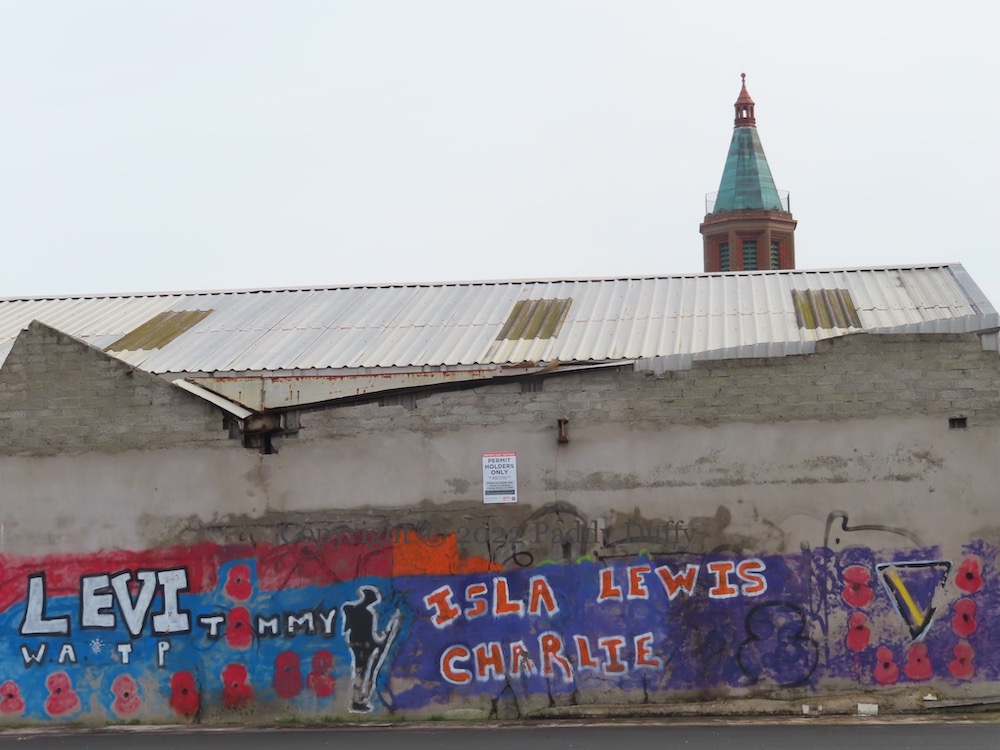
The image below is of the wall opposite, in the car-park; the names are presumably those of local children, with “WATP” [we are the people] and poppies.

Click image to enlarge
Copyright © 2022 Paddy Duffy
T01101 T01102

The Road To The Somme

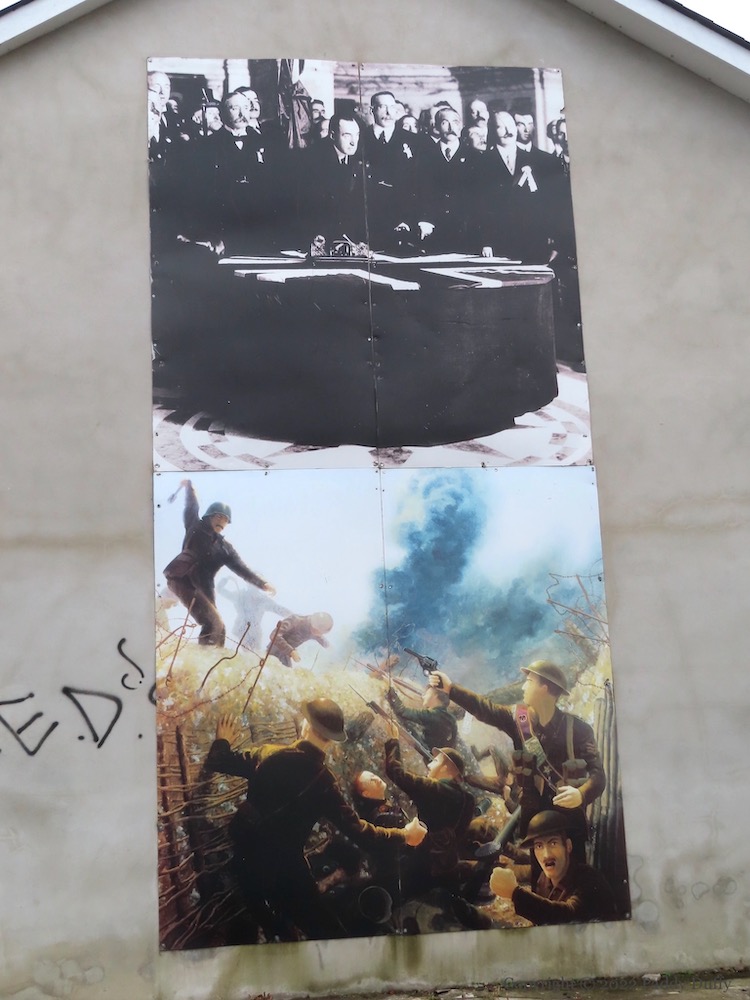
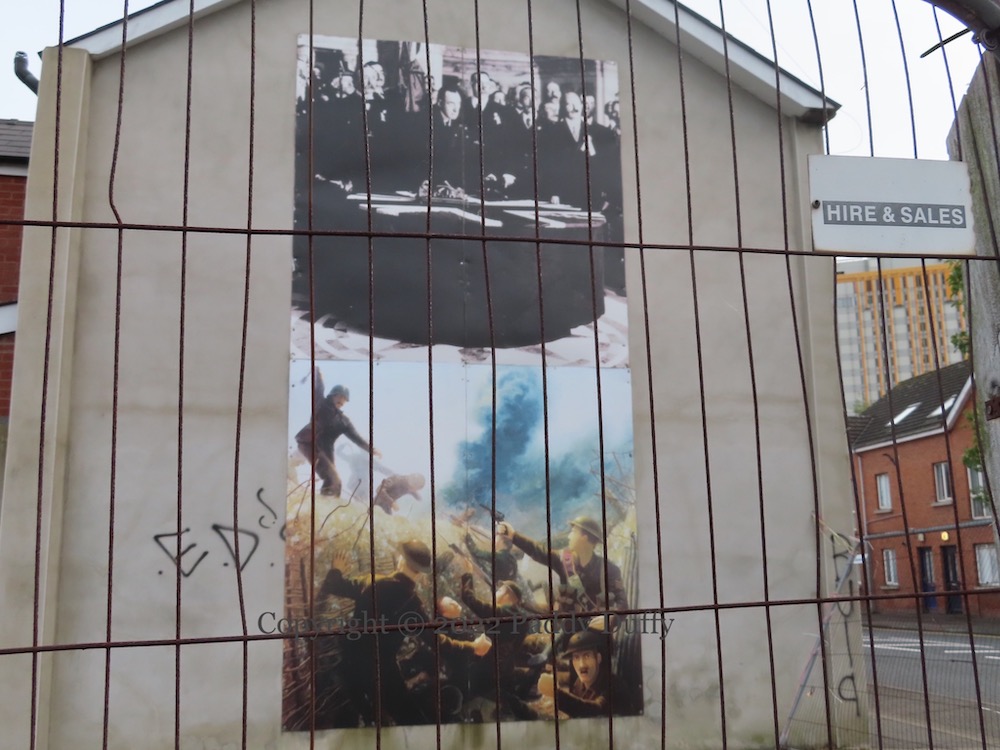
This pair of boards depict (above) the signing of the Ulster Covenant and (below) the 36th Division – formed largely from the Ulster Volunteers that were formed after the Covenant – in the trenches in WWI. It is reported that some soldiers wore their Orange Order collarettes into battle. The painting is by Carol Graham.

The pair was moved to this wall after the house on the corner was knocked down – see Out Of The Rubble.

Barrington Gardens, south Belfast.

Click image to enlarge
Copyright © 2022 Paddy Duffy
T01119 T01120

Here Lies A Soldier

RHC volunteer Stevie McCrea (born 31.5.52, killed 18.2.89) was imprisoned for his role in the killing of 17 year-old Catholic James Kerr in a Lisburn Road garage, on the same day as the RHC bombed Benny’s Bar in Sailortown. He was killed in an IPLO attack on the Orange Cross (the Shankill Social Club). This Village mural is the second tribute to McCrea this year – see also A True Soldier Of Ulster in the lower Shankill, near the former location of the Orange Cross in Craven Street.

The text on the board reads: “Stevie was raised in The Village Area of South Belfast. He was just a young man when The Troubles started but without hesitation answered the call by joi[ni]ng the Village RHC. He soon started making a name for himself by putting himself on the front line with his brothers in arms in the RHC. These men where [sic] one of the most active units in Ulster by taking the fight the republicans. In 1972 at the height of The Troubles Stevie was sentenced to life for his part in a retaliation shooting and was imprisoned in Long Kesh. After serving 15 years with dignity and courage he was released. On the 16th February 1989 just after receiving his last pay cheque [from a transitional work scheme] he decided to join a few friends in The Orange Cross Club in the Shankill area. This would be his last drink as republican scum decided to target the Loyalist club. Stevie sacrificed himself to protect his friend by throwing himself in front of a hail of bullets. Stevie died 2 days later from his injuries in the Royal Victoria Hospital.”

Click image to enlarge
Copyright © 2022 Paddy Duffy
T01132 [T01133]

Ulster Defence Association

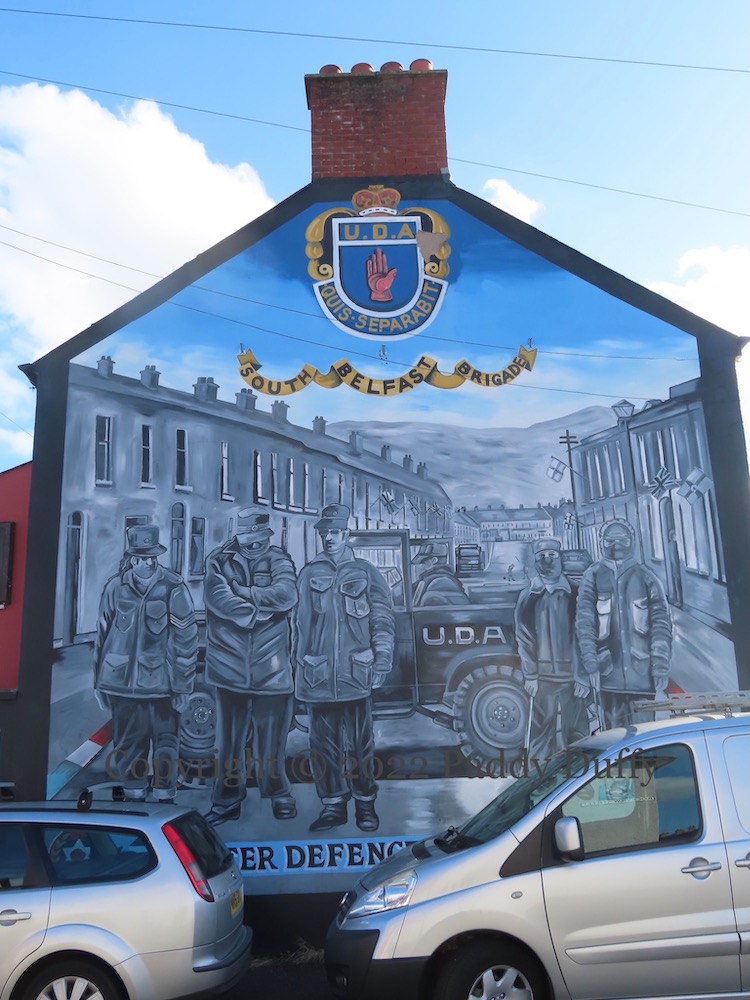
A 1972 Victor Patterson photograph of a UDA mobile patrol in the Oldpark is recreated for this new mural in the Village, south Belfast. “The UDA was formed in September 1971 for most of this time it was a legal organisation. It’s [sic] declared goal was to defend Ulster loyalist Protestant areas and to combat Irish republicanism mainly the IRA. The UDA/UFF declared a ceasefire in 1994 it ended its campaign in 2007.”

Rockview Street, Village, south Belfast.

Click image to enlarge
Copyright © 2022 Paddy Duffy
T01099 [T03094]

Village UVF

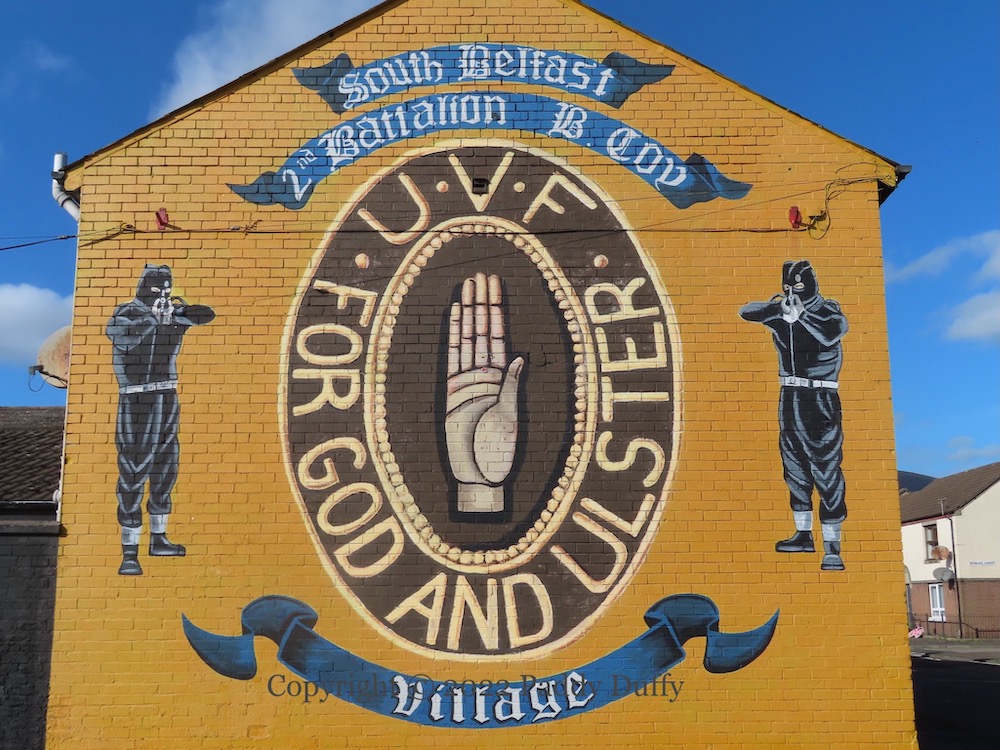
The main UVF mural in the Village area of south Belfast was freshened up in 2018. The design of the mural remains the same as before, with hooded gunmen on either side of the UVF emblem aiming directly at the viewer (see the second image). For the previous version, see 2013’s The Village People.

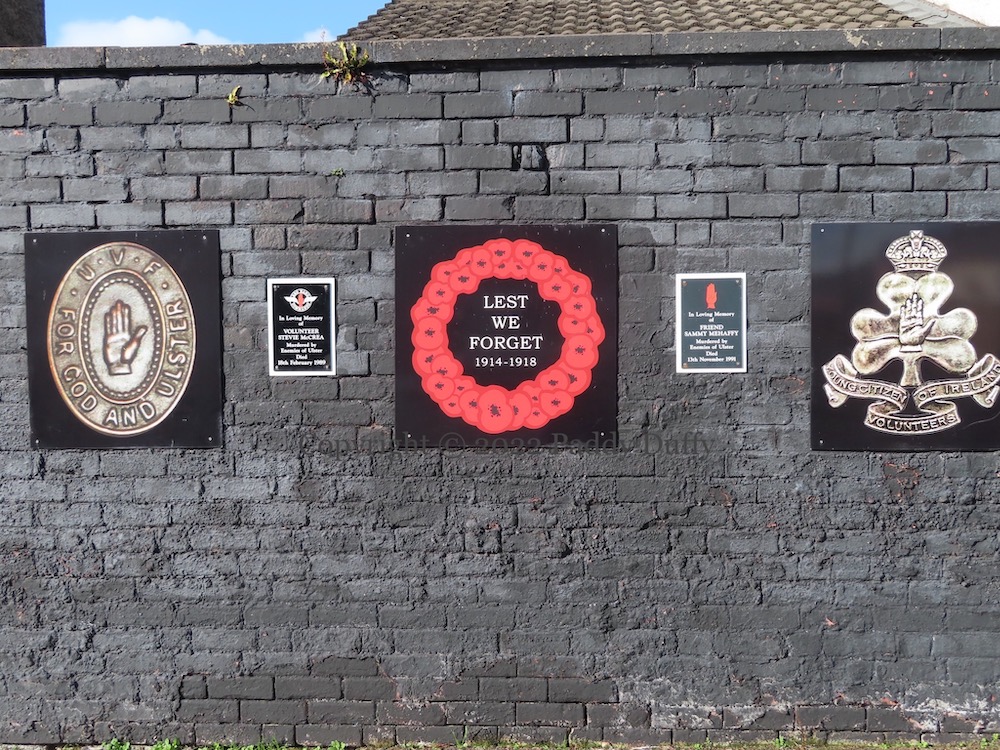
The plaques were added to the side-wall in 2022. This is the third commemoration to Village UVF volunteer Stevie McCrea and the second to Sammy Mehaffy – see Stephen Desmond McCrea and Battalion Of The Dead, which also includes John Hanna, who has a solo board in Prince Edward Pk.

As is often now the case, the modern UVF (McCrea died 1989-02-18 from wounds sustained in the IPLO attack on the Orange Cross, and Mehaffy on 1991-11-13, shot by the IRA in nearby Lecale Street) is mixed in with the 1912 anti-Home Rule Ulster Volunteers and Young Citizen Volunteers, which are themselves blended together with WWI and the 36th (Ulster) Division of 1914-1918.

Click image to enlarge
Copyright © 2022 Paddy Duffy
T01097 T01098

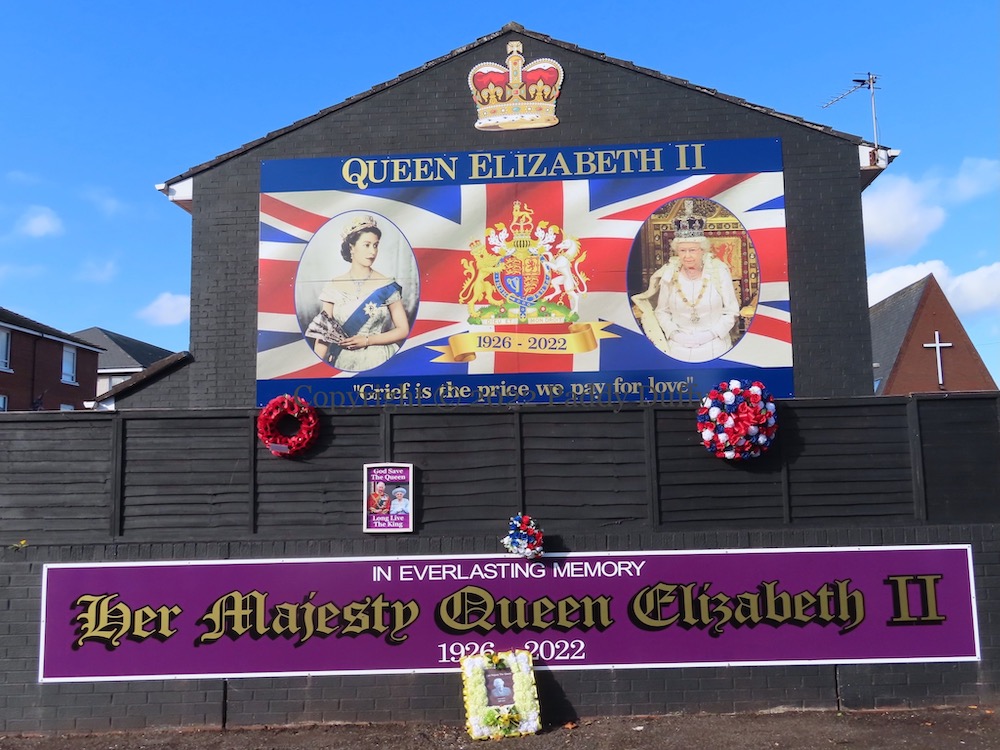
Grief Is The Price We Pay For Love

Elizabeth II, queen of the United Kingdom, passed away on September 8th, at the age of 96, in the same year of her platinum jubilee, the 70th anniversary of her accession. The phrase “grief is the price we pay for love” comes from a message from Elizabeth in consolation with the relatives of those killed in the “9-11” attacks in 2001 (text at The Guardian).

“In everlasting memory – her majesty Queen Elizabeth II – 1926-2022.” “Long live the King”

Rowland Street, south Belfast

Click image to enlarge
Copyright © 2022 Paddy Duffy
T01086 [T01087]

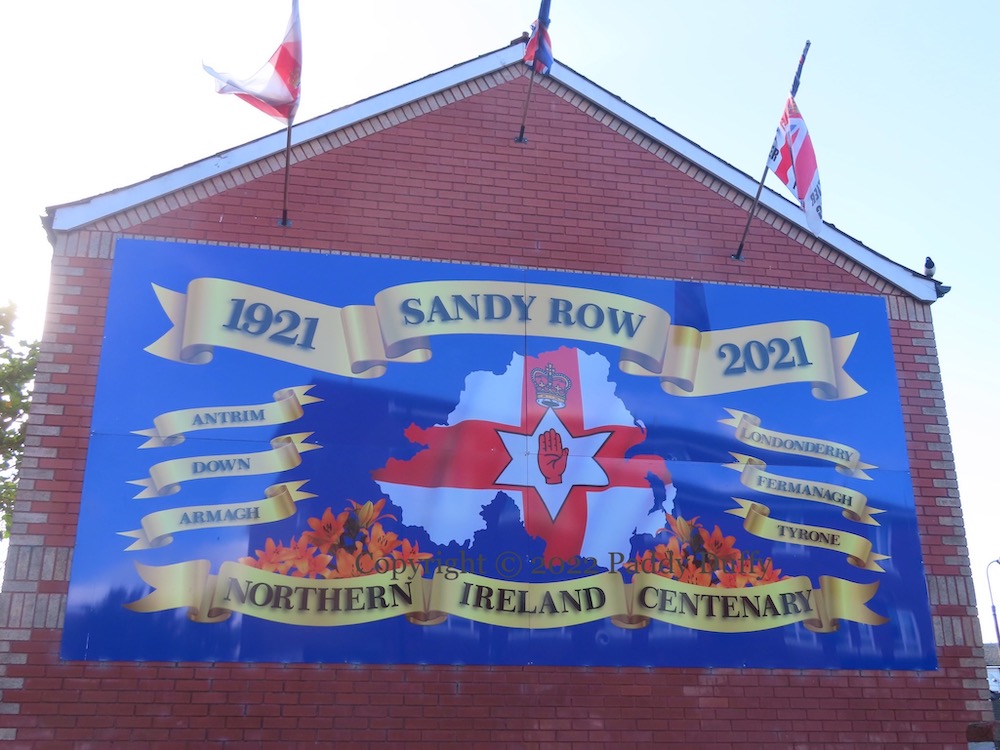
Our Wee Country

“From Sandy Row to the house of Windsor: happy diamond jubilee 1952-2012. God save the Queen.” Although the coronation was held in June 1953, Elizabeth acceded to the throne immediately upon the death of George VI, on February 6th, 1952. This board was previously on an adjacent wall but has been moved to this location (on top of the ‘Our Wee Country’ mural, replacing a damaged mosaic) to make way for the NI centenary board shown below.

The Irish Football Association (web | tw) is the governing body for Northern Irish soccer, overseeing both domestic and international events. The original Our Wee Country (fan organisation Web | tw) mural was in Carnforth Street, east Belfast.

Click image to enlarge
Copyright © 2022 Paddy Duffy
T01084 [T01083] T01085