A traffic cone provides a makeshift flower holder in front of this board Clara Street board: “Grove Community Group [Baptist Church (web | Fb)] mourns the passing of Queen Elizabeth II 1926-2022″. Charter NI has images from last September of more bouquets and a piper at the board (tw).
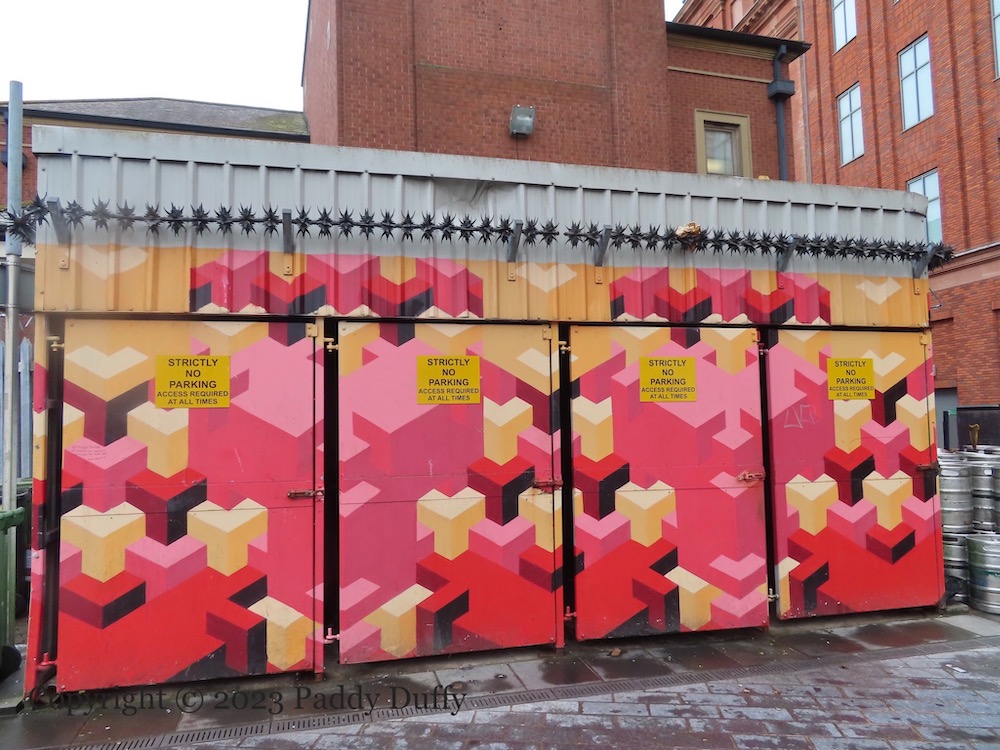
The Con O’Neill bridge crosses the Knock river just before it meets the Loop river to form the Connswater, which used to be Con’s water, and provided a way for “men, horses and livestock to cross the river” (Con O’Neill).
The mural depicting such a crossing, by Friz (ig), is on a gable wall in the car park next to the bridge; the area is now known as The Hollow, as in “Hey, where did we go?/Days when the rains came/Down in the hollow/Playin’ a new game.” (For an image of bridge partially submerged and impassable in 2012, see Geograph | more images at Google Maps Places.)
Con lived c. 1600 but the bridge might well pre-date that time. It was refurbished as part of the Connswater Greenway project in ?2014?.
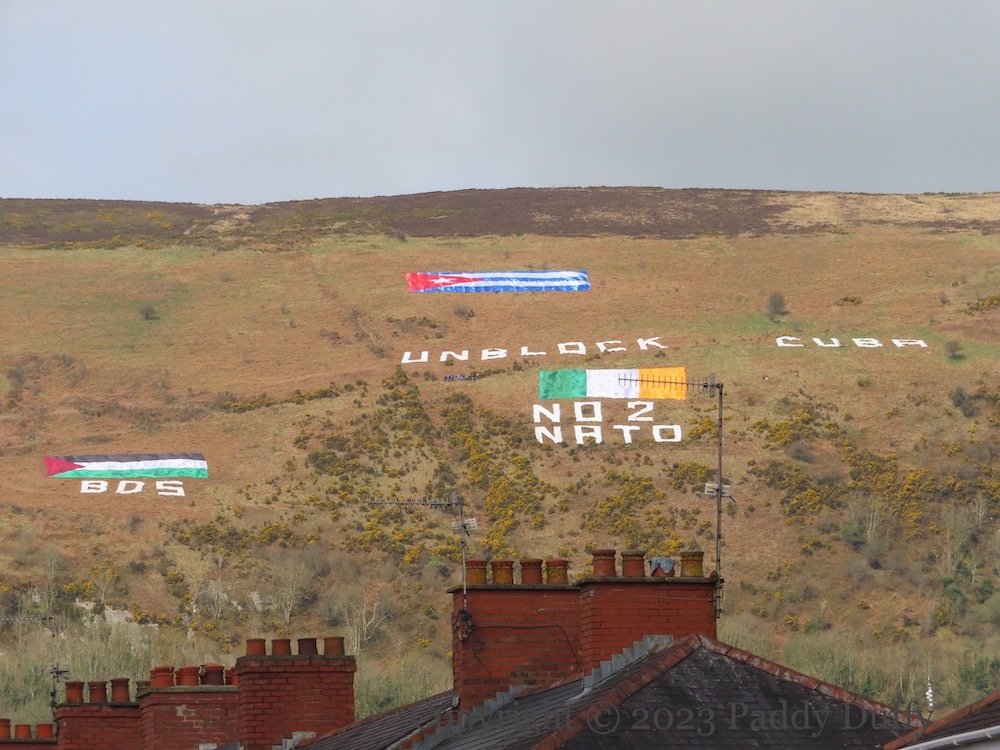
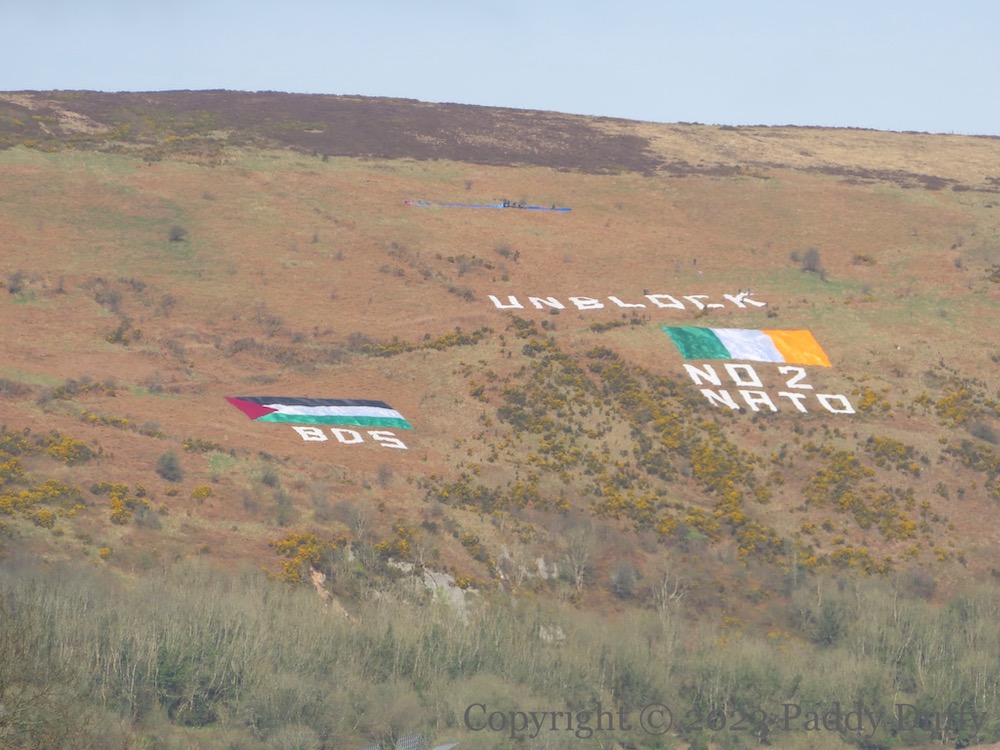
A trio of international causes aimed at the visiting Joe Biden, president of the United States, from Gael Force Art and People Before Profit. What’s new here is the “No 2 NATO” under the Irish Tricolour. The other two parts have been on the mountain previously: the Cuban flag with “unblock Cuba” reprises the maassive Cuban flag on the mountain in 2021, which was depicted in the La Solidaridad Invariable mural onDivis St, and the Palestinian flag with “BDS” [Boycott, Divestment, Sanctions] in 2018’s #BDS.
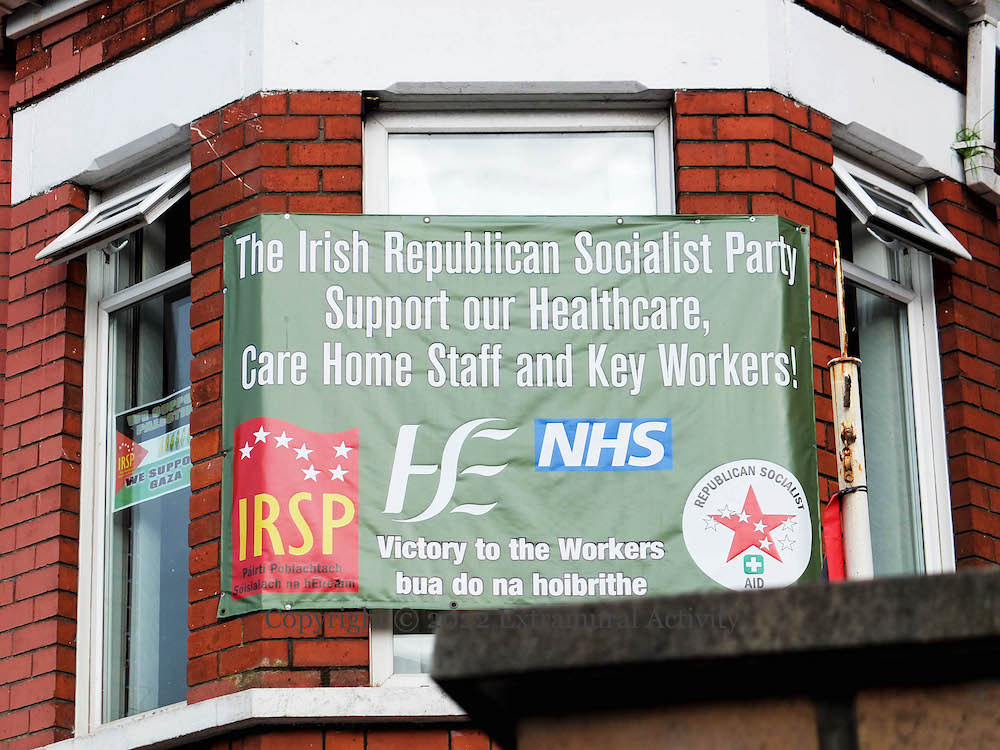
“Victory to the workers”. Costello House is home to the IRSP (tw) “Advice Hub” with representative Dan Murphy (Mid Falls & Springfield) and Michael Kelly (Lower Falls). Murphy (in Black Mountain) received 2.7% and Kelly (in Court) 3.2% of first-preference votes in the recent local elections (WP).
The first printing press in Belfast belonged to James Blow and his brother-in-law Patrick Neil in 1694 (DIB | Dublin Penny Journal gives 1696 | Mary Lowry Story Of Belfast gives 1690); a run of 8,000 Bibles is said to have been printed in 1751, one of which is part of the Linen Hall Library’s collection on Early Ulster Printing (RASCAL).
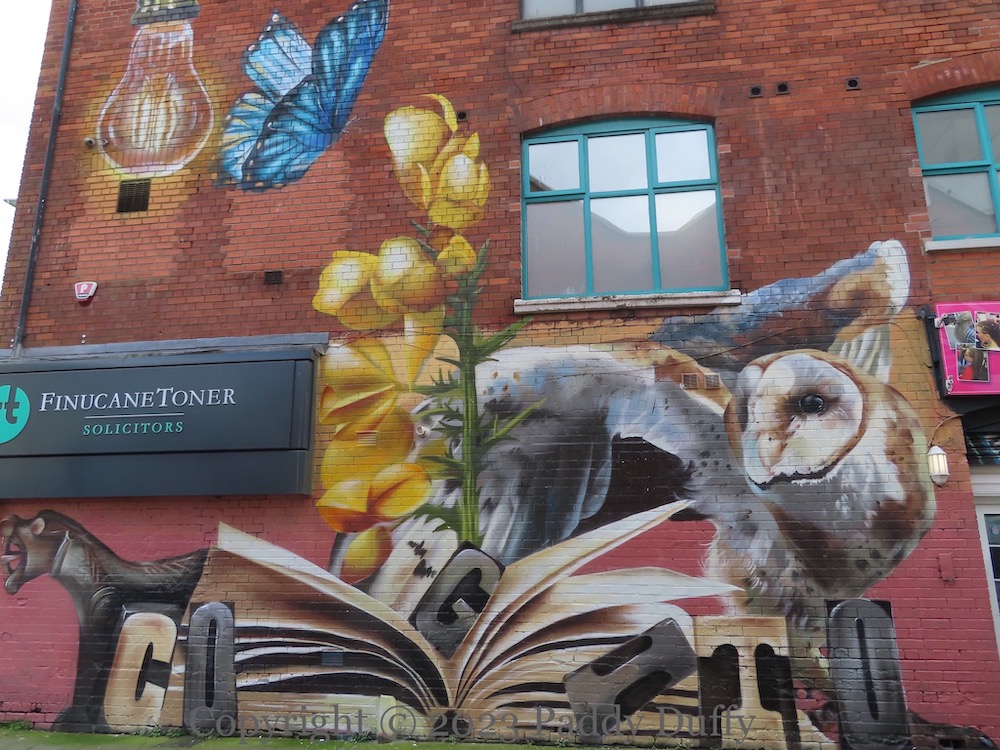
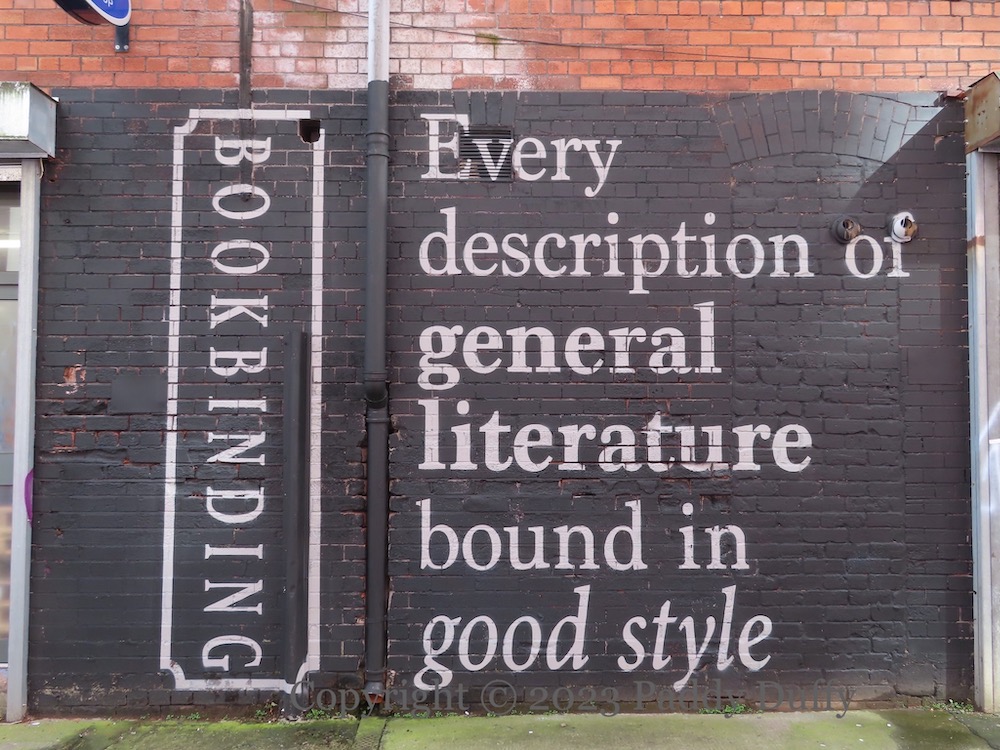
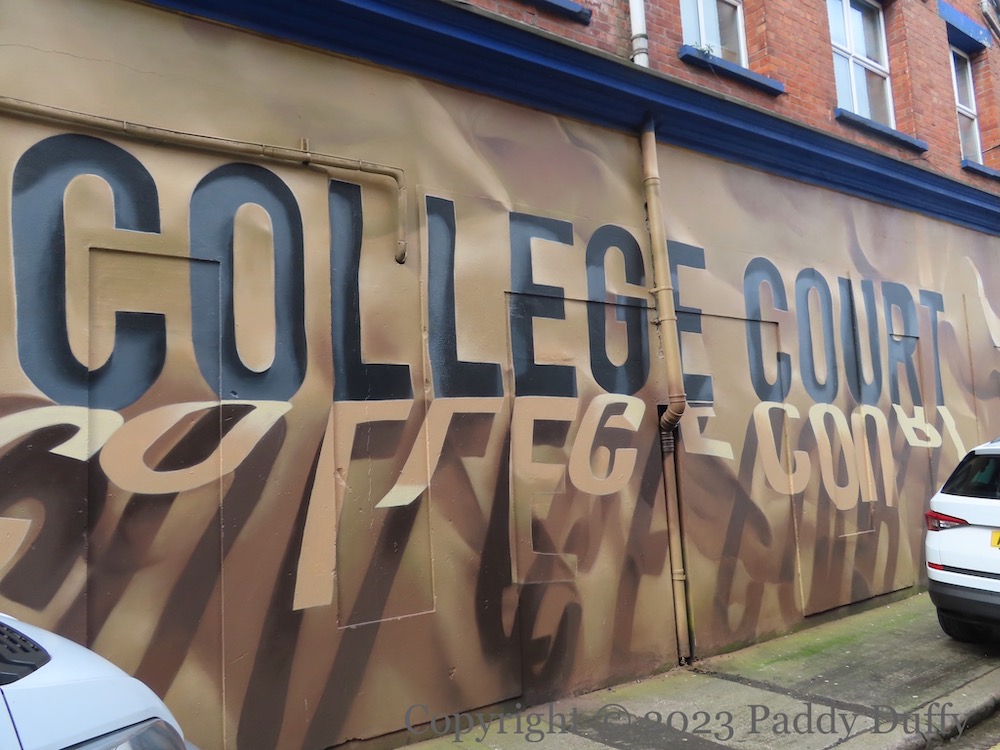
In 1895, Carswell & Sons opened a print-works and book-binders in a warehouse running with frontage in Queen Street and a rear in College Court (the building is now a bingo hall – see Kelly’s Eyes) which is currently being renovated as an office block (Bel Tel) – some of the scaffolding in College Cour can be seen in the later images in We Built This, the street art festival for International Women’s Day, 2023.
To complement those festival pieces, the mouth of College Court has been given a make-over, with work by Peachzz (ig) (above) and lettering by Woskerski (ig) that both draw on the street’s association with printing. If you know who did the “bookbinding” piece, please get in touch.
Previously on either side of College Court there were two pieces by Friz: Fox and Hare.
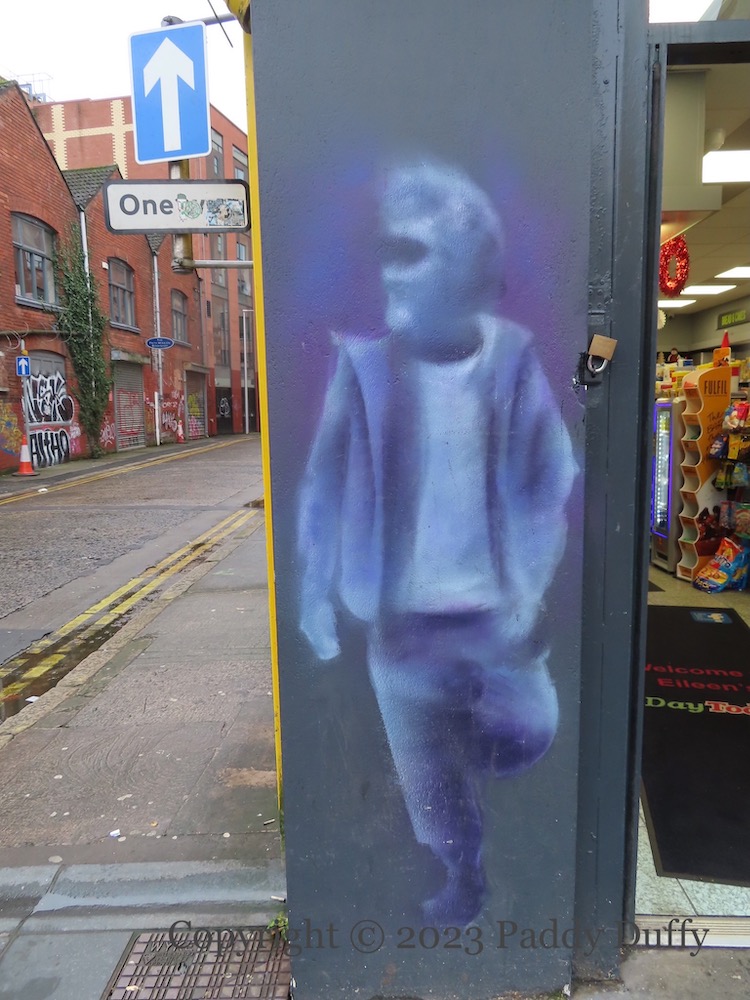
The bonus image, of a man leaning against the newsagent’s wall, is on the corner with Castle Street.
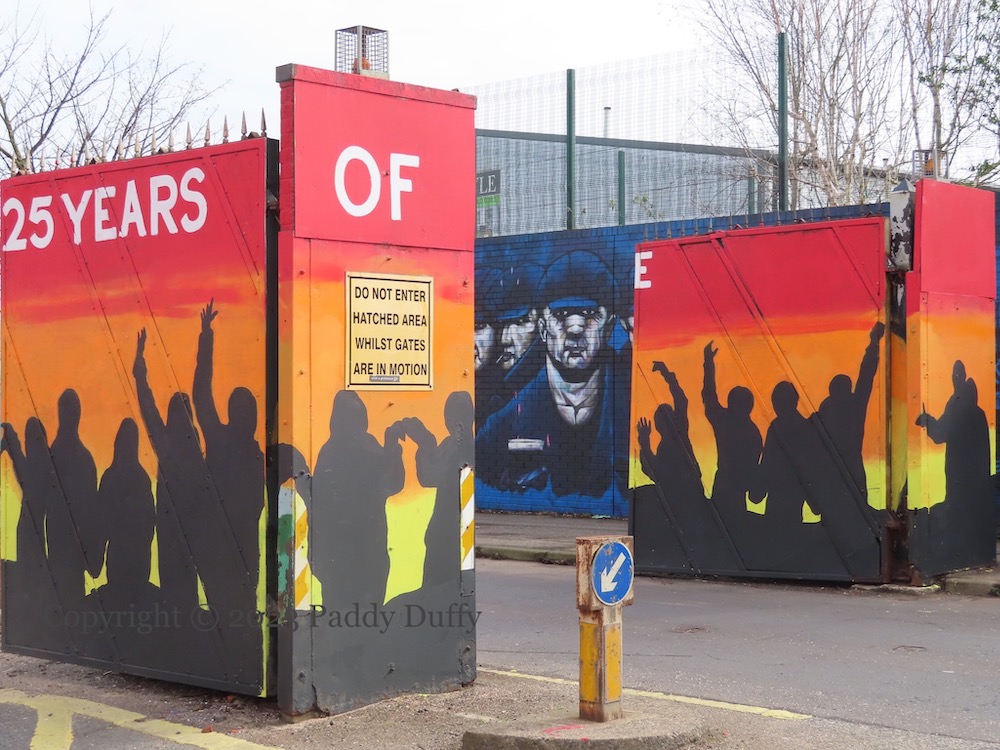
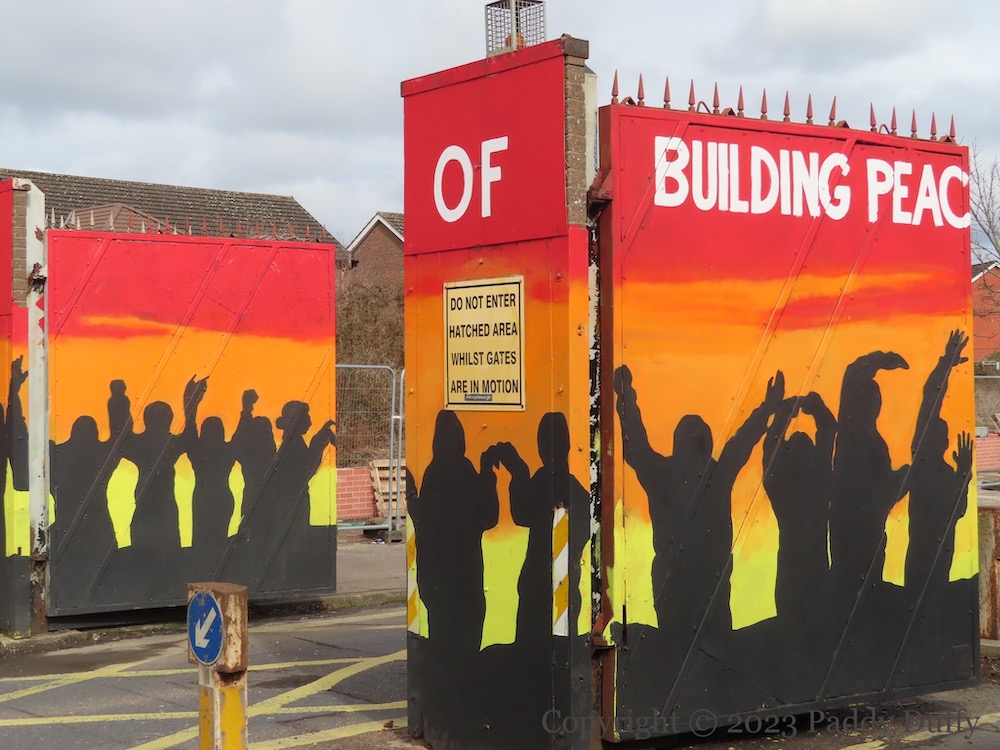
The gates on Lanark Way are part of the west Belfast “peace” wall. On this site we always put the word in scare-quotes to signify that it has a different meaning than it typically does. Without them, “peace wall” might suggest a place where people can go for a few moments of quiet reflection.
Rather, the wall – and the gates and the cages that surround many buildings on either side of the wall (see above) – is a divider meant to keep the peace by separating warring factions. Indeed the reason for the re-painting of the gates is not just the up-coming 25th anniversary of the Belfast or “Good Friday” Agreement (on April 10th) but the fact that they were damaged in the 2021 rioting (BBC). (This Irish News article surveys 150 years of violence at the site.)
The new art on the gates is inspired by the cover of the booklet sent to every household in advance of the May vote to ratify the Agreement (available at CAIN), which was similar in various ways to the television ad shown at the time (Ads On The Frontline). It showed a family of four in silhouette against a red-and-orange sunset; given the rioting associated with Lanark Way, on the gates this sunset could be mistaken for flames, and the rejoicing silhouetted figures for gesticulating and petrol-bomb-throwing rioters. For the previous art on the gates, see the Visual History page on the west Belfast “peace” line. (For the mural in the background, see Sailortown Dockers.)
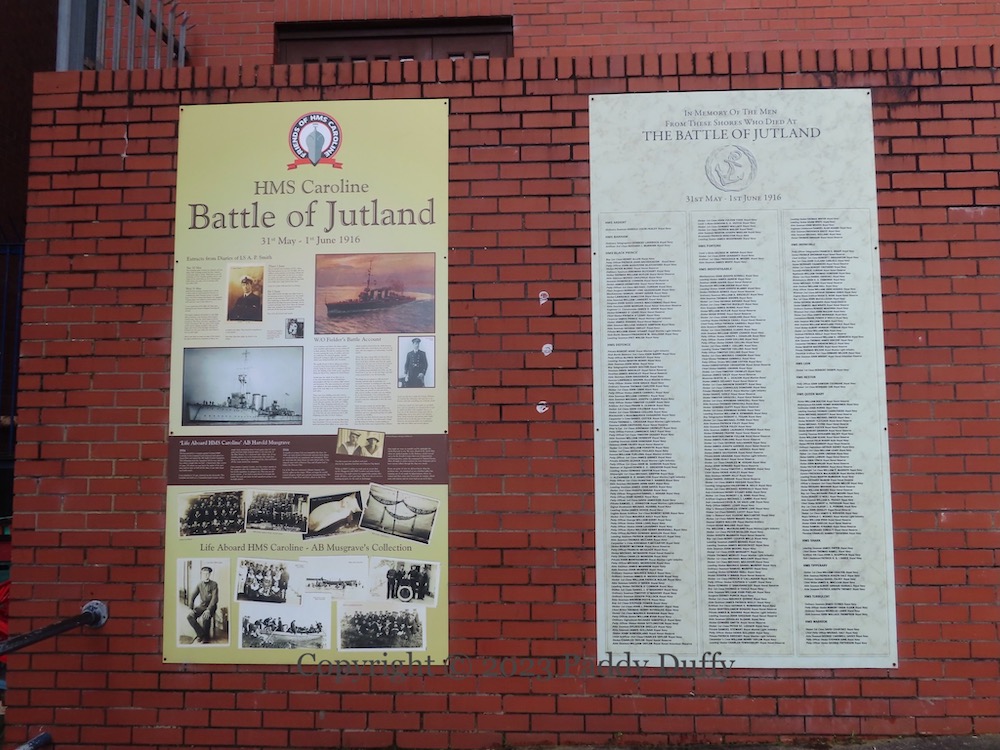
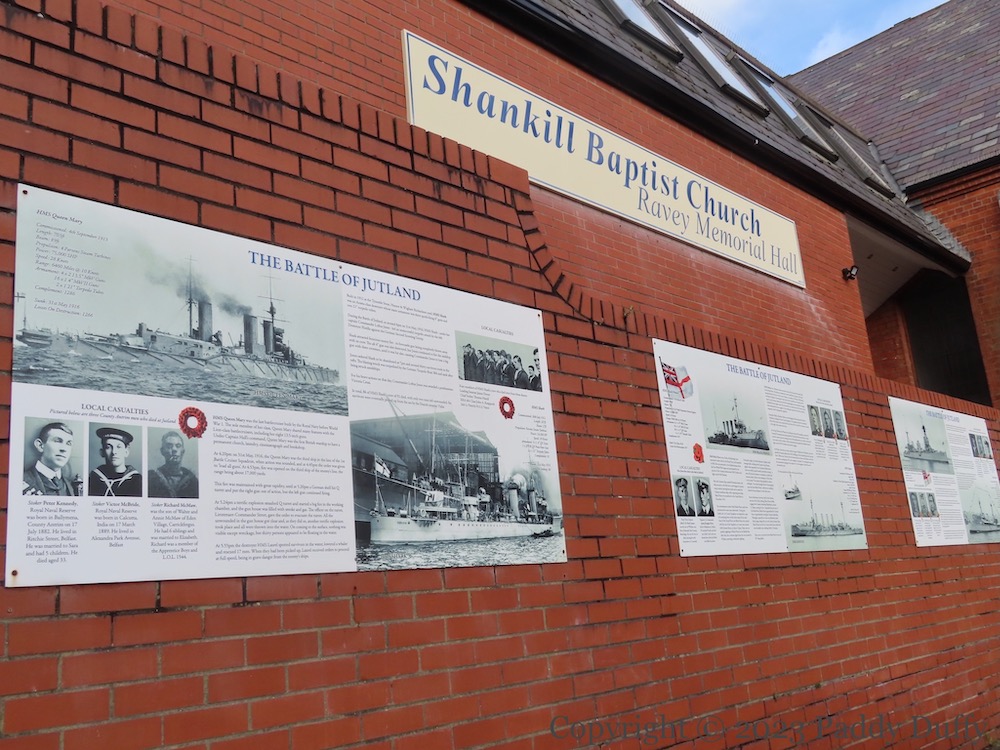
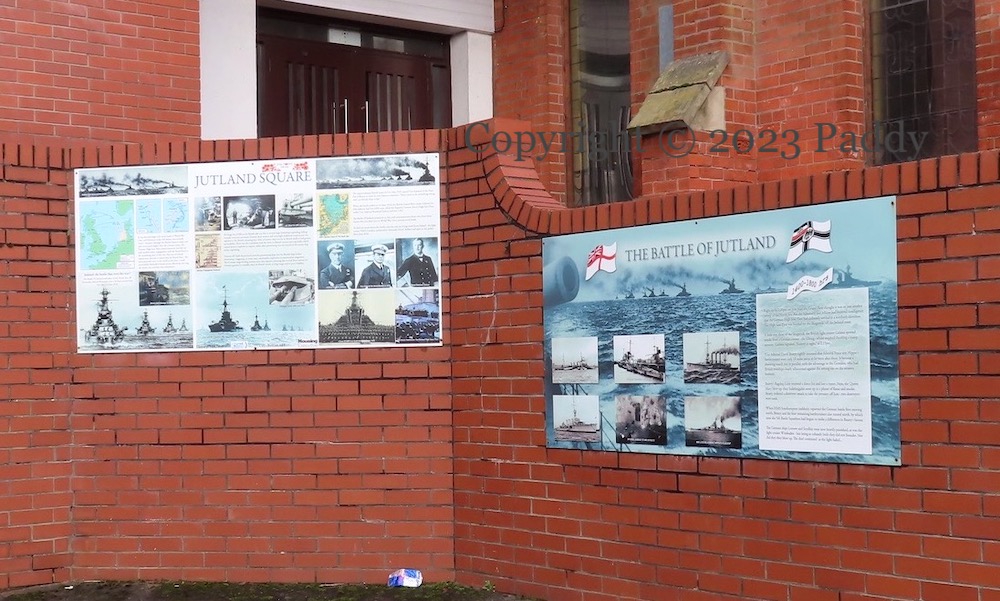
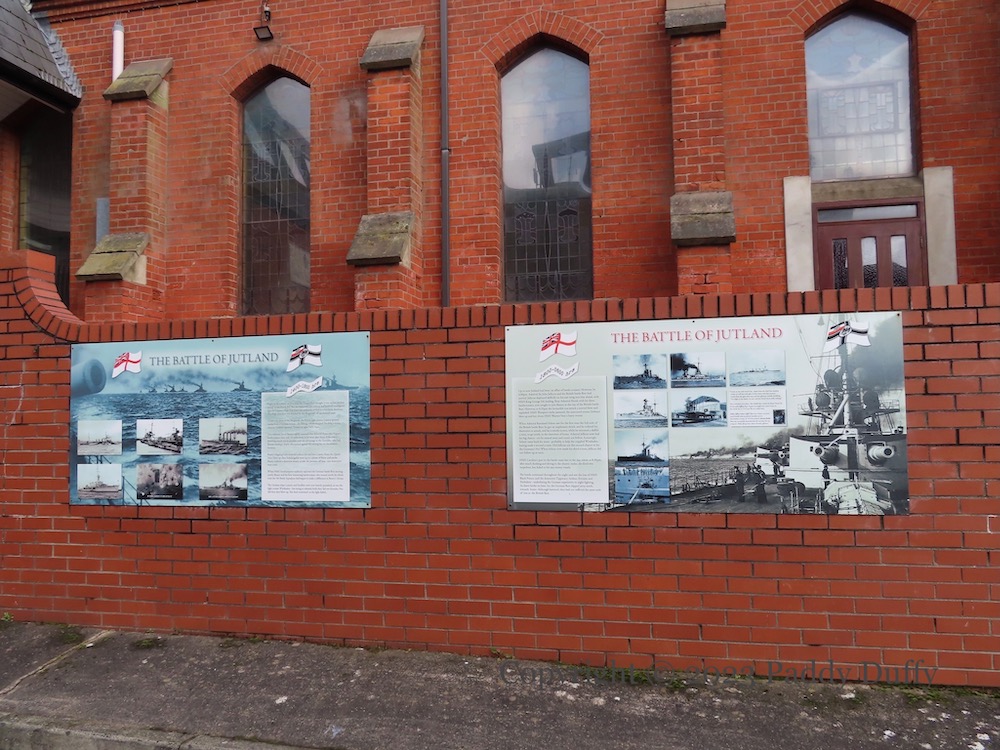
HMS Caroline re-opened in March, post Covid (Royal Navy). It opened as a floating museum in 2016, in time for the centenary of the Battle Of Jutland on May 31st-June 1st, 1916. There were almost 10,000 casualties and 25 ships were sunk that day but the Caroline survived. She served as a Navy headquarters during WWII, in Belfast habour, before being returned to reserves. (WP)
These eight panels are in Tennent Street in the Shankill. There was previously a painting of HMS Caroline at the Battle Of Jutland off the Shore Road in north Belfast – see HMS Caroline.
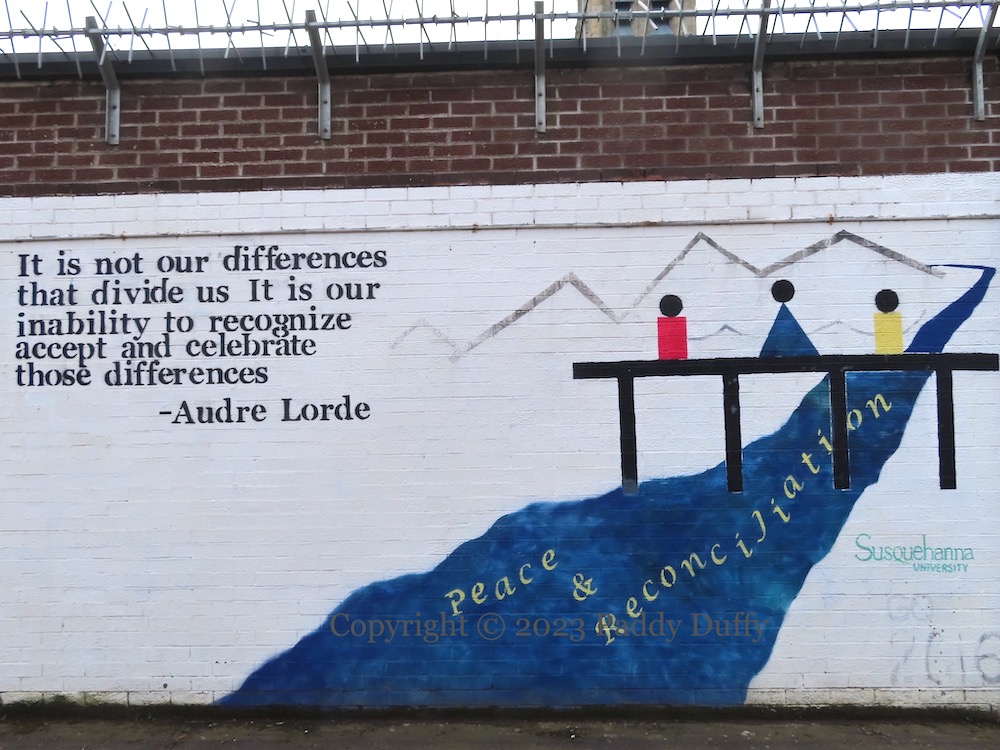
“”It is not our differences that divide us. It is out inability to recognize, accept and celebrate those differences.” – Audre Lorde”, “Peace & reconciliation”.
This does not seem to be an authentic Audre Lorde quote but an extrapolation of some lines from the essay “Age, Race, Class, and Sex: Women Redefining Difference”, where she writes, “It is not our differences which separate women, but our reluctance to recognize those differences and to deal effectively with the distortions which have resulted from the ignoring and misnaming of those differences.” (p. 122 in Sister Outsider).
Painted in 2016 by students from Susquehanna University in Bread Street, Divis. “The river and bridge represent a Lutheran hymn about the peace of mind a river provides and the bridge connecting people” (Spaces4Learning). In 2017, students from the same university painted the gates on the “peace” line – see Ambassadors For Peace.






 Paddy Duffy Collection