“Irish National Liberation Army, Belfast Brigade, roll of honour. For national liberation and socialism in Ireland.” With the named of 22 volunteers who died between 1975 and 2021: Ferguson, Loughran, McNamee, Daly, Bunting, Little, Power, McLarnon, Craven, McCann, Power, O’Reilly, Kearney, Gargan, Gallagher, McColgan, Campbell, McWilliams, O’Hara, McMullan, McElkerney, McWilliams.
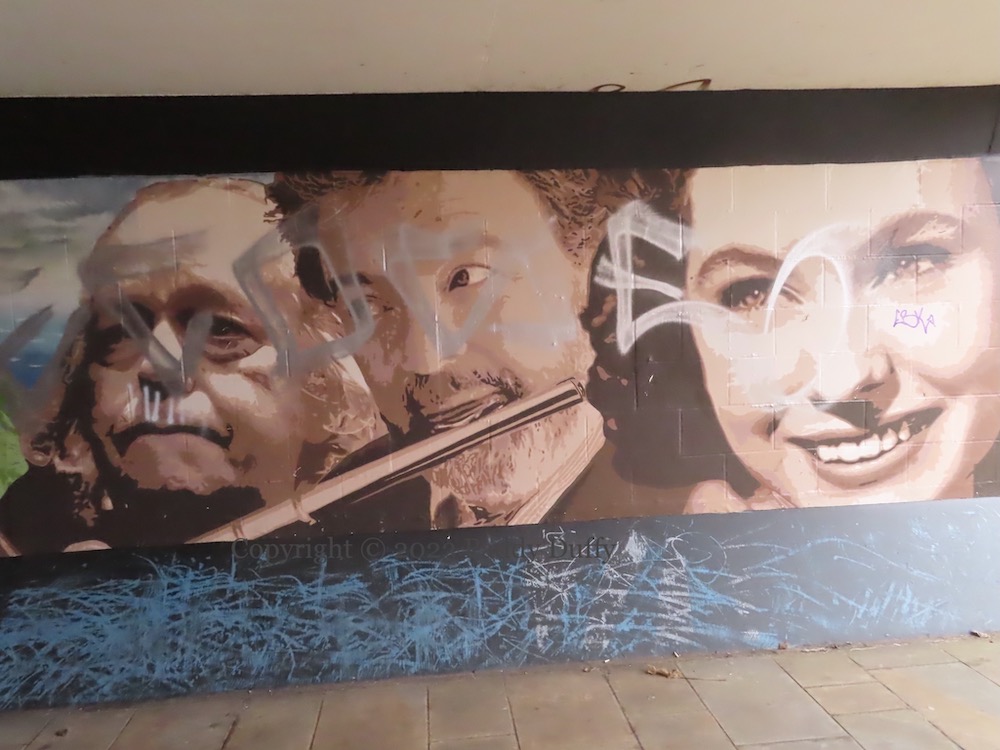
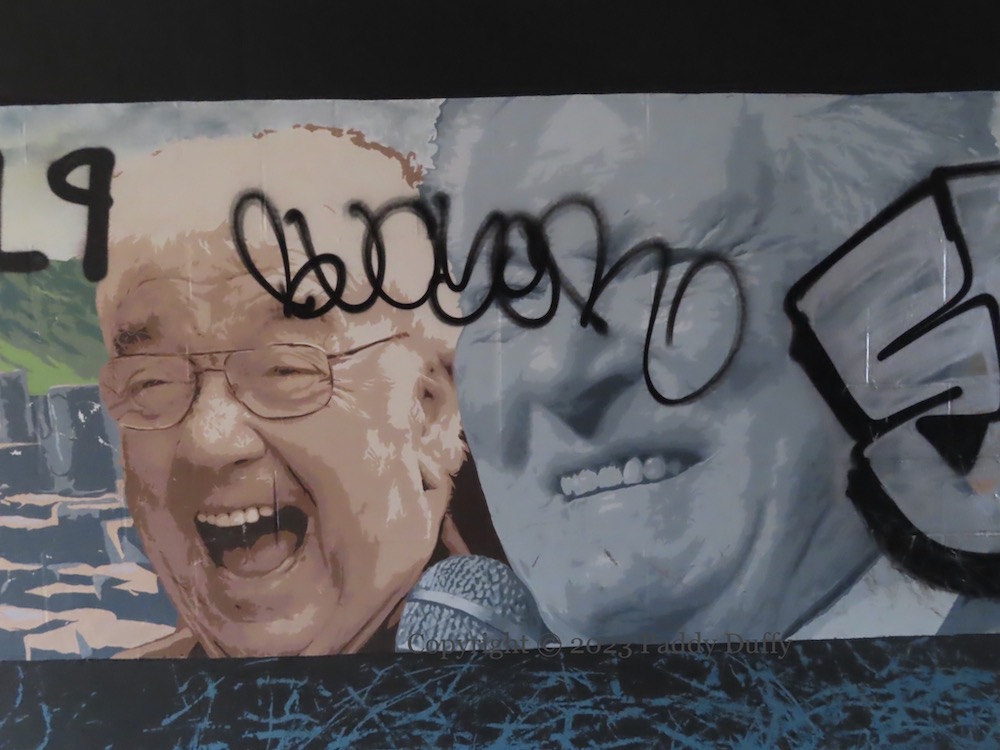
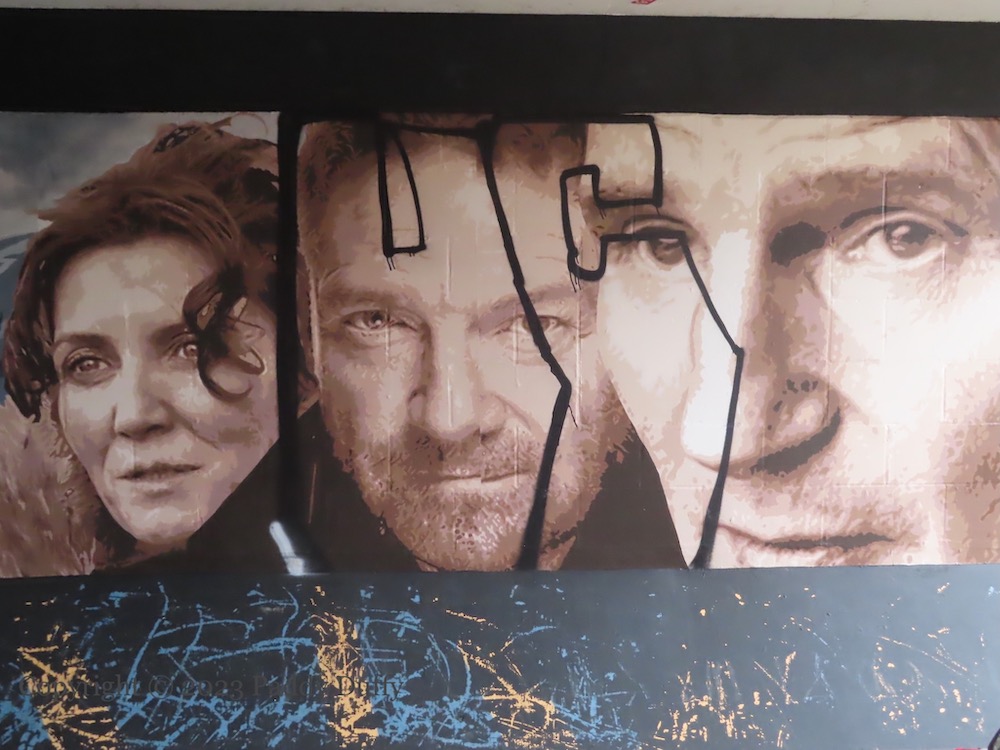
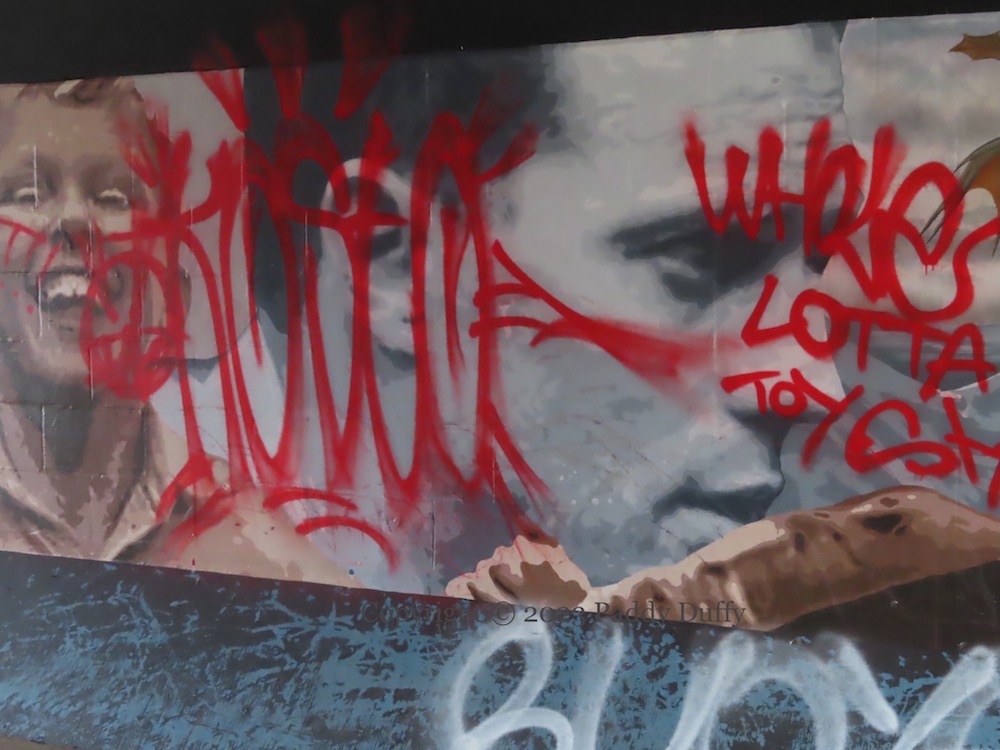
The underpass from Ballymacarrett Road to the Titanic Quarter station (formerly Bridge End and renamed in 2012 (BBC)) was remodeled in 2020, with new pavers and the removal of the bollards at the entrance to the underpass, and some new parking bays (ACS). In 2022 the old mural (Transformation, from 2012) was replaced with a gallery of famous faces – actors, musicians, comedians, and singers.
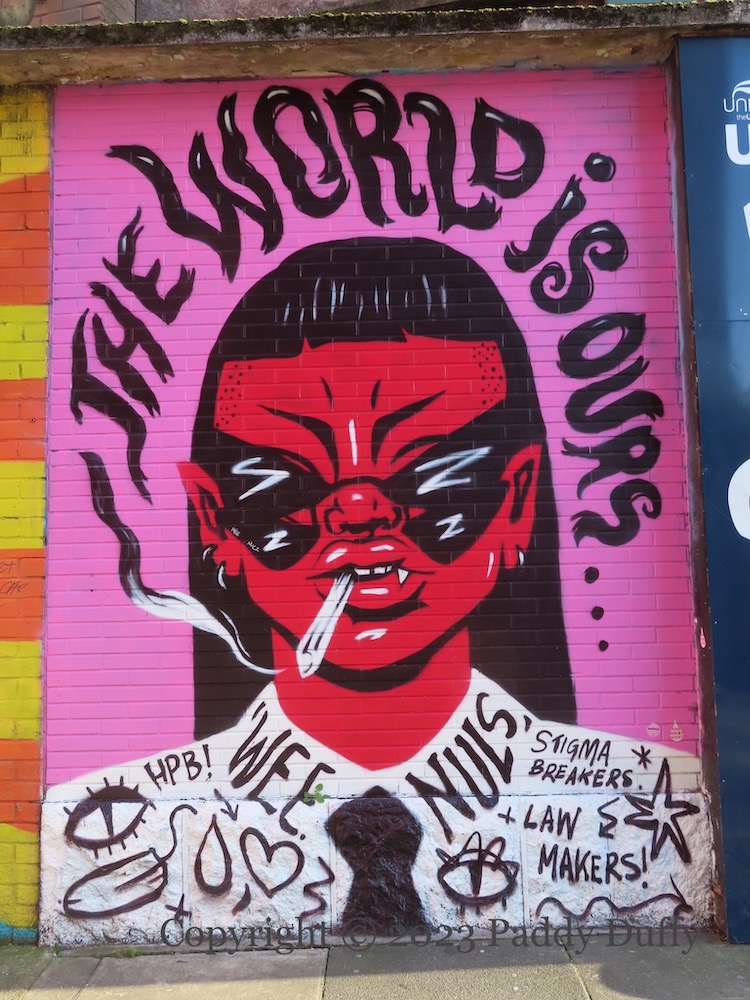
This is Wee Nuls’s (web | ig) street art celebrating the success of the ‘menstruation matters’ (ig) campaign for free period products and the passage of the Period Products Bill.
The Citizens’ Assembly is a group of 99 randomly-chosen Irish citizens, plus a chair, that considers large-scale issues over the course of months. It began in 2016 by taking up the Eighth Amendment on abortion, the “pensions timebomb” fixed-term parliaments, voter turnout and referendums, and climate change – it is not restricted, like its predecessor the Constitutional Convention, to constitutional issues (WP). The 2020-2021 Assembly considered gender equality and biodiversity loss.
Sınn Féın called for an Assembly on Irish unity at its November (2022) Ard Fheıs (Irish Examiner | Derry Journal | youtube panel) and Belfast City Council passed an SDLP motion to recommend that the Taoıseach form an Assembly (News Letter); in December, the Dublin City Council approved a measure calling for an Assembly to consider the topic (SF).
“The Irish government should establish a citizens’ assembly on Irish unity/tıonól na saoránach ar aontú na hÉıreann.” Sınn Féın’s preferred outcome of such a process is given at the bottom of the board: “#Time4Unity/Am d’Aontacht”. The images show the board in south Belfast (Cromac Street).
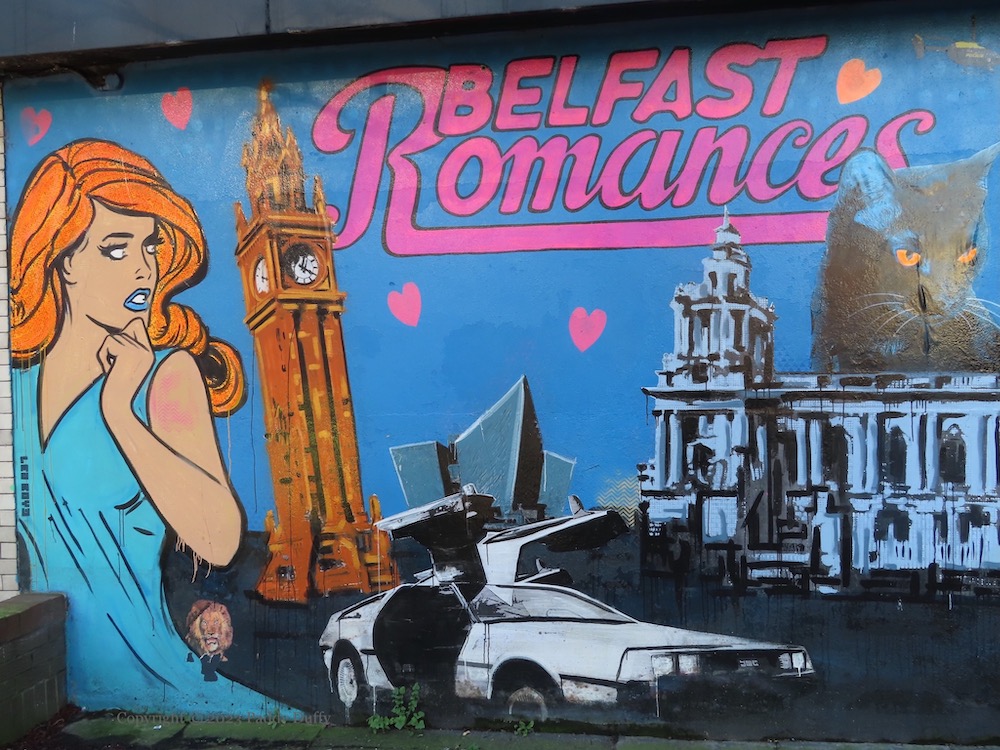
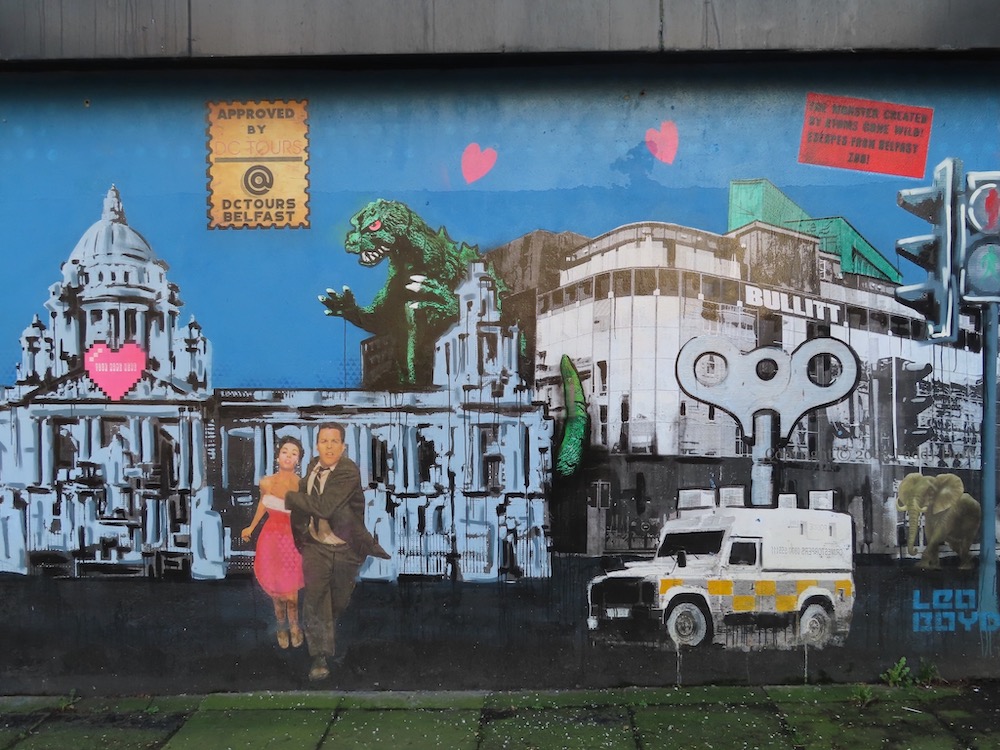
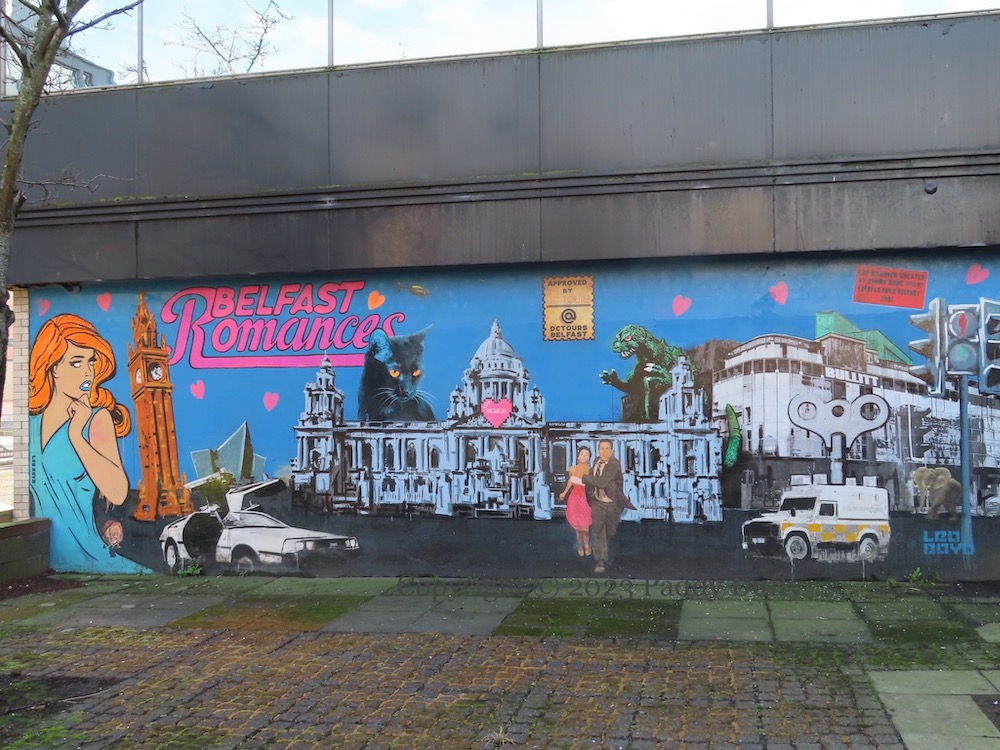
This Leo Boyd (web) piece in Great Victoria Street brings together many of the ideas seen in his posters over the years, including When Urban Love Goes Wrong, Belfast Kitty Hall, DeLorean cars, Godzilla – “The monster created by atoms gone wild! Escaped from Belfast zoo”, and the wind-up police land-rover.
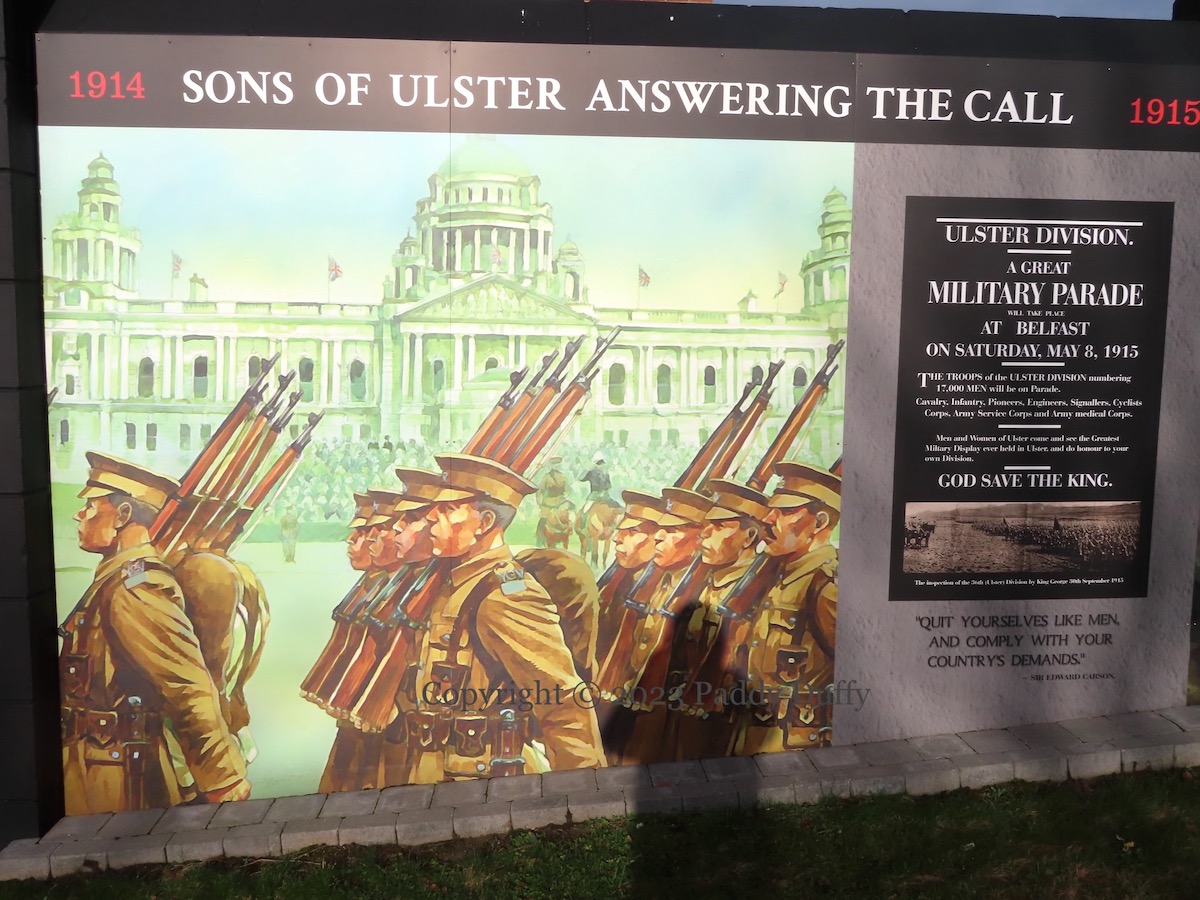
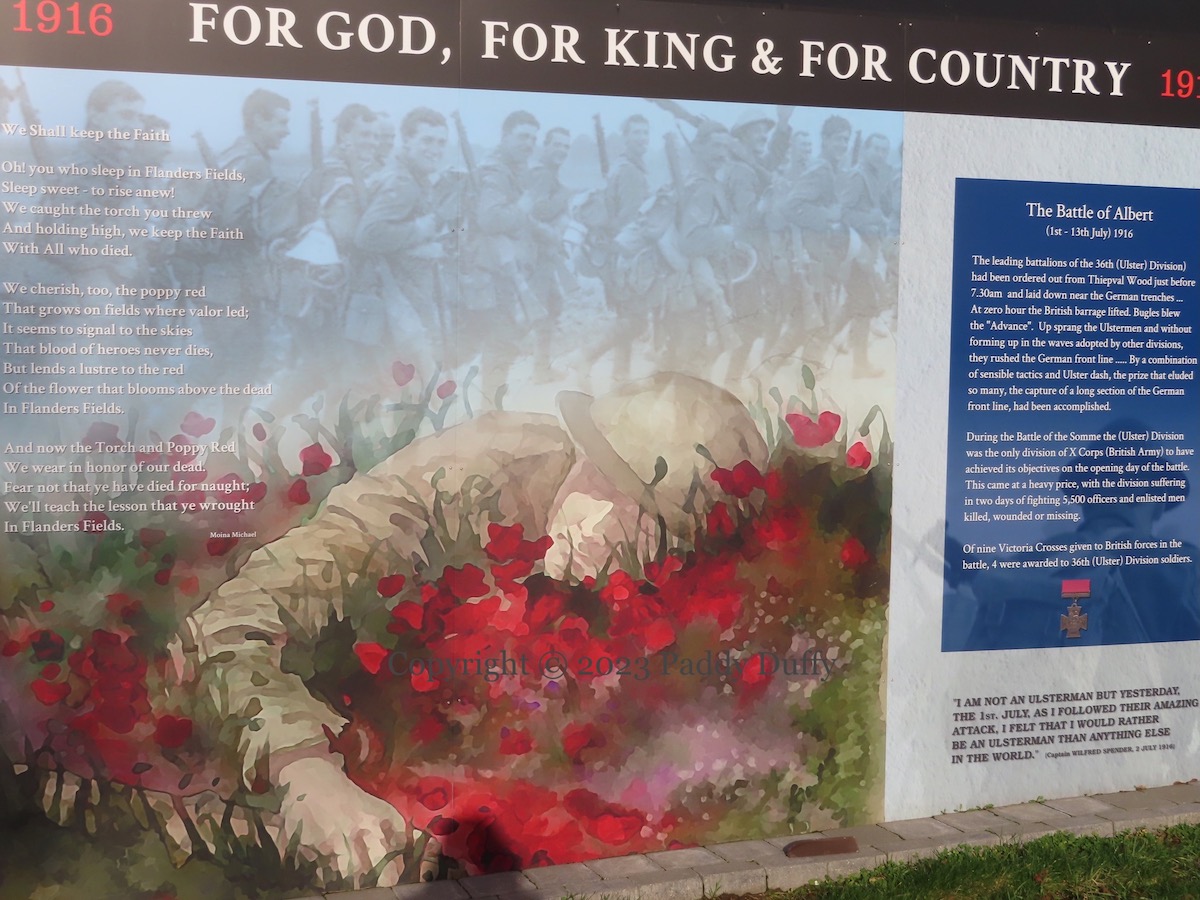
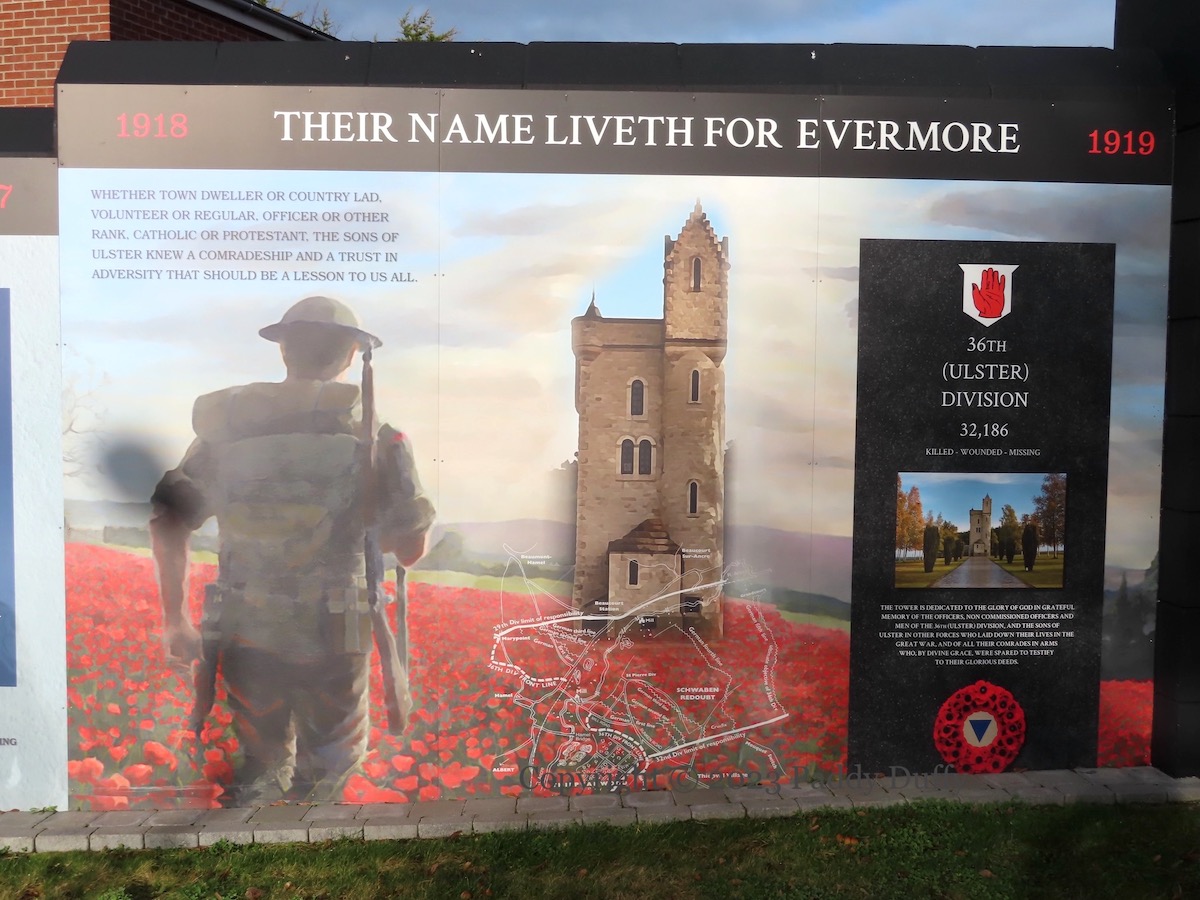
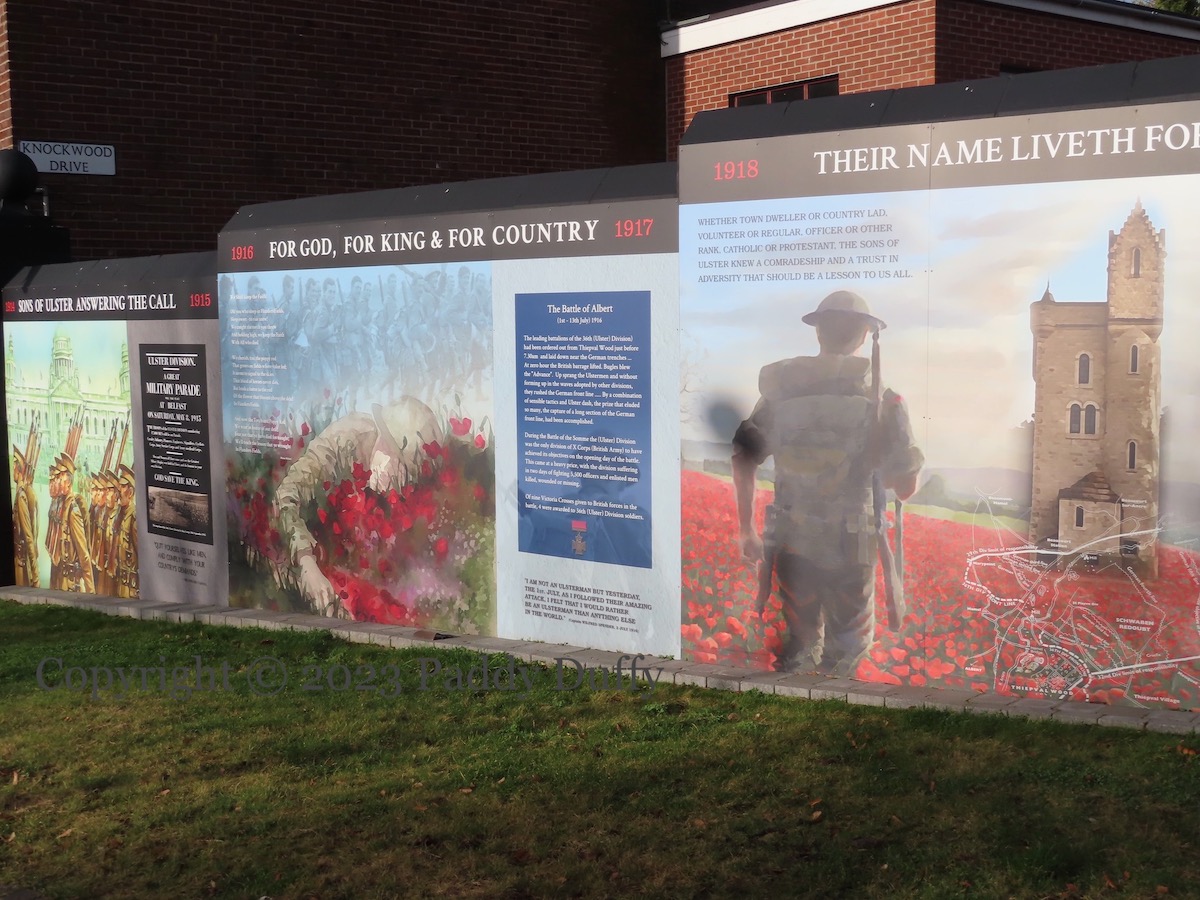
A history of the 36th (Ulster) Division in three panels along Knockwood Crescent in east Belfast:
1914 – Sons Of Ulster Answering The Call – 1915: “Ulster Division – a great military parade will take place at Belfast on Saturday, May 8, 1915. The troops of the Ulster Division numbering 17,000 men will be on parade. Cavalry, infantry, pioneers, engineers, signallers, cyclists corps, Army service corps and Army medical corps. Men and women of Ulster come and see the greatest military display every helf in Ulster, and do honur to your own Division. God save the King.” The original poster can be seen at Wartime Memories. “‘Quit yourselves like men and comply with your country’s demands.’ – Sir Edward Carson.” With a picture of “the inspection of the 36th (Ulster) Division by King George [V] 30th September 1915.
1916 – For God, For King & For Country – 1917: “The Battle of Albert (1st – 13th July) 1916. The leading battalions of the 46th (Ulster) Division) had been ordered out from Thiepval Wood just before 7.30am and laid down near the German trenches … At zero hour the British barrage lifted. Bugles blew the “Advance”. Up sprang the Ulstermen and without forming up in the waves adopted by other divisions, they rushed the German front line …… By a combination of sensible tactics and Ulster dash, the prize that eluded so many, the capture of a long section of the German front line, had been accomplished. During the Battle of the Somme the (Ulster) Division was the only division of X Corps (British Army) to have achieved its objectives on the opening day of the battle. This came at a heavy price, with the division suffering in two days of fighting 5,500 officers and enlisted men killed, wounded or missing. Of nine Victoria Crosses given to British forces in the battle, 4 were awarded to 36th (Ulster) Division soldiers.” With quotes from Wilfrid Spender (see I Would Rather Be An Ulsterman), and the poem We Shall Keep The Faith by Moina Michael. Please get in touch if you can identify the photo of soldiers going off to war at the top.
1918 – Their Name Liverth For Evermore – 1919: “Whether town dweller or country lad, volunteer or regular, officer or other rank, Catholic or Protestant, the sons of Ulster knew a comradeship and a trust in adversity that should be a lesson to us all.” “36th (Ulster) Division 32,186 killed, wounded, missing. The [Ulster] tower is dedicated to the glory of God in grateful memory of the officers, non commussioned officers and men of the 36th (Ulster) Division, and the sons of Ulster in other forces who laid down their lives in the Great War, and of all their comrades in arms who, by divine grace, were spared to testify to their glorious deeds.”
In Irish mythology, Étaín (Éadaoın, Aideen) of the Ulaıd and her lover Mıdır of the Tuatha Dé Danann turn into swans after Mıdır wins an embrace from her in a board game with her husband Eochaıd, the High King of Ireland (Tochmarc Étaíne/The Wooing Of Étaín).
Street art by JMK (ig) in the Bullit alleyway off Church Lane.
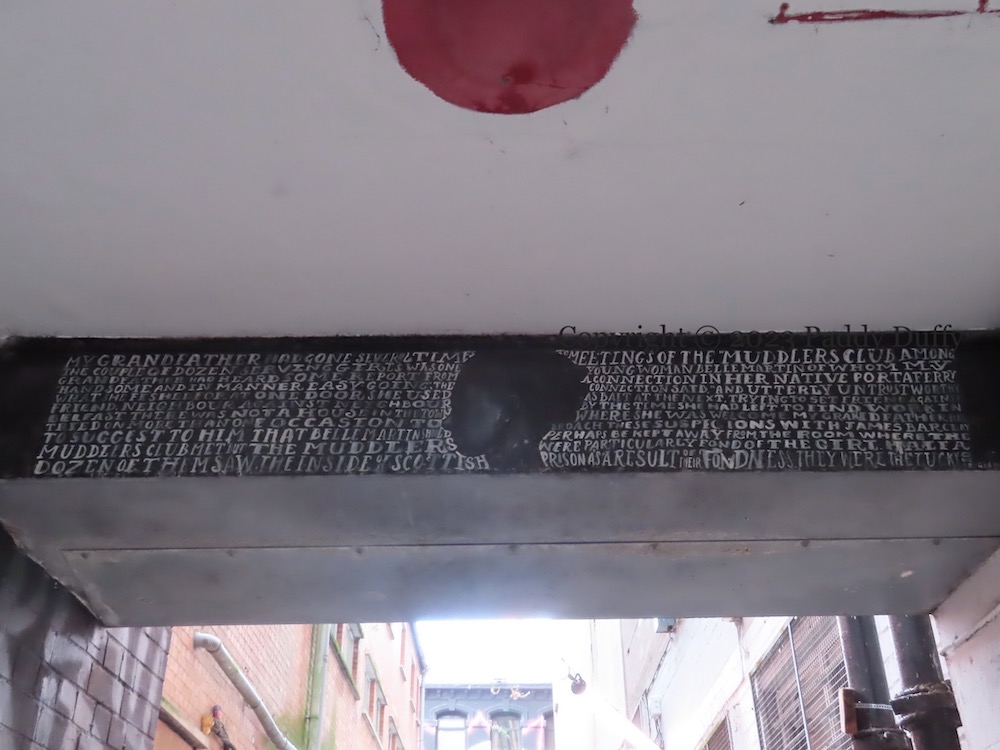
After Britain’s declaration of war against France in 1793, the United Irishmen – who hoped for French support for a rebellion in Ireland – could no longer meet openly. In Belfast, meetings were held at Dr [Benjamin] Franklin’s tavern, also called “Peggy Barclay’s” after its owner, under the guise of a social group called the Muddlers’ Club.
The true nature of the group was betrayed to the authorities in 1796 by Isabella “Belle” Martin, a serving girl in the tavern (Romanticsm Anthology | Belfast Entries | Belfast Media | Joe Baker). As the text in the Peter Strain mural above concludes, “Half a dozen of them saw the inside of a Scottish prison as a result” and the club dissolved. (The text surrounding Martin’s profile is from Glenn Patterson’s book, A Mill For Grinding Old People Young – this was the name of Peggy Barclay’s inn when she left the city centre for the Buttermilk Loney (now Skegoniell Avenue) on the Shore Road in north Belfast.
The tavern, in Sugarhouse Entry, later become a hotel before eventually being destroyed in the WWII blitz. Sugarhouse Entry still exists but has been impassable since 1972 when it was closed off as part of the “ring of steel” securing Belfast city centre (DC Tours).






 Paddy Duffy Collection