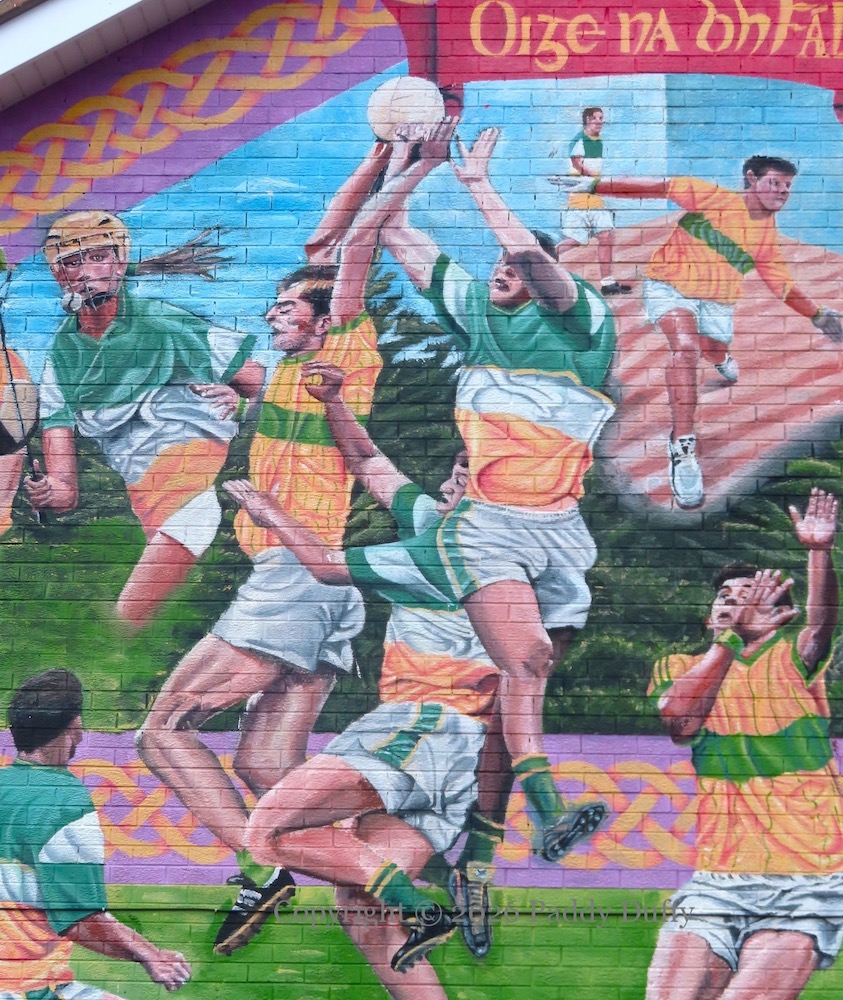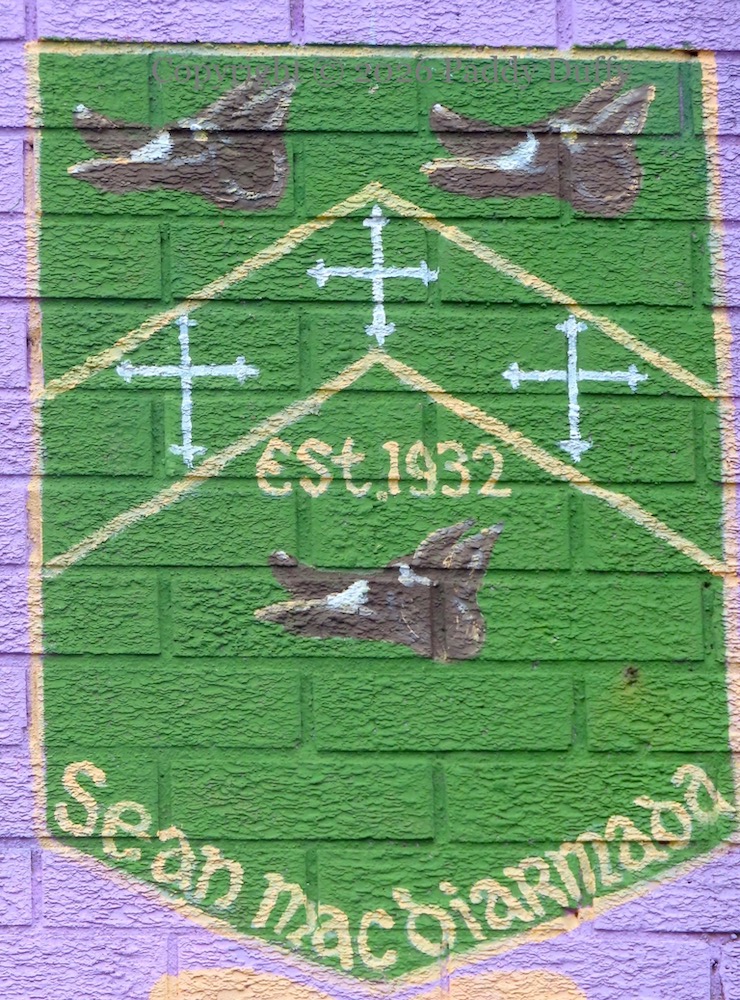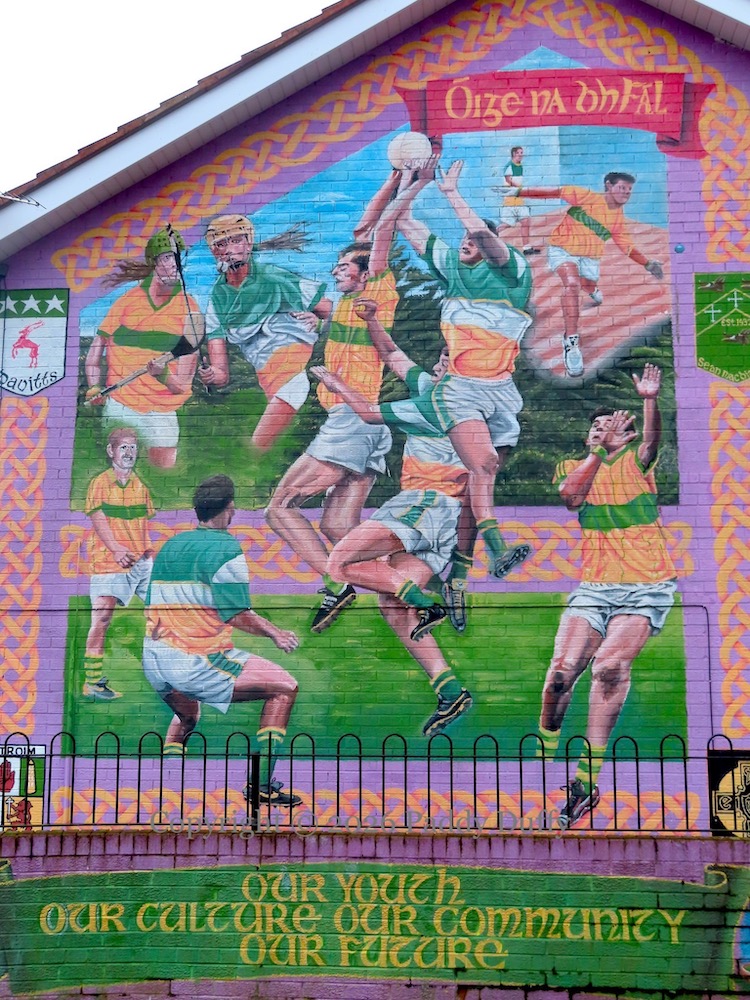
This mural in the lower Falls celebrates the 30th anniversary of the Frank Gillen Centre (Fb) and the 70th anniversary of Immaculata FC (Fb). The figure on the right is Cliftonville player Liam Boyce who grew up in the area and played for Immaculata as a youth. The team’s logo appears to the right of Boyce’s outstretched hand. (If you know the local player on the left, please leave a comment or send an e-mail.)
The piece was painted by Mickey Doherty and Lucas Quigley.
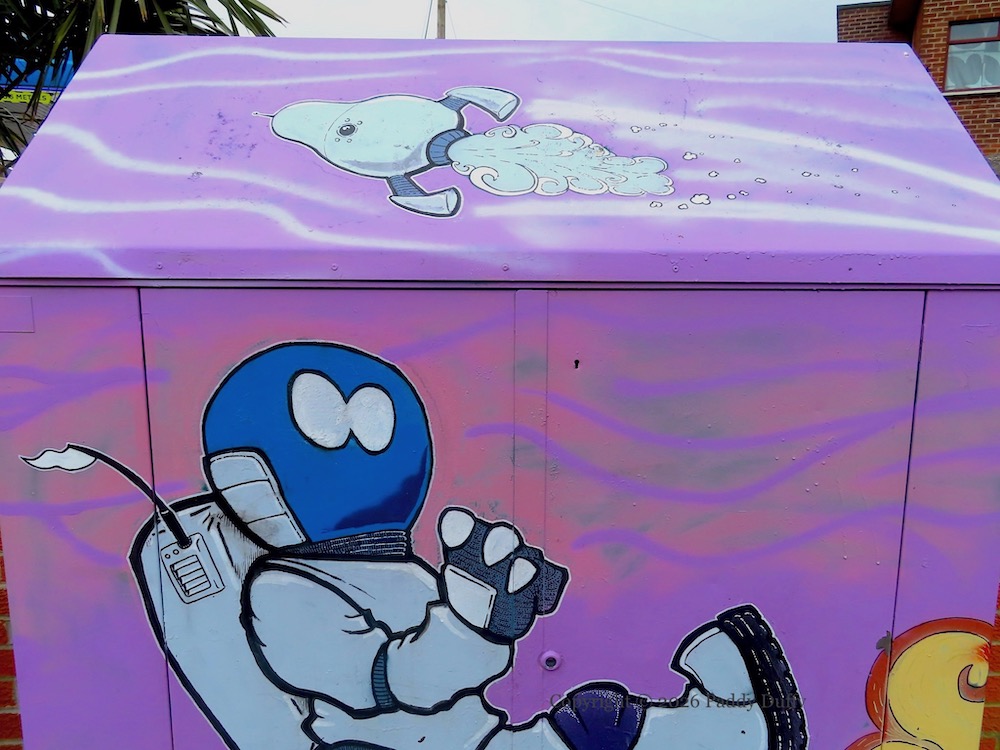
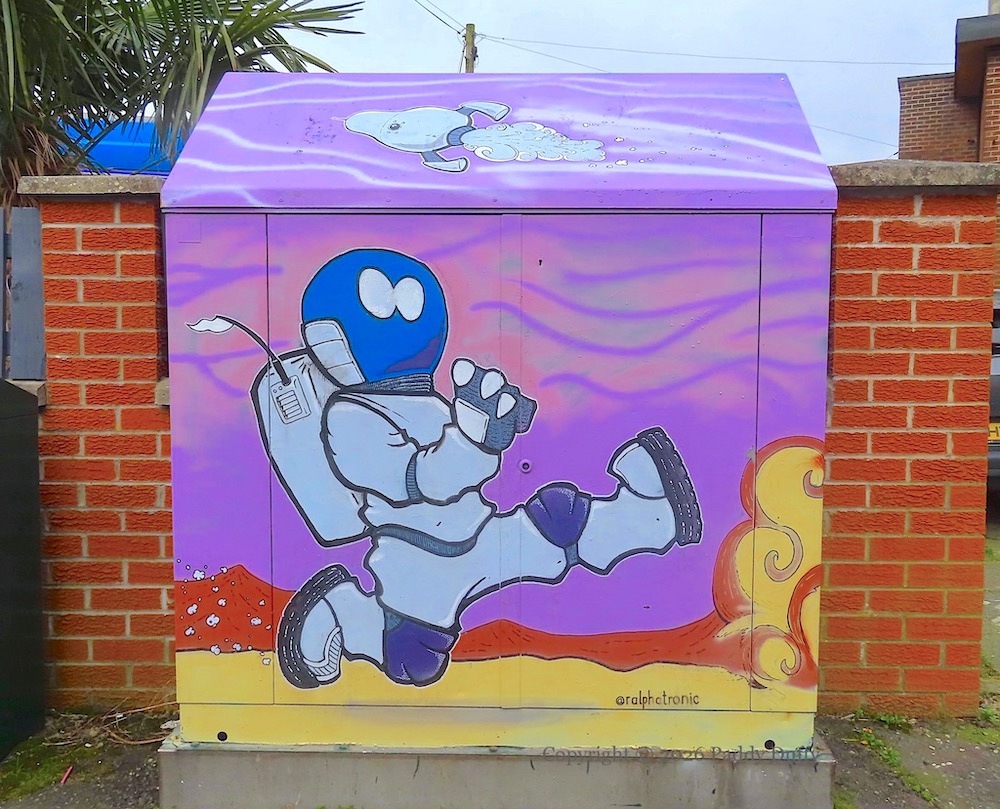
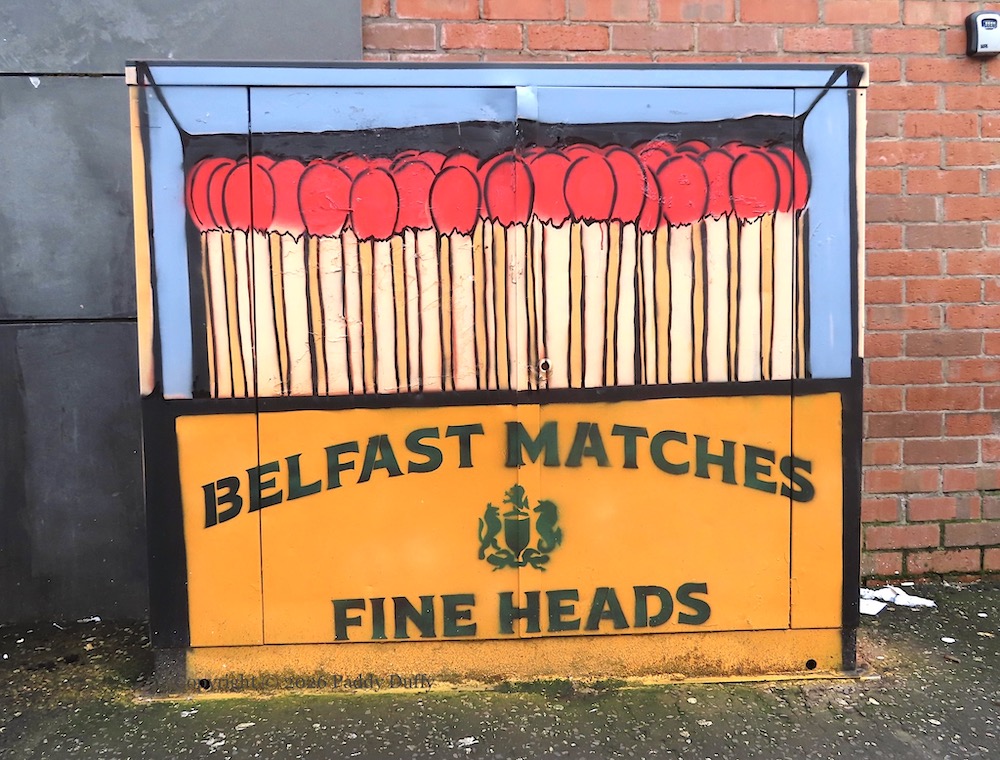
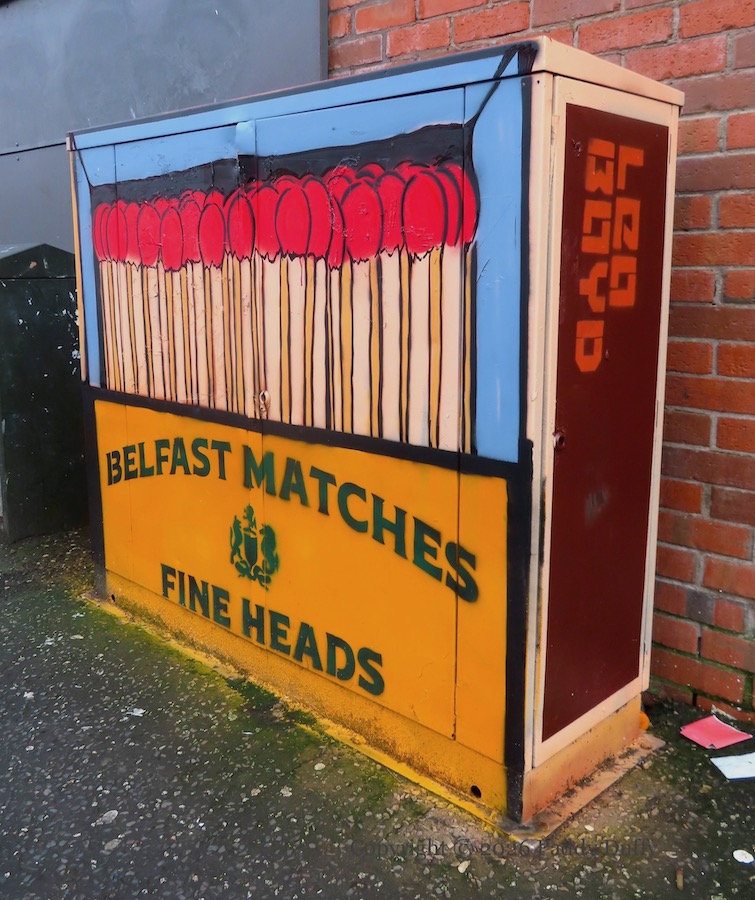
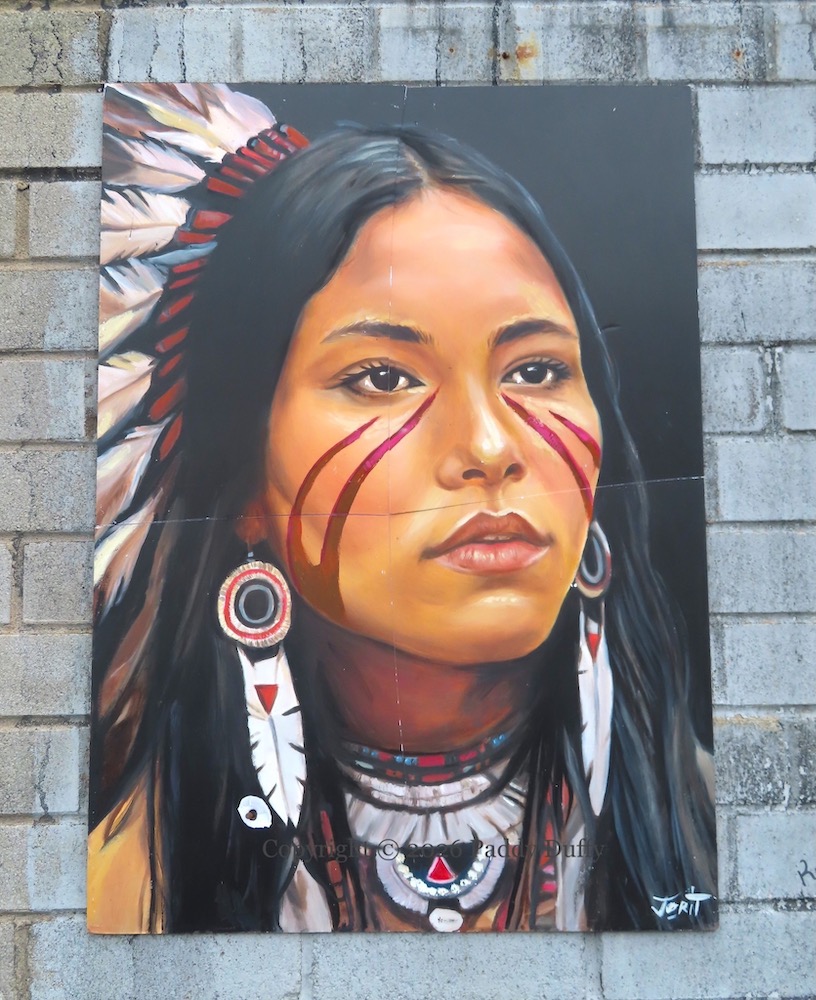
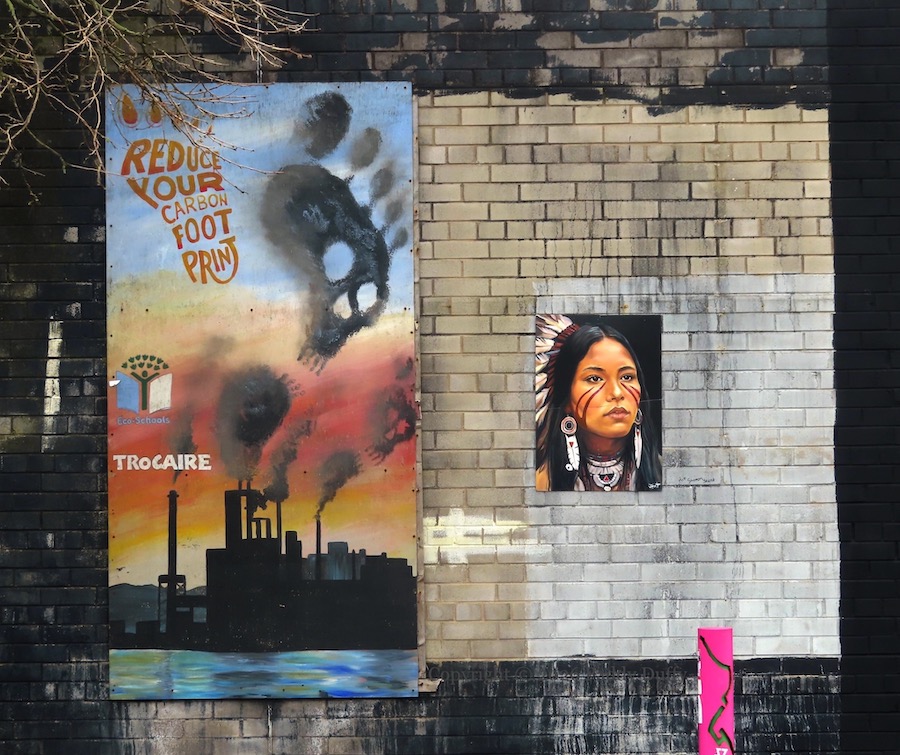
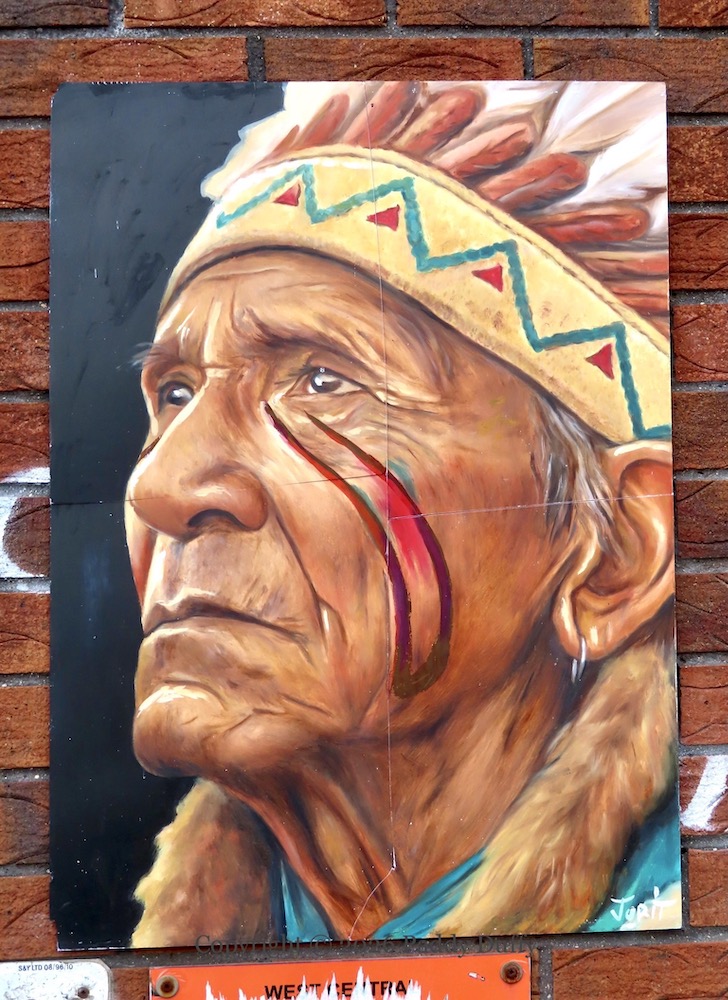
Gort Na Móna CLG was founded in 1974, developing out of the old Gort Na Móna secondary (before it became part of Corpus Christi). NVTv produced a programme to celebrate the fiftieth anniversary (youtube). These painted junction boxes are on Monagh Road and the Springfield Road.
This is a painted tribute to Jim McKee, who was known as “Mr Immaculata” for his long-time support of Immaculata FC (Fb). McKee died in August when he was hit by a car near the Grosvenor community centre (BBC).
See also: Come On, The Mac, which is a stone’s throw further down Albert Street.
A long wall along Duncrue Street has been painted with five pieces – two by Karl Fenz (web), two by Danni Simpson (web), one by HMC (web) – with design-work – presumably by Rob Hilken (web) – between the representational pieces. The photographs below span a month, as the artists painted at different times in late 2025 and generally had to contend with poor winter weather.
While HMC features a kingfisher, the others make reference to the shipping industry and the harbour as a gateway to the world. Above and immediately below: a vintage dock-worker is seen through a port-hole gazing pensively over one of the H&W gantry cranes and a ship in Belfast harbour. In the other Fenz piece, a crane can be seen in the reflection of the glasses of a visitor to the Titanic Quarter. The one work by Simpson features a cruise-ship (perhaps the Odyssey that was stuck in Belfast for four months – AP), and the compass and globe in the other piece suggest that Belfast is a gateway to the wider world.
October 31st:
December 21st:
December 21st:
November 30th:
November 16th – cartoon over the doodle-grid:
October 31st:
November 30th:
October 31st – blacking and cartoon on top of the doodle-grid:
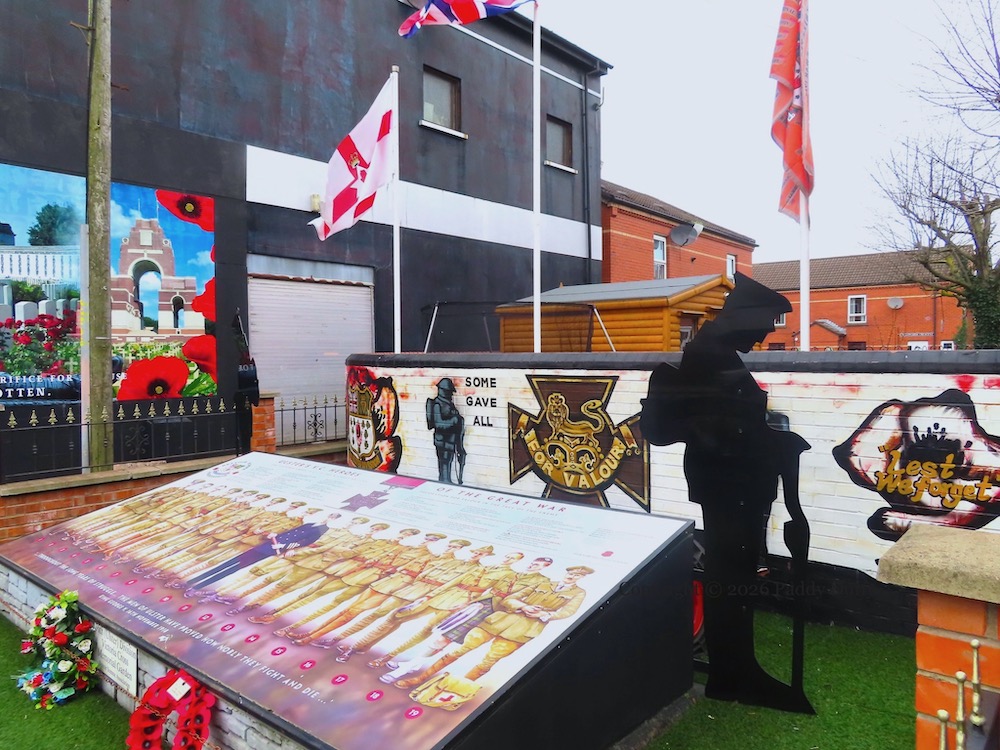
Printed panels illustrating the engagements of the British Army in the twentieth and twenty-first centuries have been added to the three stones (seen in Continuing Conflicts) that marked the World Wars and “continuing conflicts”. The conflicts depicted are the Great War 1914-1918, Second World War 1939-1945 (with individual photos of James Magennis and Blair Mayne, Korean War 1950-1953, Northern Ireland 1969-2007, Falklands War 1982 (the photo on the right is of troops “yomping”), Iraq 2003-2011, Afghanistan 2001-2023.
“Bridging divides”, “30 years of Forthspring”, “Communities of strength”. Forthspring is a cross-community group providing programming to residents of the CNR upper Springfield and PUL Woodvale areas. On its ‘about’ page, the organisation claims 1996 is the year of its founding, so this array of boards might be in anticipation of next year (2026).
Also included are some of the older pieces on the panels at the front of the Springwell House. “Stand here and think about someone you love”, “Dance here and make a new friend”, “Youth Matters Project – believe you can”.
“Late 19th century gas lamp donated by Pretani Associates, Dr Ian Adamson OBE and Helen Brooker, to the Dalaradia Historical Group to recognise their work on Common Identity. This work promotes one cultural narrative for the British Isles to which all can belong. A narrative which begins by understand the first known name of the islands – The Isles of Pretani. Knowledge brings a light which reveals the way forward towards stability within these islands. Dedicated by Professor Wesley Hutchinson on the 27th November 2019.”
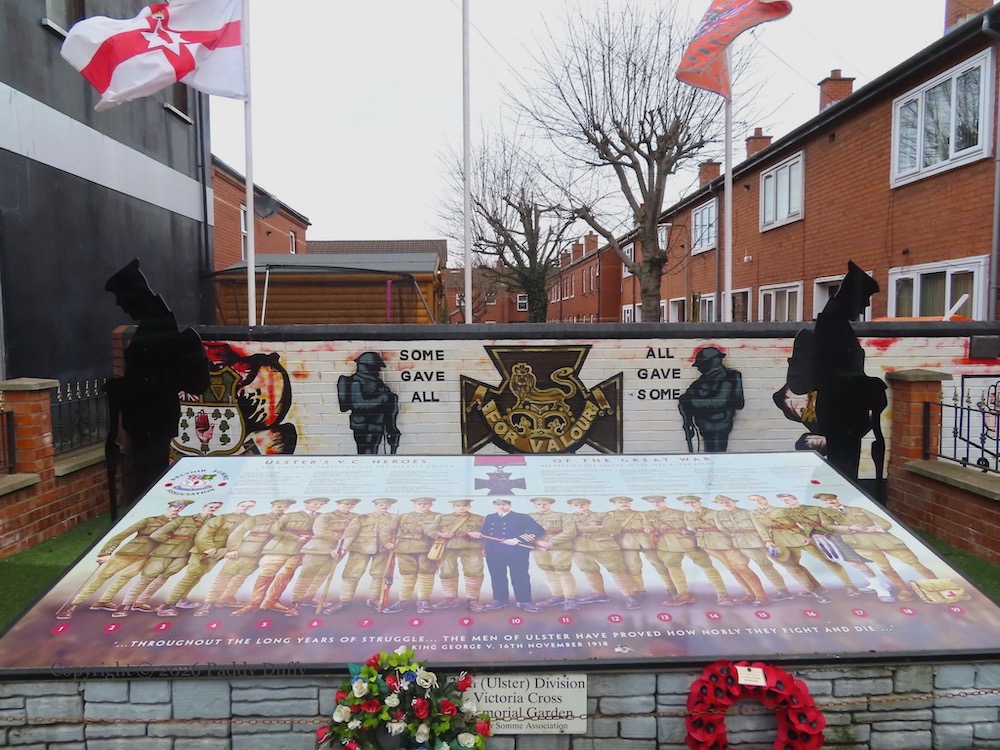
This entry updates the images seen in November’s Lest We Forget, with the addition of six military insignia to either side of the ‘Old Comrades’ board that was added just after Remembrance Sunday.
On the left (top to bottom): Royal Irish Rifles (later the Royal Ulster Rifles), 36th (Ulster) Division, Royal Inniskilling Fusiliers; on the right: Royal Irish Regiment, Order Of St Patrick, British Light Infantry.
Work to the windows has been undertaken since this art was originally painted (in 2023) by Friz (web) and Gerry Norman (ig); two windows have been bricked up with multi-coloured bricks (best seen in the image immediately below), while others have been extended and narrowed, resulting in patches of black bricks (see the third and fourth images).
The piece is inspired by the seventeenth-century Belfast Castle. Castle Arcade is so-called because it is the site the original castle of Belfast, built by the Normans in the late 12th century and then rebuilt by Arthur Chichester in 1611. Chichester’s castle had “spacious gardens which extended from the river along to Cromac Woods and near Stranmillis” with “orchards, bowling greens and cherry gardens … fish ponds,” for “hunting, hawking, and other sports”. It was destroyed by fire in 1708, after which the area became commercialised as a market (ArchiSeek | Mary Lowry | BBC | Belfast Entries).