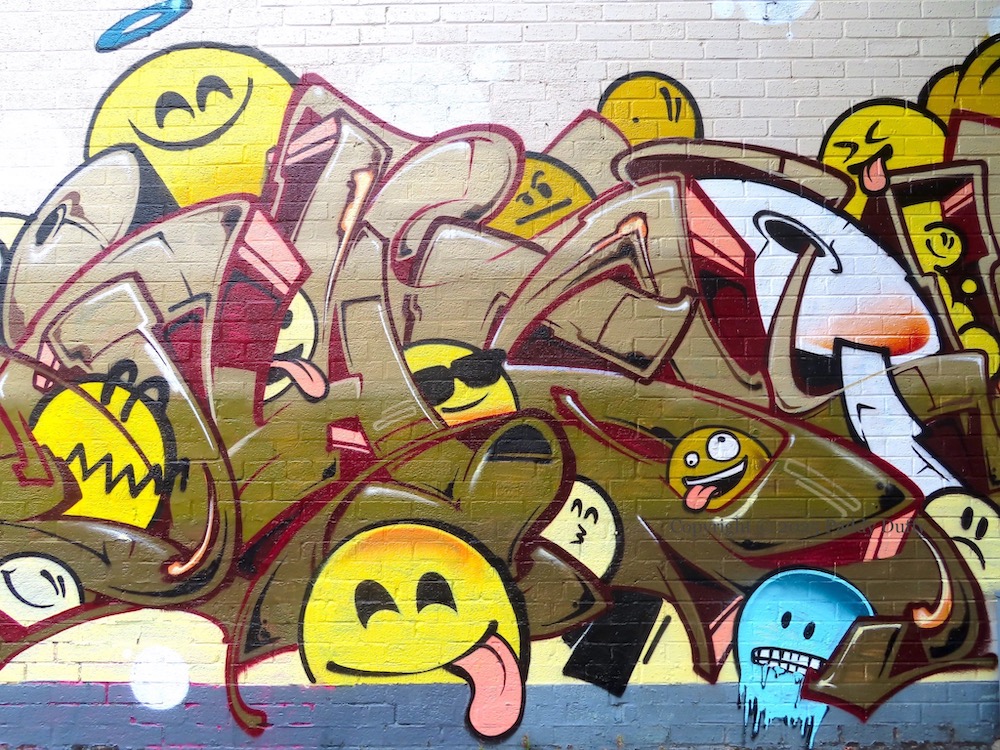
Graffiti-art in Pilot Street, Sailortown, by ?Dublin artist ASIK? (please get in touch if you can confirm).

Click image to enlarge
Copyright © 2025 Paddy Duffy
T07404 T07405
Graffiti-art in Pilot Street, Sailortown, by ?Dublin artist ASIK? (please get in touch if you can confirm).
Click image to enlarge
Copyright © 2025 Paddy Duffy
T07404 T07405
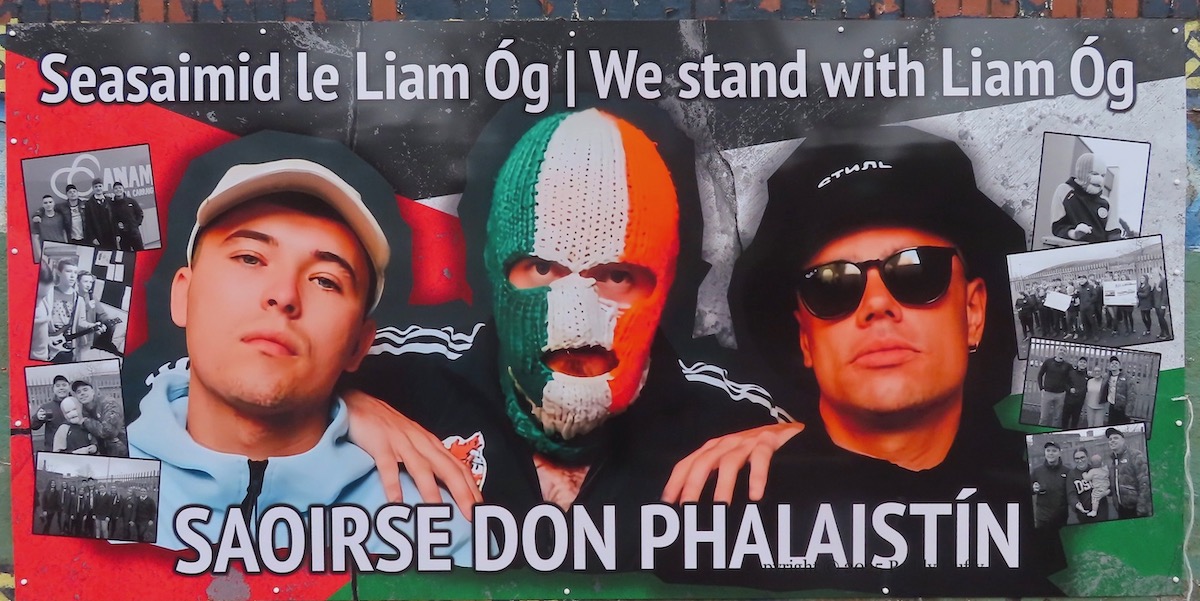
“We stand with Lıam Óg”, that is Lıam Óg Ó hAnnaıdh (on the left of the image above), a.k.a. Mo Chara, a member of the rap group Kneecap who appeared in court (in London) on Wednesday August 20th on “terrorism” charges and was bailed for a further month while the judge rules on a technical issue about whether the trial can go forward (BBC). (See previously The Magic Within and Seasaımıd Le Kneecap.)
The night before (the 19th) this board featuring images of the band-members and the band in its early days was unveiled on the Whiterock Road. (Video of the launch can be found on the Glór Na Móna instagram account.)
In the background is a Palestinian flag and “Saoırse don Phalaıstín” [Freedom for Palestine] is written along the bottom.


Click image to enlarge
Copyright © 2025 Paddy Duffy
T07416 T07417
T07436

James “Jim” Doherty was six years old when he was shot while playing in the front garden of his Turf Lodge home in 1972. Relatives For Justice and the family launched the board shown above at the entrance to the estate ten years ago – in October 2015 – in order to push for an inquiry into the death due to the insufficiency of the original investigation and the disappearance of the bullet taken from the body. (Belfast Media Group)
Monagh Road, west Belfast
Click image to enlarge
Copyright © 2025 Paddy Duffy
T07411

Michael Gaughan and Frank Stagg are presented along with the ten deceased 1981 hunger strikers on the cross-beam of a large wooden “H” at the top of Turf Lodge.
IRA volunteer Michael Gaughan died in Parkhurst prison in 1974 after 64 days on hunger strike. Gaughan’s coffin was draped with the Tricolour used to bury Terence McSwiney in 1920. He was force-fed seventeen times during the strike and his family alleged that he died from food stuck in a punctured lung. The practice was ended after Gaughan’s death.
Frank Stagg was on the Parkhurst hunger strike with Gaughan, and another in Long Lartin prison, and a third in Wakefield in December 1975. He died after 62 days on February 12th, 1976.

Click image to enlarge
Copyright © 2025 Paddy Duffy
T07413 T07412 [T07414]

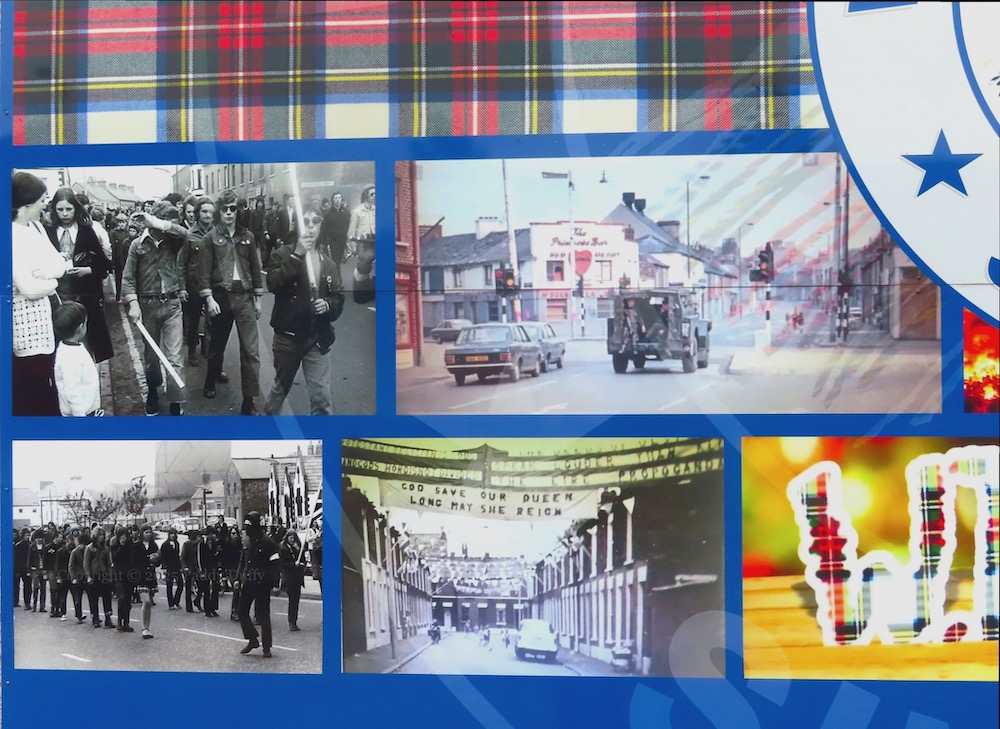
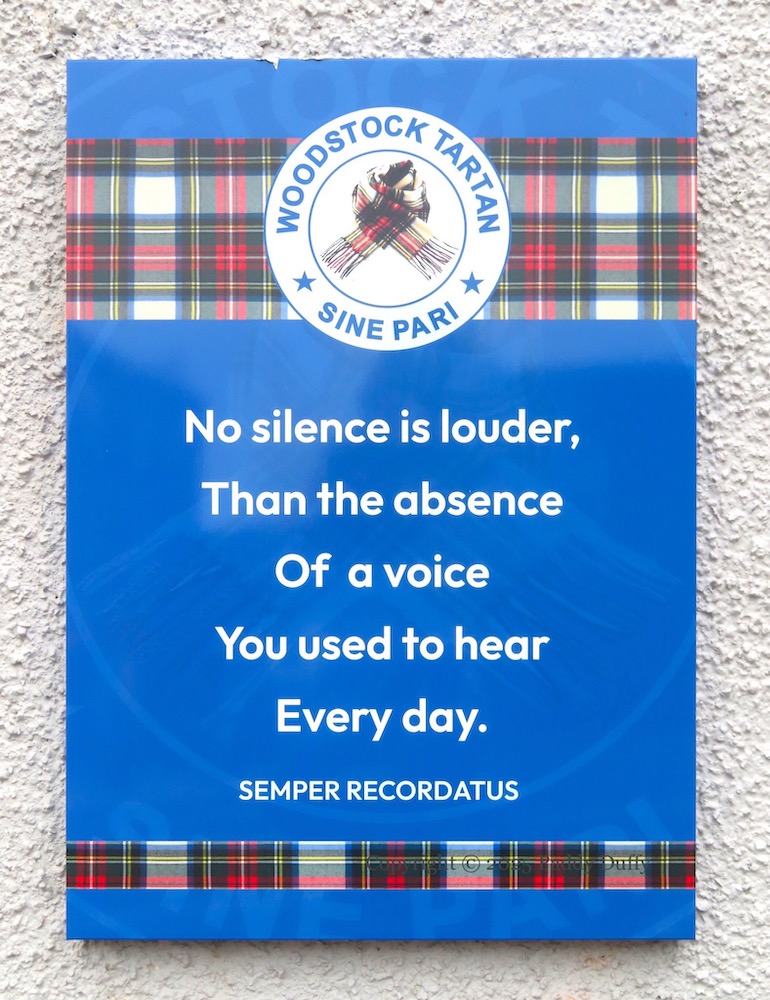
“Woodstock tartan – sine pari”.
Tartan gangs were a short-lived phenomenon in the early 70s, bridging the gap between youthful trouble-making and para-militarism. The gangs as entities distinct from youth wings of paramilitary groups had largely disappeared by the late 70s, and the teens and young adults who were members then are now in their sixties and seventies and some have passed away (“No silence is louder, than the absence of a voice you used to hear every day. Semper recordatus”). This new (July 2025) board commemorates the camaraderie of the Woodstock Tartan in those early days: “We are young, we are one, we are tartan”.
The name “tartan [gang]” comes from the tartan clothing, particularly scarves, worn by the gangs. Gareth Mulvenna (2014 and in History Ireland) reports that the first pattern worn by the Shankill Young Tartans was in fact the Burberry tartan – a box of scarves was stolen during a trip to a Rangers match in Glasgow – but they later adopted the Royal Stewart tartan, which is predominantly red rather than tan. (It was made famous by motor-racer Jackie Stewart, who wore a tartan sticker on his helmet (Henry Ford).) The Woodstock tartan pattern (shown in the new board) is the ‘dress’ (white) variant of the Royal Stewart tartan.
The speakers at the board’s launch (Loyalist East Belfast on youtube) recall the activities (and fashions) of the Woodstock gang in the early 70s – building bonfires, attending matches, holding running battles with other gangs – and only obliquely mention the turn towards sectarian violence, ultimately joining the Red Hand Commando in 1972 in response to IRA attacks such as at the Four Step Inn (Mulvenna). In this 7-minute TV report about the Woodstock Tartans from May 1972 (youtube), an interviewee distinguishes the Tartans in east Belfast from gangs in England as defenders of their area: “when IRA mobs come out [from Short Strand] and attack this Protestant area, we have to beat them back, as the soldier don’t seem able to do this.” (See also this Time interview.)



Click image to enlarge
Copyright © 2025 Paddy Duffy
T07370 T07369 T07371 T07372 T07373 T07374

The emblem in the top left of this board is the original emblem of the Irish Football Association. The Association was formed in 1880 by seven Belfast clubs but after partition a rival Football Association Of Ireland was formed and the original body eventually represented only Northern Ireland. (WP)
All of the players named and pictured post-date 1950, when the IFA stopped selecting southern players for the IFA’s team. They are … Tommy Jackson, Billy Caskey, Phil Gray, Tom Finney, Norman Whiteside, Danny Griffin, George McCartney, Alf McMichael, Tommy Cassidy, Robbie Garrett, Brodie Spencer, Jordan Owens, Billy Ferguson, George O’Boyle.
“AONISC” (bottom left) is the Amalgamation Of Northern Ireland Supporters’ Clubs (web). There are about 60 clubs in the amalgamation, but seven local clubs are named here: Albert Foundry, Woodvale Loyal, Tavern GAWA, Bootle Street, Wheatfield, 1st Shankill, Ligoniel.
In Battenberg Street on the side of the Stadium Bar and off-sales.

Click image to enlarge
Copyright © 2025 Paddy Duffy
T07311 T07310
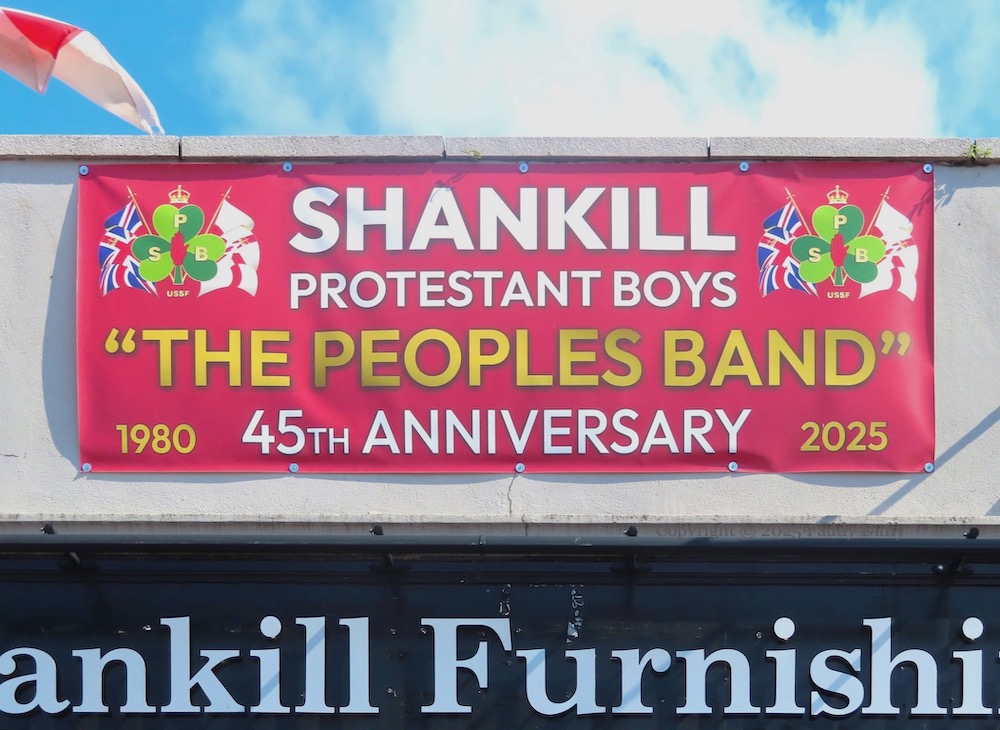
“Shankill Protestant Boys [Fb] “The People’s Band” 45th anniversary, 1980-2025.” The band held a parade on August 1st to commemorate the anniversary, with nearly forty other bands attending (Fb).
For “USSF”, see the Peter Moloney Collection. The band’s club is in Bell Close – see SPB Way.
Shankill Road, west Belfast
Click image to enlarge
Copyright © 2025 Paddy Duffy
T07327 [T07328]

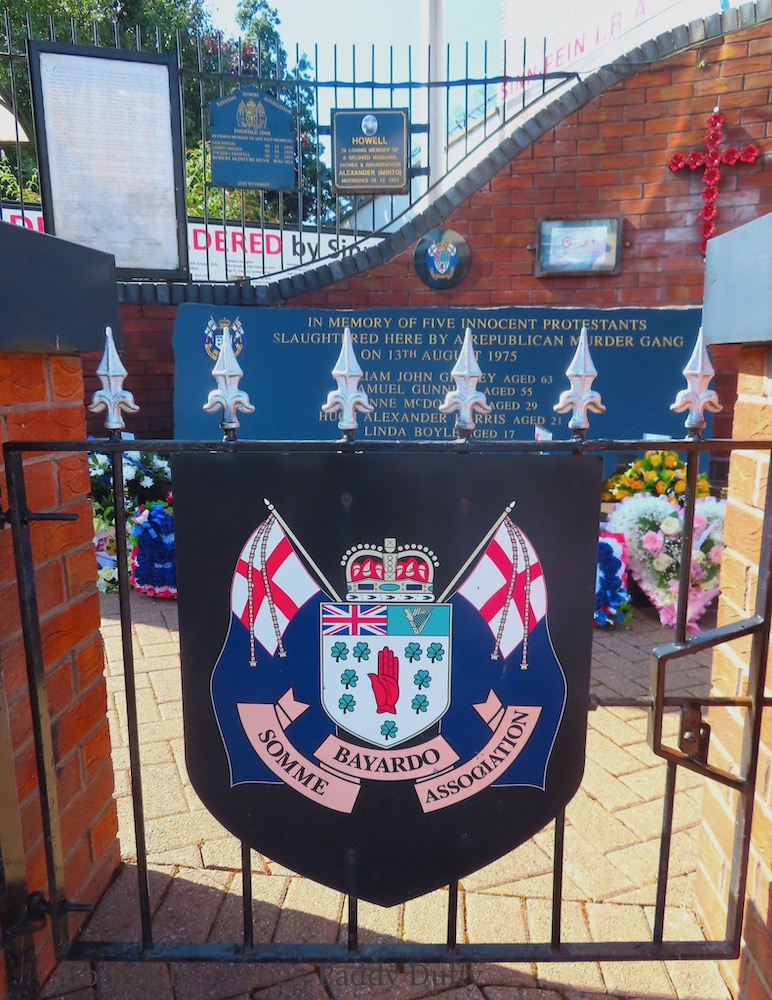
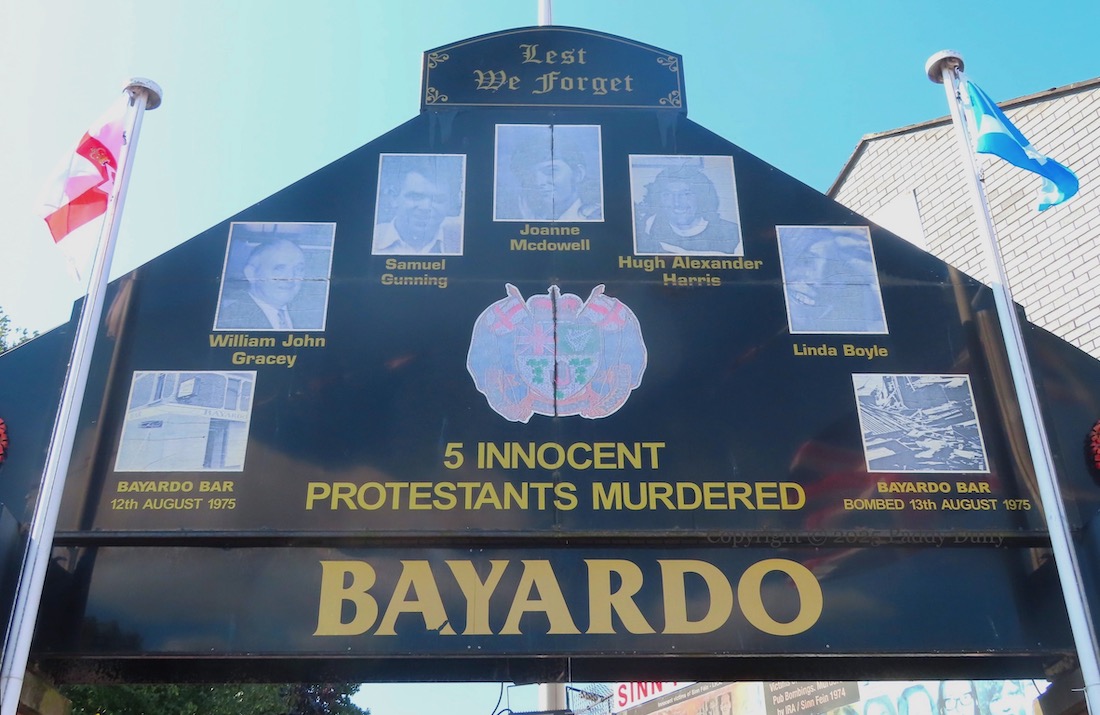
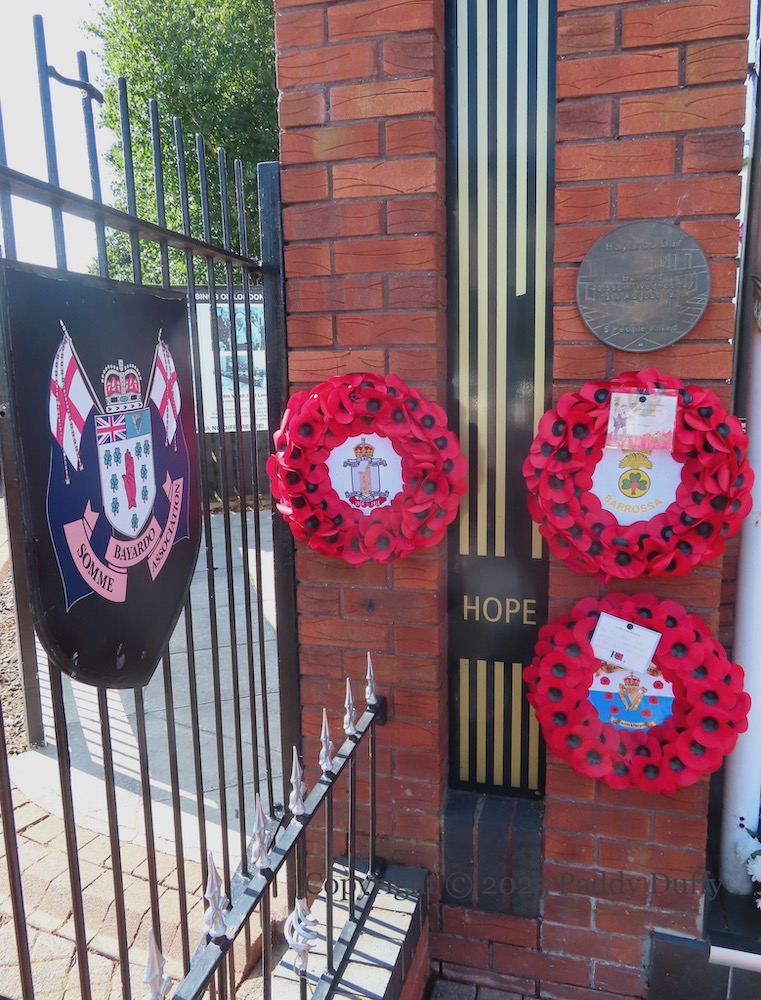
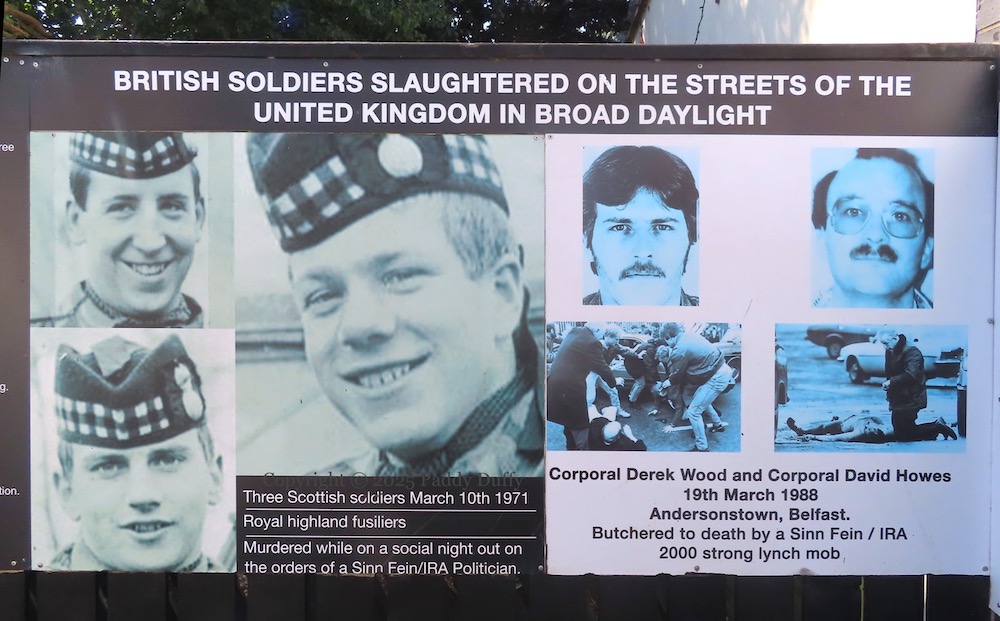
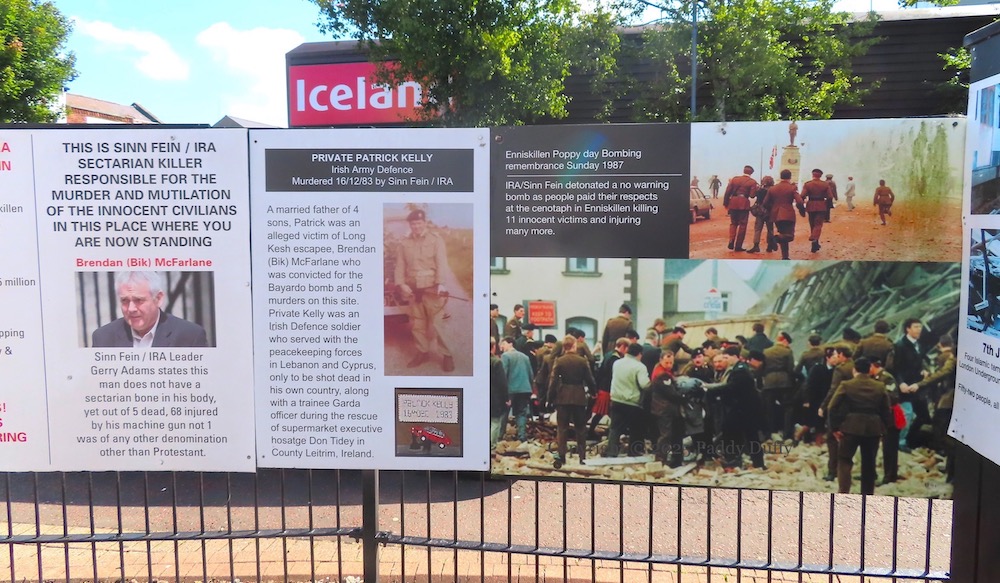
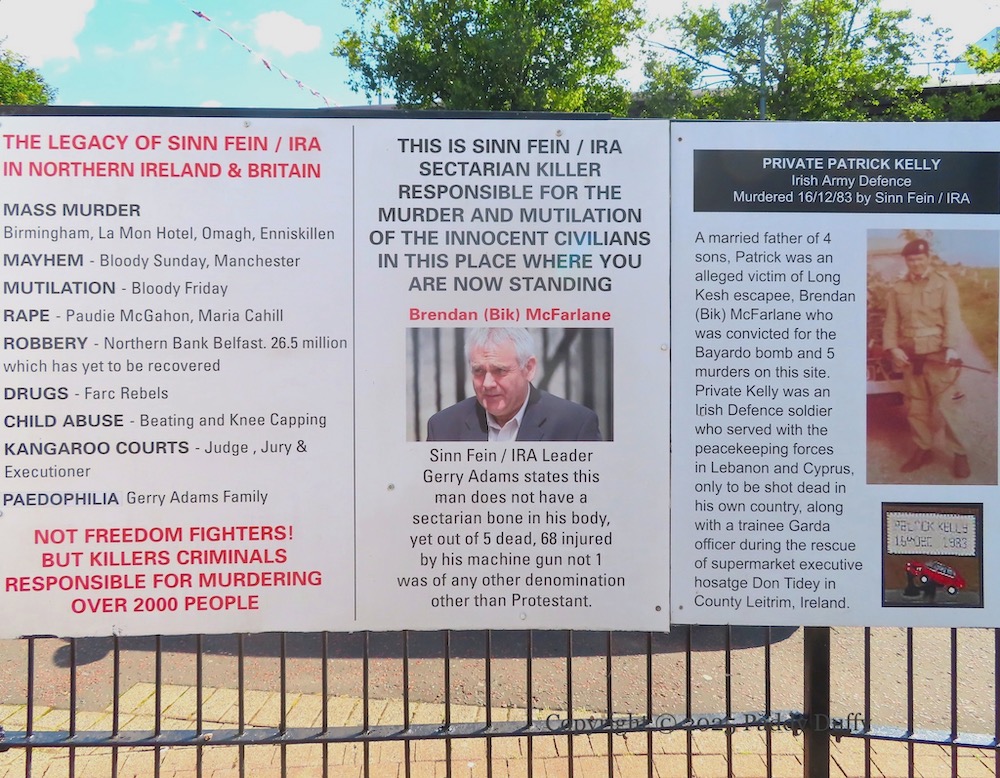
Wreaths are laid at the Bayardo Bar memorial on the Shankill Road on the fiftieth anniversary of the attack, which involved the shooting of two people at the door and the bomb being left at the entrance, which caused the deaths of a further three people: “In memory of five innocent Protestants slaughtered here by a republican murder gang on 13th August 1975. William John Gracey aged 63, Samuel Gunning aged 55, Joanne McDowell aged 29, Hugh Alexander Harris aged 21, Linda Boyle aged 17. Erected by the Bayardo Somme Association. “A forgotten atrocity”.” Fifty other people were injured in the attack.
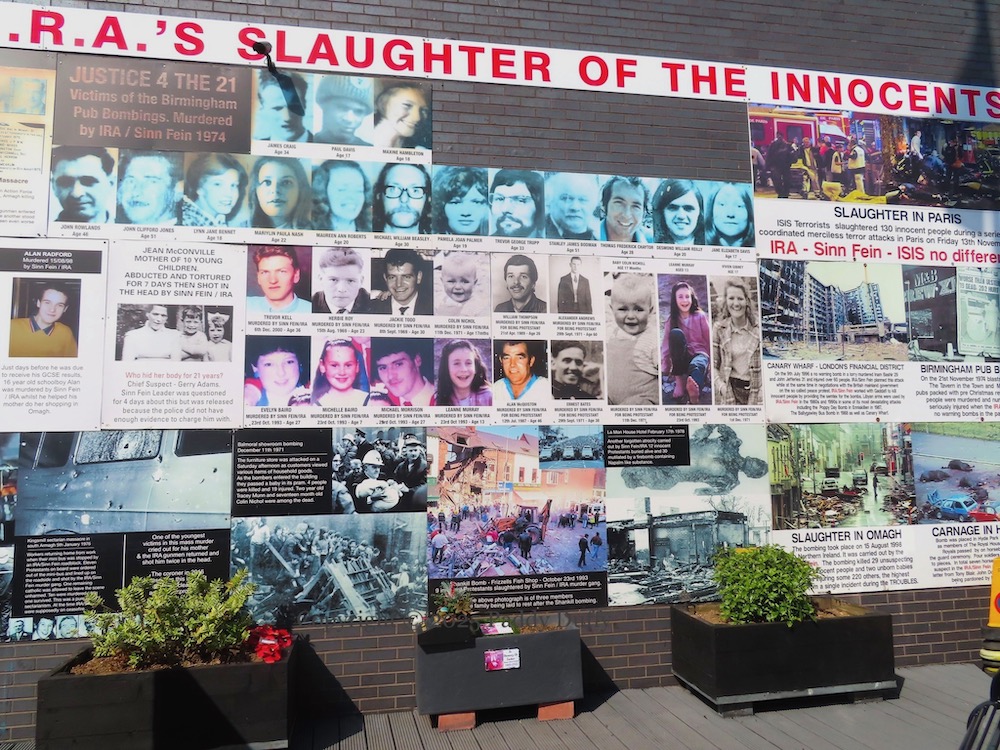
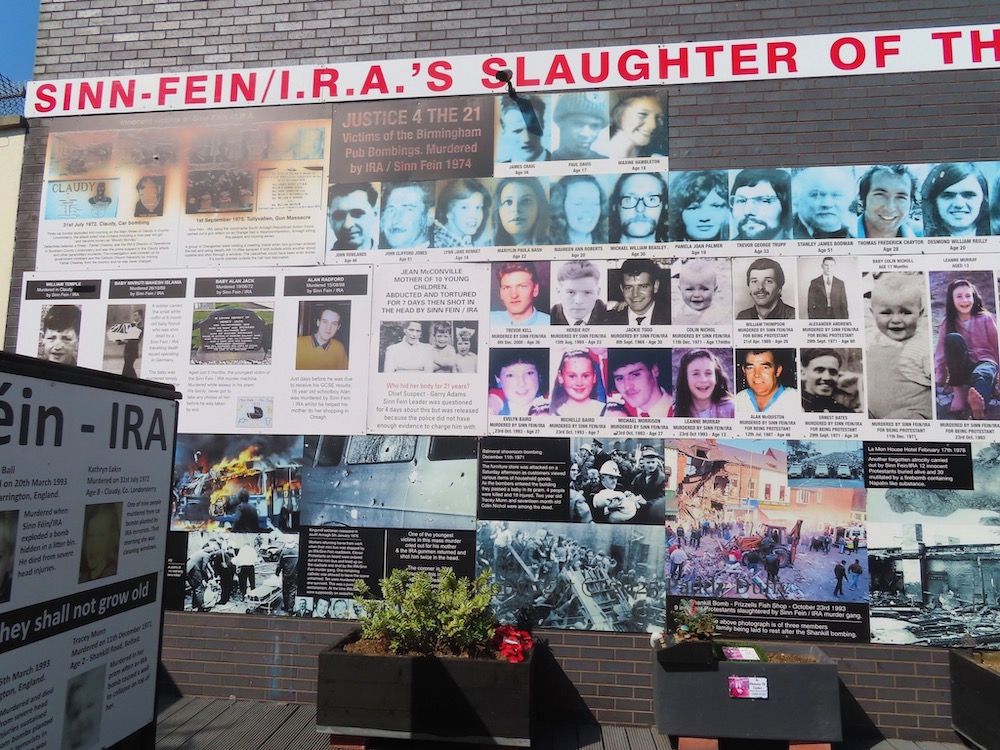
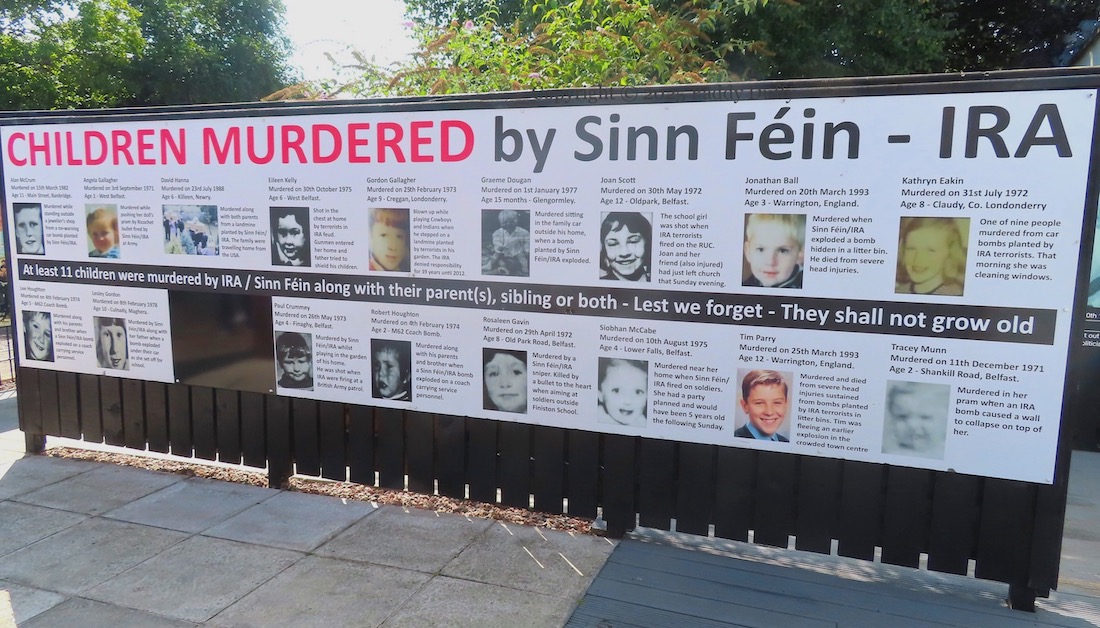
Here is an opinion piece in the BelTel claiming that “republican communities … have been far more active not only in memorialising violent events impacting upon them, but also campaigning for the truth about those actions … the lack of balance in how the past is being investigated here has created a one-track, green-tinted narrative”.
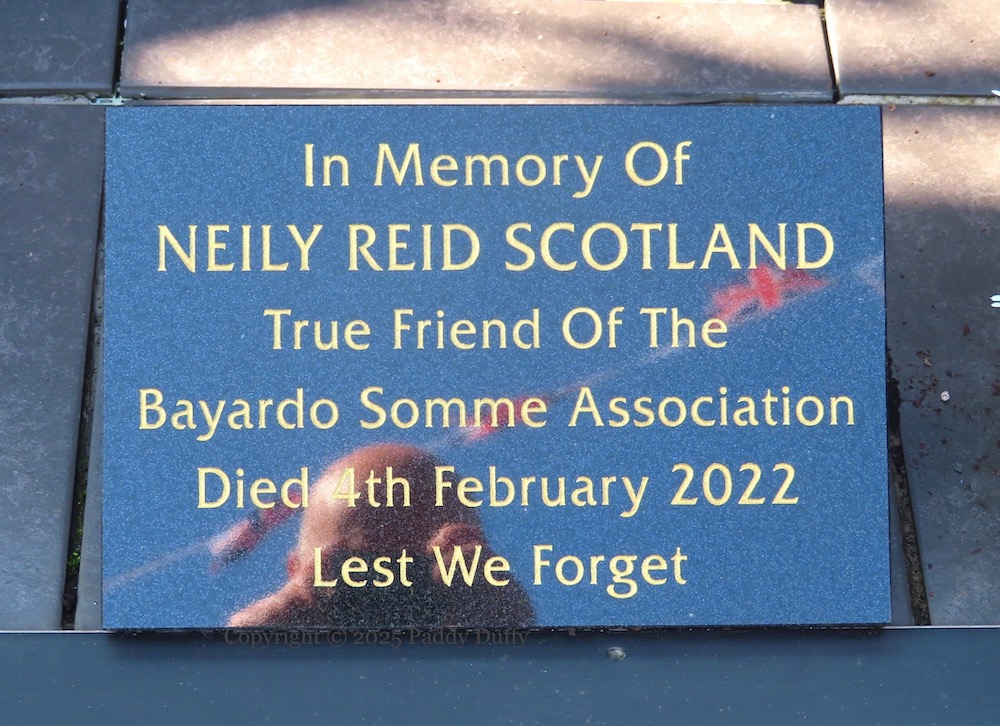
See also: the memorial in 2023. Included here are close-ups of two recent plaques, one “In memory of Neily Reid Scotland, true friend of the Bayardo Somme Association, died 4th February 2022. Lest we forget.” and the other “In memory of Billy Boyce, loyal friend of the Bayardo Somme, died 19-12-2018. Lest we forget.”
Shankill Road/Aberdeen Street, west Belfast




Click image to enlarge
Copyright © 2025 Paddy Duffy
T07312 T07314 T07313 T07326 T07315 T07316 T07317 T07318 T07319 T07320 T07321 T07322 T07323 T07324 T07325

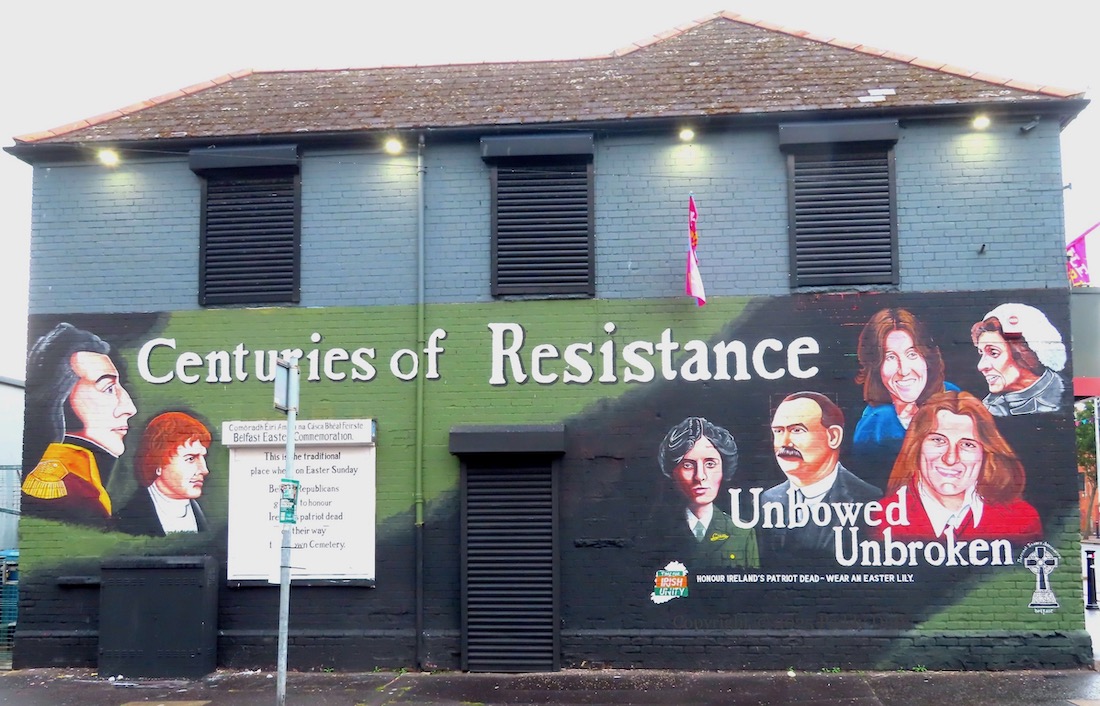
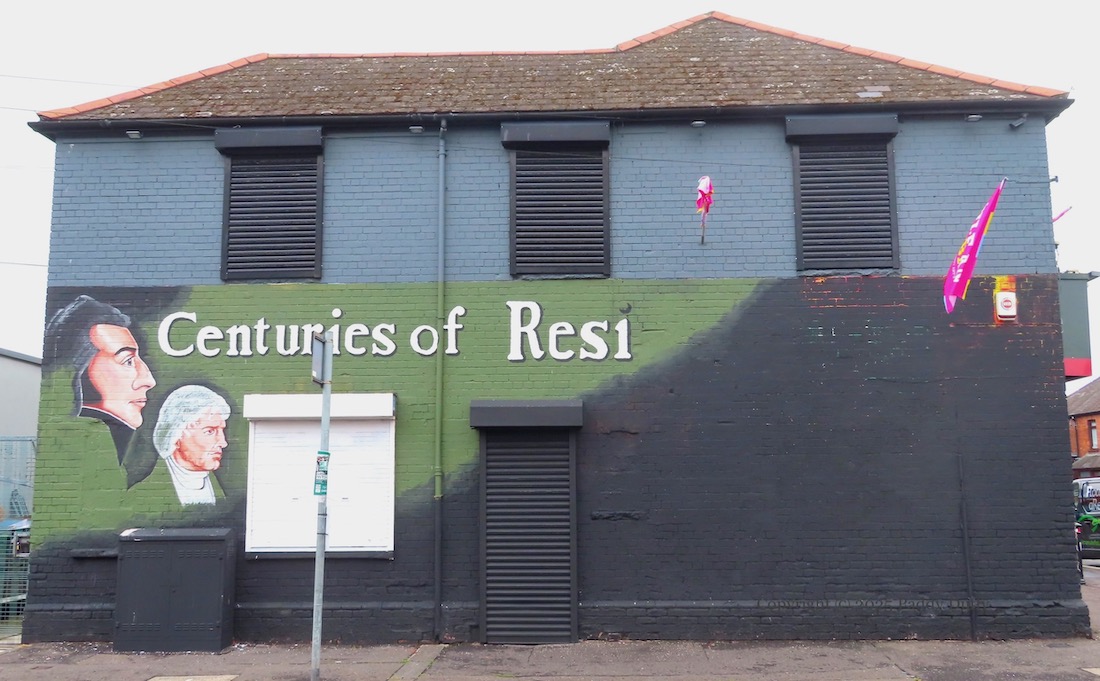
The United Kingdom Of Great Britain And Ireland was created in 1801, a reaction to the 1798 Rebellion, led by (amongst others) Wolfe Tone and Henry Joy McCracken, who were founding members of the Society Of United Irishmen in 1791 in Belfast.
In this mural, Tone and McCracken on the left gaze across the “centuries of resistance” from 1798 to 1916 Rising revolutionaries Countess Markievicz and James Connolly, and beyond to Troubles-era figures Maıréad Farrell, Bobby Sands, and Máıre Drumm.
Around the same time as this mural was painted, a Féıle exhibition called ‘Vibrant Colours, Violent Past’ included A Panorama Of Republicanism which contains dozens of figures but again chooses 1798/Tone, 1916/Connolly, and the Troubles/Martin McGuinness as the pivotal moments and figures.
“Comóradh Éırí Amach Na Cásca Bhéal Feırste/Belfast Easter Commemoration. This is the traditional place where on Easter Sunday Belfast republicans gather to honour Ireland’s patriot dead on their way to Milltown Cemetery.” “Honour Ireland’s patriot dead – wear an Easter lily.” “Unbowed, unbroken.”
The Beeechmount-Falls Corner has its own Visual History page, as the most-often painted wall in Belfast.

July 27th:

Click image to enlarge
Copyright © 2025 Paddy Duffy
T07295 T07294 T07296
T07258 T07259

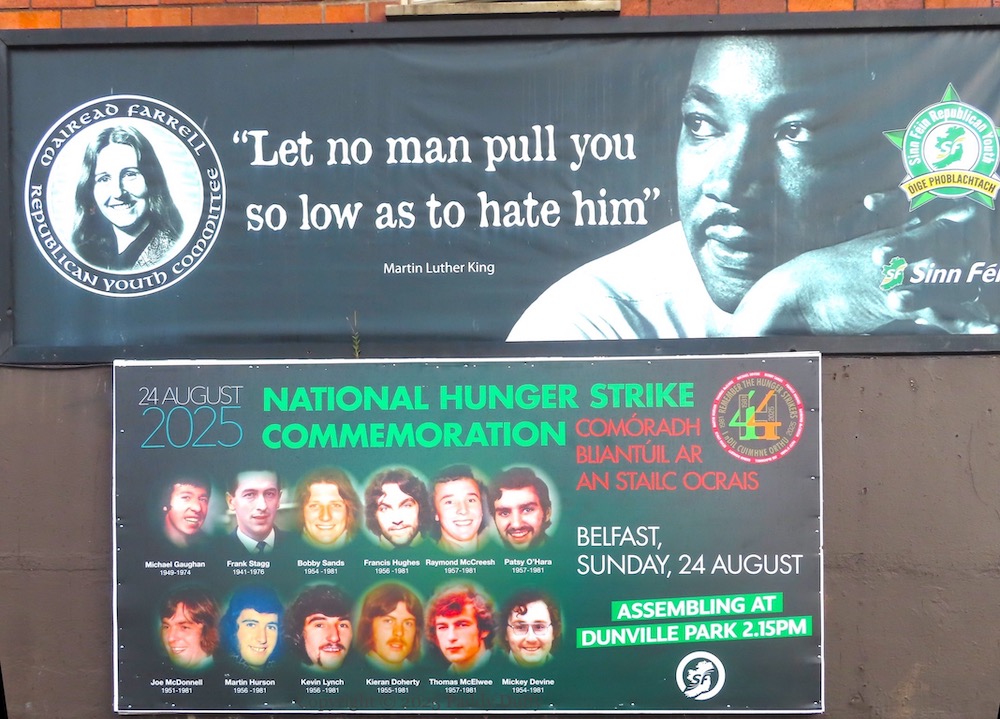
Michael Devine was the last of the 1981 hunger-strikers to die, on August 20th, 1981, and although the strike was not called off until October 3rd, his death now marks the end of the strike for commemorative purposes. The 44th annual national commemoration of the strike will take place this year on the 24th, “assembling at Dunville Park” in west Belfast.
Beechmount Street, west Belfast. The MLK tarp goes back to 2014.
Click image to enlarge
Copyright © 2025 Paddy Duffy
T07308 T07309
 Paddy Duffy Collection