Here is an instance of the ‘masked skull’ design produced by prisoners in Long Kesh (according to Mo Chara Kelly), seen also in Britains Death Squads. This version is simpler: it does not have any writing and there is no UDR emblem on the UDA-style hat.
The small boards above the mural declaring west Belfast an “apartheid-free zone”/”ceantar saor ó apartheıd” were mounted in 1986 along with the ANC mural.
Beechmount Avenue, west Belfast – this wall has its own Visual History page as it is the most-often painted wall in Belfast.
The mural of the Madonna and child on the side of the Morning Star hostel greeted travellers going up Divis Street from 1988 to (at least) 2002. It was, according to minutes of Belfast City Council’s Development Committee (2002-03-06 pdf), one of four religious murals painted in west Belfast in 1988. The other three are unknown – please get in touch if you can identify them.
The second mural, below, with similar figures and palette, was also extant in 1988, though might have been painted earlier. It was in Hillman Street in the New Lodge. It is entitled “Our Lady Of Medjugorje” despite the fact that the Medjugorje apparition (in 1981) was of Mary alone, without child.
There were two other vintage religious murals in the New Lodge, one of a paschal lamb in Lepper Street (C00111 | X05493) that was extant in 1988, and one of the 1879 apparition in Knock in Oceanic Street whose date of creation is unknown – it was visible in Street View in 2008. Of the same (1988) vintage seem to be murals of a shamrock (C04981), Gaelic games (C04977), a harpist (M01248), and doves (M01249).
Other visions of Our Lady Of Medjugorje occurred at the top of Springhill in 1990 (see the Gerard Kelly site) and in Ardoyne, painted c. 1993 (M01017) and repainted on various occasions since (possibly 2004, 2012, 2014, 2020).
“Freedom.” On the left, a Starry Plough (of the INLA) is attached a spear of ancient Ireland, next to two pikes (of the 1798 Rebellion), behind an ancient shield filled in with the Gal Gréıne of the Fıanna; on the right, a volunteer from the modern “Óglaıgh Na hÉıreann” aims an assault rifle, all against a large Irish Tricolour.
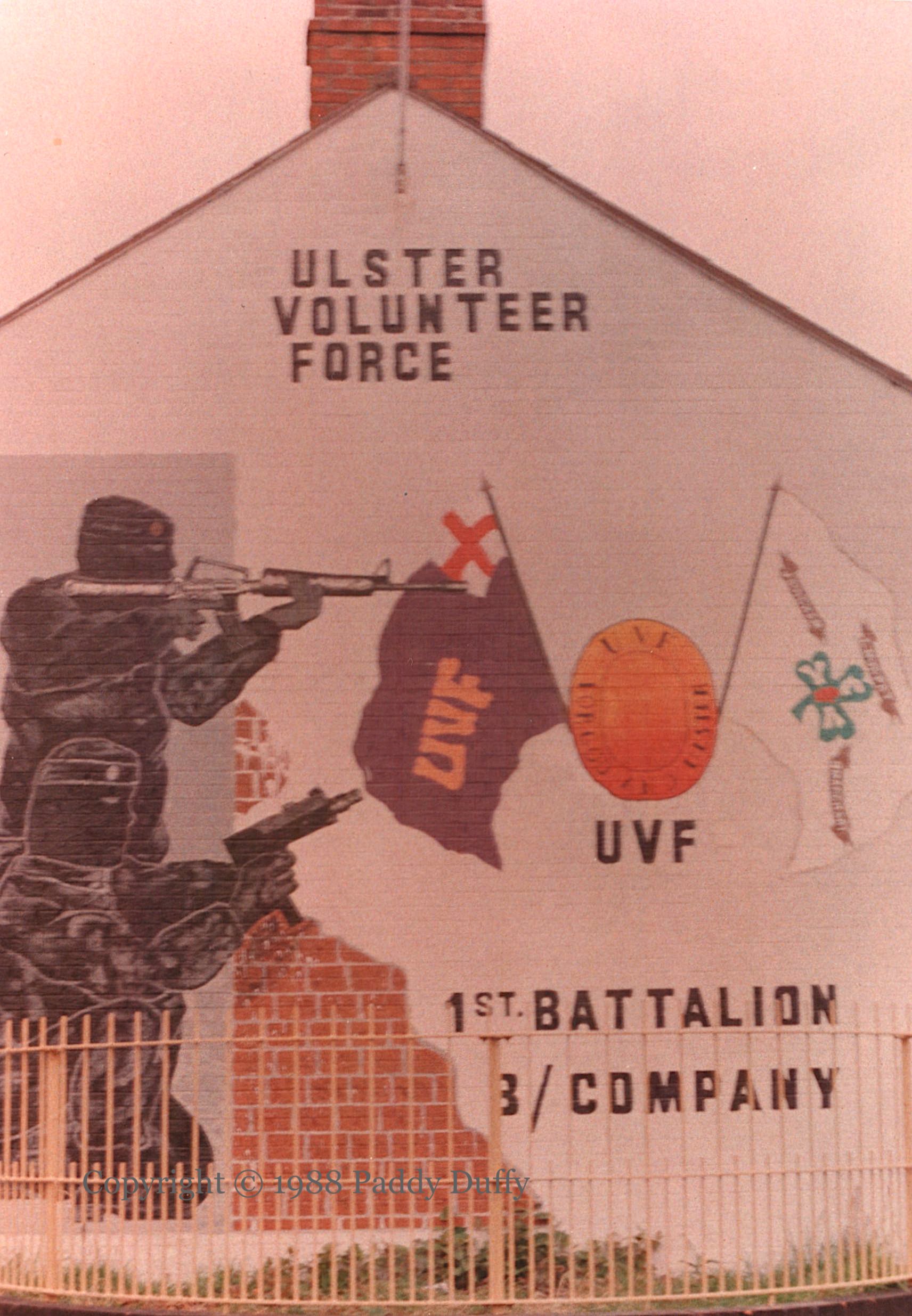
Hooded UVF volunteers from “1st battalion, B company” armed with an assault rifle and an Uzi take aim at unspecified targets.
On the side-wall to the left it reads, “The UVF reserve the right to strike at republican targets where and when the opportunity arises” – see also the Peter Moloney Collection.
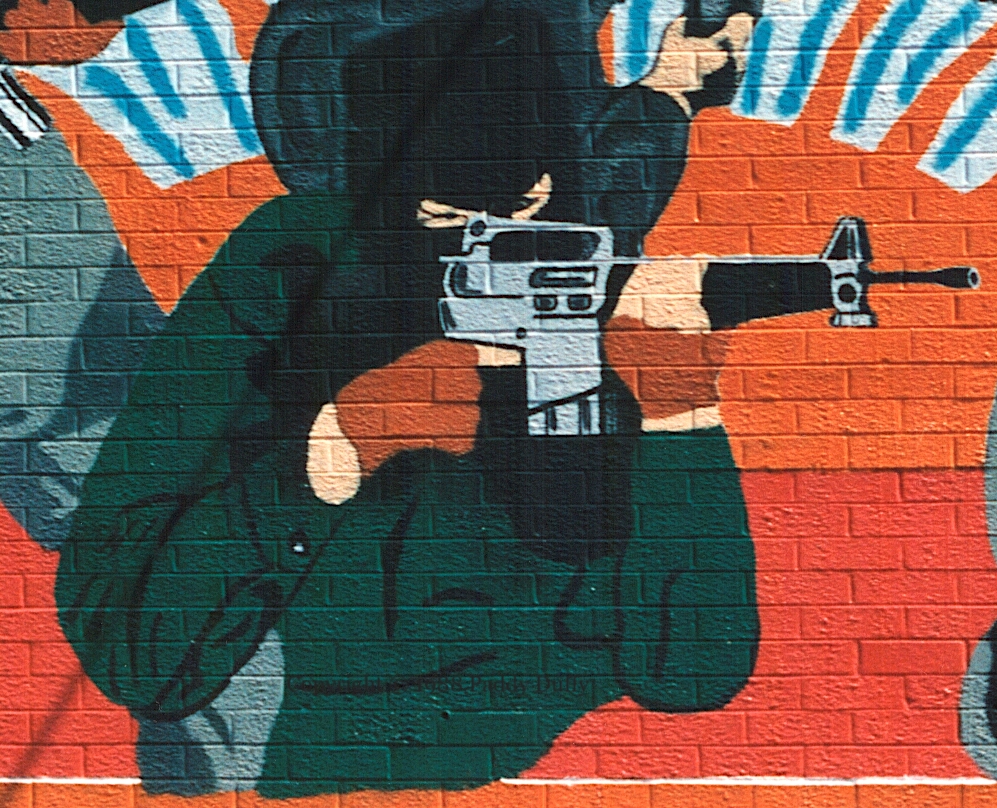
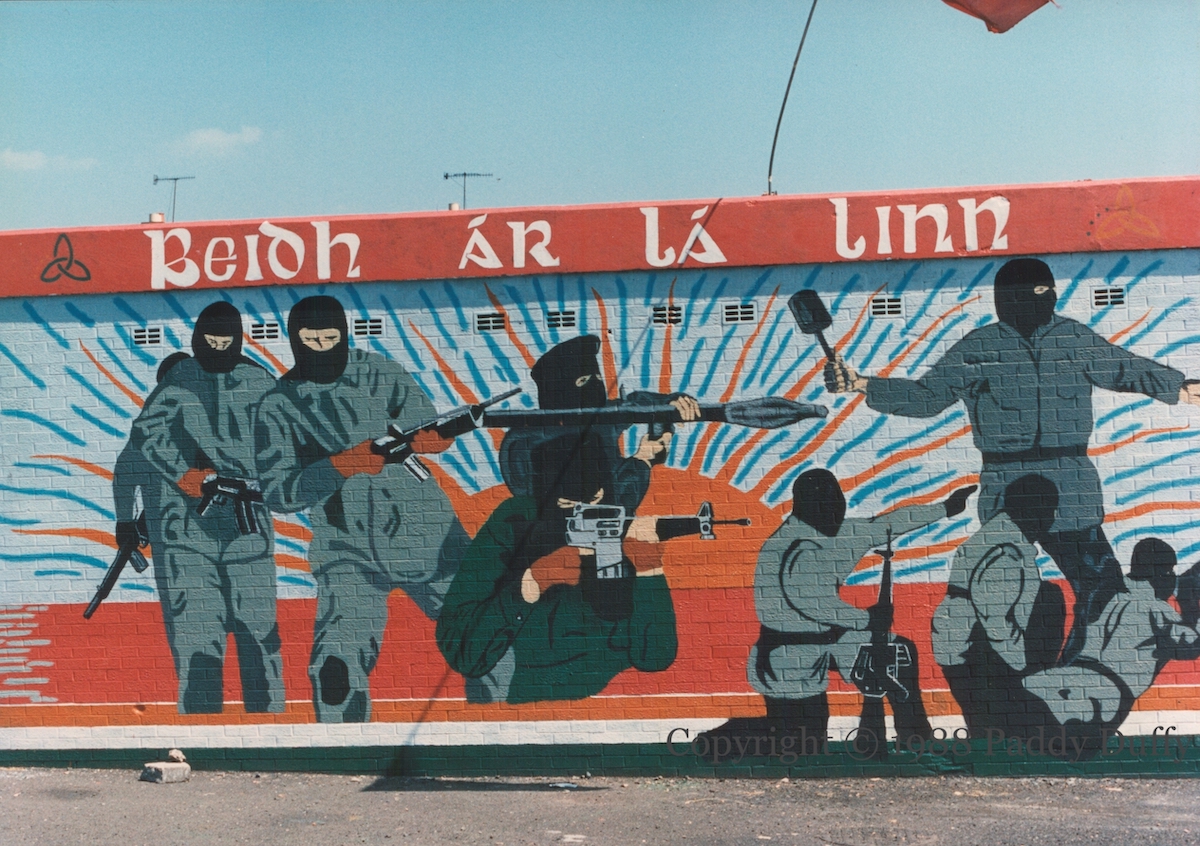
This mural shows nine hooded republican volunteers employing an assortment of weapons – rifles, RPG launcher, drogue bomb, machine gun – against a rising sun. “We will have our day.” The trio in the bottom right corner are familiar from other murals, such as this one in Strabane.
Volunteers in simplified clothing fire a funeral volley over an unseen coffin. The mural was later made more complex – see Slán Go Fóıll in the Peter Moloney Collection.
For the side wall, see Long Kesh in the Peter Moloney Collection.
Words from Padraıg Mac Pıaraıs’s poem Mıse Éıre are included alongside the portraits of the seven signatories to the 1916 Proclamation. It includes the line “Great is my glory, I who bore brave Cú Chulaınn” and Cú Chulaınn is pictured on the right, in the death pose made famous by Oliver Sheppard in a statue installed in the GPO in 1935 – see Cú Chulaınn’s Visual History page.
Mıse Éıre: Sıne mé ná an Chaılleach Bhéarra. Mór mo ghlóır: Mé a rug Cú Chulaınn cróga. Mór mo náır: Mo chlann féın a dhíol a máthaır. [Mór mo phıan: Bıthnaımhde do mo shíorchıapadh.] [Mór mo bhrón: D’éag an dream ınar chuıreas dóchas.] Mıse Éıre: Uaıgní mé ná an Chaılleach Bhéarra.
Painted by Mo Chara Kelly in Norglen Gardens, west Belfast
“In proud memory of those who gave their lives for Ireland’s freedom” (and out of sight to the left) “Also to all civilians murdered by the British crown forces” (and out of sight to the right) “Also to all civilians murdered by pro-British elements”. The Celtic cross bears three republican flags: Tricolour, Sunburst, and Starry Plough.
The volunteers (and one Sınn Féın member) listed are (on the left) “Martin Forsythe, Martin Skillen, Gerard Fennell, Terence O’Neill, John Dempsey” and (on the right) “Sean McDermott, Tom Magill, Sean Savage, Kevin McCracken, Paul Best”.
“West Belfast Brigade UDA C Company”. UDA/UDF/LPA/UFF mural on the Shankill. (For a similar quartet of names and explanation of “UDF”, see Sans Peur.)
The title “First Ulster Defence Assoc.” is an attempt to tie together the defenders of Derry in 1688 (300th anniversary) with the modern Ulster Defence Association. This is an early attempt to give the UDA historical roots, beyond the Shankill and Woodvale Defence Associations. To this end, the group would adopt Cú Chulaınn (beginning in 1992 – see the Visual History page) and (beginning in 2007 – see UDU-UFF-UDA) the 1893 Ulster Defence Union as ancestors.
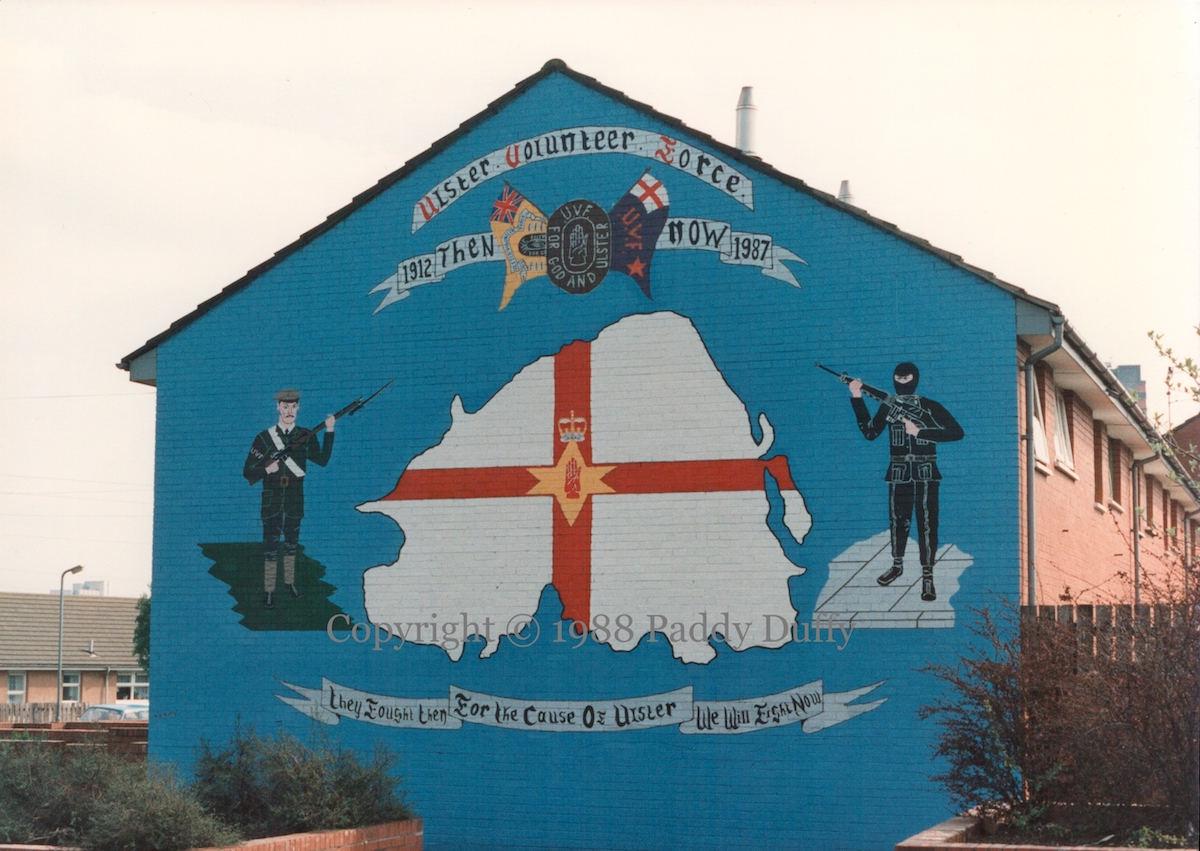
“They fought then for the cause of Ulster, we will fight now.” The 75th anniversary of the Ulster Volunteers is celebrated in this mural in Dover Place, west Belfast. On the left of the Northern Island is an Ulster Volunteer in period (1912) garb standing on a patch of ground, on the right, a modern (1987) paramilitary in hood and fatigues standing on a city footpath. The Ulster Volunteers as such did not fight for Ulster – they instead joined the British Army and fought “for King and Empire” in WWI, after which Home Rule was applied only to 26 counties of Ireland and Northern Ireland was created and remained within the UK.





 Paddy Duffy Collection