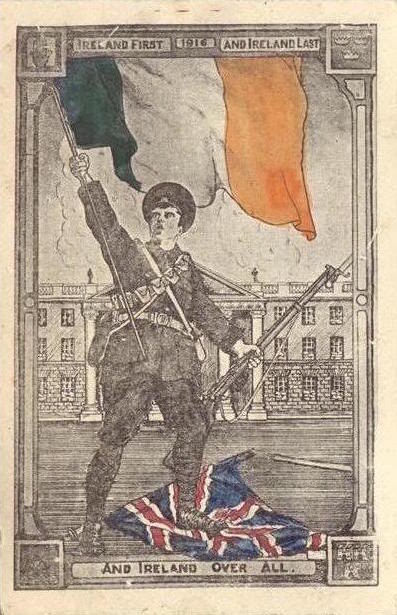
A revolutionary soldier raises the Irish Tricolour while trampling on a Union Flag on a broken mast that was perhaps attached to the poorly drawn GPO in the background. The card on which the image is based can be seen below.
On the right hand side are the Easter lily and halberds/pikes and an assault rifle, indicating the historical roots and present-day inheritors of the 1916 revolt.
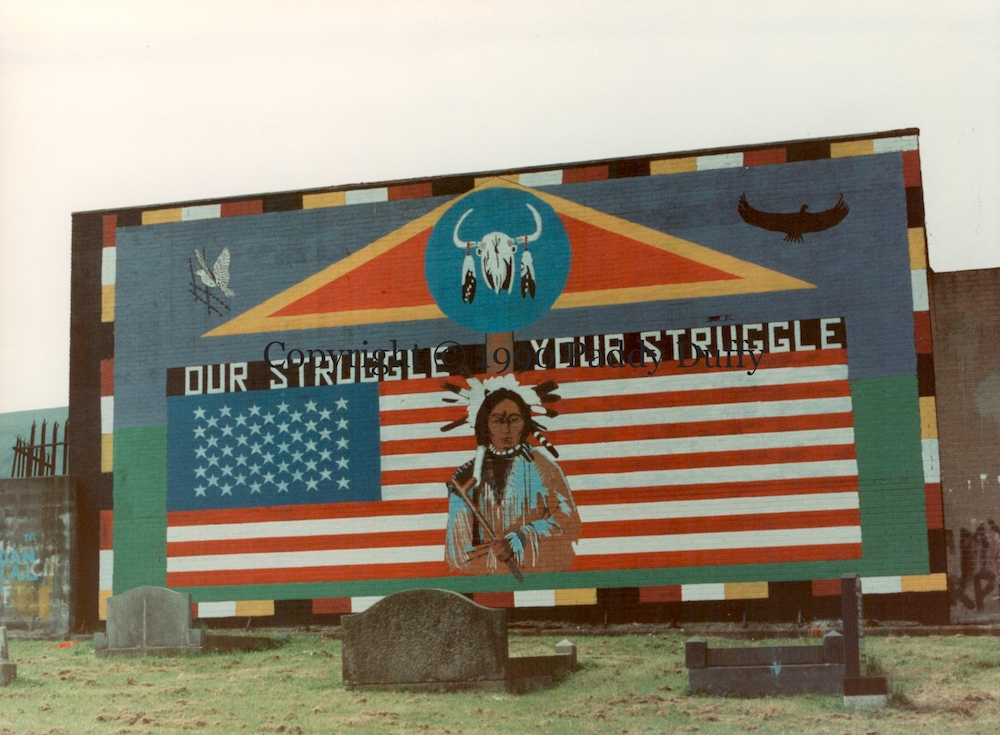
Chief sitting Bull with his back to the flag of the United States, with a lark (for the Irish struggle) and an eagle (for the Native American) and a border of the colours of humankind.
Painted by Mo Chara Kelly with Jan Attridge on the wall of the (then) Ballymurphy Community Centre just off the Whiterock Road, west Belfast.
A cartoon by ‘Cormac‘ (Brian Moore) is turned into a mural on Belfast’s Whiterock Road by Mo Chara Kelly. The mural satirizes the ad included below, which urges people to call the confidential telephone to report terrorist activity. Instead, the protagonist can no longer ignore the violence of the British Army (and RUC) and calls the Sınn Féın office.
1 When the Brits were having a go … “Who cares?” I thought. 2 And when something really rough happened I just trained harder to forget it … [Speech-bubble:] Anything for a quiet life, see. 3 But where’s it got me? What have these brave lads in khaki done for me? [British Army soldier:] We’re not here to do things for you; we’re here to do things to you. 4 [RUC commander:] Hey, don’t forget us. We’ve done our share of wrecking homes, harassing people. We’ve murdered and tortured and … 5 And when I saw their kind of justice I thought “There’s got to be something better than this.” [Judge:] You may think I’m a corrupt Orange bigot. But I know that I’m a very well-paid corrupt Orange bigot! And the only justice you’re going to get is British justice. 6 So I made up my mind. I wanted these thugs off our backs. [Thought-bubble:] Is it any wonder that the British tourist is the most despised person on earth? 7 You see I want a decent future, and it’s not going to happen while these “hero[e]s” are doing the dirty work of British imperialism. And it’s not going to happen if you’re waiting for someone else to do something. 8 622112. Hallo? Is that the Sınn Féın office?
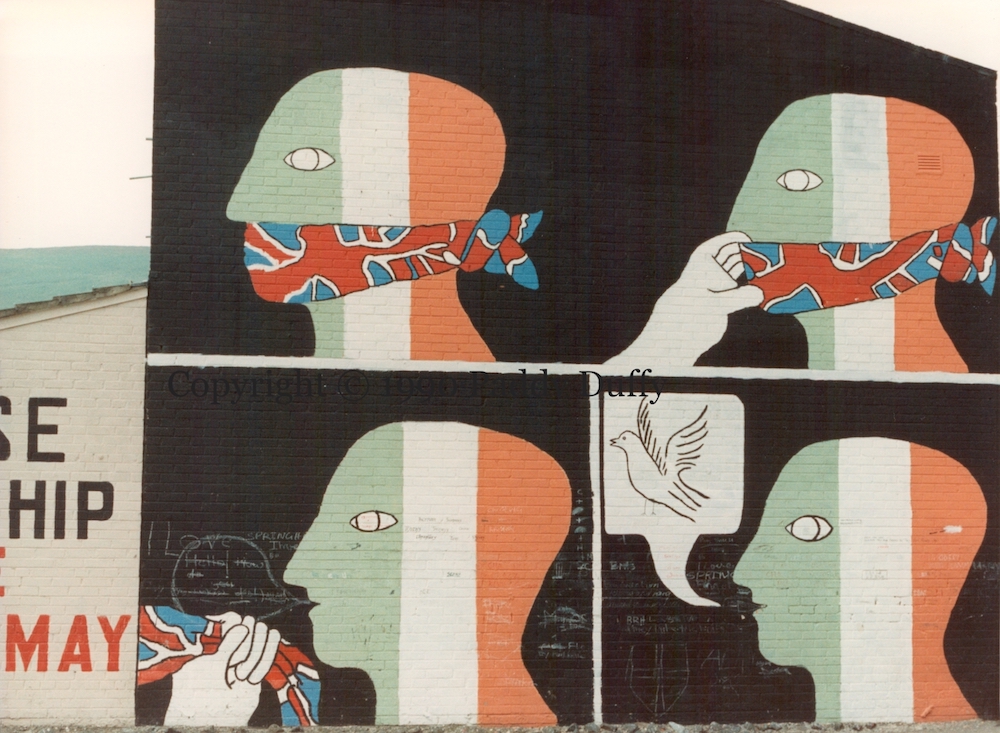
A Cormac cartoon protesting British censorship of Sınn Féın is rendered as a mural by Mo Chara Kelly. The broadcasting Ban was put in place in 1988, disallowing Sınn Féın representatives from speaking in their own voice on television and radio. But if the gag of British censorship were removed, the talk is of peace (in the form of a dove) – suggesting that there is some for negotiation on the violent removal of British forces and administration.
Out of frame to the left are written “Oppose censorship” and (in red) “Vote Richard May”. Richard May ran (unsuccessfully) for election to Belfast City Council in 1989.
Bobby Sands’s prison diary (web) ends, on March 17th, 1981, with the words “Tıocfaıdh lá éıgın nuaır a bheıdh an fonn saoırse seo le taıspeáınt ag daoıne go léır na hÉıreann – ansın tchífıdh muıd éırí na gealaí.” [A day will come when this desire for freedom will be exhibited by all the people of Ireland – then we will see the rising of the moon].
The phrase “the rising of the moon” comes from the poem/song of the same name composed by fifteen-year-old John Casey in 1865 about the 1798 Rebellion. “Full bitter was their fate” but the desire for freedom was not extinguished with them: “… e’en still are beating/Hearts in manhood’s burning noon/Who would follow in their footsteps/At the rising of the moon.”
In this mural, just off Lenadoon Avenue, a larger-than-life prisoner stands in silhouette, with first defiantly raised, over the watch-towers of Long Kesh.
“Chífıdh muıd éırí na gealaí” – “chífıdh” and “tchífıdh” are variant spellings.
Here is an instance of the ‘masked skull’ design produced by prisoners in Long Kesh (according to Mo Chara Kelly), seen also in Britains Death Squads. This version is simpler: it does not have any writing and there is no UDR emblem on the UDA-style hat.
The small boards above the mural declaring west Belfast an “apartheid-free zone”/”ceantar saor ó apartheıd” were mounted in 1986 along with the ANC mural.
Beechmount Avenue, west Belfast – this wall has its own Visual History page as it is the most-often painted wall in Belfast.
The mural of the Madonna and child on the side of the Morning Star hostel greeted travellers going up Divis Street from 1988 to (at least) 2002. It was, according to minutes of Belfast City Council’s Development Committee (2002-03-06 pdf), one of four religious murals painted in west Belfast in 1988. The other three are unknown – please get in touch if you can identify them.
The second mural, below, with similar figures and palette, was also extant in 1988, though might have been painted earlier. It was in Hillman Street in the New Lodge. It is entitled “Our Lady Of Medjugorje” despite the fact that the Medjugorje apparition (in 1981) was of Mary alone, without child.
There were two other vintage religious murals in the New Lodge, one of a paschal lamb in Lepper Street (C00111 | X05493) that was extant in 1988, and one of the 1879 apparition in Knock in Oceanic Street whose date of creation is unknown – it was visible in Street View in 2008. Of the same (1988) vintage seem to be murals of a shamrock (C04981), Gaelic games (C04977), a harpist (M01248), and doves (M01249).
Other visions of Our Lady Of Medjugorje occurred at the top of Springhill in 1990 (see the Gerard Kelly site) and in Ardoyne, painted c. 1993 (M01017) and repainted on various occasions since (possibly 2004, 2012, 2014, 2020).
“Freedom.” On the left, a Starry Plough (of the INLA) is attached a spear of ancient Ireland, next to two pikes (of the 1798 Rebellion), behind an ancient shield filled in with the Gal Gréıne of the Fıanna; on the right, a volunteer from the modern “Óglaıgh Na hÉıreann” aims an assault rifle, all against a large Irish Tricolour.
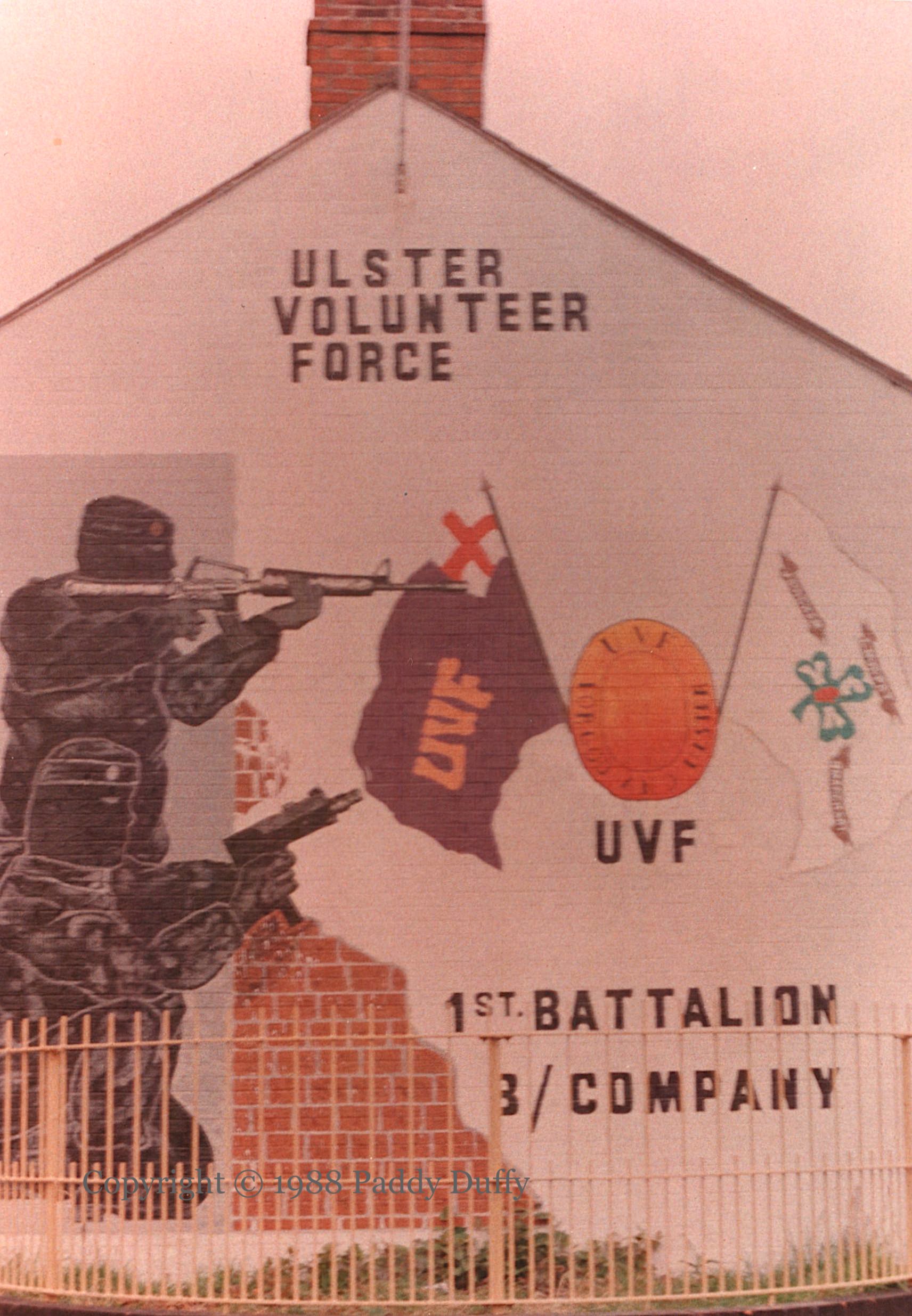
Hooded UVF volunteers from “1st battalion, B company” armed with an assault rifle and an Uzi take aim at unspecified targets.
On the side-wall to the left it reads, “The UVF reserve the right to strike at republican targets where and when the opportunity arises” – see also the Peter Moloney Collection.
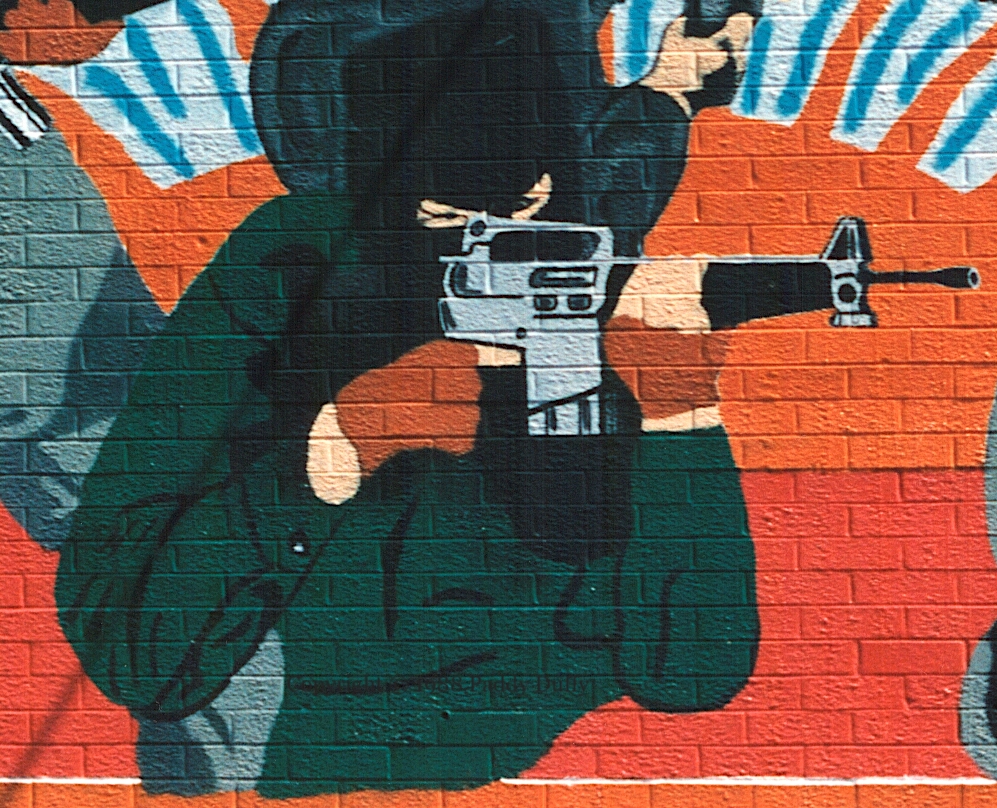
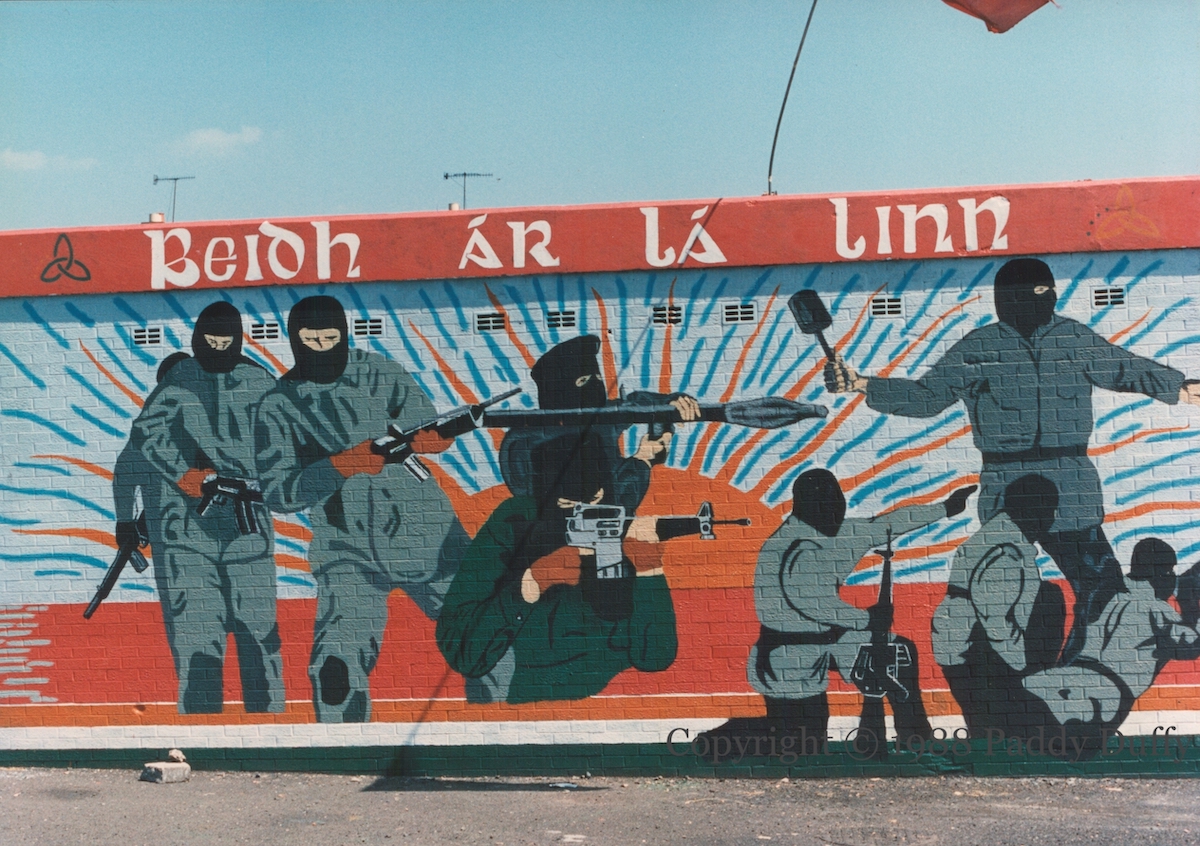
This mural shows nine hooded republican volunteers employing an assortment of weapons – rifles, RPG launcher, drogue bomb, machine gun – against a rising sun. “We will have our day.” The trio in the bottom right corner are familiar from other murals, such as this one in Strabane.





 Paddy Duffy Collection