South Belfast MP Robert Bradford was assassinated by the Provisional IRA in Finaghy at a meeting with constituents; the caretaker of the community centre, Ken Campbell, was also killed by the fleeing attackers. Taking place in late 1981, with the hunger strikes having ended only a month before, the killing was noted around the world and raised fears of broad civil unrest (BBC | NYTimes). The board above serves as a substitute for an earlier mural to Bradford on the adjacent gable wall.
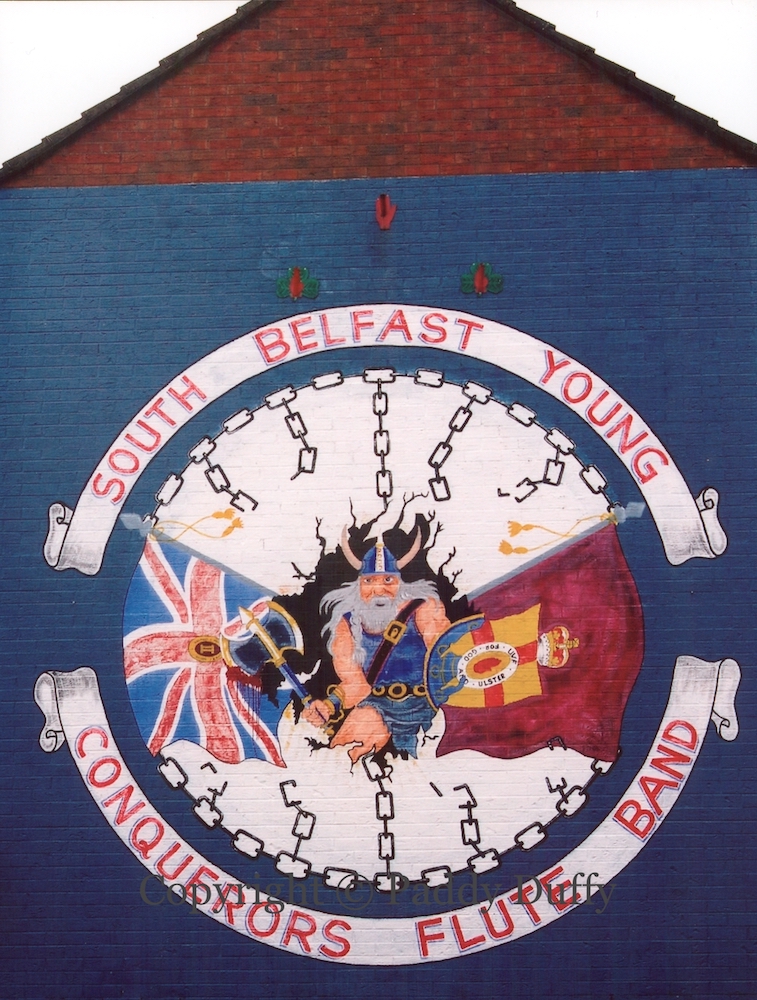
Young Conquerors Flute Band mural in Pine Street, south Belfast, connecting the band to local soldiers who died in WWI. The two boards to either side show a photograph of the original Donegall Pass Defenders Flute Band, which lasted a short time in the 1970s before the formation of the Conquerors in 1977 (Fb). The second shows the patch of the band.
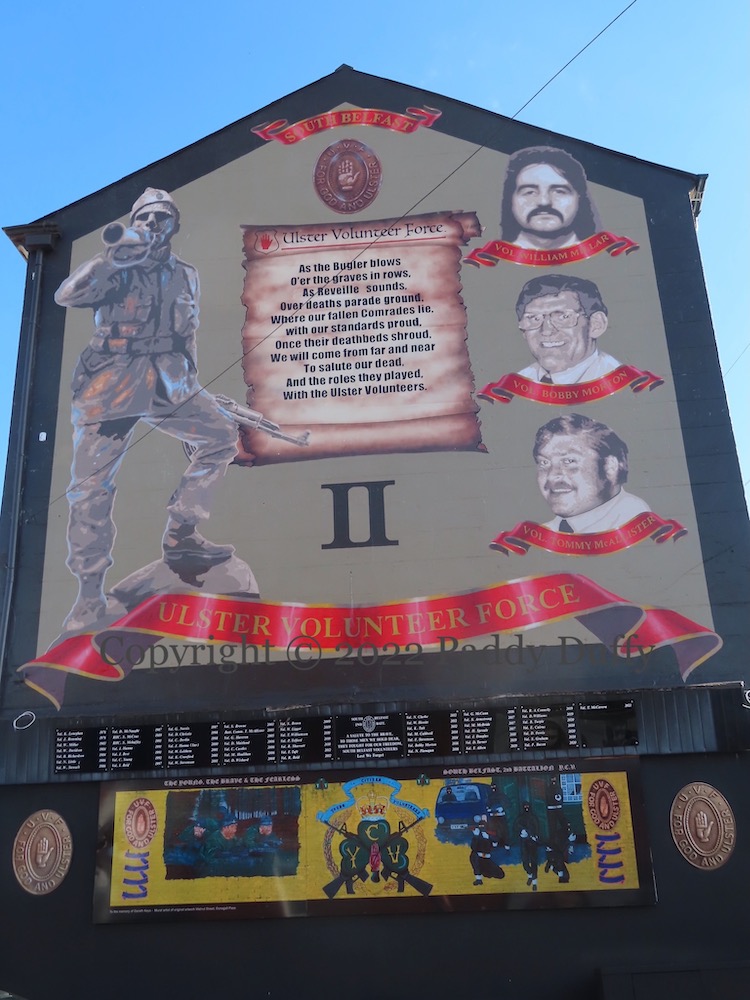
The bugler in period uniform and the language of the poem are reminiscent of WWI but all of the UVF mural, roll of honour, and reproduction of an old YCV mural refer to the modern UVF and in particular to William Millar [sometimes given as “Miller”], Bobby Morton, and Tommy McAllister. Millar and Morton were ambushed by the RUC on the 16th of March 1983 – Millar died and Morton was injured (Long Kesh Inside Out). Millar was included in an old Cregagh mural – see C00956). Morton died in 2016 (Young Conquerors), hence his portrait shows him as an older man. The same is true of McAllister’s portrait, though no information about him is readily available.
“As the bugler blows/O’er the graves in rows/As reveille sounds/Over death[‘]s parade ground/Where our fallen comrades lie/With our standards proud/Once their deathbeds shroud/We will come from far and near/To salute our dead/And the roles they played/With the Ulster Volunteers.”
The mural was launched on March 19th (ACT) in Pine St. Below the new mural are a roll of honour and a board reproducing a former mural by Gareth Keys one street over, in Walnut Street – see The Young, The Brave, The Fearless.
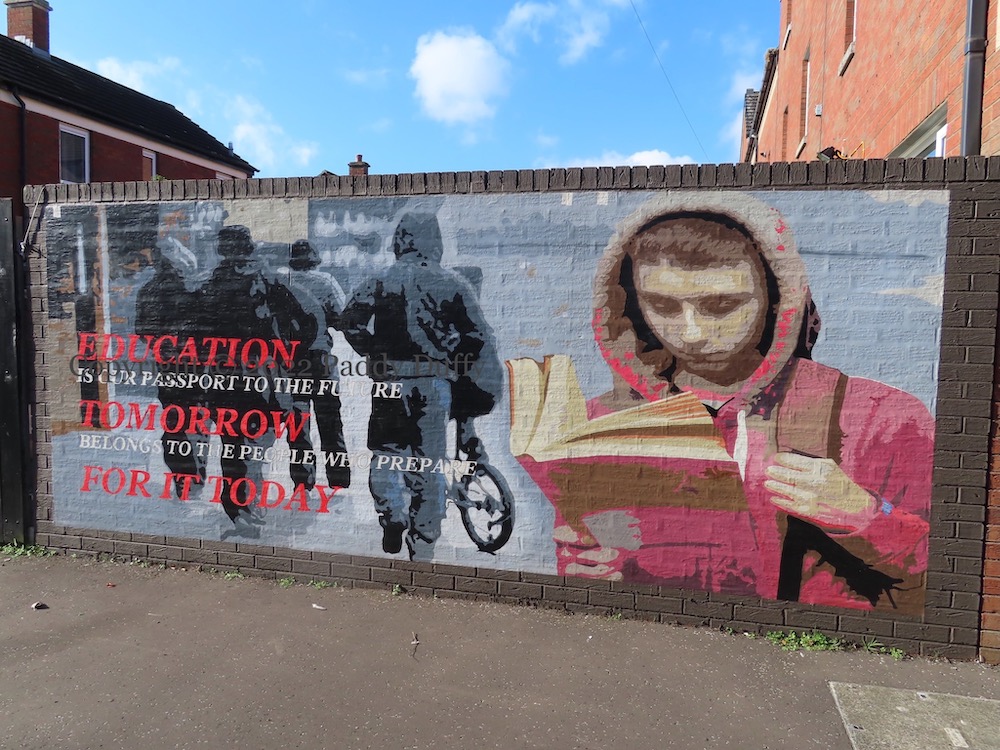
“Education is our passport to the future. Tomorrow belongs to the people who prepare for it today.” This mural, which promotes education over gangs, joins various UVF murals in Pine Street, Donegall Pass – see Death’s Parade Ground and .
Young Conquerors flute band (Fb) mural in Donegall Pass. Flanking the central viking are (left) the flag of Ulster Volunteers south Belfast battalion and (right) the USSF flag.
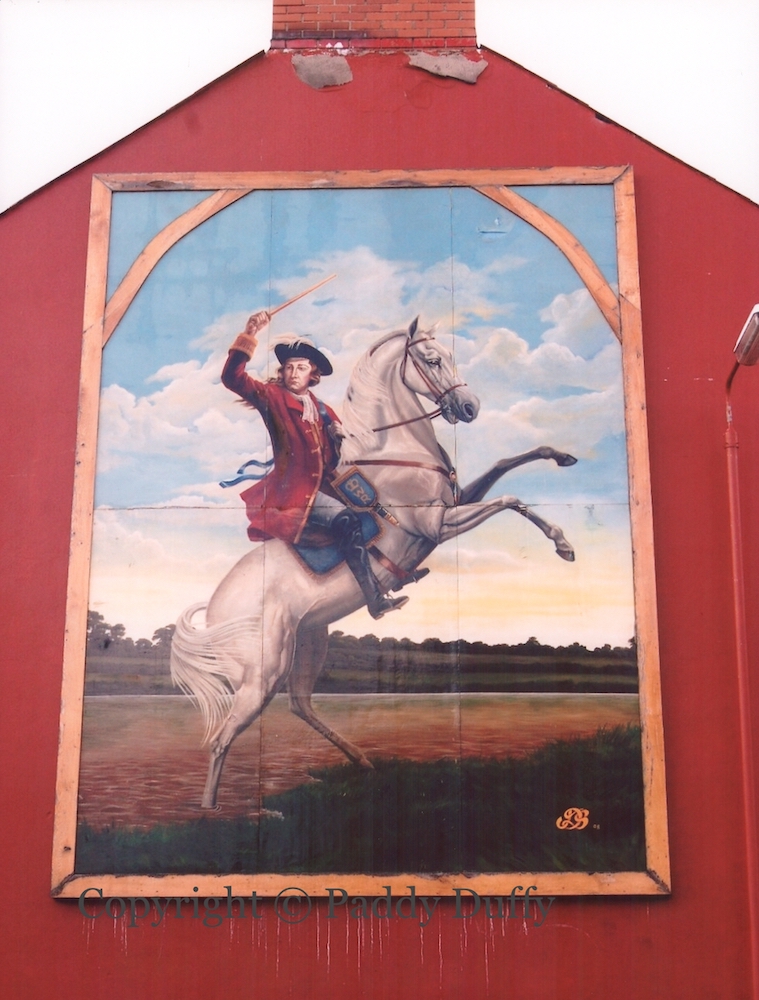
The Village Eddie is re-imaged with a painting of King Billy at the Boyne by John Darren Sutton.
“The first unionist mural was painted in 1908 on the Beersbridge Road in East Belfast by shipyard worker John McLean. It depicted King William at the Battle of the Boyne. This was the start of mural painting becoming a key element in the annual unionist celebration of the Battle of the Boyne, culminating in the Orange Order parades of July 12th. Murals, bunting, arches, painted flagstones, marked out the route of marches as well as adorning countless local areas. Between 1908 and the 1970s the vast bulk of unionist murals depicted King William at the Boyne. Other murals depicted the sinking of the Titanic, the 36th Ulster [sic] Division at the Battle of the Somme, and various royal weddings and anniversaries. Each unionist working class area vied with the neighbouring areas to have the best decorations for the Twelfth. As part of this rivalry, King William murals were painted and repainted year after year, with some surviving through six or more decades. The longest-surviving mural in the South Belfast area was in Rockland Street. It depicted King William on his white horse at the Battle of the Boyne. Painted first in the mid-1920s, it survived until the mid-1990s, when it became a victim first of the heat from an adjacent bonfire, and then of redevelopment. The King William murals began to fade from the walls in the 1970s, to be replaced with murals depicting flags and other inanimate emblems. Overall, the number of murals declined significantly in this decade. In the mid-1980s mural painting in unionist areas came under the control of loyalist paramilitary groups. From that point, the vast majority of murals in unionist areas depicted armed and hooded men. In recent years, the debate on mural painting inside and outside loyalist paramilitary organisations has led to the decline of the military iconography. This debate has led to many positive changes taking place throughout Northern Ireland and in January 2008 Greater Village Regeneration Trust secured funding through the Re-imaging Communities Programme to transform a number of areas within the village. This programme was established to help communities in both rural and urban areas to focus on positive ways of expressing their culture and identity and to encourage the creation of vibrant and attractive shared spaces. Thanks to the overwhelming support and participation of the local community in the Re-imaging process. Local organisations, community leaders, residents and young people have worked closely with artists to tackle the displays of redundant sectarian imagery and replacing these with positive expressions of wider cultural celebration.”
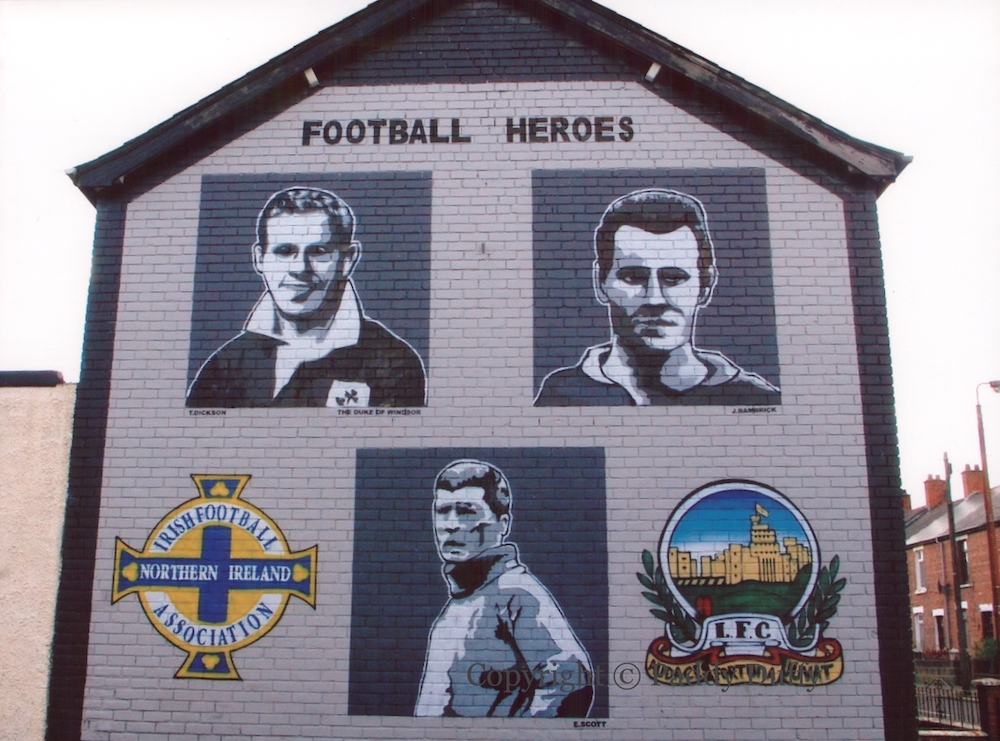
Northern Ireland and Linfield footballers T[ommy] Dickson ‘The Duke Of Windsor‘ (WP), J[oe] Bambrick (WP), and Elisha Scott (WP) are celebrated in a Village mural.
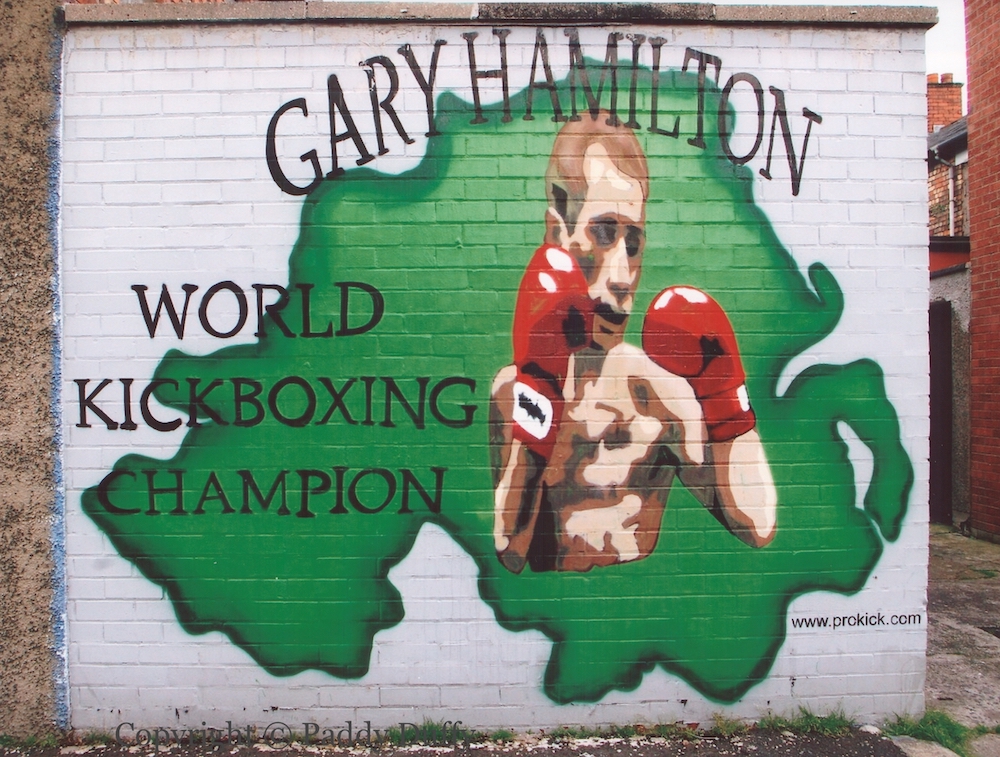
“Gary Hamilton – world kickboxing champion – www.prokick.com“. Hamilton held the featherweight full contact world title from 2002-2009 (WP). The Prokick gym is in east Belfast.
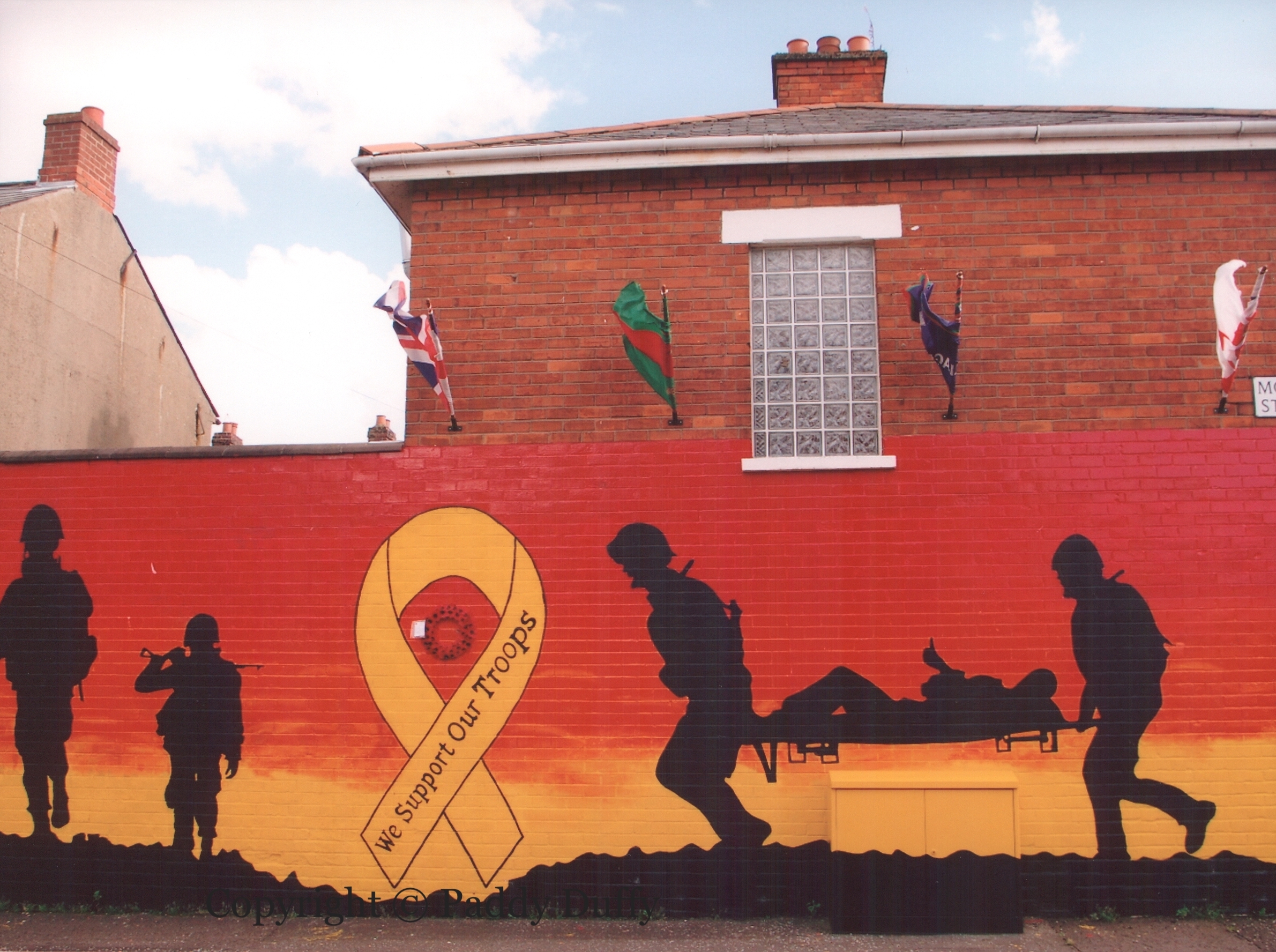
The photograph of a stretchered soldier giving a ‘thumbs up’ (shown below) was set up and photographed by Captain Ed Hodges of the King’s Royal Hussars in Basra, Iraq, in 2007 (Daily Mail). In silhouette (as shown here) it has become the icon of the Help For Heroes charity raising money for British forces.
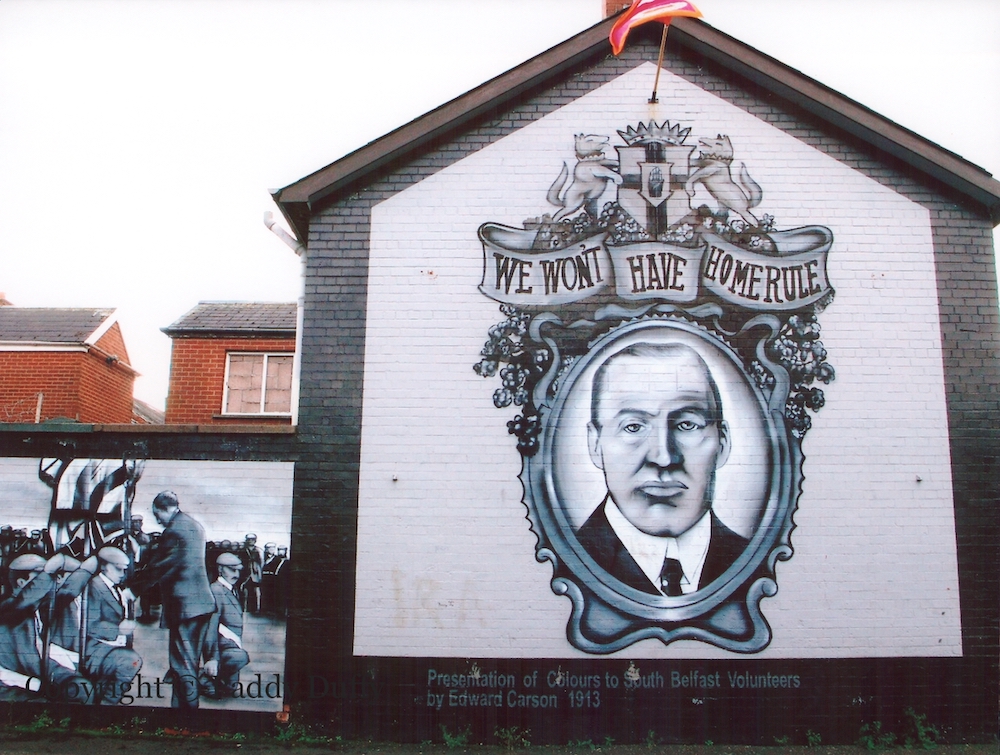
“Presentation of colours to South Belfast Volunteers by Edward Carson 1913.” According to the Digital Repository Of Ireland, however, the scene depicted is Carson and the Central Antrim Volunteers in 1914.