The board on the left includes a quote from Séamus Ó Conghaıle [James Connolly] from a 1916 piece entitled The Irish Flag, extolling the “cause of labour” as the cause of Ireland (alongside a quote from Pádraıg Mac Pıaraıs [Patrick Pearse] and portraits by Jim Fitzpatrick (Revolutionaries)).
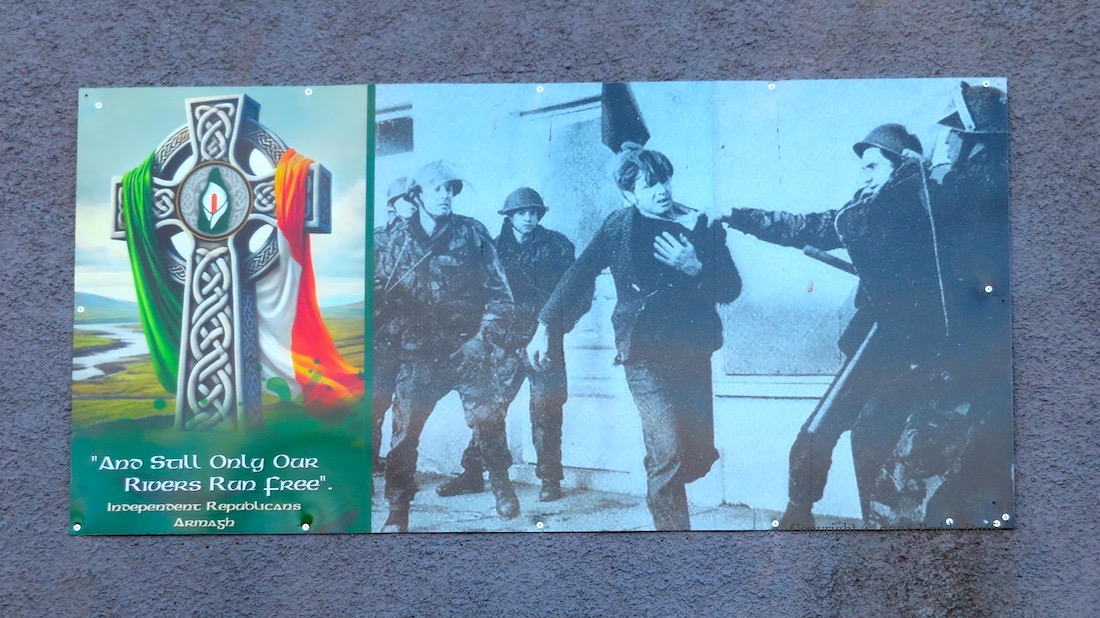
The board on the right, from “Independent Republicans Armagh” – of a Celtic cross draped with a Tricolour – was generated by AI.
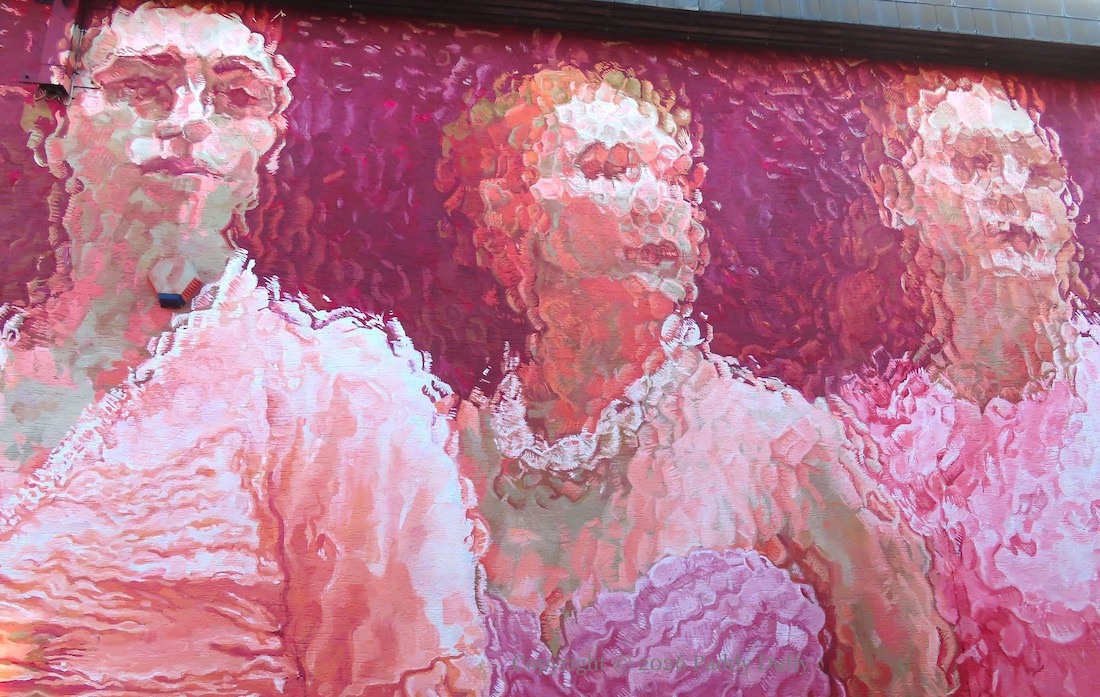
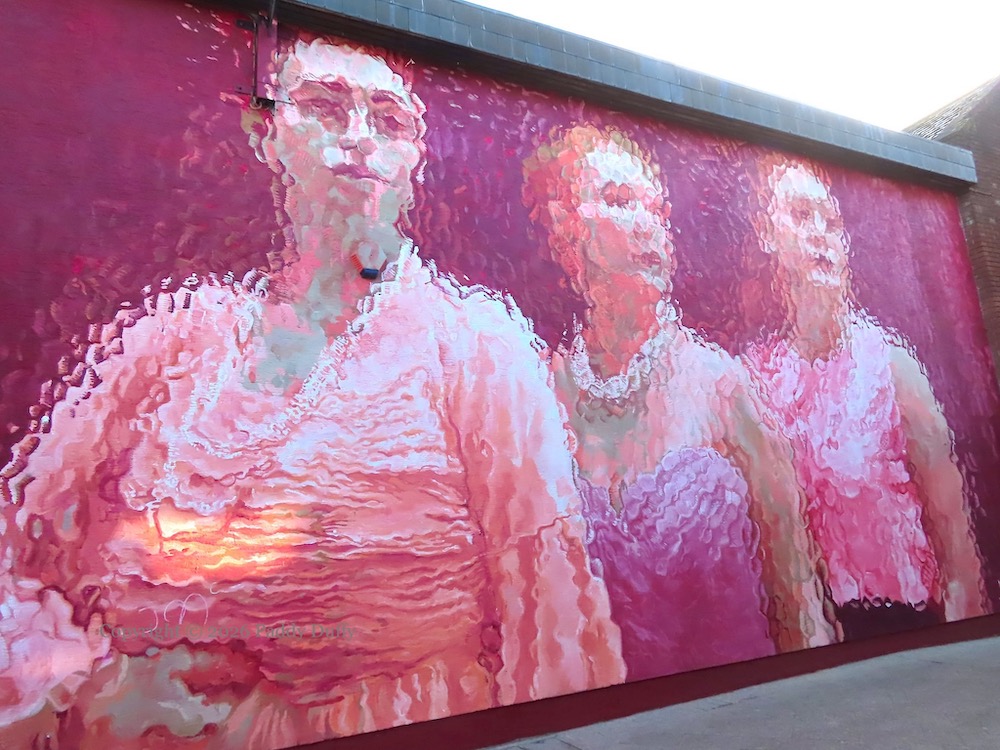
This is a piece of Fintan Magee street-art in the centre of Armagh, showing three singers at a 1950’s talent show in the Tontine Rooms (History Armagh). For the source photograph, see Magee’s instagram post. With support from Armagh City, Banbridge, and Craigavon borough council.
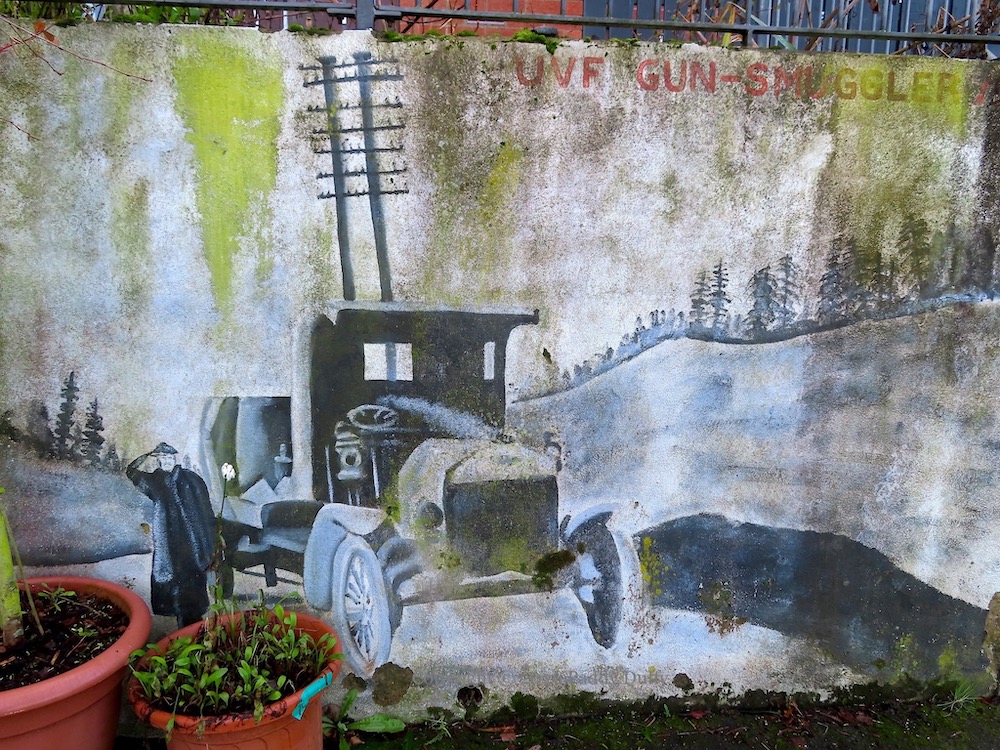
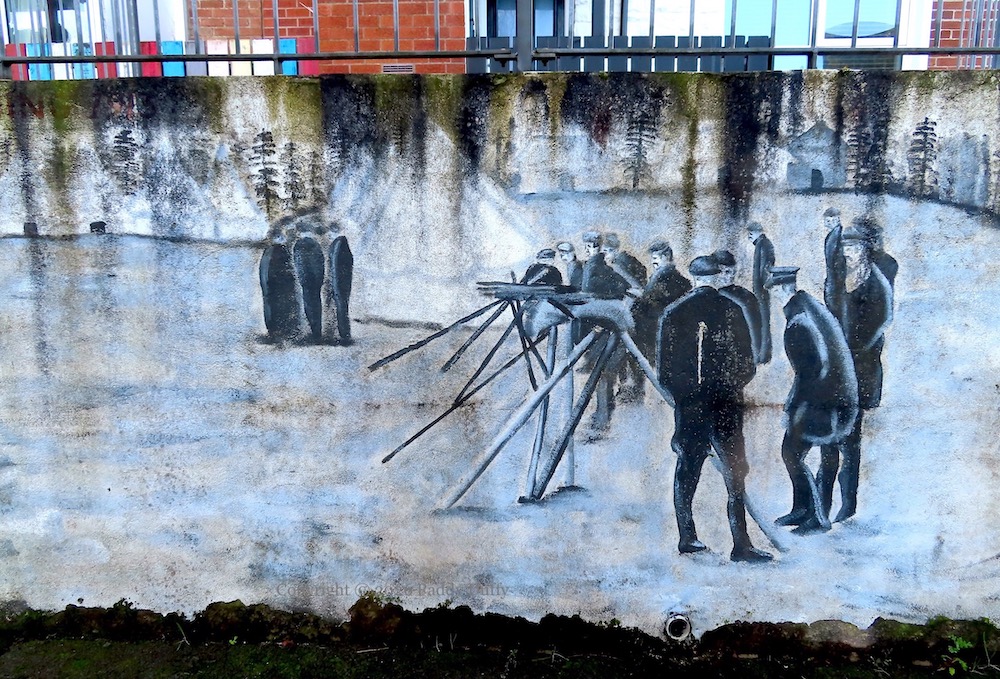
These faded Armagh murals have the titles “UVF Gun-Smuggler 1913” and “Arms Training 1913”.
The gun-smuggling mural features not the 1914 gun-running on Clyde Valley – the ship that brought in the weapons and ammunition into Larne – but a motor-car. There was earlier gun-running or bulk gun-purchasing – 175 rifles were bought from Harrods by the Earl Of Lanesborough and sent to Enniskillen (Balaclava Street) and 500 rifles were brought from Manchester in August 1913 (Irish Bayonets). (See also History Ireland.) These perhaps used automobiles for distribution, and the Larne gun-running is described as the first time that the horseless carriage was used in a military operation – there were about 350 vehicles in the “Motor Car Corps” (Angelsey p. 3).
The location of the car, and of the ‘arms training’ in the second mural, are unknown. Here is a 1914 image (Getty) showing tents and a single machine-gun at Ballywalter. The sources of both paintings are unknown.
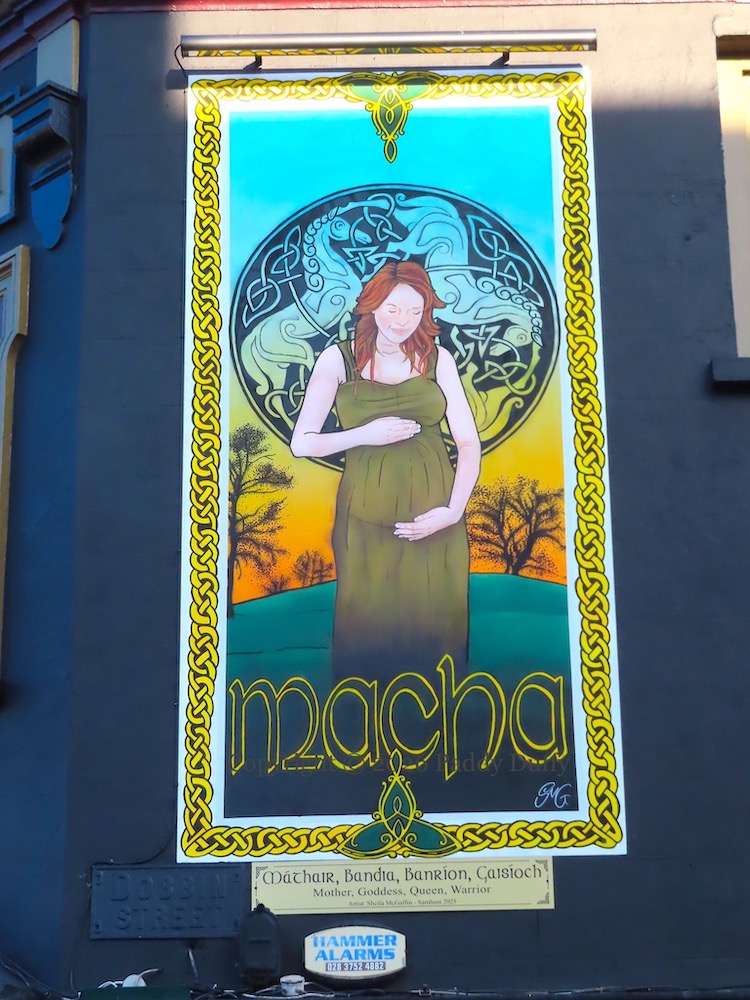
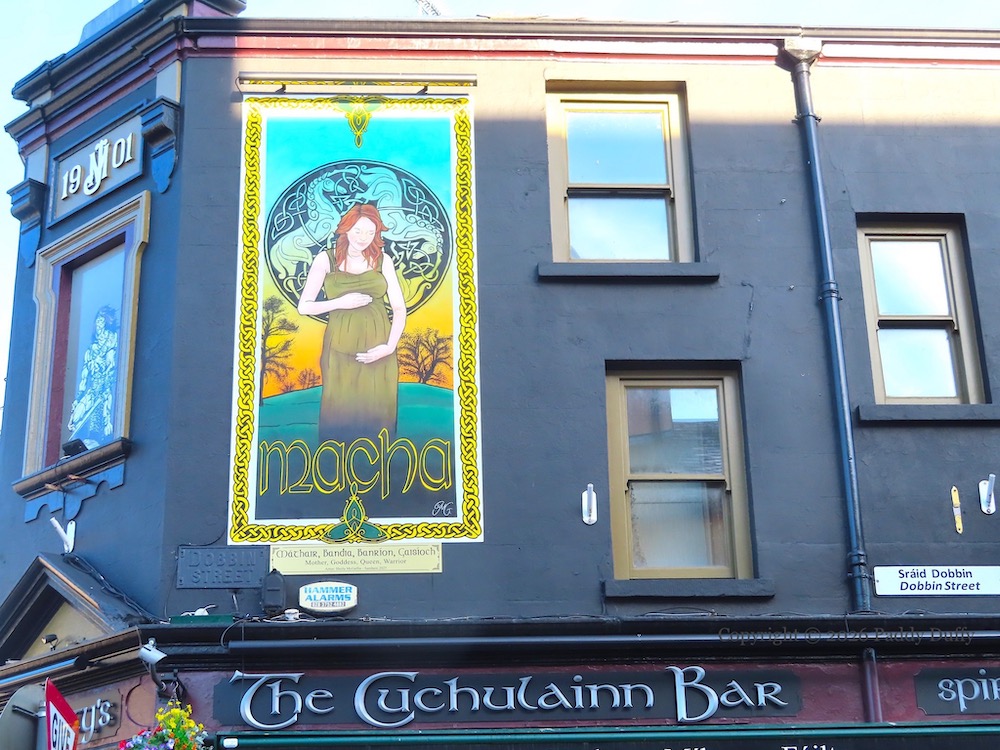
“Macha – máthaır, bandıa, banríon, gaıs[c]íoch/mother, goddess, queen, warrior.” Armagh is named after Macha, who is shown here pregnant against knot-work of three interwoven horses. In one story about Macha, she wins a race against the horses of Connor, the king of Ulster, even though she is pregnant. The race caused her to give birth and she cursed the men of the Red Branch for nine generations, which would leave them all – except for Cú Chulaınn – unable to fight to the forces of Medb (Visual History).
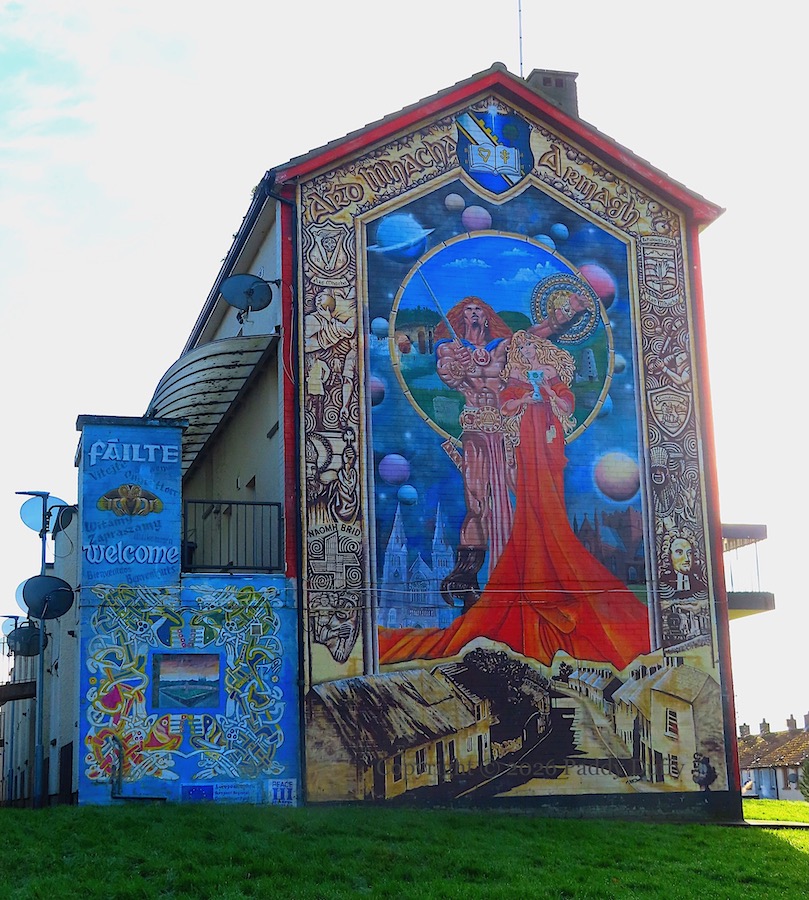
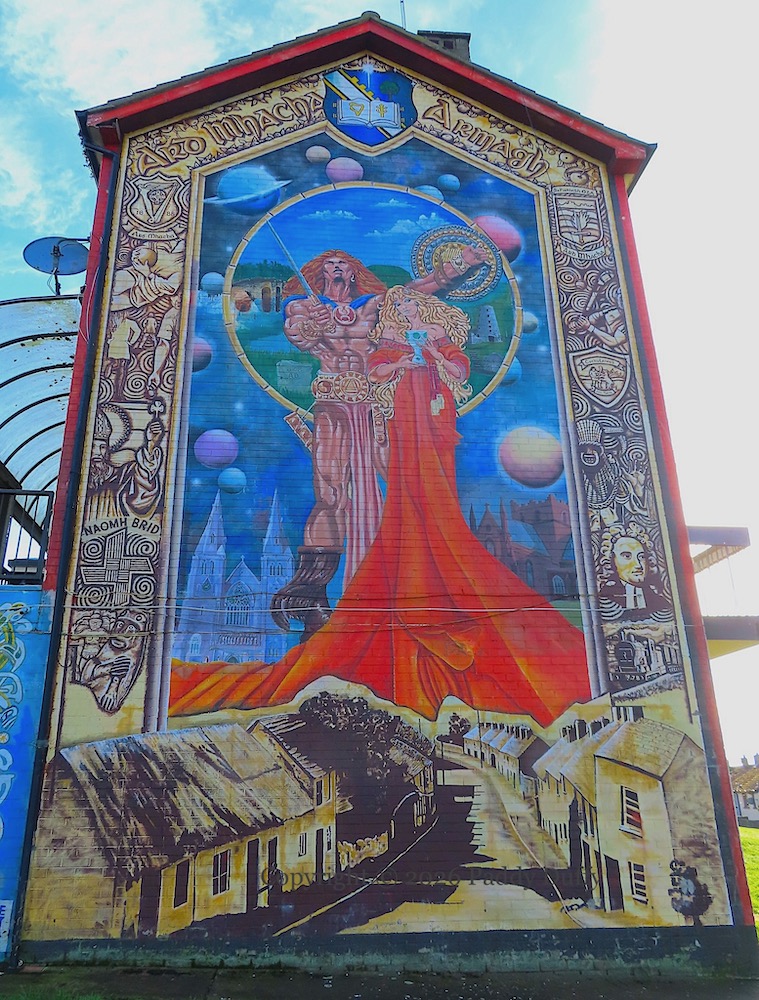
This is a mural of King Niall (Nıall Caılle, Niall of the Callan) and Queen Macha. Niall was high king of Ireland (in competition with Fedelmıd of Munster WP) who held off the Vikings in the late 800s (WP) and died in 846 by drowning in the Callan river. Macha is a much earlier and mythological queen, and gives her name to the town: Ard Mhacha.
The central figures reproduce paintings by Jim Fitzpatrick (Visual History). The Niall figure comes from Nemed The Great but the Macha figure comes from a label Fitzpatrick produced in 1988 for Rosc “mead”, even though Macha (one of them, at least) was the wife of Nemed and there is a female figure in Nemed The Great.
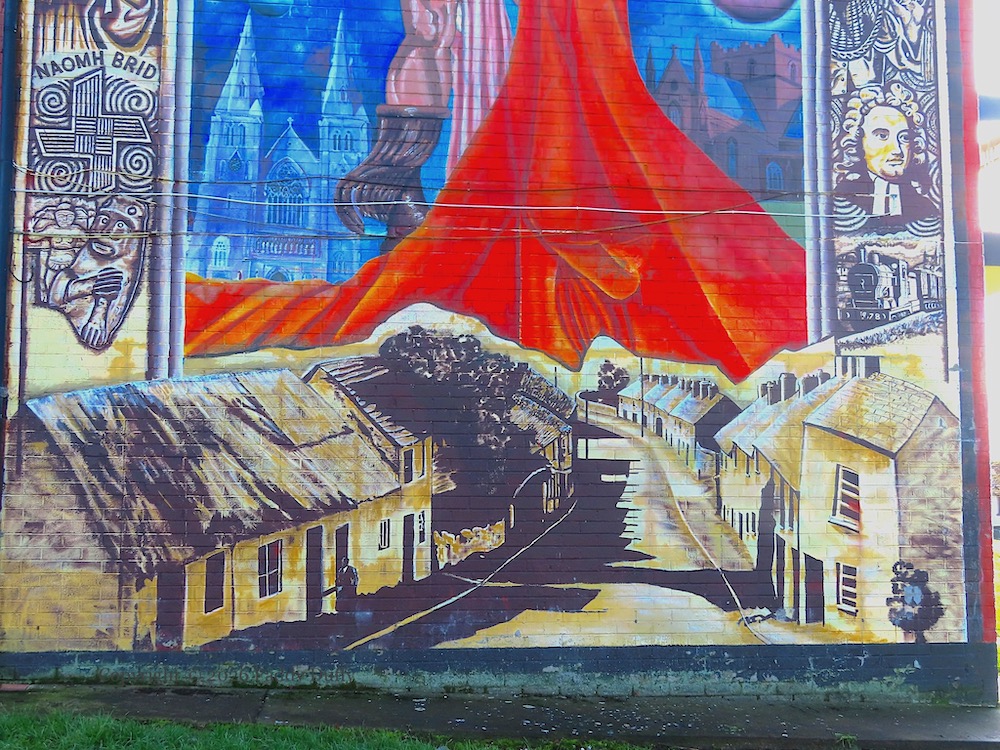
Below the planets and stars, St Patrick’s (Catholic) Cathedral is on the left (WP) and St Patrick’s (CofI) Cathedral is on the right (WP).
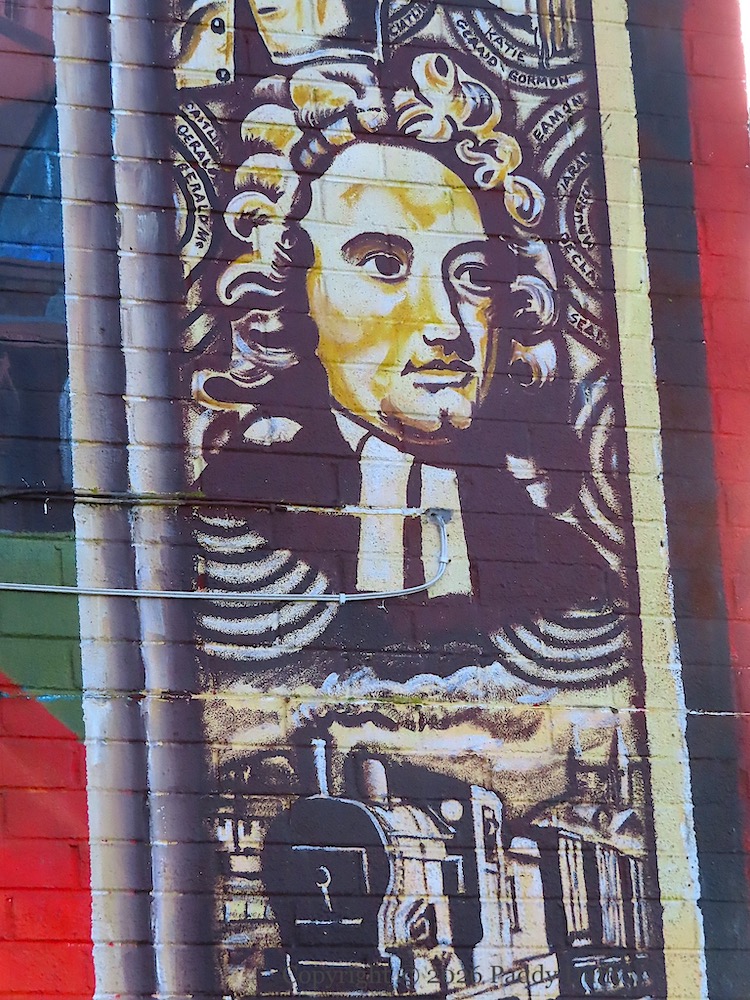
In the border, clockwise from left to right, we see: the Tandragee Idol (WP), Naomh Bríd/St Brigid’s, St Patrick preaching the trinity, Irish dancing, Gaelic football, Armagh Harps, “Ard Mhacha”, the Armagh county crest in colour in the apex (Club & County), “Armagh”, Na Pıarsaıgh Óga, hurling/camogie, Cú Chulaınn’s, mummers (perhaps specifically the Armagh Rhymers), Jonathan Swift, a steam locomotive (perhaps representing the Armagh rail disaster of 1889, in which 80 people died WP); a vintage image of Callan Street is depicted along the bottom (History Armagh).
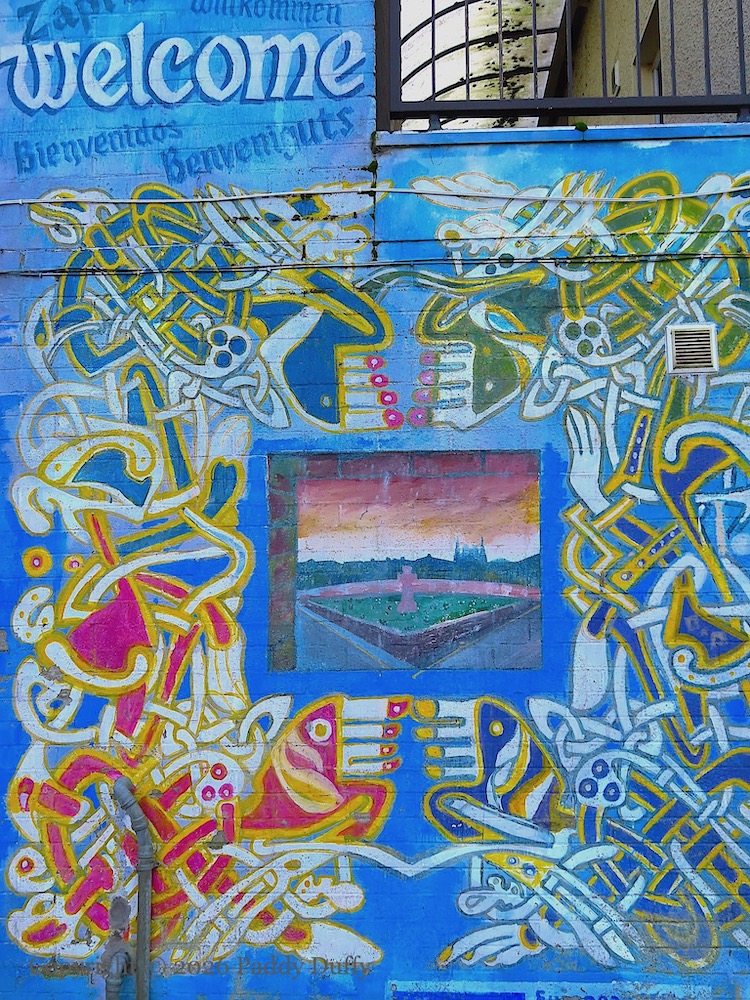
The side-wall features the word “welcome” in many languages, and Celtic knot-work surrounding an image of the Celtic Cross below St Patrick’s, perhaps inspired by this 1903 photograph (Flickr).
Painted by a crew of Belfast artists – Danny D and Mark Ervine, along with Lucas Quigley, Marty Lyons, Micky Doherty – and organised by the Callan Street Residents’ Association, with funding from the European Union’s Peace III initiative.
The photograph on the right is real: it shows British troops collaring a civilian in Coalisland in December 1971 – photographer unknown. The image on the left – a Celtic cross draped with a Tricolour – is AI slop. The first (or at least, an early and prominent) use of AI to produce images was Stop The Slaughter In Gaza from November 2023, and it is becoming more frequent in printed boards and wall-painting.
“”And still only our rivers run free” [youtube] – Independent Republicans Armagh [Fb]”
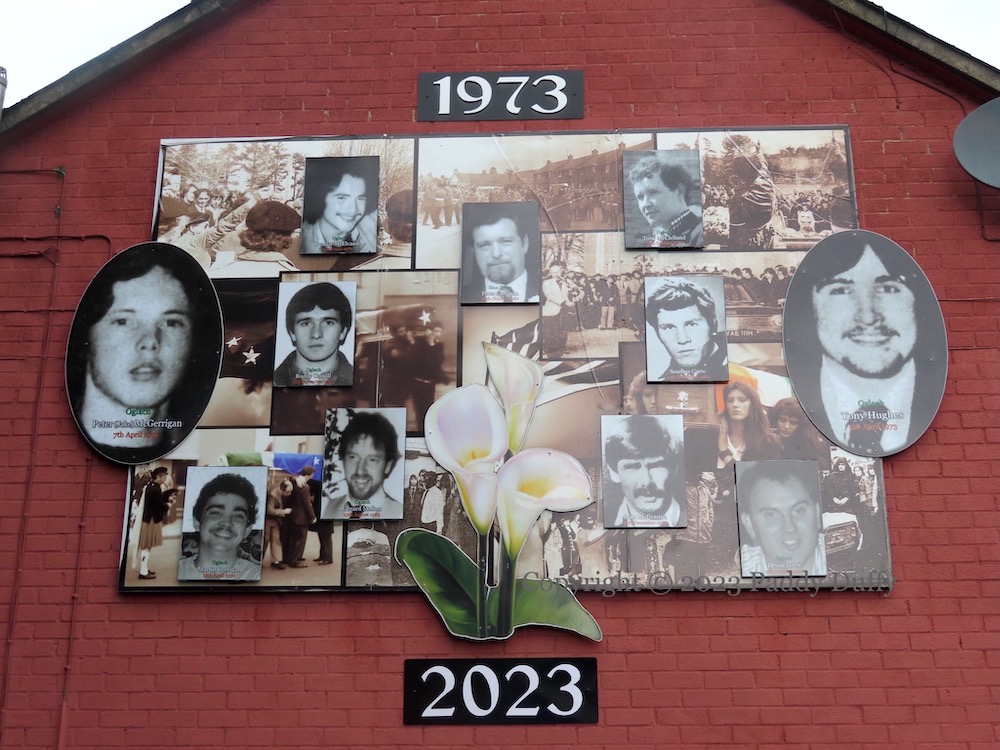
Jake McGerrigan and Tony Hughes of the OIRA were both shot and killed by British forces in the Windmill Hill area of Armagh in a 48-hour period spanning April 7th and 9th, 1973. (Lost Lives #791 incorrectly gives March 7th for McGerrigan.) The board shown above was mounted in Navan Street for the 40th anniversary of their deaths, in 2013, and the lower date has now been updated for the 50th anniversary.
The larger portraits on either side are of McGerrigan and Hughes; between them are (left) Peadar McElvanna, Roddy Carroll, Gerard Mallon, Martin Corrigan, (middle) Peter Corrigan, (right) Tony McClelland, Seamus Grew, Sean McIlvanna [McIlvenna], Dessie Grew.
There is an individual plaque to Hughes (shown immediately below) at the spot where he was shot and a stone (shown below; for text see McGerrigan – Hughes) to both of them in the same alley; there is also a stone (not shown) to McGerrigan in Windmill Avenue. (Video of Jake McGerrigan’s funeral.)
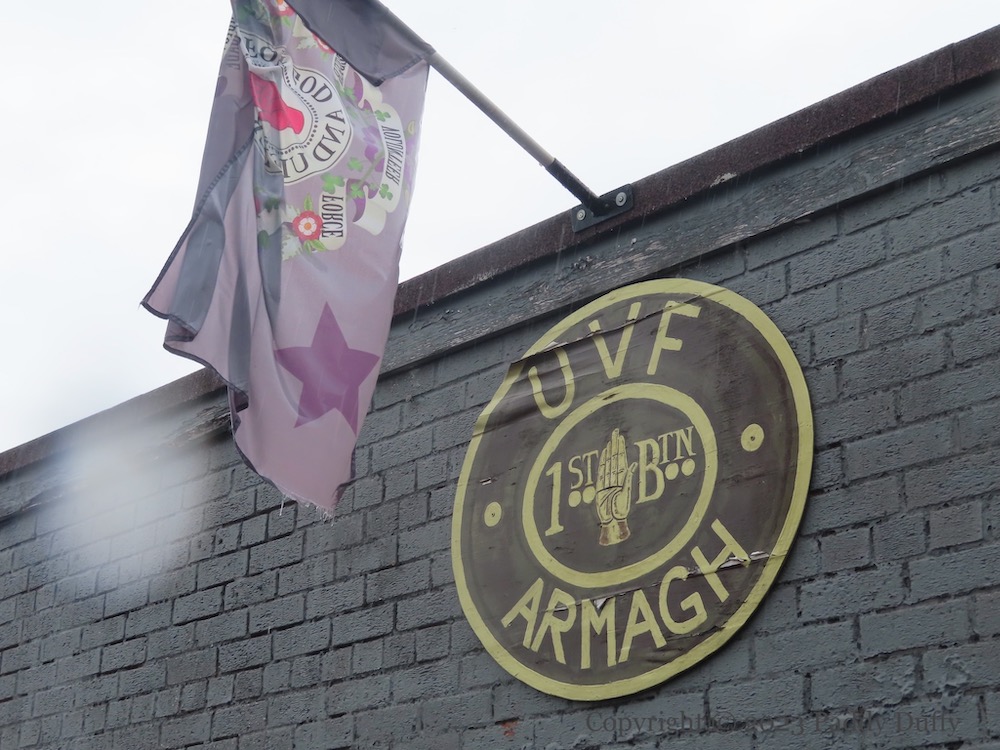
These two boards from the Armagh True Blues flute band (Fb) in Barrack Hill commemorate the Ulster Volunteers of 1912 who went on to join the 9th (County Armagh) battalion of the Royal Irish Fusiliers (Wartime Memories).
The “1st batt” emblem (in the third image) applies to both the Ulster Volunteers of the Home-Rule era and the Troubles-era Mid-Ulster UVF.
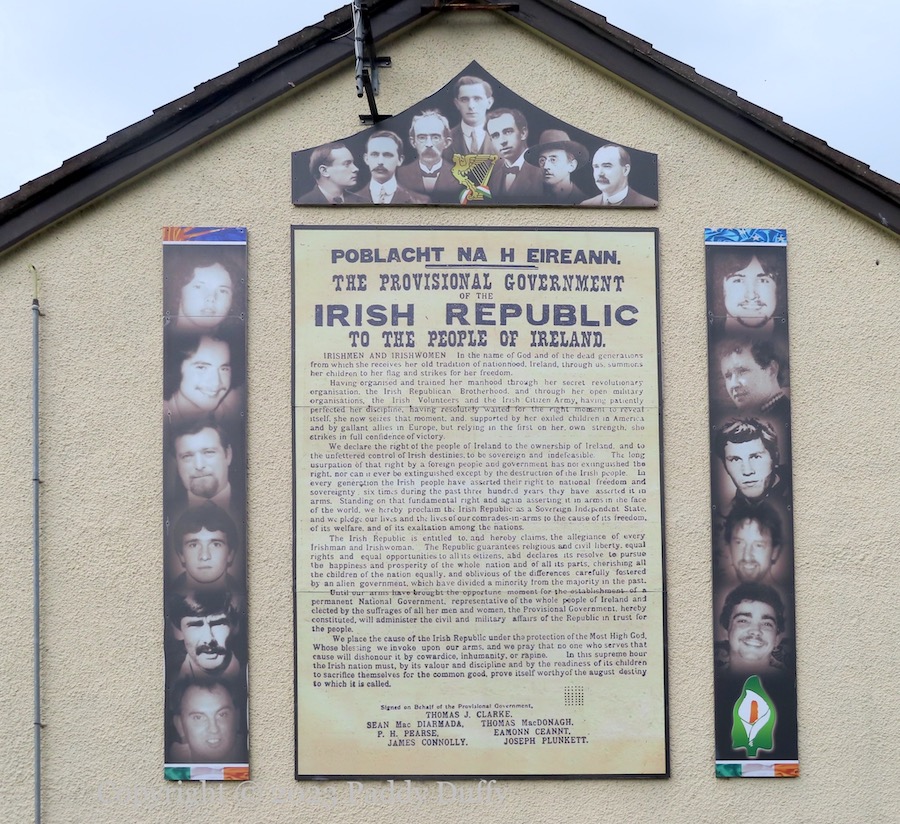
Quotations from Pádraıg Mac Pıaraıs [Patrick Pearse] and Séamus Ó Conghaıle [James Connolly] are super-imposed upon an Irish-language version of the 1916 Proclamation. From Mac Pıaraıs: Ní [h]amháın saor ach Gaelach chomh maıth; ní [h]amháın Gaelach ach saor chomh maıth [not merely free but Gaelic too; not merely Gaelic but free too]; from Ó Conghaıle: “The cause of labour is the cause of Ireland, the cause of Ireland is the cause of labour’ (from ‘The Irish Flag’ 1916).
The portraits might well be by, or based on, prints by Jim Fitzpatrick (Revolutionaries).
In the apex of the gable are the seven signatories to the 1916 Proclamation — all of whom were executed after the rising — and to the left and right of the text of the Proclamation are IRA dead from 1973 to 1990.
Left, top to bottom: Jake McGerrigan, Peadar McElvanna, Peter Corrigan, Roddy Carroll, Sean McIlvanna [McIlvenna], and Dessie Grew.
Right: Tony Hughes, Tony McClelland, Seamus Grew, Martin Corrigan, and Gerard Mallon.





 Paddy Duffy Collection