A Tale Of Ireland

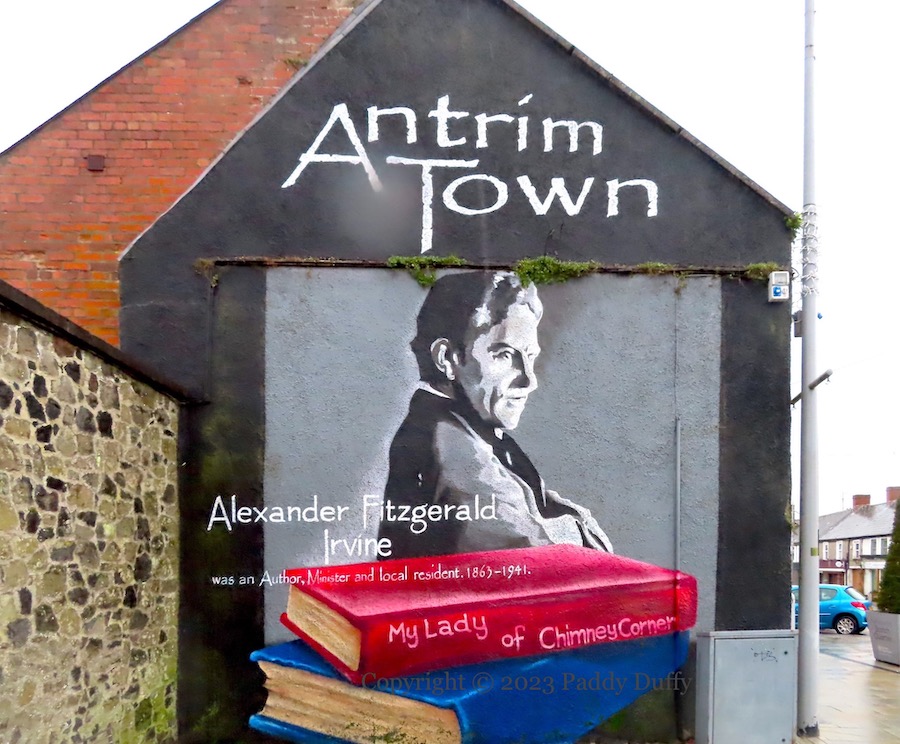
“Alexander Fitzgerald Irvine was an Author, Minister and local resident [of “Antrim Town”] 1863-1941.” The family home where he was raised was in Pogue’s Entry, now a museum and site of the blue plaque, below, outside which sits the mural above (paid for by Lidl) (Antrim Guardian). (ITV video of the house from 1960 and 1963.)

Irvine worked in Belfast and Scotland before joining the Royal Marines. He moved to the United States in 1888, graduated from Yale and was ordained, took up various ministerial positions in the US, and became a social radical over time (Irish Biography). Irvine died in Hollywood, California; his collection of autographs and letters from 77 famous figures is held by the University Of California.

He is best known as an author and playwright. The book on top of the pile is the best-seller My Lady Of [The] Chimney Corner (pdf), an autobiographical book about “Irish peasant life” written in 1913 in tribute to his mother, who had not lived to see his military successes.

Click image to enlarge
Copyright © 2023 Paddy Duffy
T03719 [T03718]

Botanical Borough

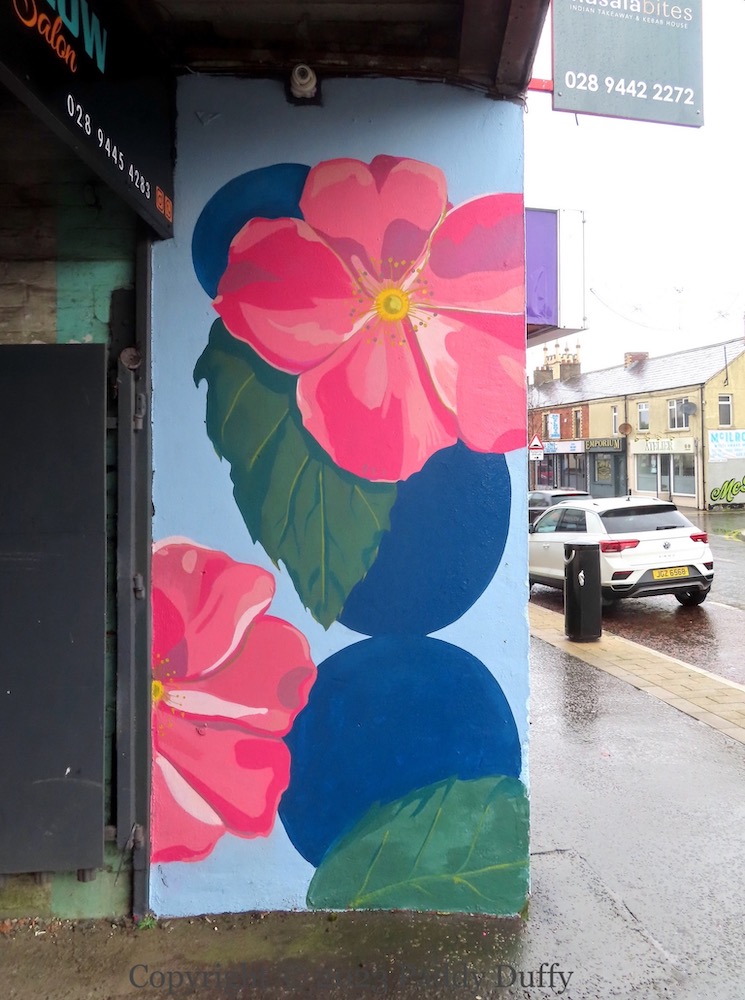
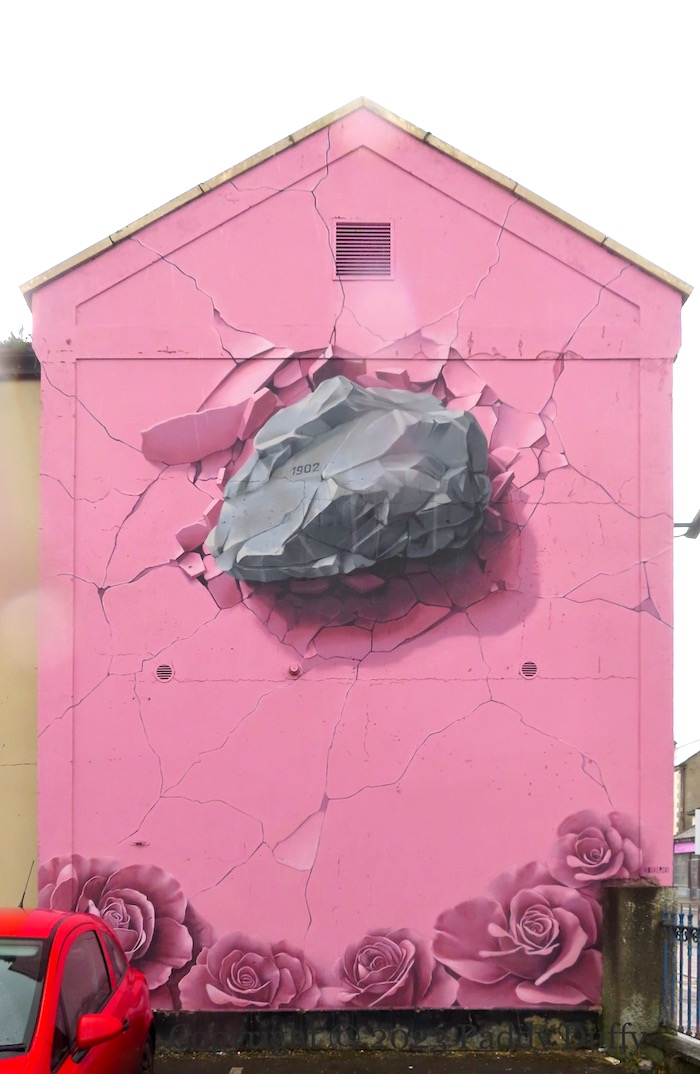
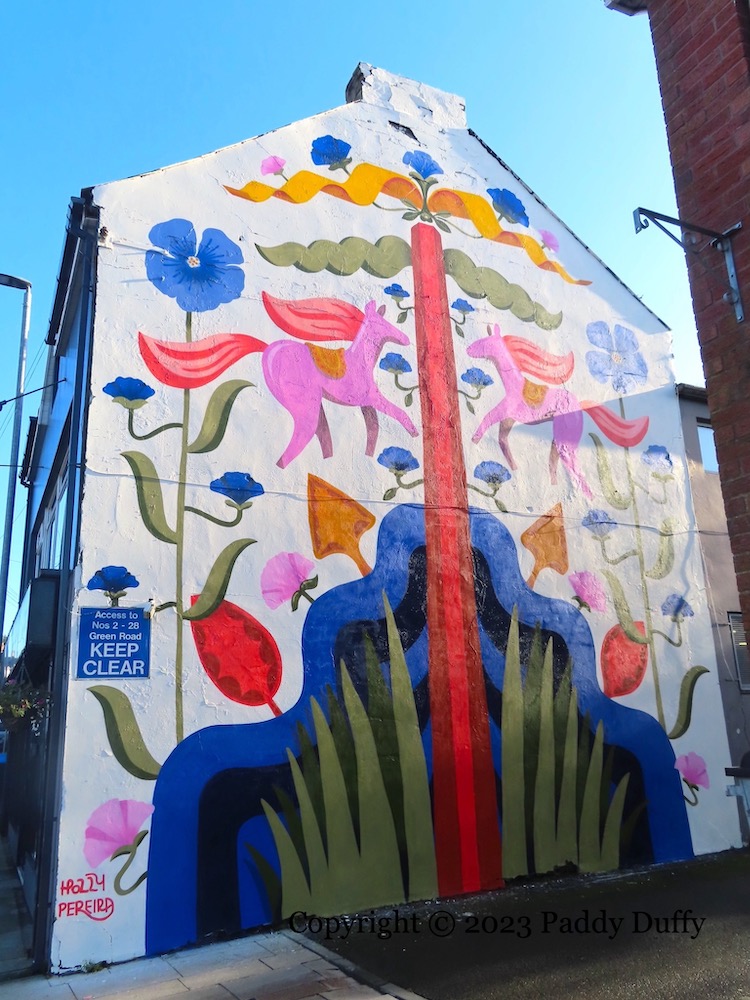
Here are the pieces painted for the Antrim and Newtownabbey Borough Council’s ‘Botanical Borough’ project (BelTel), co-orindated by Daisy Chain (web). There are seven pieces by Hixxy (ig), one of a flower chosen by each of the seven different electoral areas of the Borough, in the towns of Randalstown, Antrim, Crumlin, Ballyclare, Whiteabbey, Monkstown, and Glengormley, with an additional piece in four of the towns by other aritsts.

Above is a flax flower by Hixxy in John St, Randalstown. Immediately below are bluebells by Hixxy and Andy Council at the library in Railway St, Antrim. The others follow.

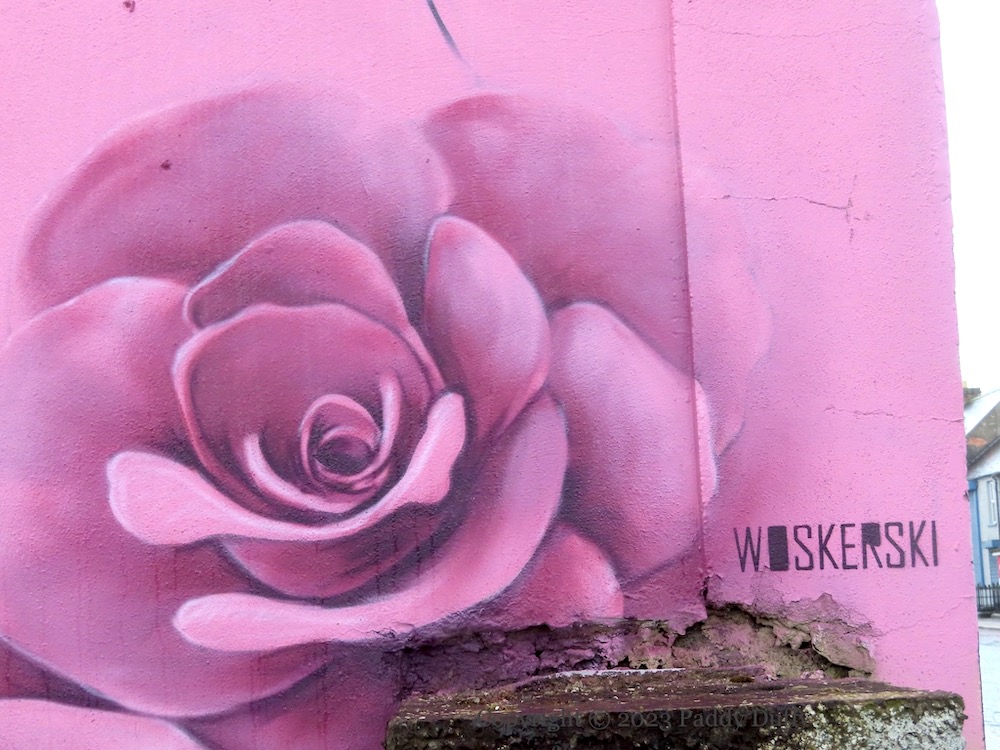
Wild Roses by Hixxy and Woskerski on Main St, Crumlin

Flax flowers by Hixxy and Holly Pereira (with horses) in Ballyclare

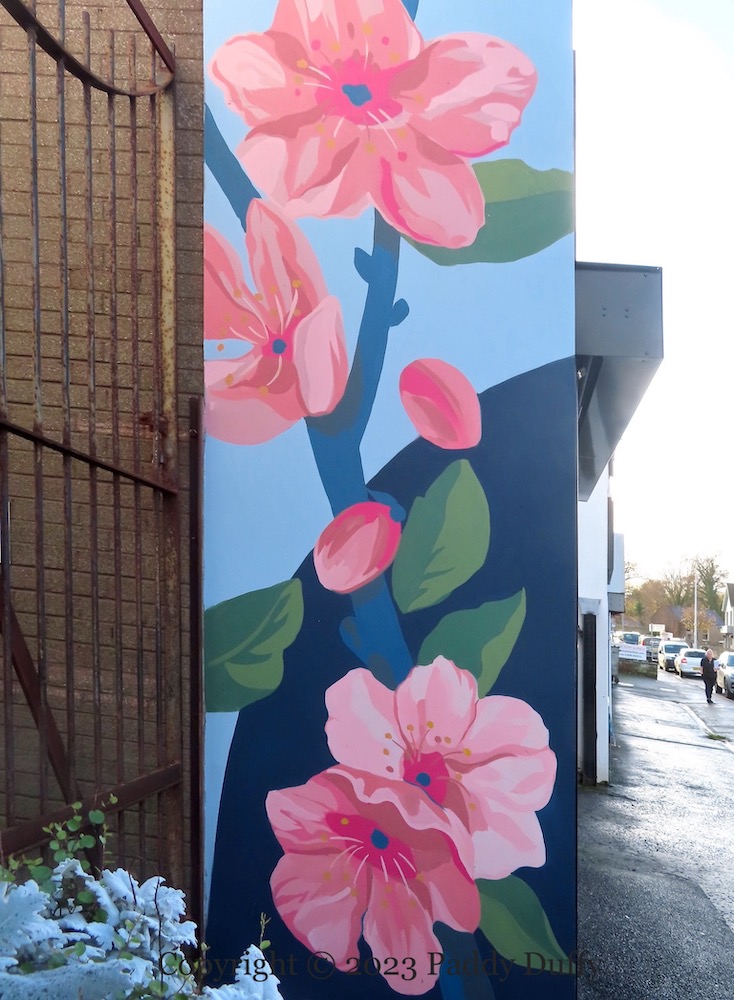
Cherry Blossom by Hixxy next to the Six Three One Cafe in Whiteabbey

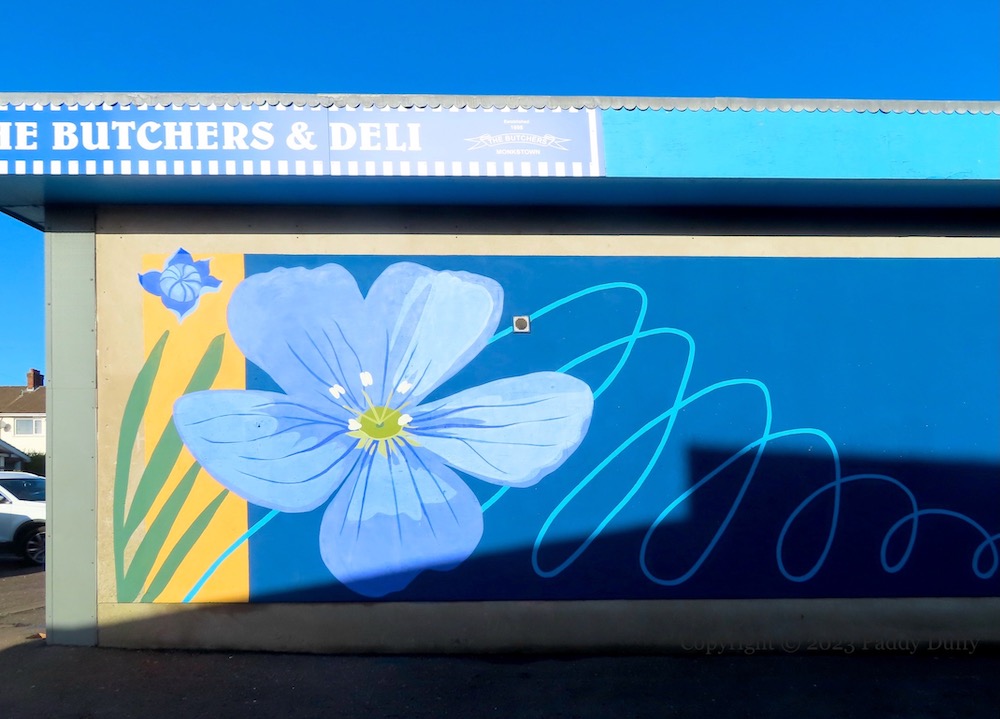
Flax by Hixxy at The Butchers & Deli in Monkstown

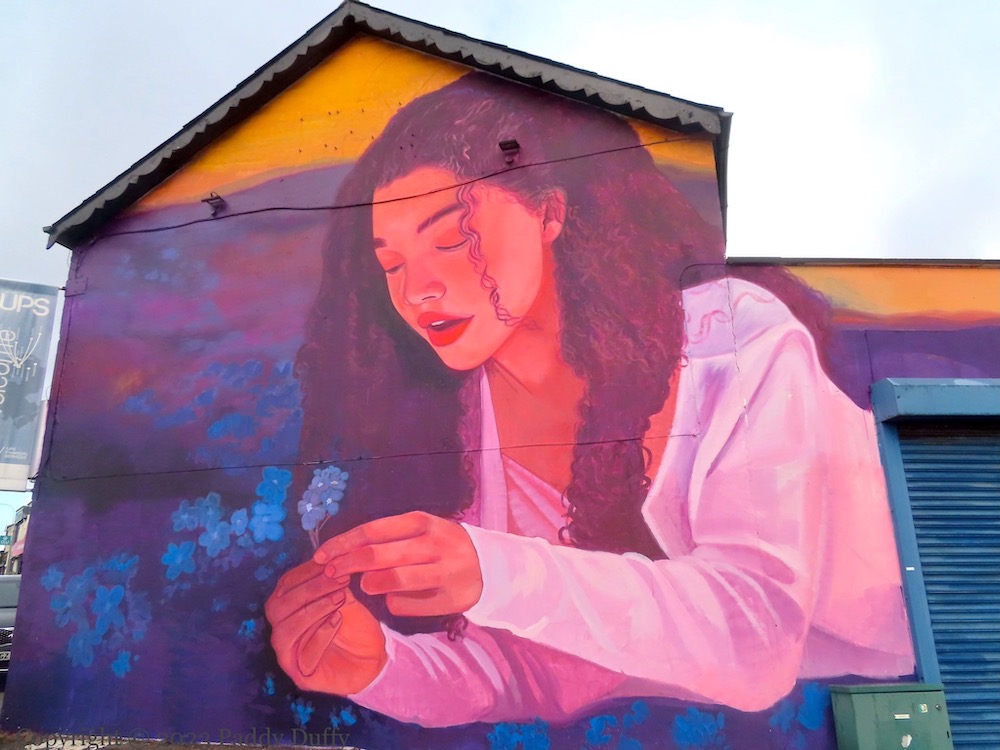
Forget-Me-Nots by both Hixxy, at the Lilian Bland Community Park, and Kitsune, on the Antrim Rd, Glengormley

Click image to enlarge
Copyright © 2023 Paddy Duffy
T03711 [T03712] [T03713]
T03717 [T03716]
T03715 [T03714]
T03730
T03733 [T03731]
T03732
T03684 [T03685]
T03683 [T03681]
T03682c
T03672
T03688
T03692 [T03693]
T03600 [T03601] [T03602]

We Will Reorganise

“Ulster Special Constabulary 1920-1970. The Ulster Special Constabulary (USC; commonly called the “B-Specials” of “B Men”) was a quasi-military reserve special constable police force in what would later become Northern Ireland. It was set up in October 1920, shortly before the partition of Ireland. It was an armed corps, organised partially on military lines and called out in times of emergency, such as war or insurgency. It performed this role most notably in the early 1920s during the Irish War of Independence and the 1956-1962 IRA Border Campaign.

During its existence, 95 USC members were killed in the line of duty. Most of these (72) were killed in conflict with the IRA in 1921 and 1922. Another 8 died during the Second World War, in air raids or IRA attacks. Of the remainder, most died in accidents but two former officers were killed during the Troubles in the 1980s. [The WP page from which this text is drawn at this point goes on to talk about Catholic mistrust of the Specials.] The Special Constabulary was disbanded in May 1970, after the Hunt Report, which advised re-shaping Northern Ireland’s security forces [to attract more Catholic recruits] and demilitarizing the police. Its functions and membership were largely taken over by the Ulster Defence Regiment and the Royal Ulster Constabulary.

[Accompanying the small photograph:] At the Twelfth demonstration at Finaghy, Sir Edward Carson, the unionist leader, deploring the state of the county, advised the government: ‘If … you are yourself unable to protect us from the machinations of Sinn Fein … we will take the matter into our own hands. We will reorganise [the Ulster Volunteers]’.” [From a NewsLetter article ‘USC Helped Establish Peace In Early Years Of NI’]

Carson’s quote is also used in a Belfast UVF mural. As is noted there, the speech is probably from the 12th of July – Treason Felony | RTÉ – and concerns the reformation of the Ulster Volunteers as a force to protect Protestant interests in the north of Ireland in light of the proposal in the (fourth) Home Rule bill to create separate northern and southern states.

Parkhall Road, Antrim

Click image to enlarge
Copyright © 2023 Paddy Duffy
T02584 [T02585]

Pass Not This Spot In Sorrow

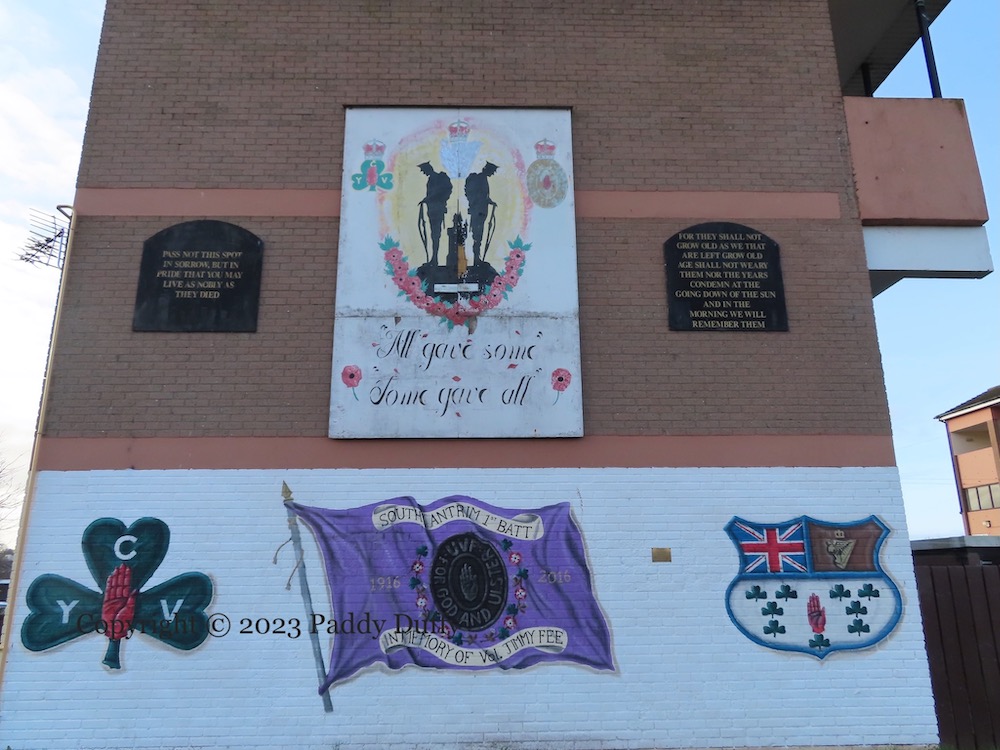
There has been a 36th Division board on this wall since 2003 (see Steeple Defenders) and this second one is now more than a decade old – see the 2013 post on Peter’s site. It is accompanied by two quotations:
“Pass not this spot in sorrow but in pride/That you may live as nobly as they died.” These lines are also used in a WWI memorial mural in Carlingford Street, Belfast.
“They shall not grow old as we that are left grow old./Age shall not weary them nor the years condemn./At the going down of the sun and in the morning, we will remember them.” from Binyon’s For The Fallen.

The mural below, with YCV and 36th Division emblems and a “South Antrim 1st Batt” flag was added in 2016. There’s no mention on-line of “Vol. Jimmy Fee” of the 1st (and only) battalion of the South Antrim brigade.

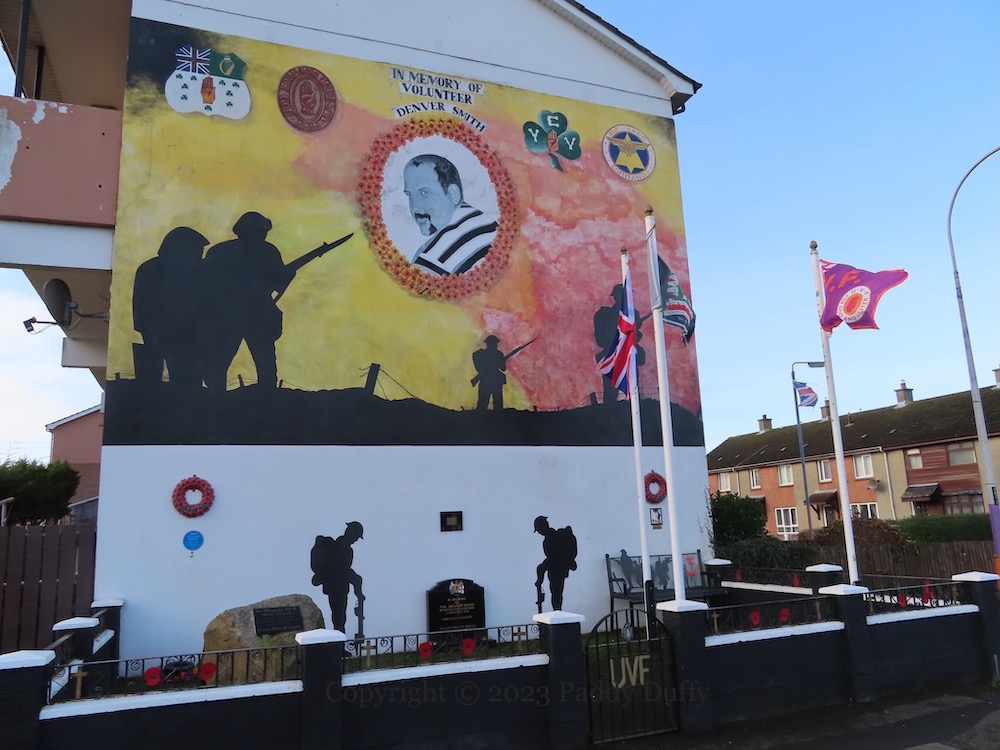
The board and mural are on the gable next to the Steeple memorial mural to Denver Smith; between the two gables is the UVF flag shown below.

Click image to enlarge
Copyright © 2023 Paddy Duffy
T01978 T01979 Parkhall Road all gave some some gave all thank you nhs

Fragments Of War

Ulster Tower in Thiepval, France, provides a background for 13 jigsaw pieces with partial images relating to the Great War, including a uniform with a Victoria Cross and badge of the 36th (Ulster) Division, the 10th (Irish) Division, the 16th (Irish) Division, and the Royal Irish Fusiliers (and a fourteenth piece for information).

Kilgreel Road, Antrim. The mural is more than a decade old and is bleached from the sun (the pinks were formerly brown); on the former site of The People’s Army (a UVF board).

“This artwork, commemorating the sacrifices made during the Great War and subsequent conflicts, was produced by the young people of Parkhall Youth & Community Club and was completed in 2010. It is part of a larger Re-imaging project undertaken by Parkhall Cultural Awareness Association & Parkhall Community Association.
14 jigsaw pieces are representated as that was the age of the youngest soldier to die on the Somme.
The Royal Irish Fusiliers, who recruited in the Antrim area, served with the 10th Irish Division and 36th Ulster Division during World War I. The cap badge is surrounded with poppies. The poppy is an international symbol commemorating the sacrifices of members of the armed forces and of civilians specifically since the Great War.
Birds were used extensively during World War I delivering important logistic message from the front line.
HMS Antrim served in the Great War and survived. After the war she became the first ship to be fitted with an experimental sonar system in 1920. Her bell can presently be viewed in Antrim Civic Centre.
The grounds of Shane’s Castle in Antrim were used as a training ground and a campsite for the 36th Ulster Division prior to their deployment to France.
Of all bell tents and parachutes during the Great War 90% were made from Irish Linen.
During the Great War a service man’s basic wage was one shilling a day (5 pence).
The sound of the bugle was heard throughout each day in the trenches, starting with Reveille to rouse you from slumber.
‘Flowers of the Forest’, a powerful Scottish lament, is often played by a lone piper at services of Remembrance.
“I am not an Ulsterman but yesterday, the 1st July, as I followed their amazing attack, I felt that I would rather be an Ulsterman than anything else in the world.” Extract from the speech by Captain Wilfred [Wilfrid] Spencer 2st July 1916.
Men from the 36th Ulster Division received 9 Victoria Crosses.
Women played a vital role in field hospitals during the Great War caring for the injured, from the front line.
The flags of the 16th and 10th Irish Divisions.
36th Ulster division.
The Ulster Tower is a memorial to the men of the 36th Ulster Division. It is situated near the entrance to Thiepval Wood, France.

Click image to enlarge
Copyright © 2023 Paddy Duffy
T01982

Parkhall UDA Remembers

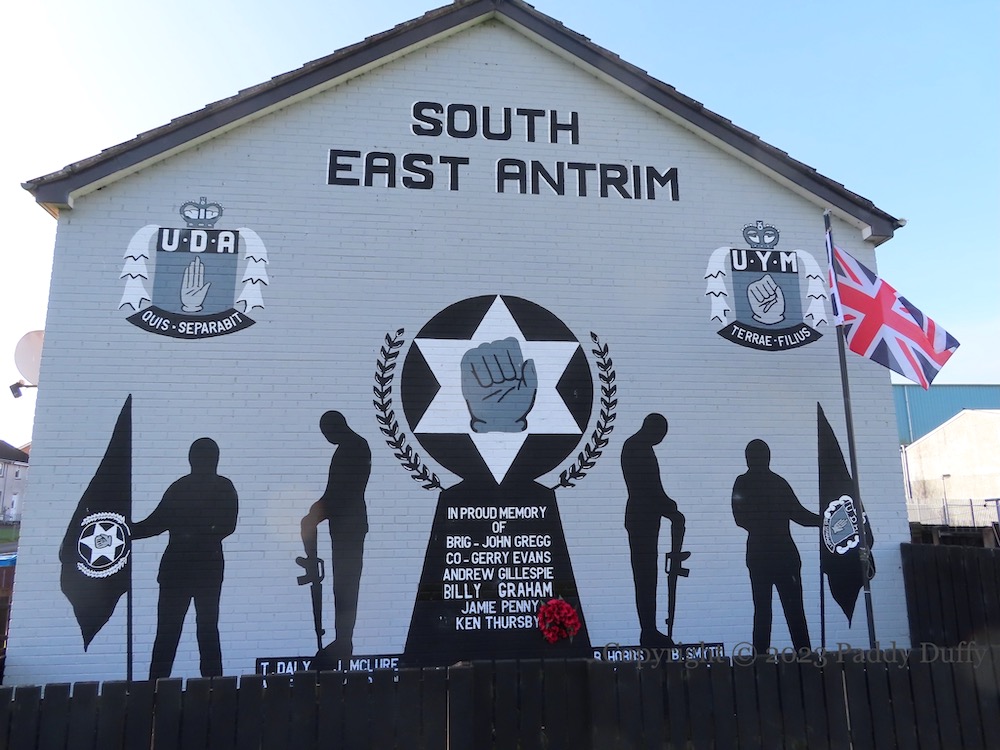
“South East Antrim UDA UYM. In proud memory of Brig John Gregg, CO Gerry Evans, Andrew Gillespie, Billy Graham, Jamie Penny, Ken Thursby, T. Daly, J. McClure, B. Hobbs, B. Smyth”. Graham replaces William Hutchings, and Thursby is a new addition. The original version of the mural, dating back to 2004, included J. Kelly, W. Gordon, G. Fittis, A. Helm (M05230) – these are perhaps below the fence-line.

Gregg was a hero to loyalists for seriously injuring Gerry Adams in 1984; he was killed in the Adair feud in 2003 (Guardian). Evans was killed by the INLA on April 27th, 1994, shot at his shop in the Northcott centre. (Lost Lives 3472. Sutton describes Evans as a “civilian”.) He was remembered first/long ago (1996) in a Cloughfern mural – see T00217.

Compare to the similar SEA UDA murals in Ballymena and (formerly) Glengormley.

Kilgreel Road, Parkhall, Antrim

Click image to enlarge
Copyright © 2023 Paddy Duffy
T01983 [T01984]

Here Lies A Soldier

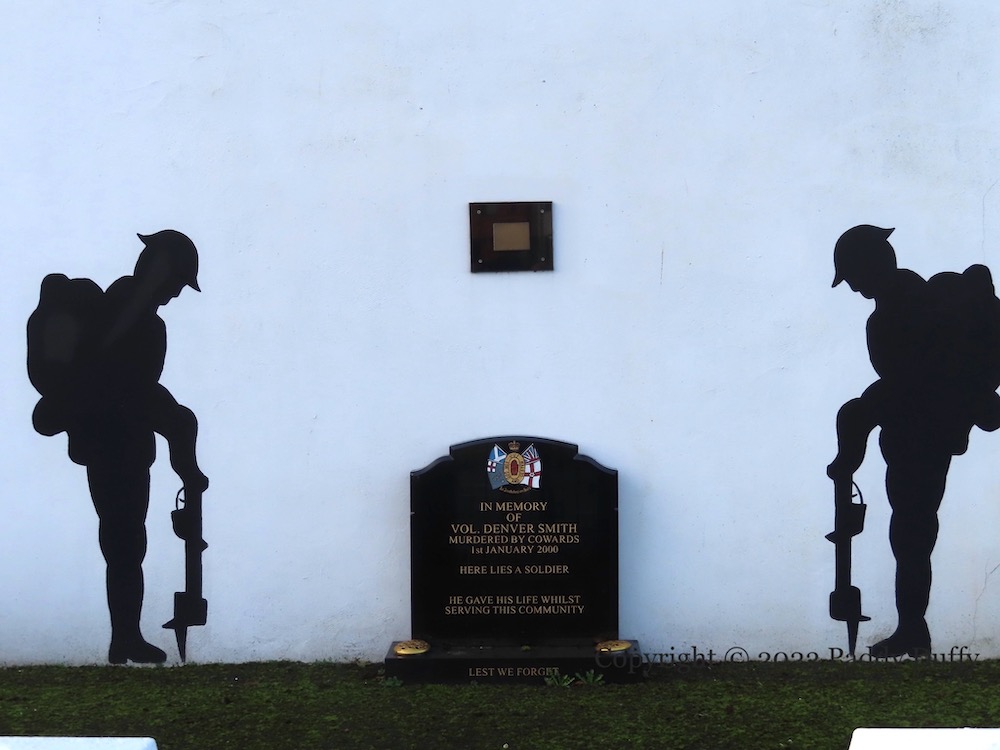
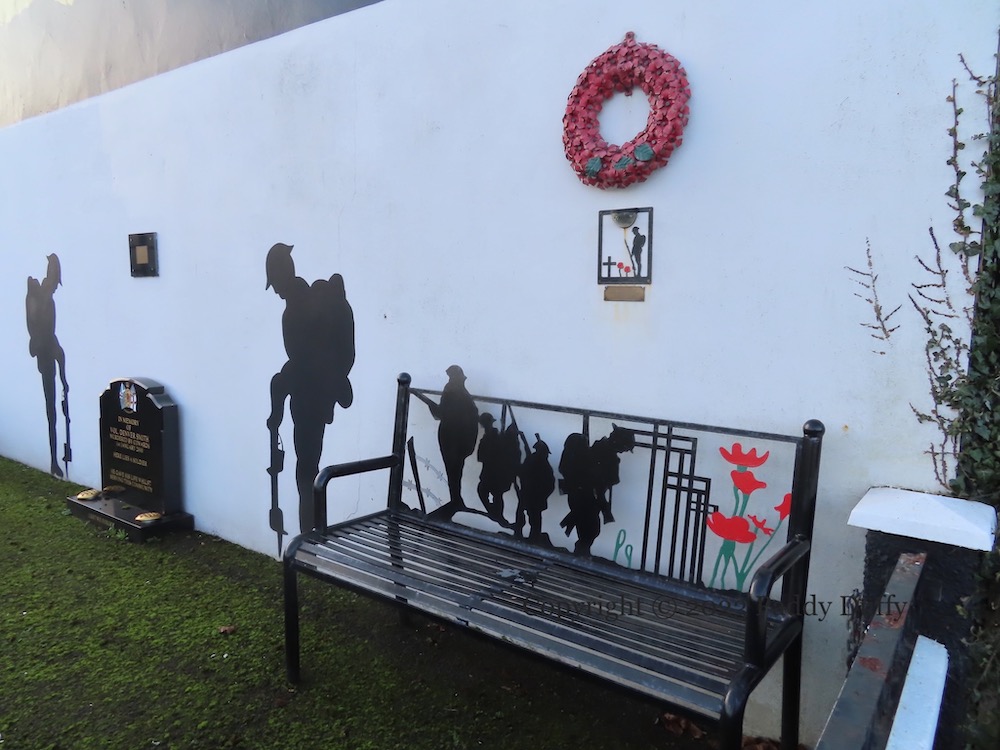
UVF volunteer Denver Smith was killed in the early morning of January 1st, 2000 by a gang of six men with machetes and pikes; the incident was perhaps drugs-related (Guardian | BBC-NI | Irish Times). The iconography, however, is all related to WWI, with soldiers moving across the fields of Flanders in the mural, above, and mourning by a graveside in the memorial garden, below.

Click image to enlarge
Copyright © 2023 Paddy Duffy
T01976 T01975 T01980

Lead The Way

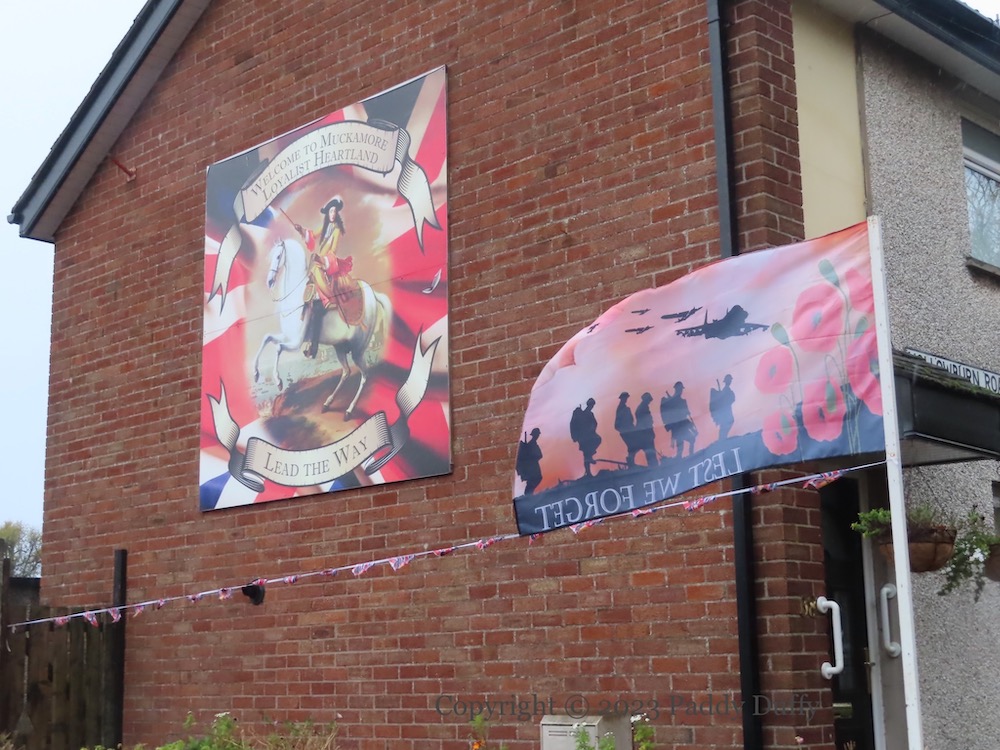
“Welcome to Muckamore, loyalist heartland – lead the way.” “In defence of our heritage and culture.”

In the Muckamore/Ballycraigy areas of Antrim the insignia of the LVF are still in place. “Lead the way” was the slogan of the LVF (see e.g. D01246 for a prominent instance in Ballycraigy). The organisation called a ceasefire and decommissioned some weapons in the years after the Agreement but persists in some form in Antrim (WP).

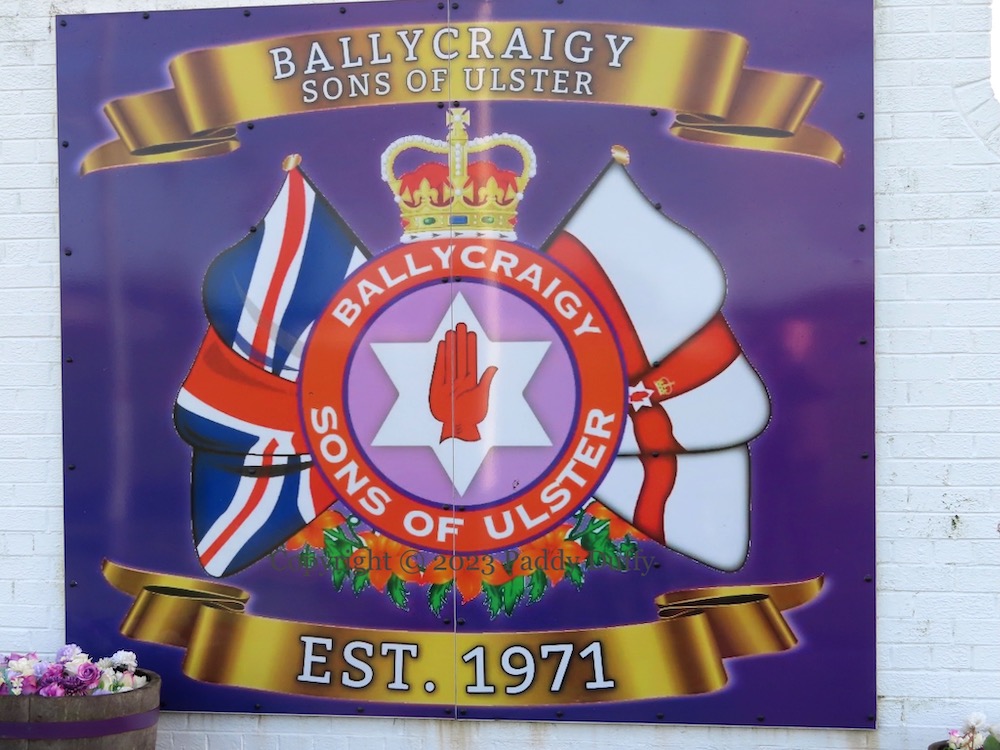
The Sons Of Ulster also used to use the slogan “Lead the way” (as described in J1947) but it is not present in the board shown in the recent (2022) Old Ulster’s Battle Cry.

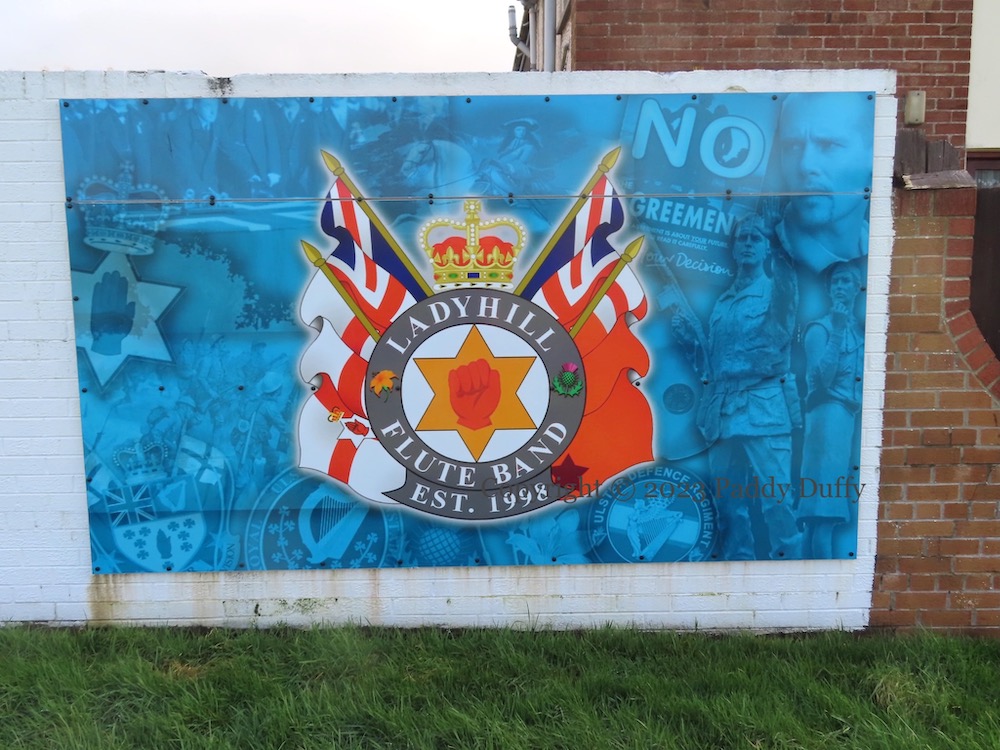
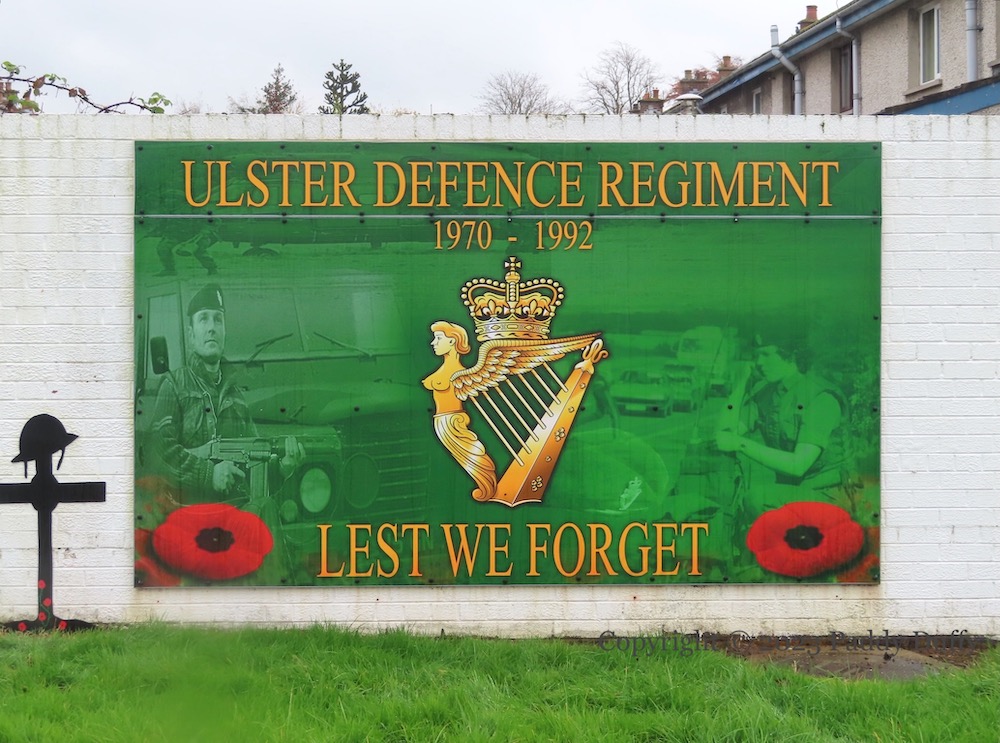
The two boards below are on gables above Woodgreen, which is the site of the bonfire (ig) featured in the third image. They used to claim that it was the biggest bonfire (see C06695) but Craigyhill (in Larne) is more recently the tallest – see Commonwealth Handling Equipment.

There is also a memorial garden to Billy Wright in Ballycraigy – see M05203.

Click image to enlarge
Copyright © 2023 Paddy Duffy
T01994 [T03725] T01985 T01986 Hollowburn Rd, Limetree Ave, Antrim

Ulster Volunteer Forces

On the front of the wall, soldiers from the 36th (Ulster) Division stop at a grave as they march through Flanders Fields; just around the corner (second image) is a memorial to a (modern) UVF member “Vol. D[avid] Langley, 1969-2018”.

For the previous Somme mural in this spot, see Steeple Defenders.

Click image to enlarge
Copyright © 2023 Paddy Duffy
T01973 T01974

Old Ulster’s Battle Cry

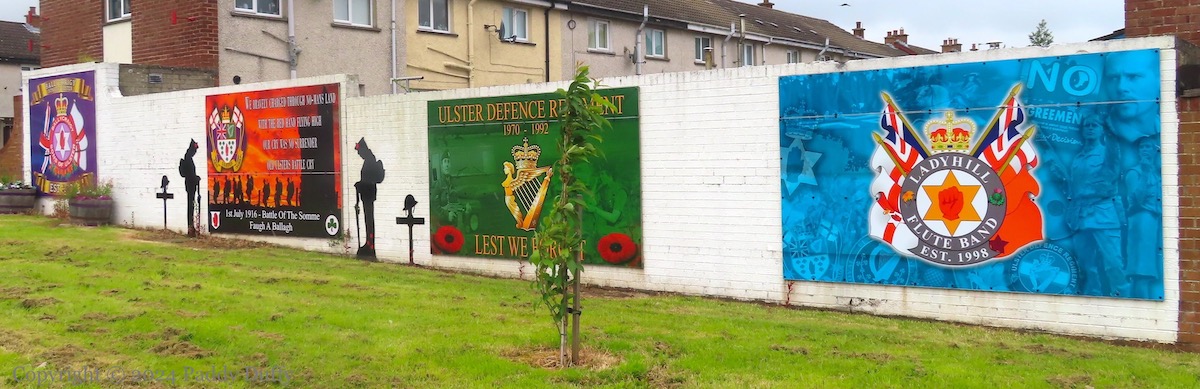
“‘We bravely charged through no-man’s land/With the red hand flying high/Our cry was ‘No surrender’/Old Ulster’s battle cry.’ 1st July 1916 – Battle Of The Somme. Faugh a ballagh.”

“No surrender” was the cry against the forces of James II as they marched on Derry on December 7th, 1688, a moment celebrated by members of the Orange Order, Royal Black Institution, and Apprentice Boys, and from there, possibly shouted on July 1st as the 36th Division, formed from the Ulster Volunteers, attacked Schwaben Redoubt from Thiepval Wood (Irish Times | History Ireland).

The red hand is the emblem of the 36th (Ulster) Division and the shamrock stands for the 16th (Irish) Division, which was not in action on July 1st (the Battle Of Albert) but at the Battle Of Ginchy and Battle Of Guillemont in early September (Long Long Trail). (See also various Messines 1917 murals: Killed Wounded Missing | Comrades In Arms | We Are The dead | Brothers In Arms | Messines 1917

“Faugh a ballagh” is also included; of the regiments who supplied battalions for the 36th Division, only one – the Royal Irish Fusiliers – used that motto, the 9th battalion of the RIF was raised from the Armagh, Monaghan, and Cavan Volunteers. The motto of the Royal Irish Rifles (who supplied 8 of the 12 battalions of the 36th), and later of the UDR, was “Quis separabit”. “Faugh a ballagh” was the motto of the Royal Irish Rangers and is the motto of the current Royal Irish Regiment.

The military boards are flanked by boards for two local flute bands: “Ballycraigy Sons Of Ulster est. 1971” (tw) and “Ladyhill flute band est. 1998” (Fb).

Update 2024-06: Silhouetted graveside mourners have been added to either side of the Somme board – see the final two images.

2023-11: with silhouetted graveside mourners and helmet on cross

2024-06 wide shot:

Click image to enlarge
Copyright © 2023 Paddy Duffy
T01990 T01989 T01988 T01992 [T01991] T01987 limetree close
2023-11: [T03270] T03721 [T03722] T03723 [T03724]
2024 wide shot: [T04793] T04794