Cú Chulaınn (or, as here, Cuchulainn) is usually shown dying, in the pose made famous by Oliver Sheppard in his statue that was installed in the General Post Office in Dublin in 1935. (See the Visual History page about Cú Chulaınn in murals.) Here, however, he is a living warrior (carrying a sword and a shield emblazoned with the crest of Northern Ireland) as an analogue to loyalist paramilitaries and prisoners of war (“LPOW” on the right).
UDA mural in Avoniel Road showing two hooded gunmen kneel on a free-floating Northern Ireland. Avoniel Road and Dee Street would fall within the territory of 2nd battalion, east Belfast.
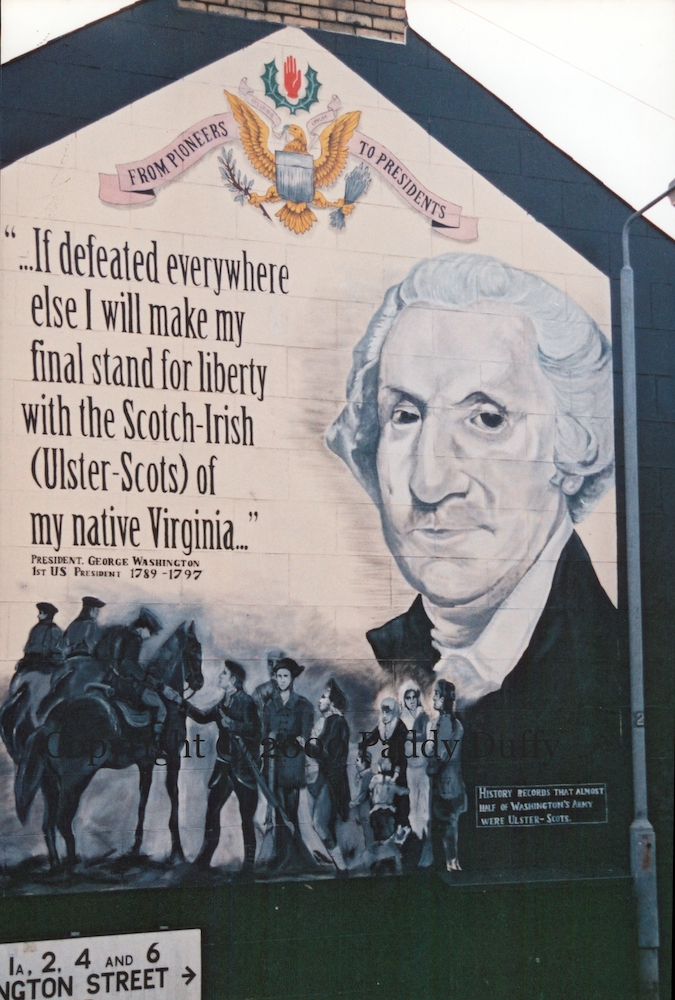
These are two of the first three murals painted in the series “From Pioneers To Presidents”, to Washington and Buchanan, in Ebrington Street Lower and Ebrington Street in the Waterside, Londonderry, along with one to Roosevelt in the Fountain.
George Washington commanded the Continental Army during the revolution and served as the first president of the United States beginning in 1789. His ancestry was English. The quote – “If defeated everywhere else I will make my final stand for liberty with the Scotch-Irish (Ulster-Scots) of my native Virginia” – is undocumented, the closest being this statement from McKinley.
The note in the corner reads “History records that almost half of Washington’s army were Ulster-Scots”; the basis for this claim might be General (Charles?) Lee’s report that “half the rebel Continental Army were from Ireland.” (See Chapter 2 of Bagenal, The American Irish and their Influence on Irish Politics.)
James Buchanan was “15th US president 1857-1861.” Buchanan’s father, also called James, was born in Ramelton, Co Donegal, and was living in Co Tyrone when he emigrated to the United States from Derry in 1783, (one of the “250,000 Ulster-Scots [who] emigrated to America in the 1700s”). James junior was born in 1791, the second of eleven children.
The confusion over the wording of the quote – “My Ulster blood is my most priceless [or simply: a priceless] heritage … [and I can never be too grateful to my grandparents from whom I derived it.]” – is matched by confusion over who said it (Buchanan junior or senior?); the source of the quote is unknown. Likewise we do not know where in Scotland the grandparents might have come from and perhaps the move to Ireland happened much earlier.
This mural is (probably) a companion to the Nelson McCausland book Patrick, Apostle Of Ulster: A Protestant View Of Patrick (Amazon), published in 1997. Here is a 2013 blog post by McCausland that perhaps gives a précis of the book and is in keep with the text in the panel out of shot to the left, which reads, “”All the exciting and glamourous features that tradition has added to Patrick must be removed if we wish to know what he was really like. And yet the historical Saint Patrick is more interesting and more worth studying than all these later gaudy traditions …” Bishop R[ichard]. P[atrick]. C[rosland]. Hanson”
With graffiti reading “had no feet” – a comment on the figure to the left.
A Visual History page details the various appearances of Eddie The Head in his guise as a Red Coat soldier-cum-UDA volunteers. In this Shankill Eddie, he carries an assault rifle and an Ulster Banner as he marches over the graves of “E[ddie] Copeland”, “S[ean] Kelly”, and “S[tephen] Larkin”. The three are IRA volunteers: Kelly, along with Thomas Begley, bombed Frizzell’s fish shop on the Shankill Road in 1993 – Kelly survived; Copeland was injured during an attack on Begley’s wake; Larkin made an attempt on the life of Johnny Adair in 1993.
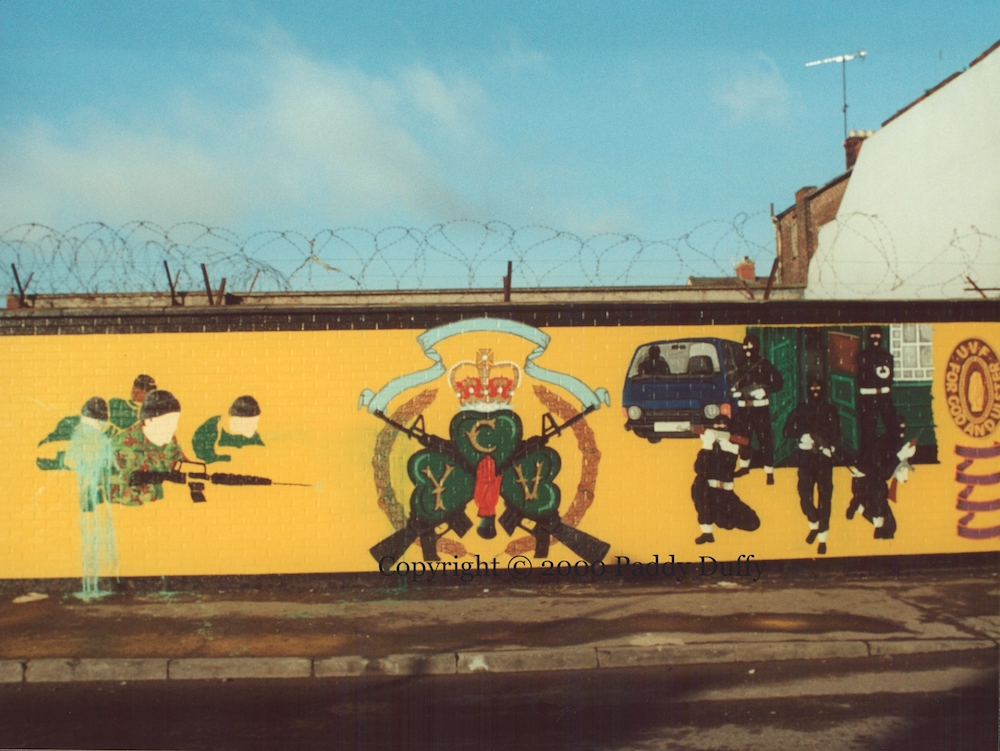
This is an in-progress image of the UVF/YCV mural in Walnut Street, Donegall Pass, south Belfast, being painted by Gareth Keys and already paint-bombed. For the completed work, see M01522.
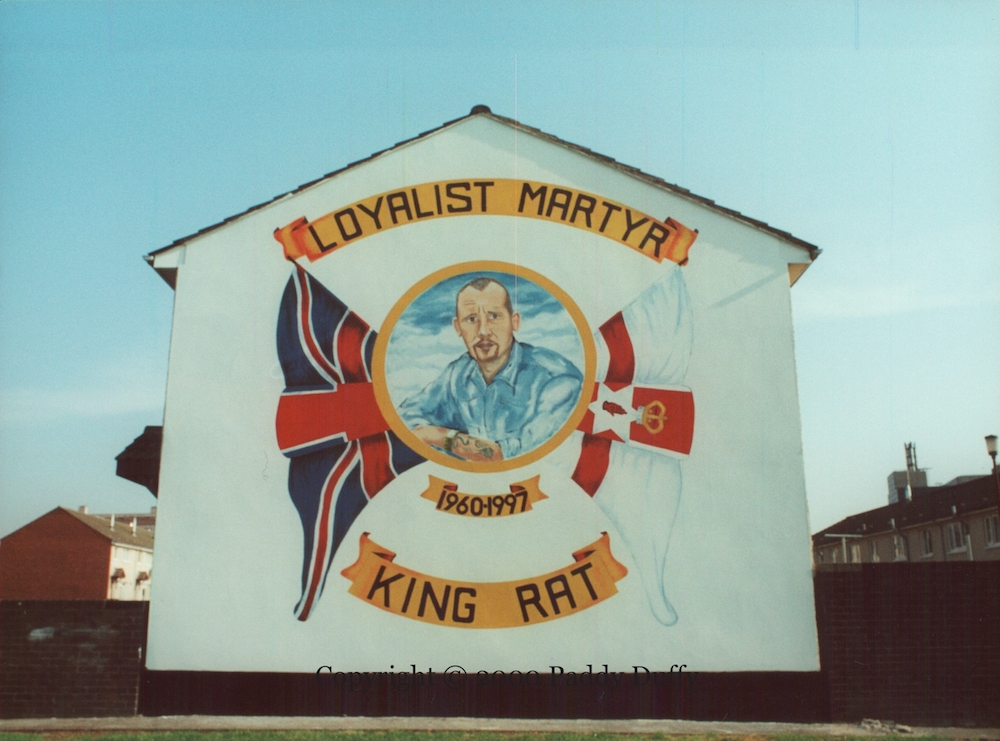
“Loyalist martyr King Rat 1960-1997”. Billy Wright broke with the UVF over the ceasefire in 1994 and after being expelled (and the Mid-Ulster brigade disbanded) in the summer of 1996, formed the LVF (WP). Wright was killed in the Maze in December 1987 by members of the INLA (neither the INLA or LVF were on ceasefire). Johnny Adair of the UDA’s west Belfast C company was an admirer and supported of Wright and this is one of the murals he had painted in the lower Shankill estate.
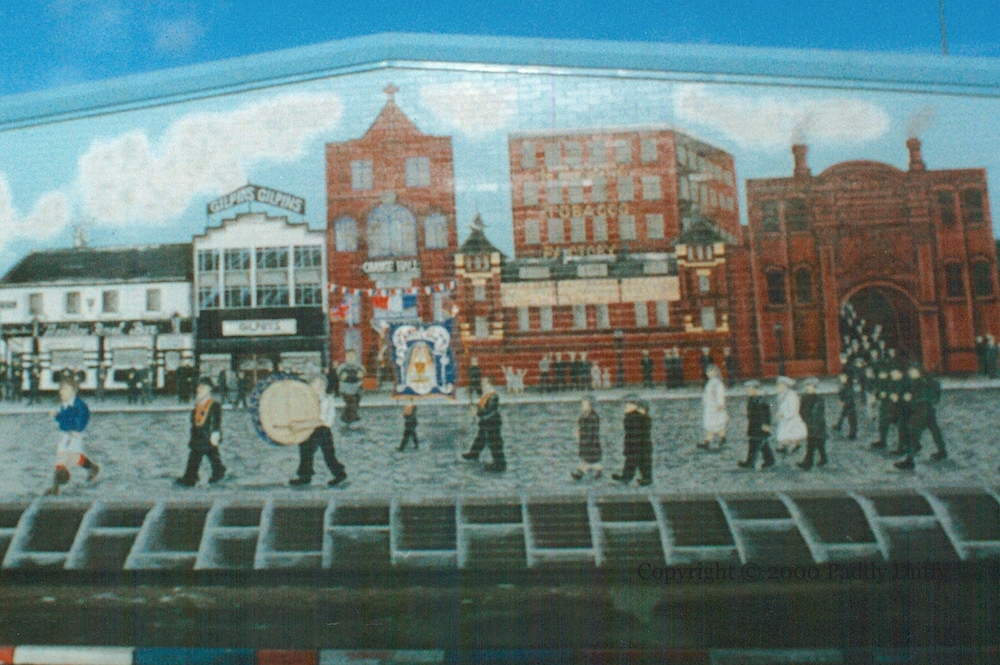
Here (in three parts) is a wide community mural replacing the POW mural in Linfield Road, in the Sandy Row area of south Belfast, depicting a parade marching along Sandy Row past a lot of landmarks (not all in appearing as they actually do along the road).
From left to right, the buildings shown are: the Carnegie Library on Donegall Road, Weaver’s Court (which is at the end of the road that the mural is on), the Royal Bar (Hamilton’s), Gilpin’s shoe shop, Orange Hall, Murray’s tobacco factory, the Belfast & Ulster Brewery building (the courtyard of which was used as a drilling ground by the Ulster Volunteers), Sandy Row District No 5 (Fb) arch.
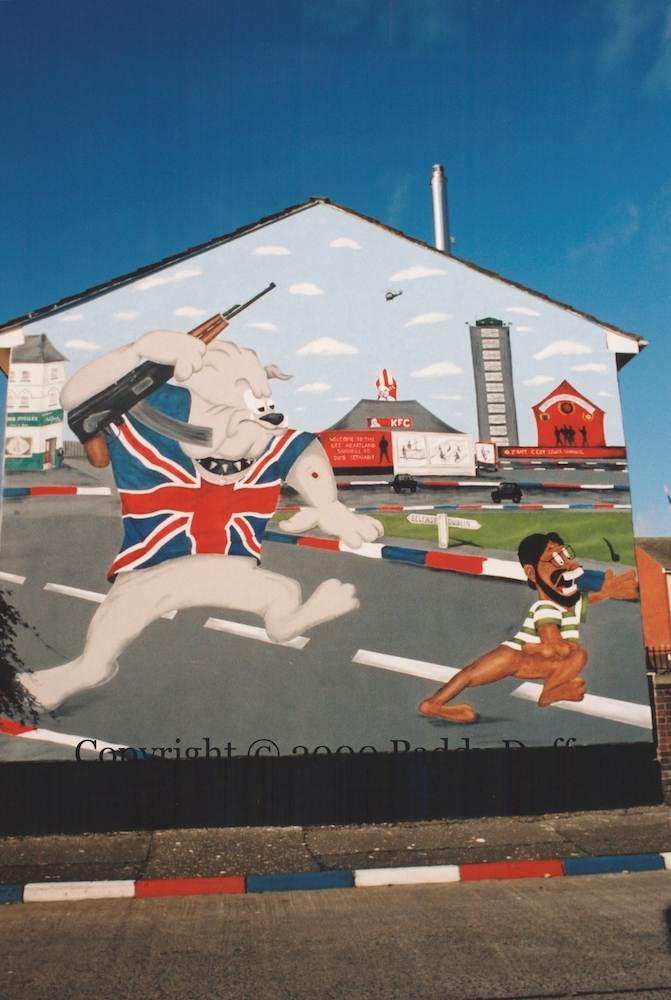
Spike (the dog from Tom & Jerry) wears a Union Flag t-shirt and brandishes an assault rifle as he chases Sınn Féın’s Gerry Adams, wearing a Celtic top, out of Belfast and towards Dublin, in front of the UDA murals at (D00971) and behind (D00969) the KFC.
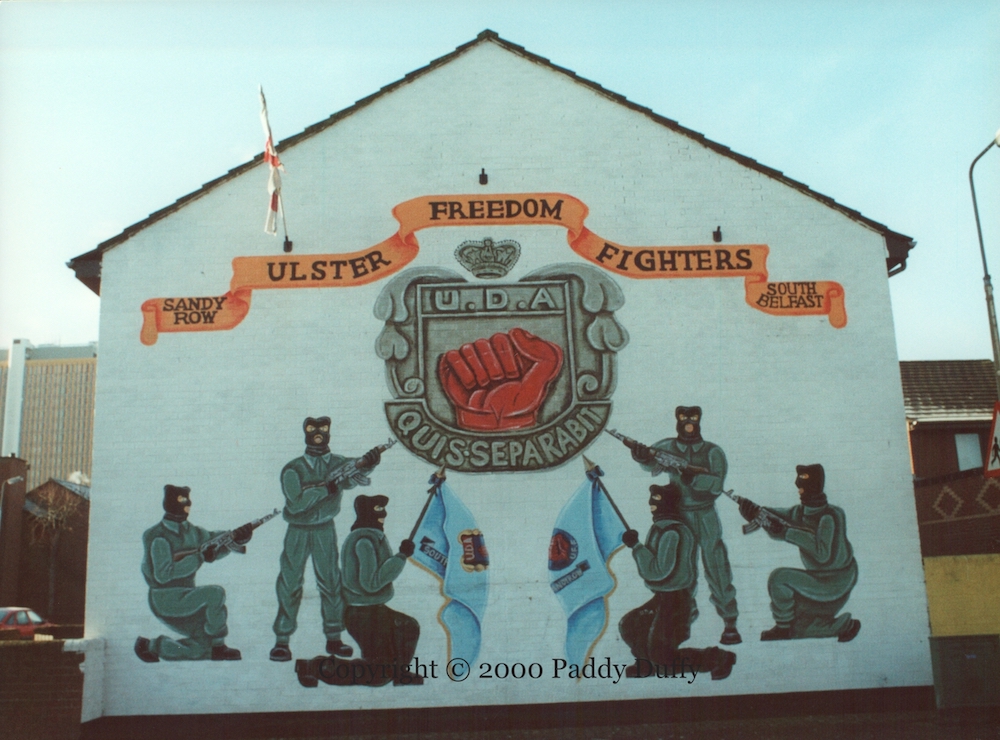
“Free our prisoners o[f] w[ar]”, specifically prisoners from the South Belfast UFF/UDA. This pair of smaller murals is in the garden next to St Alban’s, and the gable mural is across the road.








 Paddy Duffy Collection