Our British Birthright

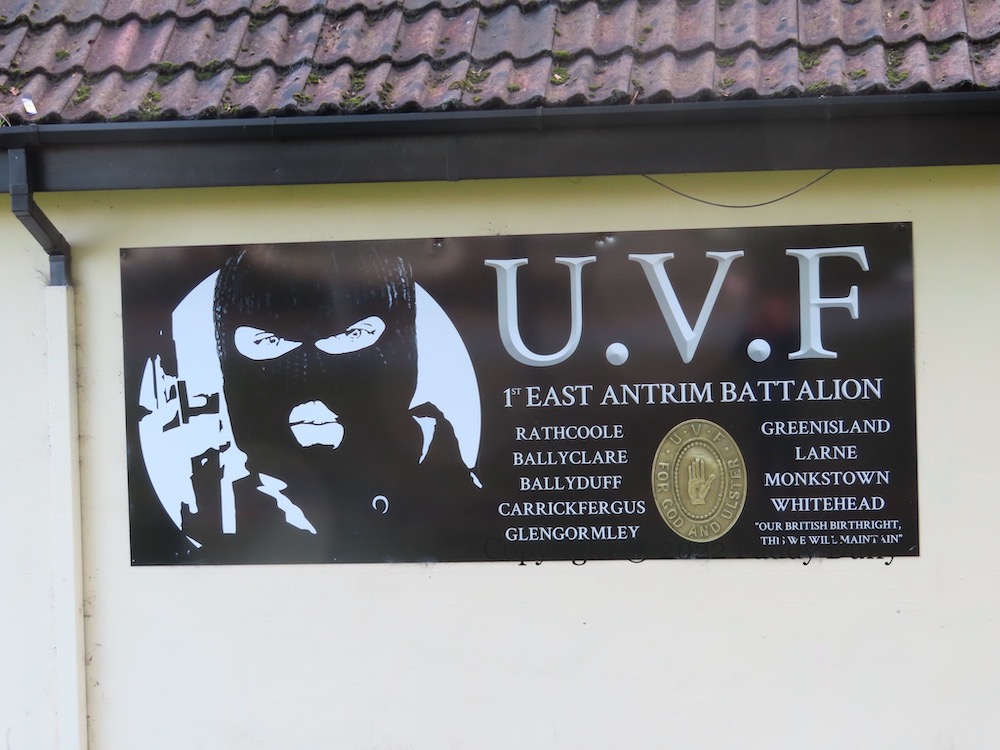
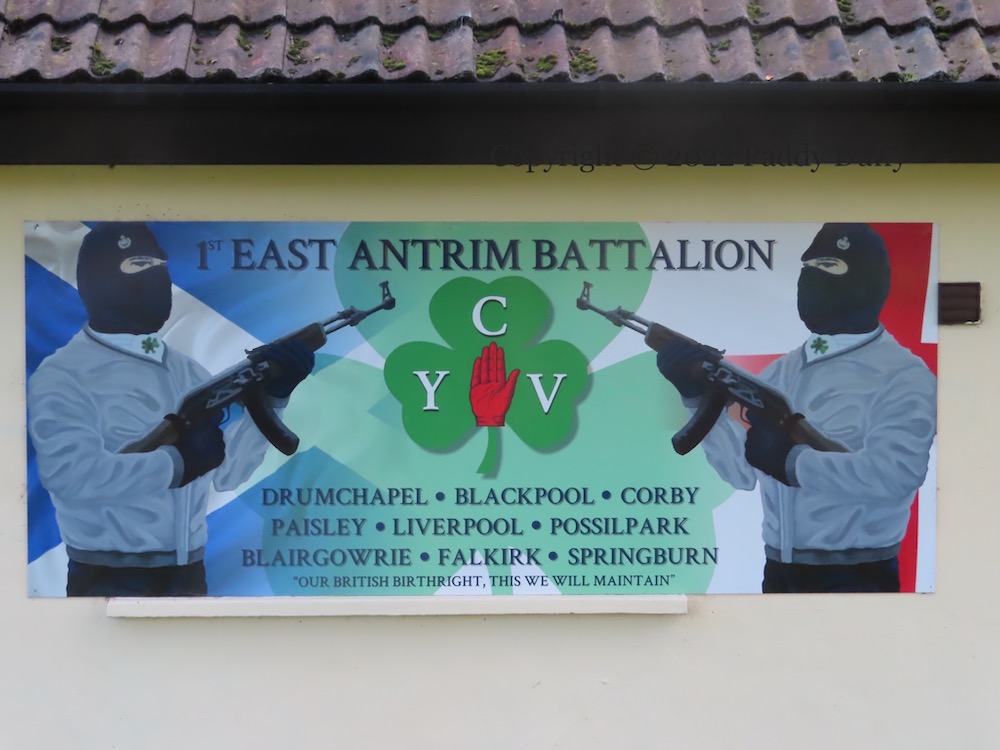
This pair of UVF boards are on the wall of the Fern in Rathcoole and right next to the UDA markings seen in Rathcoole UDA. Included in the 1st East Antrim are both local areas (Carrickfergus, Ballyduff, Ballyclare, Greenisland, Glengormley, Monkstown, Rathcoole, Larne, Whitehead) and affiliated British units (Drumchapel (Glasgow, Scotland), Blackpool (England), Corby (England), Paisley (Scotland), Liverpool (England), Possilpark (Glasgow), Blairgowrie (Scotland), Falkirk (Scotland), and Springburn (Glasgow)) of the 1st East Antrim Battalion, “The people’s army”.
Click image to enlarge
Copyright © 2022 Paddy Duffy
[T01216] T01217 T01218

The Rifles Of The UDA

South East Antrim UDA, 1st battalion, mural, complete with assault rifle, next to the Youth & Community Centre at the Diamond in Rathcoole. Two men from the area were convicted in December (2018) for attempting to purchase Glock pistols from PSNI officers posing as ‘dark web’ sellers (BelTel). Fears of a feud continue (Belfast Live).

Rathmore Drive, Rathcoole, Newtownabbey

Click image to enlarge
Copyright © 2022 Paddy Duffy
T01212

Dalaradia

“Pretani” is the Brittonic version of the Greek term “Prettanoi”, possibly borrowed from the Gauls (WP), for the inhabitants of the two islands now known as Ireland and Britain, and “Cruthin” the Gaelic term. According to the eponymous web site, Dalaradia was “was a kingdom of the Cruthin in the north-east of Ireland and parts of Scotland in the first millennium” with the Cruthin being (more narrowly than above) a people in Antrim and Down with (in the middle of the mural) “the field of Crewe Hill, with the Ancient Crowning Stone of Ulster Kings” (REACH) in Glenavy (pretani.co.uk).

The WP page on the Cruthin notes, “The name Cruthin survives in the placenames Duncrun (Dún Cruithean, “fort of the Cruthin”) and Drumcroon (Droim Cruithean, “ridge of the Cruthin”) in County Londonderry, and Ballycrune (Bealach Cruithean, “pass of the Cruthin”) and Crown Mound (Áth Cruithean, “ford of the Cruthin”) in County Down. These placenames are believed to mark the edges of Cruthin territory.”

The towers of Rathcoole can be seen underneath the slogan “Respect, heritage, culture.” They also famously appear behind a trio of hooded gunmen in a Rathcoole mural.

Carmeen Drive, Rathcoole, Newtownabbey

Click image to enlarge
Copyright © 2022 Paddy Duffy
T01210 [T01211]

Dignity And Pride

The UVF mural dedicated to Colin Caldwell on Derry Hill in Rathcoole was repainted in 2016 and a mention added of “Marky” Mark Quail — who has a separate mural a short distance away — added on a (painted) ribbon. The mural shows two hooded volunteers — from the 3rd [north] Belfast battalion and 1st east Antrim battalion – aiming rifles; the previous mural (X00512) showed volunteers mourning beside a memorial stone. “We salute all volunteers at home and on the mainland who served with dignity and pride.”

Click image to enlarge
Copyright © 2022 Paddy Duffy
T01209

Honour, Service, Sacrifice

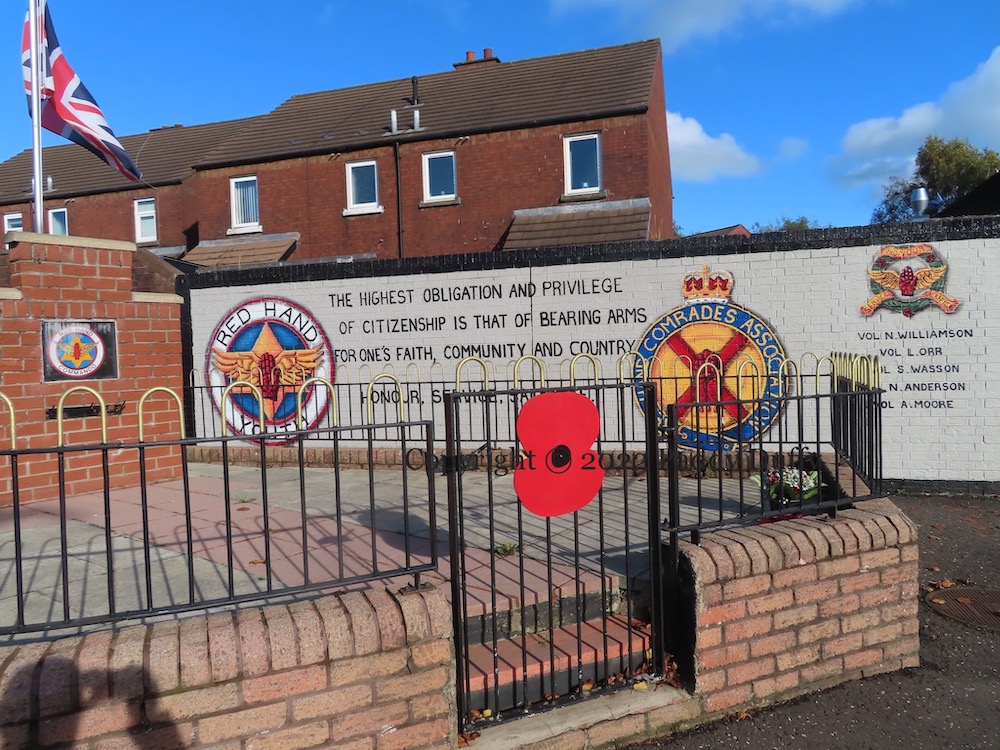
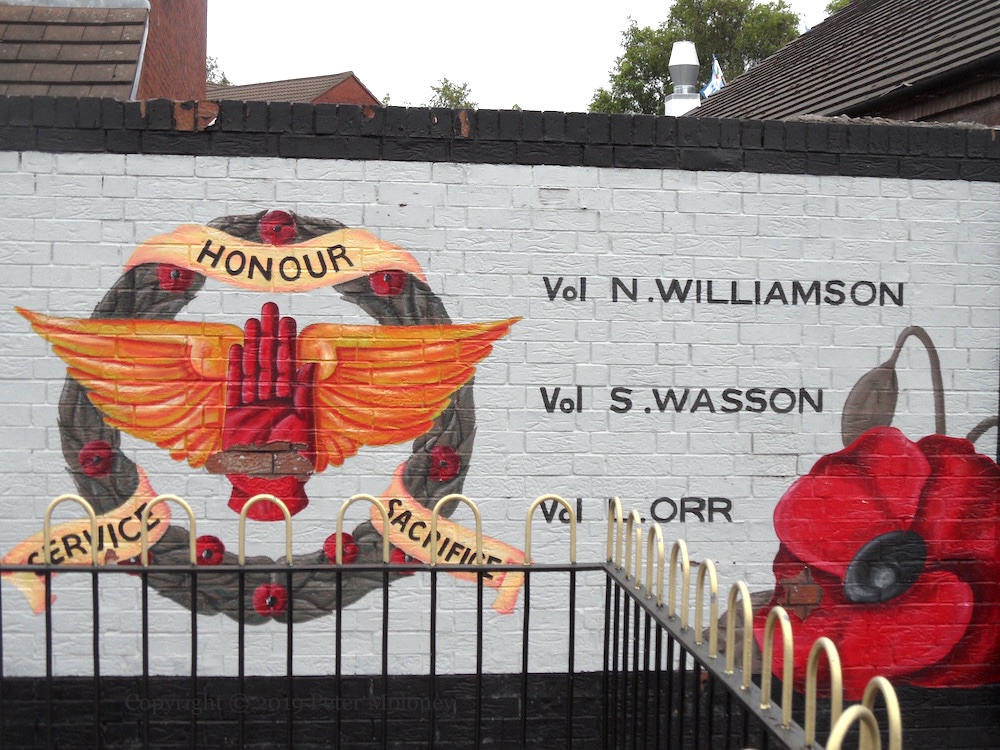
The backdrop to the Red Hand Commando memorial garden in Rathcoole has been repainted (compare with the final image, below) with the emblem of the “Red Hand Comrades Association” (for background see We Await In The Shadows). “The highest obligation and privilege of citizenship is that of bearing arms for one’s faith, community and country. [George S. Patton, Jr.] Honour, service, sacrifice.” With the names “N[orman]. Williamson, L. Orr, S. Wasson, N. Anderson, A. Moore.” (Anderson and Moore are new additions, compared to M16237 and M16236, below;

For the plaque to Williamson on the main mural see the Peter Moloney Collection.

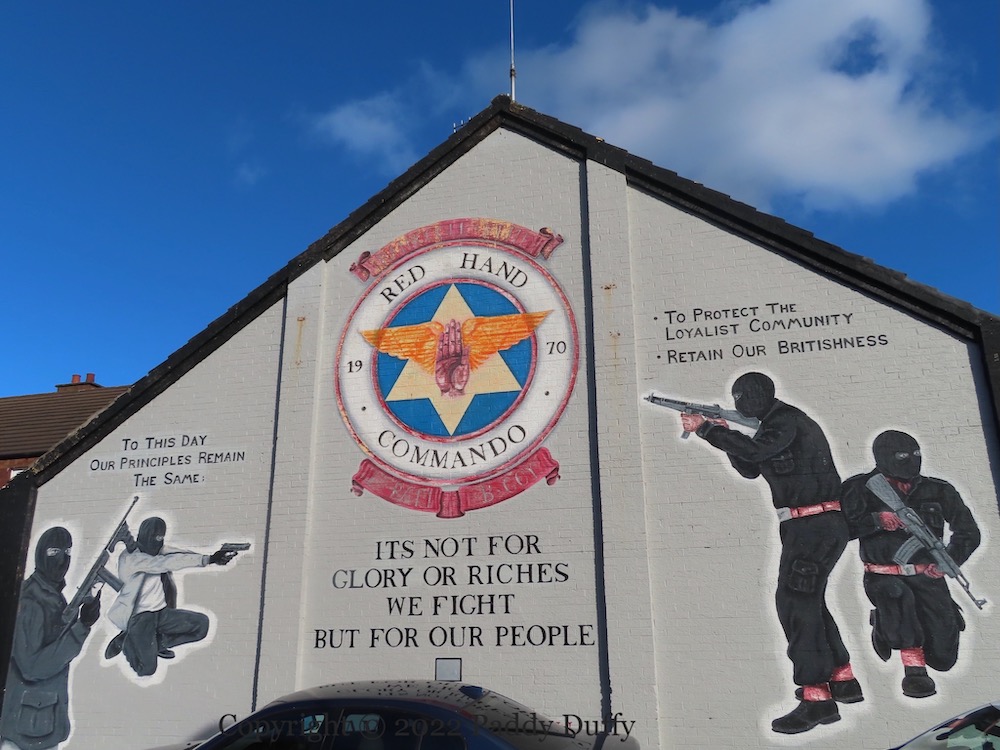
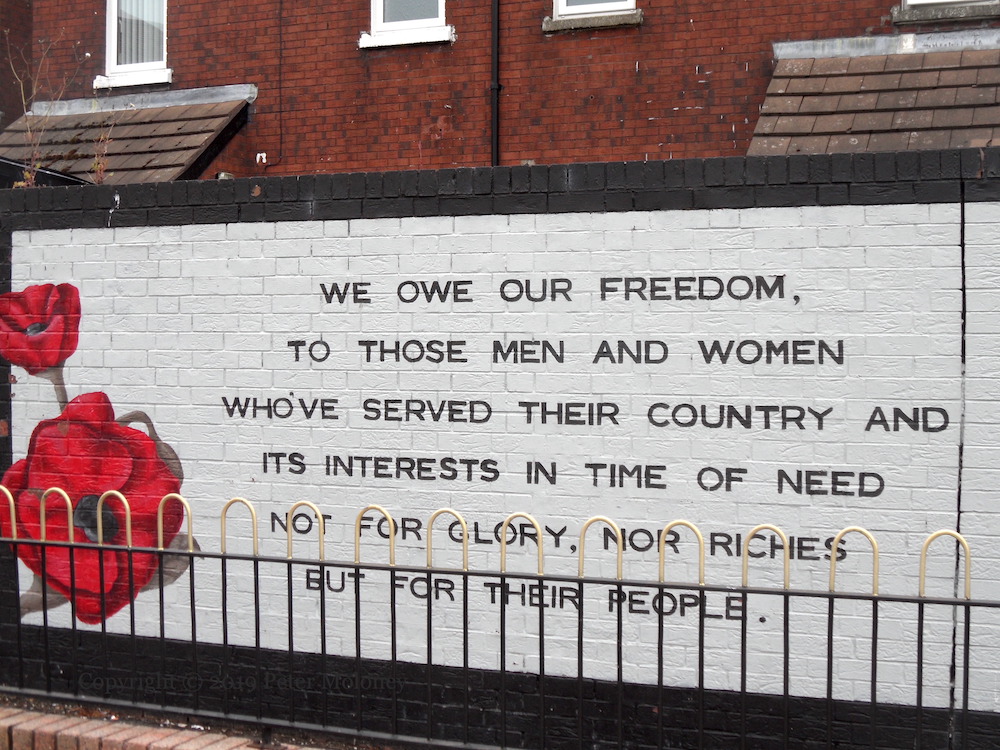
It is in the same colour-scheme as the main wall, which is now fading somewhat: Founded in 1970, “To this day our principles remain the same: to protect the loyalist community, to retain our Britishness. It is not for glory or riches we fight but for our people. Lamh Dearg Abu.” The mural shows the “Rathcoole Elite” unit (1st Batt., B. Coy) of the Red Hand Commando, complete with four masked men each bearing weapons.

Click image to enlarge
Copyright © 2022 Paddy Duffy
T01207 T01208 [T01206]

Copyright © 2019 Peter Moloney
M16237 M16236

From Rathcoole To The House Of Windsor

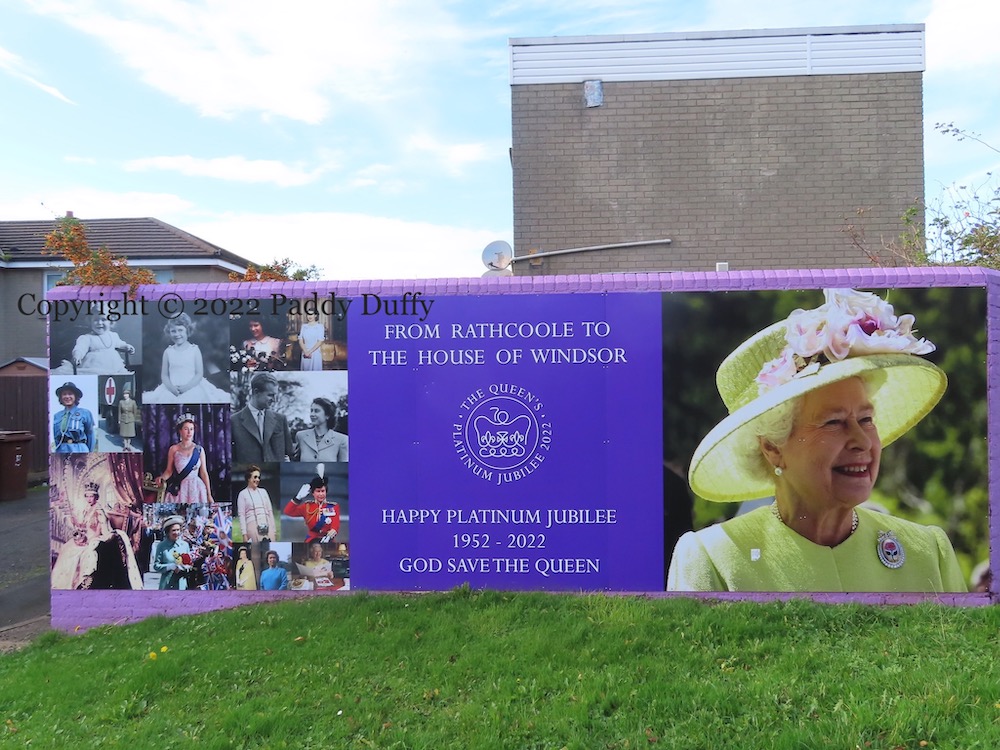
These two boards in Owenreagh Drive, Rathcoole, were mounted to celebrate the seventieth (platinum) jubilee of Queen Elizabeth in June 2022. Similar paintings were produced by schoolchildren in west Belfast – see The People’s Monarch.

“This artwork was designed and created by pupils from Abbots Cross Primary School in partnership with the local children from Rathcoole Community Hub to commemorate the platinum jubilee of Her Majesty Queen Elizabeth II.”

“From Rathcoole to the house of Windsor – happy platinum jubilee 1952-2022. God save the Queen.”

Click image to enlarge
Copyright © 2022 Paddy Duffy
T01220 T01221

Help For Heroes

“Remember the fallen, care for the living”. Five boards arranged into a single piece in Ebor Street, south Belfast. The large bottom panel features a silhouette of a (staged) photograph taken in Basra (DailyMail) of a soldier on a stretcher giving the ‘thumbs up’ sign.

Ebor Street, Village, south Belfast

Click image to enlarge
Copyright © 2022 Paddy Duffy
T01139

Floreat Ultona

“May Ulster flourish” as the newly created Northern Ireland under “Sir James Craig, 1st Viscount Craigavon, Prime Minister of Northern Ireland”. The Northern Ireland parliament was opened in 1921 and the coat of arms adopted in 1924 (WP); the Special Constabulary (including the B-Specials) had been formed prior to and in preparation for partition – the quote from Carson (also seen in an east Belfast mural) is from July 12th, 1920.

The text on the board is the same as at WP: “The Ulster Special Constabulary (USC; commonly called the “B-Specials” or “B Men”) was a quasi-military reserve special constable police force in what would later become Northern Ireland. It was set up in October 1920, shortly before the partition of Ireland. It was an armed corps, organised partially on military lines and called out in times of emergency, such as war or insurgency. It performed this role most notably in the early 1920s during the Irish War of Independence and the 1956-1962 IRA Border Campaign. During its existence, 95 USC members were killed in the line of duty. Most of these (72) were killed in conflict with the IRA in 1921 and 1922. Another 8 died during the Second World War, in air raids or IRA attacks. Of the remainder, most died in accidents but two former officers were killed during the Troubles in the 1980s. The Special Constabulary was disbanded in May 1970, after the Hunt Report, which advised re-shaping Northern Ireland’s security forces and demilitarizing the police. Its functions and membership were largely taken over by the Ulster Defence Regiment and the Royal Ulster Constabulary.”

This Belfast Live article (which has images from the launch) leads with the headline that this new board replaces a UVF mural, but there hasn’t been anything on this wall since a large “UDA” lettering in 1999. The adjacent wall, which has now been painted over, previously (in 2010) had a UVF flag which had been vandalised with “Jesus Christ Is Lord Of All’ graffiti by 2017.

Click image to enlarge
Copyright © 2022 Paddy Duffy
T01142