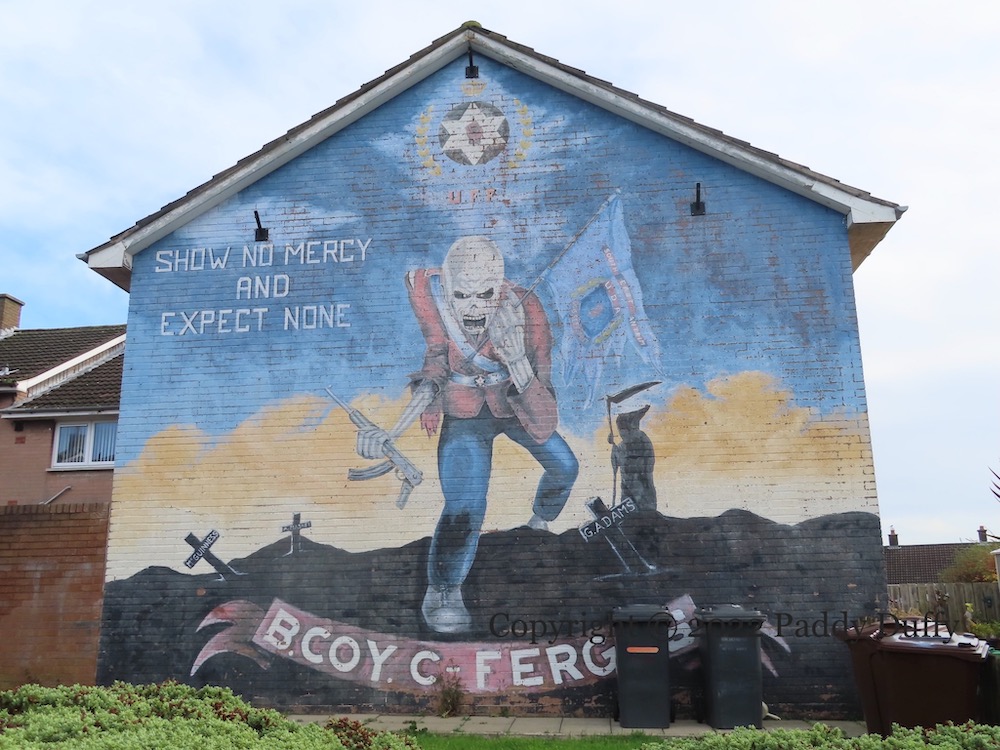
“Show no mercy and expect none”. Iron Maiden’s Eddie the trooper, armed with an assault rifle and carrying a UDA flag, leads the grim reaper over the graves of “G. Adams”, “McGuinness” and “A. Maskey”. UDA/UFF mural in Castlemara, Carrickfergus.
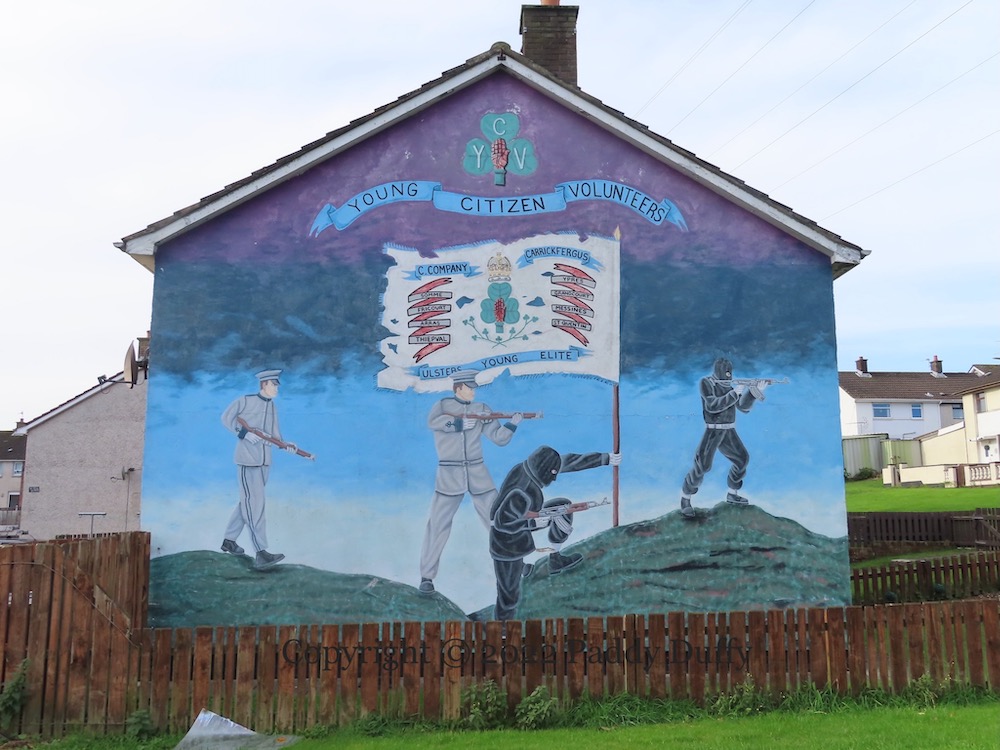
The Young Citizen Volunteers of 1912 eventually joined the Ulster Volunteers (in 1914) as the 14th battalion of the Royal Irish Rifles and part of the 36th (Ulster) Division (WP). In 1972 the name was resurrected for use as the youth wing of the UVF (WP). In the wide shot, below, this history is presented as a continuous movement from left to right; a modern-day hooded gunman climbs out of a WWI trench with one hand on a YCV flag.
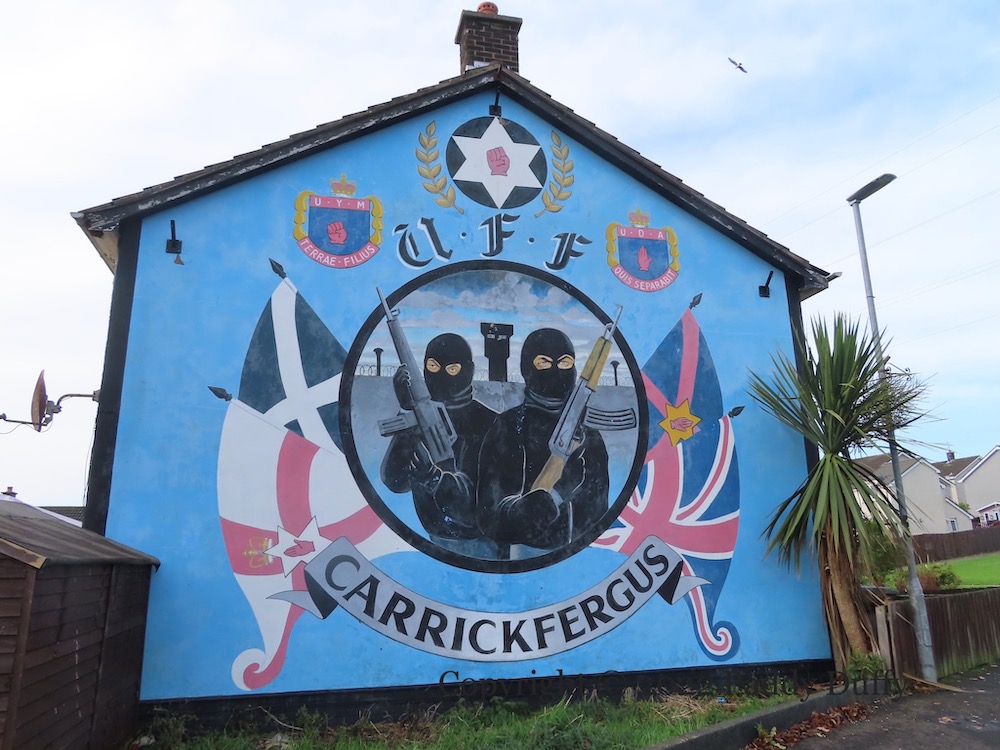
The upper flag on the right-hand side of this mural – purple saltire on a blue background with star and red hand – is the proposed flag of Ulster nationalists. The position was espoused by the UDA of the 1970s, under the guise of the political parties the Ulster Loyalist Democratic Party and the Ulster Democratic Party, and for a time by the Red Hand Commandos under the Ulster Loyalist Central Coordinating Committee.
For the previous (identical) version, see UFF Carrickfergus in the Peter Moloney collection.
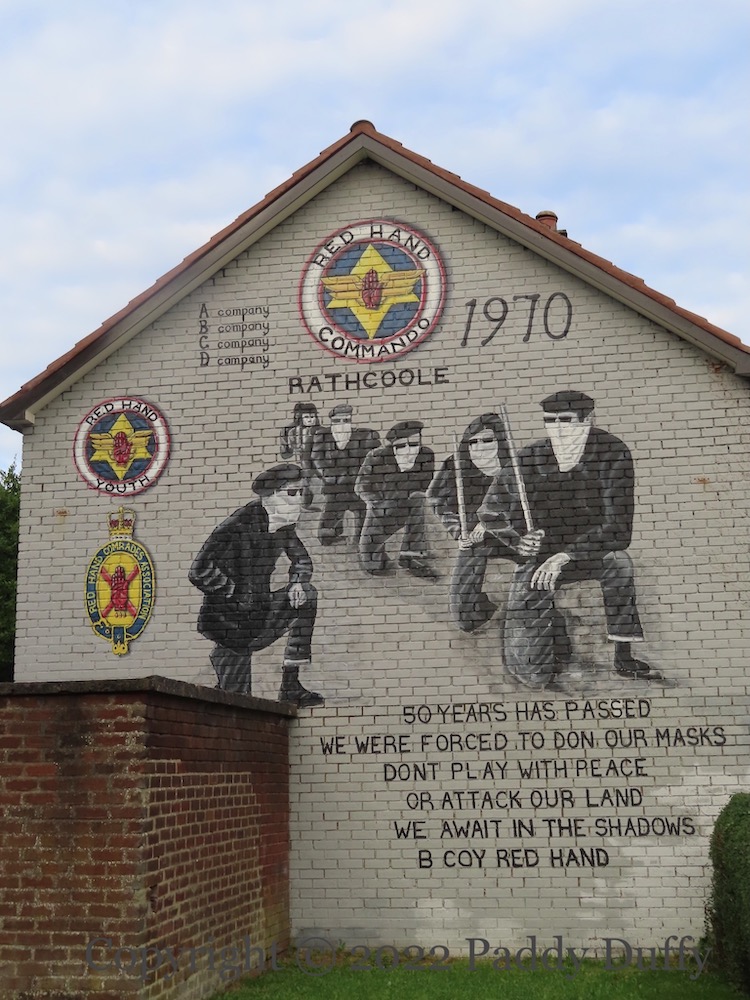
Ten years after ending its armed campaign, the Red Hand Commando in 2017 applied to be de-proscribed, on the basis that it had given up its arms in 2009 and transformed itself into an ‘old comrades association’ (see the emblem in the bottom left of the wide shot) (BBC | NewsLetter). According to this mural, however, B company is ready to reform in response to those who “play with peace”, fifty years later (or so – the mural claims the group was founded in 1970; other sources give 1972 (WP cites Peter Taylor).
“50 years has passed/We were forced to don our masks/Don’t play with peace/Or attack our land/We await in the shadows/B Coy Red Hand”
William III, statholder of Holland, landed at Torbay, England, in November, 1688 with 250+ ships and 30,000 men in order to overthrow the Catholic convert James II who had become king in 1685. As he came ashore he proclaimed “the liberties of England and the Protestant religion I will maintain.” As king of England, William was automatically made king of Ireland, but he and his forces had to go to Ireland to win the island from James and the forces loyal to him. Schomberg had already successfully besieged Carrickfergus in 1689 when William landed in June 1690.
The mural reproduces the illustration from a postcard.
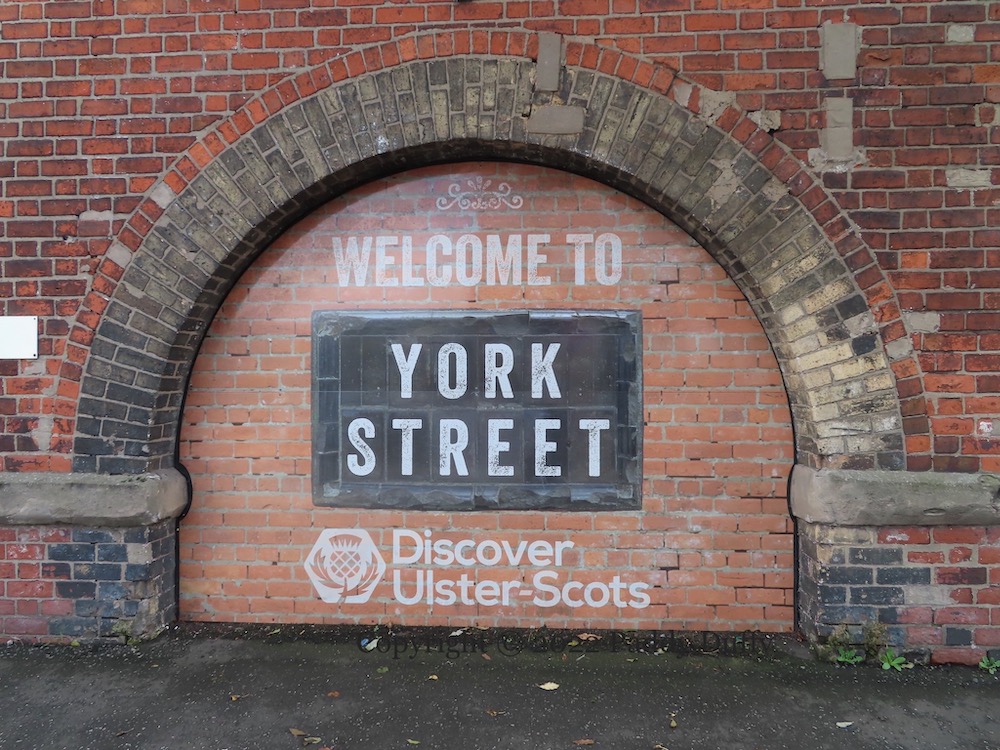
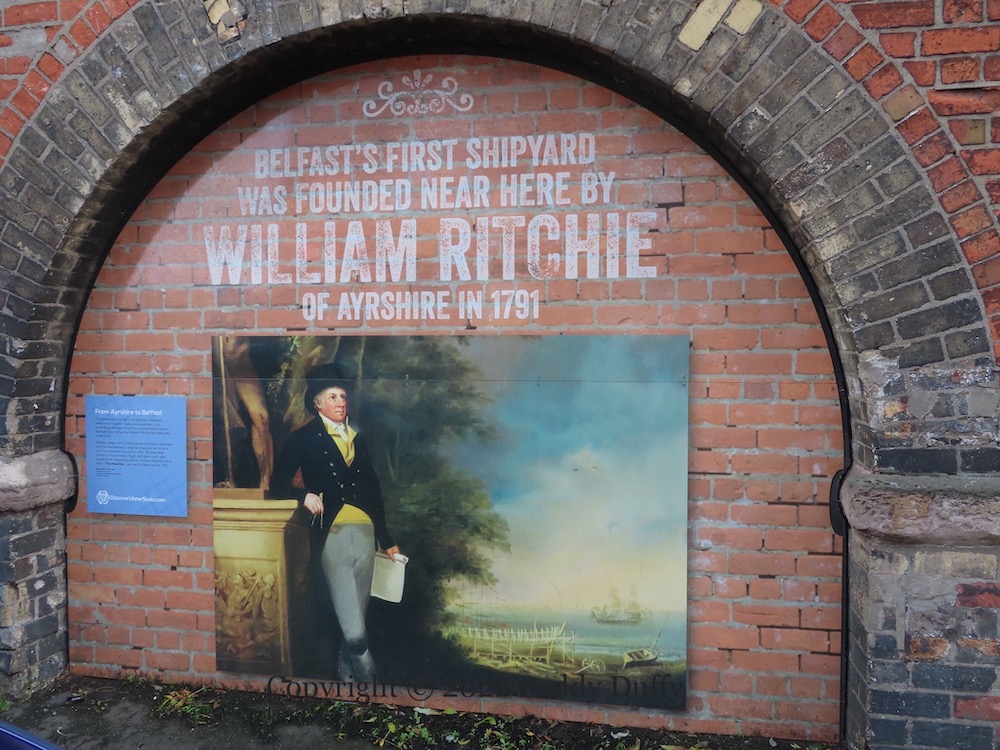
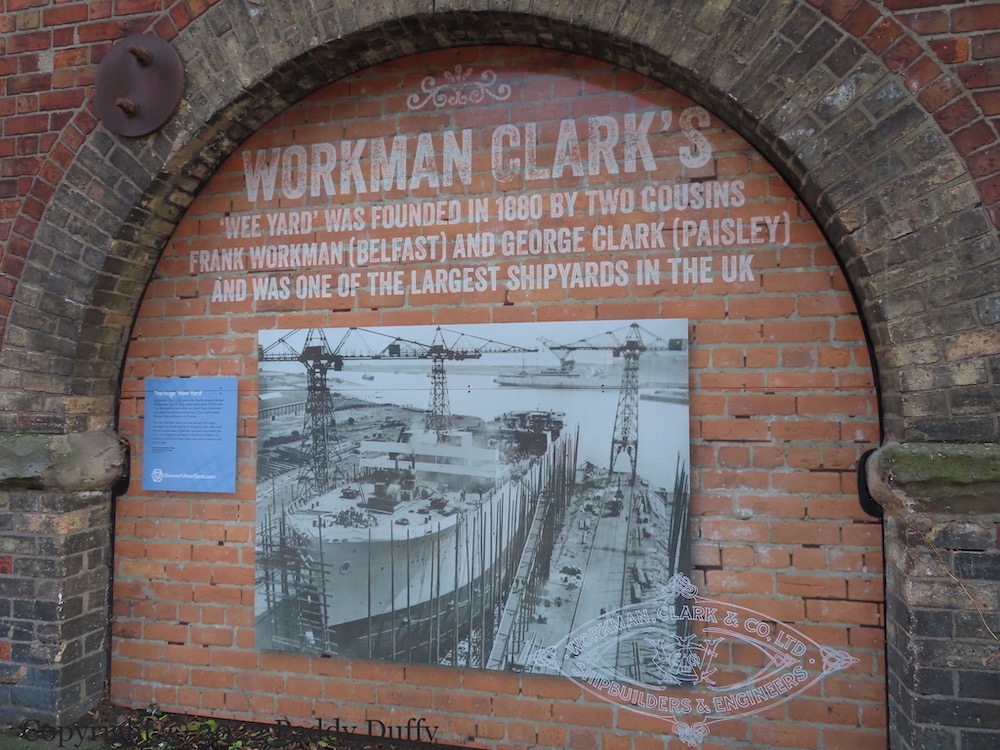
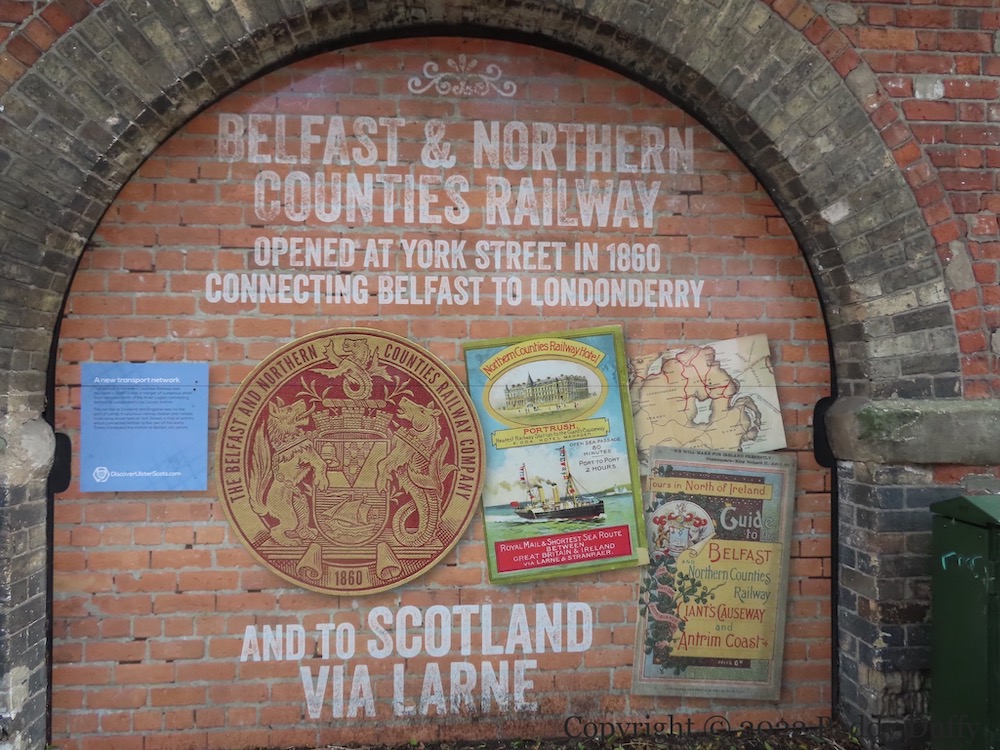
This is a 13-panel installation along York Road from discoverulsterscots.com about York Street businesses and Ulster Scots businessmen. It begins by telling a history of shipbuilding and its role in Belfast’s industrial life (“The harbour made York Street Belfast’s global gateway”) and in particular its connection with Scotland.
Two Scots, William Ritchie (whose 1802 portrait by Thomas Robinson is shown) and Charles Connell (who oversaw the construction of the first wooden steamboat in Belfast – Aurora, pictured below) along with another Scot, Alexander MacLaine, were the leading shipbuilders in Belfast from 1791 until the 1860s, when Englishman Edward Harland (soon joined by German Gustav Wolff, and then in 1874 by William Pirrie and Wilson brothers Walter and Alexander) took over the rival Hickson yard (which included land on Queen’s Island and on the south side of the Lagan) and became dominant. Their connection to York Street is that all of them except Pirrie lived on or near York Street.
Workman & Clark’s was a Belfast shipyard existing from 1880 to 1935. During the first world war it took over the construction of two monitor ships (specifically, M29 and M31) for the Royal Navy that H&W did not have space to build. For more, see Grace’s Guide | BBC audio on monitor ships and their construction, including a record for number of rivets hammered in by one John Moore at Workman Clark’s.
Among the Belfast goods “exported around the world from York Street by rail and sea” were Gallaher’s Blues (cigarettes), Irish linens, Davidson & Co (Samuel Davidson, born in County Down to an Ulster-Scots family, was the inventor of the Sirocco centrifugal fan “for mine ventilation, dust removal, induced draft, forge fires”), and linen carpet thread from York Street (Threads) Ltd. Robinson & Cleaver’s department store is now out of business. Gallaher’s is now the multinational Gallaher Group, but its factories in Belfast and Ballymena have closed. And Davidson’s company was bought by Howden UK in 1988.
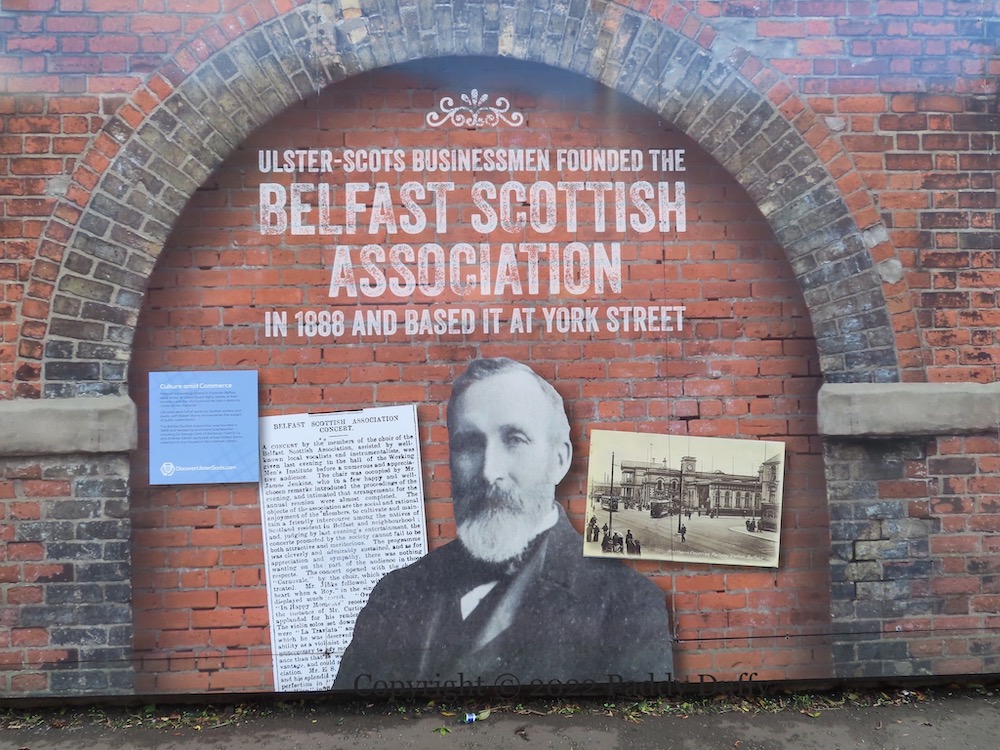
“The Belfast Scottish Association was founded in 1888 and headed by prominent businessmen, including Sir George Clark of Workman Clark and Andrew Gibson (pictured) whose Robert Burns collection is now housed in the Linenhall Library.”
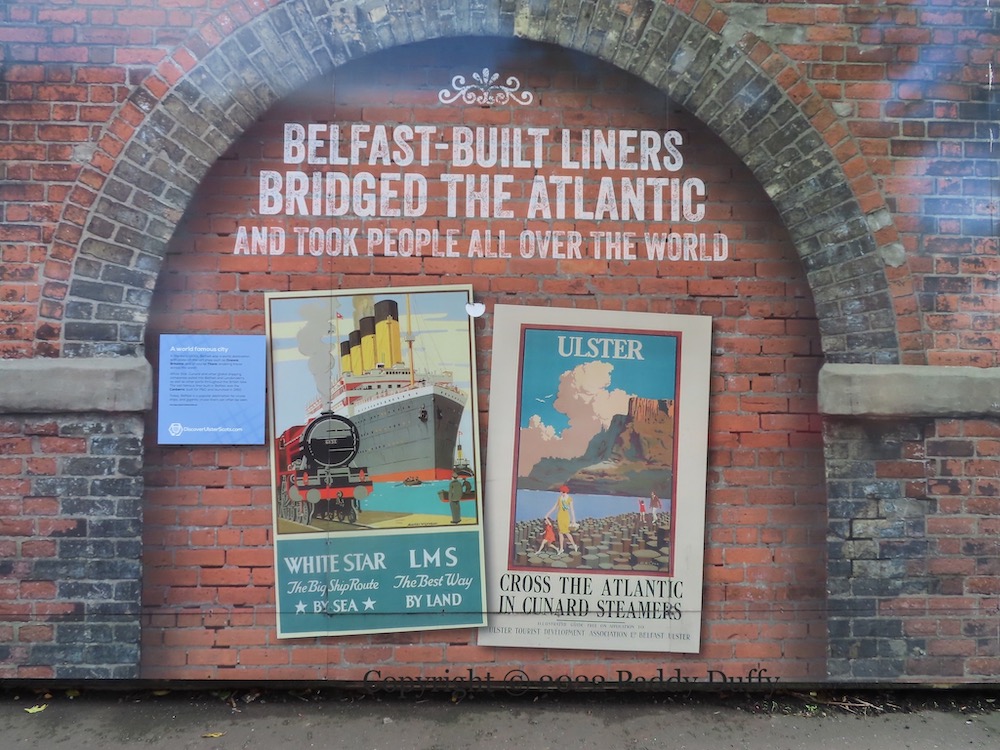
In addition to the famous trans-Atlantic ships (image below), Belfast was part of the travel network in the UK and Ireland (image above). Before there was British Railways, there were the Big 4: the Southern, Great Western, London and Northeastern, and London, Midland, and Scottish (LMS) railways. The latter included the railways in the Northern Counties. In addition to railways, the company owned canals, ships (including the Princess Victoria which sank on the Larne-Stranraer route), and hotels. “Belfast-built liners bridged the Atlantic and took people all over the world.” “Railway-owned ships ensured a seamless journey throughout the British Isles.”
Compared to the UVF, the UDA more strongly detect an existential threat to loyalism and evince a siege mentality that provokes the need for armed resistance. Hence the more frequent presence of armed gunmen in UDA murals (which is also due in part to the UVF being able to “re-image” around the Ulster Volunteers and the Somme). With Brexit and the Protocol, however, armed gunmen have recently been appearing more frequently in UVF murals – see, for example, If Our Shores Are Threatened | Bang Up To Date | Our British Identity.
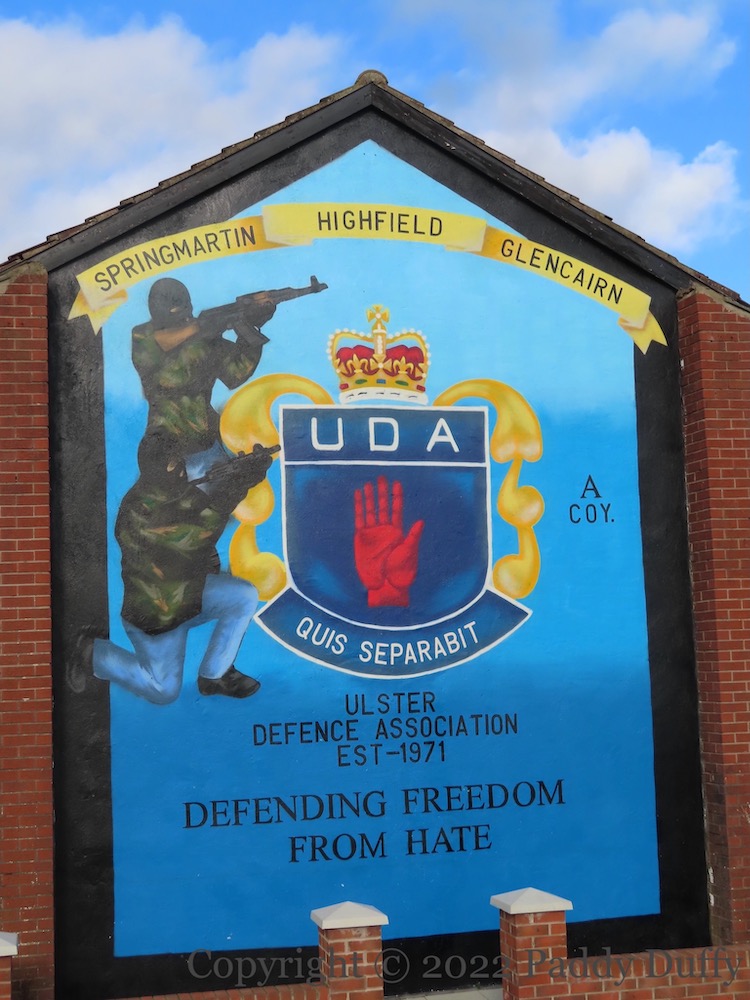
“Springmartin–Highfield–Glencairn Ulster Defence Association est. 1971. Defending freedom from hate.” As the companion mural (We Will Take Nothing Less) makes clear, the hate is coming from a “fascist republican enemy” (“Sinn Féin/IRA”, presumably) and the government of Ireland. Graphically, this mural is the same as the previous one on this wall: Under The Protection Of The UDA.
An estimated 100,000 people congregated at Craigavon House on the 23rd of September, 1911, to hear Edward Carson’s inaugural speech as Unionist leader (McNeill Ch. 4). In his speech he said “Our demand is a simple one. We ask for no privileges, but we are determined that no one shall have privileges over us. We ask for no special rights, but we claim the same rights from the same government as every other part of the United Kingdom. We ask for nothing more; we will take nothing less”. Ten years later, in 1921, Northern Ireland was created and it has survived to reach its centenary, despite (according to this mural) “100 years of fighting a fascist republican enemy sponsored by the Irish state.”
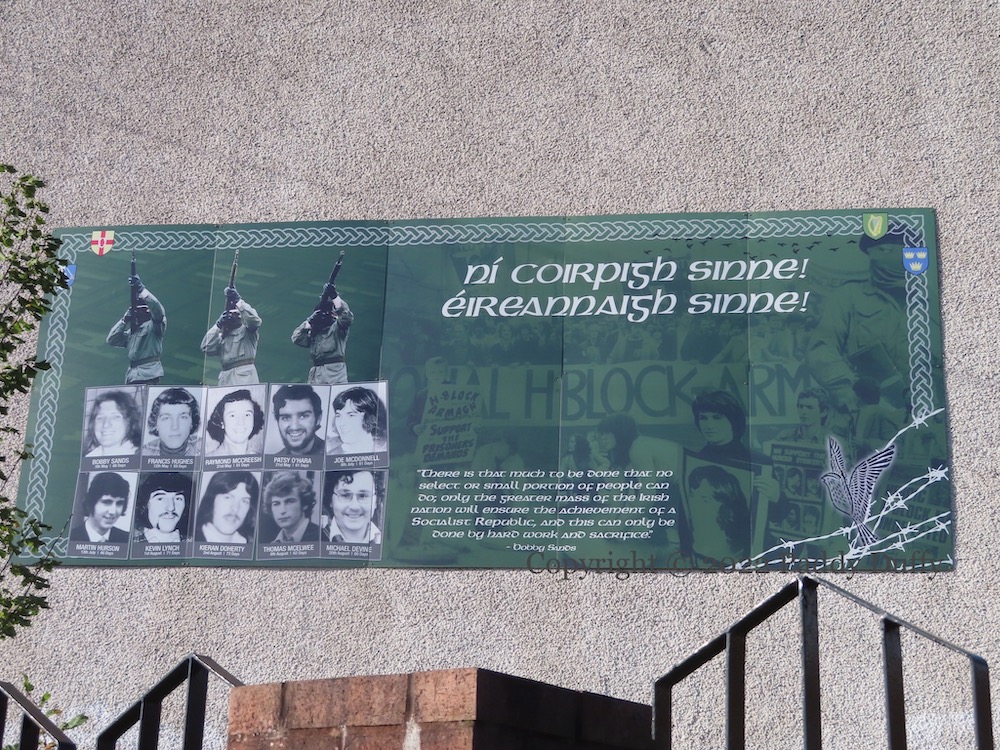
“Ní coırpıgh sınne! Éıreannaıgh sınne! [we are not criminals; we are Irish people] “There is that much to be done that no select or small portion of people can do; only the greater mass of the Irish nation will ensure the achievement of a socialist republic, and this can only be done by hard work and sacrifice.” – Bobby Sands [Hunger strike diary, March 14th, 1981]” With photographs of the ten deceased 1981 hunger strikers.
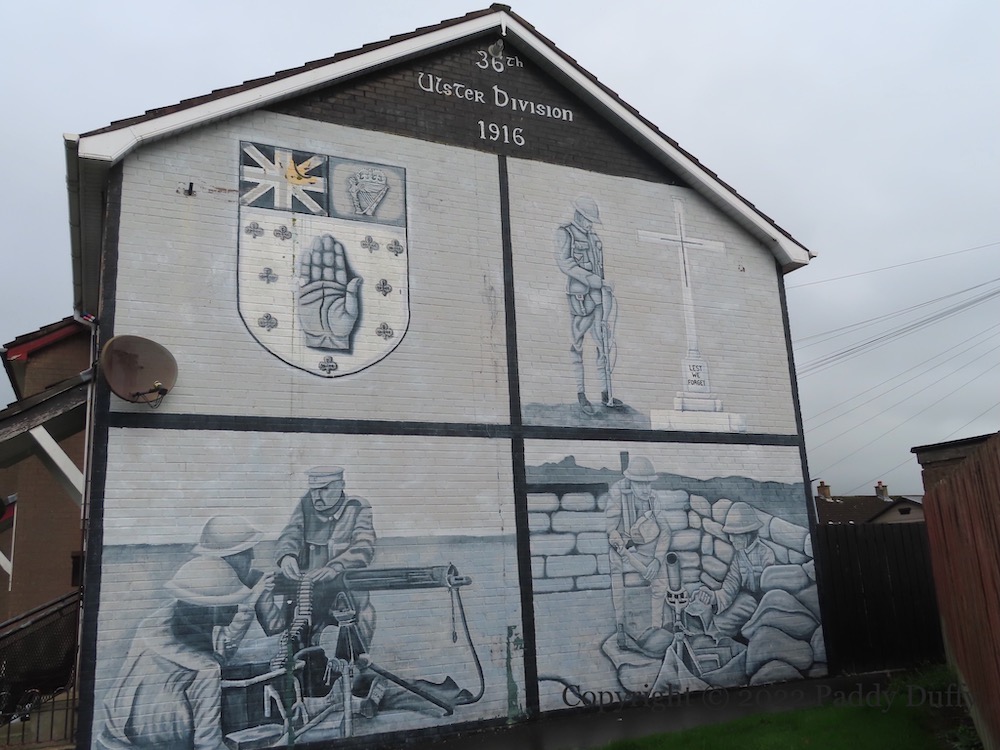
Monkstown WWI mural in four quadrants showing the emblem of the 36th (Ulster) Division, a soldier at the cross in the Thiepval Cemetery, soldiers feeding a belt of ammunition into a Vicker’s machine gun, and others loading a Stokes mortar.








 Paddy Duffy Collection