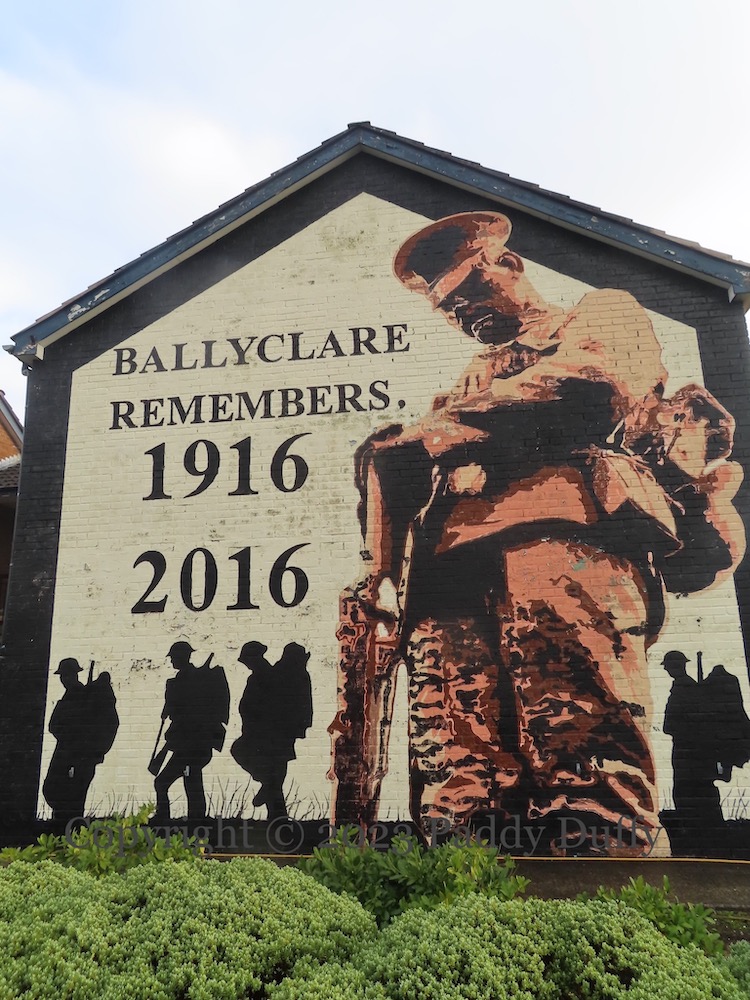
Spared To Testify To Their Glorious Deeds

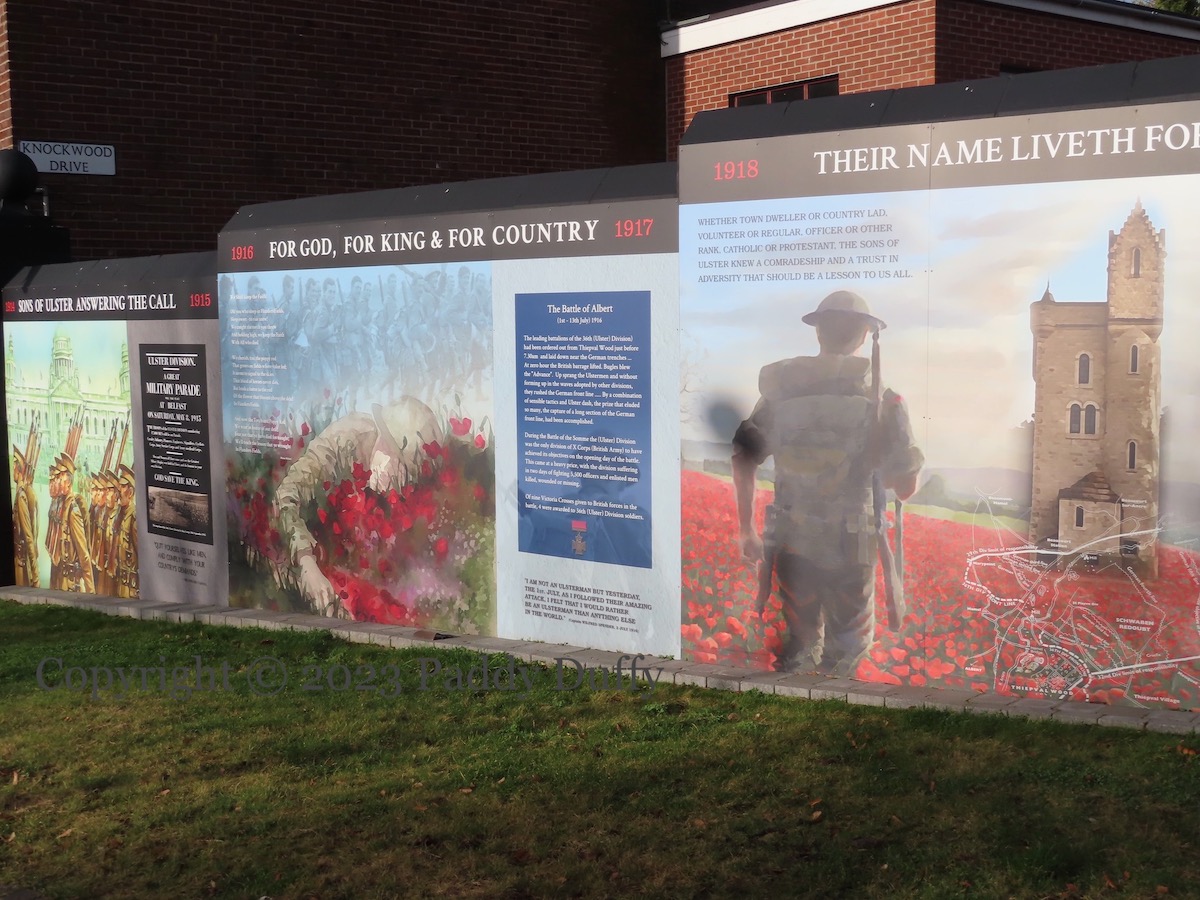
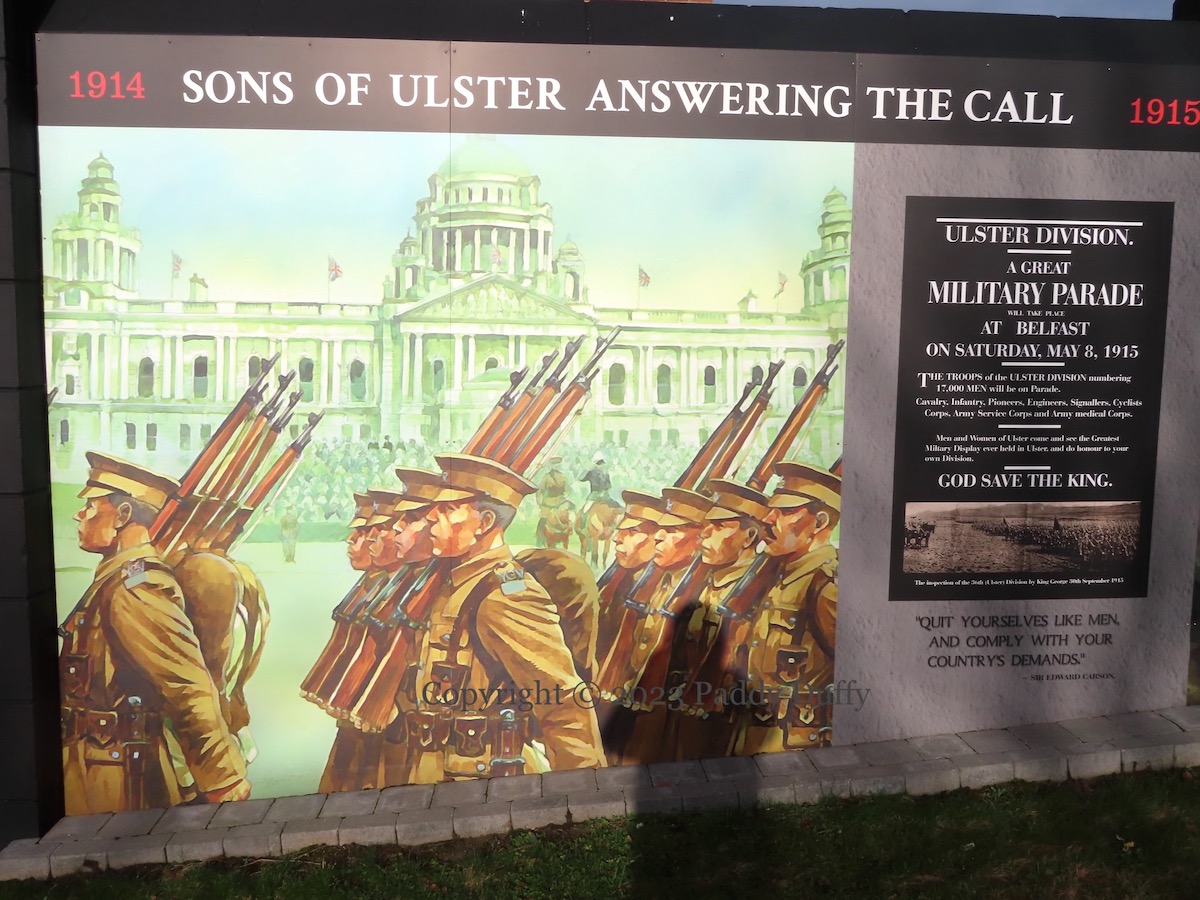
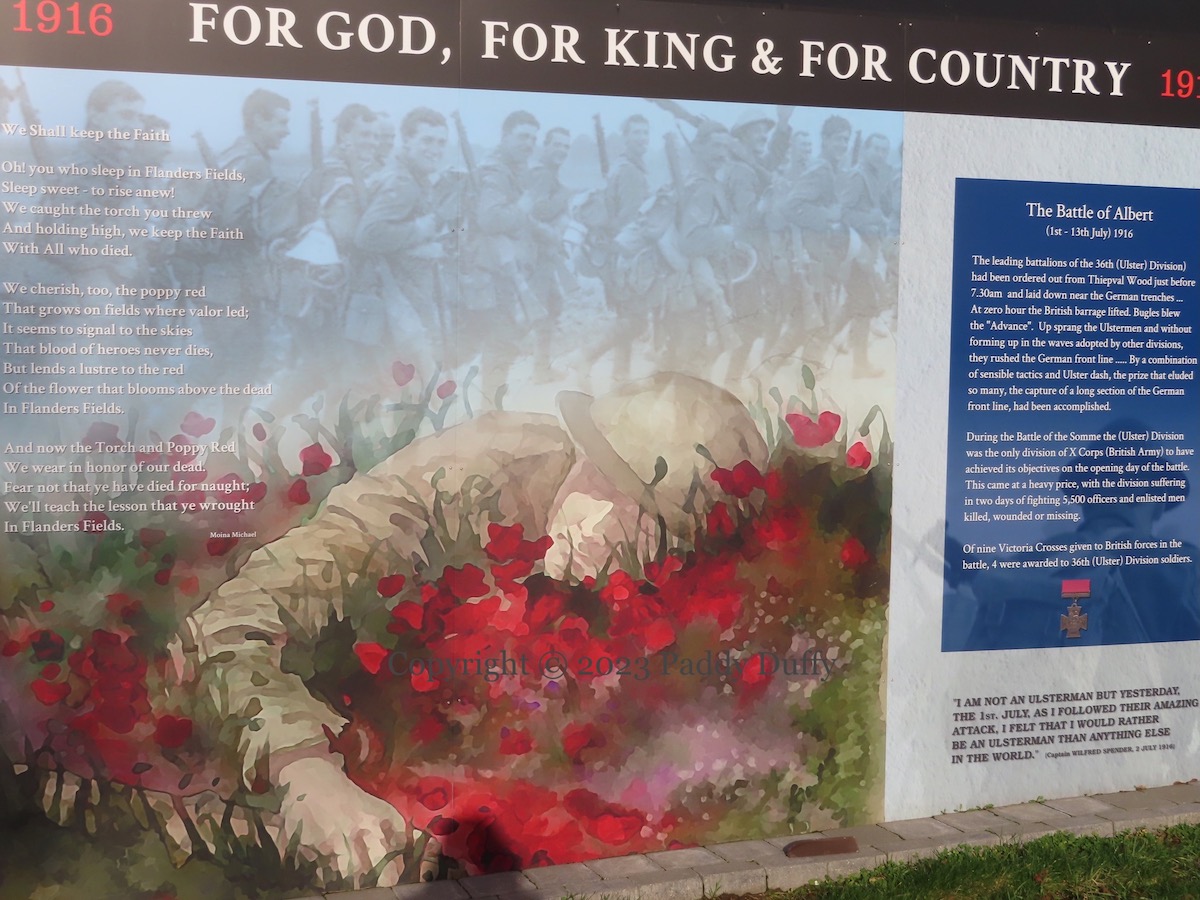
A history of the 36th (Ulster) Division in three panels along Knockwood Crescent in east Belfast:

1914 – Sons Of Ulster Answering The Call – 1915: “Ulster Division – a great military parade will take place at Belfast on Saturday, May 8, 1915. The troops of the Ulster Division numbering 17,000 men will be on parade. Cavalry, infantry, pioneers, engineers, signallers, cyclists corps, Army service corps and Army medical corps. Men and women of Ulster come and see the greatest military display every helf in Ulster, and do honur to your own Division. God save the King.” The original poster can be seen at Wartime Memories. “‘Quit yourselves like men and comply with your country’s demands.’ – Sir Edward Carson.” With a picture of “the inspection of the 36th (Ulster) Division by King George [V] 30th September 1915.

1916 – For God, For King & For Country – 1917: “The Battle of Albert (1st – 13th July) 1916. The leading battalions of the 46th (Ulster) Division) had been ordered out from Thiepval Wood just before 7.30am and laid down near the German trenches … At zero hour the British barrage lifted. Bugles blew the “Advance”. Up sprang the Ulstermen and without forming up in the waves adopted by other divisions, they rushed the German front line …… By a combination of sensible tactics and Ulster dash, the prize that eluded so many, the capture of a long section of the German front line, had been accomplished. During the Battle of the Somme the (Ulster) Division was the only division of X Corps (British Army) to have achieved its objectives on the opening day of the battle. This came at a heavy price, with the division suffering in two days of fighting 5,500 officers and enlisted men killed, wounded or missing. Of nine Victoria Crosses given to British forces in the battle, 4 were awarded to 36th (Ulster) Division soldiers.” With quotes from Wilfrid Spender (see I Would Rather Be An Ulsterman), and the poem We Shall Keep The Faith by Moina Michael. Please get in touch if you can identify the photo of soldiers going off to war at the top.

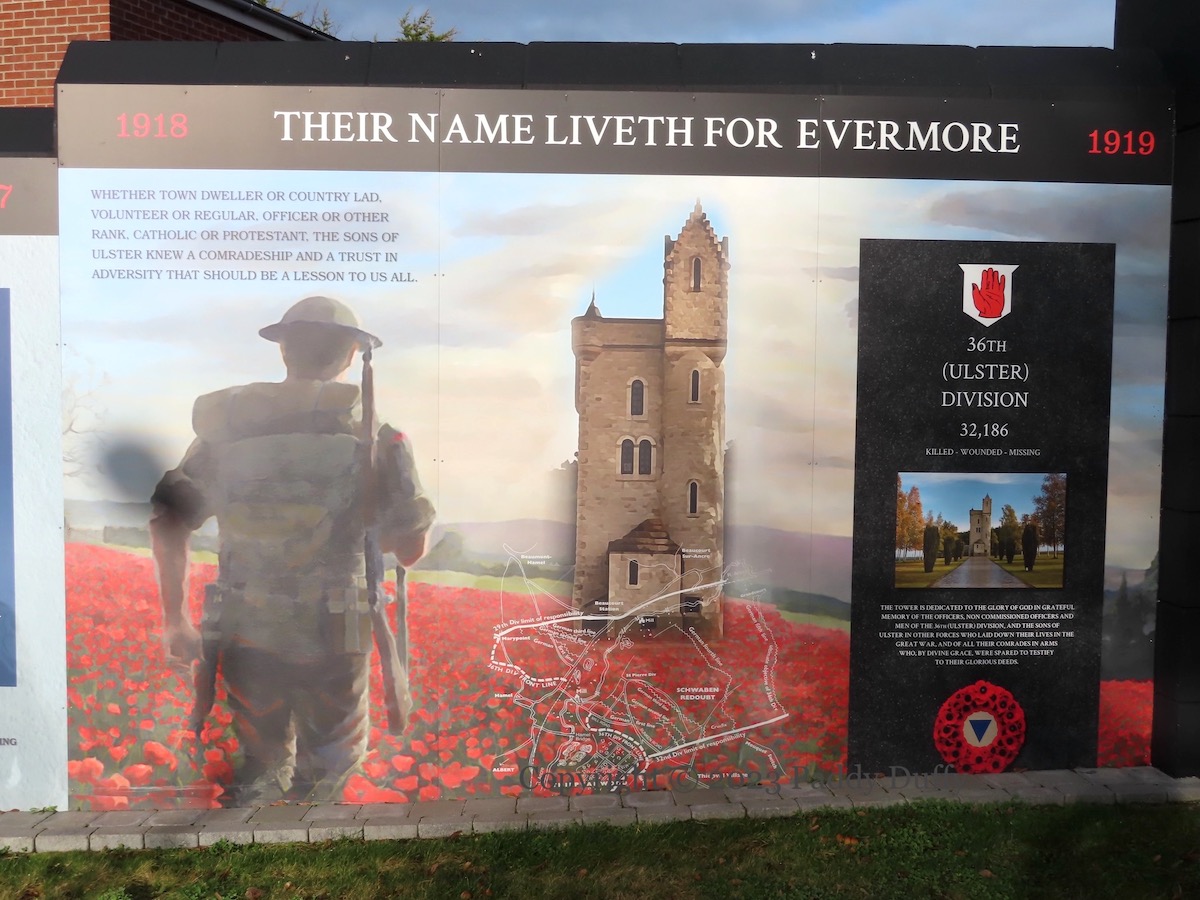
1918 – Their Name Liverth For Evermore – 1919: “Whether town dweller or country lad, volunteer or regular, officer or other rank, Catholic or Protestant, the sons of Ulster knew a comradeship and a trust in adversity that should be a lesson to us all.” “36th (Ulster) Division 32,186 killed, wounded, missing. The [Ulster] tower is dedicated to the glory of God in grateful memory of the officers, non commussioned officers and men of the 36th (Ulster) Division, and the sons of Ulster in other forces who laid down their lives in the Great War, and of all their comrades in arms who, by divine grace, were spared to testify to their glorious deeds.”
Click image to enlarge
Copyright © 2023 Paddy Duffy
T01895 T01896 T01898 T01897
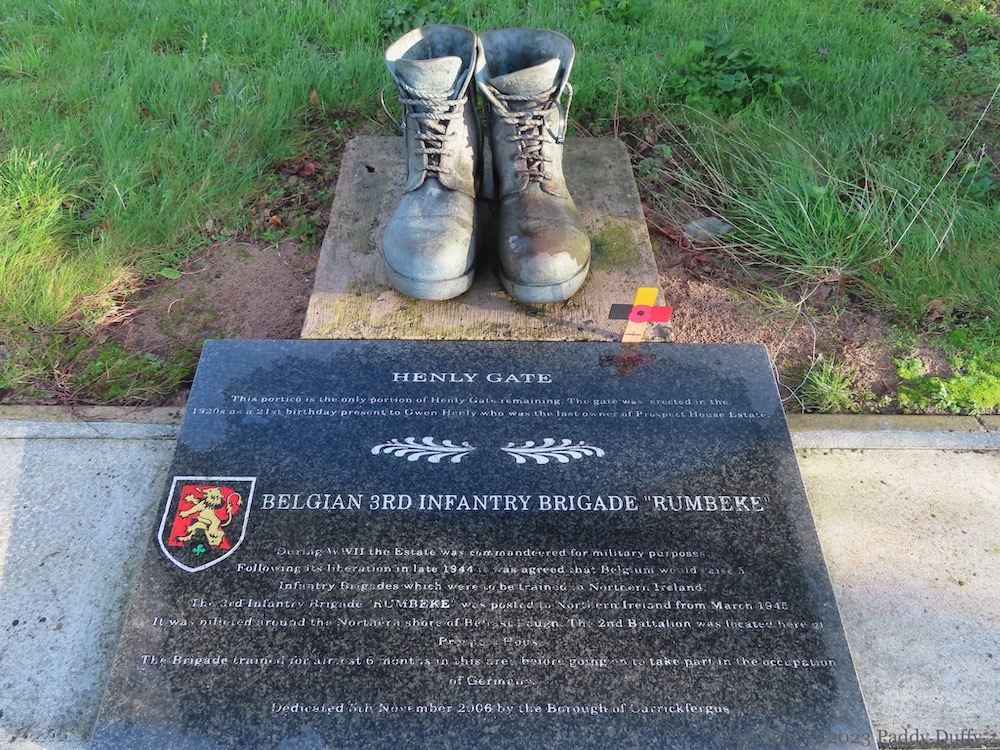
Henly Gate

Five Belgian brigades trained in Northern Ireland towards the end of WWII, as the Belgian Army rebuilt itself after the liberation of Belgium in 1944 (WarTimeNI). The 3rd or ‘Rumbeke’ brigade was raised in March 1945 and trained in six south-east Antrim towns, including Carrickfergus, where they were stationed at Henly House. After training, it took part in the occupation of Germany for about six months (BE Brigades). The boots and plaque are beneath the arch of what was once Prospect House.

The text on the plaque reads in full: “Henly Gate. This portico is the only portion of the Henly Gate remaining. The gate was erected in the 1920s as a 21st birthday present to Gwen Henly who was the last owner of Prospect House Estate. Belgian 3rd Infantry Brigade “Rumbeke”. During WWII the Estate was commandeered for military purposes. Following the liberation in late 1944 it was agreed that Belgium would raise 5 Infantry Brigades which were to be trained in Northern Ireland. The 3rd Infantry Brigade “Rumbeke” was posted to Northern Ireland from March 1945. It was billeted around the Northern shore of Belfast Lough. The 2nd Battalion was located here at Prospect House. The Brigade trained for almost 6 months in this area before going on to take part in the occupation of Germany. Dedicated 5th November 2006 by the Borough of Carrickfergus.”

At the junction of Woodburn Rd and Prospect Rd, Carrickfergus.

Click image to enlarge
Copyright © 2023 Paddy Duffy
T01827 [T01828]

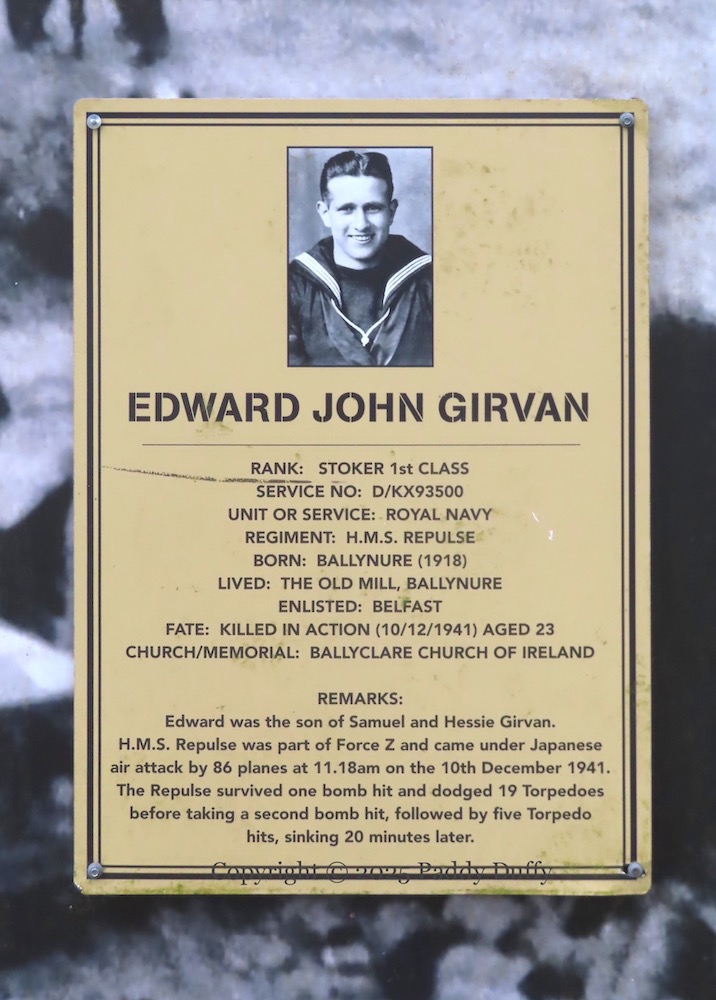
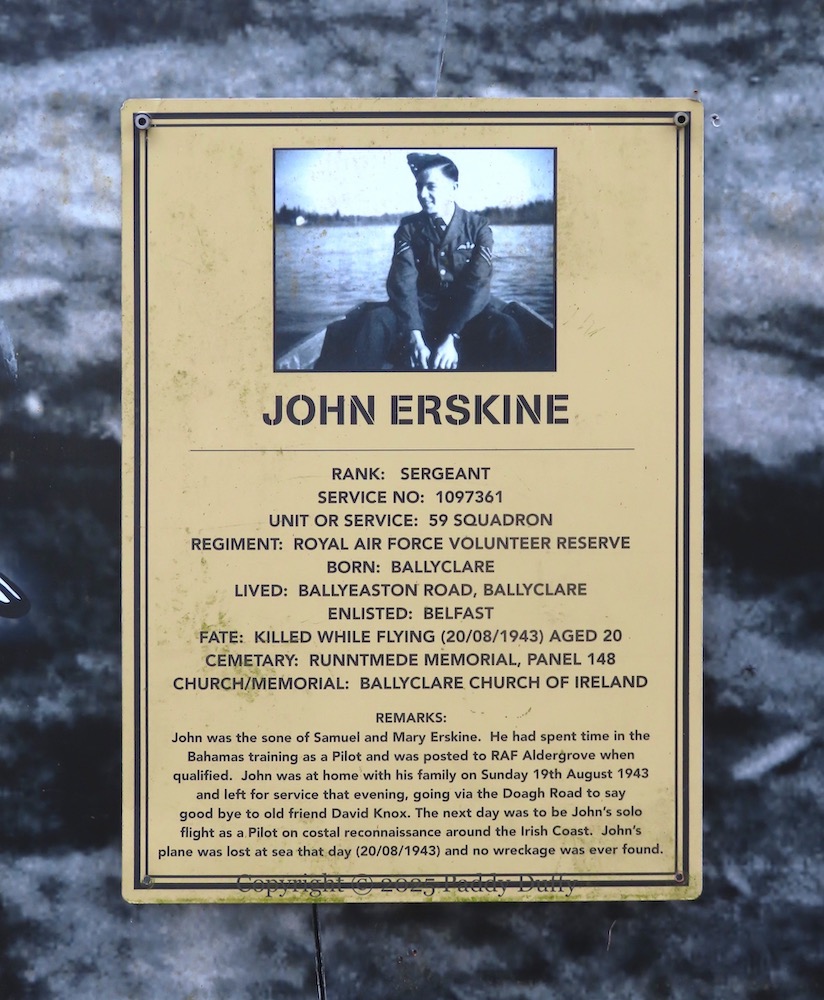
The Men From Ballyclare

The Men From Ballyclare & District was launched without the board along the fence/wall in front of the mural. The original post shows “UDA reserved” graffiti on the wall to the right. In 2021, there was some South East Antrim lettering to the right – see A0835. (For the SEA UDA in Ballyclare, see previously the companion WWI mural and 100 Loyal Men. Also, Belfast Live | Bel Tel.)

There is now a long board along the front. The two info plaques profile Edward Girvan and John Erskine, whose portraits are also featured in the larger mural, and between them are the emblems of the branches of the British Army: Merchant Navy, Navy, Army, and Air Force.

To the right of and out of frame in the image above, there is a Union Flag painted for the 75th anniversary of VE Day – see Street View.

Erskine Park, Ballyclare

Click image to enlarge
Copyright © 2023/2025 Paddy Duffy
T01817 [T01818]
T07246 T07245

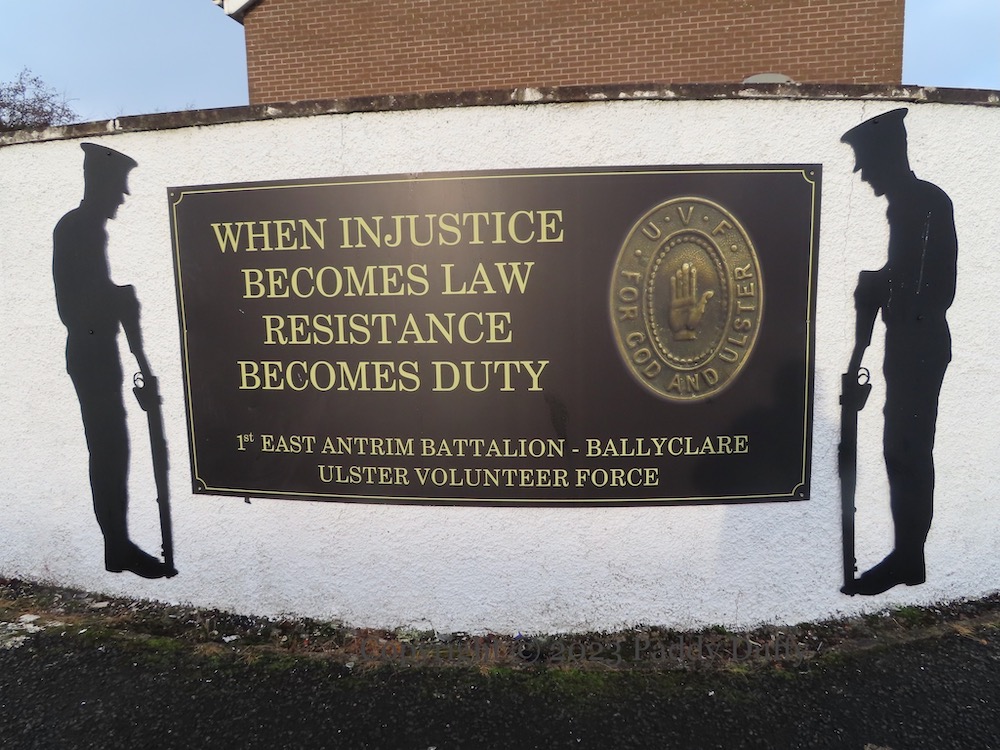
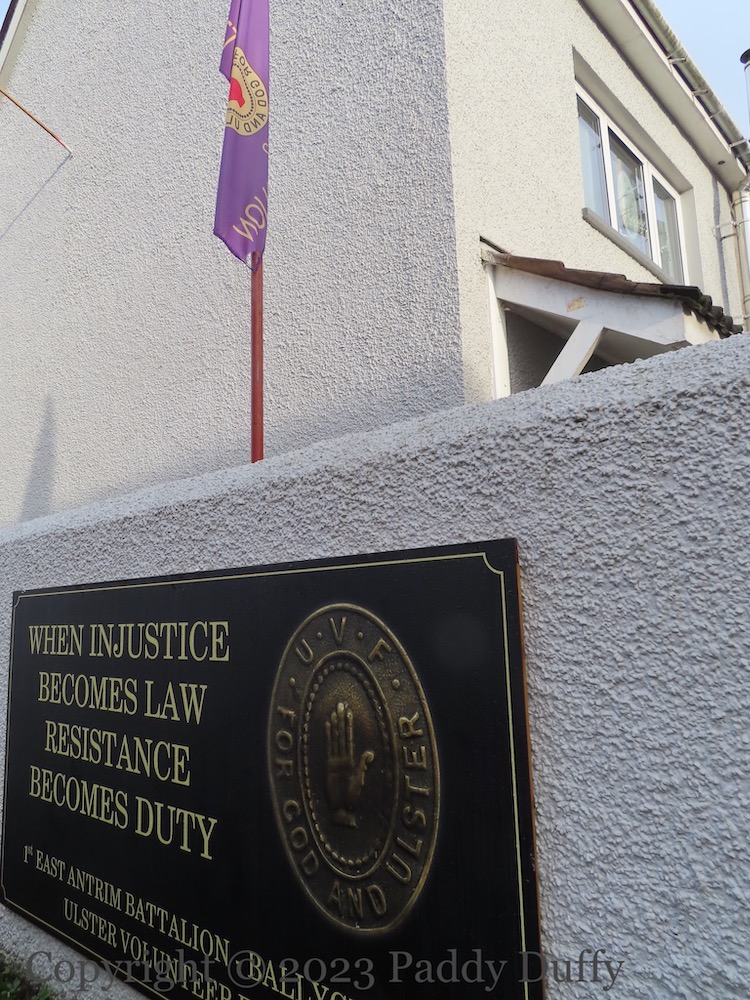
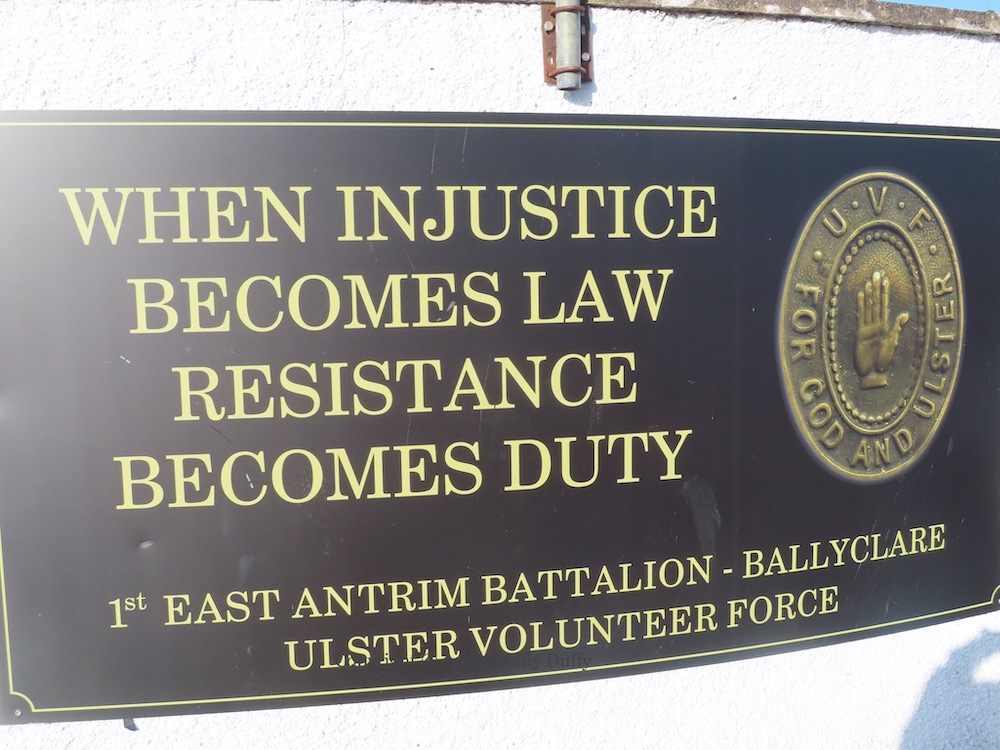
Resistance Becomes Duty

The phrase “When injustice becomes law, resistance becomes duty” is commonly but spuriously attributed to Thomas Jefferson (Monticello). It is used here by “1st East Antrim Battalion – Ballyclare – Ulster Volunteer Force” in the Grange and Erskine Park estates (Ballyclare) to protest Brexit and the NI Protocol. The graveside mourners, however, belong to WWI.

Previously on the gable in Erskine Park: The Heaneys.

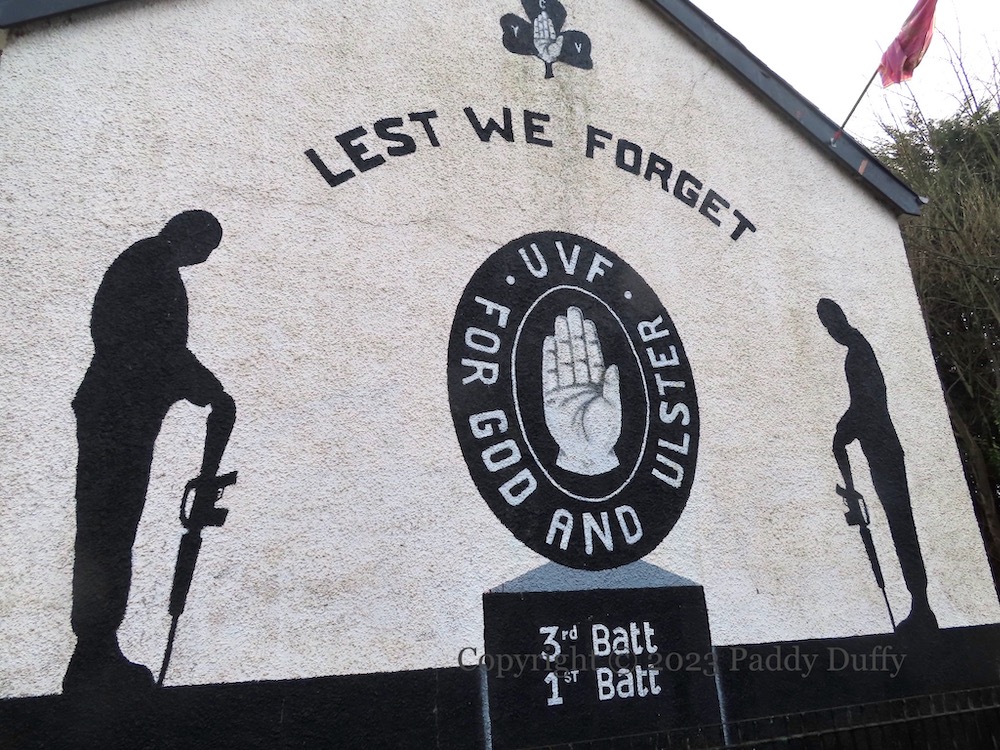
The one shown above is next to the 3rd batt/1st batt memorial – see Lest We Forget.

Click image to enlarge
Copyright © 2023 Paddy Duffy
T01803 T01825
T03687 [T03686]

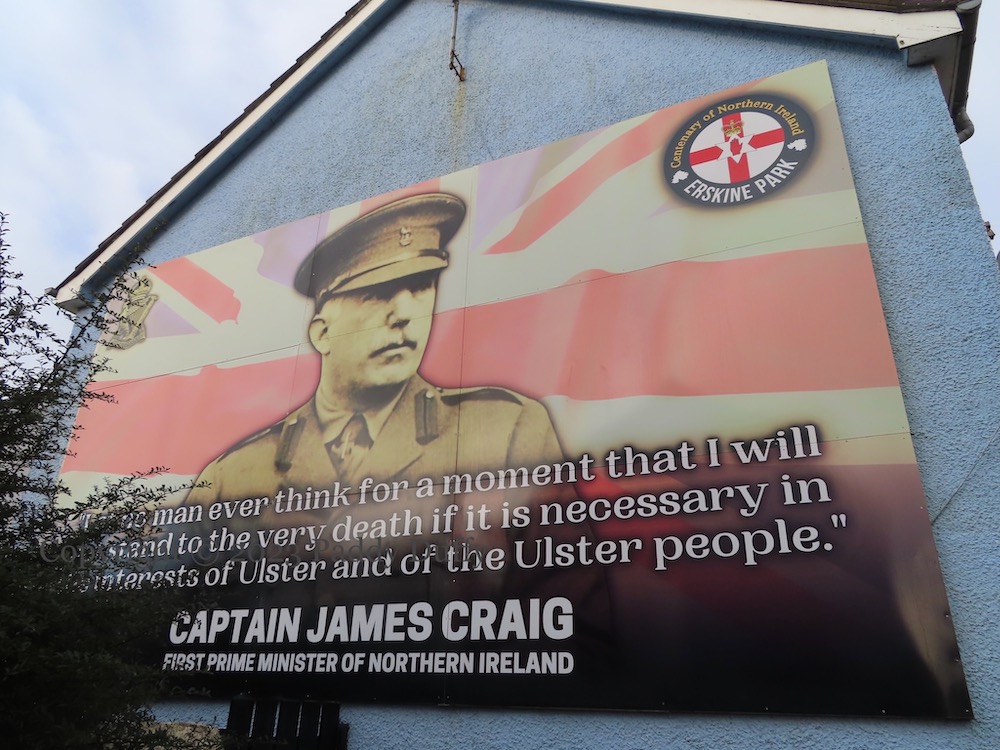
To The Very Death

“‘Let no man ever think for a moment that I will not stand to the very death if it is necessary in the interests of Ulster and of the Ulster people.’ Captain James Craig, first prime minister of Northern Ireland.”

To go with the fighting words, Craig is shown here in military uniform – though he was a young man when joined the Royal Irish Rifles and served in South Africa for two years (1899-1901), with the Imperial Yeomanry and the Imperial Military Railways. As the politician who was instrumental in the Ulster Volunteers and the creation of Northern Ireland (and prime minister until his death in 1940), he is usually shown in civilian clothes – see e.g. Floreat Ultona | Ulster Welcomes Her King & Queen | Because He Loves What Is Behind Him.

The source of the quote is unknown – please comment or get in touch if you can say what it is from. It’s also not clear what uniform Craig is wearing – the cap badge is the ‘lion on crown’ used e.g. by officers of the Devonshire yeomanry; it is perhaps a officer’s dress uniform for the Imperial Military Railways (though see the IMR pouch badge). Craig was also assistant adjutant to the 36th Division (DIB).

Erskine Park, Ballyclare

Click image to enlarge
Copyright © 2023 Paddy Duffy
T01815

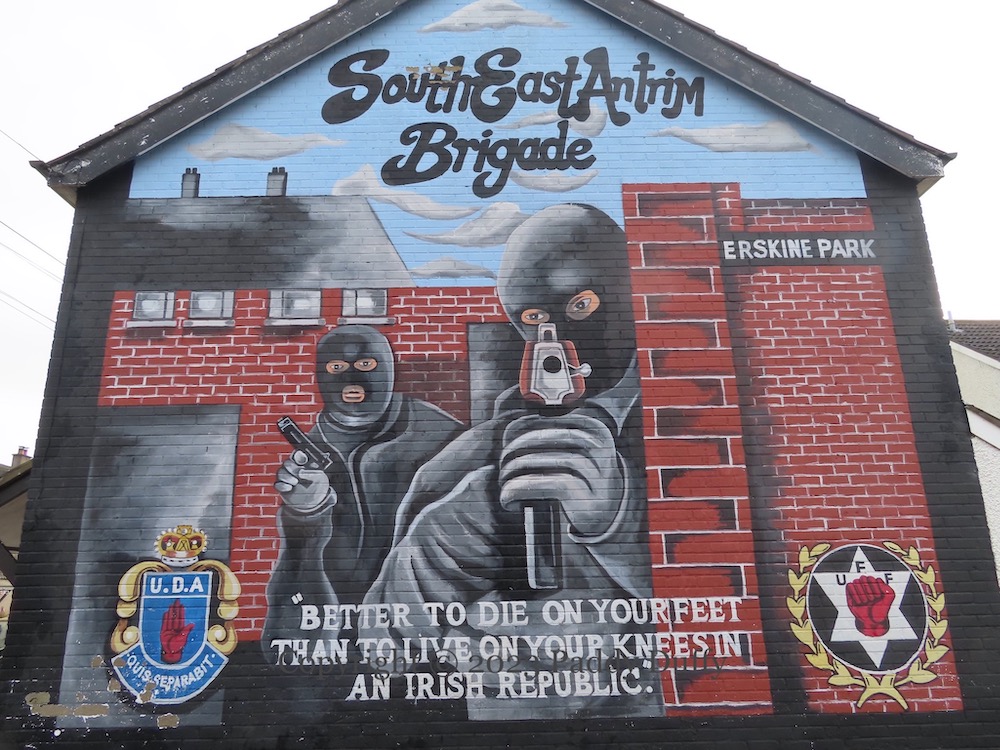
South East Antrim Brigade

UDA volunteers in balaclavas stand ready to defend Erskine Park (Ballyclare) against forces (from the south? from Britain?) that would implement ‘home rule’ in (north-east) Ireland.

“South East Antrim Brigade – “Better to die on your feet than to live on your knees in an Irish republic.” (A slogan from Mexican revolutionary Emiliano Zapata.)

Click image to enlarge
Copyright © 2023 Paddy Duffy
T01814

Your Country Needs You

“The UDA formed in 1971 as an umbrella for Loyalist Vigilante groups being formed. There [sic] role to defend the Protestant community from IRA violence. They remain today. Ask yourself this question: When the battle has been finally won, will I be able to stand and be counted amongst the men won it? Make sure the answer is yes – join your local unit of the UDA. Your country needs you.” This is an addition to the panels shown in Show No Mercy, Expect None Back.

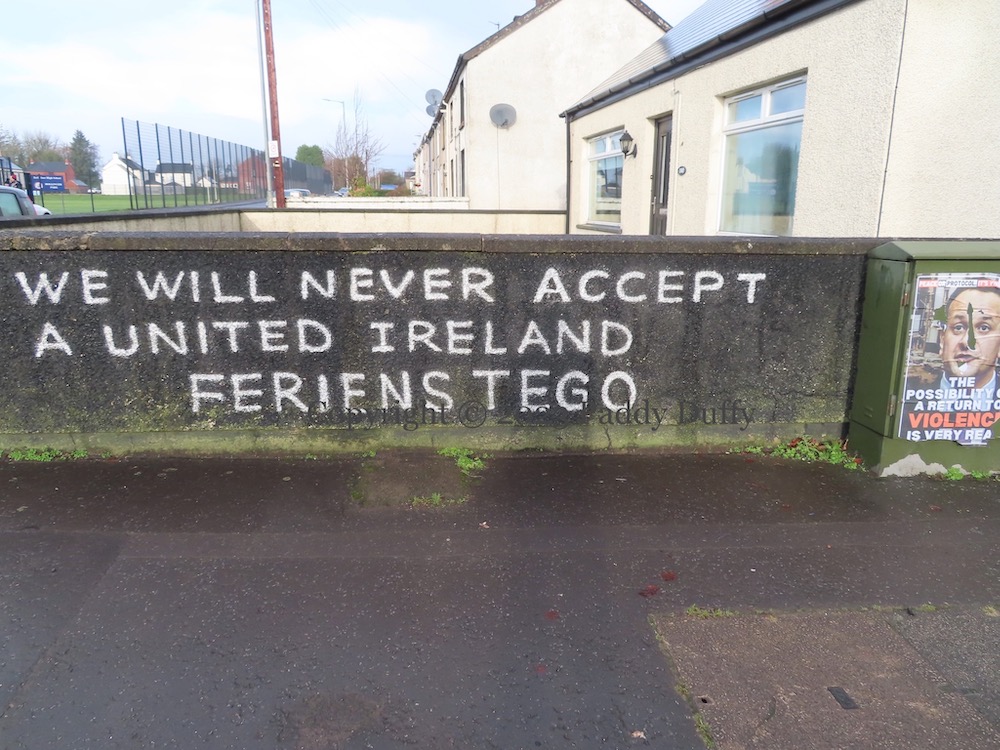
And (on the other side of the street) the tarp is an addition to ‘We Will Never Accept A United Ireland’. “We remember our culture, from the siege of Derry to the battle of the Boyne. ‘No Surrender’.”

For the Varadkar poster, Political Leaders Are Not Listening.

Click image to enlarge
Copyright © 2023 Paddy Duffy
T01823 T01820 T01821 T01822 T01819