This image of King Billy crossing the Boyne in 1690 is on the No Surrender lodge (LOL 241) in Donaghadee. King William III’s victory in Ireland is celebrated annually on July 12th, with parades and gatherings of fraternal lodges and flute bands.
William’s victory is joined here by a number of small boards commemorating the 80th anniversary of Victory In Europe, on May 8th, 1945, “remembered with pride” by Orange lodges 241 and 836 (Brother Henry Ferguson Memorial), Royal Black Preceptory 768 (Ulster), and Flutes And Drums Donaghadee (Fb).
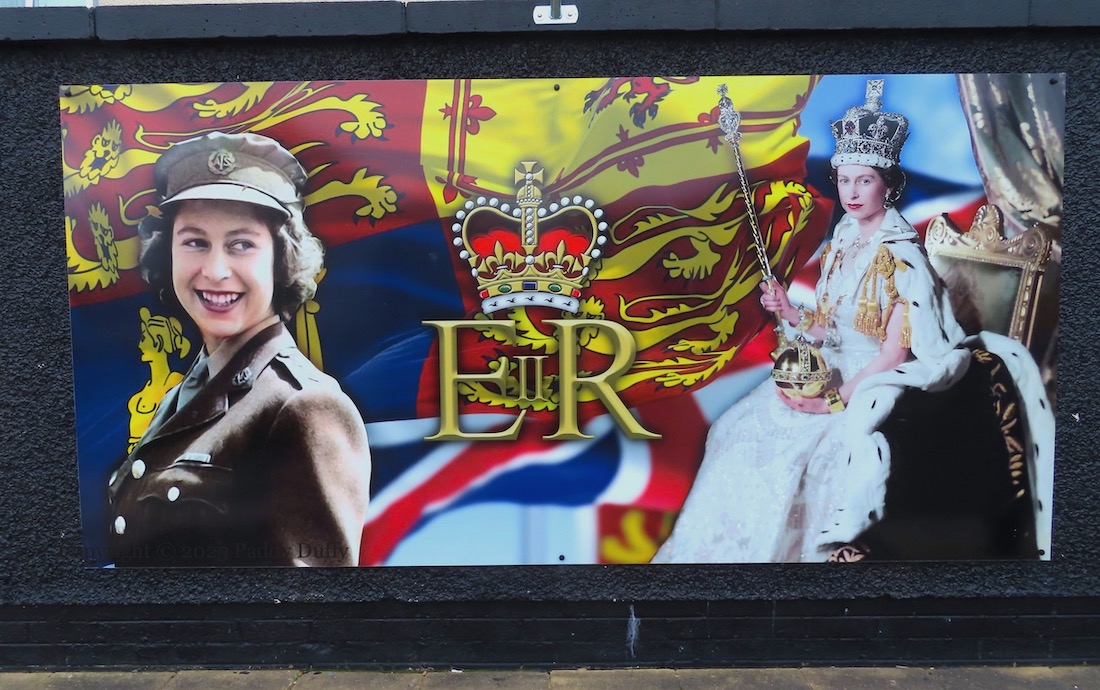
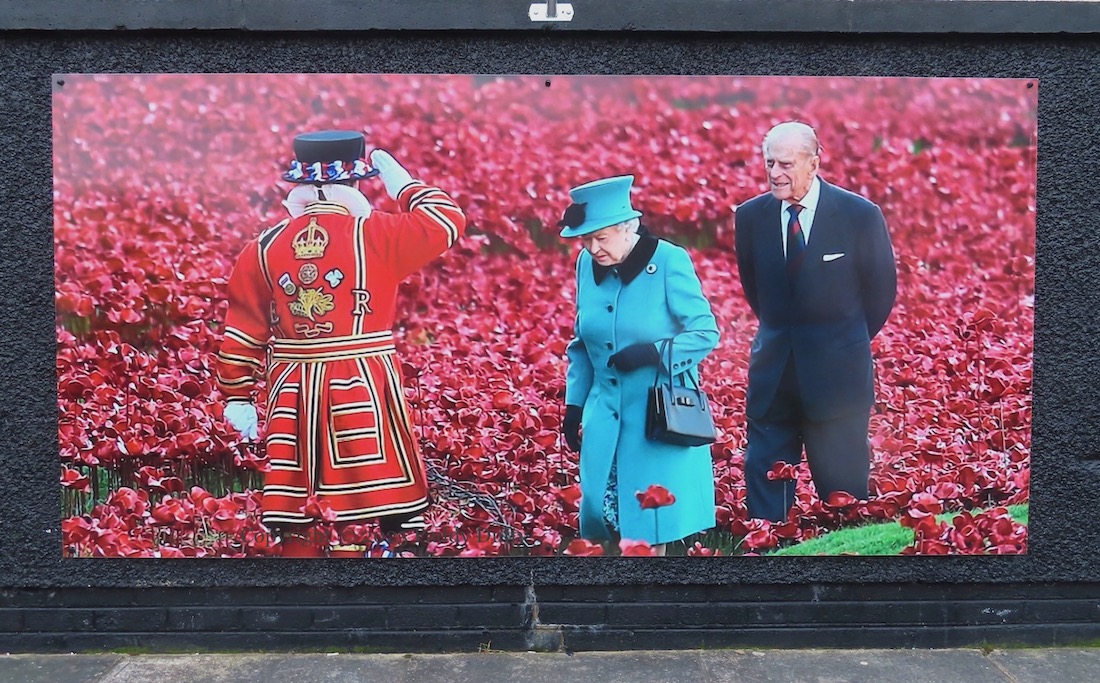
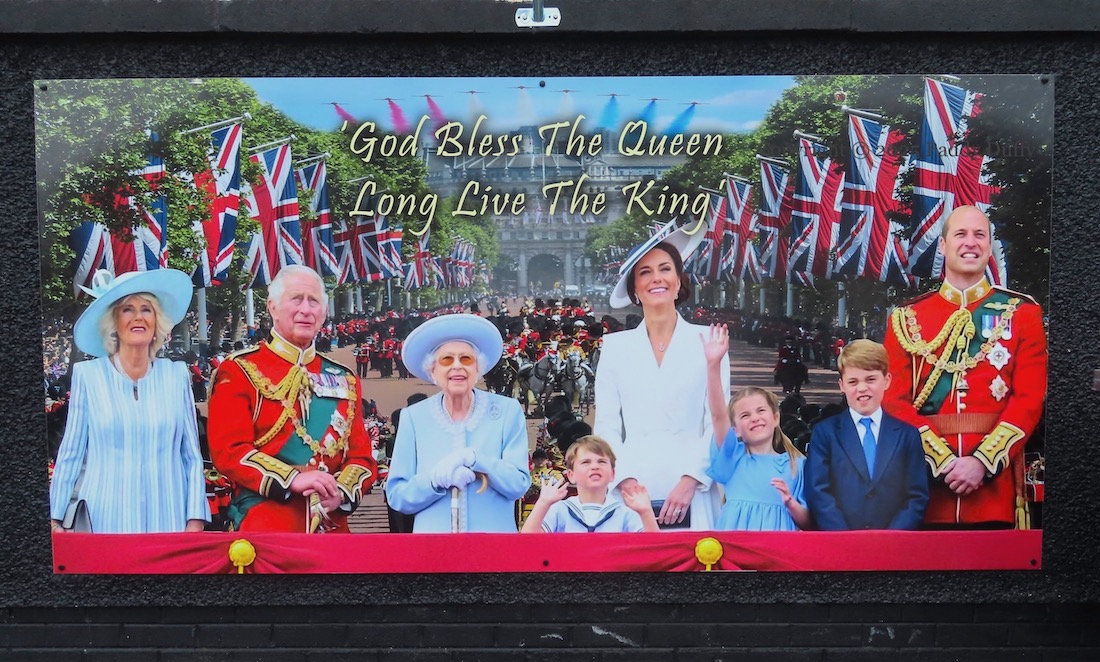
Manor Street, Donaghadee, replacing two Platinum Jubilee boards.
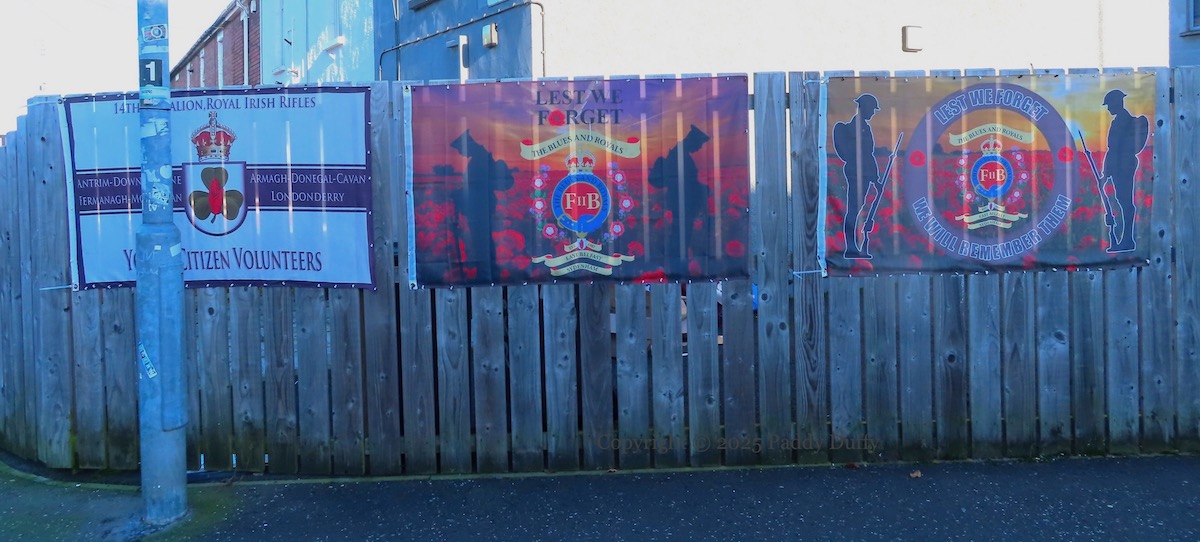
These two boards in the West Winds estate, Newtownards, were removed by the NIHE in May (BelTel) but restored in August (News Letter). One (above and immediately below) is from the First Newtownards Somme & Historical Society (old Fb page) and the other from the “East Belfast And North Down Veterans’ Association”, which does not appear to have an on-line presence.
The original NIHE statement cited in the BelTel piece mentions both the removal of paramilitary imagery and boards being placed on NIHE properties without permission. A meeting took place between the NIHE and the Somme Society which secured the return of the pieces (News Letter) and in August they were mounted again.
Blenheim Drive, Newtownards. Also included is the Society’s board on the Dakota Avenue shops.
West Winds received its first residents back in 1970 but celebrations of the estate’s fiftieth anniversary were made impossible by the coronavirus lockdown (Supporting Communities). The long board shown here – official title “West Winds Through The Decades” – was launched in 2022 and recounts the development of the estate and the institutions that support it.
Here (from the Fb group 50 Years Of West Winds) is an image of the area before development, which began with Canberra Gardens and the houses along the bottom of Blenheim Drive. The streets are named after RAF aircraft, as illustrated by the second panel.
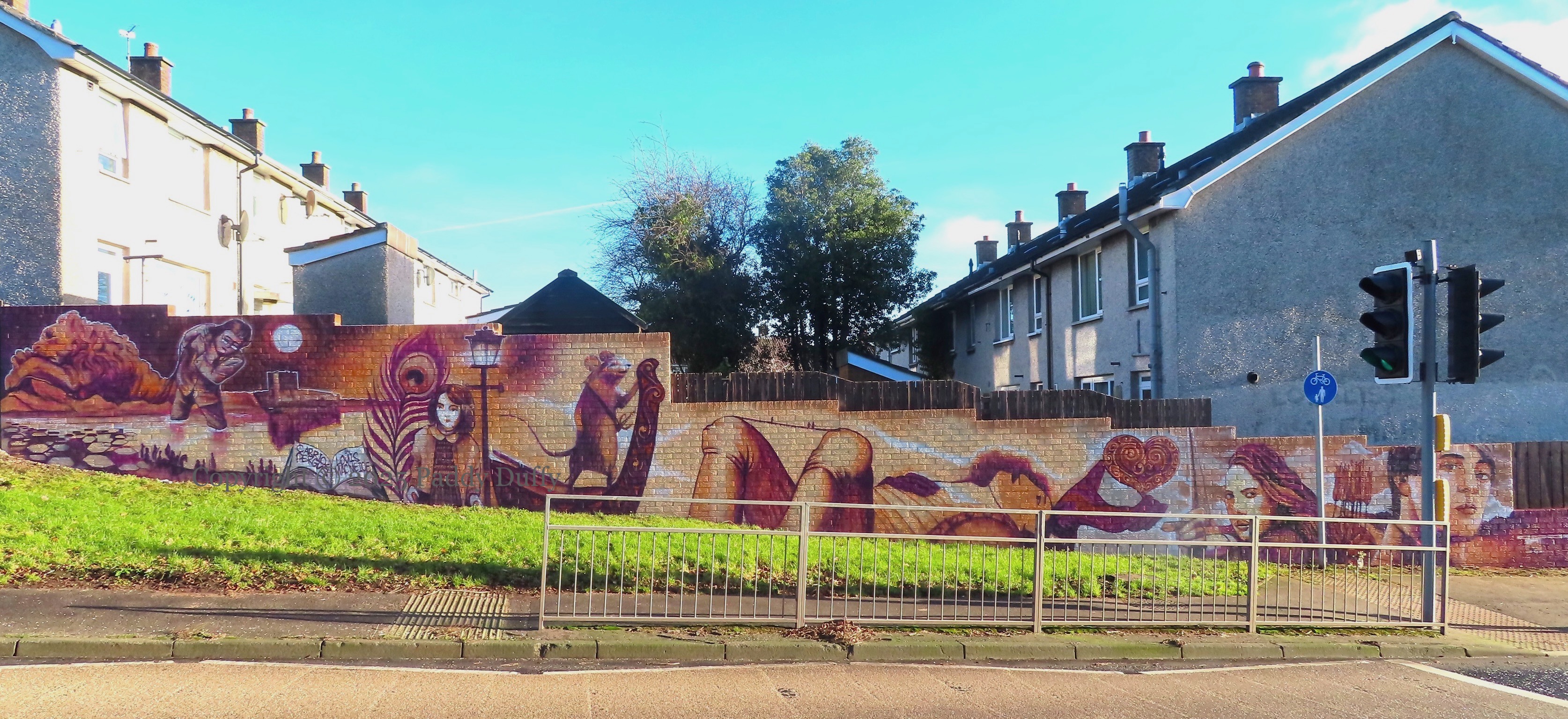
The third panel gives “A Brief History Of The Estate” (included below) while others describe West Winds primary school, First Newtownards Somme & Historical Society, Scrabo Presbyterian church, West Winds Community Centre, Towerview adult care, Little Doves childcare centre.
In Shackleton Walk, with support from the Housing Executive and West Winds Development Association (Fb).
“The first sod cut early 1969 and the initial tenants hailing from the Oldpark, Shankill, Ardoyne and Newtownards Road areas, arrived under Scrabo Hill to the new West Winds Estate in January of 1970. With the close location to Ards Airport, the street names were derived from RAF military aircraft which were used in WW2 through to the early stages of the Cold War. With the initial streets being Blenheim Drive and Canberra Gardens, this eventually developed into the wider estate as it is today with the help of a Residents’ Association and the Estate being taken under the wing of the newly formed Housing Executive, the street designers’ road layout provided a clear flight path to the airport in the growing roads. The Estate was planted with trees to reduce the strong winds prevalent in the area. Hence the name. Early tenants of note included the parents of Sir James Galway, ‘The Man with the Golden Flute’ and Lt Col Simon Nichols MBE, who instructed our future King, Prince William, and his younger brother Prince Harry at Sandhurst Royal Military Academy. The Tenants’ Association, formed by John McClelland in 1972 as Chairman and Miss Ruth Irvine as Secretary and assisted by other members including Miss Pat Shirley, Deaconess of the local church and Mr James Ingram began work in earnest with the development of the community centre, a sports complex with two football pitches, a tennis court, a hockey pitch, a playground, improved street lighting and a bus service for the growing number of tenants. There was also the West Winds Roadhouse Hotel, initially a part of the Officers’ Mess during the Second World War. It wasn’t long before the Towerview Resource Centre and Loch Cuan Nursing Facility were built. Both are still in operation today, with The Apex Housing Association taking over Loch Cuan, which now includes a supportive living complex on the grounds. In 1997 the West Winds Residents’ Association became active working with the local Housing Executive and various other statutory bodies to continue upgrading the Estate. Funded by SPOD [Small Pockets Of Deprivation] They are now now known as the West Winds Development Association and have been involved for the last 25 years, in Youth Clubs, Pensioners’ Clubs, upgrading of the park, formation of a ‘MUGA’ pitch, fun days, addressing housing problems, community gardens, teenage drop in, girls’ groups, boys’ groups, raised beds, Christmas Parties and numerous other activities and events to mention but not forgetting, the day to day striving to make the Estate a better place in which to live.”
The streets of the West Winds estate in Newtownards are named after RAF aircraft: Lysander, Beaufort, Shackleton, Valetta, Sunderland, Catalina, Auster, Canberra, Lancaster, Dakota, Hampton, Stirling, Blenheim, Anson, and Halifax. (See 50 Years And Counting for a picture of the aircraft.)
The first units built in the estate, in 1970, were Canberra Gardens and Blenheim Drive, just off the Comber Road.
“English Electric Canberra – bomber, photo-reconnaissance, trainer, interdictor, radio countermeasures, drone & target tug … the world’s first jet bomber … first jet aircraft to make a nonstop transatlantic flight … world altitude record”
“Bristol Blenheim – light bomber, night bomber, aerial reconnaissance, heavy fighter, maritime patrol & trainer … the fastest light/medium bomber in the world”
Also celebrated is flautist James Galway, whose parents lived in the estate for a time, and Greenwell Star (Fb) – “Bridging communities through football”. Club members were involved in painting over the UVF mural on the side of the club’s changing-rooms in March (Fb), in preparation for the new board being mounted in April.
West Winds Development Association and Newtownards Cultural Society with support from the Housing Executive (Newtownards Chronicle)
Tartan gangs were a short-lived phenomenon in the early 70s, bridging the gap between youthful trouble-making and para-militarism. The gangs as entities distinct from youth wings of paramilitary groups had largely disappeared by the late 70s, and the teens and young adults who were members then are now in their sixties and seventies and some have passed away (“No silence is louder, than the absence of a voice you used to hear every day. Semper recordatus”). This new (July 2025) board commemorates the camaraderie of the Woodstock Tartan in those early days: “We are young, we are one, we are tartan”.
The name “tartan [gang]” comes from the tartan clothing, particularly scarves, worn by the gangs. Gareth Mulvenna (2014 and in History Ireland) reports that the first pattern worn by the Shankill Young Tartans was in fact the Burberry tartan – a box of scarves was stolen during a trip to a Rangers match in Glasgow – but they later adopted the Royal Stewart tartan, which is predominantly red rather than tan. (It was made famous by motor-racer Jackie Stewart, who wore a tartan sticker on his helmet (Henry Ford).) The Woodstock tartan pattern (shown in the new board) is the ‘dress’ (white) variant of the Royal Stewart tartan.
The speakers at the board’s launch (Loyalist East Belfast on youtube) recall the activities (and fashions) of the Woodstock gang in the early 70s – building bonfires, attending matches, holding running battles with other gangs – and only obliquely mention the turn towards sectarian violence, ultimately joining the Red Hand Commando in 1972 in response to IRA attacks such as at the Four Step Inn (Mulvenna). In this 7-minute TV report about the Woodstock Tartans from May 1972 (youtube), an interviewee distinguishes the Tartans in east Belfast from gangs in England as defenders of their area: “when IRA mobs come out [from Short Strand] and attack this Protestant area, we have to beat them back, as the soldier don’t seem able to do this.” (See also this Time interview.)
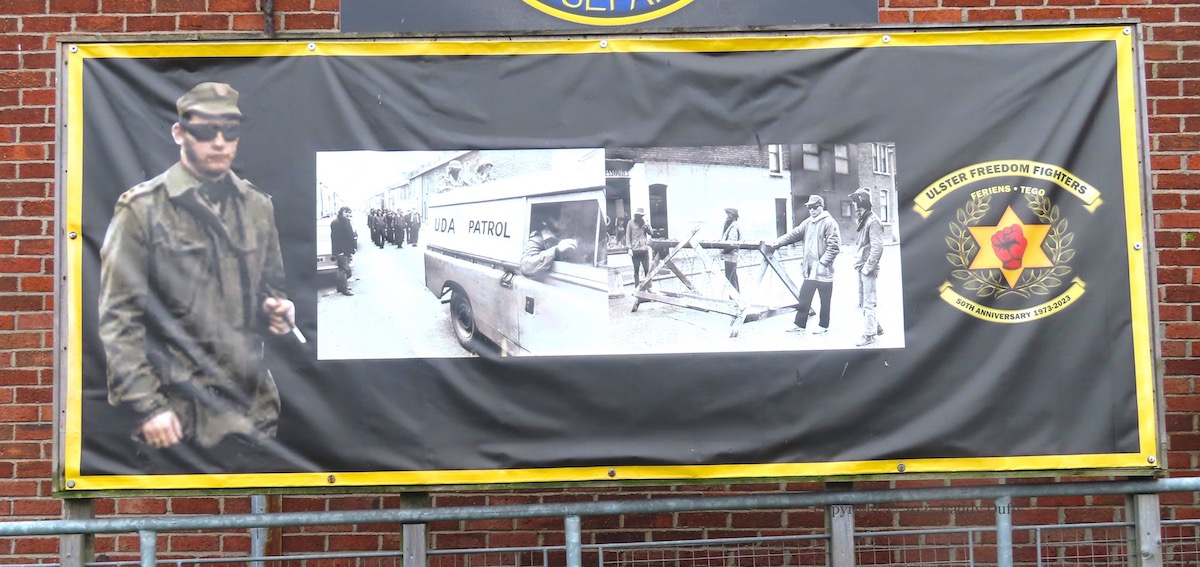
The Sergeant Lindsay Mooney Memorial Flute Band was formed in 1973 after the St. Patrick’s day death of Lindsay Mooney, a UDA member killed by the premature explosion of a bomb near Lifford, County Donegal (Sutton). The band was not in operation between 1993 and 2013 (NI World) but re-formed some time around 2021. This new piece replaces the faded board seen in 2023’s In A Foreign Land.
“‘Nothing great and durable can be created without the presence of an elite’ – SLMMFB” with a list of battalions from the Londonderry And North Antrim brigade of the UDA: Londonderry, Coleraine, Ballymoney, Ballymena, Bushmills, and “South Londonderry & East Tyrone”.
The quotation (“Nothing great and durable …”) seems to be a UDA creation; it has been used in other UDA murals in east Belfast (T00245) and Larne (J1611/J2039).
The emblem in the top left of this board is the original emblem of the Irish Football Association. The Association was formed in 1880 by seven Belfast clubs but after partition a rival Football Association Of Ireland was formed and the original body eventually represented only Northern Ireland. (WP)
All of the players named and pictured post-date 1950, when the IFA stopped selecting southern players for the IFA’s team. They are … Tommy Jackson, Billy Caskey, Phil Gray, Tom Finney, Norman Whiteside, Danny Griffin, George McCartney, Alf McMichael, Tommy Cassidy, Robbie Garrett, Brodie Spencer, Jordan Owens, Billy Ferguson, George O’Boyle.
“AONISC” (bottom left) is the Amalgamation Of Northern Ireland Supporters’ Clubs (web). There are about 60 clubs in the amalgamation, but seven local clubs are named here: Albert Foundry, Woodvale Loyal, Tavern GAWA, Bootle Street, Wheatfield, 1st Shankill, Ligoniel.
In Battenberg Street on the side of the Stadium Bar and off-sales.
The house in Bond’s Place that had been home to an Eddie mural for many years was torn down in the summer of 2021; it had been used since at least 1982 for images of the Commonwealth, King Billy, and, since 1996, Eddie The Trooper. The final Eddie board that was on the wall has been moved one neighbourhood over, into Lincoln Court. It was the first to include the words “Spirit Of ’93” – presumably a reference to the Greysteel Massacre in which eight people in the Rising Sun bar were killed in reprisal for the Shankill Bombing (BelTel). The “raid” was planned in – and both gunmen rented rooms at – the UDP office on Bond’s Place, just across Bonds Street (NI Judiciary).
“SLMFB” is the Sergeant Lindsay Mooney Flute Band, though it is more fully the “SLM Memorial FB“.
“Shankill Protestant Boys [Fb] “The People’s Band” 45th anniversary, 1980-2025.” The band held a parade on August 1st to commemorate the anniversary, with nearly forty other bands attending (Fb).
Wreaths are laid at the Bayardo Bar memorial on the Shankill Road on the fiftieth anniversary of the attack, which involved the shooting of two people at the door and the bomb being left at the entrance, which caused the deaths of a further three people: “In memory of five innocent Protestants slaughtered here by a republican murder gang on 13th August 1975. William John Gracey aged 63, Samuel Gunning aged 55, Joanne McDowell aged 29, Hugh Alexander Harris aged 21, Linda Boyle aged 17. Erected by the Bayardo Somme Association. “A forgotten atrocity”.” Fifty other people were injured in the attack.
Here is an opinion piece in the BelTel claiming that “republican communities … have been far more active not only in memorialising violent events impacting upon them, but also campaigning for the truth about those actions … the lack of balance in how the past is being investigated here has created a one-track, green-tinted narrative”.
See also: the memorial in 2023. Included here are close-ups of two recent plaques, one “In memory of Neily Reid Scotland, true friend of the Bayardo Somme Association, died 4th February 2022. Lest we forget.” and the other “In memory of Billy Boyce, loyal friend of the Bayardo Somme, died 19-12-2018. Lest we forget.”