The sixth mural from the Bogside Artists commemorates the 1980 hunger strikes, first in Long Kesh and subsequently in Armagh Women’s Prison. The main figure is Raymond McCartney; the female figure is perhaps Mary Doyle (the other two female strikers were Maıréad Farrell and Maıréad Nugent).
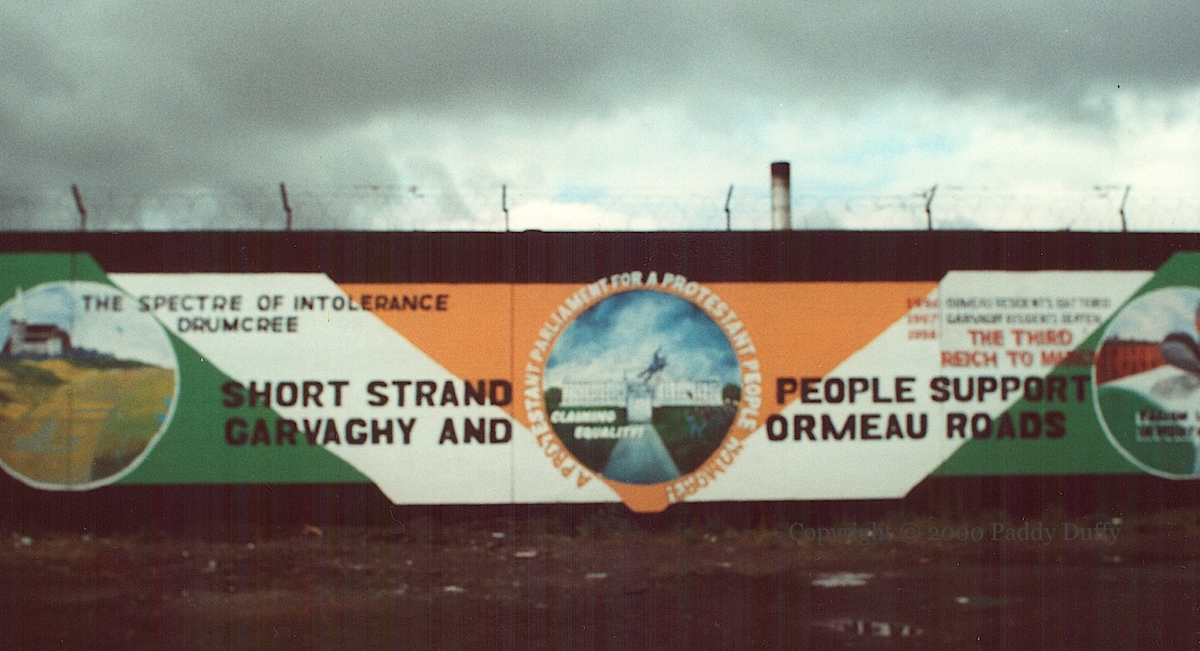
Northern Ireland’s first Prime Minister, James Craig, said in 1934, that Stormont was “carrying on a Protestant Government for a Protestant People” (NI Parliamentary Debates), though the phrase has now been transformed into the doubly alliterative “A Protestant parliament for a Protestant people”. In the centre of a long mural at the waste-ground at the top of Mountpottinger Road, people carrying Irish Tricolours tear down the statue to Northern Ireland’s most prominent leader, Sir Edward Carson, that stands outside Stormont, “claiming equality”.
The main issue that has tested the resolve of governments both local and national to the equality declared in the 1998 Belfast (Good Friday) Agreement is Orange Order parading through nationalist areas, such as the Garvaghy Road below Drumcree church in Portadown, and the Ormeau Road in south Belfast.
“Short Strand people support Garvaghy and Ormeau Roads.” On the left: The spectre of intolerance – Drumcree.” Centre: “A Protestant parliament for a Protestant people no more!” On the right “1996: Ormeau residents battered; 1997: Garvaghy residents beaten; 1998: The third reich to march.” and “Fascism lives! in Portadown”.
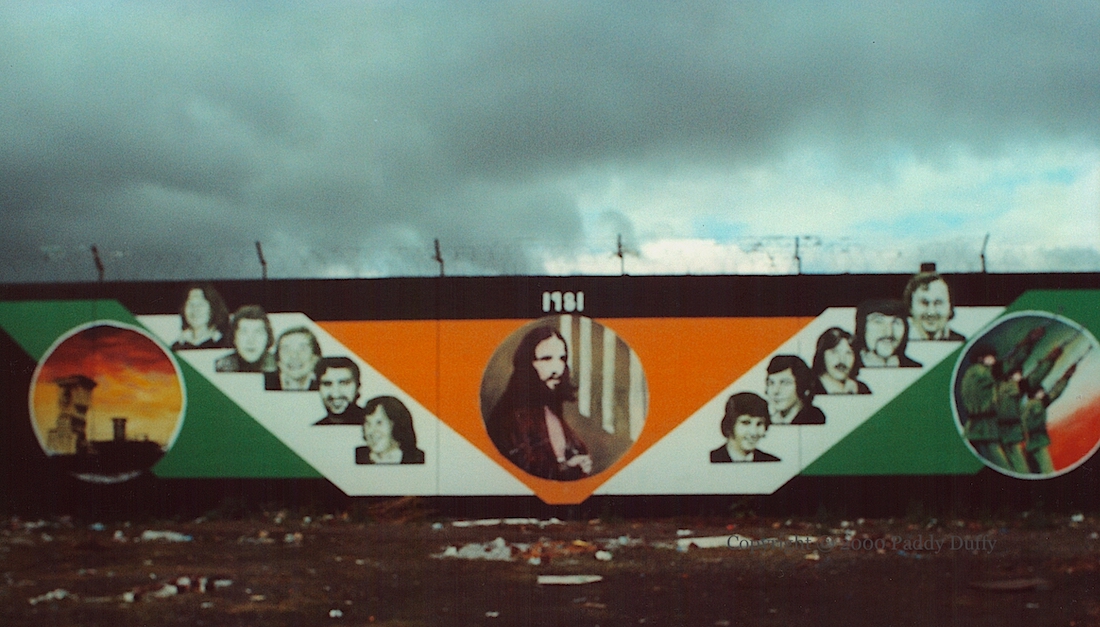
The piece is next to a hunger-strikers commemoration piece with ten portraits on shaped wooden boards against a painted background with blanket-man Hugh Rooney in the center. Between the two is a “spirit of freedom” lark and the names of the ten deceased 1981 strikers.
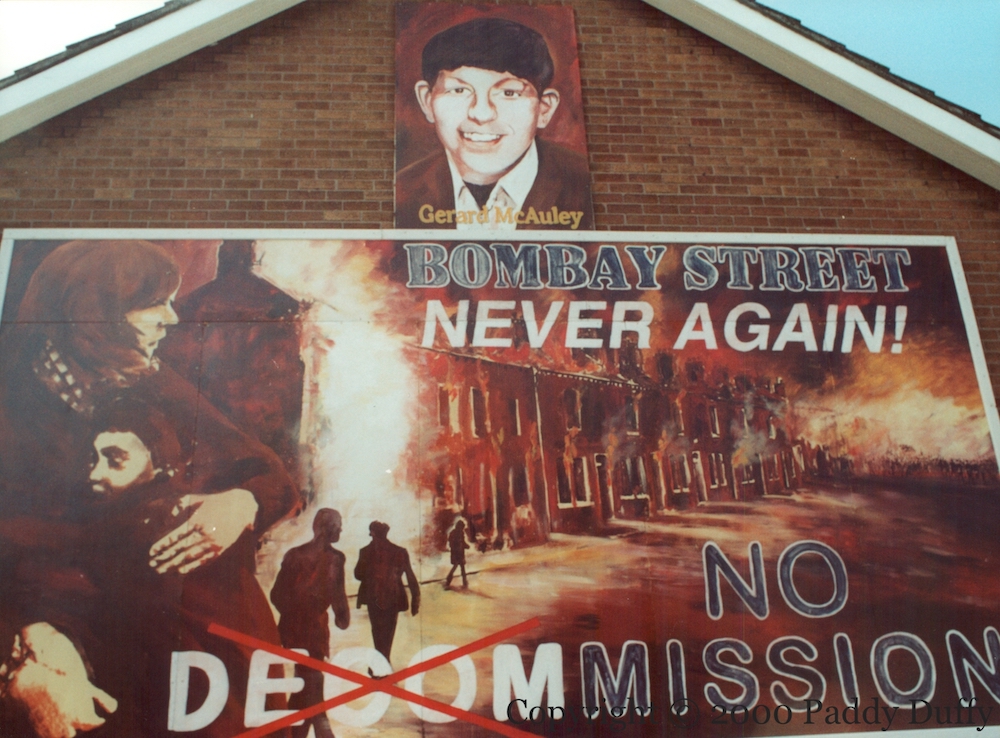
In August, 1969, families, mostly Catholic, were driven out and their homes burned in Bombay Street (and surrounding streets), between the Falls and Shankill (RTÉ news report). The defenselessness of the community then is reflected in the urging for “No decommission” in the present. Fıan Gerard McAuley (aged 15) was shot in nearby Waterville Street.
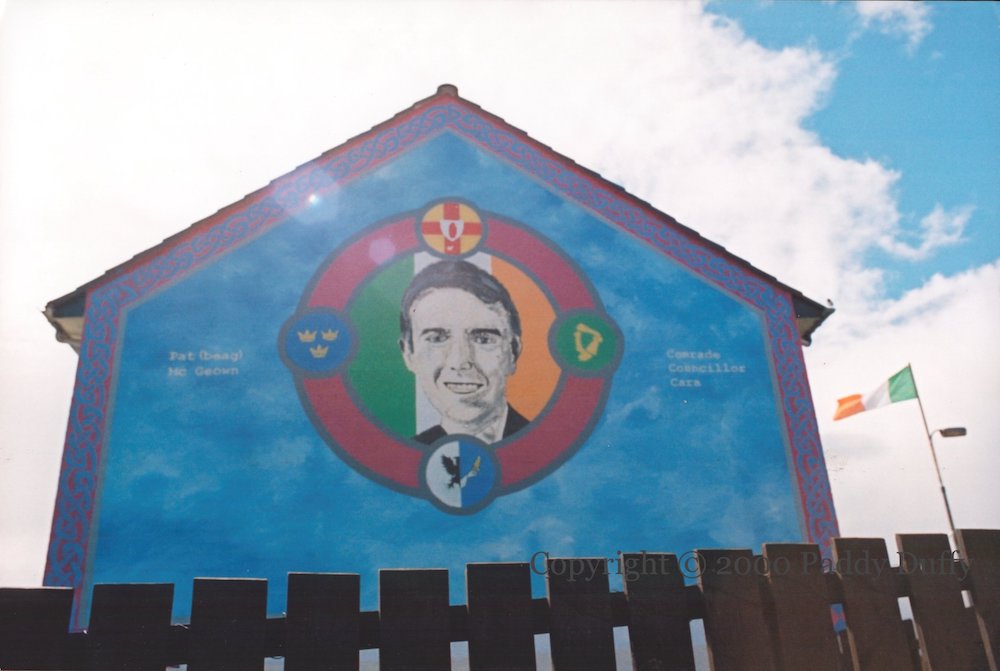
“Comrade, councillor, cara [friend].” Pat McGeown was a 1981 IRA hunger striker whose family intervened when he lapsed into a coma. After his release in 1985 he also worked for Sınn Féın and was elected to Belfast City Council in 1993. He died in 1996 of a heart attack. He is also remembered by a plaque on the Sınn Féın office on Falls Road.
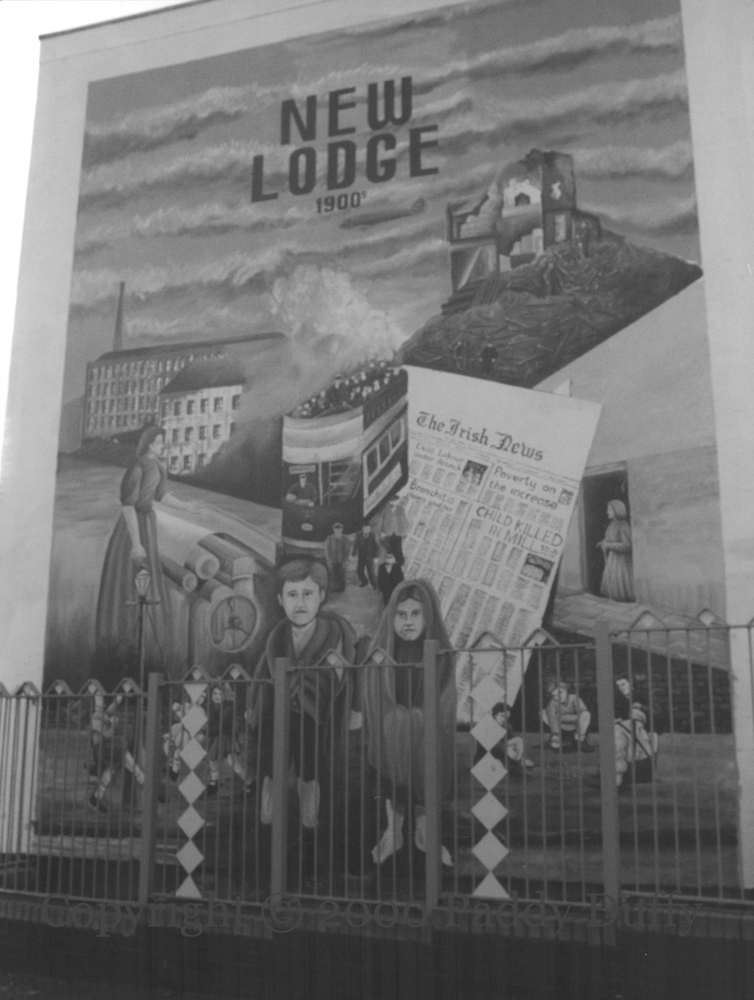
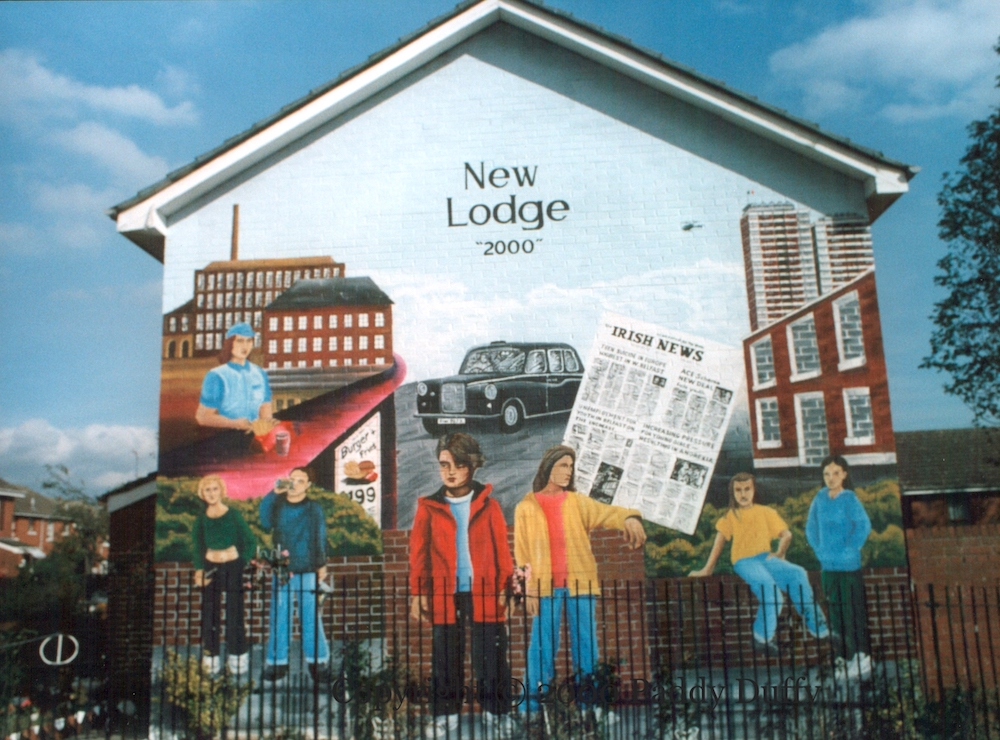
This pair of murals, on the New Lodge Road, Belfast, contrasts life for young people in the black-and-white “1900s” to life in colourful “2000”. Instead of working (and dying – in the headlines from the Irish News) in mills, they work in fast-food restaurants and drive black taxis (and suffer unemployment, suicide, and anorexia – again, in the newspaper), and instead of playing in the streets and wrapping themselves in blankets, they sit on walls and drink.
There was originally a memorial to Bobby Sands and painted crests of the four provinces below this phoenix emerging from the flames – see M01001 from 1991. It was originally painted by Mo Chara Kelly in 1987.
“Our laughter will be the joy of our victory + [the] joy of the people; our revenge will be the liberation of all.” This is perhaps the only appearance of this quote from Bobby Sands’s hunger strike diary, from Thursday March 12th. In the background are the towers of Long Kesh; in the foreground is Sands’s funeral procession (RTÉ | youtube).
On the left, the Belfast/Good Friday Agreement establishes “The right to freedom from sectarian harassment” but, on the right, the Orange Reality involves “10 Catholics murdered as a result of Drumcree, 150 Catholic homes petrol bombed, 1350 Catholic families forced out, many dozens or pipe bombs, attacks on Catholic homes”. The left-hand panel shows the cover of the Agreement booklet that was sent to every household ahead of the vote, showing a family of four silhouetted against a sunset; the right-hand panel shows the same family, but the source of light is now burning houses.
This is a complete version of Bobby Sands’s poem The Rhythm Of Time, along with the names and portraits of the ten deceased 1981 hunger strikers, and Michael Gaughan and Frank Stagg, who died on hunger strike in England.
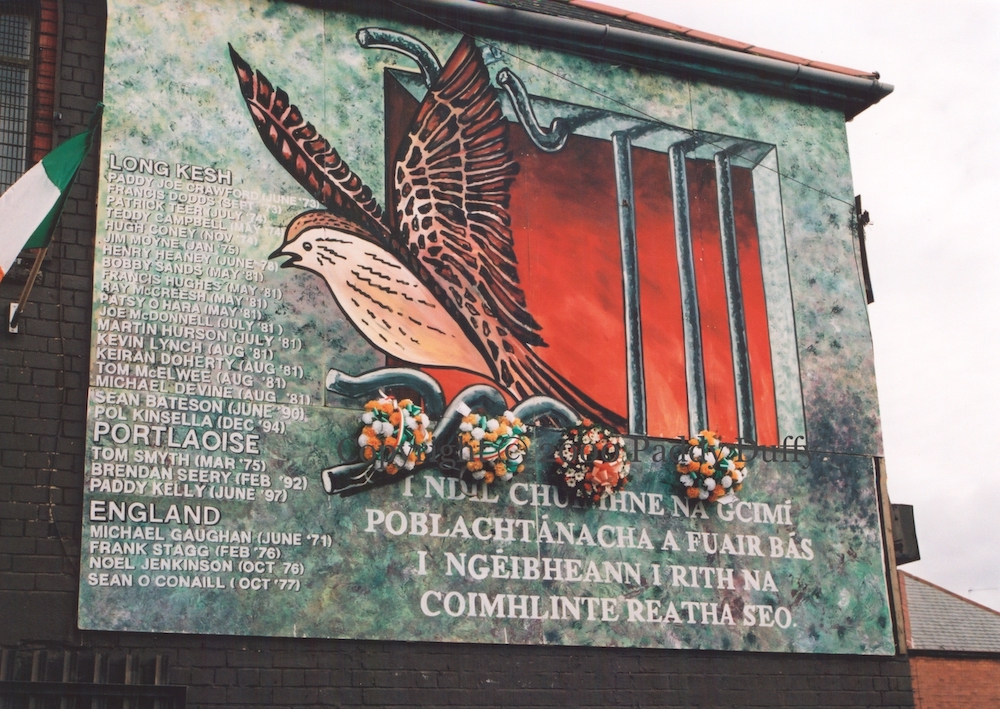
“I ndıl chuımhne na gcımí poblachtanacha a fuaır bas ı ngéıbheann ı rıth na coımhlınte reatha seo.” A lark bursts through prison bars of Long Kesh, Portlaoise, and prisons in England, in which republicans have died from the 70s to 90s.





 Paddy Duffy Collection