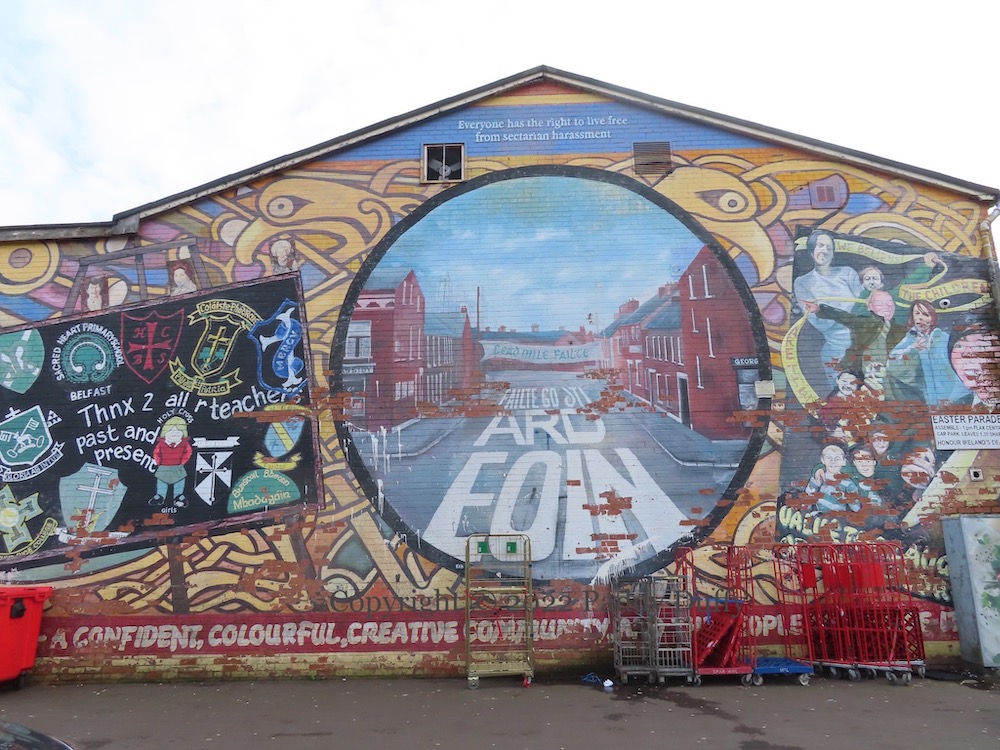
“Fáılte Go Dtí Ard Eoın. Ardoyne – a confident, colourful, creative community, and the people who made it so” particularly the local schools, whose insignia are shown on the left: “Thnx 2 all r teachers past and present.” The previous mural in this spot (M01783) is invoked by the banner across the top: “Everyone has the right to live free from sectarian harassment” and the inclusion of Holy Cross Girls among the schools.
Whitney Houston and Bobby Sands are invoked on the right “We believe the children are the future – value the laughter of our children“.
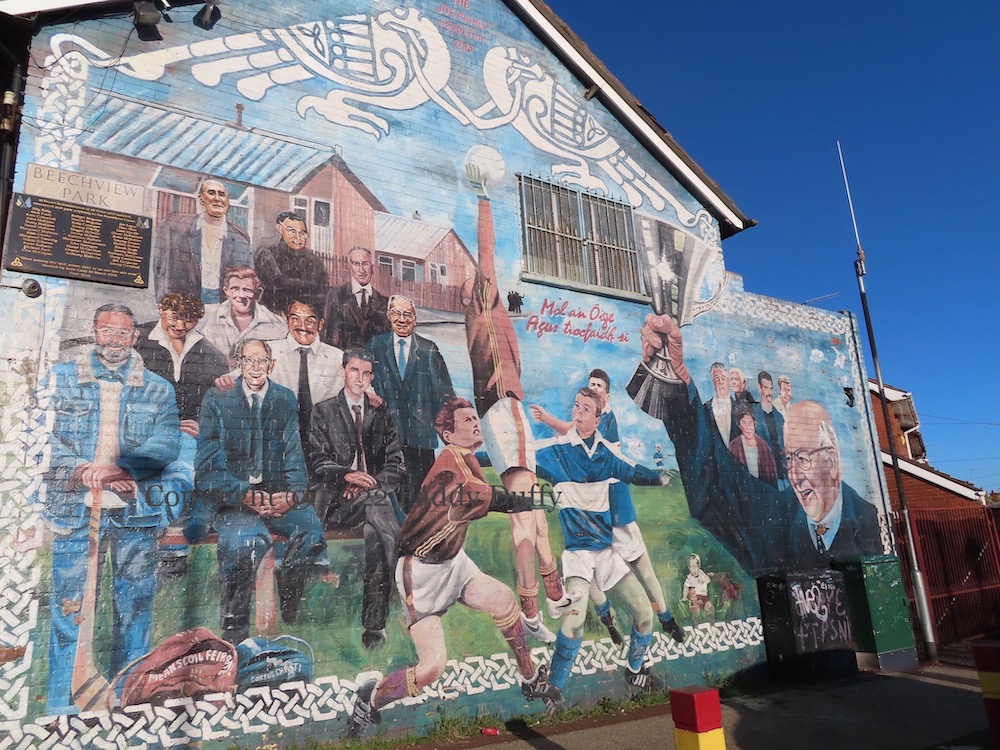
“Mol an óıge agus tıocfaıdh sÍ”. [Praise youth and it will flourish/Youth responds to praise] Above is the Joe Cahill mural in Beechview Park, next to the GAA pitch. The mural was unveiled on September 2nd, 2013. (Images of the unveiling from An Phoblacht.) Joe Cahill (WP) holds the cup aloft. The group in the bottom left corner (see the second image, below) are Pat O’Hare, Frank Cahill, Tom Cahill, (the three Cahills were featured in the previous mural) Ned Maguire, Jr., Ned Maguire, Sr., Alec Crowe, Paddy Meenan, Tommy Crowe, Dal Delaney, and Hugh Elliot. In the crook of Cahill’s arm are Rita McParland, Sean Wallace, Paddy Corrigan, John Pettigrew, and John Stone. None of these adults is still alive; all were from the local area.
The chalet bungalows in the background on the left are gone, but you can see images of them on the Belfast Forum.
The plaque on the left names others in addition: Billy Kelly, Alice Cush, Kate Campbell, John Mulligan, Mary Mulligan, David Mulhern, Margaret Mulhern, John Clarke, Margaret Farrelly, Marie Williams, Kevin Sullivan, Michael Rock, John McColgan, Bridget Maguire, Martin Maguire, Sally Corrigan, Sonny O’Reilly, Maggie McArdle, Jimmy McArdle, Kathleen Wallace, Maragret McGuinness, John Flanagan, Maisie McGuckian, Charlie McGuckian, Anthony Muldoon, Jim Logue, Ellen Weir, Liam Mackie, Oliver McParland, Sadie McMahon, Tommy Crowe, Maddie Holden, Sarah Doyle, Jimmy Doyle, Kathleen Pettigrew, Mary Cushnihan, Bell Cosgrove, Gerry Campbell.
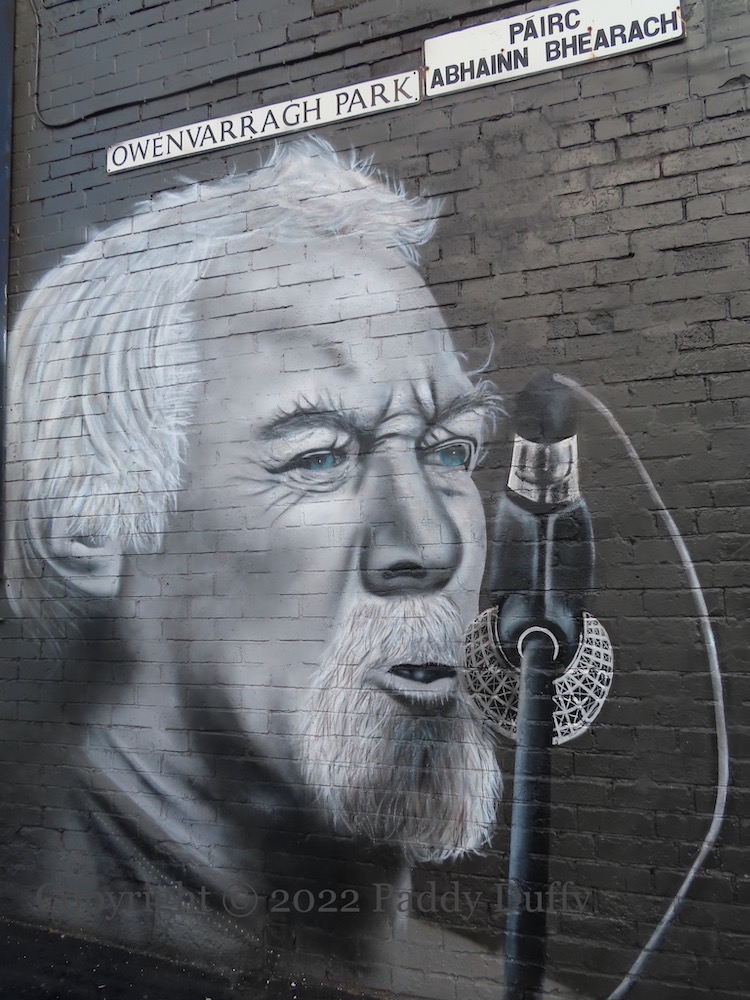
The career of Belfast blues/rock guitarist Rab McCullough spanned more than five decades, beginning with the formation of Baraka back in the 1970s, and included opening for Jimi Hendrix and a 20-year residency in the Empire. McCullough died in May (of 2021) after suffering a heart attack while swimming in Andersonstown leisure centre (BBC | BelTel | Belfast Media | Love Belfast). McCullough’s family is maintaining his Facebook page.
The mural was painted in Owenvarragh Park/Páırc Abhaınn Bhearach near his former home by Glen Molloy (ig). (Belfast Media)
A succession of Irish rebels is shown in this new mural in Andersonstown, west Belfast. It begins (top left) with the rebellion of 1798 and then to the Easter Rising of 1916 at the GPO in Dublin. In the lower left, a pious Padraıg Pearse awaits his execution with rosary beads in hand. There are then shown female figures from Cumann Na mBán and the IRA (see previously: United Irishwomen, Do You Care? and Mothering Sunday In Beechmount), and then Maıréad Farrell in Armagh Women’s Prison (for the original, see Prison Walls). In the bottom right corner there is a blanketman. The busts of Bobby Sands and Joe McDonnell float above the GPO and the last verse of Sands’s The Rhythm Of Timeform the epigraph: “It lights the dark of this prison cell, it thunders forth its might, it is the undauntable thought, my friend, the thought that says, “I’m right”.
On the side wall, “Ag fíorú na poblachta” means “Realising the republic”. It celebrates the centenary (“Céad Blıaın 1916 – 2016”) of the Easter Rising and shows a copy of the proclamation of the republic and an Easter lily. The next wall over (see below) shows portraits of the seven signatories to the Proclamation: Joseph Plunkett, Sean Mac Dıarmada, Thomas Clarke, James Connolly, Patrick Pearse, Eamonn Ceannt, and Thomas McDonagh.
This is and old (2009) repaint of the mural in the Markets to IRA volunteers: They are: Tony Nolan, Joseph Downey, Frank Fitzsimons, Joey Surgenor, Paul Marlowe, Jim Templeton, and Brendan Davison.
One of the first casualties of the Easter Rising, on the evening of Good Friday, was Belfast-born Charles Monahan (Charlie Monahan, Cathal Ó Monacháın/Ó Muıneacháın), who died along with Con Keating and Daniel Sheehan in a motor accident in Kerry, when their car – which only had one headlamp – was driven off a pier. His body was not found until October 30th. The driver, Tommy McInerney – shown here studying a map – survived. This mural is in the Markets; Monahan is also claimed by east Belfast and a 2006 mural to him was painted on Mountpottinger Road (Visual History).
“Born in Riley[‘s] Place in the Market area of Belfast, Charles was one of many people who left Belfast to take part in the events leading up to the Easter Rising. Charles[‘s] role was to meet up with 3 other vols and help guide Roger Casement (top left) land a ship full of weapons. On the 21st April, 1916, the driver took the wrong road and drove off the pier into the Laune at Ballykissane. Charles, 37, drowned along with two of his comrades.”
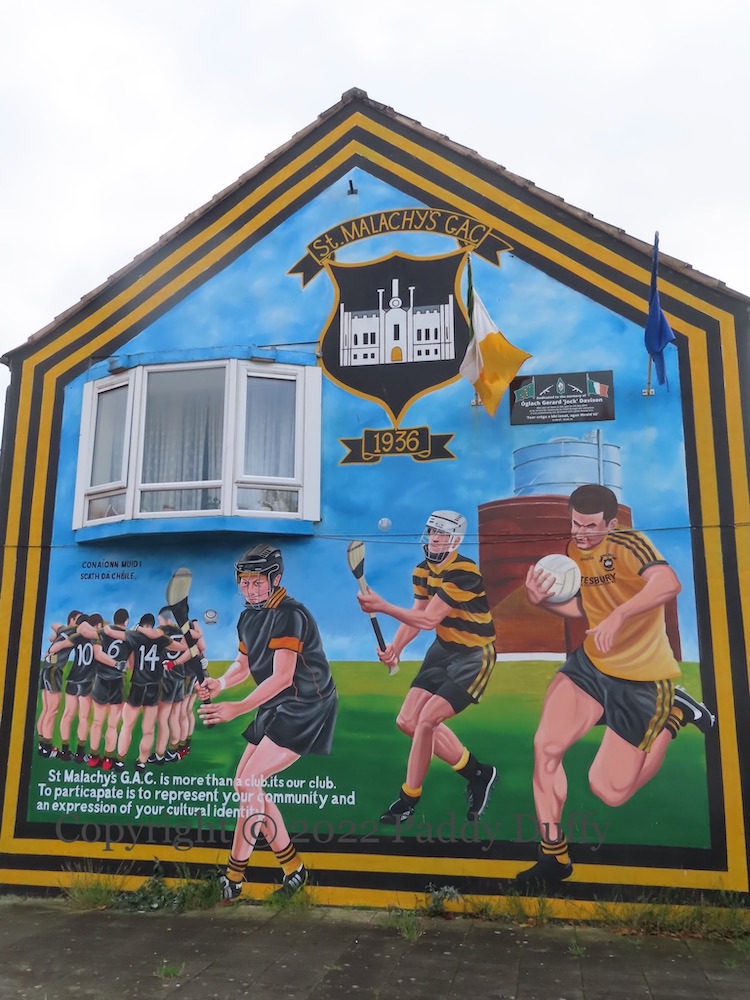
“Saint Malachy’s G.A.C. is more than a club. It’s our club. To participate is to represent your community and an expression of your cultural identity.”
This is the 2021 repaint of the mural celebrating Gaelic games in the parish of St. Malachy/Naomh Maolmhaodhóg, in the Markets area of Belfast. The parish church – featured in the top centre – has a celebrated fan-vaulted ceiling (WP). This mural, on the other hand, features a bay window.
“Conaíonn [Cónaíonn] muid ı scath dá chéıle” is a straightforward rendering of the epigrammatic “Ar scáth a cheıle a mhaıreann na daoıne”, which was included in the previous version – see Cultural Identity.
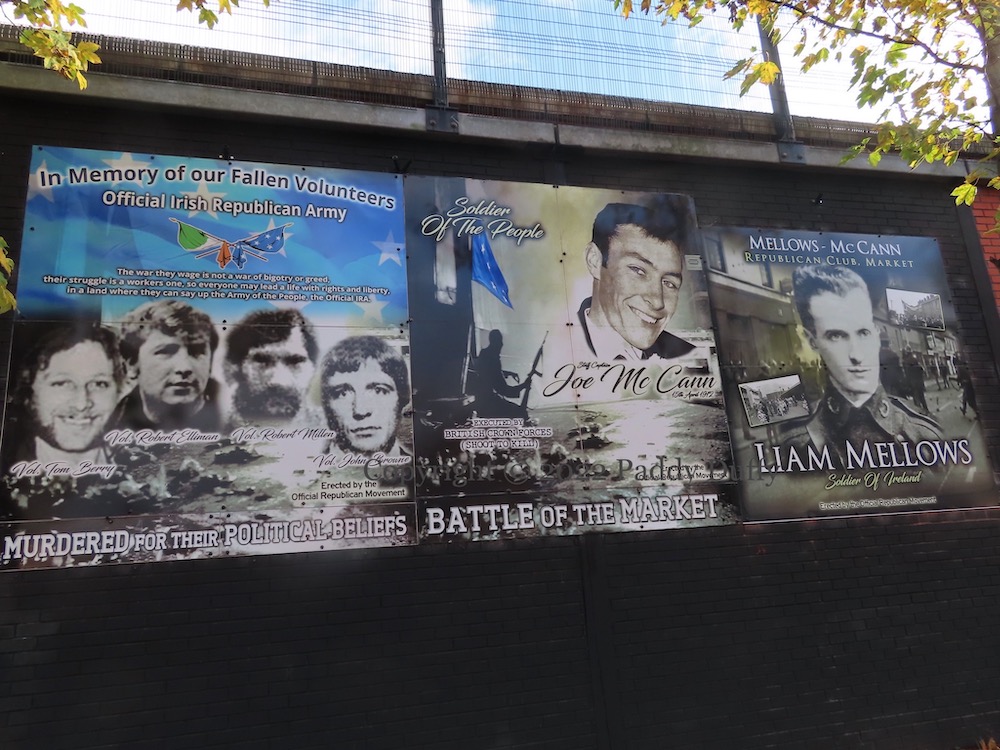
Left: “Murdered for their political beliefs: Tom Berry, Robert Elliman, Robert Millen, John Browne”. All four had a connection Markets or Ormeau area of south Belfast. Millen, from the Ormeau area, was shot in 1973 by the UVF; he played on the same soccer team (Bankmore Star) as Thomas Berry, who was shot in a Short Strand GAA club; Elliman was shot in a Markets pub; John Brown (without the “e”) was shot in his Cooke Street home in front of his family. The first three were all Protestants; the latter three were among 11 people who died in the 1975 feud between the Officials and the Provisionals. (Lost Lives)
“The war they wage is not a war of bigotry or greed, their struggle is a workers one, so everyone may lead a life with rights and liberty, in a land where they can say “Up the Army of the people, the Official IRA”.” “Erected by the Official Republican Movement.”
Centre: Internment (imprisonment without trial) was introduced on August 9th, 1971 by NI Prime Minister Brian Faulkner, with 342 people arrested on the first day. The Bogside was “hysterical with hated”, according to Eamonn McCann (History Ireland) and of Belfast Kevin Myers wrote “Insanity seized the city.” Two dozen people would die in the rioting and gun-battles that followed, leading to the suspension of Stormont rule (WP). In the Markets area, OC Joe McCann and other (Official) IRA volunteers took over the Inglis bakery and reportedly prevented 600 British troops from entering the area – the image to the left of the board above is a Ciaran Donnelly photograph showing McCann during the battle, kneeling beneath a Starry Plough and holding an M1.
Right: After serving in the IRA in the War Of Independence, Liam Mellows was elected to the First Dáil and as a member of the second Dáil voted against the Treaty in January 1922 (his speech is recorded in Oireachtas.ie under the name “Liam Mellowes”). In the Civil War that followed, he served as IRA quartermaster in the force in the Four Courts that surrendered to Free State forces on June 30th, 1922. He was imprisoned in Mountjoy and executed in December, in reprisal for the killing of Seán Hayes (see Executed). (WP | An Phoblacht) His proposals for government were published posthumously as ‘Mellows Testament’ (NLI) and include state ownership of heavy industry, large estates, the transport system, and the banks. The sticker below quotes from that document: “Ireland, if her industries and banks were controlled by foreign capital, would be at the mercy of every breeze that ruffled the surface of the world’s money-markets.”
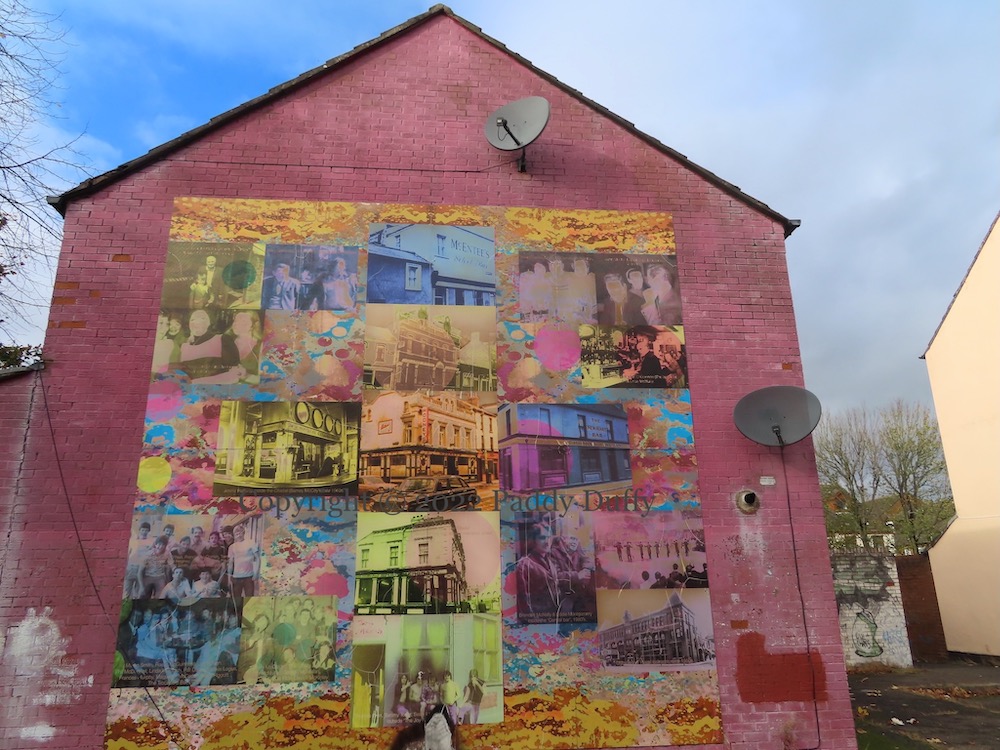
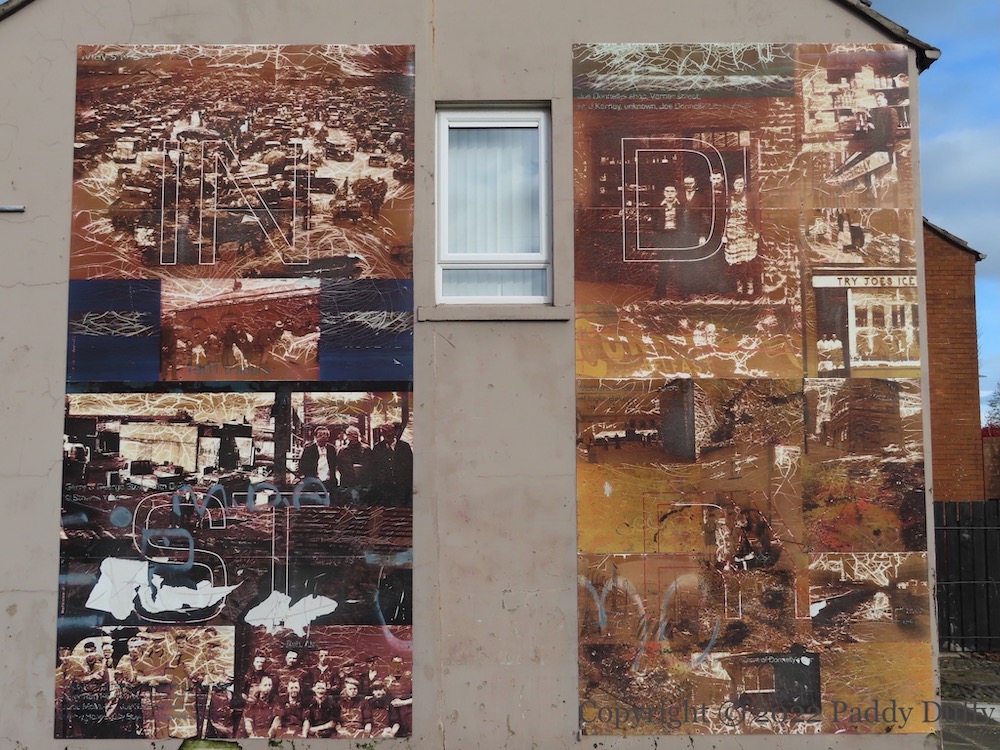
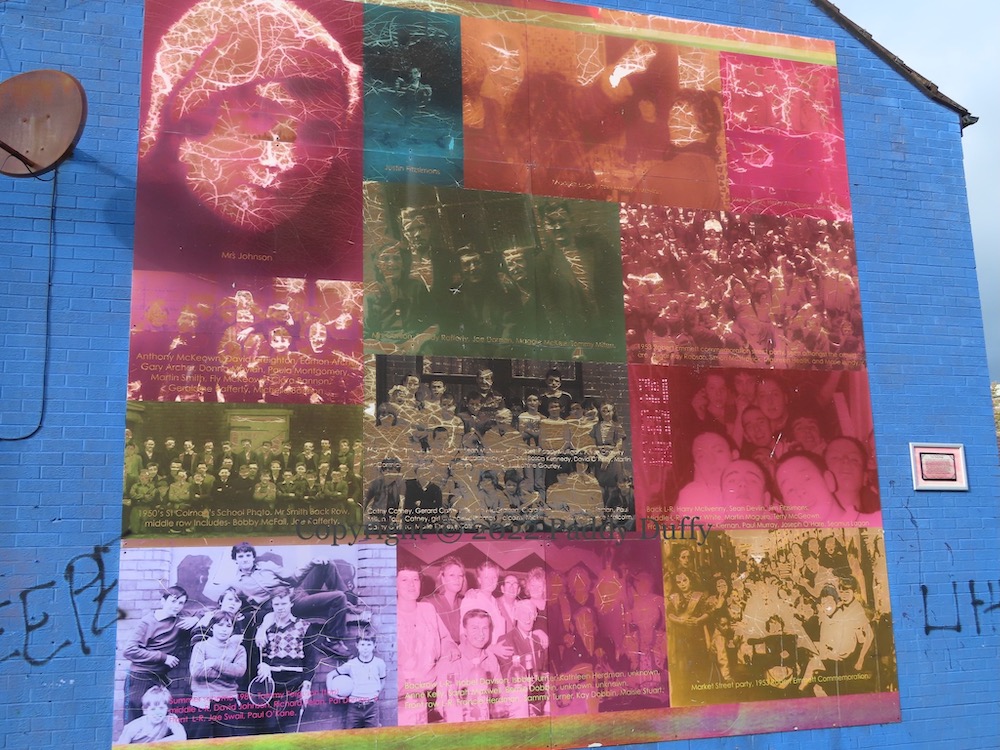
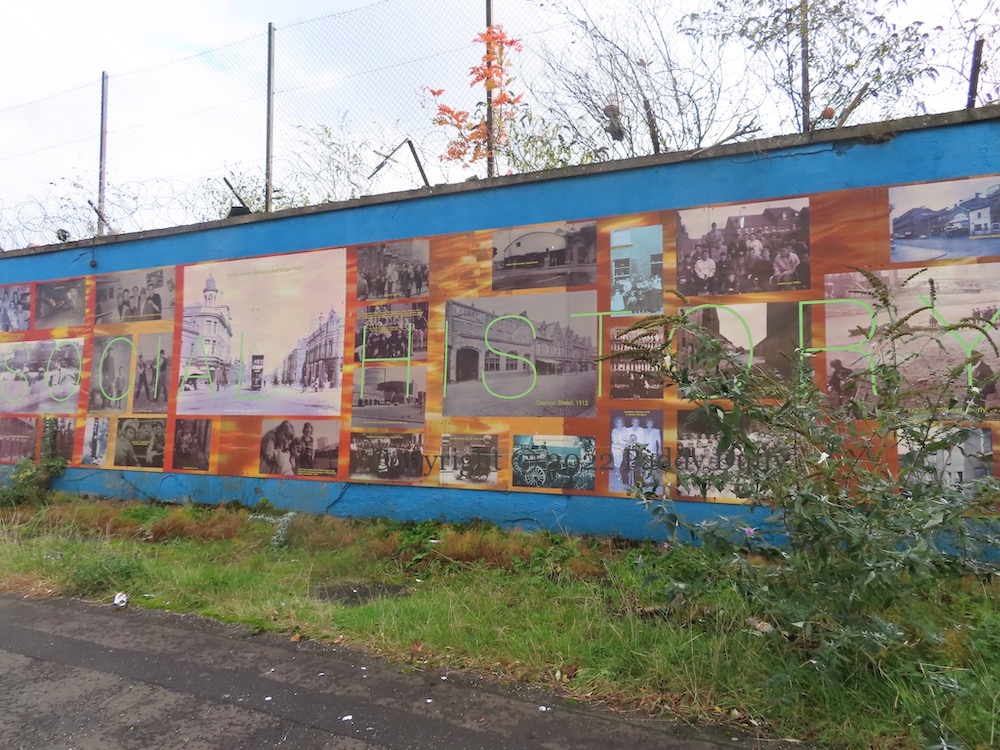
Artist Raymond Henshaw produced a series of boards in 2008 and 2009, with support from the Arts Council, depicting the Markets area in the good old (i.e. pre-Troubles) days. Above are the bars of the Markets and below ‘industry’, ‘social’ and ‘social history.


 Paddy Duffy Collection