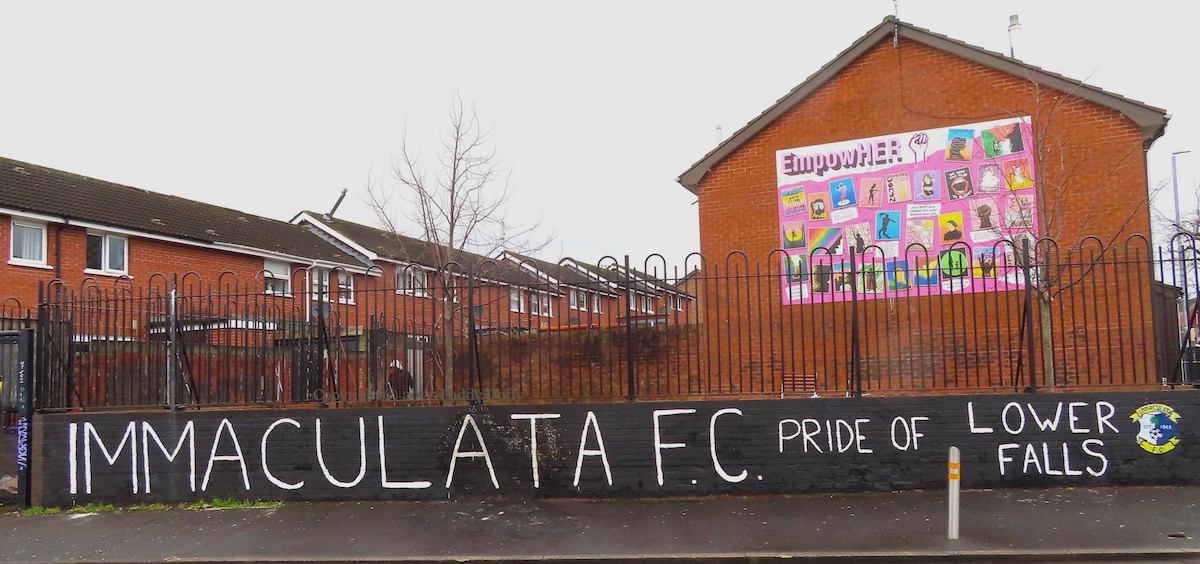
This mural in the lower Falls celebrates the 30th anniversary of the Frank Gillen Centre (Fb) and the 70th anniversary of Immaculata FC (Fb). The figure on the right is Cliftonville player Liam Boyce who grew up in the area and played for Immaculata as a youth. The team’s logo appears to the right of Boyce’s outstretched hand. (If you know the local player on the left, please leave a comment or send an e-mail.)
The piece was painted by Mickey Doherty and Lucas Quigley.
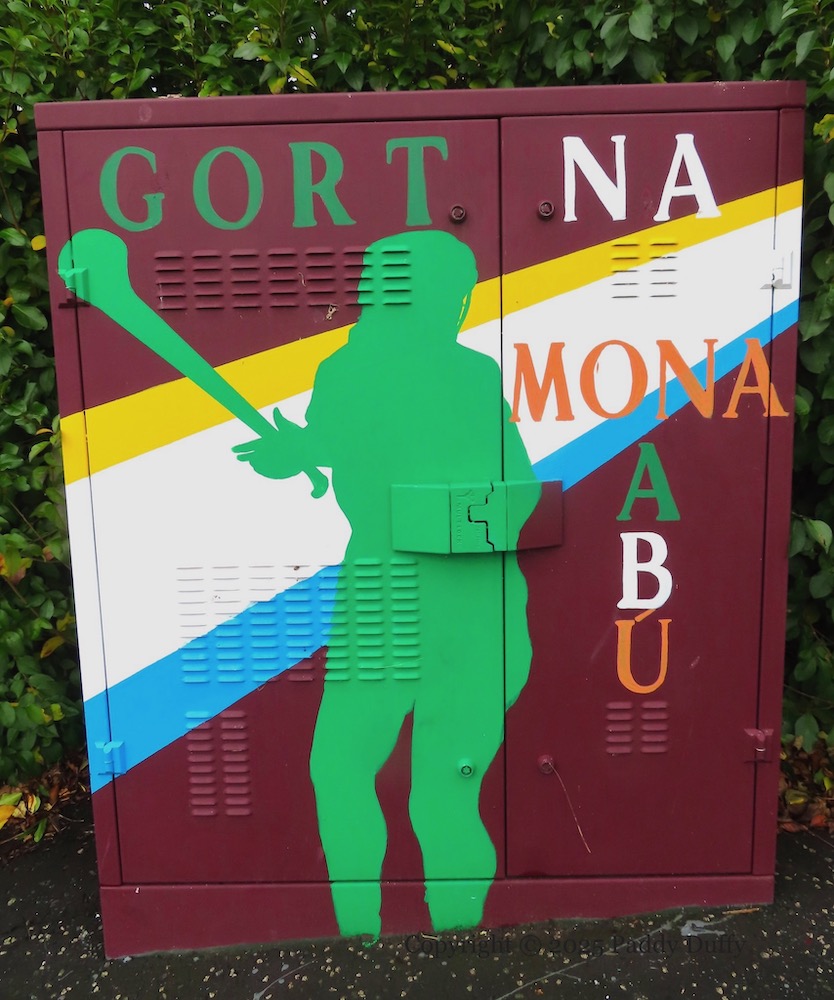
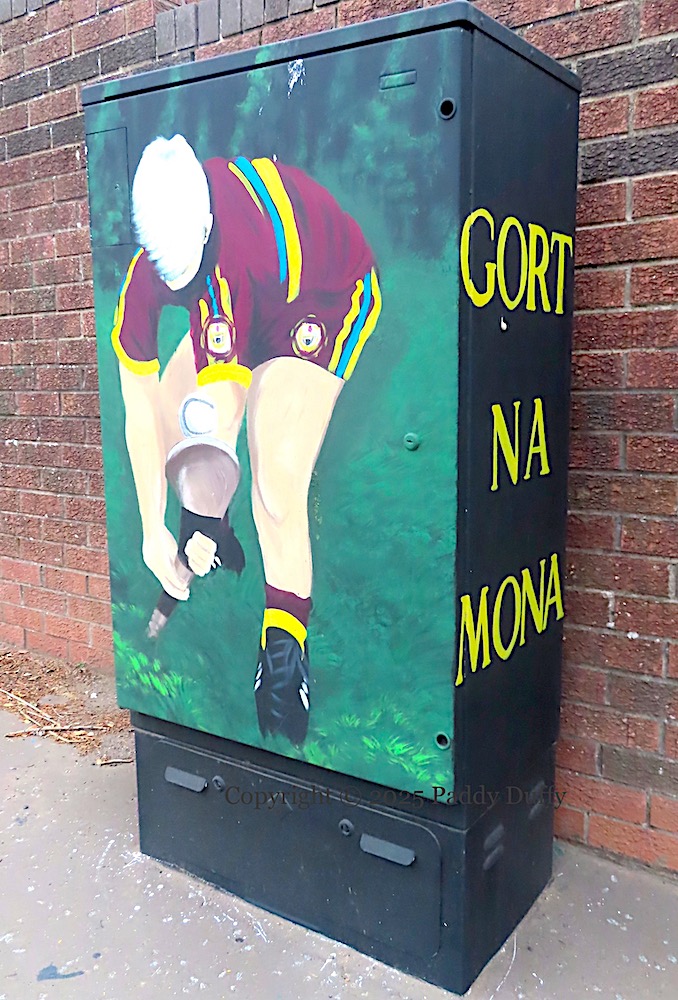
Gort Na Móna CLG was founded in 1974, developing out of the old Gort Na Móna secondary (before it became part of Corpus Christi). NVTv produced a programme to celebrate the fiftieth anniversary (youtube). These painted junction boxes are on Monagh Road and the Springfield Road.
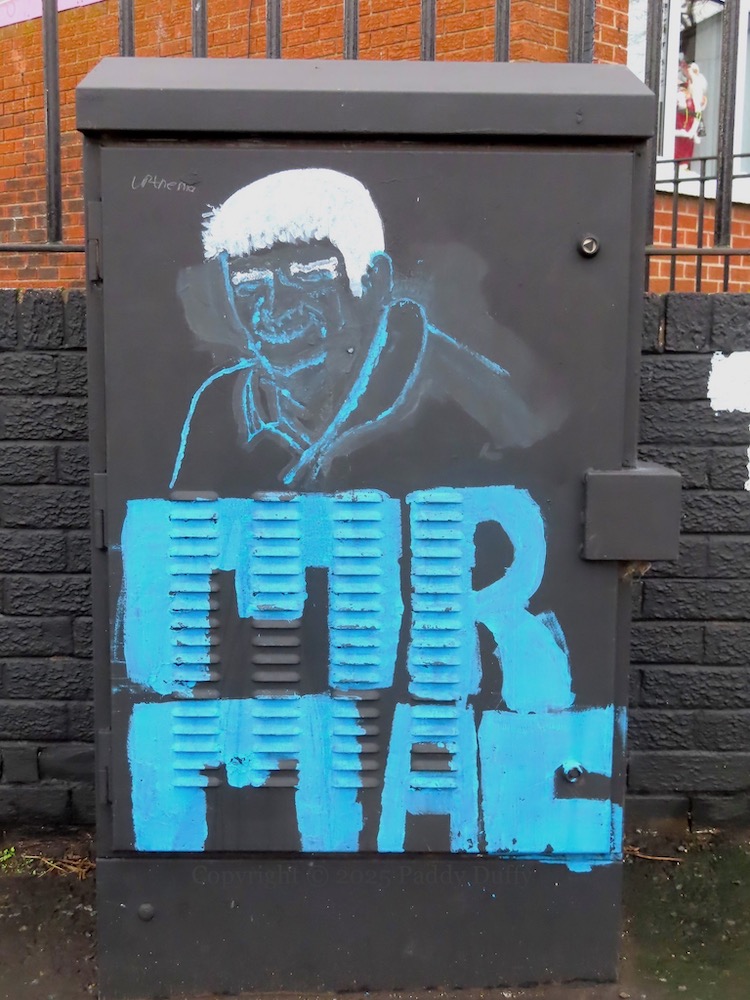
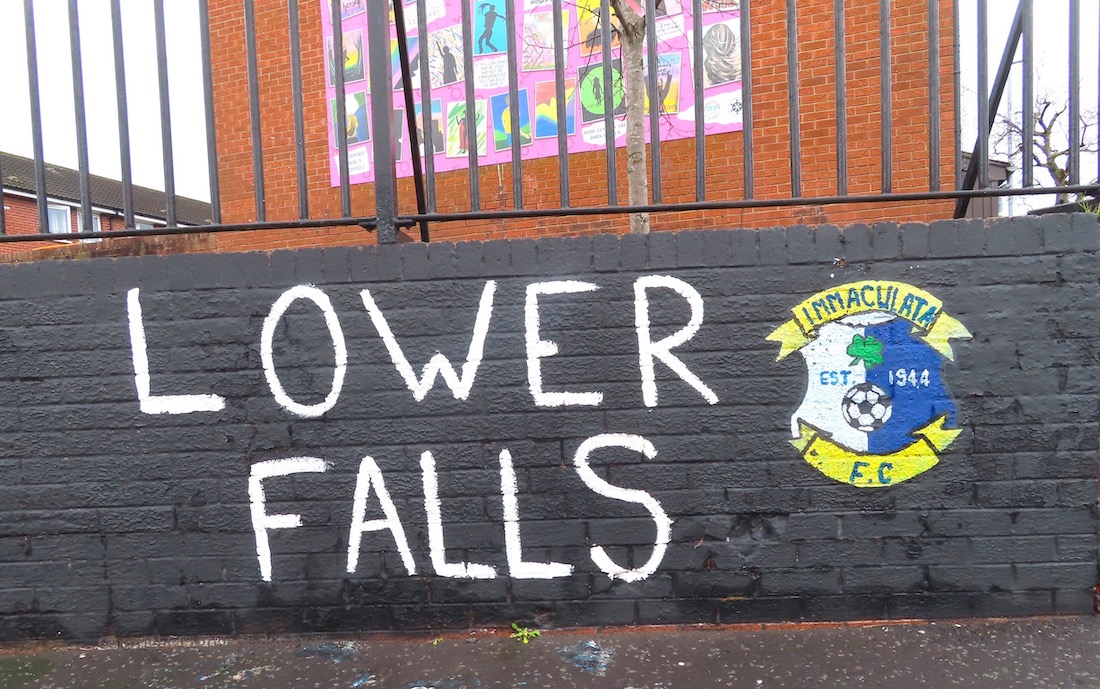
This is a painted tribute to Jim McKee, who was known as “Mr Immaculata” for his long-time support of Immaculata FC (Fb). McKee died in August when he was hit by a car near the Grosvenor community centre (BBC).
See also: Come On, The Mac, which is a stone’s throw further down Albert Street.
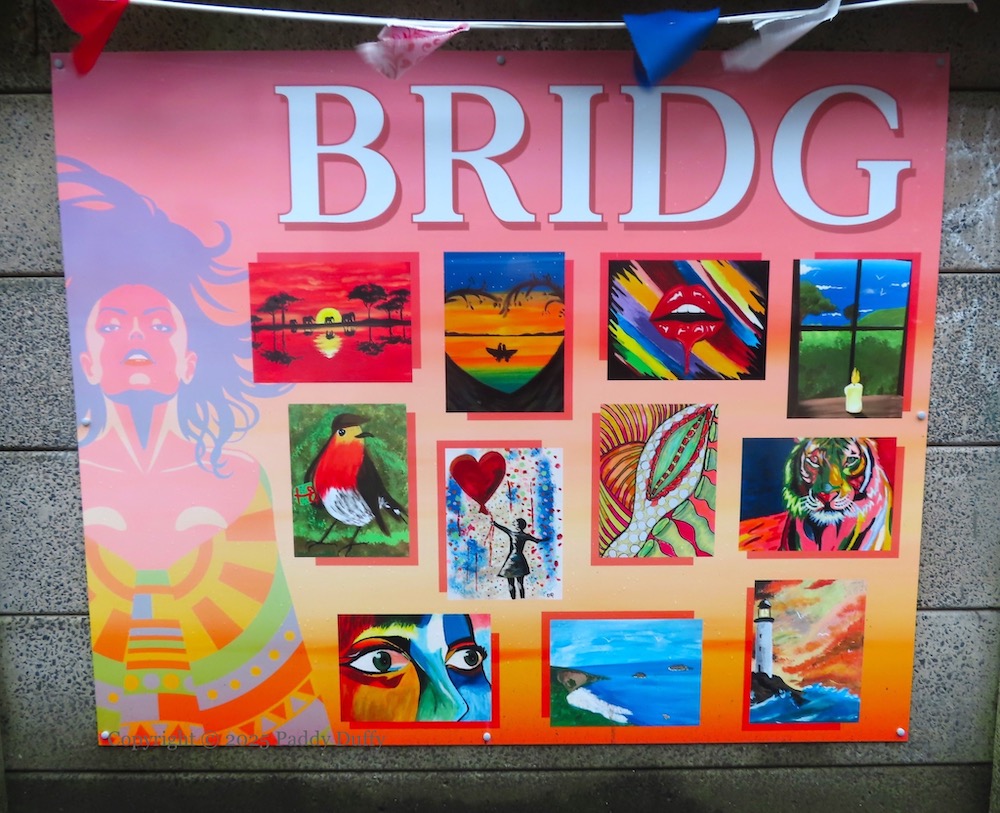
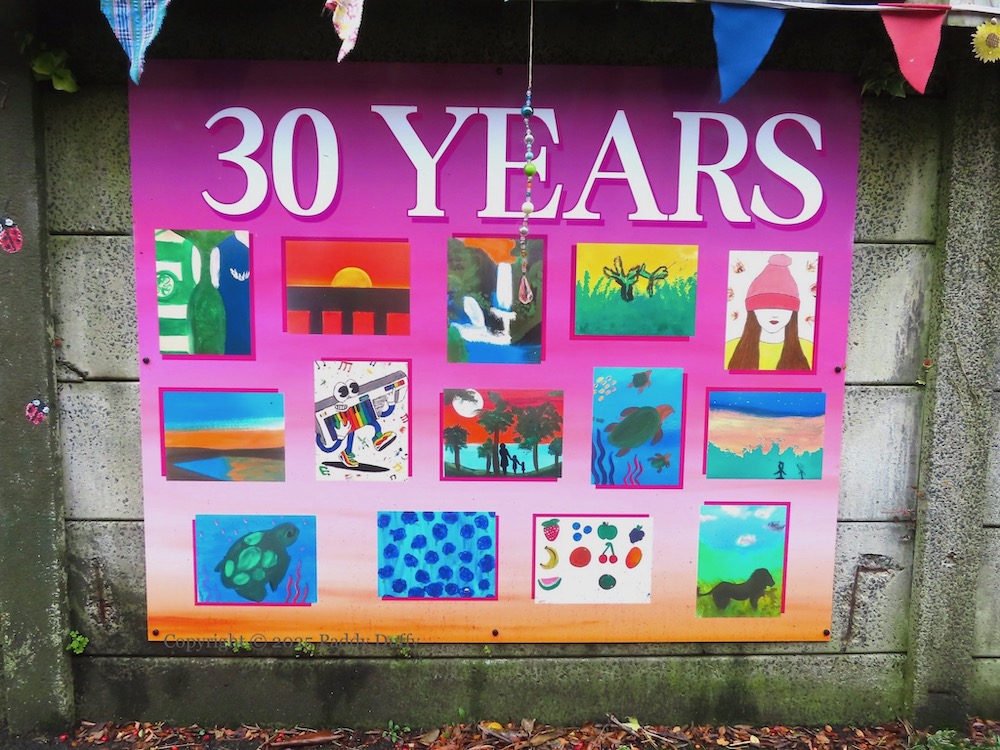
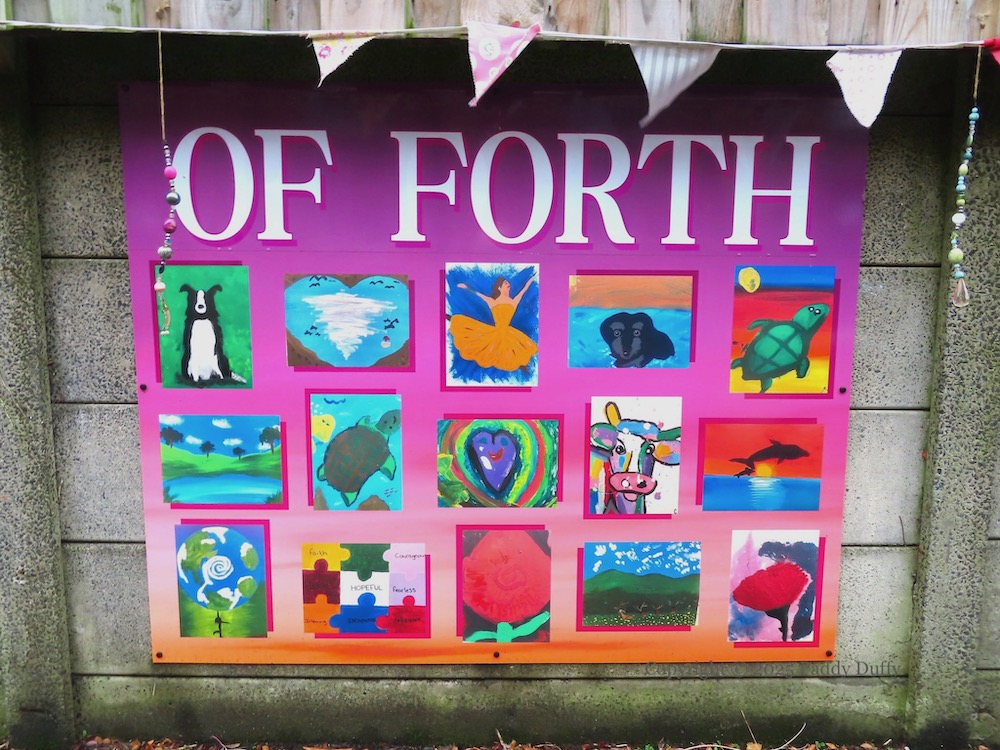
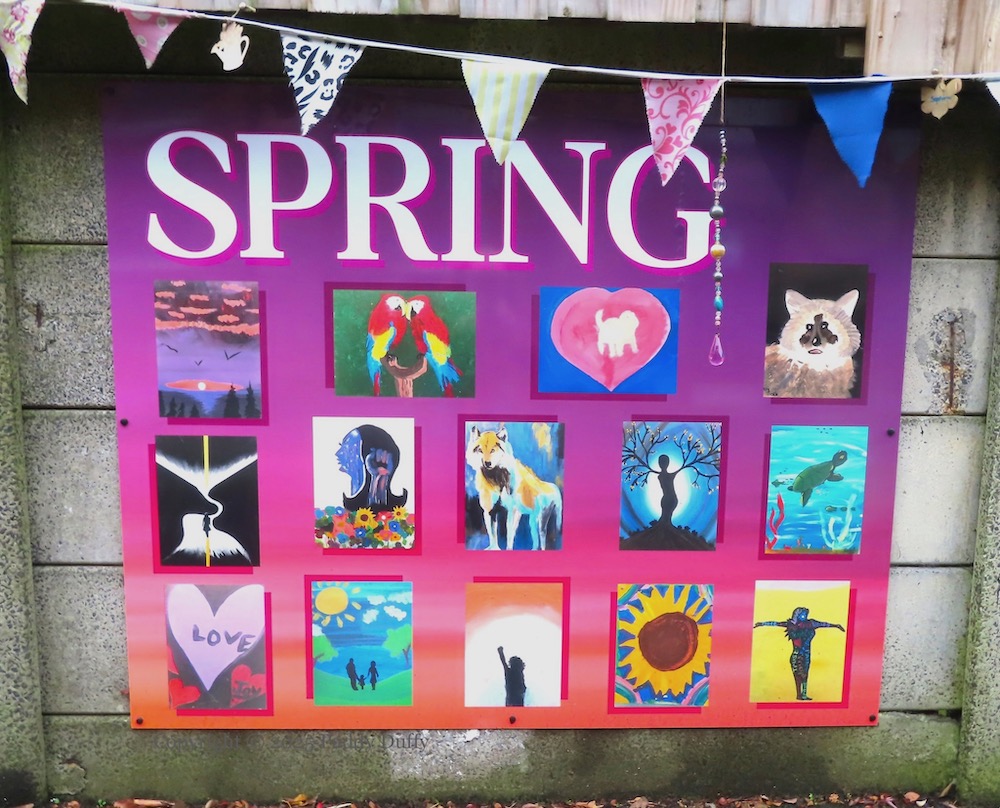
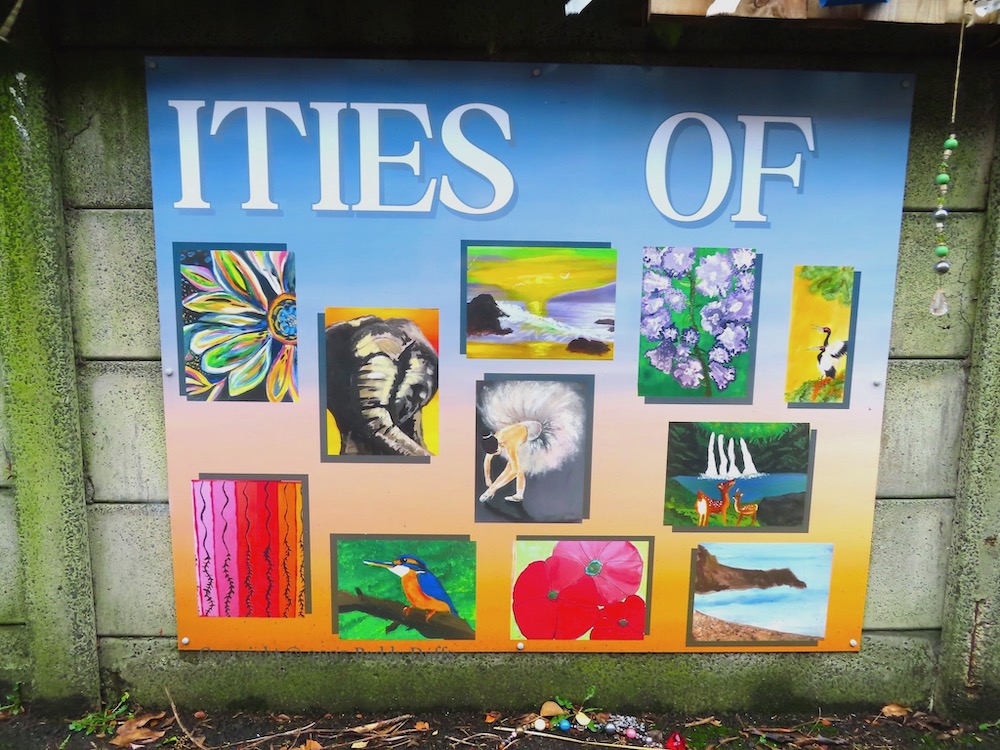
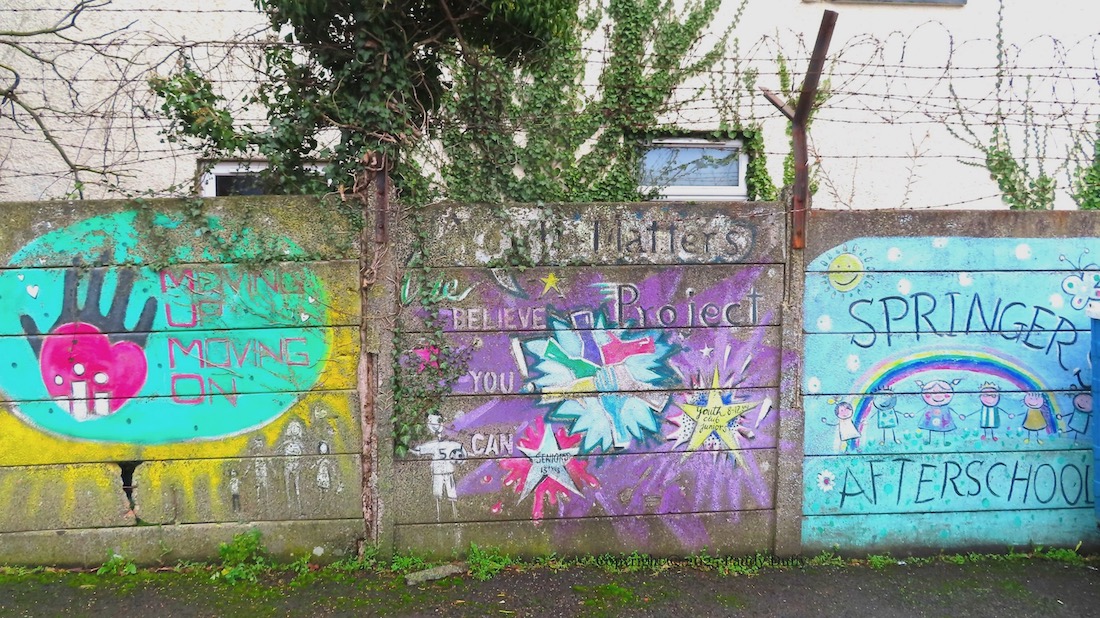
“Bridging divides”, “30 years of Forthspring”, “Communities of strength”. Forthspring is a cross-community group providing programming to residents of the CNR upper Springfield and PUL Woodvale areas. On its ‘about’ page, the organisation claims 1996 is the year of its founding, so this array of boards might be in anticipation of next year (2026).
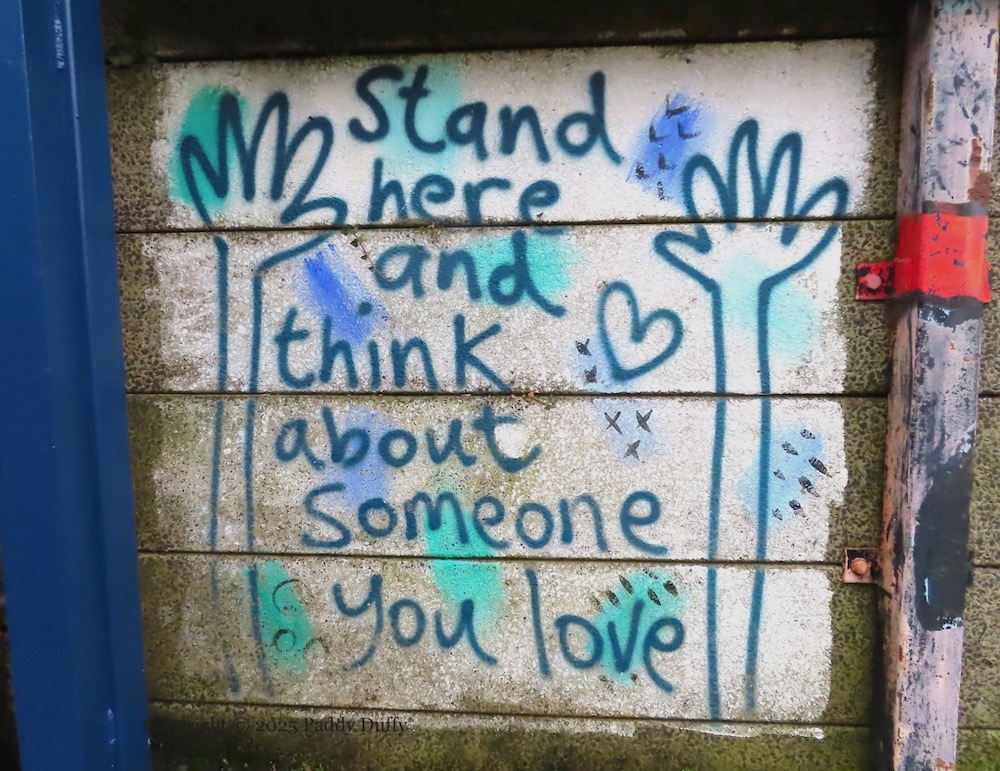
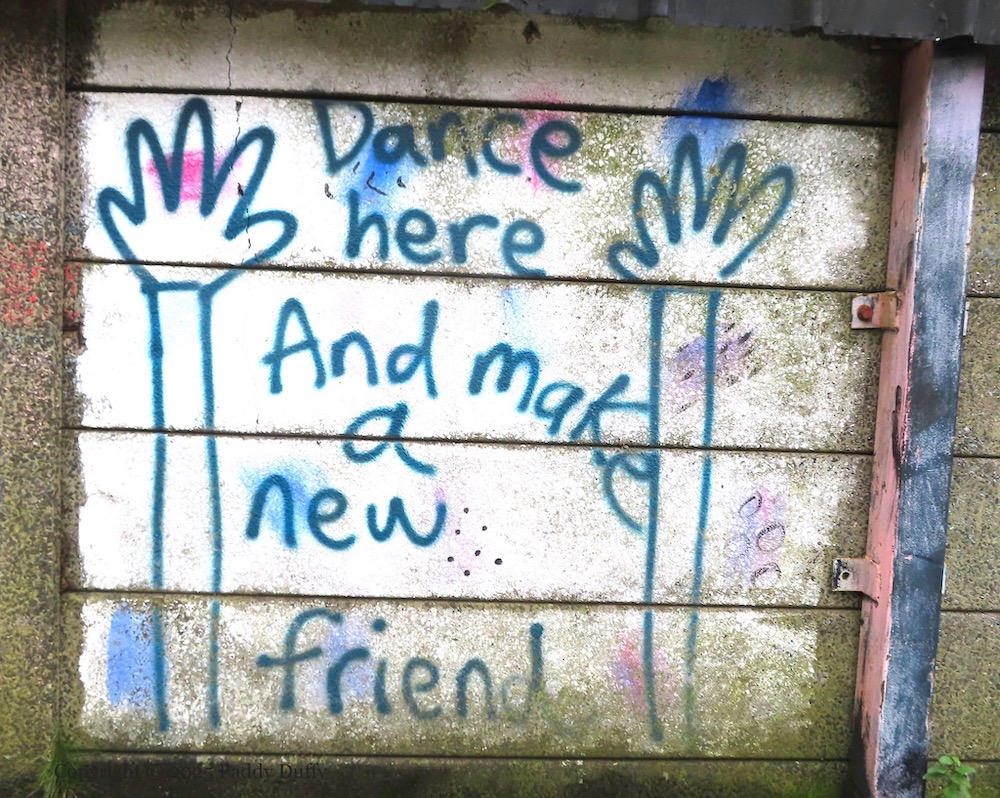
Also included are some of the older pieces on the panels at the front of the Springwell House. “Stand here and think about someone you love”, “Dance here and make a new friend”, “Youth Matters Project – believe you can”.
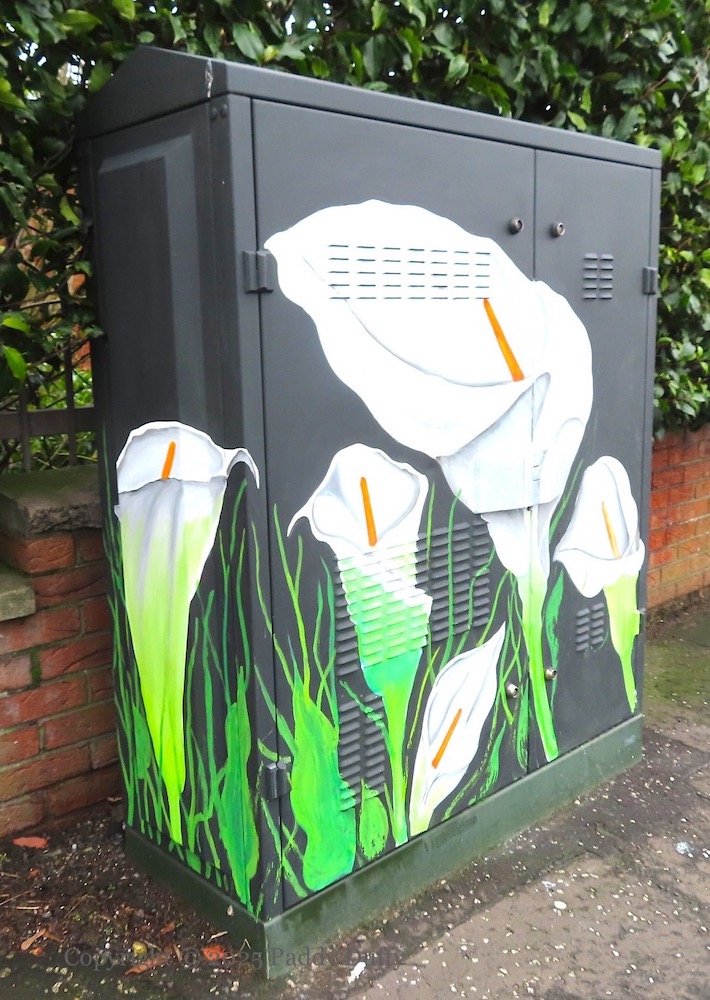
These Easter lilies are on a junction box on the Springfield Road at New Barnsley Park, west Belfast, and across the street from the boxes seen in Bóthar Chluanaí and Gaırdín Na hÉıreann.
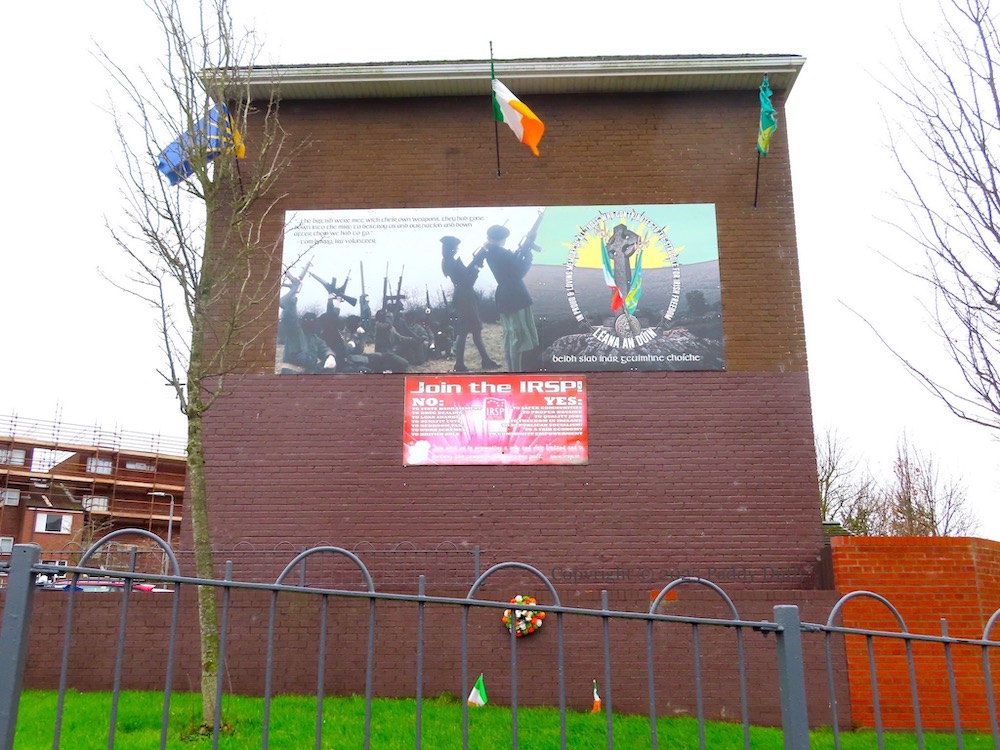
“[They said I was ruthless, daring, savage, blood thirsty, even heartless. The clergy called me and my comrades murderers; but] The British were met with their own weapons. They had gone down into the mire to destroy us and our nation and down after them we had to go. – Tom Barry, IRA volunteer.”
Tom Barry served in the British Army as a teenager and saw action in Mesopotamia and Egypt. The military training served him well when he joined the IRA and soon became commander of the West Cork brigade’s flying column. The quotation above offer a justification for the guerrilla tactics which helped drive the British to the negotiating table. In the Civil War, Barry was on the anti-Treaty side. (WP)
“In proud and loving memory of all those who contributed to the struggle for Irish freedom. Léana An Dúın. Beıdh sıad ınár gcuımhne choíche.”
The red board below is an old (2019) IRSP board, reading, “Join the IRSP. No to state harassment, to drug dealing, to loan sharks, to benefit cuts, to bedroom tax, to work schemes, to British rule. Yes to safer communities, to proper housing, to quality jobs, to freedom in Ireland, to republican socialism!, to a fair economy, to community empowerment. Join with us in promoting a new and fair Ireland and in building the campaign for a border poll. www.irsp.ie“
“NFC – representing our community with pride”. Newington Football Club [Fb], also known as “the swans”, is an NIFL team from north Belfast. The club was “est[ablished] 1979” as Jubilee Olympic FC, and was later Newington Youth Club, before becoming Newington FC c. 2018. A full list of its honours can be found on the club’s WP page.
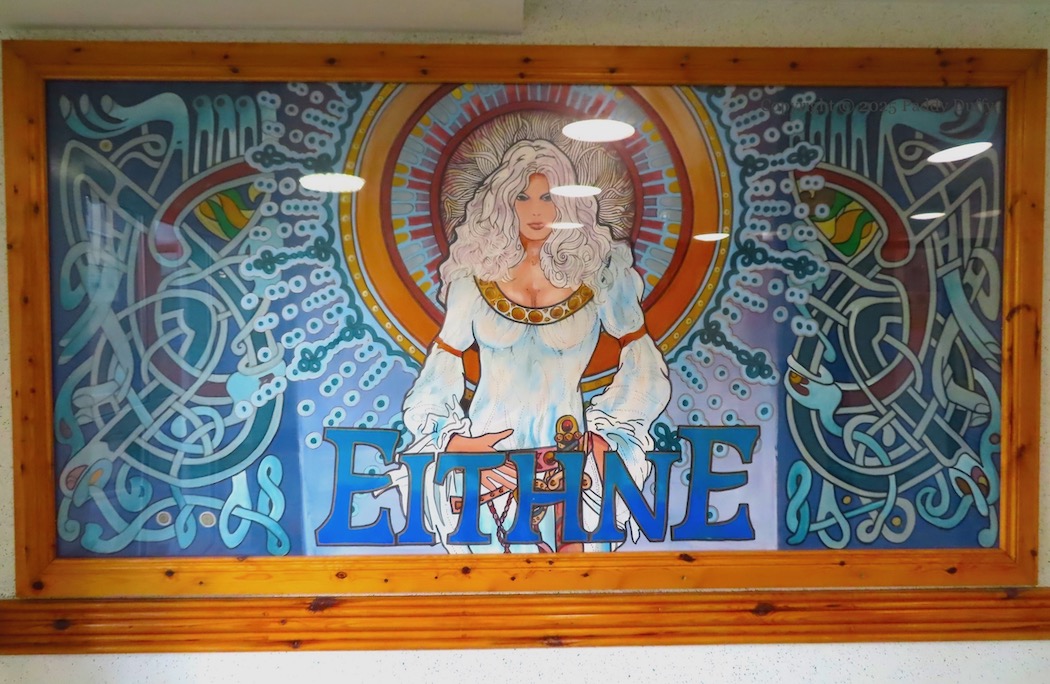
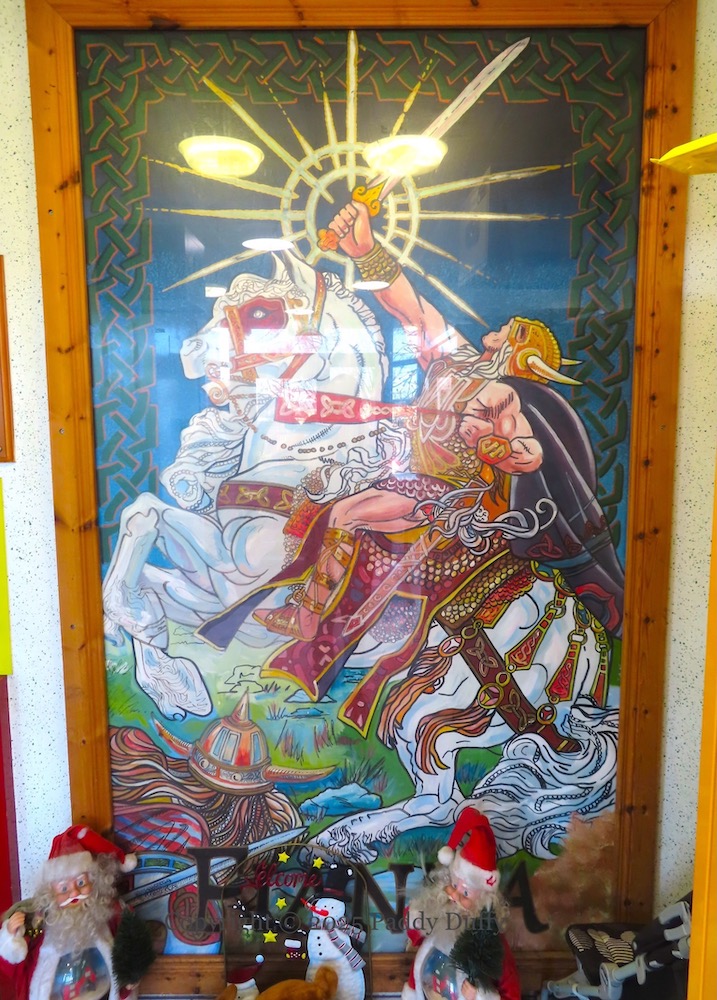
The seven “houses” (tower blocks) in the New Lodge are named after figures from Irish mythology: Méabh, Eıthne, Cú Chulaınn, Fınn, Na Fıanna, Gráınne, and Oısín. In the foyer of each house there is a painting of the eponymous hero, painted by Danny D and Marty L in imitation of Jim Fitzpatrick (as is explicitly acknowledged in the Gráınne painting, below): Eıthne is represented by Fitzpatrick’s Palu The Cat Goddess; Na Fıanna are represented by Lugh; Gráınne is represented by Fann. The bulls are by Finbarr O’Connor; Cú Chulaınn is inspired by the Oliver Sheppard statue in the GPO.
For the old names of the buildings, and the pairs of hunger-strikers painted on the tops of six of the seven towers, see New Lodge Flats.
“Fıonn Mac Cumhaıll gained fable knowledge after sucking his thumb which he burned while cooking the magical Salmon of Knowledge. He followed in his father Cumhall’s footsteps becoming captain of the Fıanna. His death at the Battle of Gabhra marked the beginning of the decline in the might of the Fıanna.”
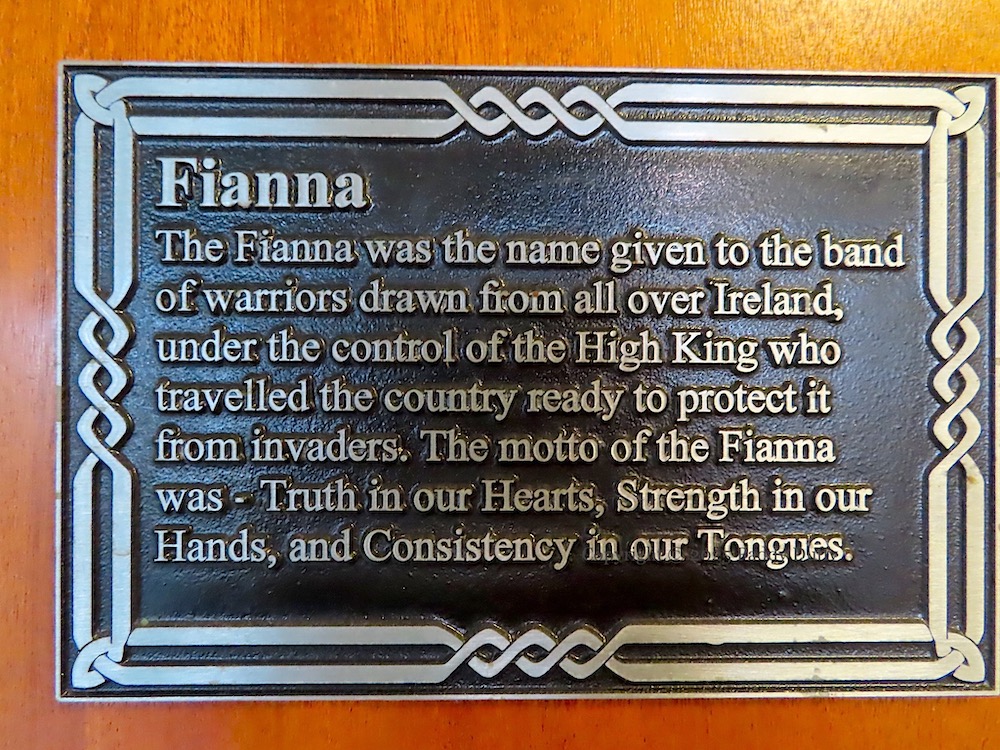
“The Fıanna was the name given to the band of warriors drawn from all over Ireland, under the control of the High King who travelled the country ready to protect it from invaders. The motto of the Fıanna was – Truth in our Hearts, Strength in our Hands, and Consistency in our Tongues.”
“Gráınne, daughter of Cormac Mac Art, High King of Ireland, betrothed to a grey-haired Fıonn Mac Cumhaıll but ran away with the handsome young Dıarmuıd before the marriage took place. She returned to marry Fıonn after Dıarmuıd’s death.”
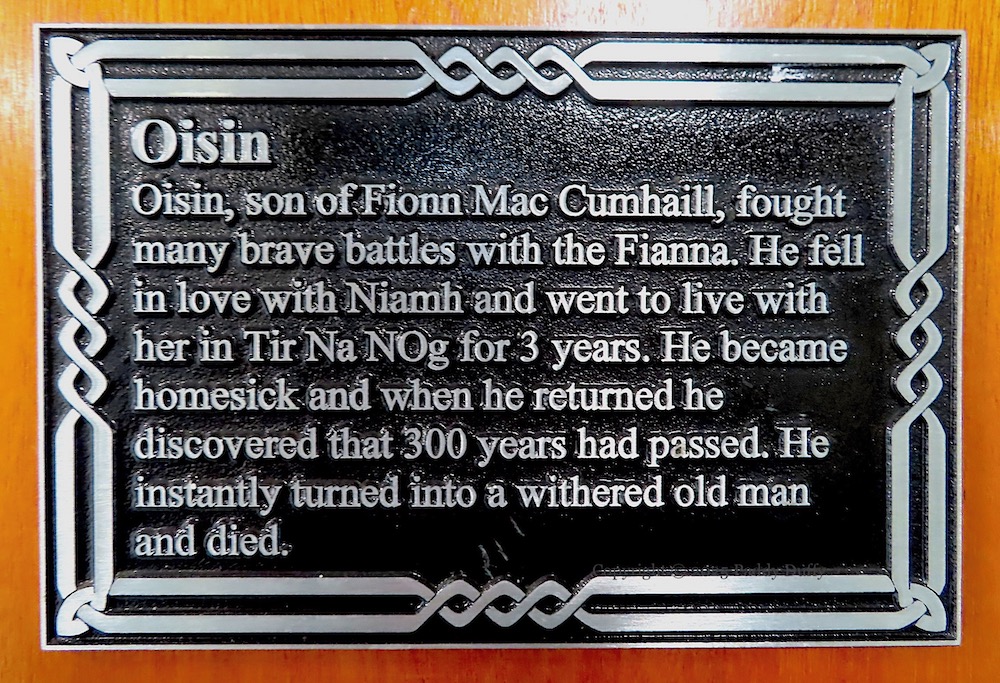
“Oısín, son of Fıonn Mac Cumhaıll, fought many brave battles with the Fianna. He fell in love with Nıamh and went to live with her in Tír Na nÓg for 3 years. He became homesick and when he returned he discovered that 300 years had passed. He instantly turned in a withered old man and died.”
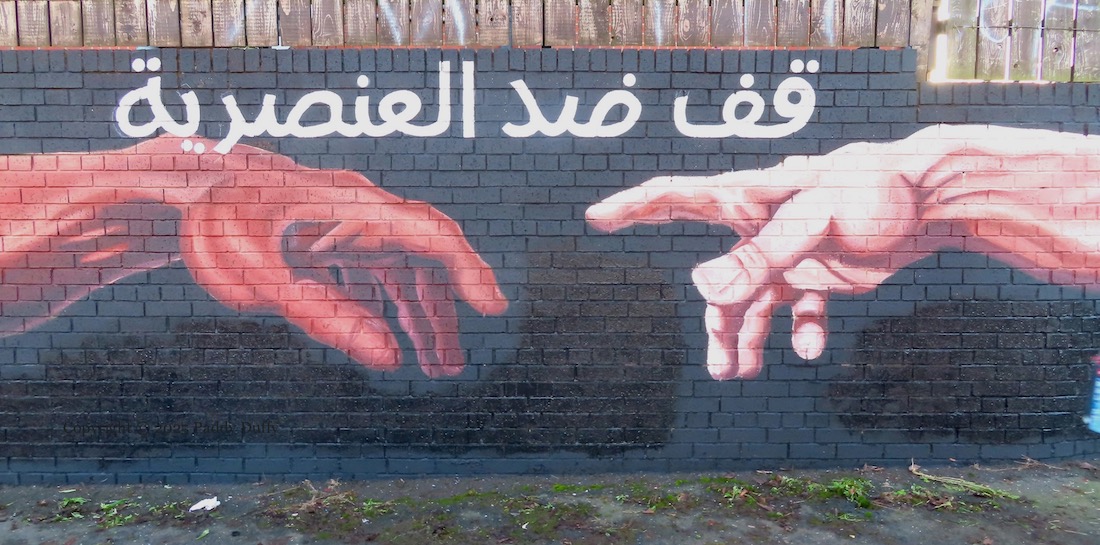
“RNU [Fb] stands with Palestine” – the board has been augmented by some knotwork corner-borders in the colours of the Palestinian and Irish flags, along with “freedom” in Irish (saoırse) and Arabic (الحرية).
For the board as originally presented in April 2024, see X14944.




















 Paddy Duffy Collection