
Street art by Friz (ig) at Urban Ink Tattooz (ig) at the top of Donegall Road, St James’s, Belfast.
Click image to enlarge
Copyright © 2023 Paddy Duffy
T02785

“Est 1913 Irish Citizen Army / Irish National Liberation Army Est. 1974”. The Irish Citizen Army was founded in Dublin in 1913 to protect striking workers from police violence. After taking part in the Easter Rising of 1916, however, the ICA did not participate in the War Of Independence and the Civil War. In 1974, some founding members considered reviving the “ICA” name to reflect the organisation’s “allegiance to the working class” while Costello (pictured on the right) suggested “National Liberation Army”, which was then amended to include “Irish” (History Ireland | WP | WP). MNI includes an “ICA-INLA” Starry Plough on the stairs into the New Lodge from 1989 (C00105).
The banner raised over the Liberty Hall headquarters of the ICA read “We serve neither king nor kaiser but Ireland” – the famous photograph is included in the post of the same name – but this has been updated. The Belfast version of the board, on Northumberland Street (above) and outside Costello House on the Falls Road (below), reads “nor Nato”.

Click image to enlarge
Copyright © 2023/2025 Paddy Duffy
T02781 T06510 james connolly

Long-time Palestinian activist and former spokesperson for Islamic Jihad Khader Adnan died on May 2nd, at the age of 45, after 87 days on hunger strike in Ramla prison, in central Israel (Al Jazeera).
This was Adnan’s fifth time on hunger strike. In 2017, he spent 58 days on hunger strike and in 2015, 56 days. The strike in 2011-2012 lasted 66 days, during which time a mural was painted just to left of the mural shown here, featuring Adnan and Hanna Shalabi; they, along with many other prisoners, were on hunger strike to protest the “administrative detention” (imprisonment without trial) of more than 300 Palestinians – see Administrative Detention. Earlier, shorter, strikes took place in 2002 and in 2000, when he was imprisoned by the Palestinian National Authority for directing a protest against Lionel Jospin, then French Prime Minister (Gulf News).
According to Amnesty International, there are currently more than 1,000 Palestinians being held on ‘administrative detention’ (Amnesty).
As can be seen from the in-progress shots below, Rısteard Ó Murchú painted Latuff’s cartoon, with Latuff looking on.
Cartoons by Latuff himself, in Belfast: Pacifying The Six Counties and in Derry: Killing With Impunity.
Latuff-based murals: The Butcher’s Apron | Do Not Disturb | Hand Across The Yard. Poster: End Impunity
This mural takes the place of the No To PII mural on the “International Wall”, Divis Street – see the Visual History page for the wall.
Also included is a “March for Palestine – 75 Years Of Nakba” poster on the Saber Al-Ashkar mural.

Click image to enlarge
Copyright © 2023 Paddy Duffy
T02783 [T02782]
T02760 [T02759] [T02758]

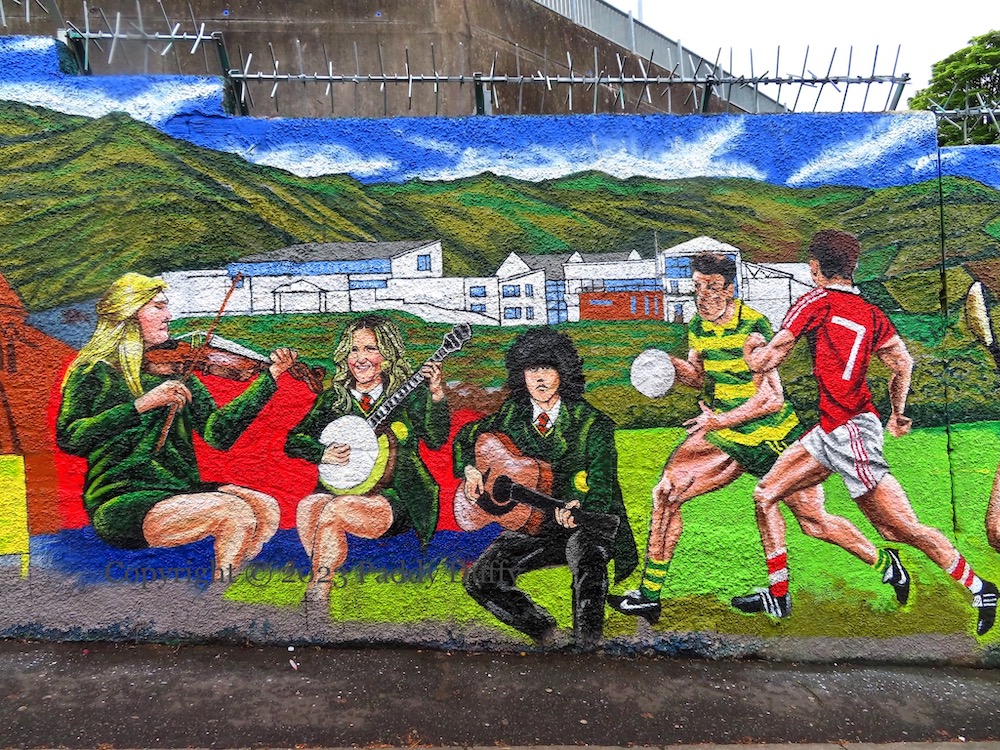
What is now Coláıste Feırste began life as Meánscoıl Feırste in 1991, teaching a group of nine students a curriculum inspired by Patrick Pearse (discussed previously in An Tusa An Chéad Laoch Eıle?) and based in Cultúrlann MacAdam-Ó Fıaıch (Cultúrlann). It moved to Beechmount in 1998 and in 2018 expanded into new buildings that were meant to accommodate 600 pupils (Doherty Architects), which it has now exceeded (BBC) as it enters its thirty-third year in existence.
The theme of preserving and promoting the Irish language occurs in several places in the mural: next to Pearse we see his saying, “Máırtín Ó Chadháın ” [a land without a language [is] a land without a soul], in the classroom scene we have “Labhaır í agus maırfıdh sí” [speak it and it will endure], and finally we see the Dream Dearg protesting for an Irish-Language Act (see previously #AchtAnoıs).
The in-progress images included below among completed detailed shots date from May 6th and 20th.
Giant’s Foot/Beechview Park. Replaces the short-lived mural of Olympians, seen in Sporting Giants.


Click image to enlarge
Copyright © 2023 Paddy Duffy
T02779 T02778 T02777 T02776 T02780
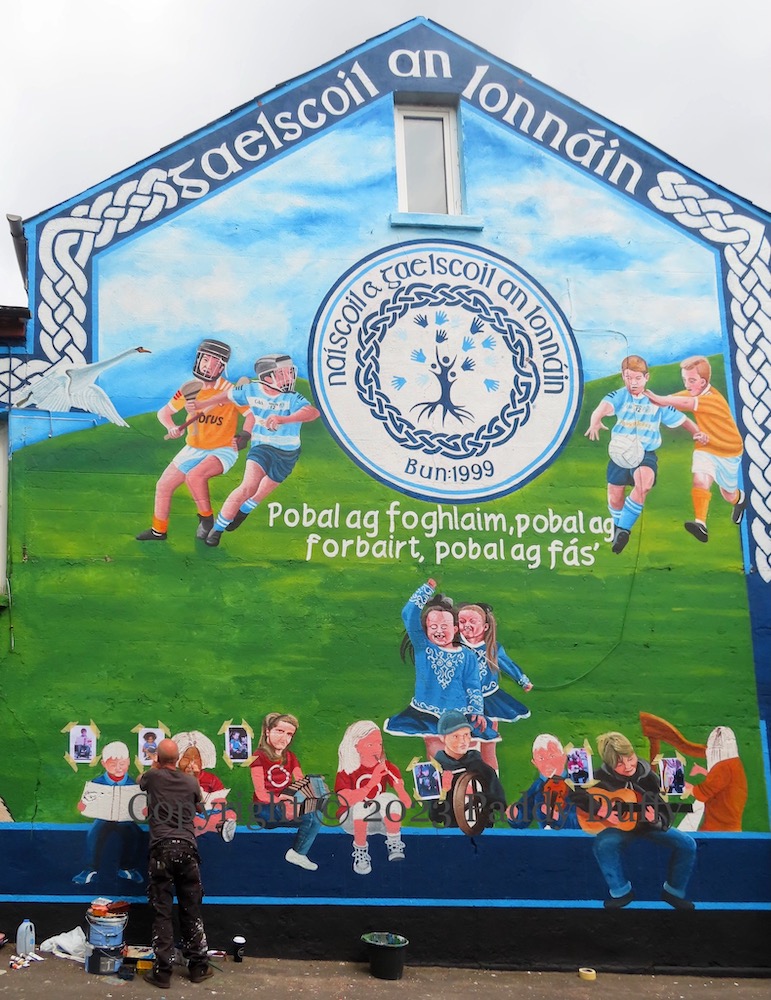
“Pobal ag foghlaım, pobal ag forbaırt, pobal ag fás” [a community learning, developing, growing]
Students from “Naíscoıl & Gaelscoıl An Lonnáın (Fb) bun[aithe] 1999″ [Nursery-school and Irish-language [primary] school of the loney, founded 1999] are shown playing Gaelic games, Irish dancing, and playing traditional instruments (and the guitar). On the left are representations from Irish mythology: the Children Of Lear and Setanta killing Culann’s hound (and taking the name Cú Chulaınn in taking its place), along with hedge-row school (see Hedge Row School).
The origin of the name is unclear; the nearest loney [lane] was the “Pound” loney, so-called because of the animal pen just outside Barrack Street, used to store livestock before moving on to the markets the following day (Rushlight | Uachtar Na bhFál). (The Pound Loney is included in the mural in Durham Street – see Et In Arcadia Ego.)
The other well-known loney in Belfast is the “buttermilk loney” which was either/both what is now Ballysillan Park (that is, connecting Olpark with the horsehoe bend) or the top part of the loney that connected Wheatfield (the top of Ardoyne) to the Ligoniel junction and on towards the old Ligoneil House (there are a mixture of usages in this Belfast Forum thread); this image from the 1930s might show the lane in (what was still at the time) the hills above Oldpark; a new housing-development towards the top of the Ballysillan Park is euphemistically called “Buttermilk Loney”. (It is also said to have been a prior name of Skegoniell Avenue (Belfast History).)
(The Uachtar Na bhFál page also mentions “Turf” loney, “Mountain” loney, and “Killoney”.)
The history of the Irish word “lonnán” is unclear. Uachtar na bhFál says the word is of Scots origin (perhaps as “loanin”). (See this BelTel article on the opening of the Ulster-Scots centre in 2014.) Spelled “lonnen”, it is also a Geordie word (Heslop’s Northumberland Words | wiktionary). The Irish News and Belfast Live, working from the same (uncited) press-release about Páırc An Lonnáın (which is along the Westlink below Raıdıó Fáılte), state that “loney” comes from the English word “loaning”. The Irish word “lonnán” does not appear in Dinneen 1904; Dinneen 1953 defines it (hyper-specifically) as “a grassy recess running up into high basaltic cliffs”.
The image above and immediately below are from May 19th, as the mural was nearing completion; other ‘in-progress’ images are as dated below. See Extramural Activity for images of the completed work.

May 10th:

April 20th:

Click image to enlarge
Copyright © 2023 Paddy Duffy
May 19th T02755 [T02756] T02757
May 10th T02718 [T02717]
Apr 25th [T02579] [T02580]
Apr 20th T02558 [T02557]
Marty Lyons

“Our revenge will be the laughter of our children” – The words of Bobby Sands are illustrated on an electrical box on the Whiterock Road, Belfast, with silhouettes of children at play in nature.
Click image to enlarge
Copyright © 2023 Paddy Duffy
T02730

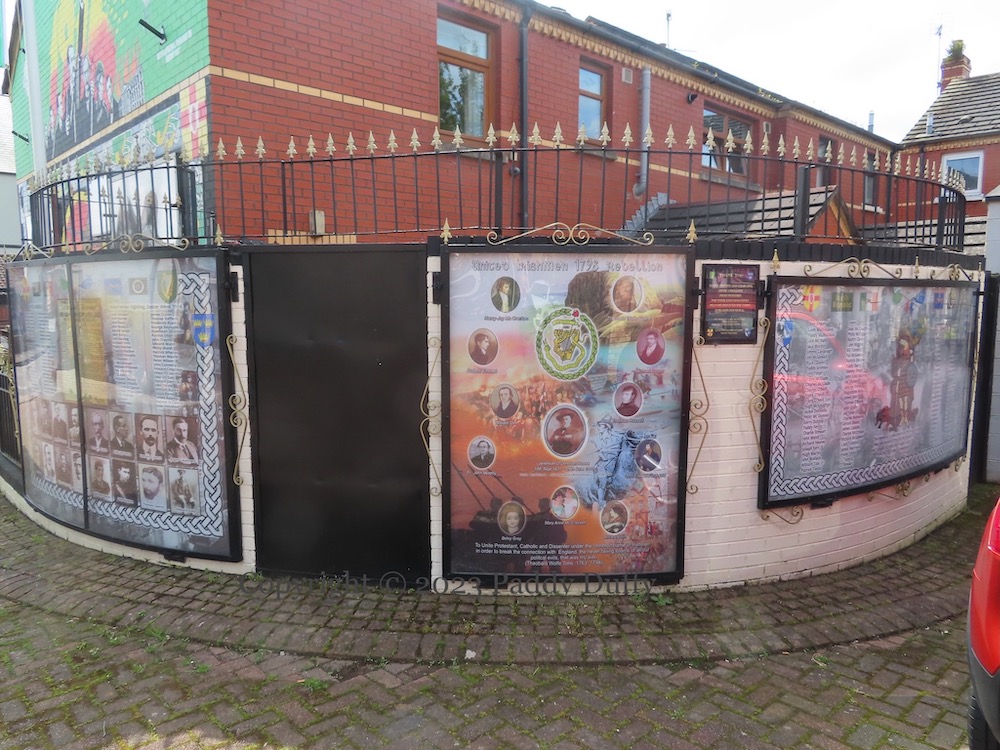
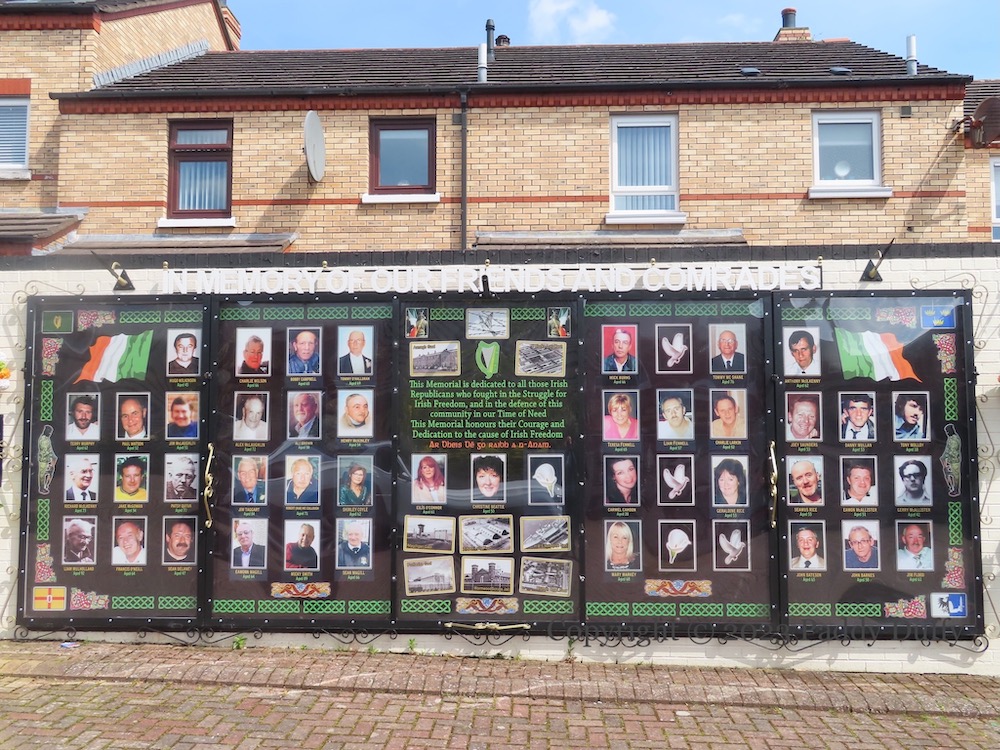
Here is a gallery of the murals and plaques in Clós Ard An Lao/Ardilea Close in the Machaıre Botháın/Marrowbone area of north Belfast. A full repertoire of republican events is commemorated – the United Irishmen, Great Hunger, the Rising, the Troubles, the (modern) hunger strikes. What is most striking is the significant presence of religious icons, such as the Sacred Heart in the glass cases in front of the two main murals (above and last below).


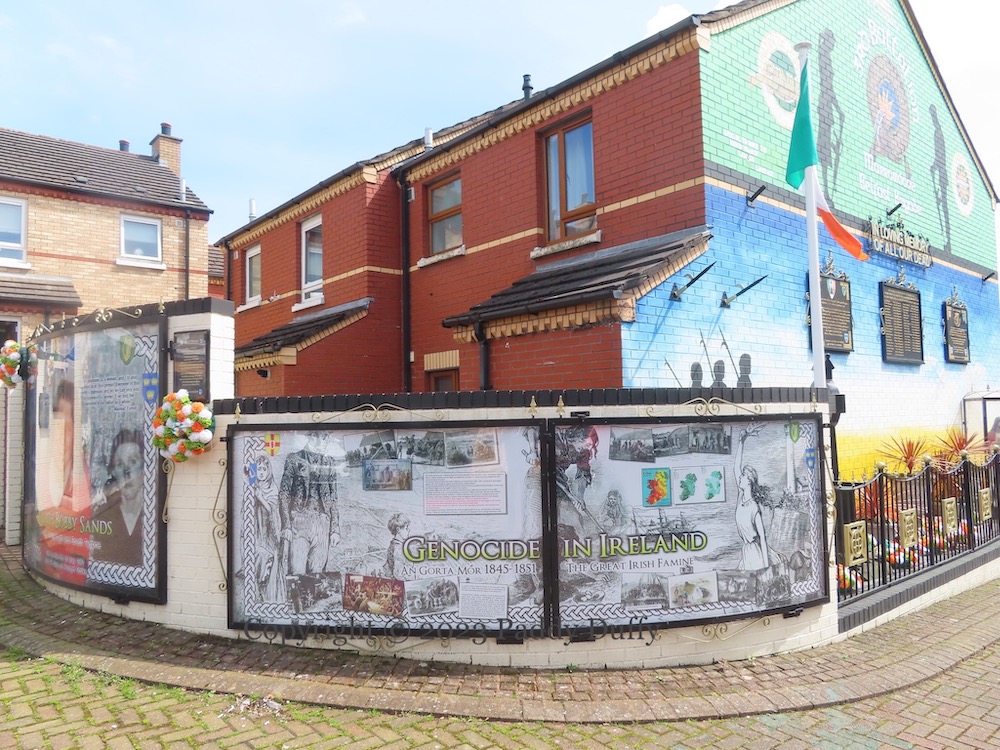
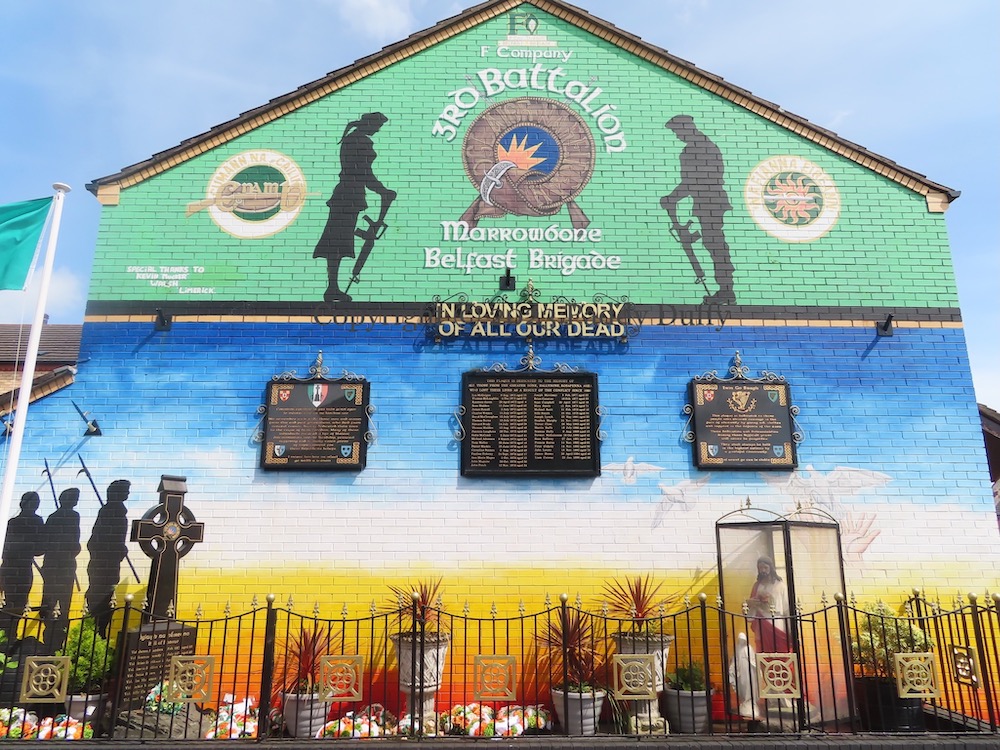
Click image to enlarge
Copyright © 2023 Paddy Duffy
T02709 T02713 T02712 T02716 T02717 T02715 T02714 T02710 [T02711]
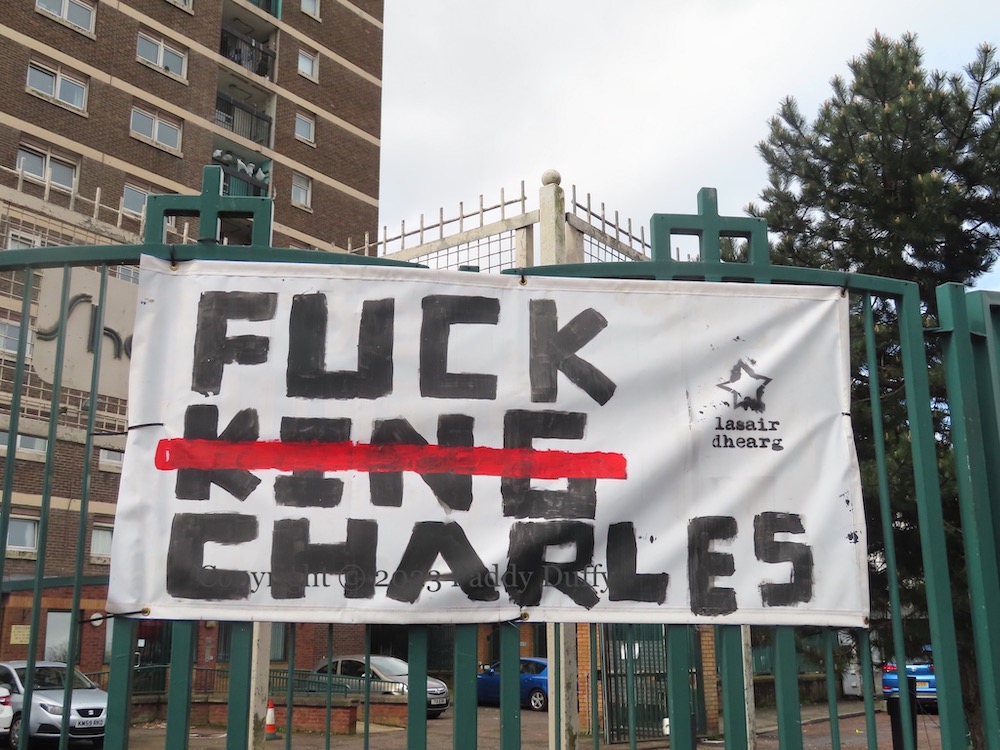
Here is another response to the coronation of King Charles last weekend: (above and last) a Lasaır Dhearg (web) tarp in north Belfast reading “Fuck King Charles”.
Compare previously: England’s Bloody Empire and Not Our King with May The King Live Forever and The Settlement Of The True Protestant Religion.
Click image to enlarge
Copyright © 2023 Paddy Duffy
T02696
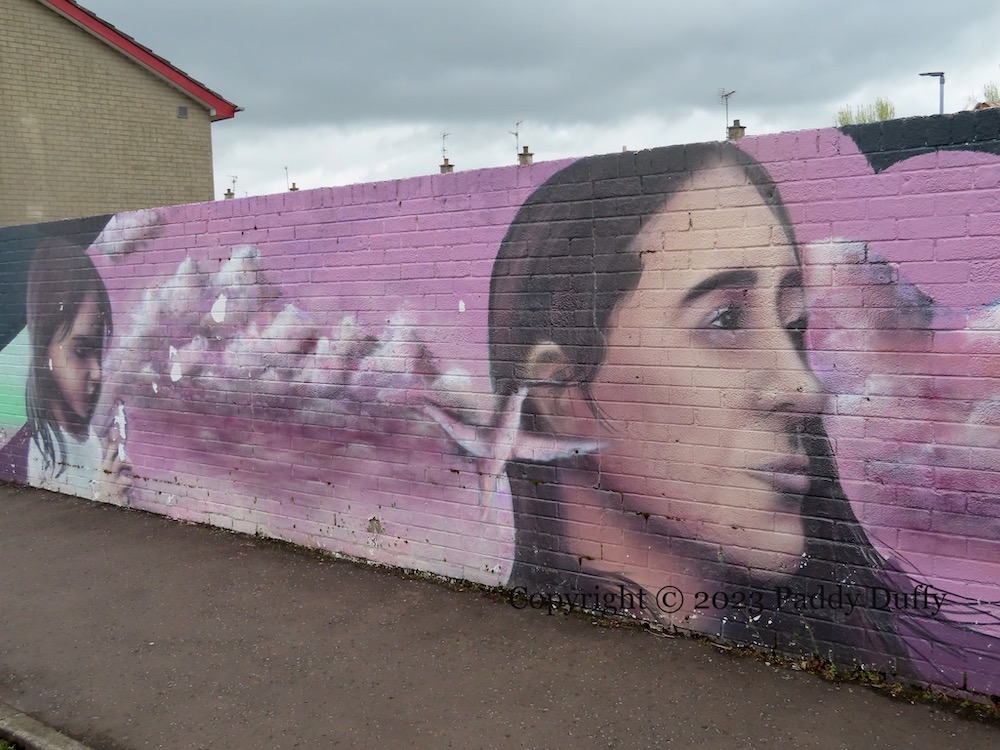
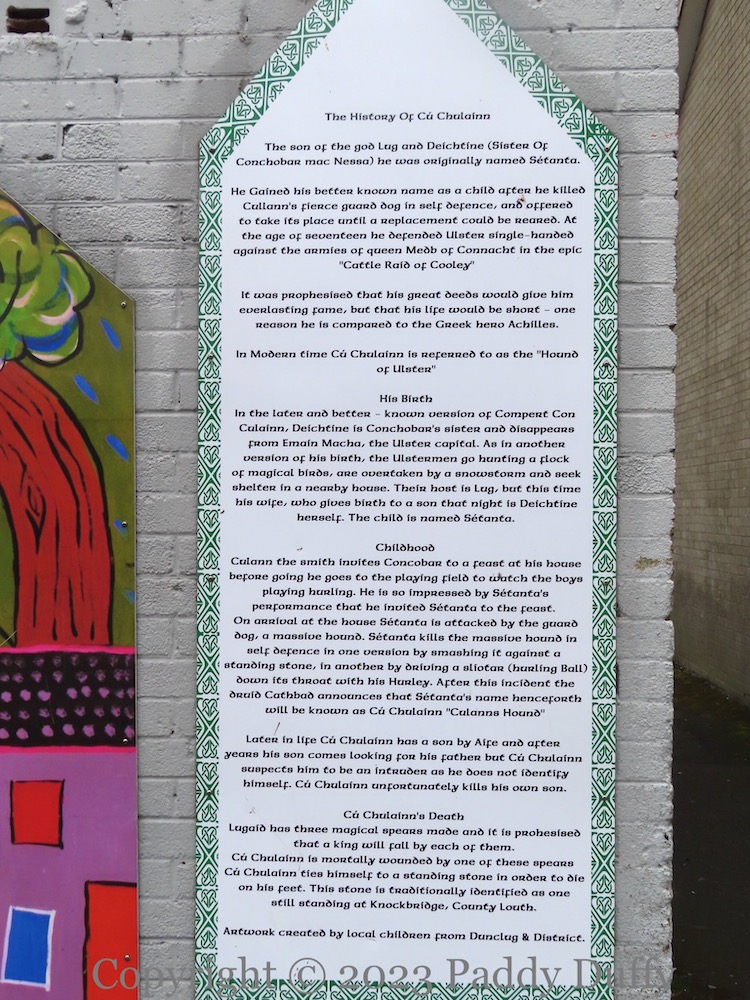
This mural is at the entrance to Dunclug Park, in Ballymena. The wall was formerly the site of ‘The Seven Ages Of Dunclug’ (C03798) which (like the Cú Chulaınn installation that is still standing) replaced a Tricolour. By emic (ig) with support from the Dunclug Youth Forum and the Housing Executive.
Click image to enlarge
Copyright © 2023 Paddy Duffy
T02515

Cú Chulaınn is revered as a living god who might watch over children and their pets, homes, food, and toys in these devotional panels in Dunclug, Ballymena. As the info board says, “It was prophesied that his great deeds would give him everlasting fame.” Cú Chulaınn has his own Visual History page.
Dunclug Park, Ballymena.
Click image to enlarge
Copyright © 2023 Paddy Duffy
T02516r T02517
 Paddy Duffy Collection