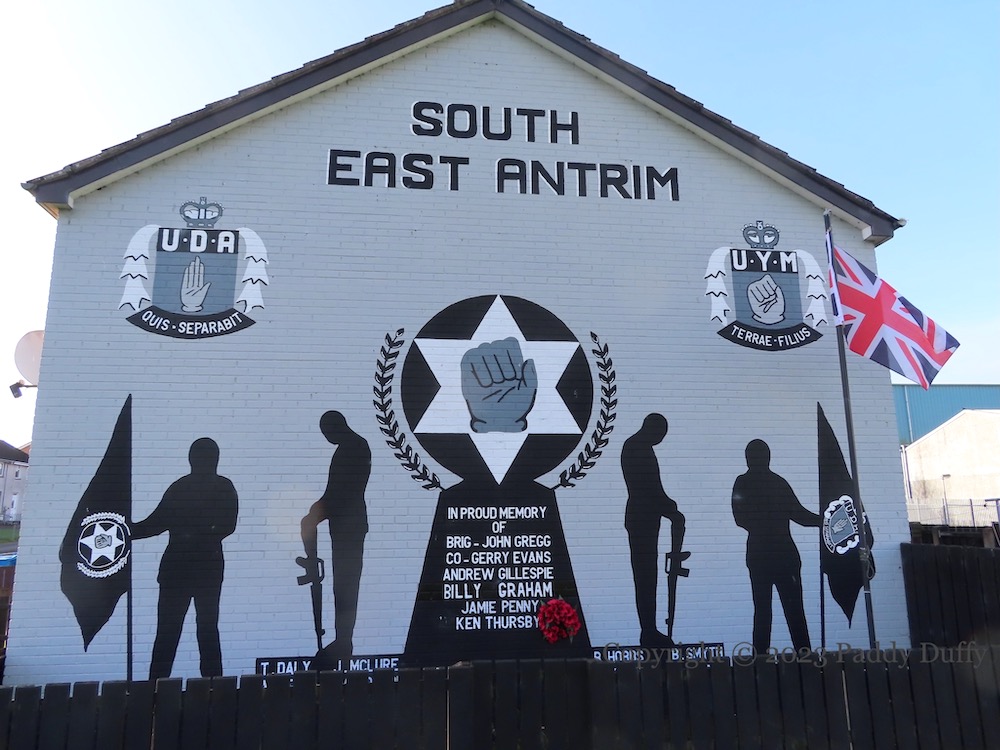
“South East Antrim UDA UYM. In proud memory of Brig John Gregg, CO Gerry Evans, Andrew Gillespie, Billy Graham, Jamie Penny, Ken Thursby, T. Daly, J. McClure, B. Hobbs, B. Smyth”. Graham replaces William Hutchings, and Thursby is a new addition. The original version of the mural, dating back to 2004, included J. Kelly, W. Gordon, G. Fittis, A. Helm (M05230) – these are perhaps below the fence-line.
Gregg was a hero to loyalists for seriously injuring Gerry Adams in 1984; he was killed in the Adair feud in 2003 (Guardian). Evans was killed by the INLA on April 27th, 1994, shot at his shop in the Northcott centre. (Lost Lives 3472. Sutton describes Evans as a “civilian”.) He was remembered first/long ago (1996) in a Cloughfern mural – see T00217.
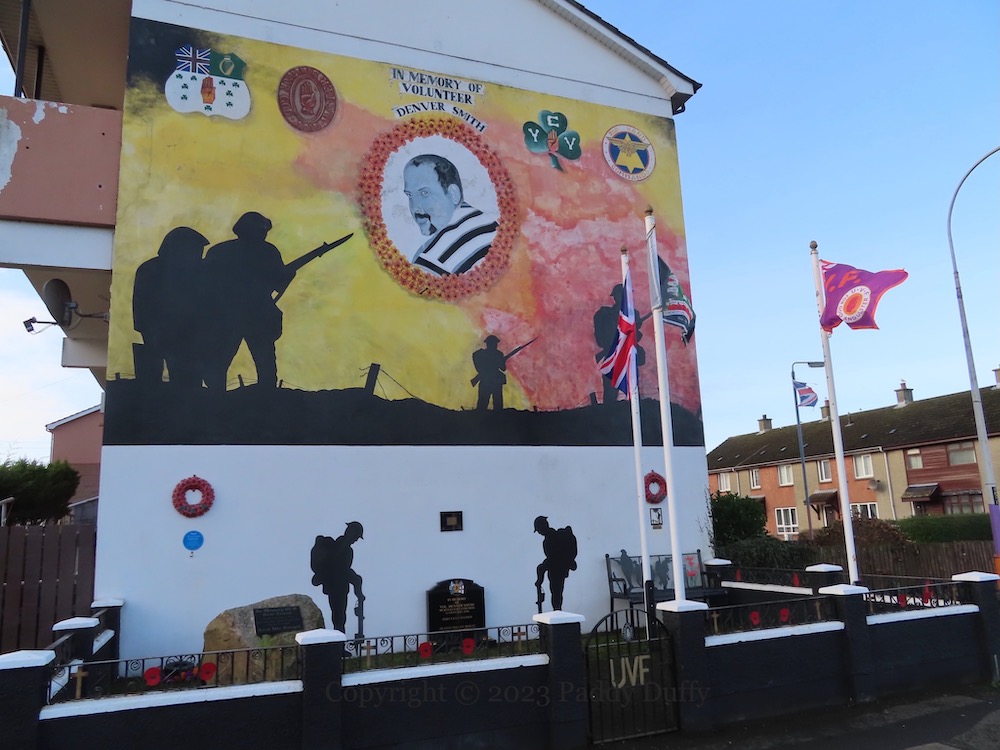
UVF volunteer Denver Smith was killed in the early morning of January 1st, 2000 by a gang of six men with machetes and pikes; the incident was perhaps drugs-related (Guardian | BBC-NI | Irish Times). The iconography, however, is all related to WWI, with soldiers moving across the fields of Flanders in the mural, above, and mourning by a graveside in the memorial garden, below.
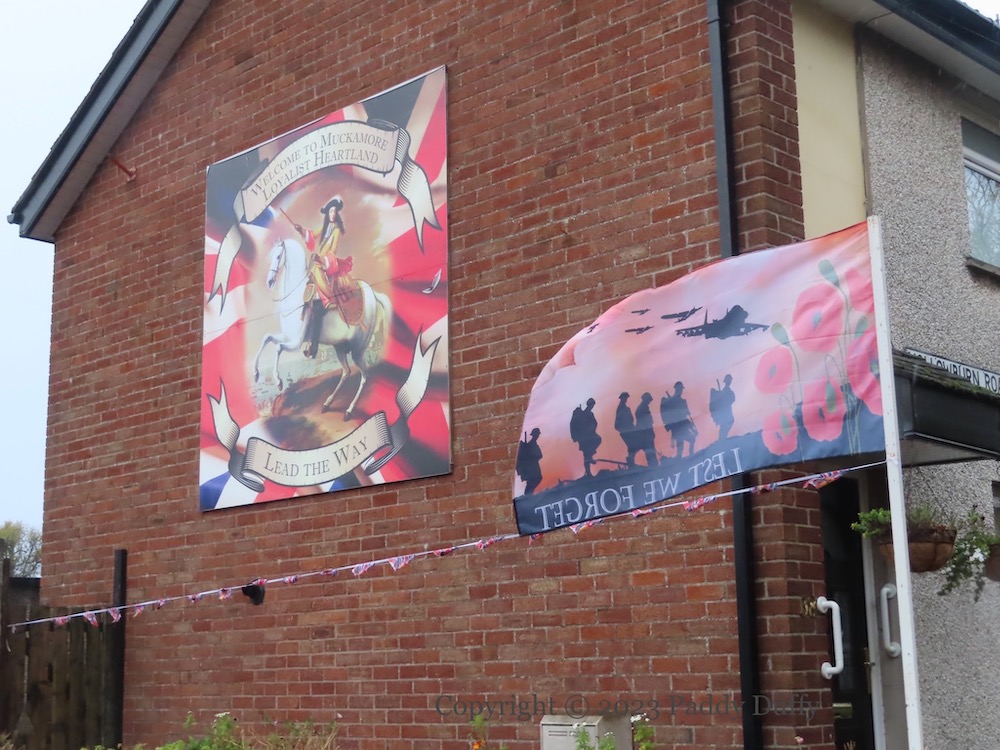
“Welcome to Muckamore, loyalist heartland – lead the way.” “In defence of our heritage and culture.”
In the Muckamore/Ballycraigy areas of Antrim the insignia of the LVF are still in place. “Lead the way” was the slogan of the LVF (see e.g. D01246 for a prominent instance in Ballycraigy). The organisation called a ceasefire and decommissioned some weapons in the years after the Agreement but persists in some form in Antrim (WP).
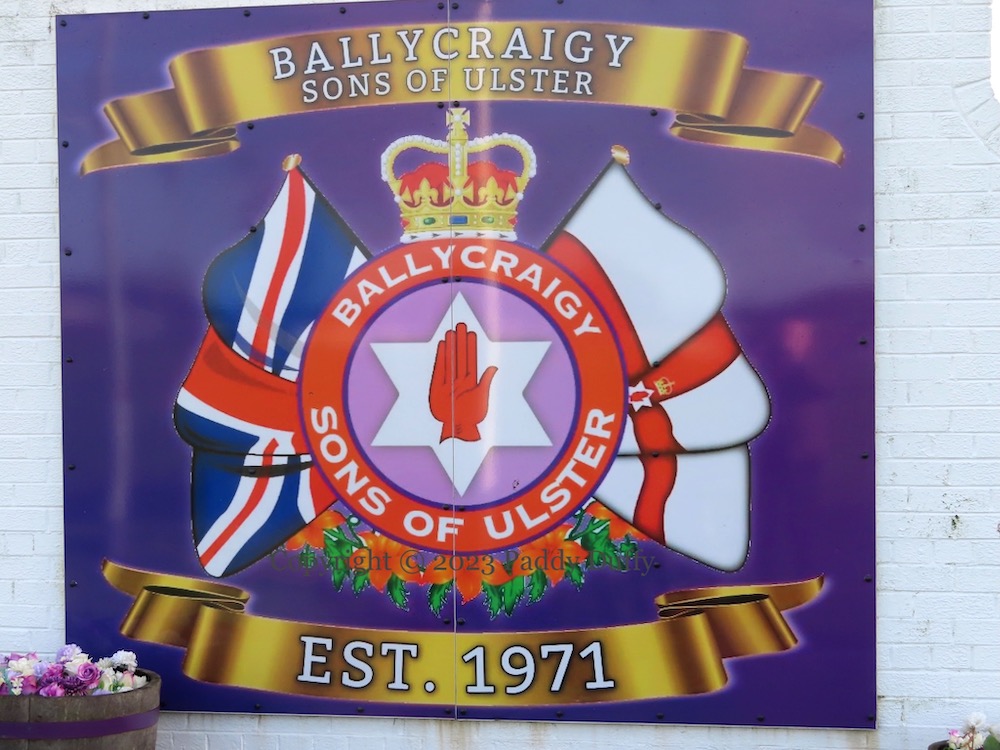
The Sons Of Ulster also used to use the slogan “Lead the way” (as described in J1947) but it is not present in the board shown in the recent (2022) Old Ulster’s Battle Cry.
The two boards below are on gables above Woodgreen, which is the site of the bonfire (ig) featured in the third image. They used to claim that it was the biggest bonfire (see C06695) but Craigyhill (in Larne) is more recently the tallest – see Commonwealth Handling Equipment.
There is also a memorial garden to Billy Wright in Ballycraigy – see M05203.
On the front of the wall, soldiers from the 36th (Ulster) Division stop at a grave as they march through Flanders Fields; just around the corner (second image) is a memorial to a (modern) UVF member “Vol. D[avid] Langley, 1969-2018”.
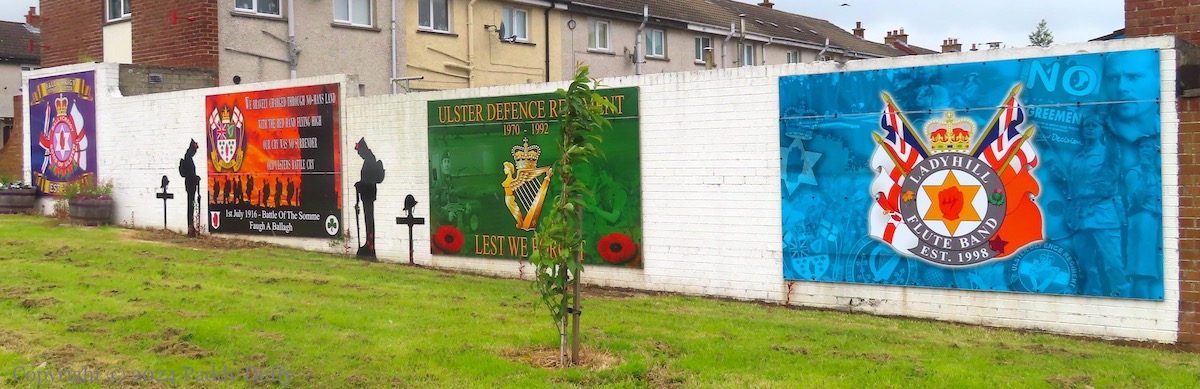
“‘We bravely charged through no-man’s land/With the red hand flying high/Our cry was ‘No surrender’/Old Ulster’s battle cry.’ 1st July 1916 – Battle Of The Somme. Faugh a ballagh.”
“No surrender” was the cry against the forces of James II as they marched on Derry on December 7th, 1688, a moment celebrated by members of the Orange Order, Royal Black Institution, and Apprentice Boys, and from there, possibly shouted on July 1st as the 36th Division, formed from the Ulster Volunteers, attacked Schwaben Redoubt from Thiepval Wood (Irish Times | History Ireland).
The red hand is the emblem of the 36th (Ulster) Division and the shamrock stands for the 16th (Irish) Division, which was not in action on July 1st (the Battle Of Albert) but at the Battle Of Ginchy and Battle Of Guillemont in early September (Long Long Trail). (See also various Messines 1917 murals: Killed Wounded Missing | Comrades In Arms | We Are The dead | Brothers In Arms | Messines 1917
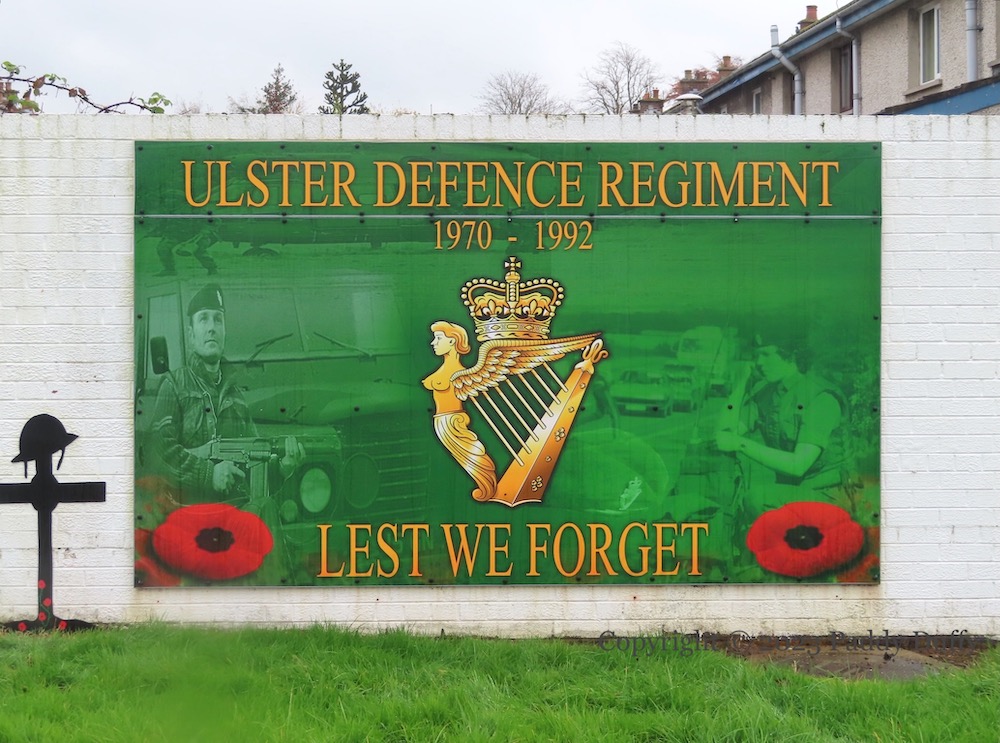
“Faugh a ballagh” is also included; of the regiments who supplied battalions for the 36th Division, only one – the Royal Irish Fusiliers – used that motto, the 9th battalion of the RIF was raised from the Armagh, Monaghan, and Cavan Volunteers. The motto of the Royal Irish Rifles (who supplied 8 of the 12 battalions of the 36th), and later of the UDR, was “Quis separabit”. “Faugh a ballagh” was the motto of the Royal Irish Rangers and is the motto of the current Royal Irish Regiment.
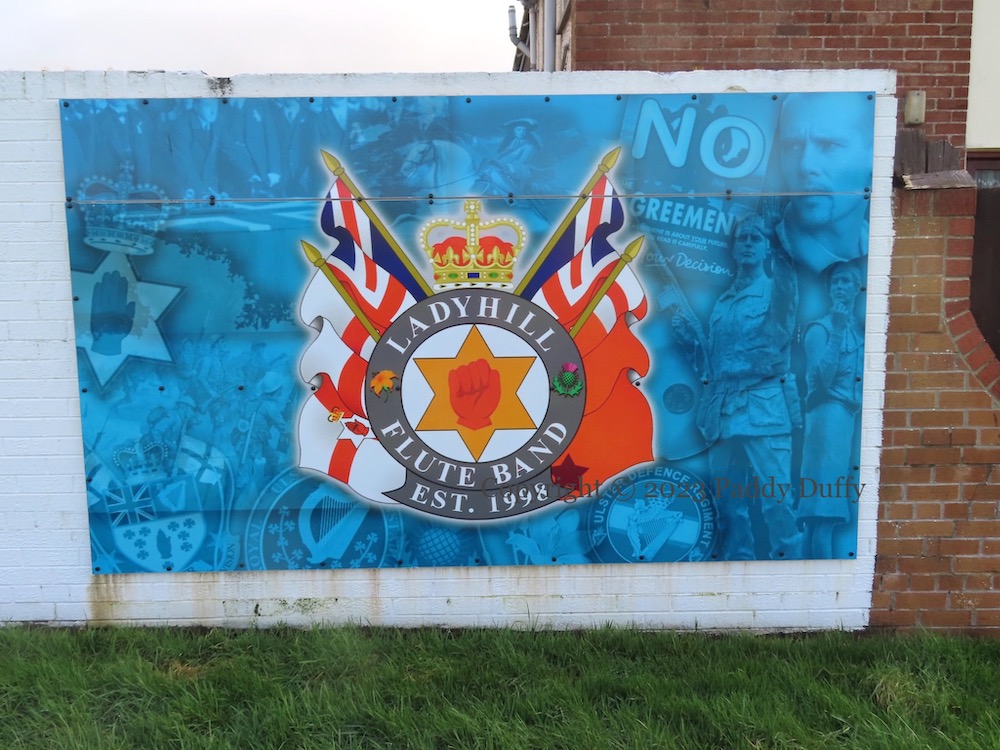
The military boards are flanked by boards for two local flute bands: “Ballycraigy Sons Of Ulster est. 1971” (tw) and “Ladyhill flute band est. 1998” (Fb).
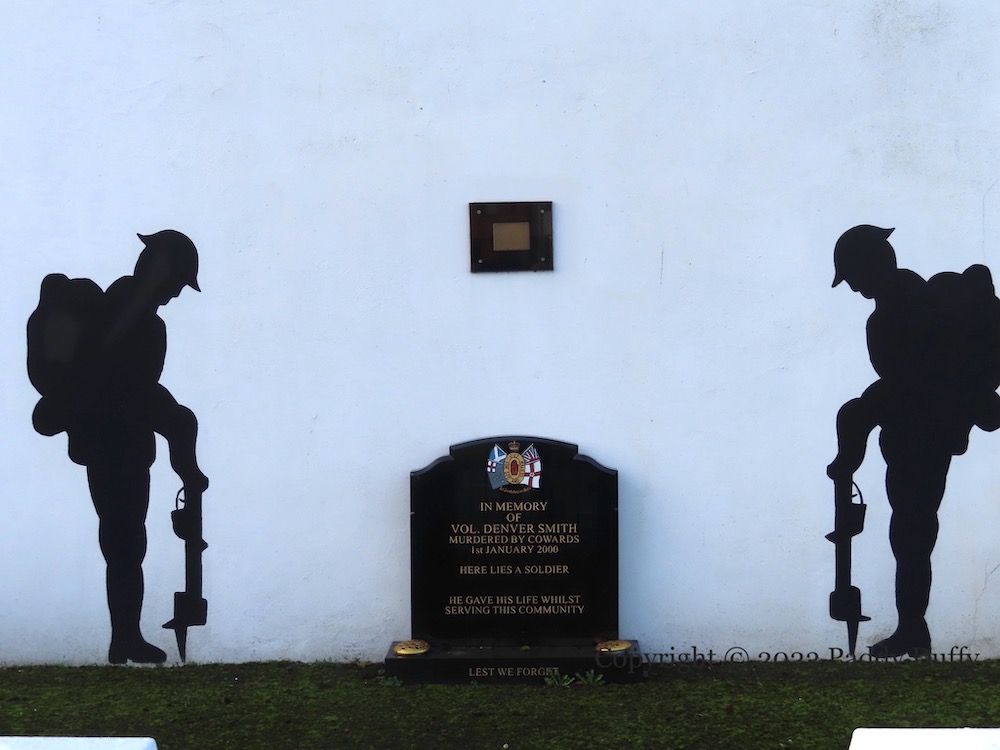
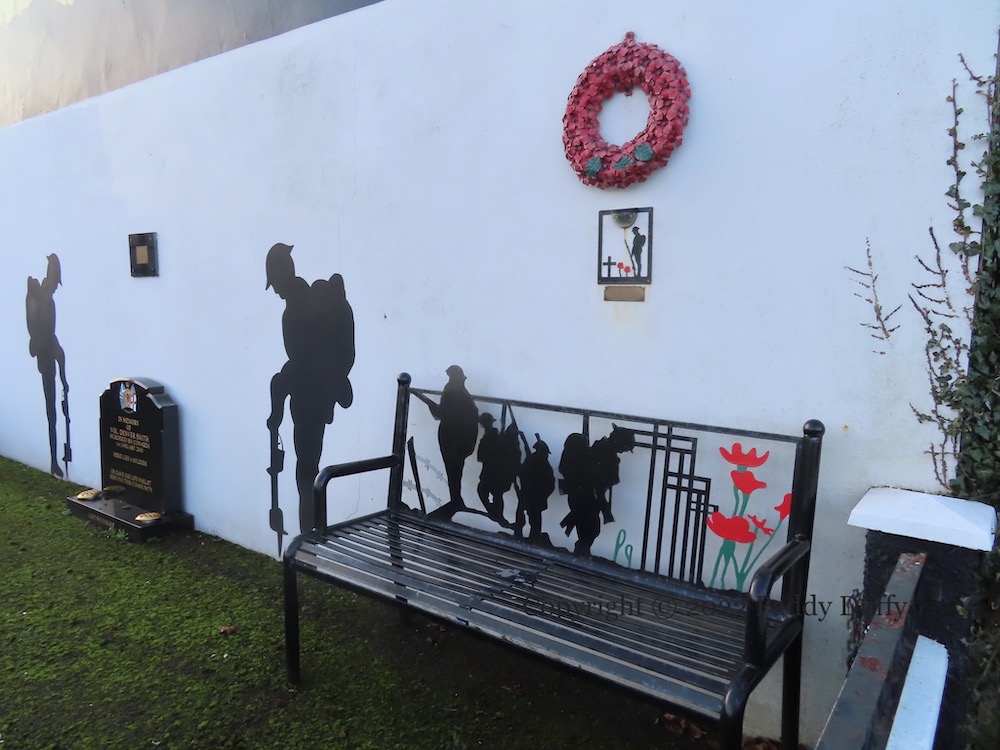
Update 2024-06: Silhouetted graveside mourners have been added to either side of the Somme board – see the final two images.
2023-11: with silhouetted graveside mourners and helmet on cross
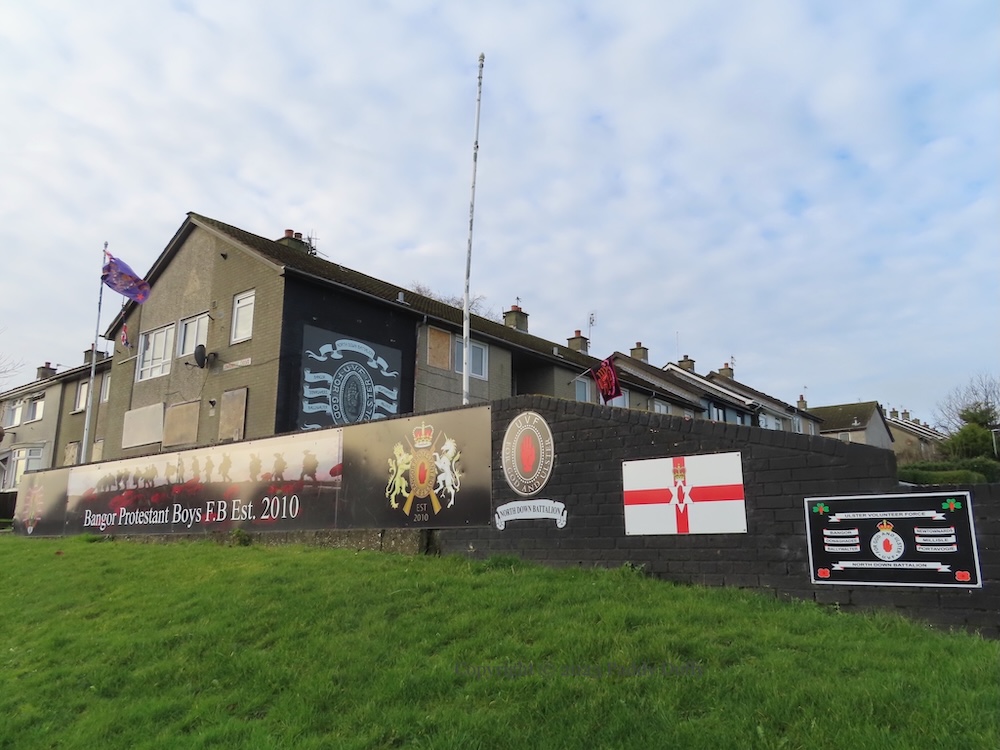
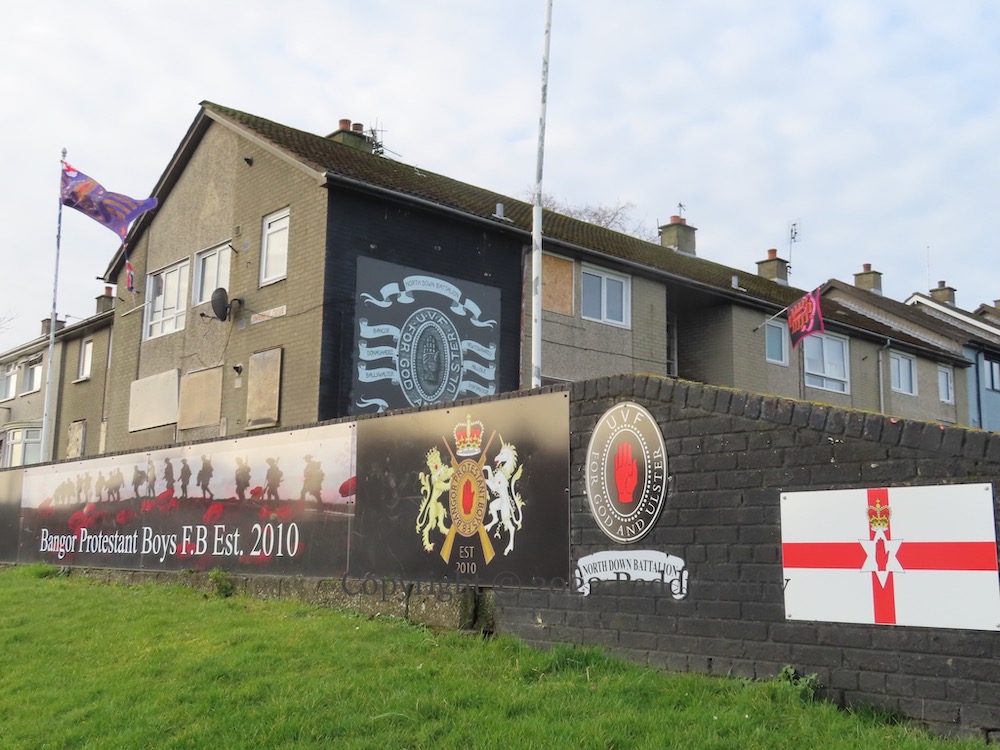
Here are images of a long wall of printed boards from the Bangor Protestant Boys Flute Band (Fb).
On the far left is a (modern) shield of the 36th (Ulster) Division – the Union flag and Irish harp above a red hand on a field of shamrocks – on a garland of orange poppies and WWI battlefields on a purple ribbon – orange and purple being the colours of the Ulster Volunteers.
Right of the long board is an emblem for the band itself: the lion and the unicorn on either side of crossed rifles and the red hand of Ulster on an oval.
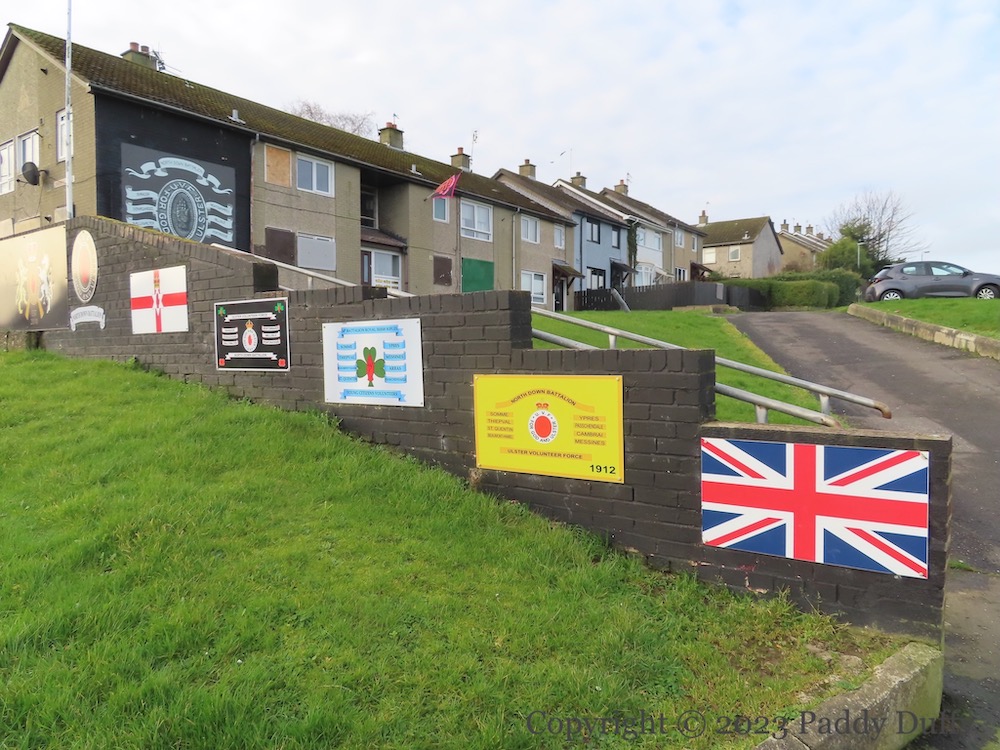
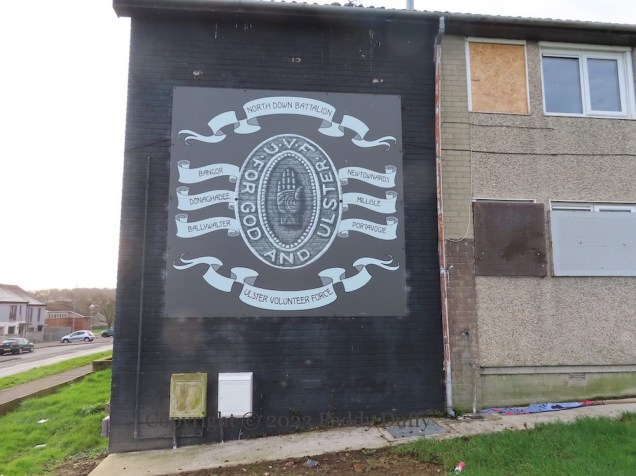
The five small boards use the Ulster Banner and Union Flag as book-ends. Between them are three concerning the Ulster Volunteers. Recruiting for the Ulster Volunteers in Down was so successful that it was divided into four areas (North, South, East, and West), each with a battalion, and the North down battalion comprised 15 companies (History Ireland). The Down battalions became the 13th battalion of the (108th Brigade) Royal Irish Rifles in WWI. The YCV (Young Citizen Volunteers) was formed separately (in 1912) but joined the Volunteers in May 1914, before becoming the (109th Brigade) 14th battalion of the Royal Irish Rifles when the war broke out (WP). Both began their campaigns at Boulogne-Sur-Mer in October, 1915 (WP).
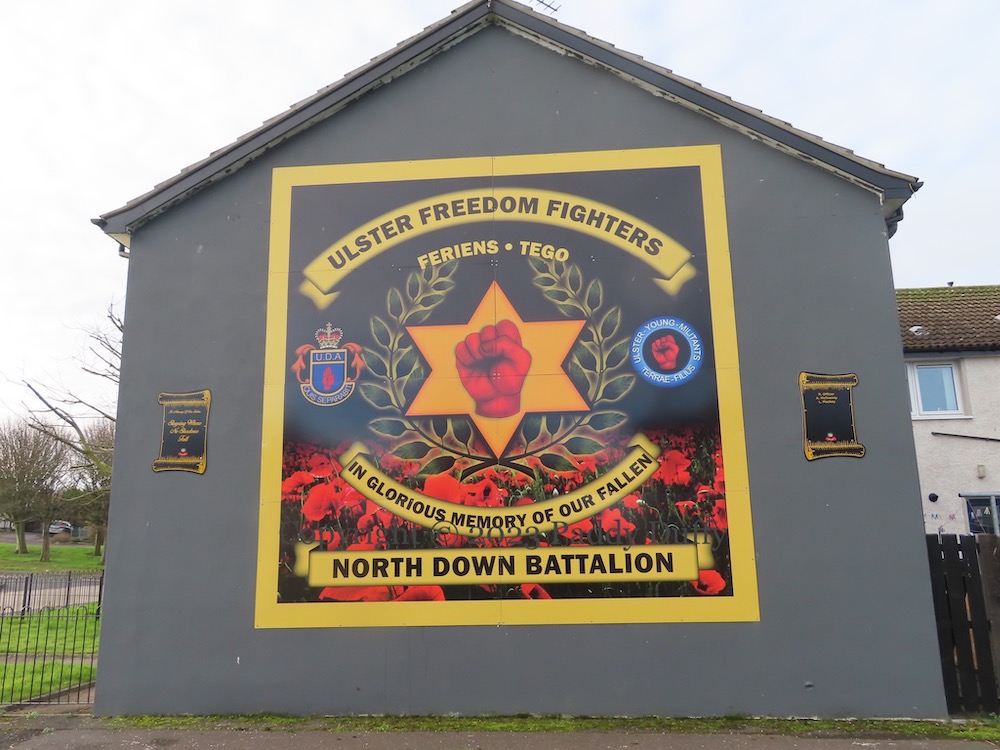
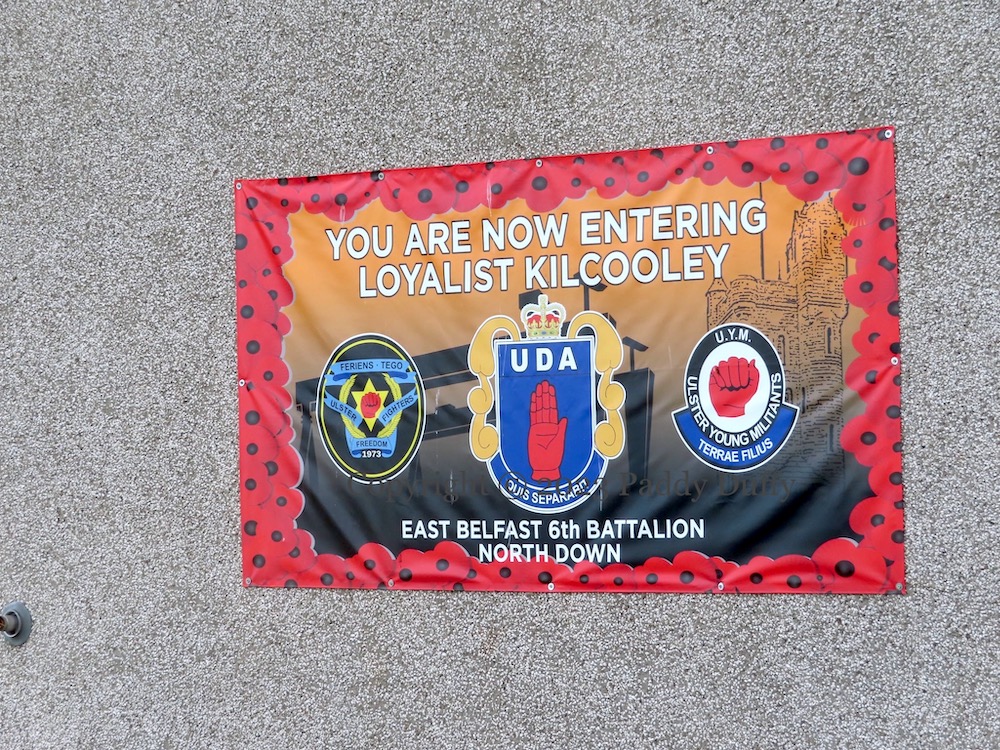
Three rival factions in Kilcooley: North Down UDA, East Belfast UDA, and North Down UVF. The two small plaques (which read, “In memory of the fallen. Sleeping where no shadows fall.” and “R[oy] Officer, A[ndrew] McIlvenny, L[?]. Mackey.”) are new, compared to the images in the SMC Collection.
Inishargie Gardens and Owenroe Drive, Kilcooley, Bangor
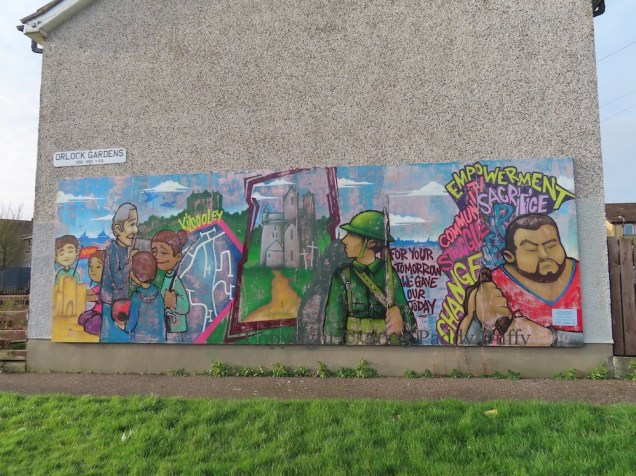
“This mural was designed by the Kilcooley participants in part of the PEACE IV Open Dialogue programme facilitated by NI Alternatives.” From left to right: children building a “future” sandcastle on the beach; a map of Kilcooley; a WWI soldier and the saying “For your tomorrow, we gave our today”; a ?wrestler? ?dragging? a cloud of positive words: empowerment, community, sacrifice, struggle, change, help.
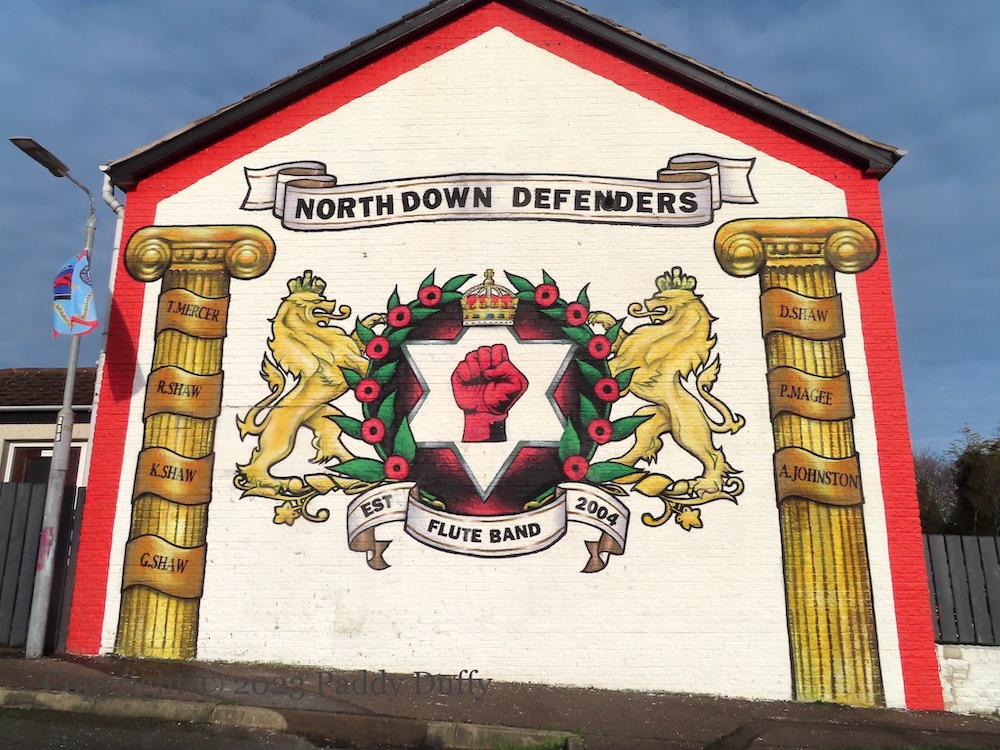
At the end of 2016, Dee Stitt of Charter NI and the UDA was criticised for remarks describing his North Down Defenders (Fb) as the “homeland security” of Bangor’s Kilcooley estate and describing working-class estates as “jungles” in which there is always a “big guy” (Guardian video 8 min mark ff.| BelTel | ITv) .
The mural above does not directly indicate ties to the UDA/UFF, except for the red fist. For a more explicit NDD board further down the estate, with UDA, UFF, UYM, and LPA flags, see North Down Defenders.
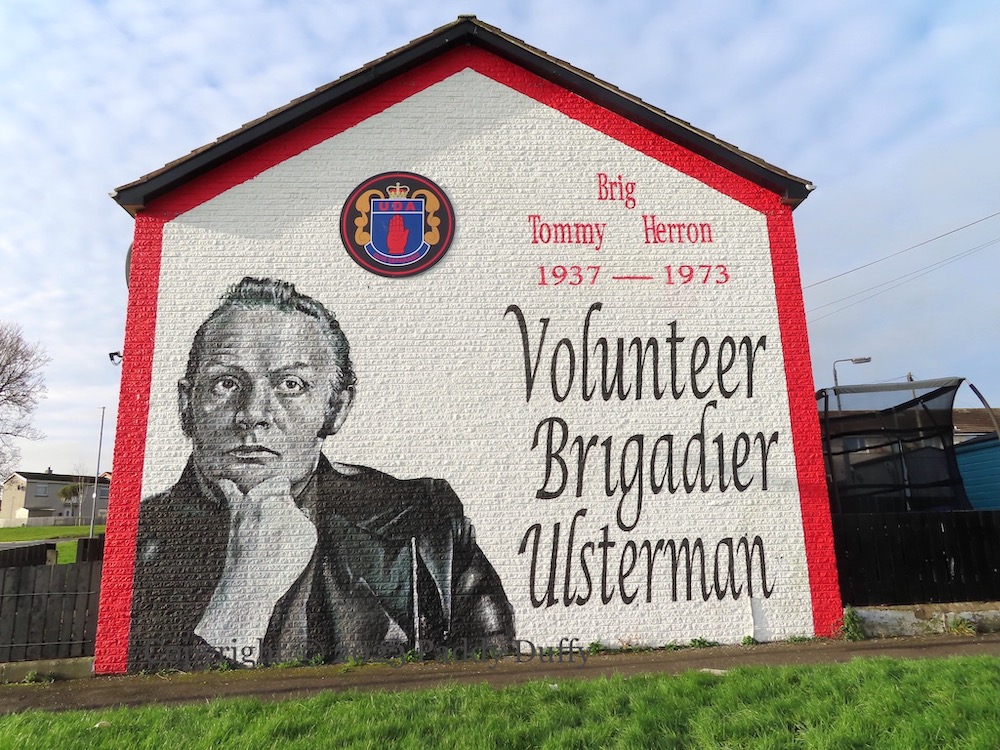
Tommy Herron was kidnapped and executed in September 1973, probably by members of his own East Belfast UDA brigade in a dispute over money from a robbery (Irish Times | Lost Lives 938 | Holland | BelTel) though others allege it was by the security forces (BelTel), perhaps the SAS or MI5. These BBC News videos (one | two) give a sense of the perplexity of the case; a HET inquiry years later was inconclusive (Irish Times). His 18-year-old brother-in-law, Michael Wilson, had been killed by the UDA at their shared house in June, perhaps in a case of mistaken identity, perhaps as an informer (WP | Lost Lives 877).
Despite the internal conflict over Herron’s position and profiteering, 25,000 people attended his funeral and hearkened to the words of the Reverend Ian Paisley (AP video | Patterson images). The AP video shows ranks of UDA volunteers marching in the procession; the mural was launched with (two) masked UDA volunteers flanking speaker Dee Stitt (BelTel).