You Can Change The Ending

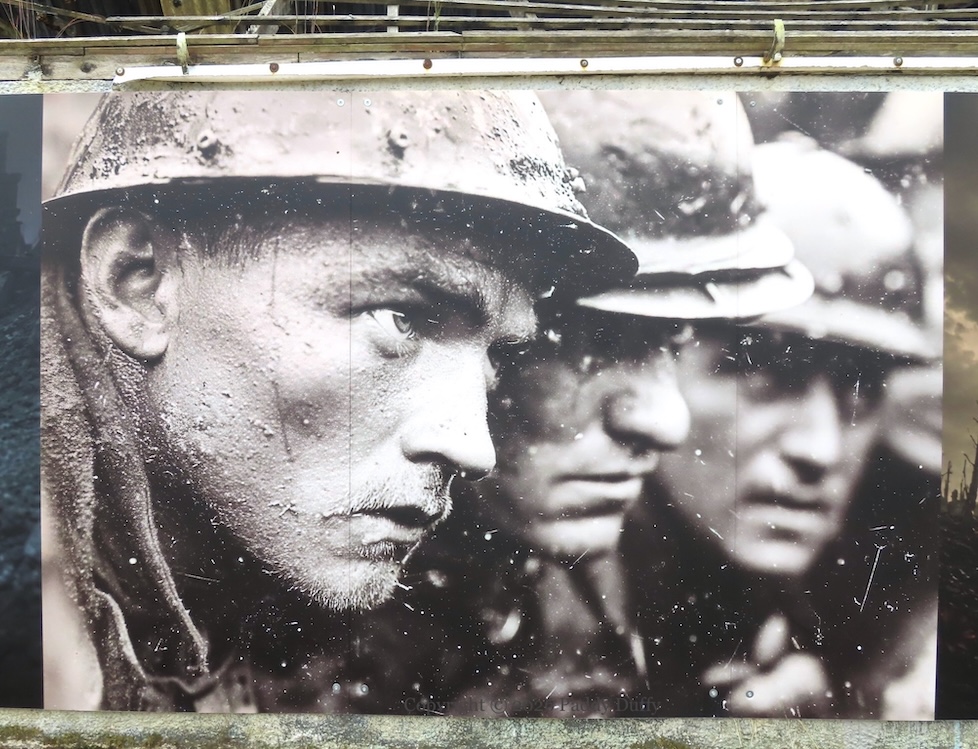
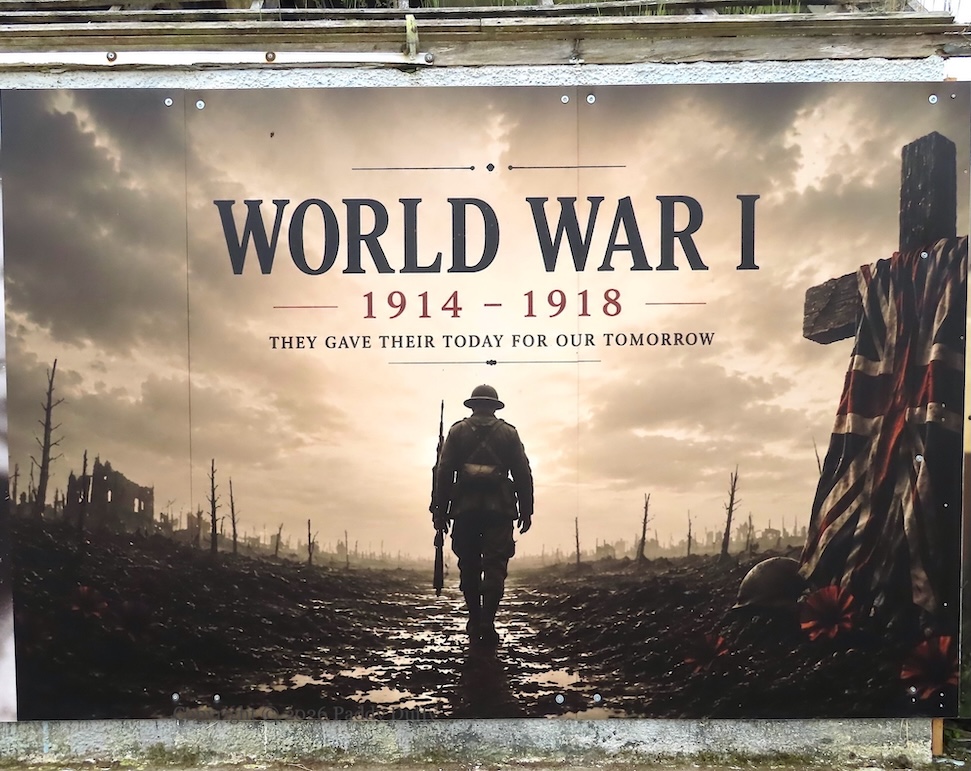
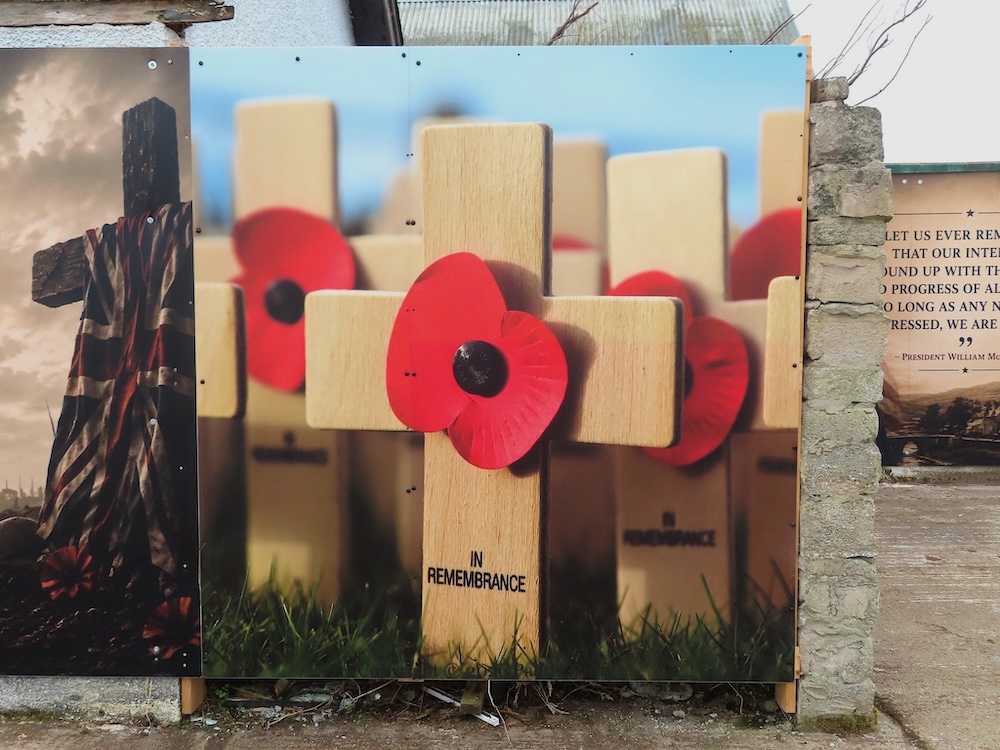
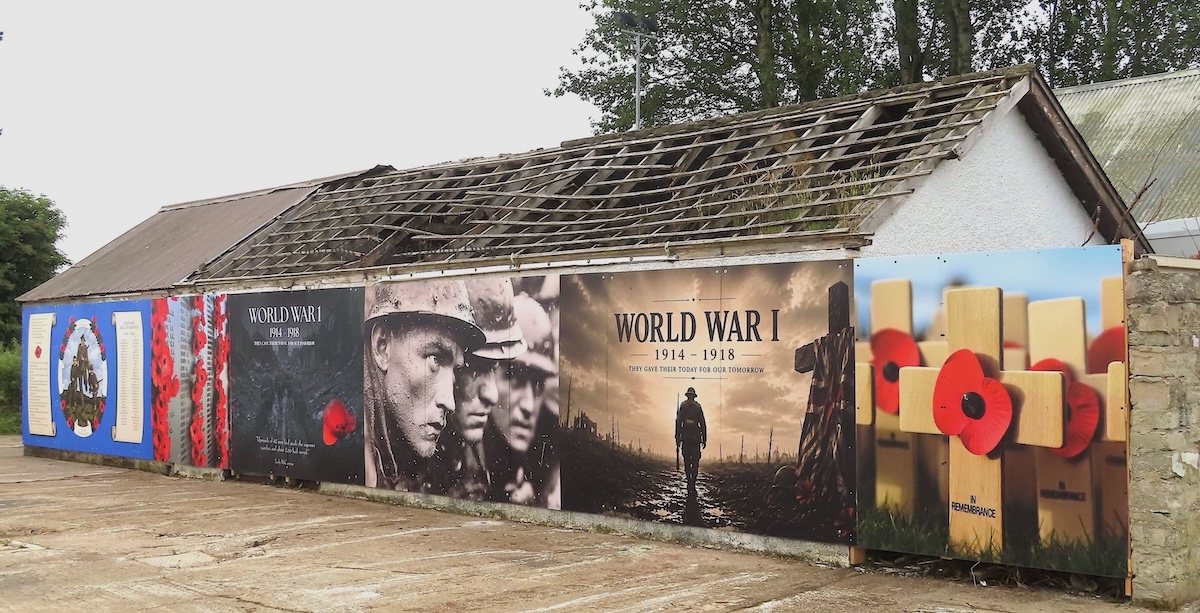
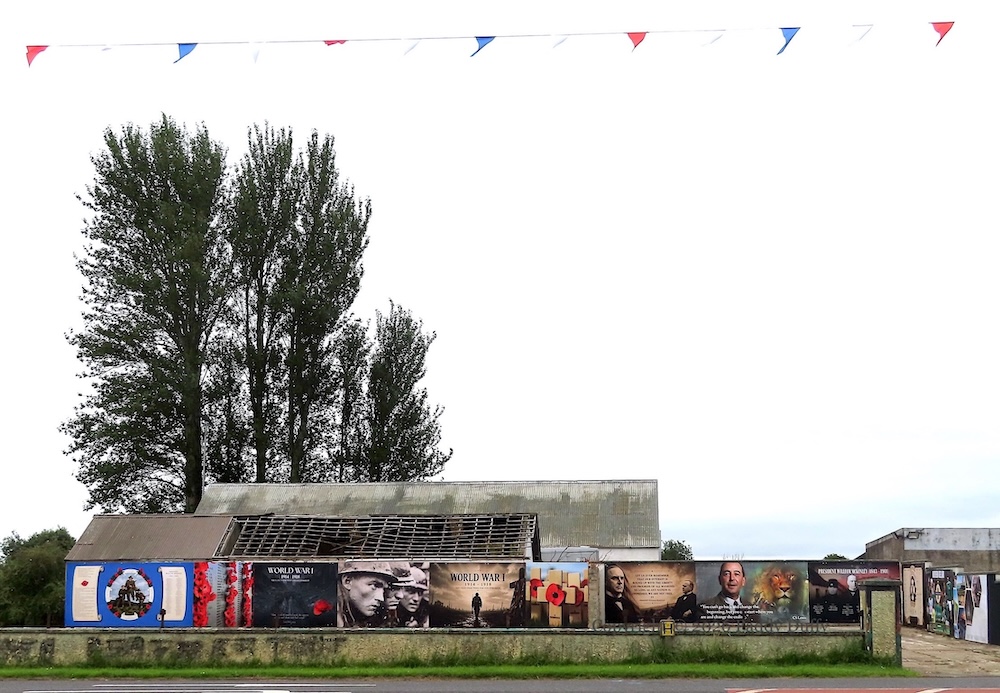
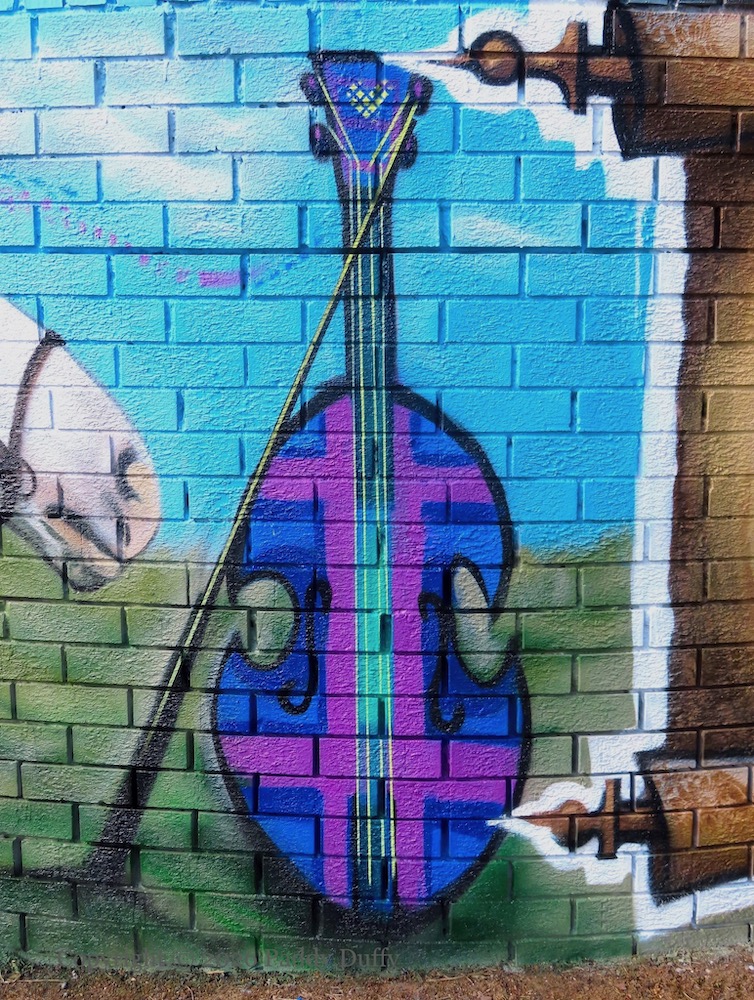
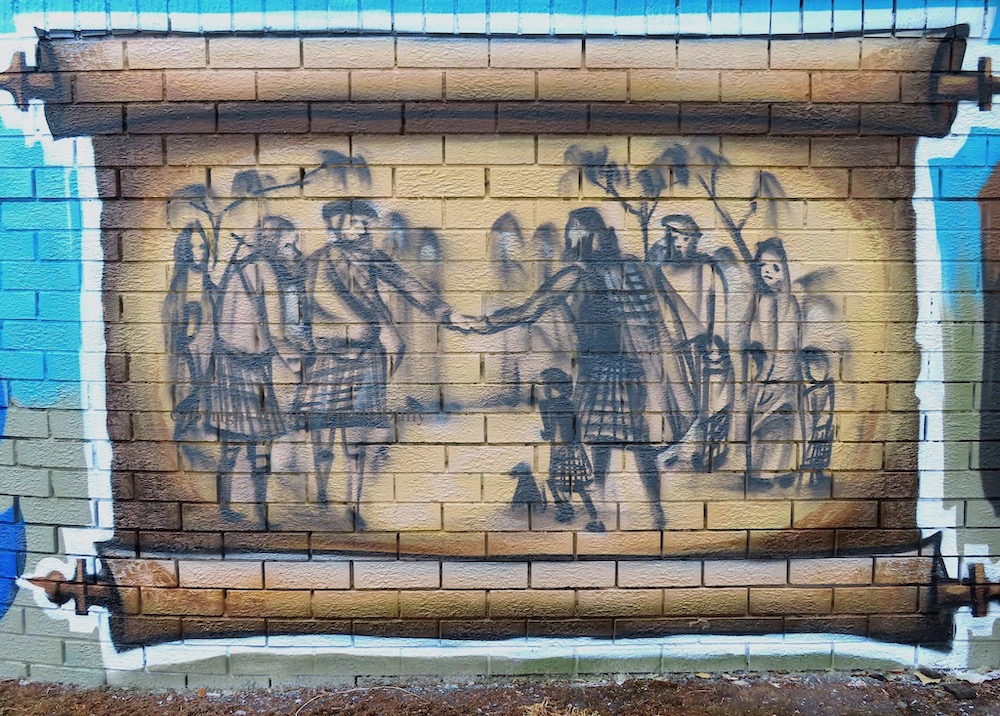
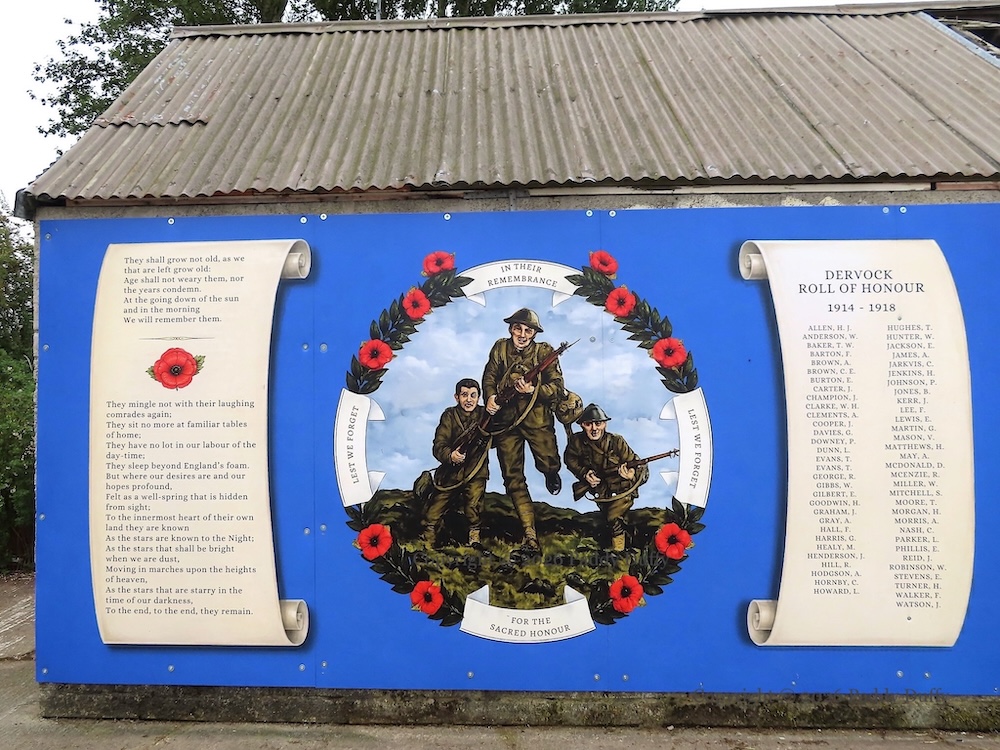
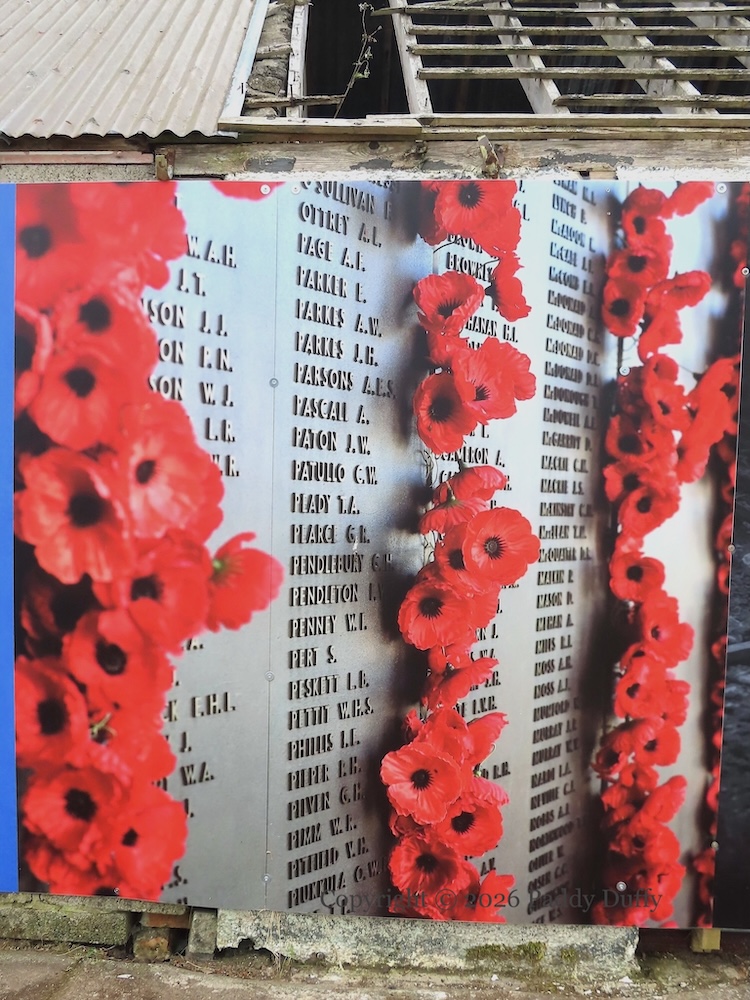
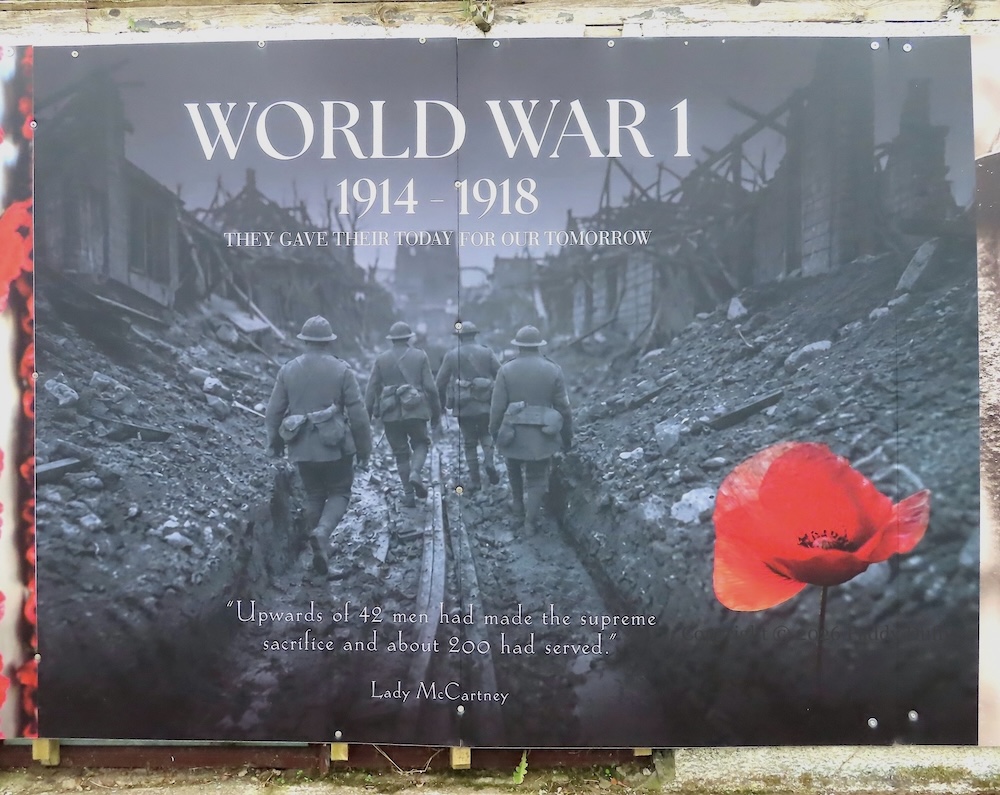
The left-hand part of this large installation in Dervock is given over to six boards commemorating the First World War and the locals who served and died in it. Sixty-two names are listed on the “roll of honour”, including the “Upwards of 42 men [who] had made the supreme sacrifice” from the roughly 200 who served – as noted by “Lady McCartney” (perhaps at the opening of the Dervock War Memorial Institute – Larne Times & Weekly Telegraph, 25th December 1922). (For the Institute, see Ulster War Memorials, which also gives a (very different) list of Dervock dead.) The central image was long ago a mural in the centre of the village – it can be seen in the plates to Bill Rolston’s Politics And Painting and as image 24 in volume one of Drawing Support.

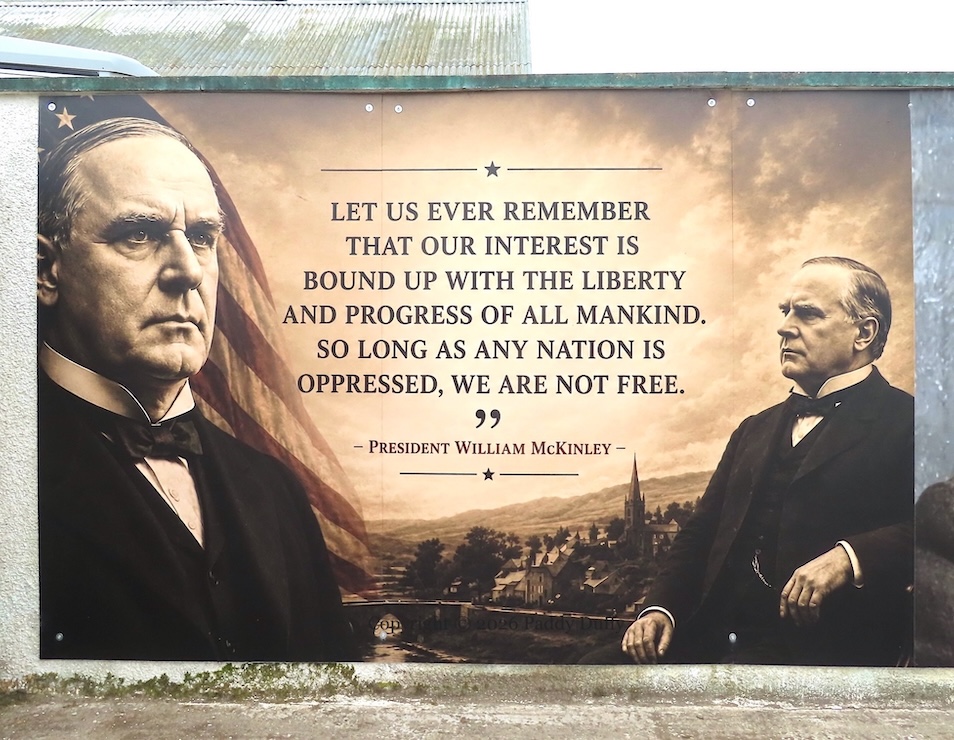
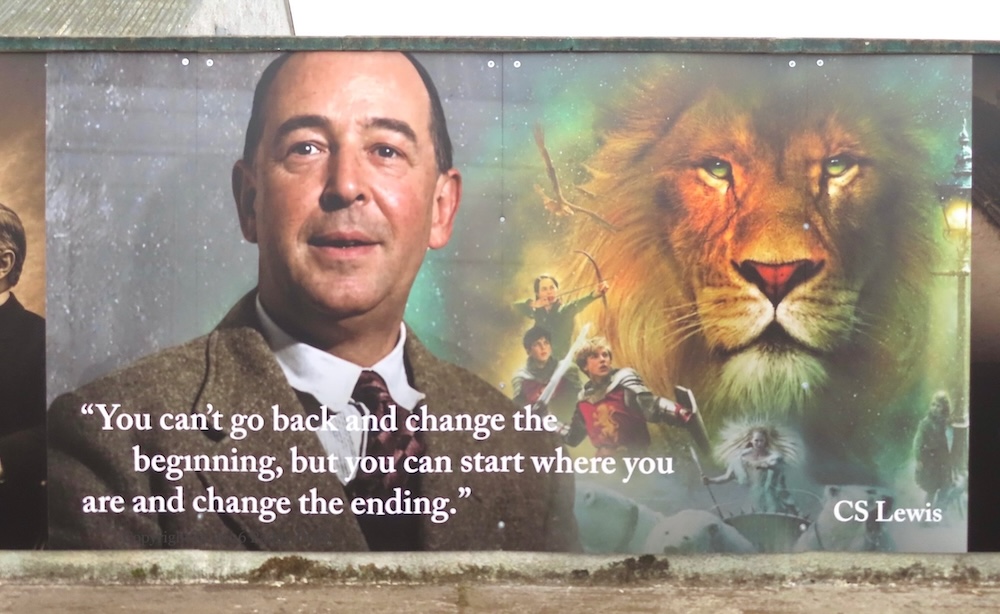
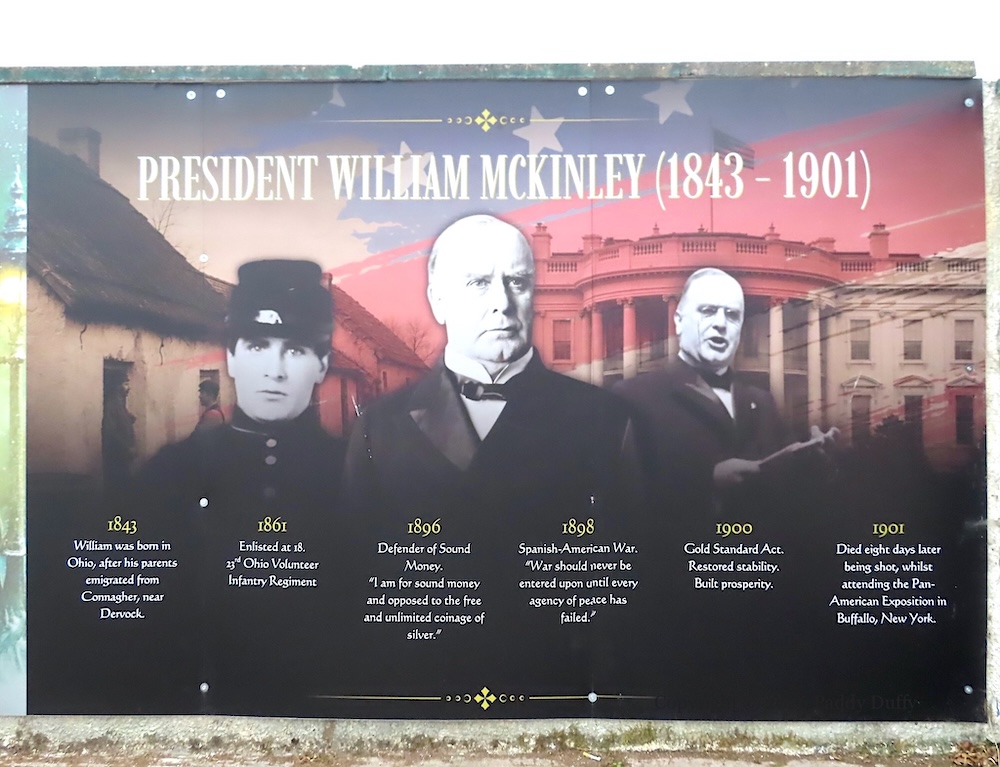
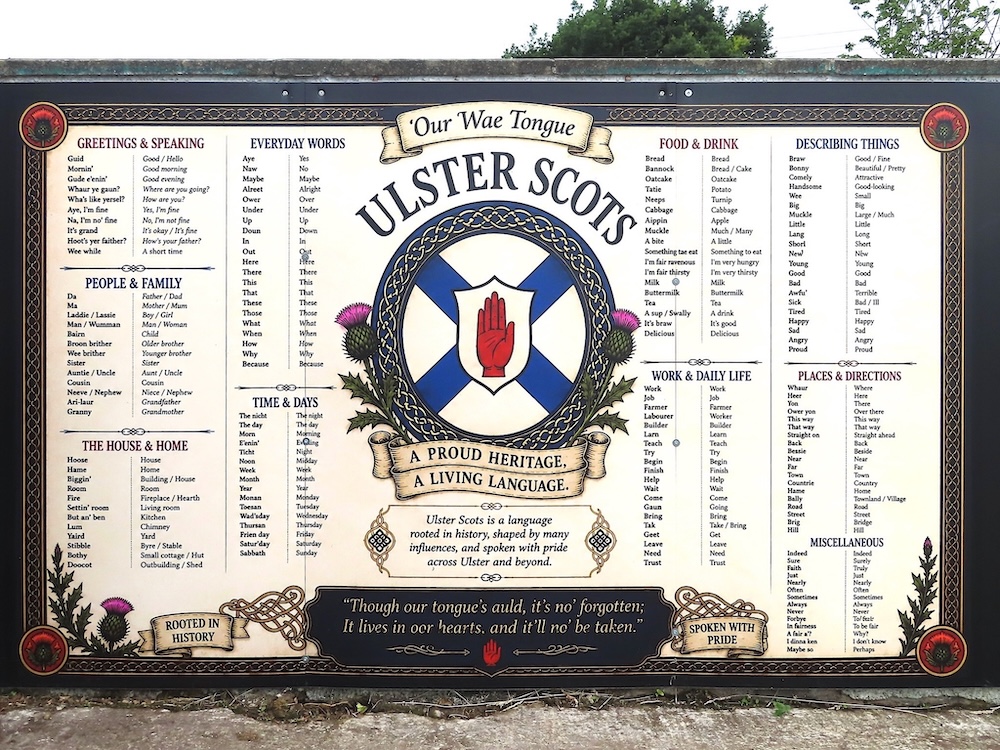
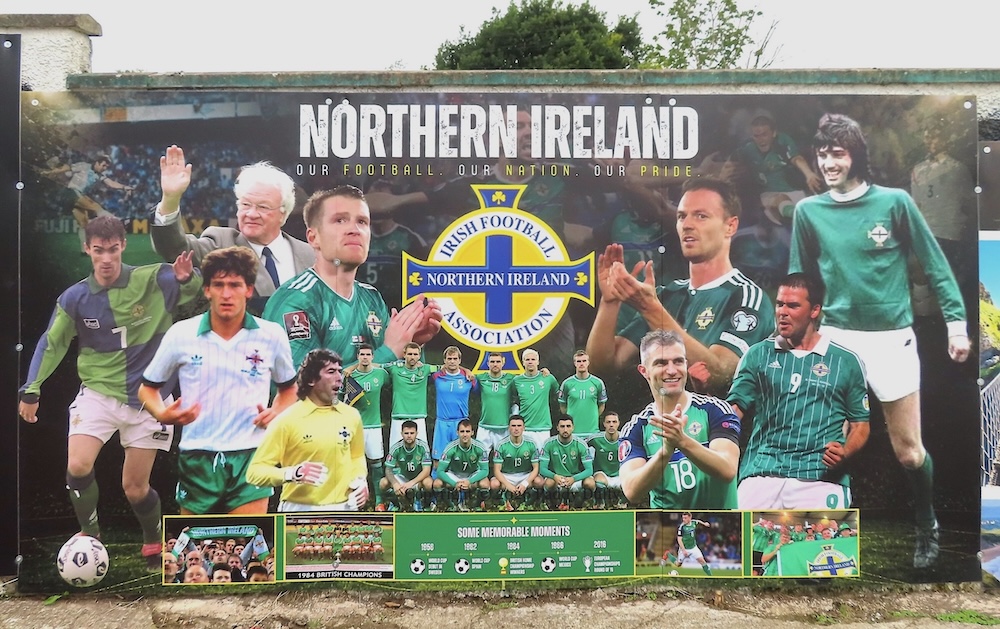
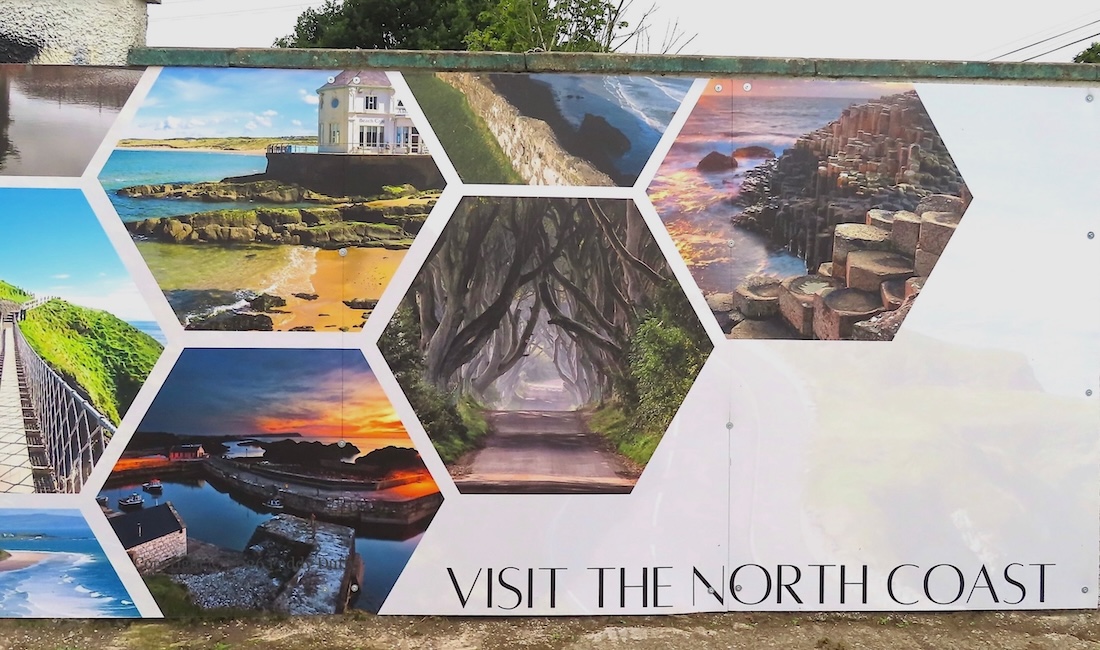
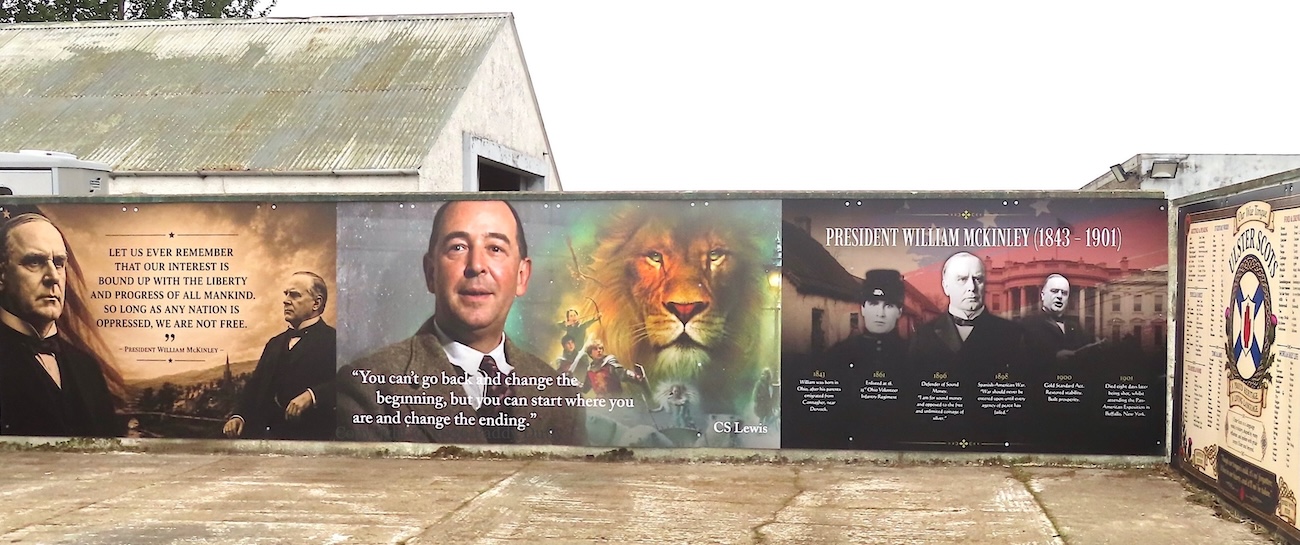
The right-hand part contains two boards about William McKinley, one to CS Lewis, one providing a small dictionary of Ulstèr-Scots words (“Our wae tongue – a proud heritage, a living language.”), one listing “memorable moments” of the Northern Ireland soccer team (“Our football. Our nation. Our pride.”), and one inviting people to “visit the north coast”.

There is no record (on-line, at least) of McKinley saying or writing, “Let us ever remember that our interest is bound up with the liberty and progress of all mankind. So long as any nation is oppressed, we are not free.” And only one of the quotations in the bio can be verified:

“President William McKinley (1843 – 1901).
1843: William was born in Ohio, after his parents [perhaps his great-great-grandfather] emigrated from Connagher [Conagher], near Dervock.
1861: Enlisted at 18. 23rd Ohio Volunteer Infantry Regiment. [The American Civil War]
1896: Defender of Sound Money [i.e. the Gold Standard]. “I am for sound money and opposed to the free and unlimited coinage of silver.” [“sound money” was a campaign slogan; the remainder can be found in the Republican policy platform of 1900]
1898: Spanish-American War. “War should never be entered upon until every agency of peace has failed.” [From the first inaugural, 1897, and so not in response to the Spanish-American War; Congress declared war despite McKinley’s reticence]
1900: Gold Standard Act. Restored stability. Built prosperity.
1901: Died eight days later [sic, “after”] being shot, whilst attending the Pan-American Exposition in Buffallo [sic] New York.”

See also: the Visual History page on Ulster-Scots murals.

CS Lewis did not say or write, “You can’t go back and change the beginning, but you can start where you are and change the ending.” (CS Lewis)

Knock Road, Dervock, with support from Causeway Policing And Community Safety Partnership (Causeway PCSP) and the Causeway Coast & Glens borough council’s Good Relations team. Unveiled July 2nd, 2026.
Click image to enlarge
Copyright © 2026 Paddy Duffy
T09504 [T09505] [T09506] [T09507] T09508 T09509 T09510 T09511 T09512
T09513 T09514 T09515 T09516 [T09517] T09518 T09519
T09521 T09520 T09503
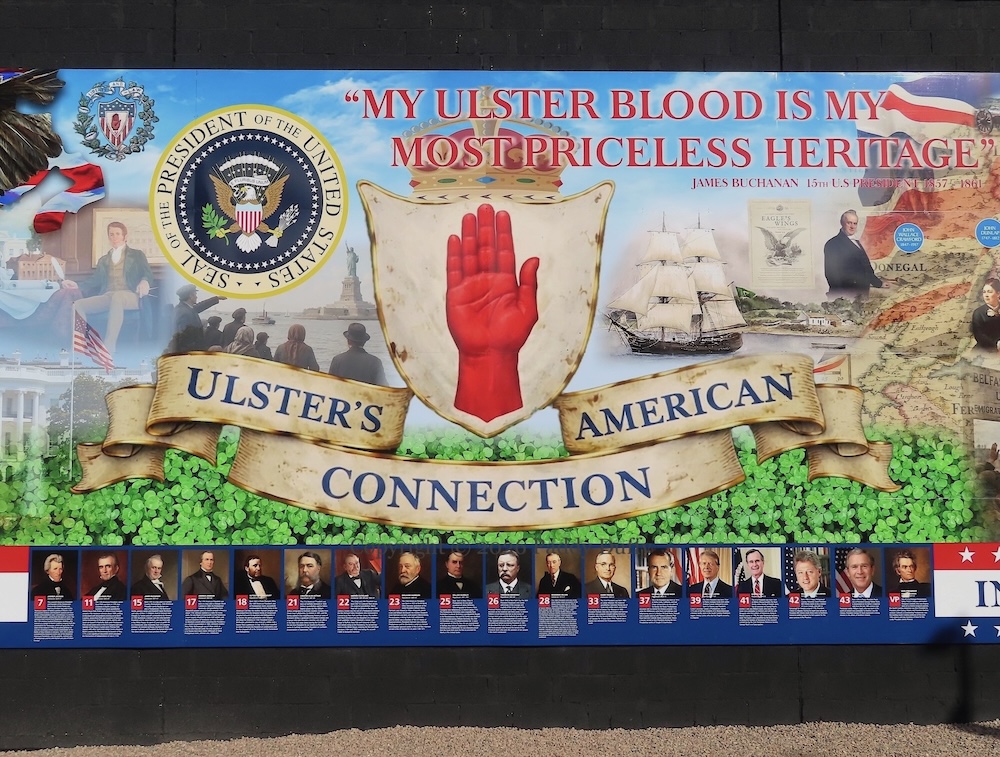
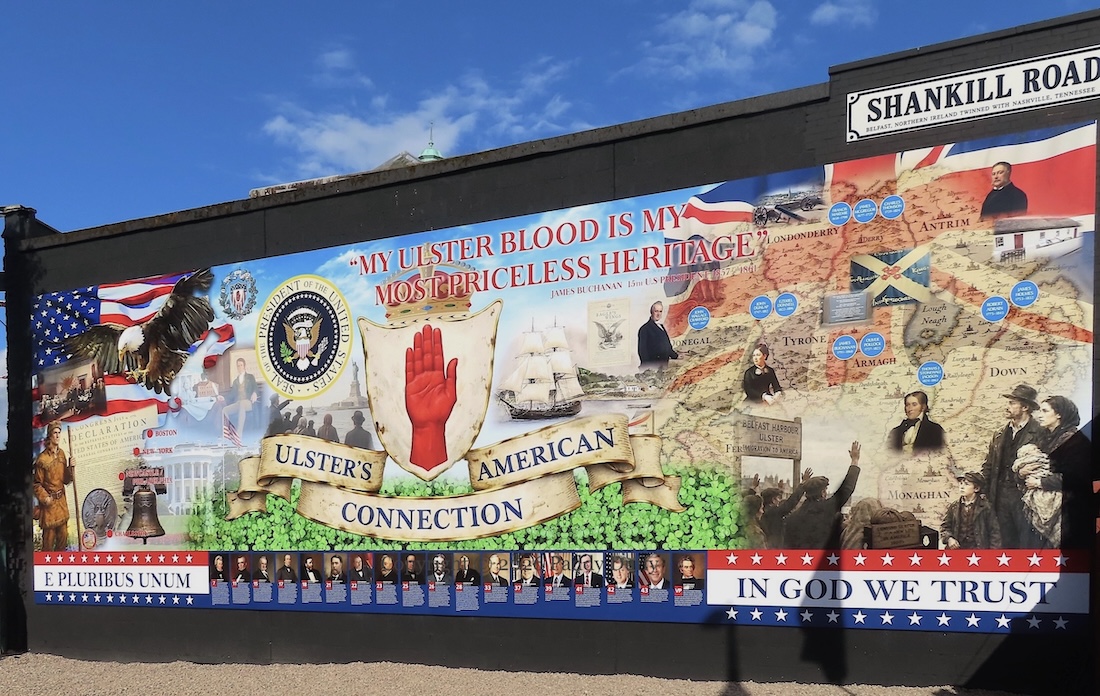
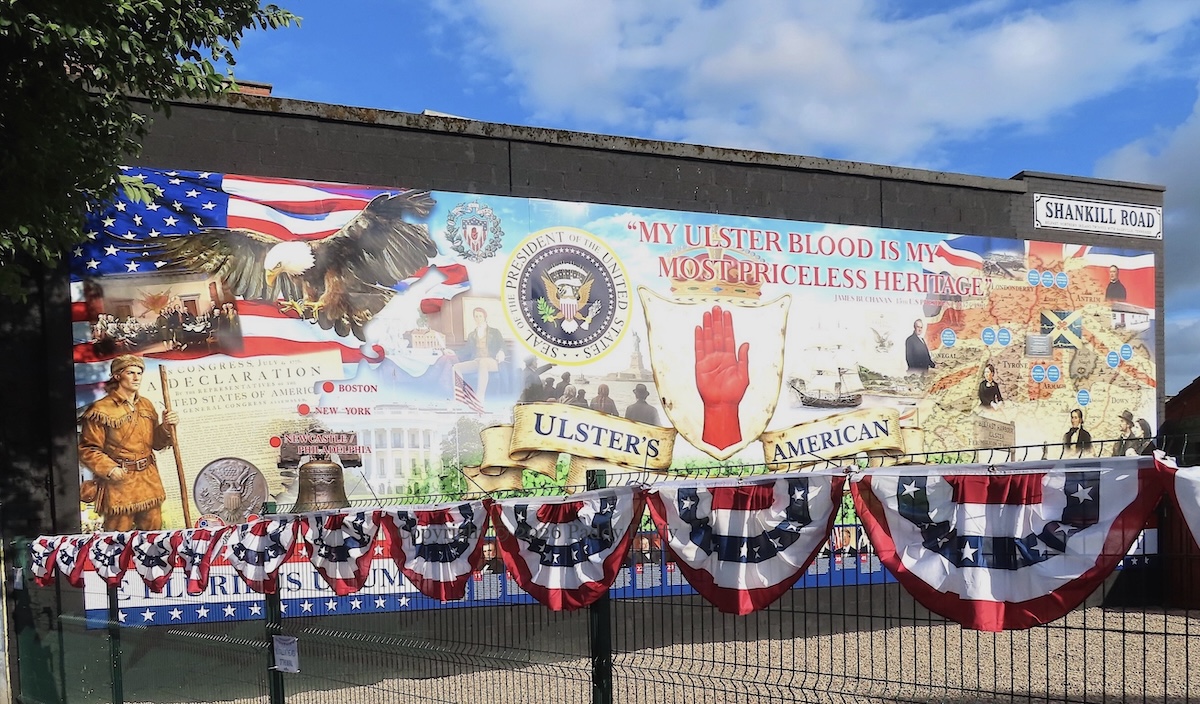
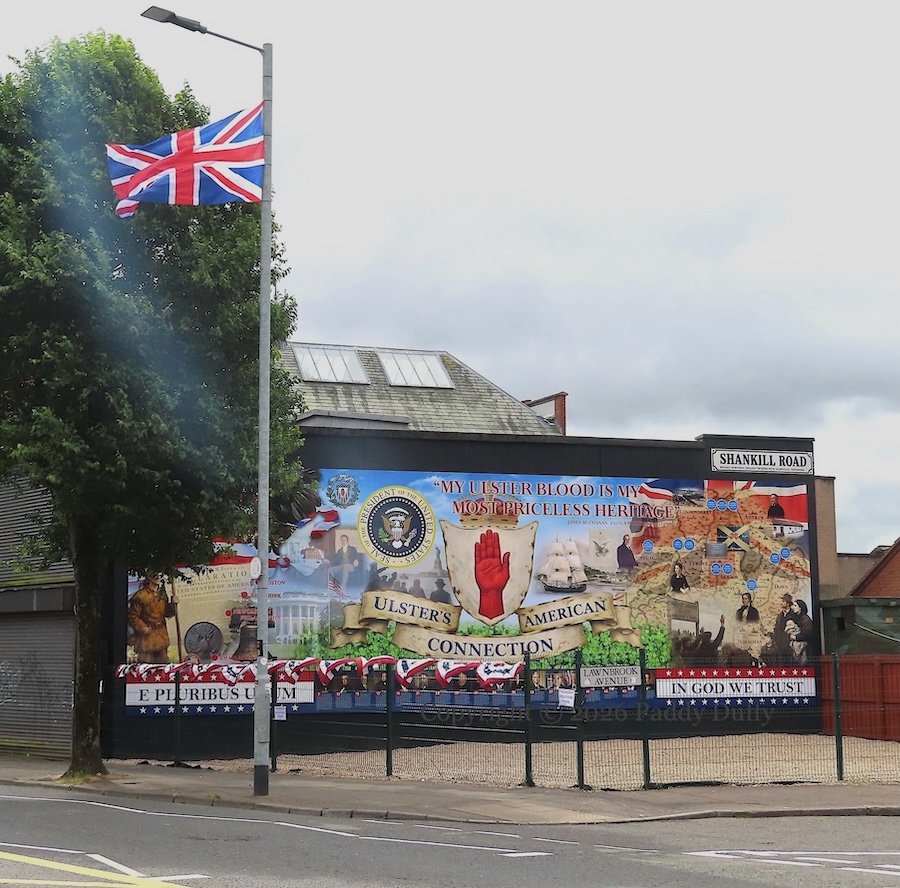
Ulster’s American Connection

The United States Of America celebrates the 250th anniversary of its adoption of the Declaration Of Independence today, July 4th, 2026. In the Declaration, delegates from the thirteen (former) colonies set out their reasons for voting to overthrow British rule on July 2nd, noting twenty-seven grievances against the reigning monarch, George III of Great Britain And Ireland. At the time, the American Revolution was ongoing, and the Continental Congress meeting this time in Philadelphia was soon compelled to move to Baltimore, Maryland; the permanent Congress was not established until 1781.

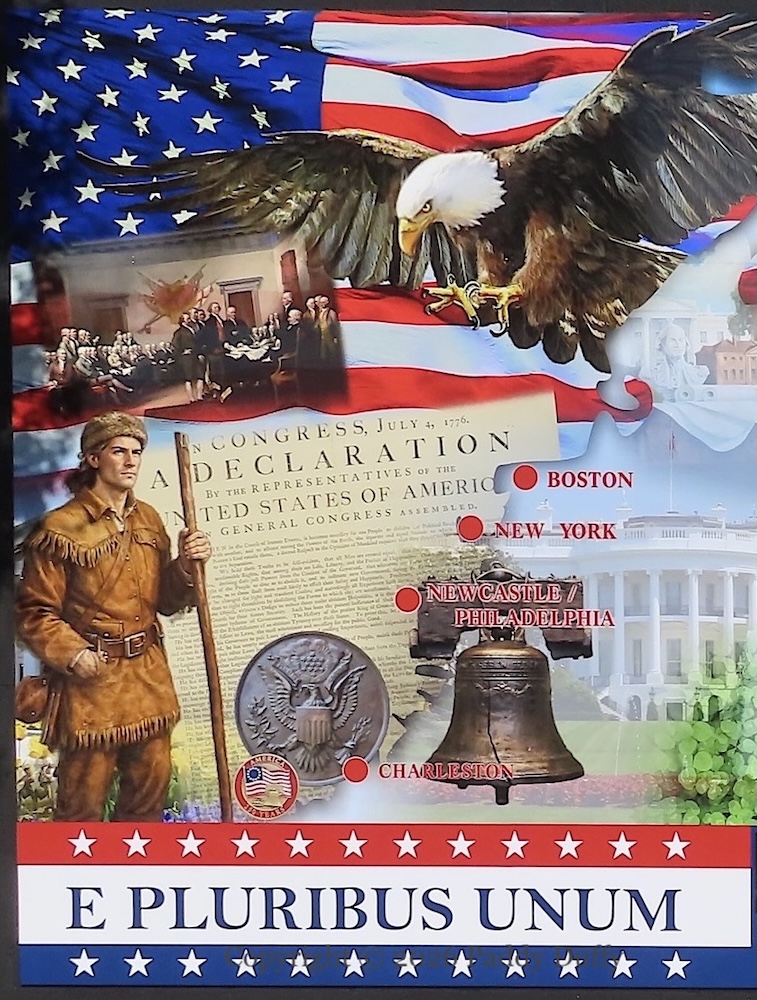
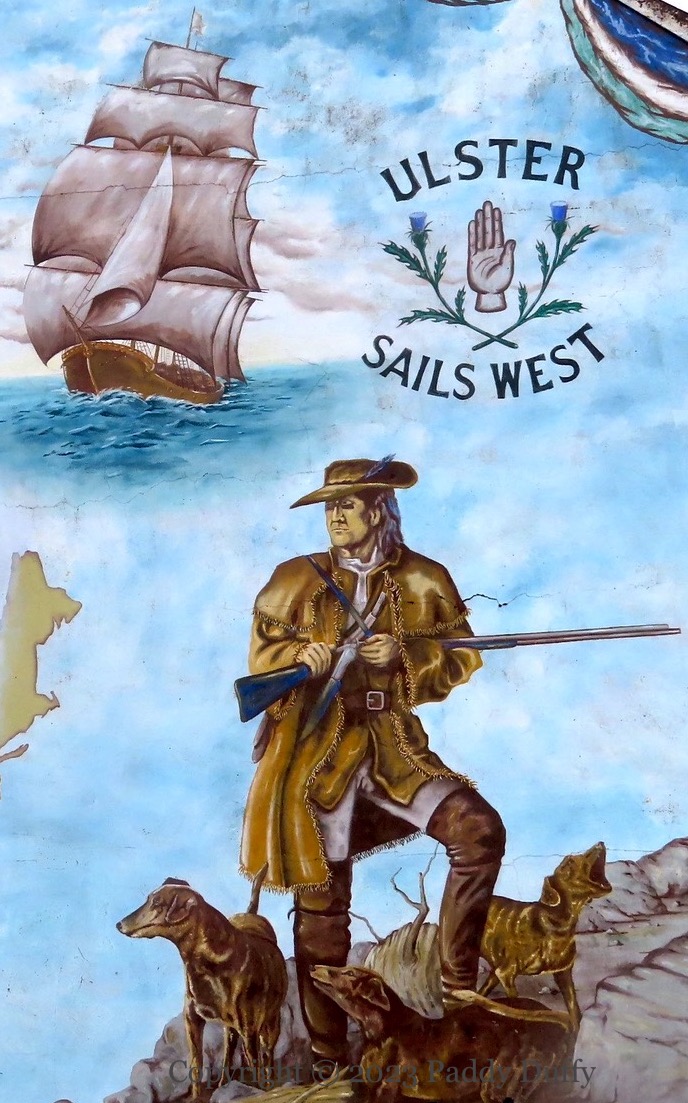
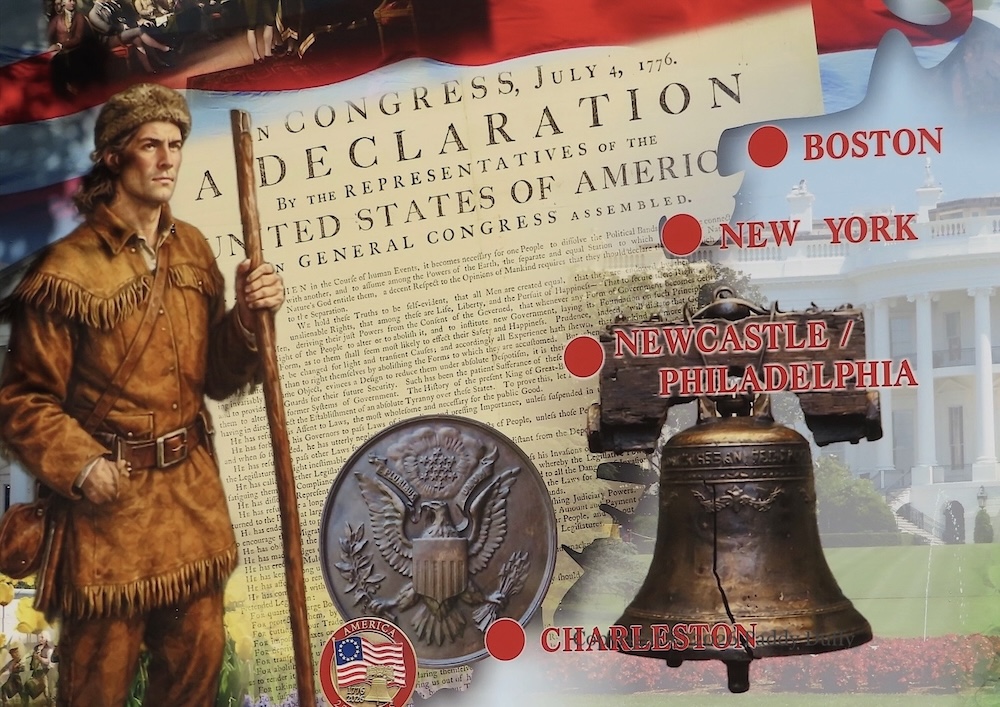
On the left of the board, various symbols of the eventual United States Of America – John Trumbull’s painting ‘Declaration Of Independence’ (image at WP) and a bald eagle upon a Stars And Stripes formed by an outline of the eastern sea-board (which for an unknown reason lists New Castle (not “Newcastle”) alongside Philadelphia), the Liberty Bell, an “America 250 years” pin, the Seal, the Declaration, and a trapper or frontiersman who represents the westward expansion of European Americans – including the Scotch-Irish (Ulster Sails West) – across the continent.

The “liberty and law” emblem, with the red hand against the stars and stripes, surrounded by a garland of thistle and shamrock, is unknown.

The seated gentleman is James Hoban, a Catholic from Co Kilkenny, who studied architecture in Dublin and (after emigrating in 1878) designed the White House – a three-storey model (later reduced to two) is on the desk behind his quill – and (in the framed picture behind him) the Charleston (South Carolina) court-house.

In the centre is a quote attributed to James Buchanan, “My Ulster blood is my most priceless heritage”; for confusion over the quote see James Buchanan. Buchanan is also pictured (next to the word “Donegal”). The Great Seal was designed by Charles Thomson, originally from Maghera. He was also a signatory to the Declaration.

The crown above the red hand is probably the Tudor Crown, destroyed in 1649 (WP). A bed of shamrock supports the title banner.

The Ulster-Scots lineage of seventeen presidents (plus vice-president Andrew Calhoun) is presented along the bottom between the mottos “E pluribus unum” and “In God we trust”. (The Ulster-Scots Agency has a pdf of the Presidents.)

On the right, the poster marked “Eagle’s Wings”, under the Buchanan quote, also appears to come from the Ulster-Scots Agency. It is actually about the Eagle Wing, the ship pictured to the poster’s left (as imagined by water-colour painter Dan Parsons) that undertook the first voyage of Scots-Irish to North America in 1636. The journey was not a success: the roughly 140 dissenters returned to Ireland and some went to Scotland to avoid continued persecution (Presbyterian History.)

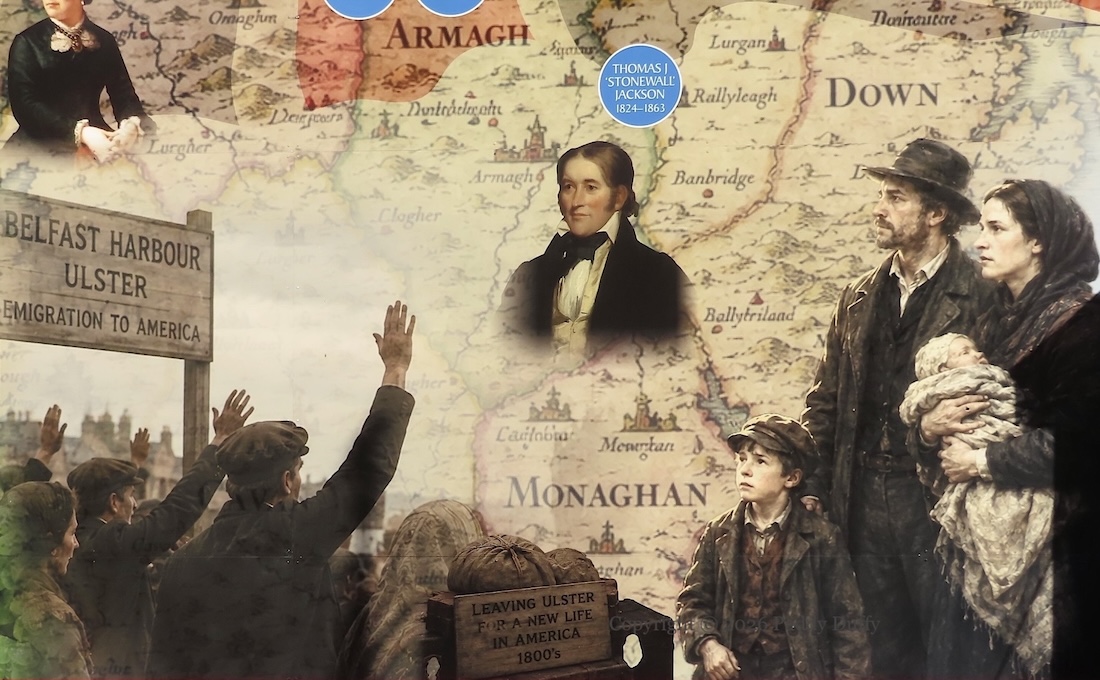
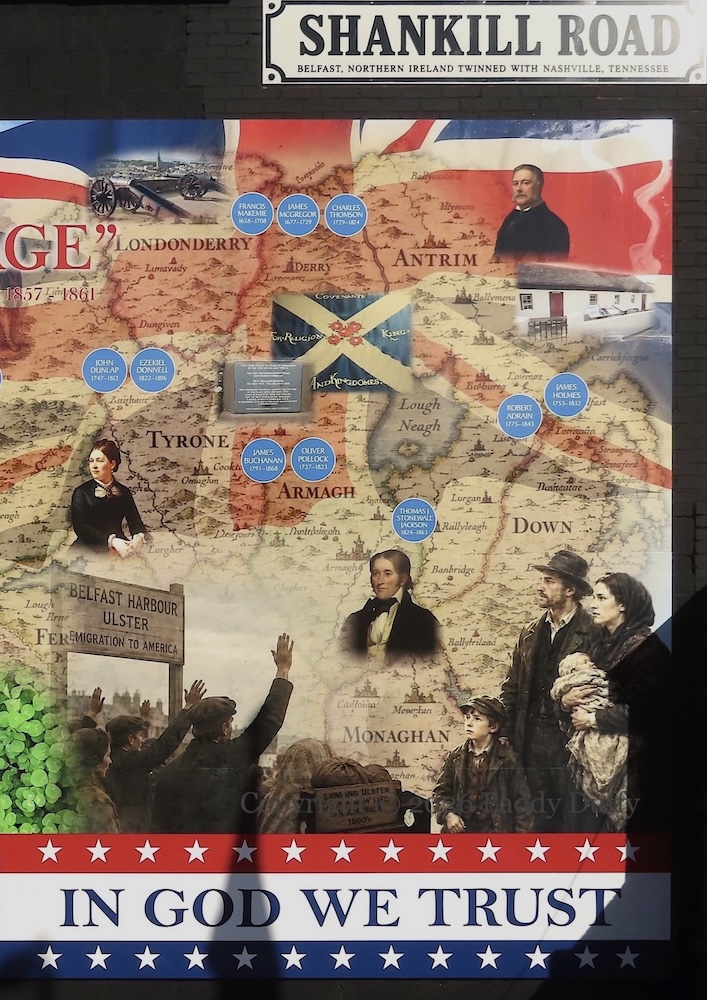
The ‘Blue Plaques’ of various notable figures are superimposed upon a period map: John Wallace Crawford, Francis Makemie, James McGregor, Charles Thomson, John Dunlap, Ezekiel Donnell, James Buchanan, Oliver Pollock, Thomas J ‘Stonewall’ Jackson, Robert Adrain, James Holmes. The portraits are of James Buchanan, Teddy Roosevelt (above Andrew Jackson’s ancestral cottage in Carrickfergus), Davey Crockett, and an unknown female figure (comment/get in touch if you can identify her).

The gravestone is to the Rev William Martin, a Reformed Presbyterian (Covenanter) minister, who led a contingent of 1,000 people in five ships in 1772 to Charlestown, South Carolina (Reformation History | History Ireland). The flag is the flag of the Covenanters (WP).

See also the Visual History page on Ulster-Scots Murals

Lawnbrook Avenue, upper Shankill, west Belfast

For two other celebrations of USA 250, see the Visual History page on Ulster-Scots Murals.

Click image to enlarge
Copyright © 2026 Paddy Duffy
T09463 T09467 T09462 T09468 T09464
T09465 T09466 T09478 [T09461] [T09469] [T09479]

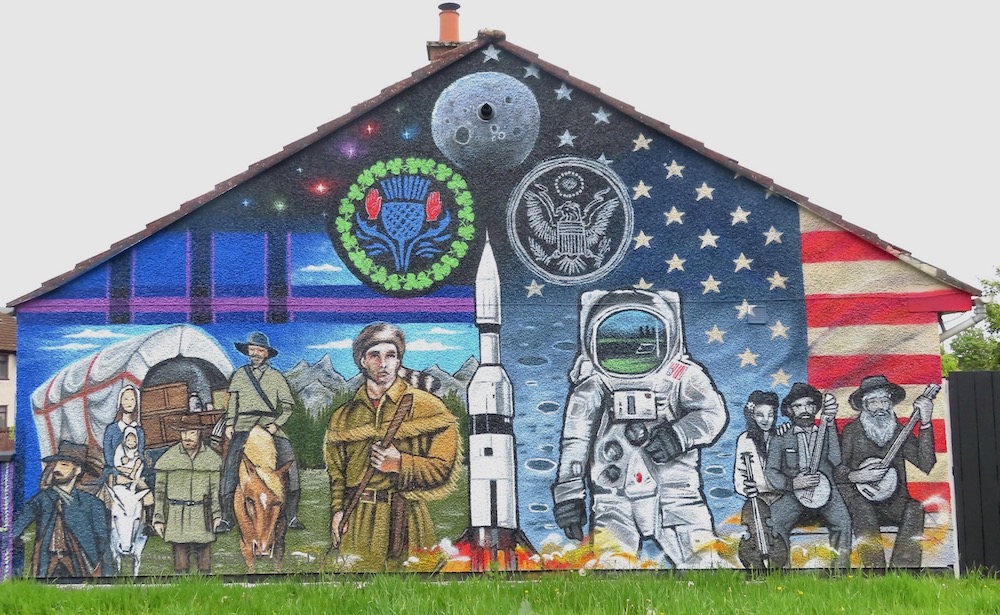
The Making Of America

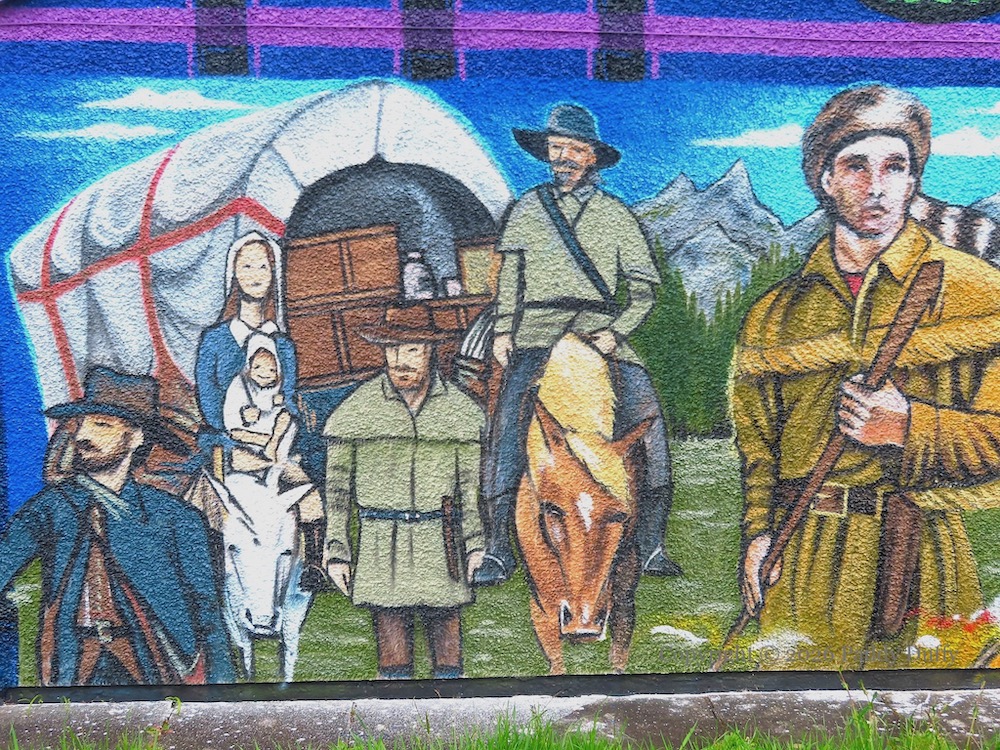
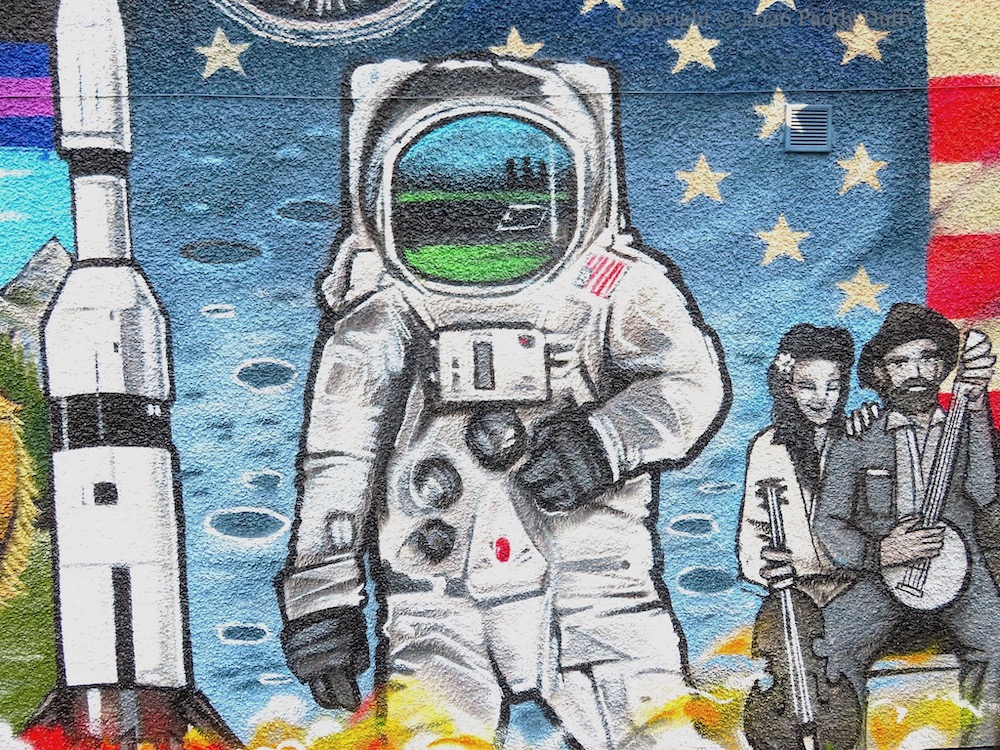
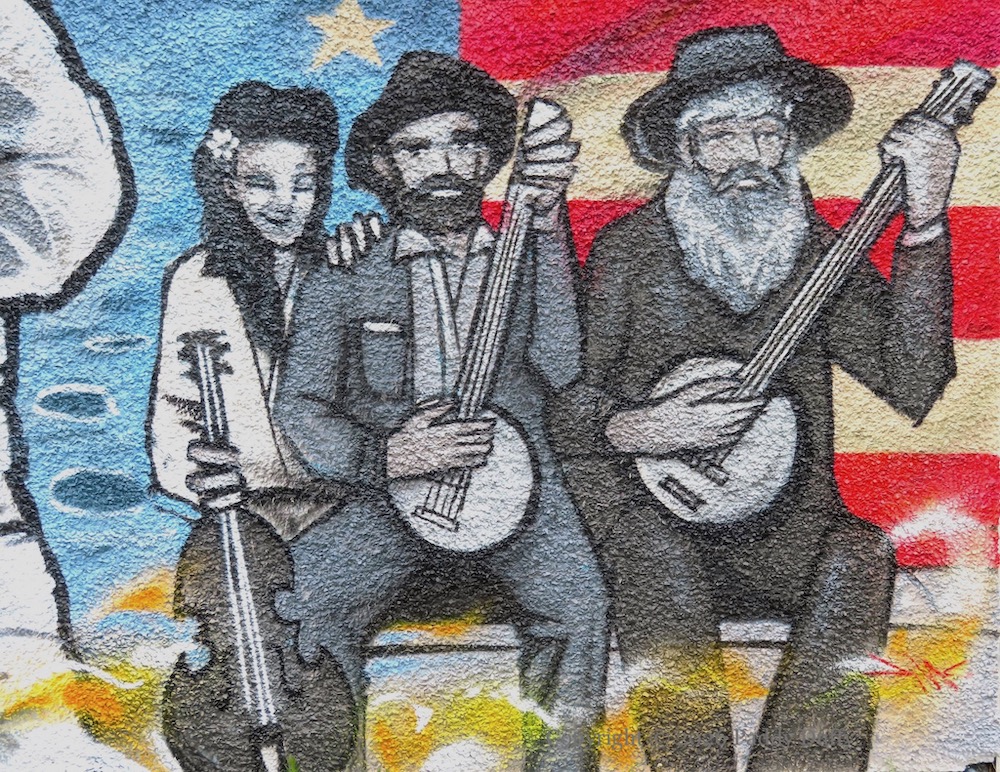
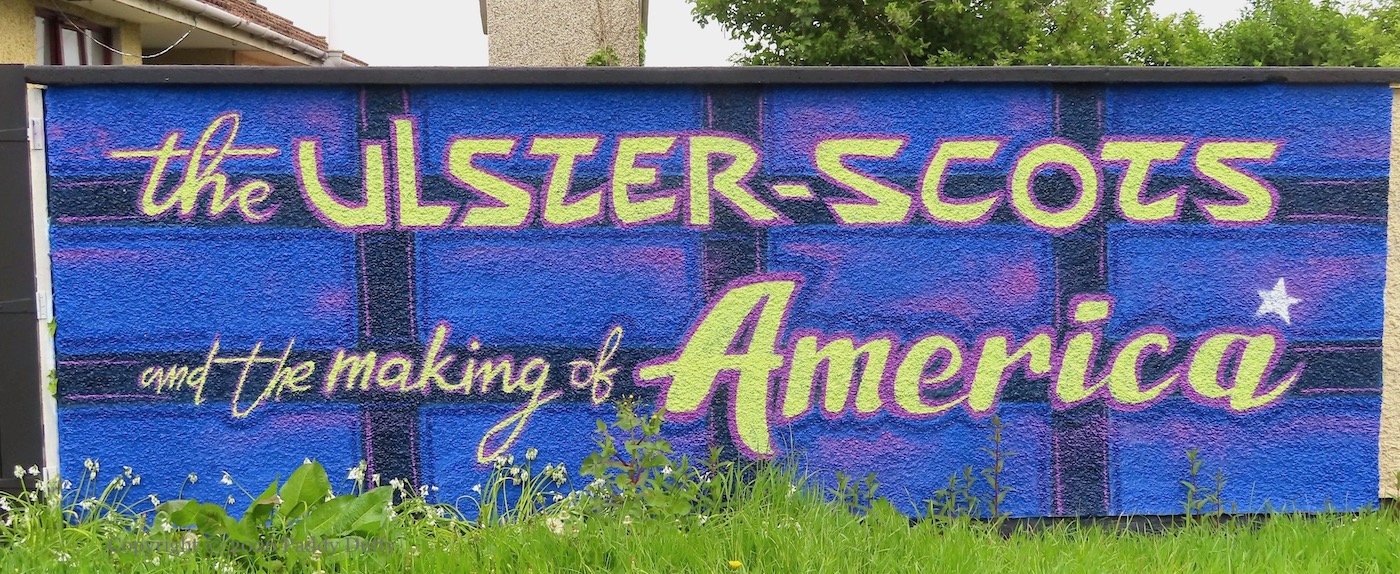
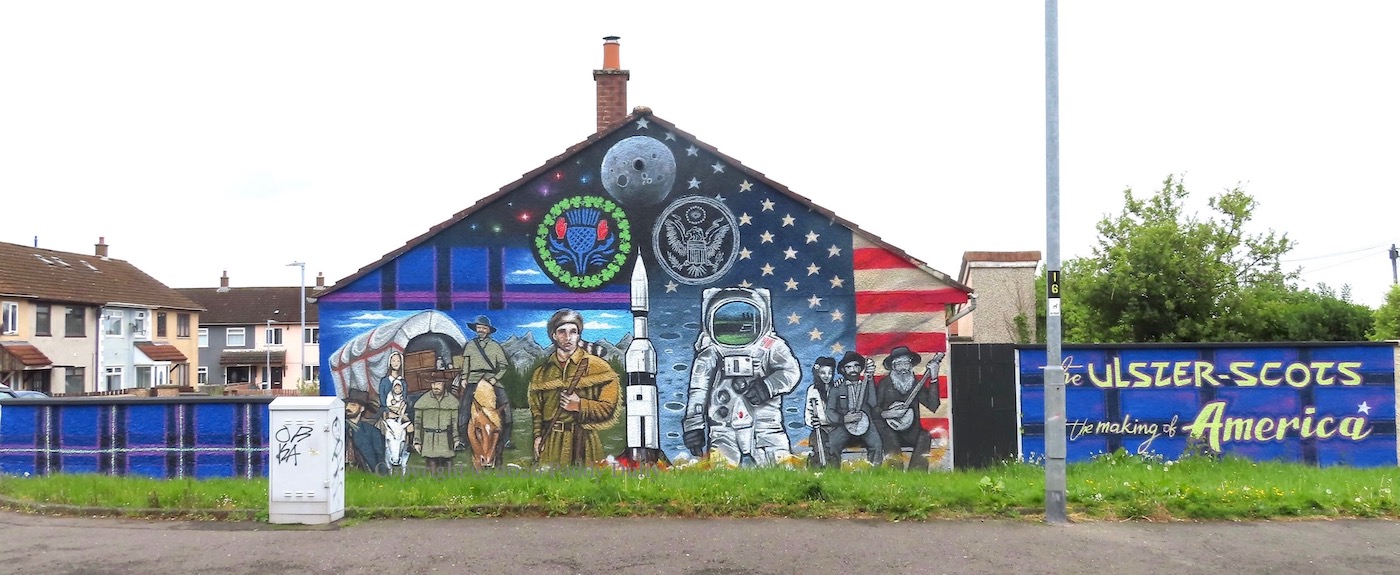
“The Ulster-Scots and the making of America” is a new mural in Carrickfergus celebrating the impact of Ulster-Scots (or, Scotch-Irish) emigrants to the colonies that became the United States.

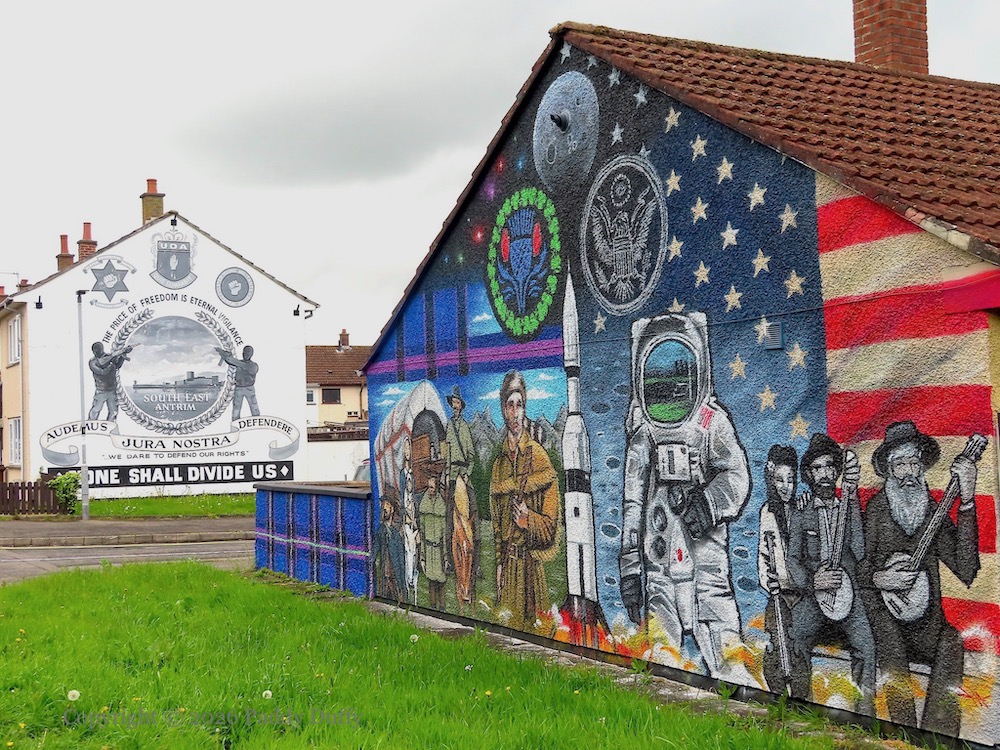
On the left and right of the main gable (above), the arrivals are shown expanding the territories as they travel in a covered wagon and as embodying Appalachian culture in the form of “old time” (fiddle and banjo) music. (For the Ulster-Scots as frontiersmen, see Ulster Sails West in Ballymoney.)

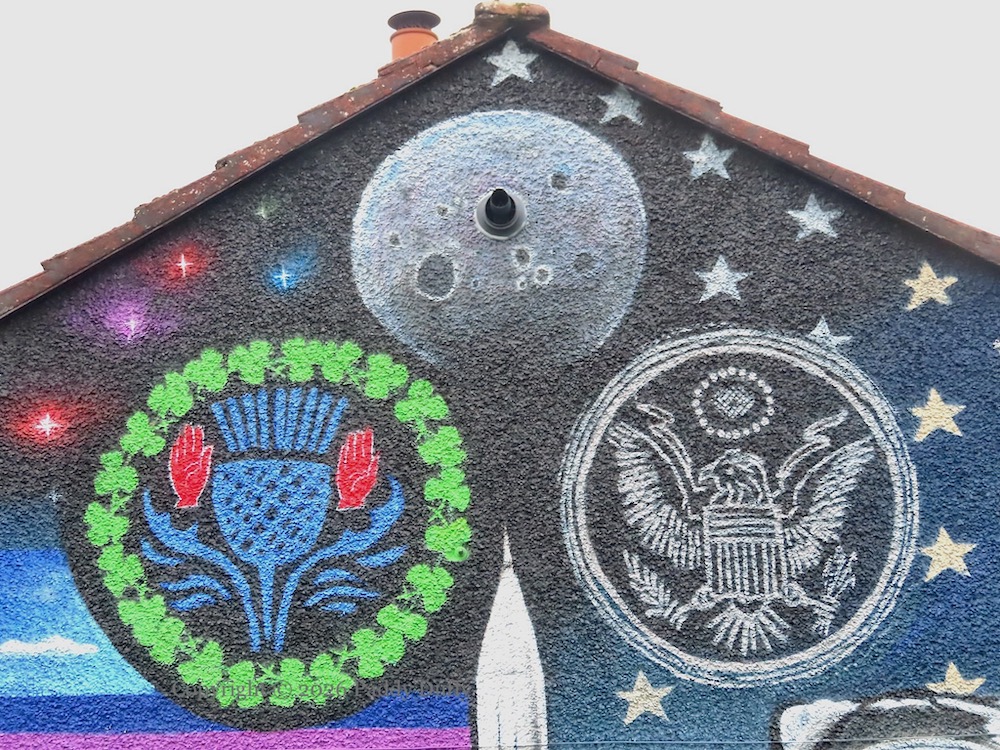
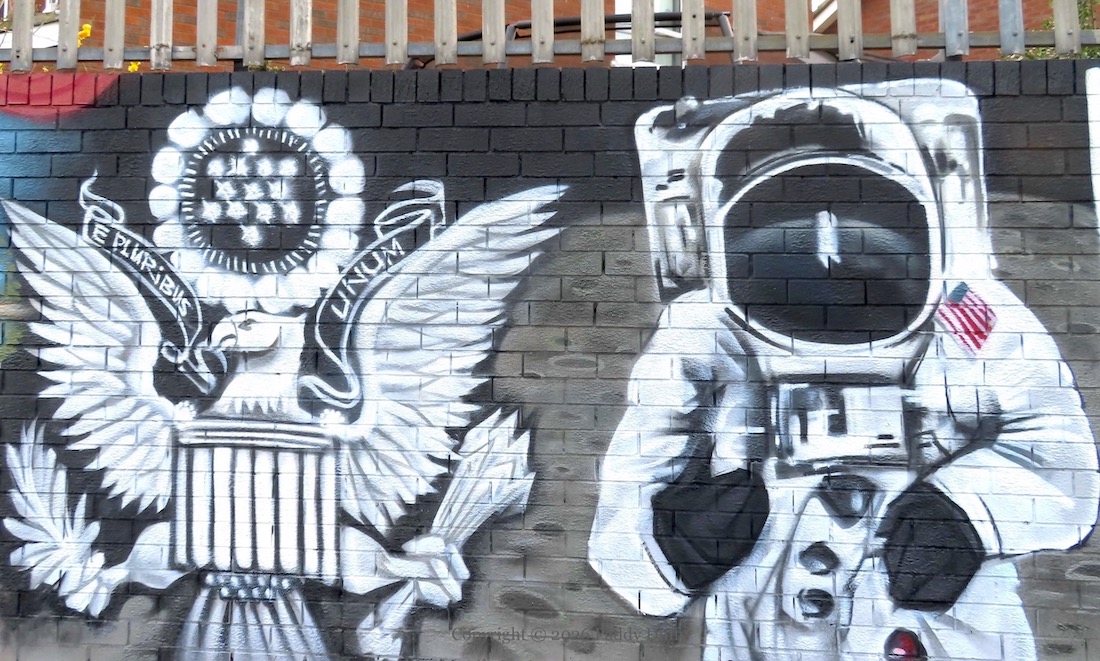
In the centre are images of space travel, the rocket (perhaps the Saturn V) is heading to the moon (shown in the apex of the wall), upon which Buzz Aldrin walked in the 1969 mission on Apollo 11.

(These are the same themes as deployed in the new mural for the 250th anniversary of the United States in the Shankill – see We Lead Across Time And Space.)

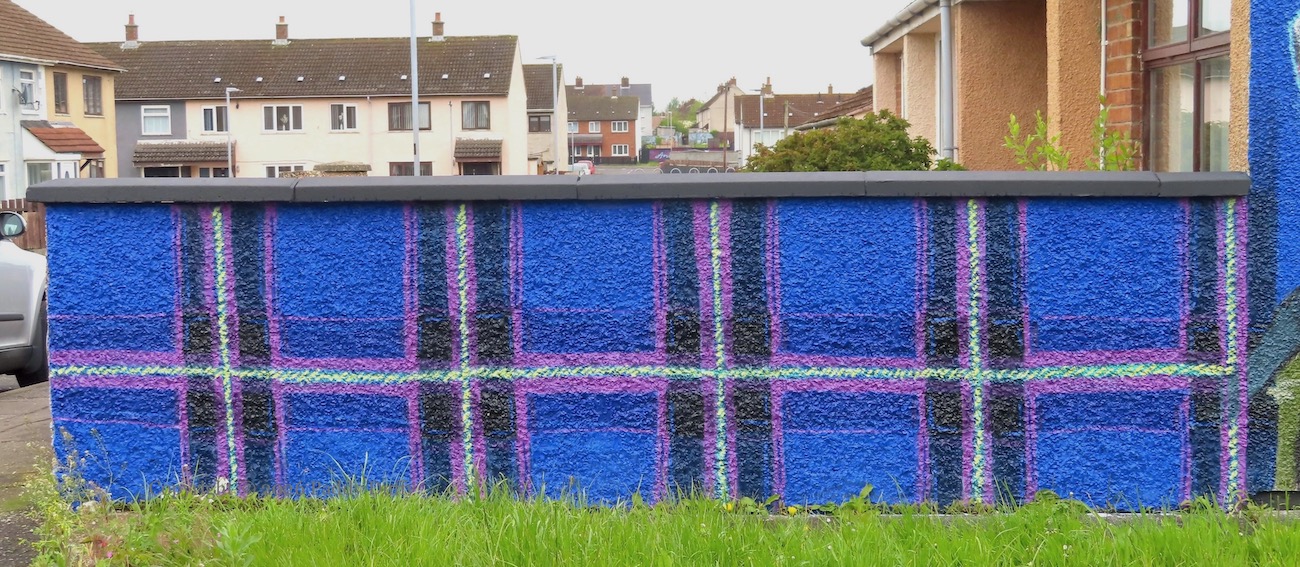
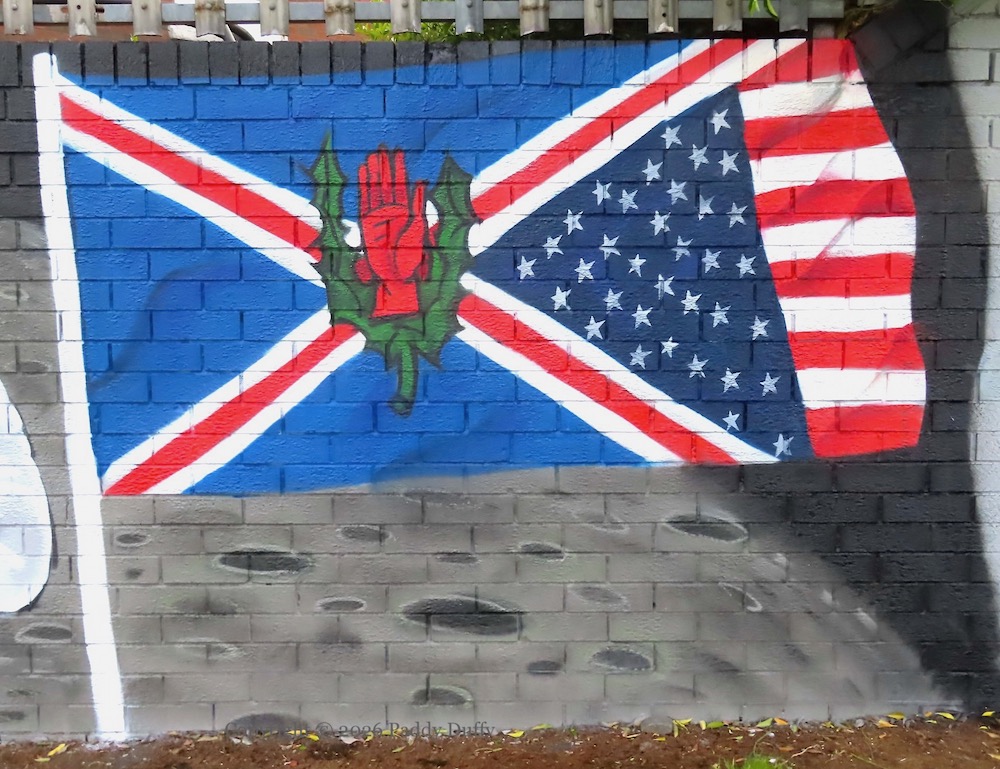
The tartan pattern is called “Ulster Scots” (Tartan Register). The emblem combining a thistle and two red hands within a circle of shamrocks appears to be original work. The Great Seal of the United States was designed by Charles Thomson from Maghera; his contribution is commemorated in his home town.

For the UDA mural to the left (in the final image), see None Shall Divide Us.

Woodburn Avenue, Carrickfergus

Click image to enlarge
Copyright © 2026 Paddy Duffy
T09034
T09035 T09036 T09037 T09038 T09039 T09040
T09033 T09041

We Lead Across Time And Space

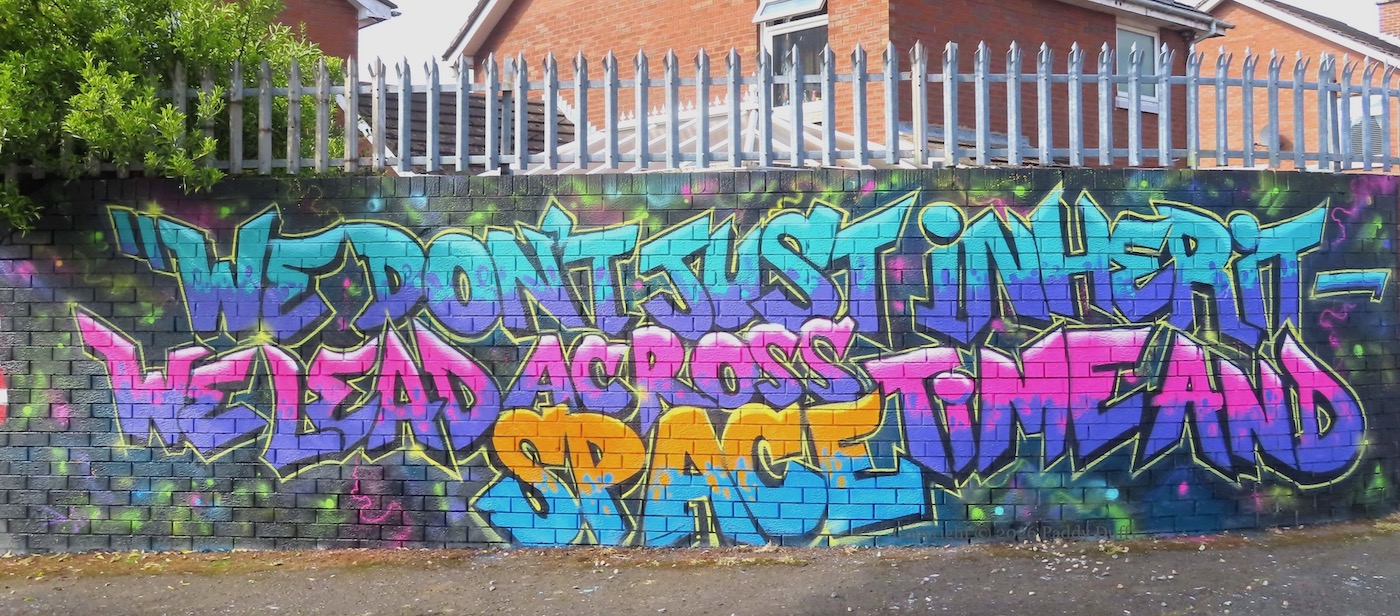
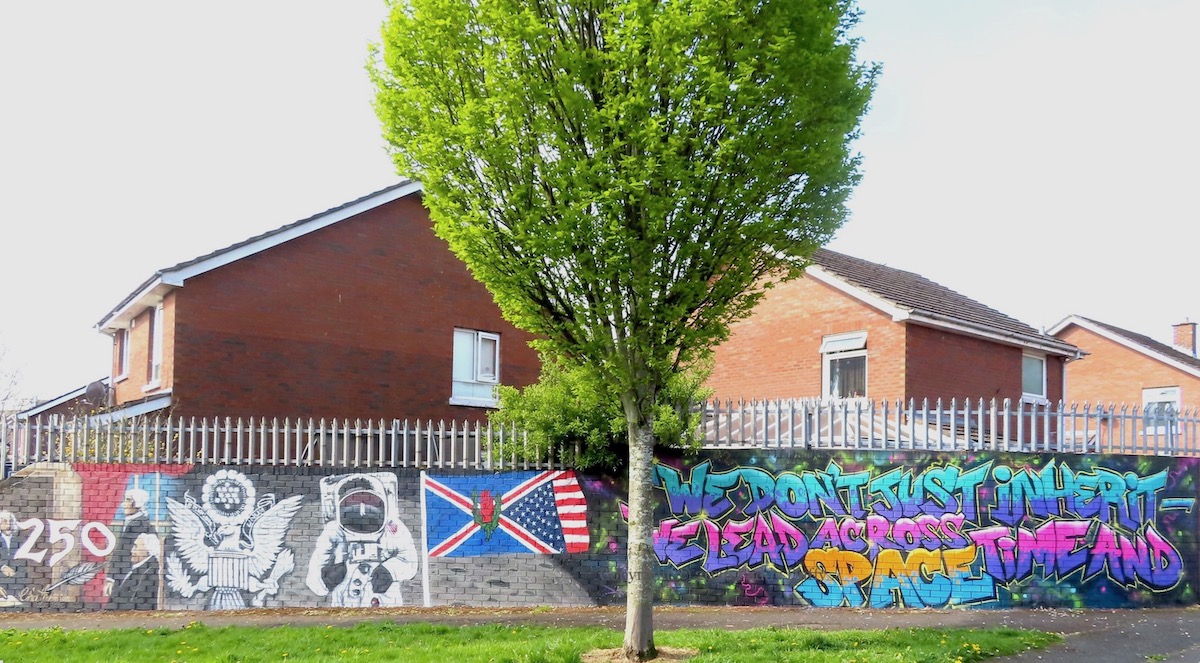
“We don’t just inherit, we lead across time and space.”

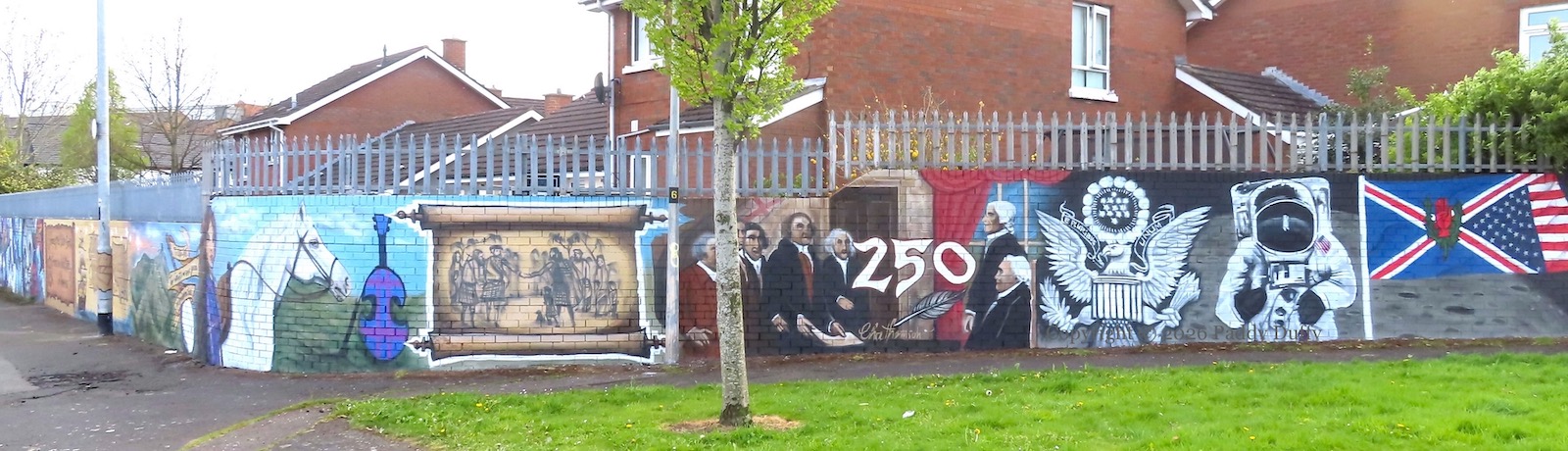
Here is the second half of the Ulster-Scots (Visual History) mural painted in North Howard Street and Fifth Street, continuing the work seen in Echoes Of The Ulster Scots, which took the Scotch-Irish from Ulster to the Appalachians.

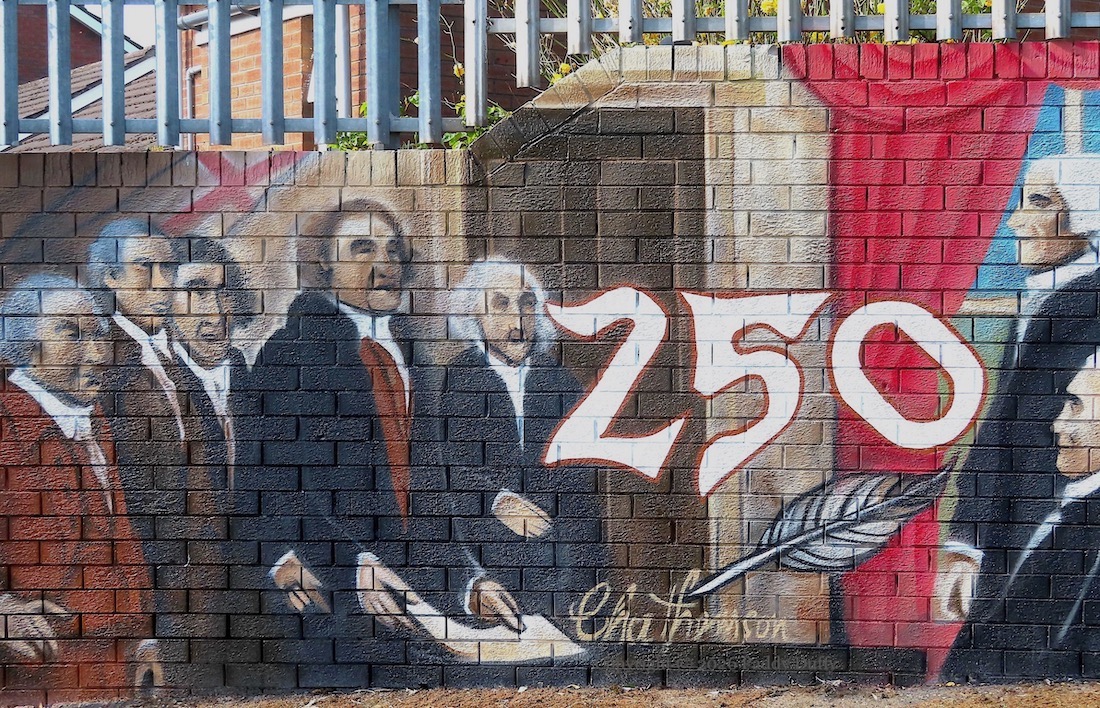
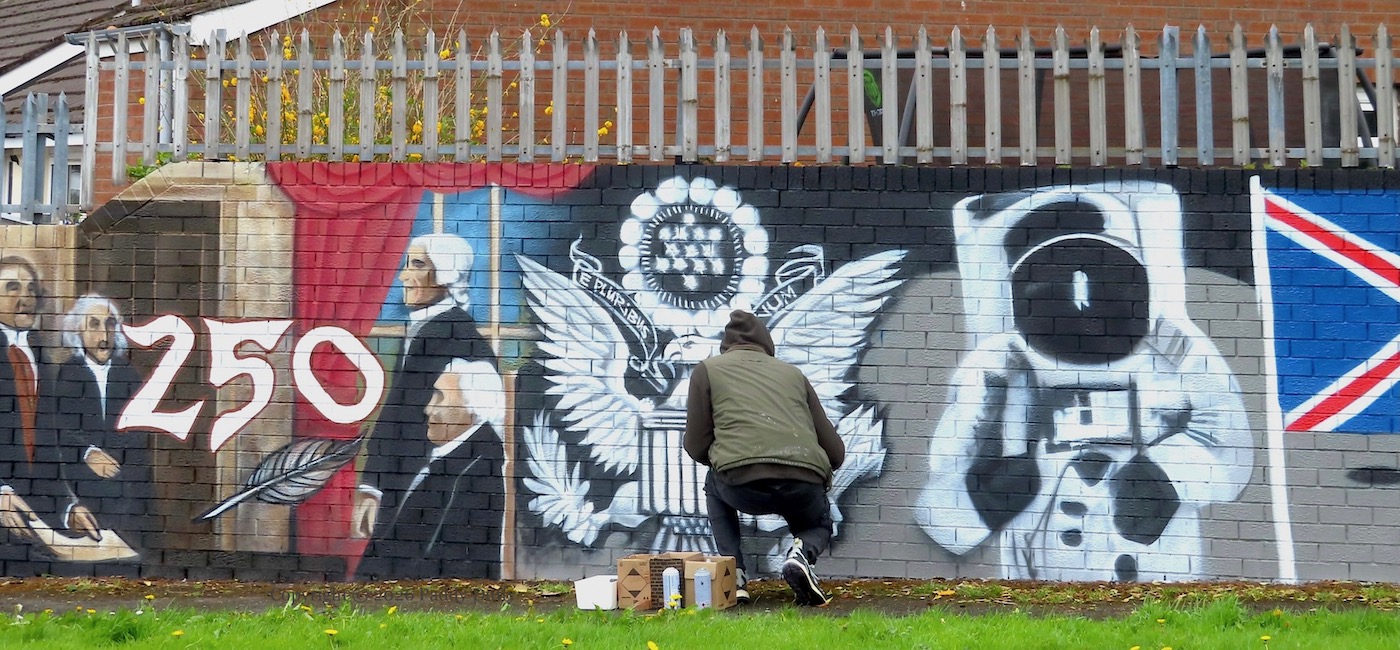
The new panels bring us from the founding of the United States in 1776 to the space age. The panel above is a rendition of John Trumbull’s painting ‘Declaration Of Independence’ (image at WP) along with (below the “250”) the signature of “Cha[rles] Thomson”, who was born in Maghera, served as Secretary of the Continental Congress, designed the Great Seal Of The United States (which appears next to the right), and signed the Declaration (Ulster Scots Agency pdf).

The person third from the left is Robert R. Livingston, one of the Committee Of Five that prepared the Declaration; he also negotiated the Louisiana Purchase in 1803 (Discover Ulster Scots).

The flag is a combination of a proposed Ulster Scots flag and the Stars And Stripes of the United States.

North Howard Street/Fifth Street, west Belfast

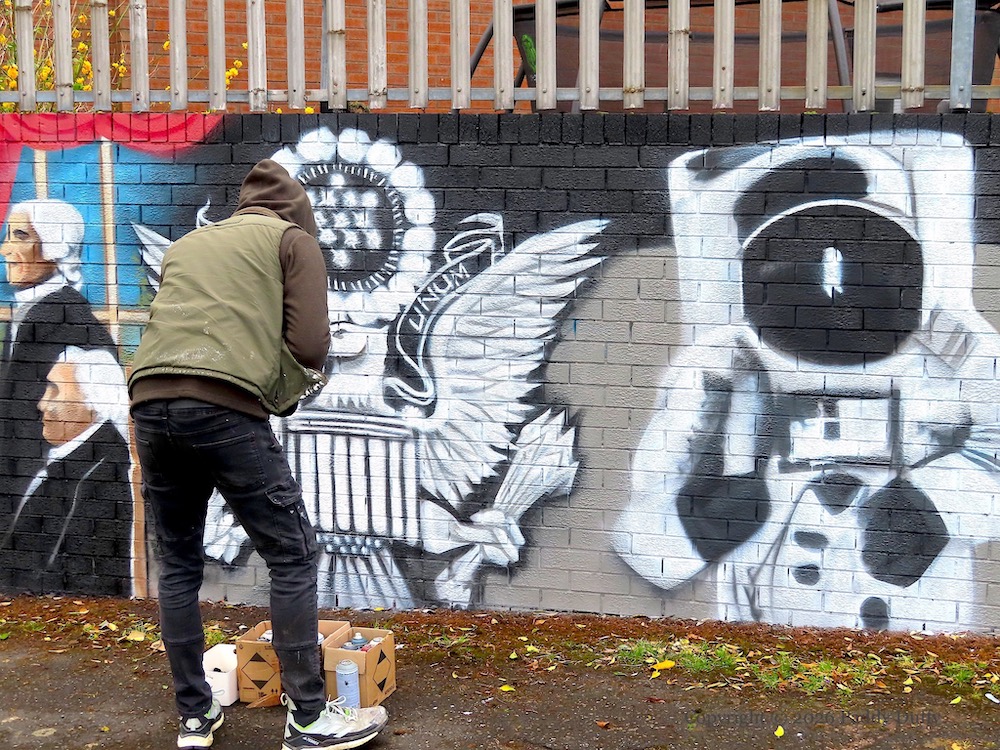
April 19th: Artist DMC at work on the second half of the mural.

Click image to enlarge
Copyright © 2026 Paddy Duffy
T08846 [T08848] T08847 T08823 T08834 T08835 T08844
T08845 T08838
[T08836] [T08837]
T08823 T08821 [T08822] [T08824] [T08825]

The Great Seal Of The United States

Charles Thomson was born in Maghera in 1729 and moved to North America in 1739. He served as the secretary of the Continental Congress and signed the Declaration Of Independence. He helped design both the front and back of the nation’s Great Seal in 1782. (WP)

He is honoured in his home town by the board shown here. Thomson’s design for the reverse of the seal – the all-seeing eye over an unfinished pyramid (WP) – appears in the eagle’s left-hand wing, and his preliminary sketch, with wing-tips pointed downward (WP), in the right-hand wing.

Meeting House Avenue, Maghera

See also: the Visual History page of Ulster-Scots Murals.

Text of the information panel: “The Final Design of the Great Seal – June 20, 1782. On June 13, 1782, Congress asked Charles Thomson to come up with a suitable design for America’s Great Seal. With the reports and drawings of the three committees before him, he set to work. Thomson had served the past eight years as the Secretary of the Continental Congress where he acquired a reputation for fairness, truth, and integrity. Well-versed in the classics, he was once a Latin master the Academy of Philadelphia. Although today he is not a well-known founder, Charles Thomson was at the heart of the American Revolution. Thomson incorporated symbolic elements from all three committees with ideas of his own to create a bold and elegant design. He made a sketch and wrote a description of his preliminary design. For the front of the Great Seal, Thomson drew an American bald eagle and for the centrepiece he a [sic] placed the shield upon the eagle’s breast. Thomson envisioned an eagle “on the wing and rising.” In the eagle’s right talon is an olive branch. In its left, a tightly drawn bundle of arrows. Thomson said these symbols represent “the power of peace and war.” In the eagle’s beak, he placed a scroll with the first committee’s motto: E Pluribus Unum ‘Out of Many, One’. For the crest above the eagle’s head, Thomson used the radiant constellation of thirteen stars suggested by the second committee. He described the light rays as “breaking through a cloud.” For the reverse side of the Great Seal, Thomson used Barton’s (third committee) suggestion: an unfinished pyramid with the eye of Providence in its zenith, but added a triangle around the eye (like the first committee did). He also created two new mottos: Novus Ordo Seclorum ‘A New Order of the Ages’ and Annuit Coeptis ‘Providence has Favoured Our Undertakings’. After consulting with William Baron, the position of the eagle was changed to “displayed” (wings spread with tips up) and the chevrons on the shield were changed to the vertical stripes we see today.”

Click image to enlarge
Copyright © 2025 Paddy Duffy
T07009 T07010

The Ulster Fry

Discover Ulster-Scots (web) has added some more boards in north Belfast, joining the recent gallery of famous figures at Mountcollyer Avenue (see The Scots In Ulster).

Above, Alexandra Park Ave: “The Ulster Fry – Ulster-Scots put the Ulster into the Ulster Fry with our famous soda and potato farls. Farl is an Ulster-Scots word describing the quarter round shape of the breads.” Breakfast fries as we now think of them date back only to the Victorian period and became popular particularly after WWII (WP). Soda farls (and soda bread) go back further, to the 1830s and 1870s when baking soda began to be commercially manufactured and cheaply available (ACS). Recipes can be found at the Discover Ulster-Scots ‘Food Traditions’ page.

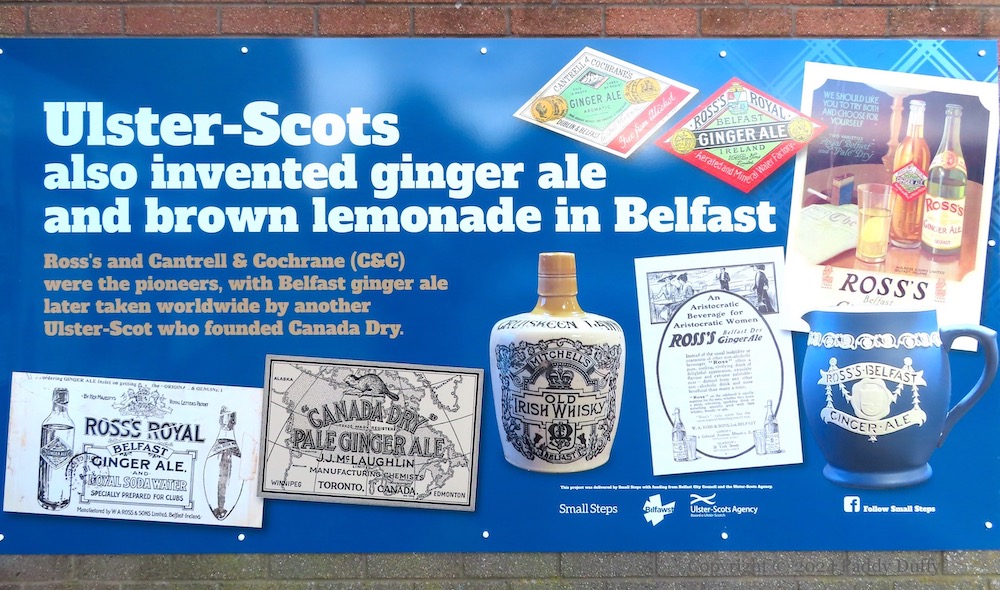
Below, from Upper Canning St: “Ulster-Scots distilleries made Belfast a global centre of whisky production. Historic Ulster-Scots brands like, Dunville’s, Mitchell’s and McConnell’s are making a comeback in the 21st century.” “Ulster-Scots also invented ginger ale and brown lemonade in Belfast. Ross’s and Cantrell & Coughran (C&C) were the pioneers, with Belfast ginger ale later taken worldwide by another Ulster-Scot who founded Canada Dry.” The labels shown use the “-y” spelling, perhaps in order to emphasise the Scottish association rather than the Irish. Cowan’s appear to have used both spellings (“whisky” and “whiskey”) in their labelling – see the gallery at Bloggin’ Fae The Burn. Dunville’s now appear to use the “-ey” spelling exclusively (web).

Finally, in North Queen St: “Ulster-Scots have been making Belfast a better place for over 400 years. Many of Belfast’s leading charitable, religious and educational institutions were founded by Ulster-Scots.” with images of BRA (James Crombie), Clifton House (possibly William Tennant is intended), the Linen Hall Library (a list of founders can be found on page 11 of this History), the Assembly buildings (of the Presbyterian church), and Queen’s (John Mowat).

See also: the Visual History page on Ulster-Scots murals.

Click image to enlarge
Copyright © 2024 Paddy Duffy
T04764 T04726 T04727 T04728 T04729 T04730

Born For A Storm

The family of “Andrew Jackson 1767-1845”, seventh president of the United States, hailed from Carrickfergus (Discover Ulster-Scots | Carrickfergus History) and there is a period cottage that functions as a museum on the site of the home from which his parents and two older brothers departed (Discover NI).

There is a Visual History page on Ulster-Scots murals. A series of murals was painted, beginning in 1999, under the title ‘Pioneers To Presidents’, the last of which was of Andrew Jackson in the lower Shankill in 2007. Why he was chosen as the subject of this new mural in Pinewood Avenue, Sunnylands, Carrickfergus, is as yet unknown.

Click image to enlarge
Copyright © 2024 Paddy Duffy
T04413c T04414

The Scots In Ulster

The name “Ulster-Scots” refers to the emigrants to North America from Ulster that had previously come from Scotland and the English borders, and most of the Ulster-Scots murals in the 2000s focused on emigration to America and on US Presidents with Scotch-Irish heritage (see the Visual History page of Ulster-Scots murals).

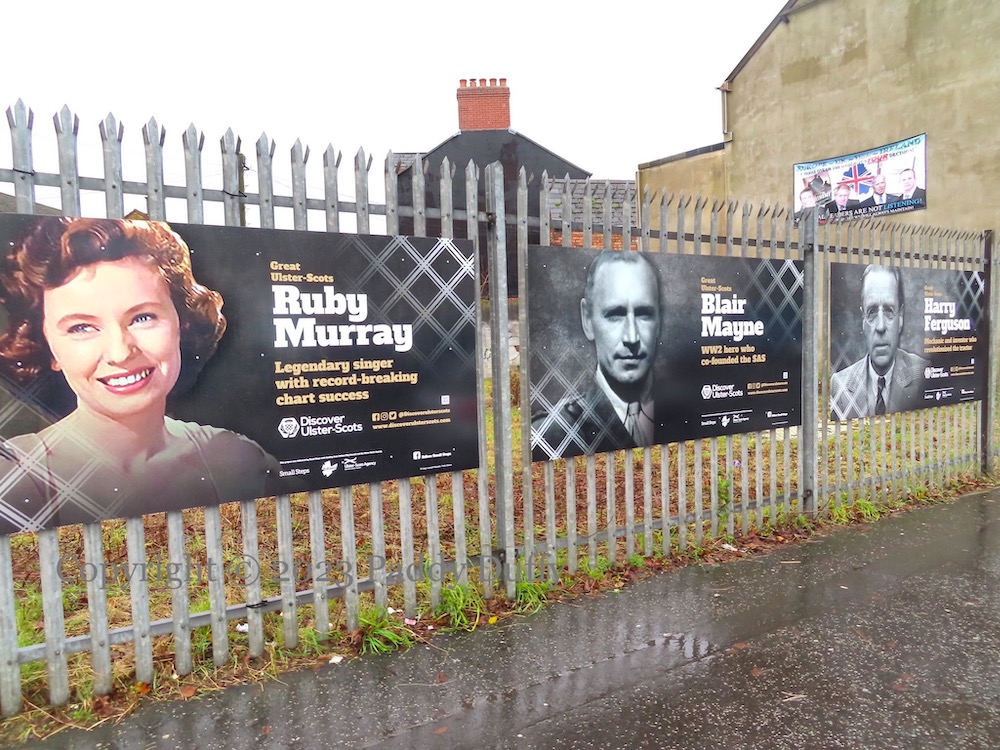
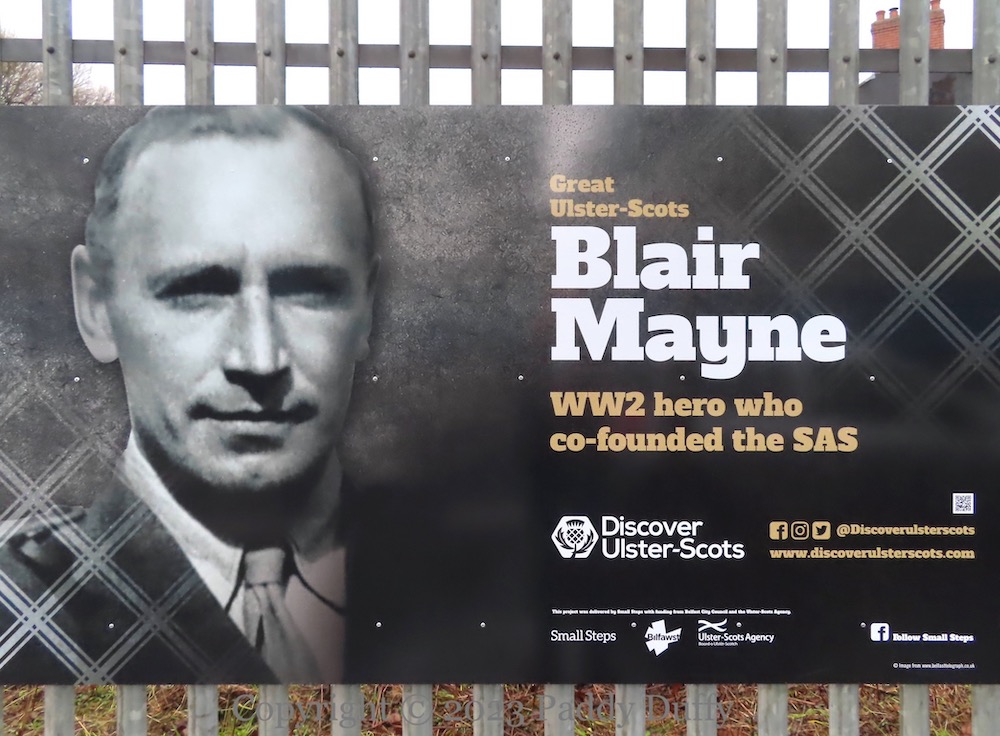
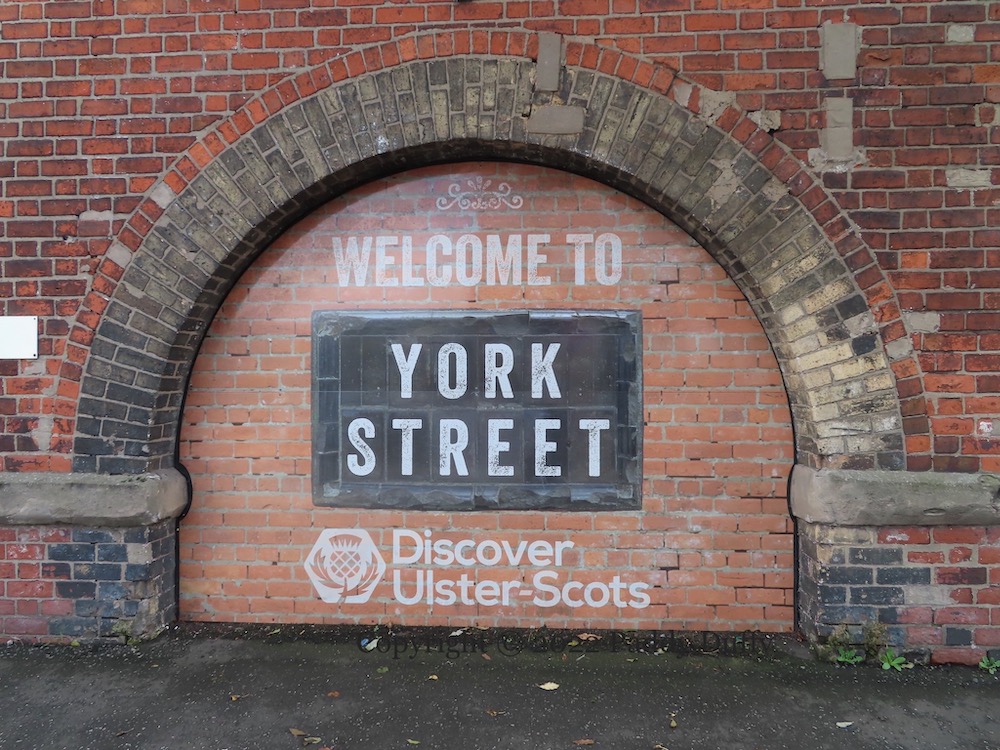
In 2017, a series of boards along York Street focused on industrialists in Northern Ireland with Scottish backgrounds: 13 panels in five posts: one | two | three | four | five. And this new collection of “Ulster-Scots” luminaries (which is 100 paces away) likewise presents figures who are associated with Northern Ireland rather than America. Modern folk such as those portrayed in these new boards presumably have Scottish heritage rather than Scotch-Irish. (The title of this entry – The Scots In Ulster – comes from a Discover Ulster Scots poster about the Scots who came to Ulster in the 1600s, regardless of whether or not they or their descendants later moved to America.)

From left to right, the people shown are as follows. (Links are to previous entries in the Extramural collection.)

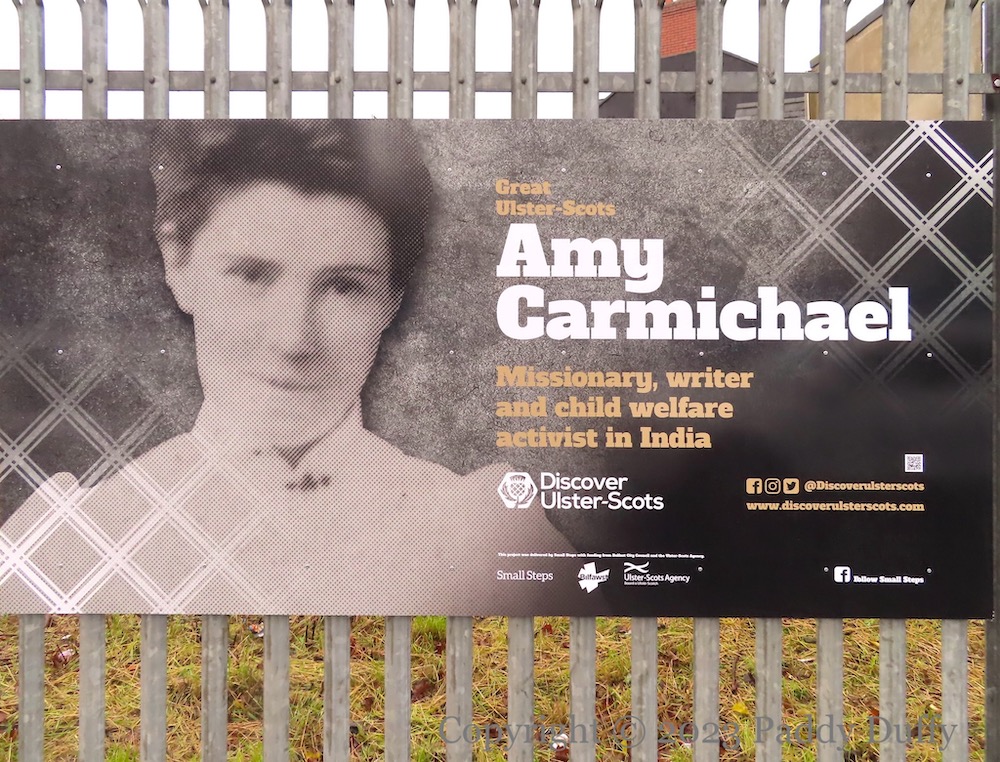
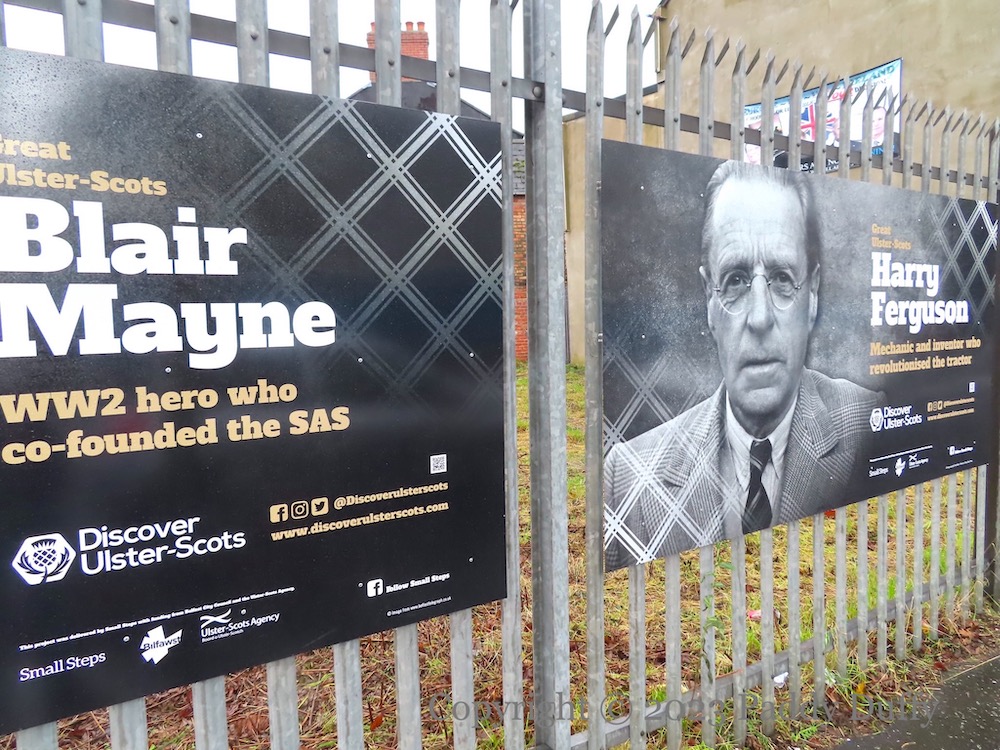
Mountcollyer: motorcyclist Rex McCandless, author CS Lewis, physicist John Stewart Bell, song-writer Jimmy Kennedy, medical inventor Frank Pantridge

York Rd: snooker player Alex Higgins, singer Ruby Murray, soldier Blair Mayne, agricultural inventor Harry Ferguson, missionary Amy Carmichael

For the political tarp on the gable in the background, see Choose One Or The Other.

Click image to enlarge
Copyright © 2023 Paddy Duffy
T03832 T03834 T03833 T03837 T03836 T03835 T03838

Ulster Sails West

This Ballymoney mural goes all the way back to at least 2004 and to the wave of Ulster-Scots – or as here, “Scotch-Irish” – murals painted in PUL areas after the promotion of Ulstèr-Scotch as a parallel language to Irish by the Good Friday/Belfast Agreement.

As the Visual History page on Ulster-Scots Murals shows, most of these murals made a connection to (what would-become) the United States, to where about a quarter million people emigrated (WP). The mural is intended to tell a story of emigration (signified by the sailing ship), American independence (the McKinley quote), and American expansion (the frontiersman).

The Scotch-Irish were Presbyterians and supporters of breaking the ties to Great Britain. In 1893, Governor Of Ohio (and later US President) (Ulster Nation) William McKinley said, “They were the first to proclaim for freedom in these United States. Even before Lexington [i.e. the outbreak of the Revolutionary War, on April 19, 1775] the Scotch-Irish blood had been shed for American Freedom.” (According to William Marshall’s book Ulster Sails West, the battle McKinley is referring to took place on the Alamace river in North Carolina in 1771 (p. 29).)

The frontiersman on the right is generally taken to be David “Davy” Crockett (Rolston in Al Jazeera | McCormick J2024) because of the Scotch-Irish heritage on his father’s side. Crockett, however, was born in 1786 and so does not fit with the McKinley quote. Daniel Boone – though of English stock – would provide an appropriate referent for the revolutionary period, having lived from 1734 to 1820. The image is in fact a 1991 sketch of a frontiersman by David Wright (web), called “The Long Knife”, and the figure is referred to generically as “a trapper” by the artist (BBC).

None of the conquests of European-American colonists provides a good parallel to unionism, due to the complicated nature of political conflicts both there and here. The Americans, of course, threw off British rule in their revolution; Irish unionists want to remain part of the UK. And Crockett died in the Battle Of The Alamo in the Texas Revolution; that is, he died fighting for Texan independence from the Mexican government, which again doesn’t line up well with the desire of Irish unionists to remain part of the United Kingdom. (For another strained analogy involving the Scotch-Irish and US political history, see The War Of Northern Aggression and its discussion in the Ulster-Scots Murals page.)

The reason for its inclusion is the simpler idea that the Scotch-Irish are a rugged and feisty people who are not to be trifled with, whether in North America or Ireland.

Painted by Kenny Blair (Fb) in Hillview Avenue, Ballymoney; sponsored by the North Antrim Cultural And Musical Society and funded by the Heritage Commission. “Ulster Sails West” is the title of a 1943 book by WF Marshall (Isles Abroad).

Hillview Avenue, Ballymoney

Click image to enlarge
Copyright © 2023 Paddy Duffy
T03233c T03232

Discover Ulster-Scots

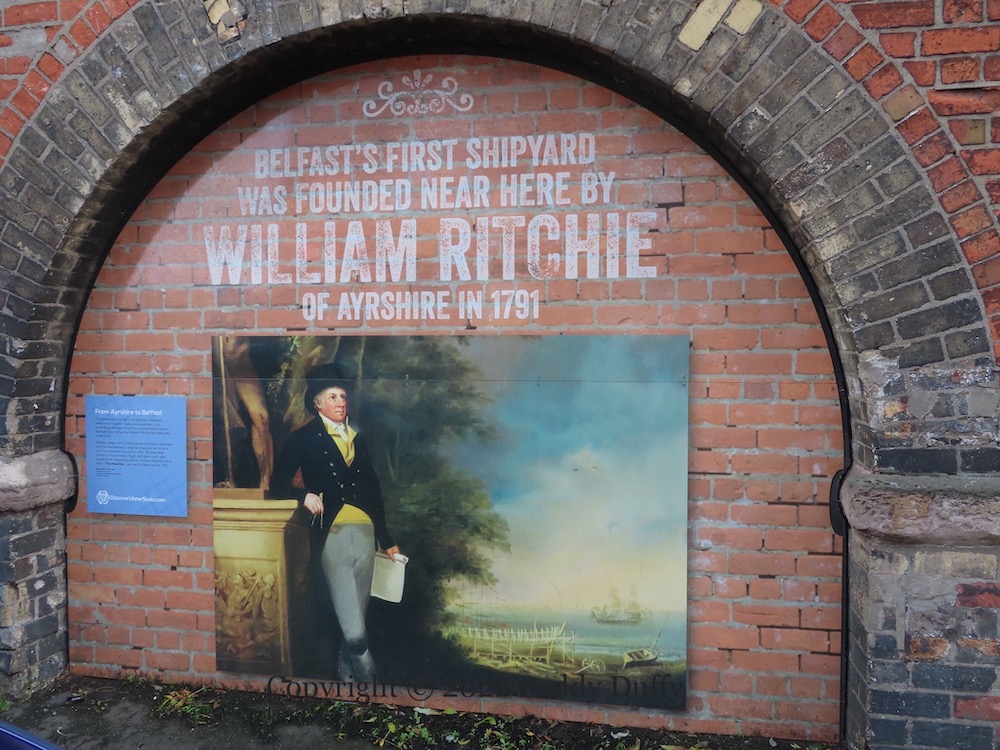
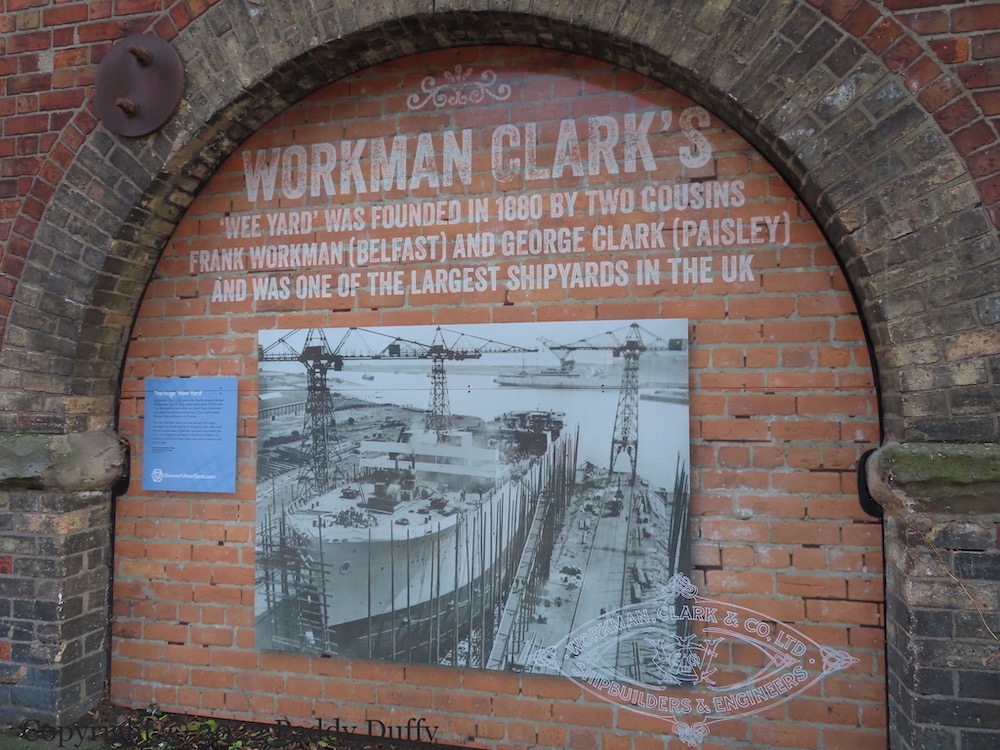
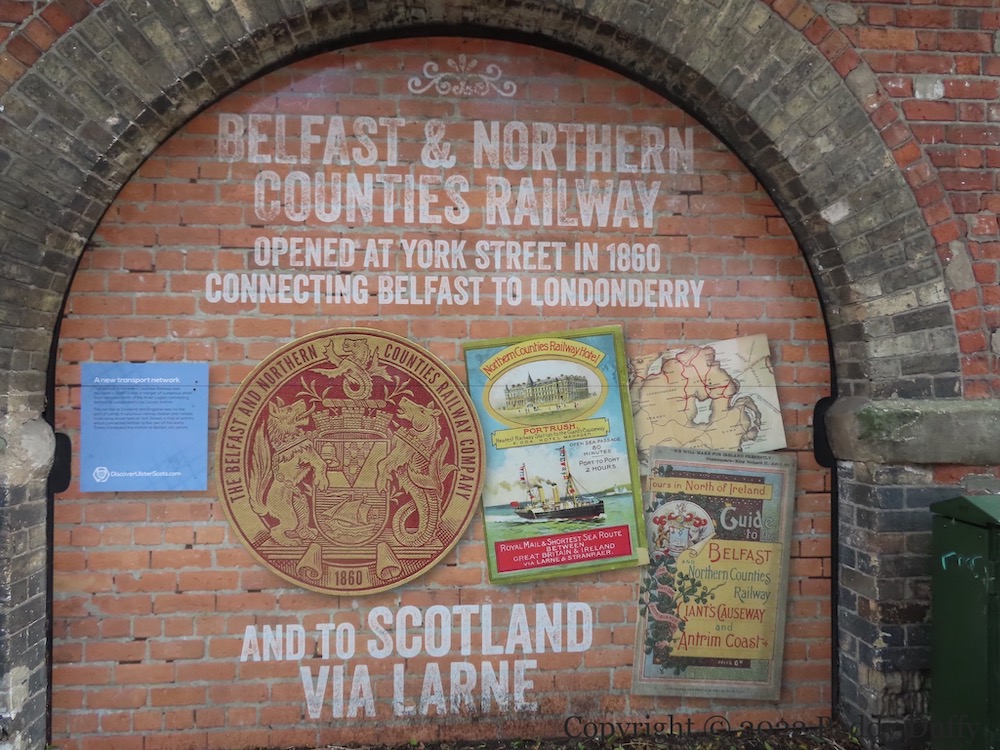
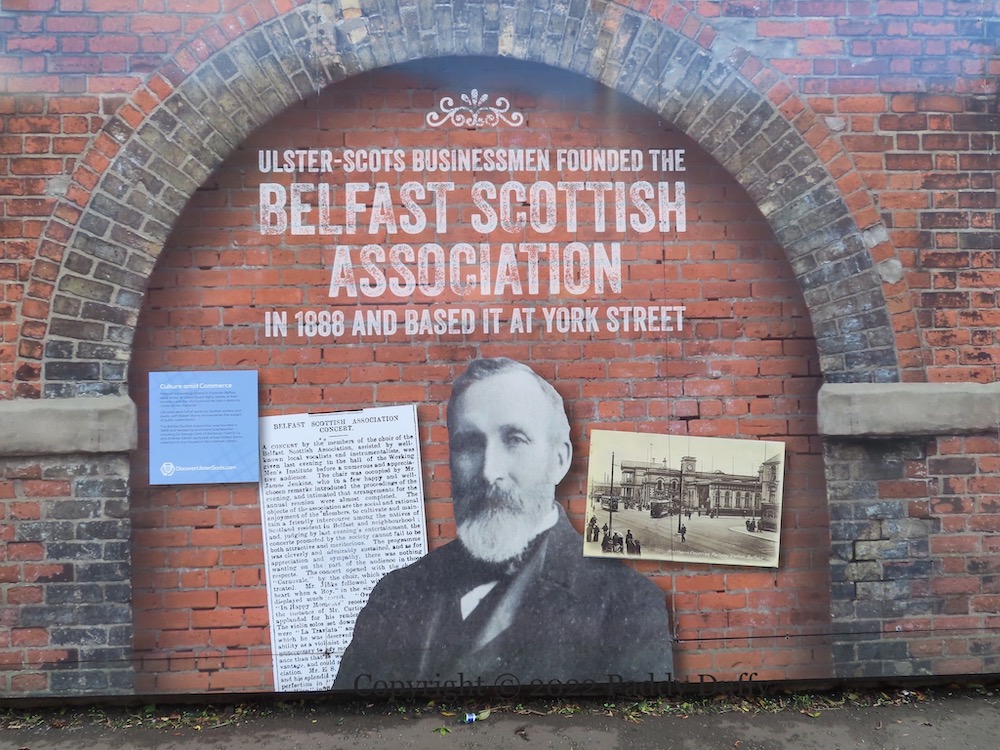
This is a 13-panel installation along York Road from discoverulsterscots.com about York Street businesses and Ulster Scots businessmen. It begins by telling a history of shipbuilding and its role in Belfast’s industrial life (“The harbour made York Street Belfast’s global gateway”) and in particular its connection with Scotland.

Two Scots, William Ritchie (whose 1802 portrait by Thomas Robinson is shown) and Charles Connell (who oversaw the construction of the first wooden steamboat in Belfast – Aurora, pictured below) along with another Scot, Alexander MacLaine, were the leading shipbuilders in Belfast from 1791 until the 1860s, when Englishman Edward Harland (soon joined by German Gustav Wolff, and then in 1874 by William Pirrie and Wilson brothers Walter and Alexander) took over the rival Hickson yard (which included land on Queen’s Island and on the south side of the Lagan) and became dominant. Their connection to York Street is that all of them except Pirrie lived on or near York Street.

Workman & Clark’s was a Belfast shipyard existing from 1880 to 1935. During the first world war it took over the construction of two monitor ships (specifically, M29 and M31) for the Royal Navy that H&W did not have space to build. For more, see Grace’s GuideBBC audio on monitor ships and their construction, including a record for number of rivets hammered in by one John Moore at Workman Clark’s.

Among the Belfast goods “exported around the world from York Street by rail and sea” were Gallaher’s Blues (cigarettes), Irish linens, Davidson & Co (Samuel Davidson, born in County Down to an Ulster-Scots family, was the inventor of the Sirocco centrifugal fan “for mine ventilation, dust removal, induced draft, forge fires”), and linen carpet thread from York Street (Threads) Ltd. Robinson & Cleaver’s department store is now out of business. Gallaher’s is now the multinational Gallaher Group, but its factories in Belfast and Ballymena have closed. And Davidson’s company was bought by Howden UK in 1988.

“The Belfast Scottish Association was founded in 1888 and headed by prominent businessmen, including Sir George Clark of Workman Clark and Andrew Gibson (pictured) whose Robert Burns collection is now housed in the Linenhall Library.”

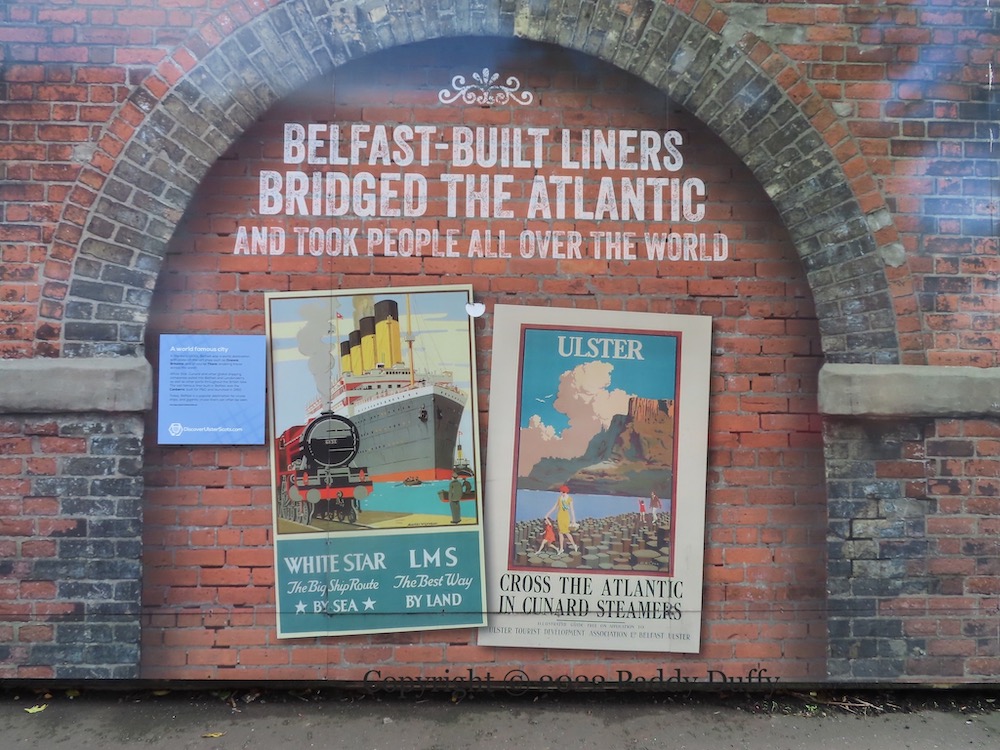
In addition to the famous trans-Atlantic ships (image below), Belfast was part of the travel network in the UK and Ireland (image above). Before there was British Railways, there were the Big 4: the Southern, Great Western, London and Northeastern, and London, Midland, and Scottish (LMS) railways. The latter included the railways in the Northern Counties. In addition to railways, the company owned canals, ships (including the Princess Victoria which sank on the Larne-Stranraer route), and hotels. “Belfast-built liners bridged the Atlantic and took people all over the world.” “Railway-owned ships ensured a seamless journey throughout the British Isles.”

Click image to enlarge
Copyright © 2022 Paddy Duffy
T01246 T01247 T01248 T01249 T01250 T01251 T01252 T01253 T01254 T01255 T01256 T01257 T01258 [T01259]