Discover Ulster-Scots

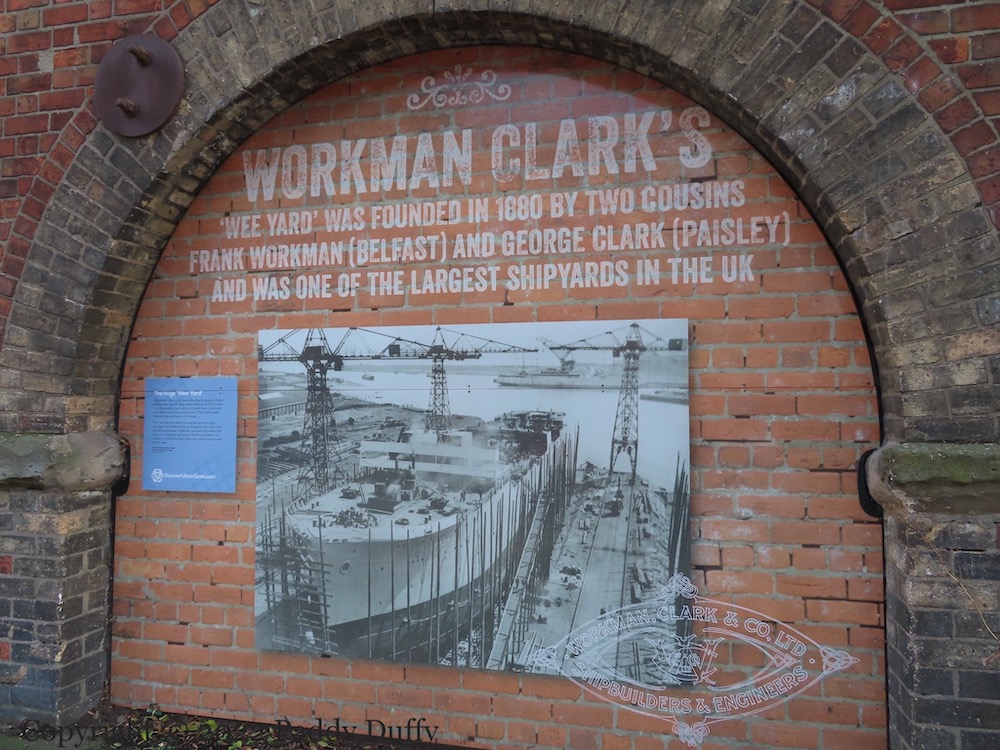
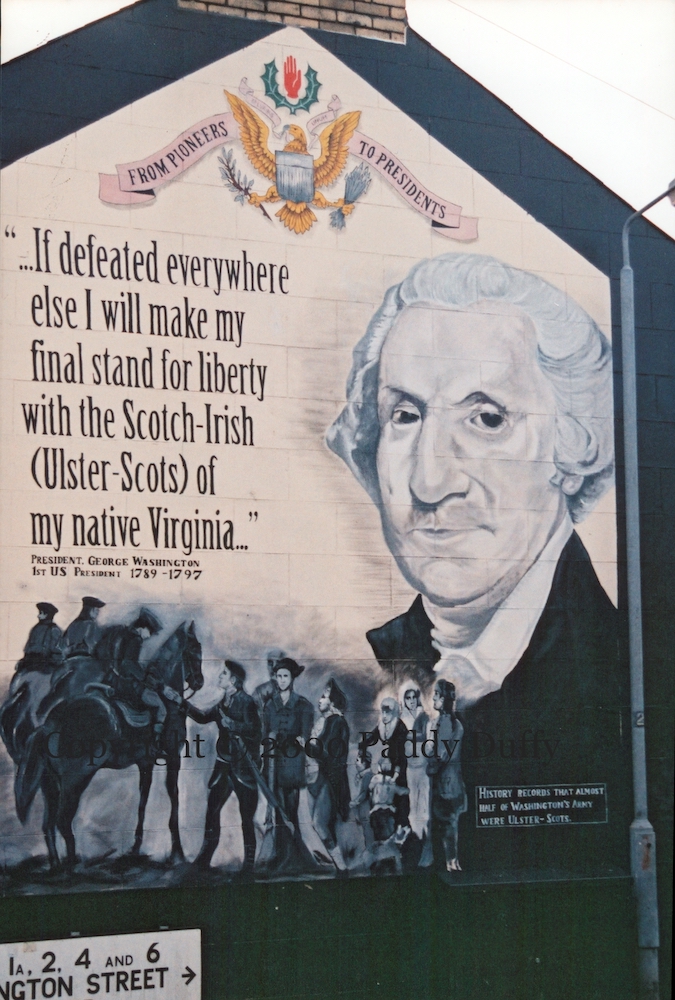
This is a 13-panel installation along York Road from discoverulsterscots.com about York Street businesses and Ulster Scots businessmen. It begins by telling a history of shipbuilding and its role in Belfast’s industrial life (“The harbour made York Street Belfast’s global gateway”) and in particular its connection with Scotland.

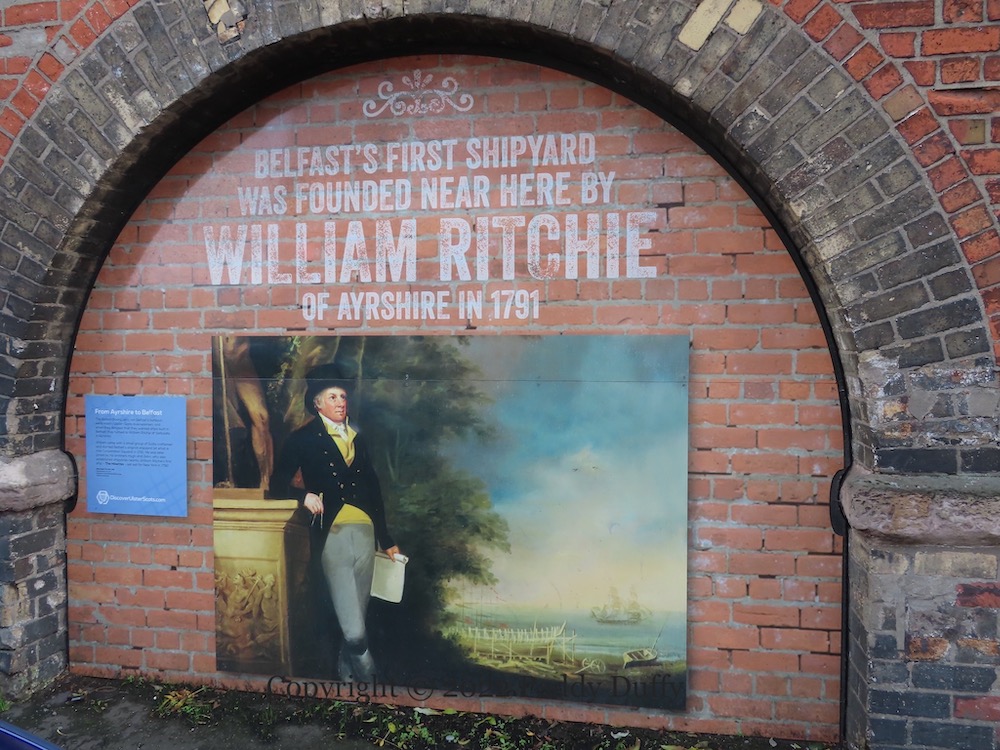
Two Scots, William Ritchie (whose 1802 portrait by Thomas Robinson is shown) and Charles Connell (who oversaw the construction of the first wooden steamboat in Belfast – Aurora, pictured below) along with another Scot, Alexander MacLaine, were the leading shipbuilders in Belfast from 1791 until the 1860s, when Englishman Edward Harland (soon joined by German Gustav Wolff, and then in 1874 by William Pirrie and Wilson brothers Walter and Alexander) took over the rival Hickson yard (which included land on Queen’s Island and on the south side of the Lagan) and became dominant. Their connection to York Street is that all of them except Pirrie lived on or near York Street.

Workman & Clark’s was a Belfast shipyard existing from 1880 to 1935. During the first world war it took over the construction of two monitor ships (specifically, M29 and M31) for the Royal Navy that H&W did not have space to build. For more, see Grace’s Guide | BBC audio on monitor ships and their construction, including a record for number of rivets hammered in by one John Moore at Workman Clark’s.
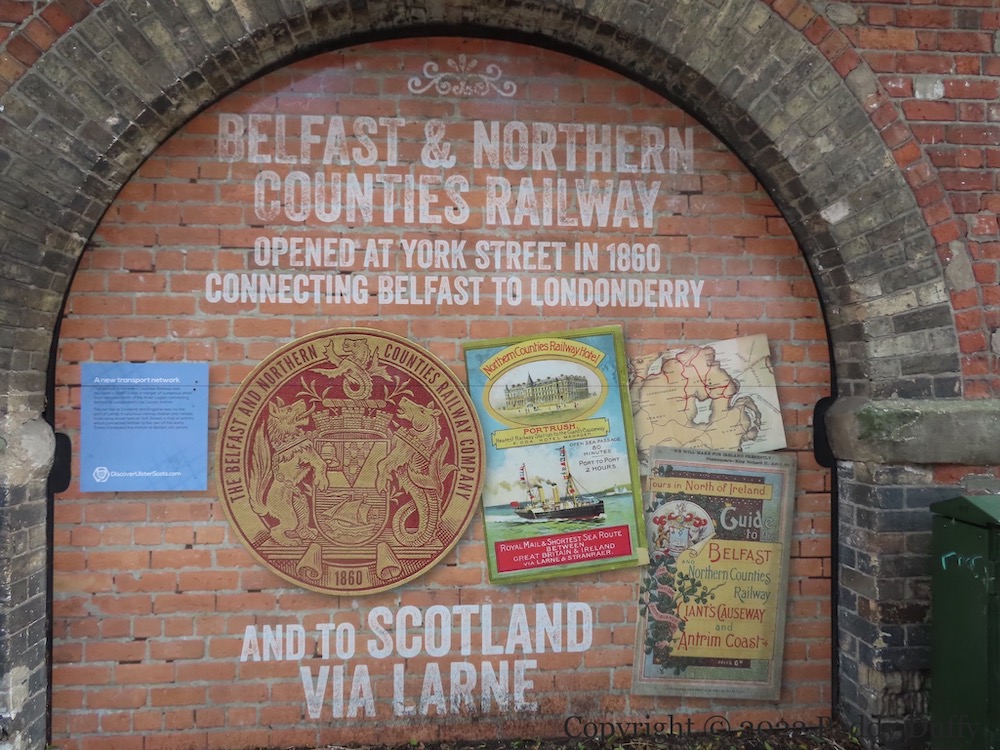
Among the Belfast goods “exported around the world from York Street by rail and sea” were Gallaher’s Blues (cigarettes), Irish linens, Davidson & Co (Samuel Davidson, born in County Down to an Ulster-Scots family, was the inventor of the Sirocco centrifugal fan “for mine ventilation, dust removal, induced draft, forge fires”), and linen carpet thread from York Street (Threads) Ltd. Robinson & Cleaver’s department store is now out of business. Gallaher’s is now the multinational Gallaher Group, but its factories in Belfast and Ballymena have closed. And Davidson’s company was bought by Howden UK in 1988.
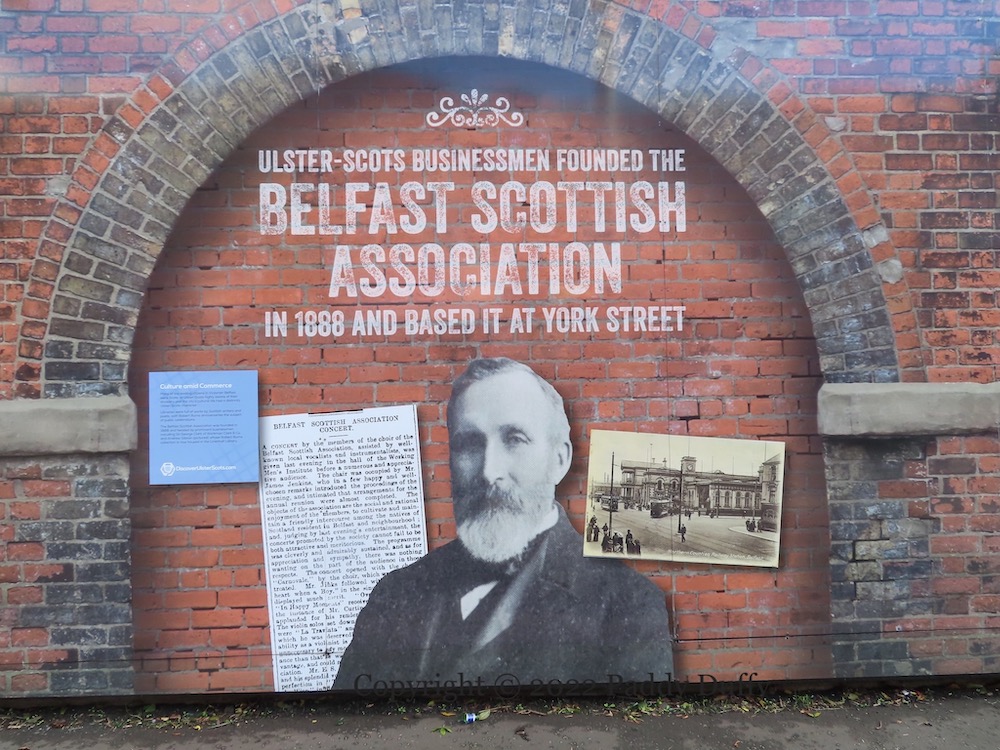
“The Belfast Scottish Association was founded in 1888 and headed by prominent businessmen, including Sir George Clark of Workman Clark and Andrew Gibson (pictured) whose Robert Burns collection is now housed in the Linenhall Library.”

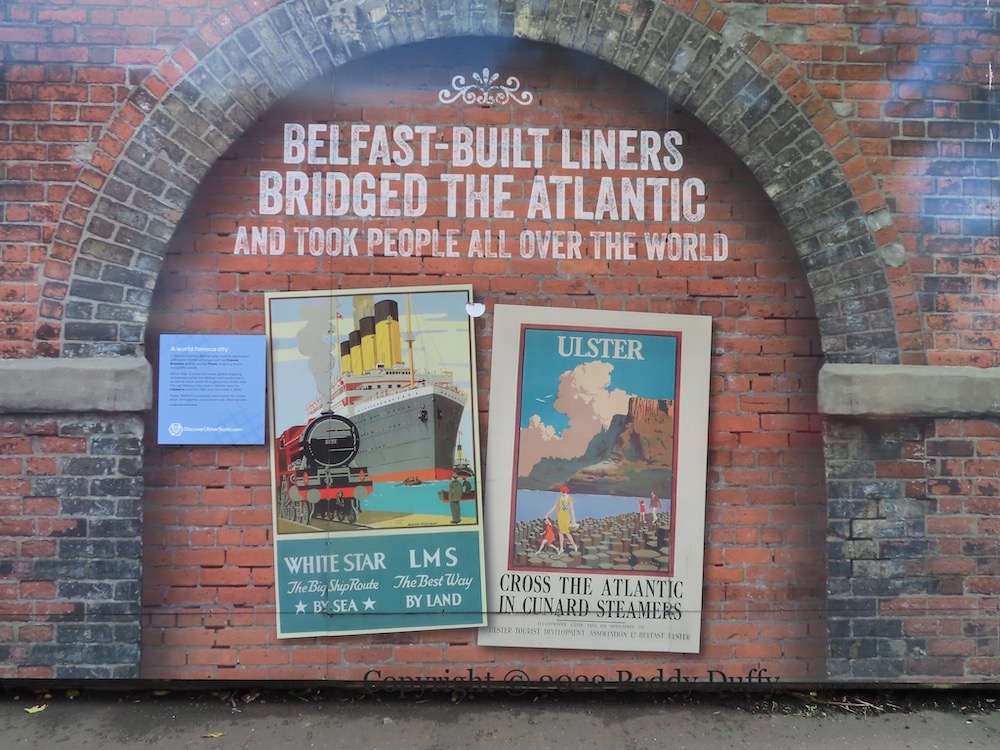
In addition to the famous trans-Atlantic ships (image below), Belfast was part of the travel network in the UK and Ireland (image above). Before there was British Railways, there were the Big 4: the Southern, Great Western, London and Northeastern, and London, Midland, and Scottish (LMS) railways. The latter included the railways in the Northern Counties. In addition to railways, the company owned canals, ships (including the Princess Victoria which sank on the Larne-Stranraer route), and hotels. “Belfast-built liners bridged the Atlantic and took people all over the world.” “Railway-owned ships ensured a seamless journey throughout the British Isles.”
Click image to enlarge
Copyright © 2022 Paddy Duffy
T01246 T01247 T01248 T01249 T01250 T01251 T01252 T01253 T01254 T01255 T01256 T01257 T01258 [T01259]

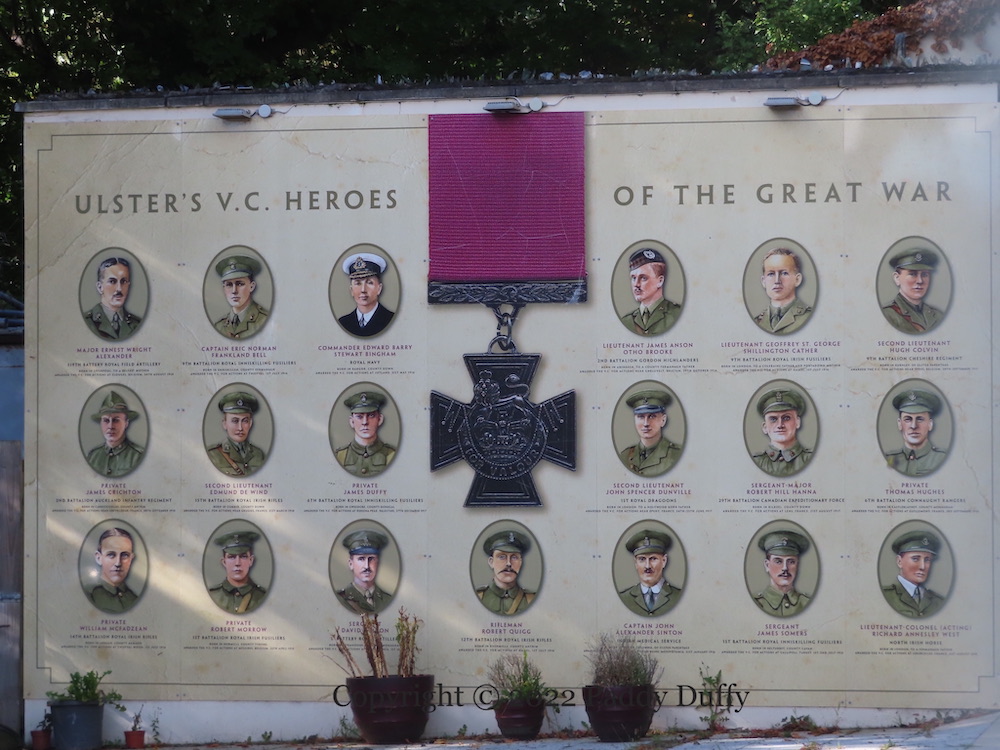
Ulster-Scots Heroes

Here are two boards outside the north Belfast Orange hall in Alexandra Park Avenue, north Belfast.

Above: sporting heroes Joey Dunlop, Alan Campbell, Darren Clarke, Alex Higgins, George Best, and Carl Frampton.

Below: nineteen winners of the Victoria Cross: (left) Major Ernest Wright Alexander, Captain Eric Norman Frankland Bell, Commander Edward Barry Stewart Bingham, Private James Crichton, Second Lieutenant Edmund De Wind, Private James Duffy, Private William McFadzean, Private Robert Morrow, Sergeant David Nelson, (centre) Rifleman Robert Quigg, (right) Lieutenant James Anson Ortho Brooke, Lieutenant Geoffrey St. George Shillington Cather, Second Lieutenant Hugh Colvin, Second Lieutenant John Spencer Dunville, Sergeant-Majjor Robert Hill Hanna, Private Thomas Hughes, Captain John Alexander Sinton, Sergeant James Somers, Lieutenant-Colonel (Acting) Richard Annesley West.

Click image to enlarge
Copyright © 2022 Paddy Duffy
T01025 [T01026] [T01027] T01028

Andrew Jackson

The information along the bottom reads: “Andrew Jackson was the 7th President of the USA and the first of Ulster-Scots descent, his family emigrated from Carrickfergus to North Carolina in 1765. After leading the army to victory in the Battle Of New Orleans in 1815 Jackson became a national hero and became known as “Old Hickory” after the tough wood of the native American tree. His “common man” credentials earned Jackson a massive popular vote and swept him into the Presidency for two consecutive terms (1829-1837).” He also hated the British, owned slaves, and signed the Indian Removal Act of 1830, which led to the infamous “Trail of Tears” (Irish Times).

Boundary Way, west Belfast

See also the Visual History page on Ulster-Scots murals.

Click image to enlarge
Copyright © 2008 Paddy Duffy
T00438

Theodore Roosevelt

“‘My forefathers were … the men who had followed Cromwell and who shared in the defence of Derry, and in the victories of Aughrim and the Boyne.’ – President Theodore Roosevelt, 20th US president, 1901-1904.” The “shutting of the gates” of Derry is represented in the bottom left.

The quote is derived from Volume 1, Chapter 5, of Roosevelt’s The Winning Of The West (available at Project Gutenberg). Roosevelt, however, is describing the forefathers of the Scotch-Irish, rather than his own forefathers, who, as the name suggests, were Dutch.

He writes, “The Presbyterian Irish were themselves already a mixed people. Though mainly descended from Scotch ancestors—who came originally from both lowlands and highlands, from among both the Scotch Saxons and the Scotch Celts—many of them were of English, a few of French Huguenot, and quite a number of true old Milesian Irish extraction. They were the Protestants of the Protestants; they detested and despised the Catholics, whom their ancestors had conquered, and regarded the Episcopalians by whom they themselves had been oppressed, with a more sullen, but scarcely less intense, hatred. They were a truculent and obstinate people, and gloried in the warlike renown of their forefathers, the men who had followed Cromwell, and who had shared in the defence of Derry and in the victories of the Boyne and Aughrim.”

Some sources claim that an ancestor(s) on his mother’s side emigrated from Gleno, Co Antrim in 1729, but this seems to be her great-great-grandfather James, who was a Scot (WP) and appears to have emigrated directly from Scotland, specifically Baldernock, in 1728 or 1729 (WikiTree | Friends Of Bulloch). The search for a connection continues, according to Irish Central.

This mural is one (and perhaps the first to be painted) in the series “From pioneers to presidents”. For more such murals, see the Visual History page about Ulster-Scots murals.

Replaces the King Billy mural in Wapping Lane, the Fountain, Londonderry.

Click image to enlarge
Copyright © 2007 Paddy Duffy
T00439

From Pioneers To Presidents

These are two of the first three murals painted in the series “From Pioneers To Presidents”, to Washington and Buchanan, in Ebrington Street Lower and Ebrington Street in the Waterside, Londonderry, along with one to Roosevelt in the Fountain.

George Washington commanded the Continental Army during the revolution and served as the first president of the United States beginning in 1789. His ancestry was English. The quote – “If defeated everywhere else I will make my final stand for liberty with the Scotch-Irish (Ulster-Scots) of my native Virginia” – is undocumented, the closest being this statement from McKinley.

The note in the corner reads “History records that almost half of Washington’s army were Ulster-Scots”; the basis for this claim might be General (Charles?) Lee’s report that “half the rebel Continental Army were from Ireland.” (See Chapter 2 of Bagenal, The American Irish and their Influence on Irish Politics.)

James Buchanan was “15th US president 1857-1861.” Buchanan’s father, also called James, was born in Ramelton, Co Donegal, and was living in Co Tyrone when he emigrated to the United States from Derry in 1783, (one of the “250,000 Ulster-Scots [who] emigrated to America in the 1700s”). James junior was born in 1791, the second of eleven children.

The confusion over the wording of the quote – “My Ulster blood is my most priceless [or simply: a priceless] heritage … [and I can never be too grateful to my grandparents from whom I derived it.]” – is matched by confusion over who said it (Buchanan junior or senior?); the source of the quote is unknown. Likewise we do not know where in Scotland the grandparents might have come from and perhaps the move to Ireland happened much earlier.

See also the Visual History page on Ulster-Scots murals.

Buchanan was also painted on the Shankill in west Belfast.

Click image to enlarge
Copyright © 2000 Paddy Duffy (no date given)
T01192 T01193

4,000 Years Of Ulster Scots

“4,000 years of Ulster-Scots history and heritage. Ulster & Scotland – shared language, shared literature, shared culture.” 400 years takes us back to the plantation; 4,000 years suggests an even deeper connection.

Ulster-Scots was included in the 1998 Good Friday Agreement (pdf) under the principle of support for “linguistic diversity”. This mural celebrating Ulster-Scots and ties between Northern Ireland and Scotland dates to 1999, with the crests of St Andrew and St Patrick on the left, and an Ulster Banner and Scottish lion rampant on the right.

“Dinnae houl yer wheest, houl yer ain!” [Don’t hold your tongue, hold your own!]

See also the Visual History page about Ulster-Scots murals.

Templemore Street, east Belfast

Click image to enlarge
Copyright © 2000 Paddy Duffy
T00448 [T00449]