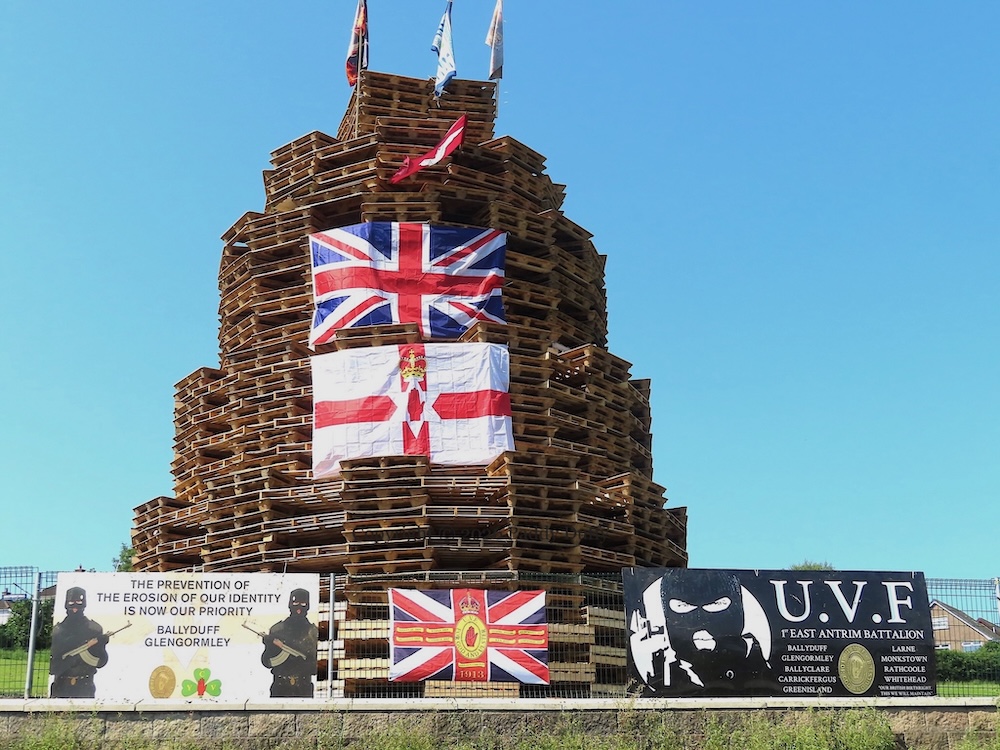
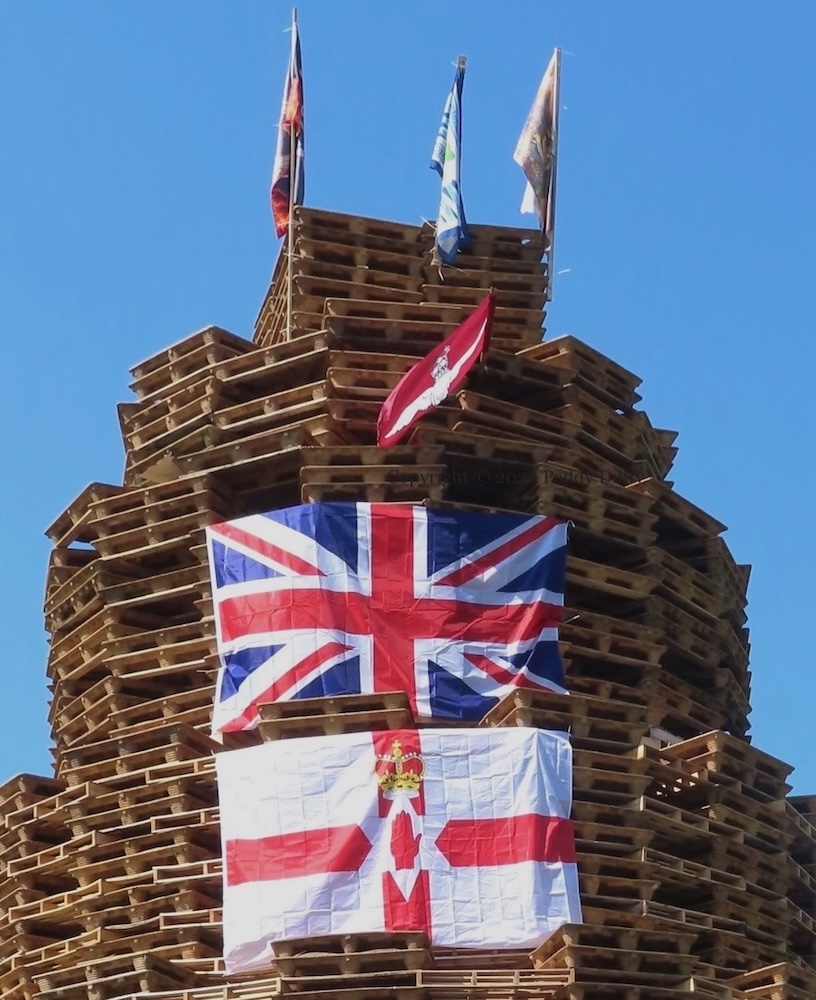
Various flags are flying or hanging on the Ballyduff bonfire prior to their removal and its incineration, including the flag of the Paratroop regiment. On the fencing in front are two UVF hooded gunmen boards and an Ulster Volunteers (1913) flag.
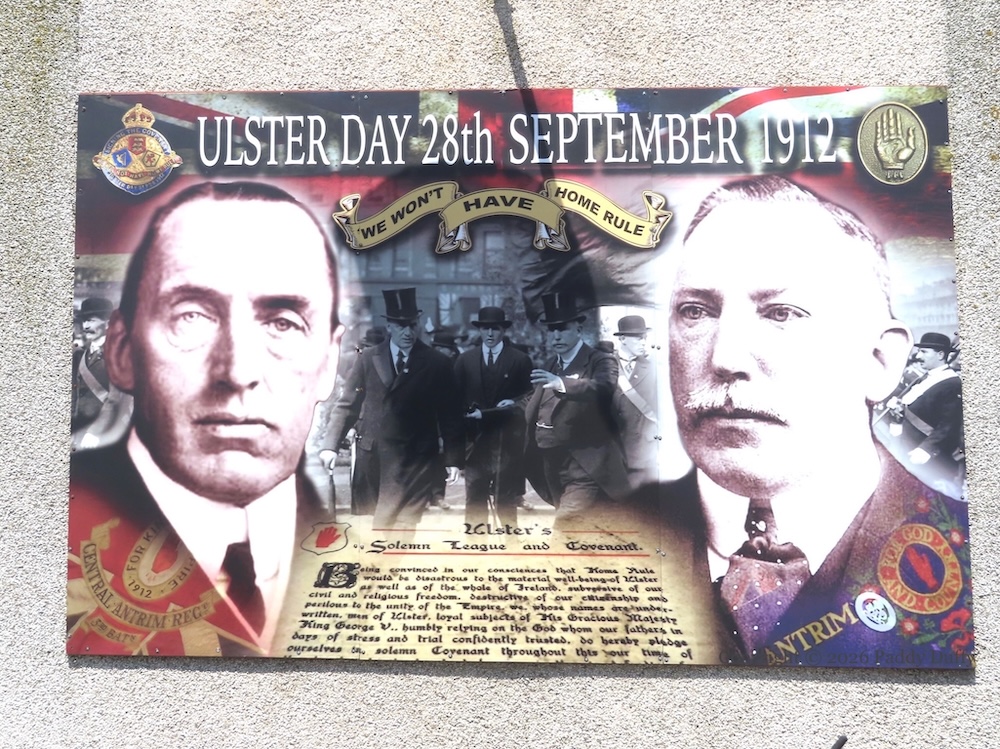
“We won’t have Home Rule.” Here is another view of the “Ulster Day” board seen previously in a gallery of five others. The heroes of the anti-Home Rule movement are Edward Carson (left) and James Craig (right). Carson and Craig were the first and third people to sign Ulster’s Solemn League And Covenant on September 28th, 1912.
For Ballymena during the Home Rule crisis, see History Ireland.
A few months later, in January 1913, the pair would found the Ulster Volunteers. The flags of the third (left) and second (right) battalions of the Central Antrim regiment of the Ulster Volunteers are in the bottom corners – see The Central Antrim Regiment. Ballymena men, however, joined the first battalion.
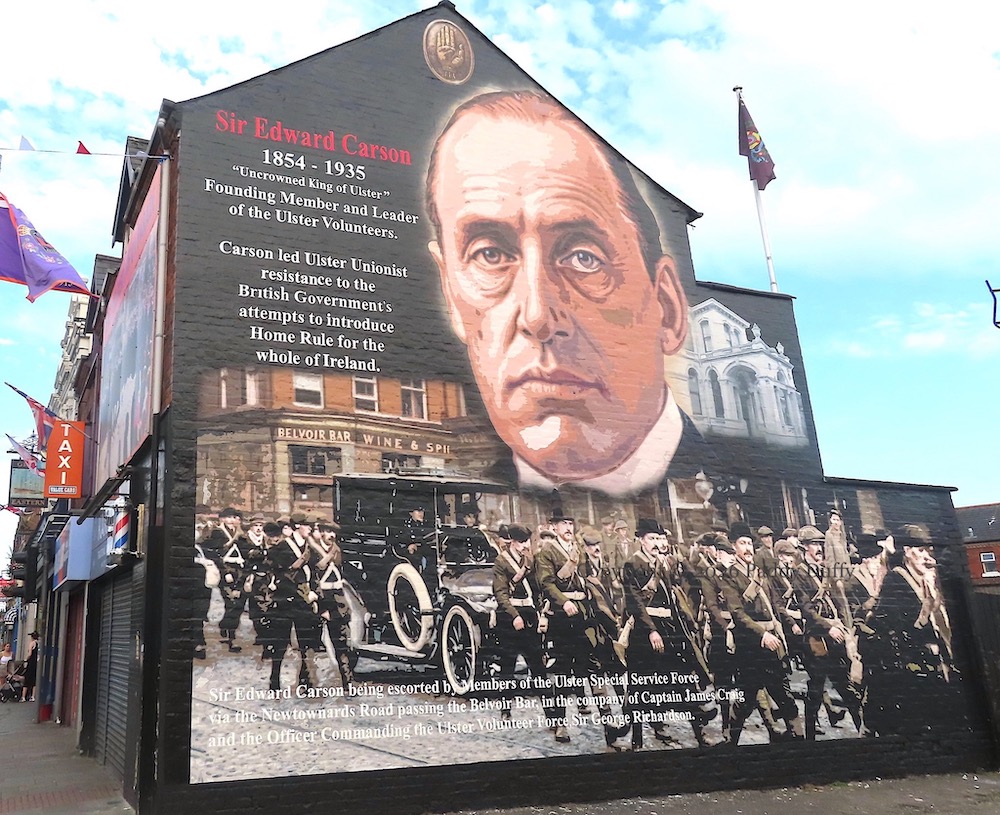
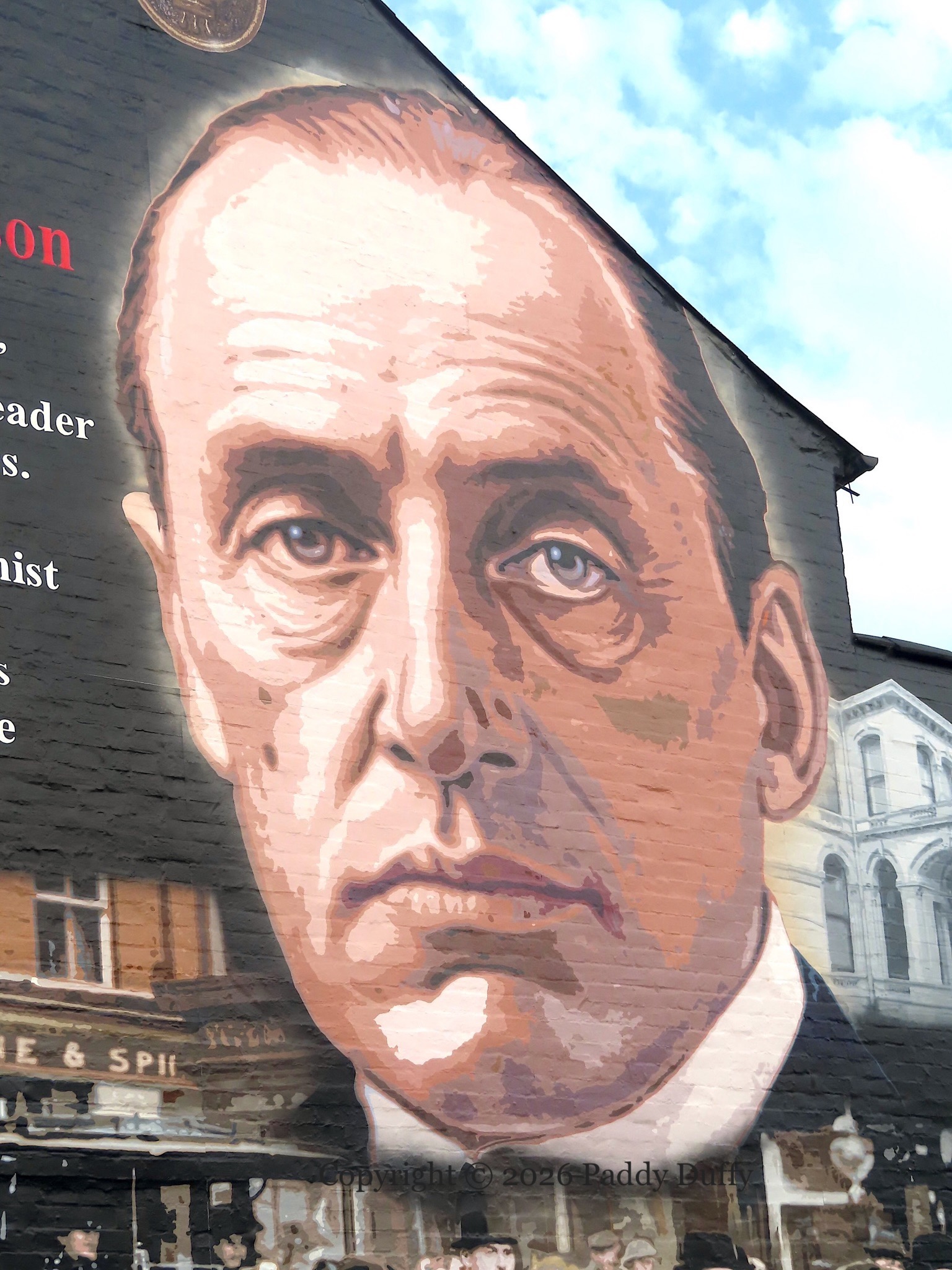
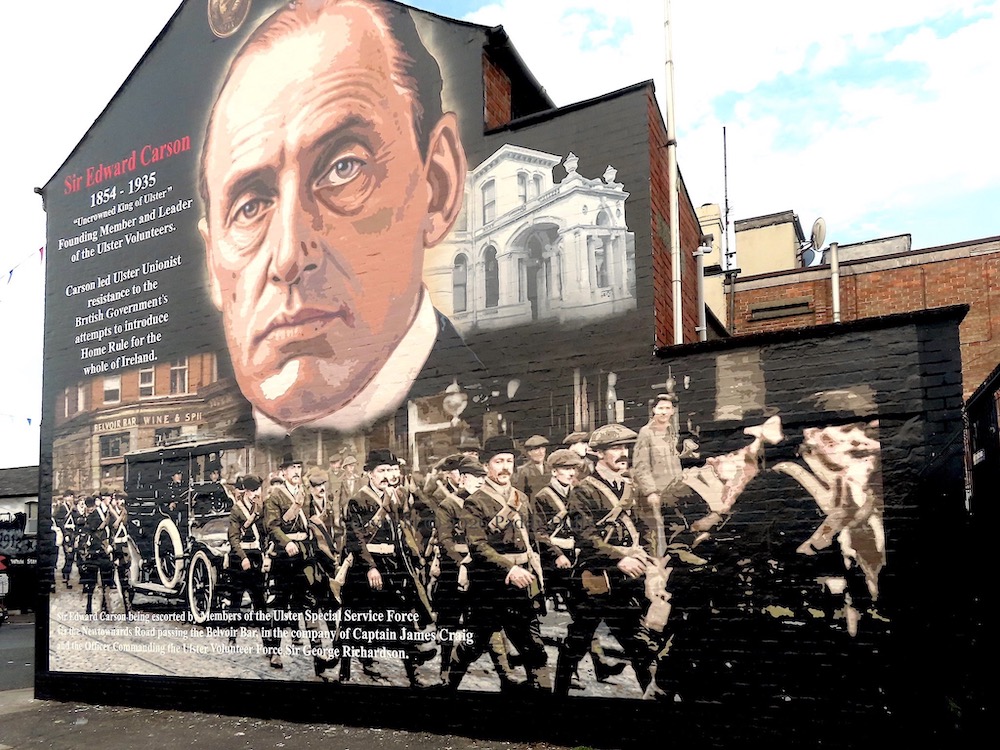
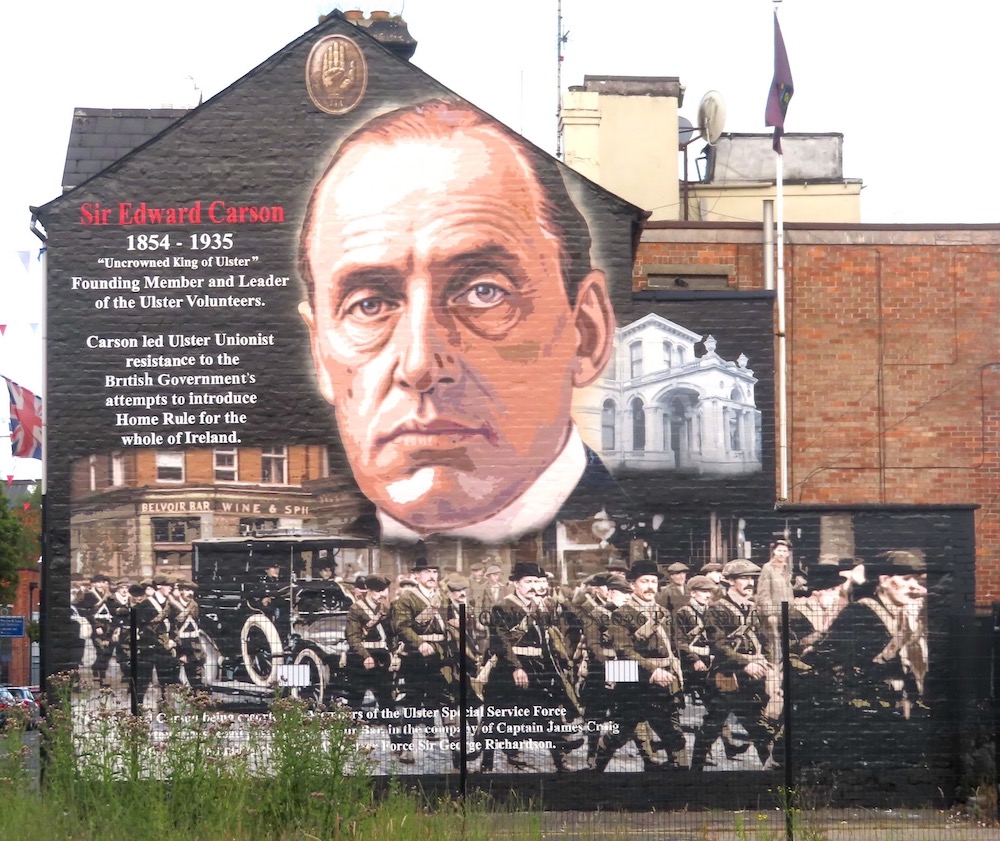
Painted by Dee Craig and mounted in Queen Street, Harryville, Ballymena.
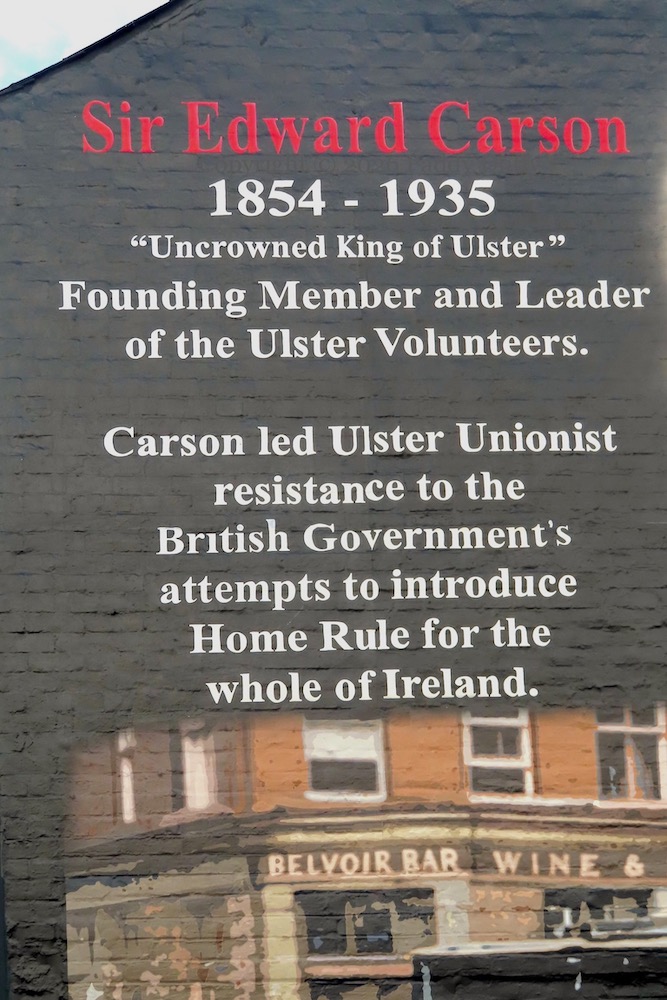
Text above: “Sir Edward Carson 1854 – 1935 “Uncrowned King of Ulster” Founding member and leader of the Ulster Volunteers. Carson led Ulster Unionist resistance to the British Government’s attempts to introduce Home Rule for the whole of Ireland.”
The epithet “uncrowned King” seems to be generally used of Carson and not attributable to any one source. Here is a September 1912 newspaper article that calls Carson the “uncrowned King of the North” and relays criticisms of a Carson reception in Portadown as “a parody upon a royal reception” and “an insult to the King”. A May 1914 review of (the book) The Reign Of Edward Carson refers to “King Carson”. (Here is a postcard depicting Carson as a king upon a throne – Postcards Ireland.)
The phrase is an echo of and response to the phrase “uncrowned king of Ireland”, which was used of both O’Connell and Parnell. Here is an 1847 article describing both O’Connell and the Napoleonic Governor-General of Algeria (WP) as “uncrowned monarch[s]”. According to WP, the epithet was first applied to Parnell in 1880, because he was so popular during a tour of the United States and Canada. At the end of James Joyce’s story ‘Ivy Day In The Committee Room’ a character recites a poem about Parnell, beginning “He is dead. Our uncrowned king is dead” (archive.com).
The wording “the British government’s attempts to introduce Home Rule” is more forthright than we are used to. Typically the resistance is simply to “Home Rule”. This wording makes clear that the Ulster Volunteers were a private militia preparing for the possibility of fighting the regular British Army and Navy. By being so explicit, this wording suggests that we are currently living through a time in which loyalists consider the “British government” to be insufficiently British, just as was the case in 1912.
Text below: “Sir Edward Carson being escorted by members of the Ulster Special Service Force on the Newtownards Road passing the Belvoir Bar in the company of Captain James Craig and the Officer Commanding of the Ulster Volunteer Force Sir George Richardson.”
According to a Regimental Band Fb post, “Sir Edward Carson was speaking at the Reform Club in Royal Avenue. There was an opinion that the British Government were going to try and arrest him so he was escorted to the safety of Craigavon House [shown on the right of the mural]. This photo was taken on the 20th March, 1914.” This October 1913 article, in addition to calling Carson “Ulster’s Uncrowned King”, notes that he travelled with a detective and carried a revolver.
By Dee Craig (Fb), presumably, replacing his hooded gunmen mural The Right To Defend Yourself, on the Newtownards Road at (the former) Bright Street.
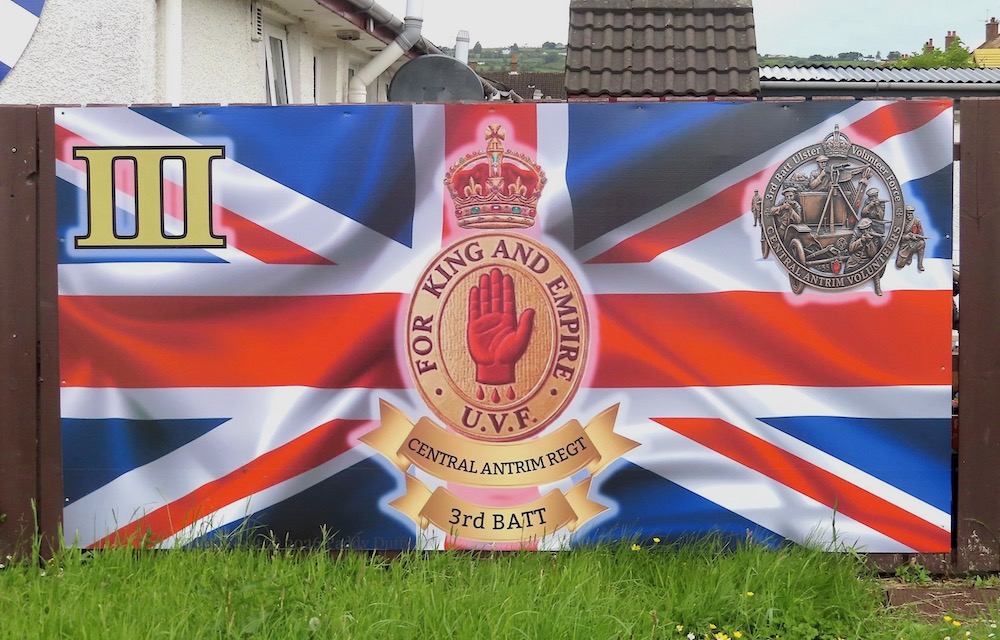
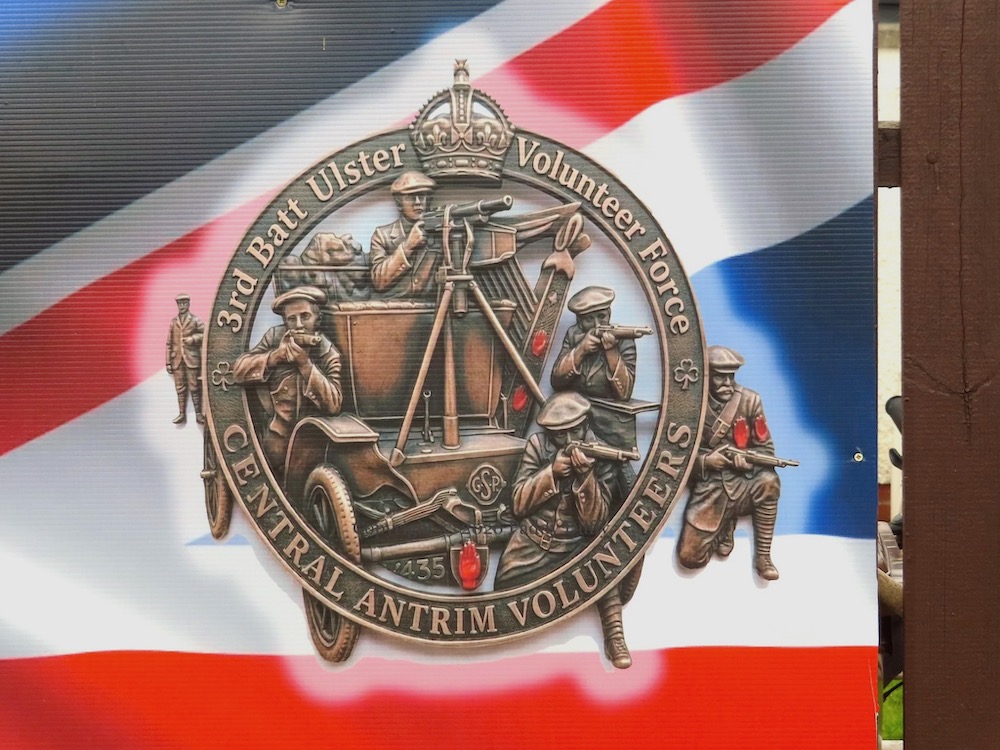
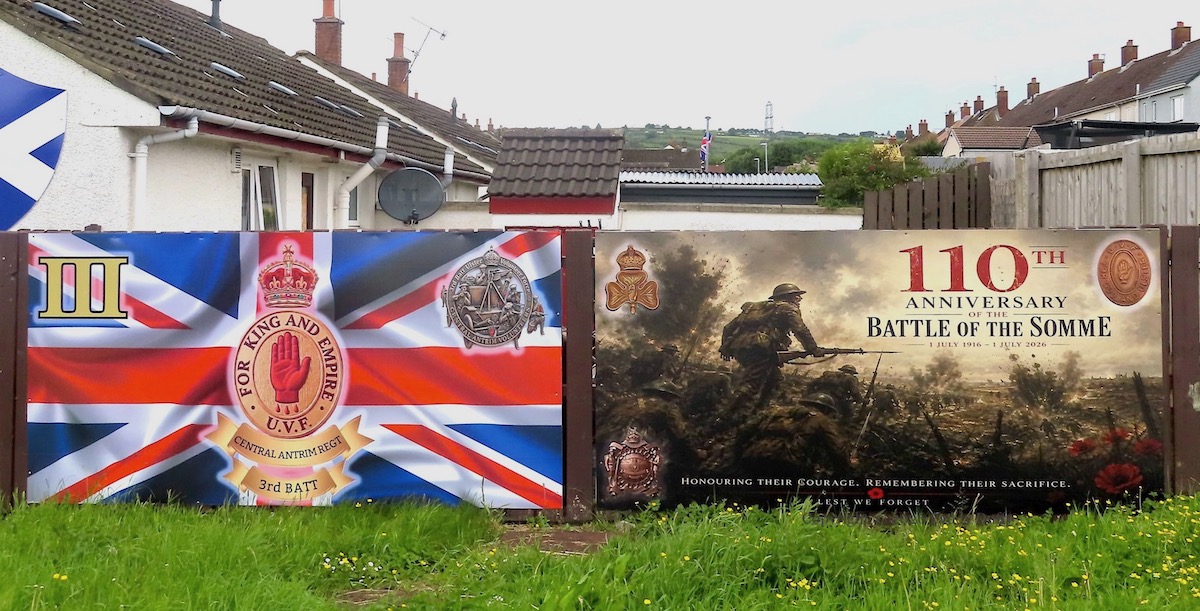
The colours of the third (Carrickfergus) battalion of the Central Antrim regiment of the Ulster Volunteers can be seen at Sam’s Flags. They are very similar to the piece shown above, except for the addition of the emblem in the top right corner (close-up immediately below) which shows the Ulster Volunteers drilling with a machine-gun mounted in a car, preparing to resist Home Rule – see this 1988 mural and the photograph in this History Ireland article. (See also UVF Motor Car Corps.) In the Royal Irish Rifles of WWI, however, Central Antrim became the 12th battalion (War Time Memories Project).
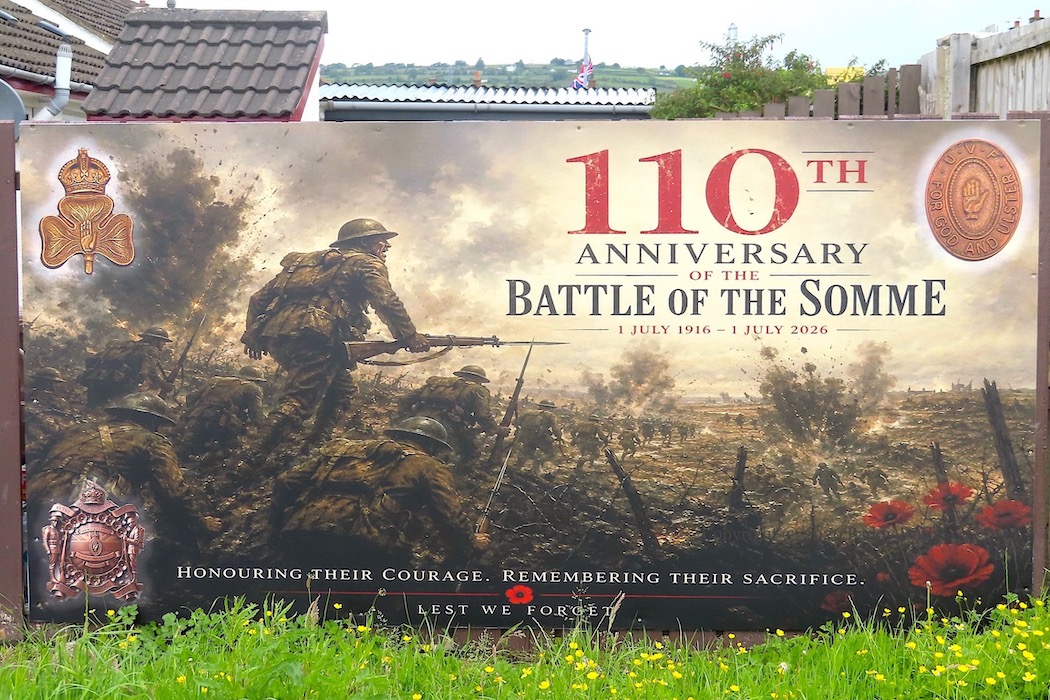
Next to the Central Antrim flag is a board marking the “110th anniversary of the Battle Of The Somme 1 July 1916 – 1 July 2026. Honouring their courage, remembering their sacrifice. Lest we forget.”
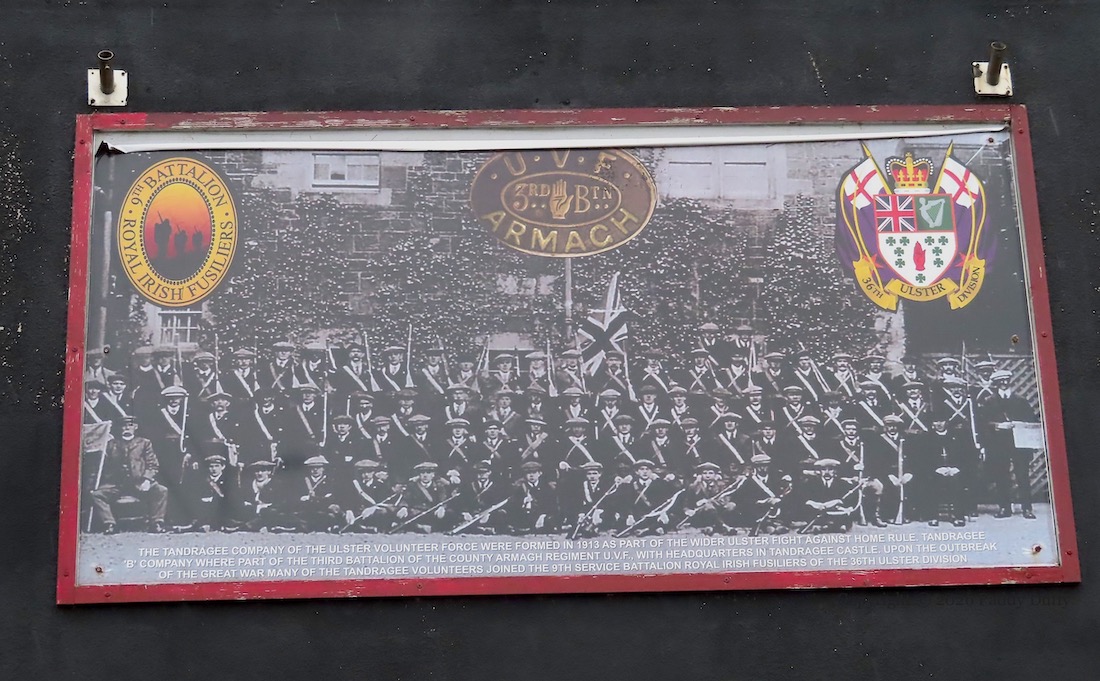
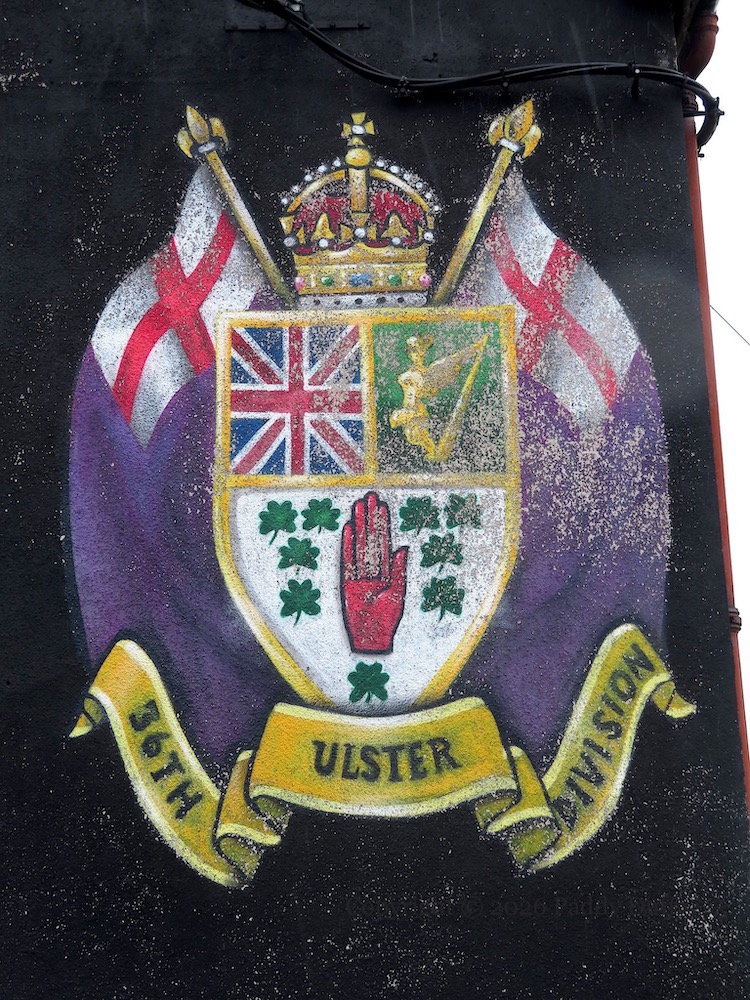
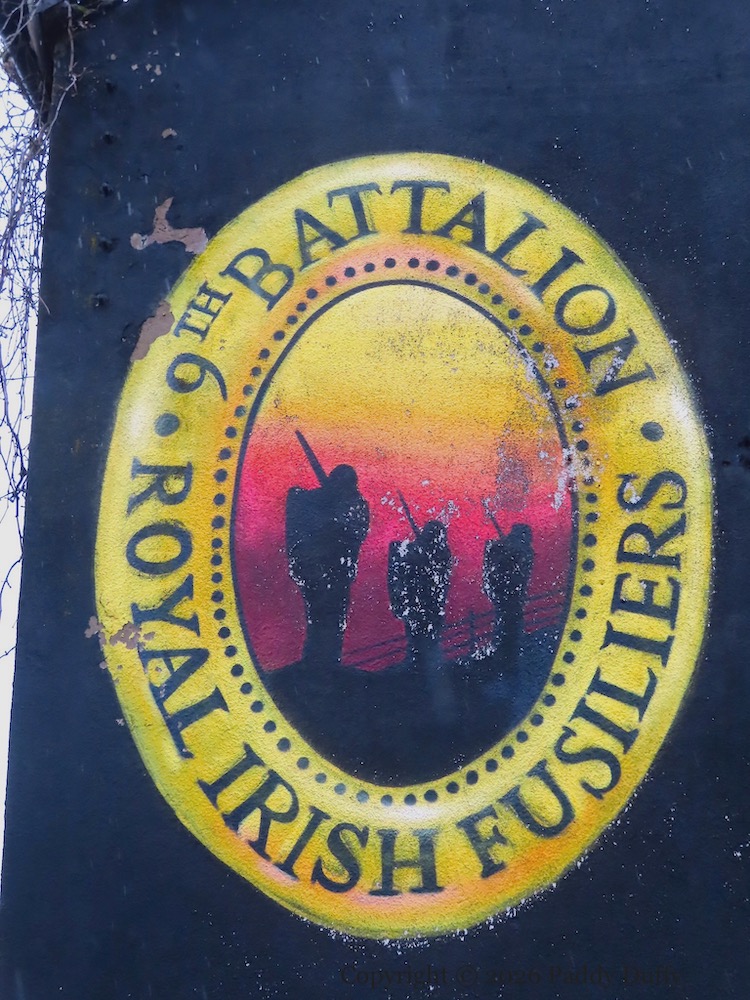
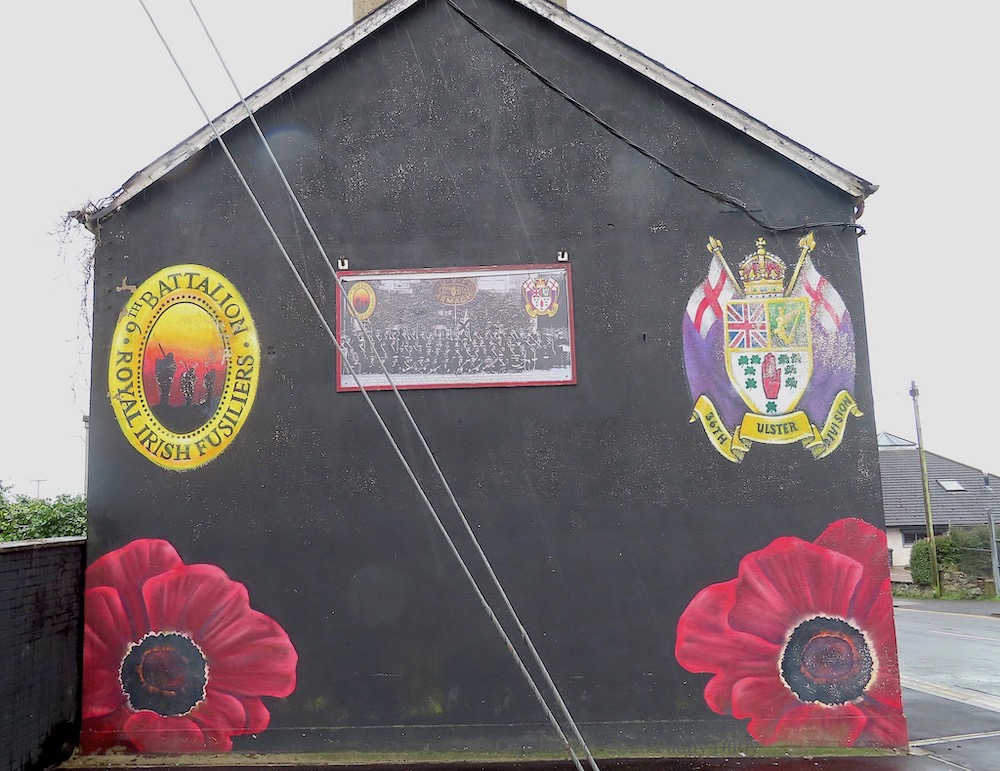
“The Tandragee company of the Ulster Volunteer Force were formed in 1913 as part of the wider Ulster fight against Home Rule. Tandragee ‘B’ Company where [were] part of the third battalion of the County Armagh Regiment UVF with headquarters in Tandragee Castle. Upon the outbreak of the Great War many of the Tandragee Volunteers joined the 9th Service Battalion Royal Irish Fusiliers of the 36th (Ulster) Division.”
The 9th battalion comprised volunteers from Armagh, Monaghan, and Cavan.
For a fuller version of the photograph, see Cyberprod.
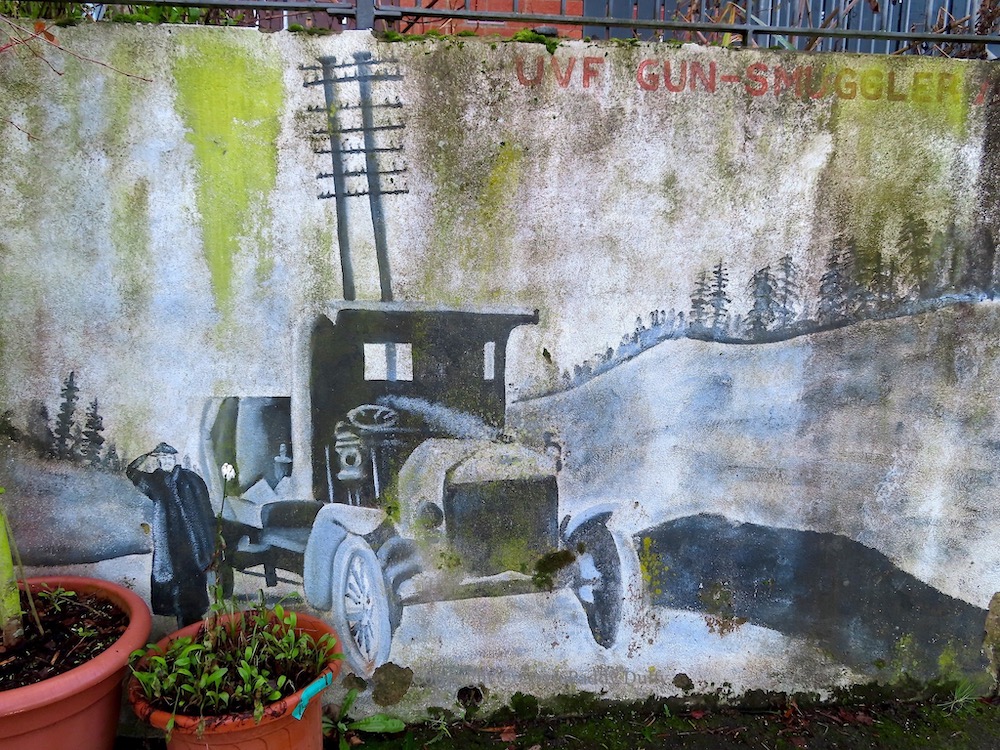
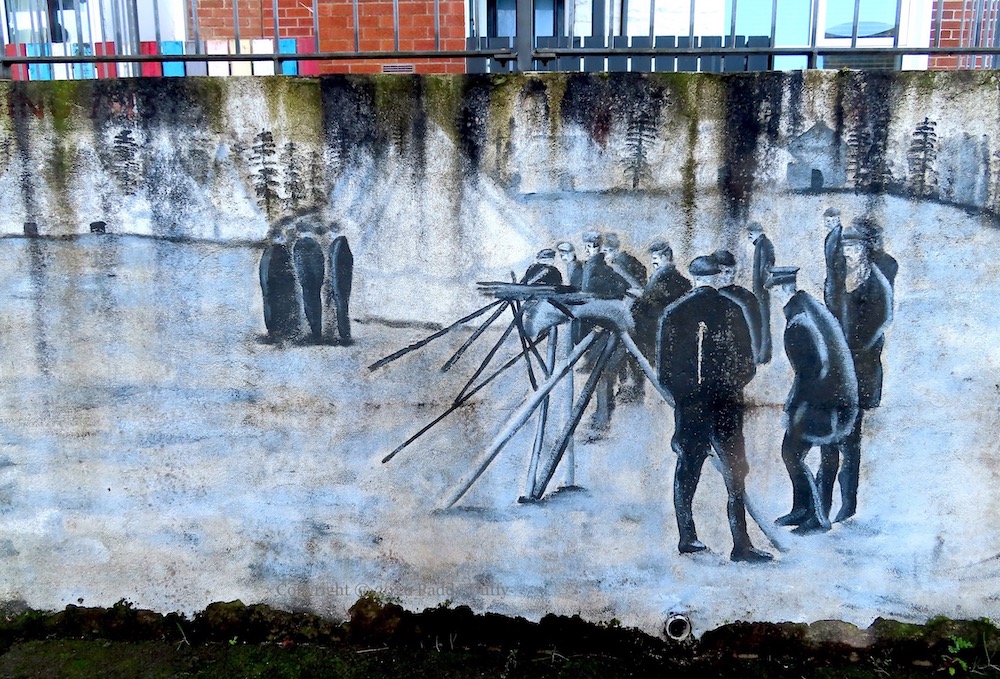
These faded Armagh murals have the titles “UVF Gun-Smuggler 1913” and “Arms Training 1913”.
The gun-smuggling mural features not the 1914 gun-running on Clyde Valley – the ship that brought in the weapons and ammunition into Larne – but a motor-car. There was earlier gun-running or bulk gun-purchasing – 175 rifles were bought from Harrods by the Earl Of Lanesborough and sent to Enniskillen (Balaclava Street) and 500 rifles were brought from Manchester in August 1913 (Irish Bayonets). (See also History Ireland.) These perhaps used automobiles for distribution, and the Larne gun-running is described as the first time that the horseless carriage was used in a military operation – there were about 350 vehicles in the “Motor Car Corps” (Angelsey p. 3).
The location of the car, and of the ‘arms training’ in the second mural, are unknown. Here is a 1914 image (Getty) showing tents and a single machine-gun at Ballywalter. The sources of both paintings are unknown.
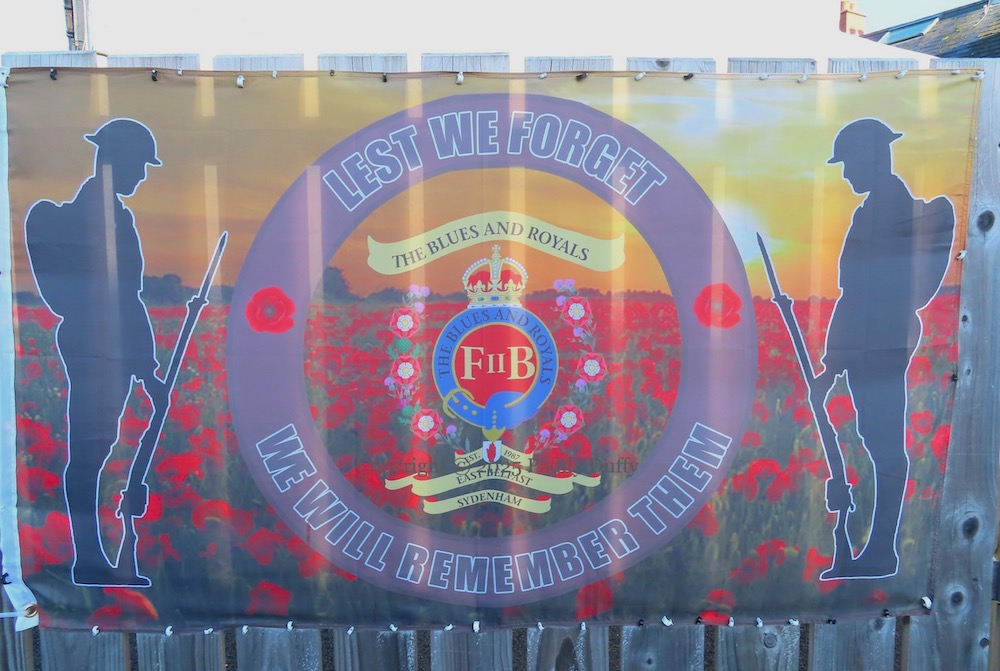
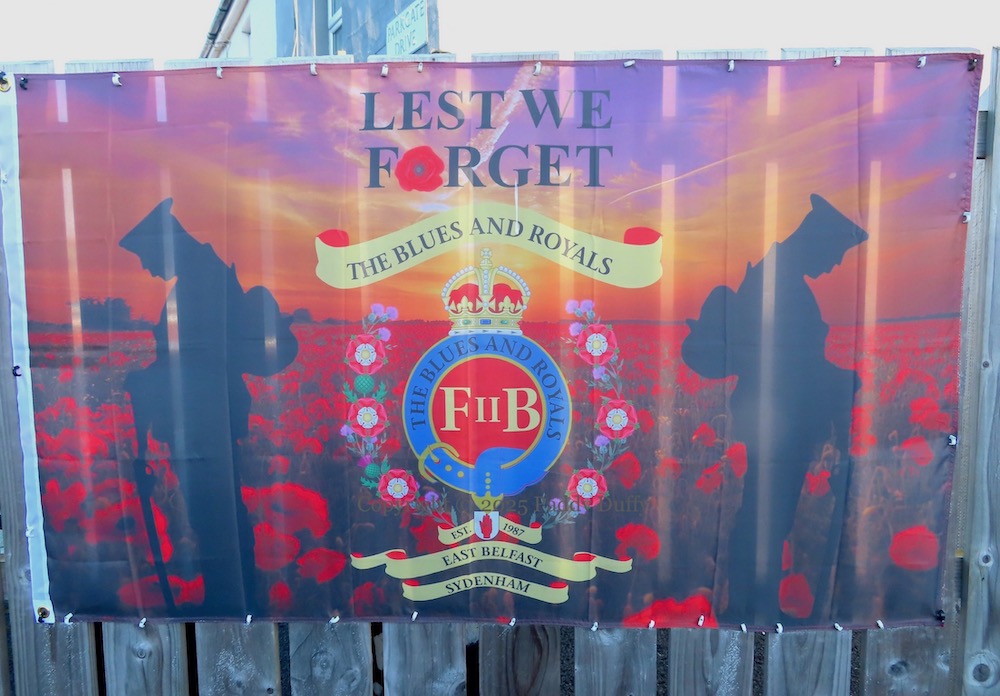
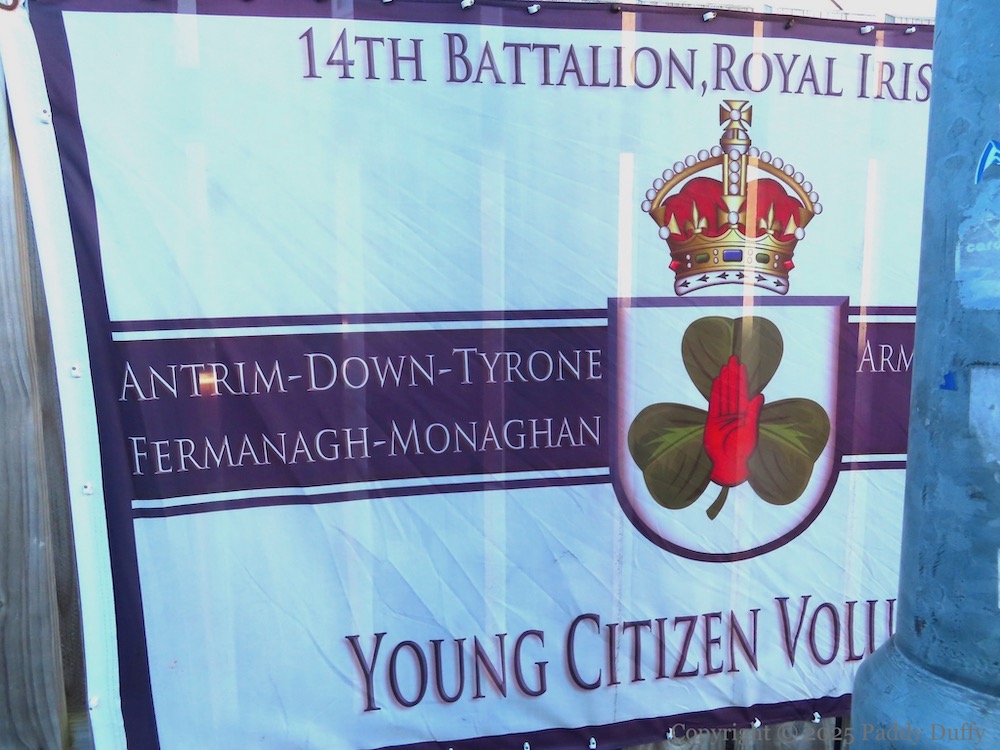
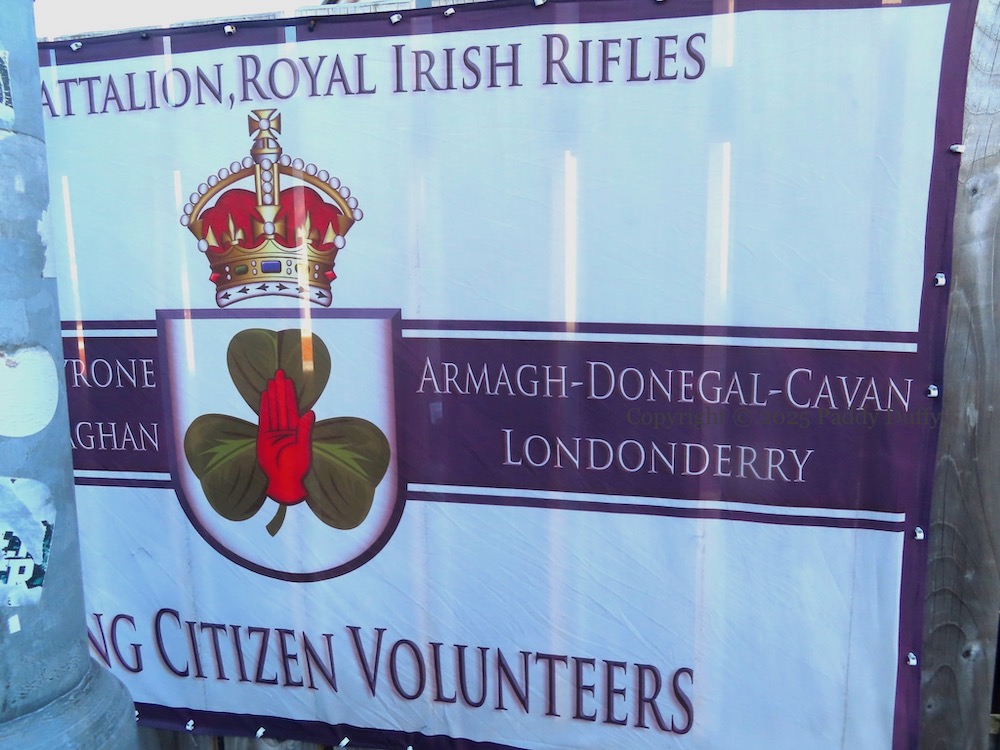
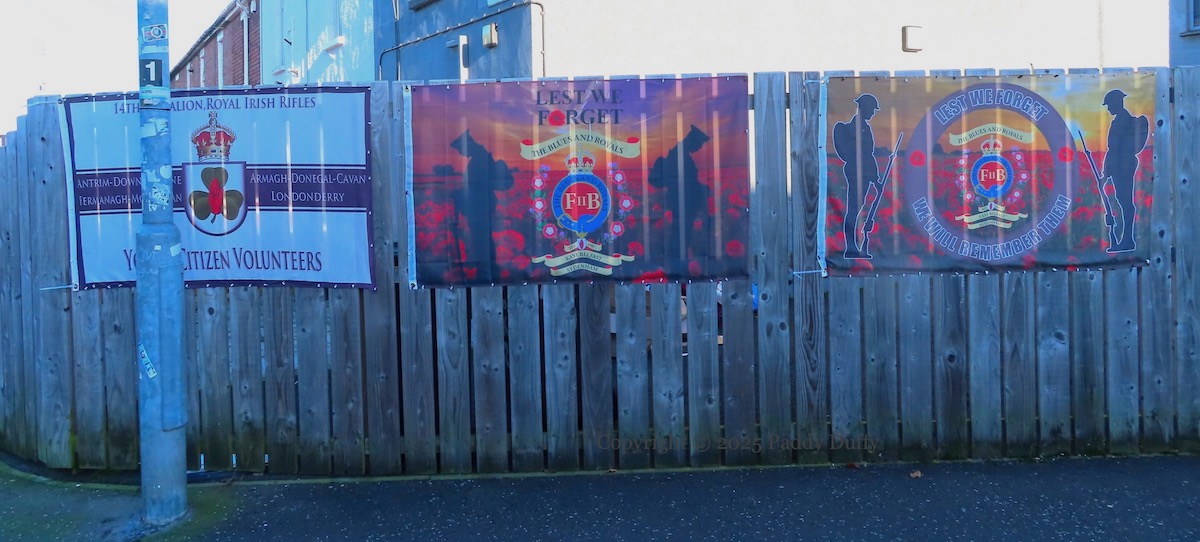
These flags – one to the Ulster YCV (14th RIR) and two to the Blues And Royals flute band, Sydenham (Fb) – are on the fence below the Northern Ireland Centenary board in Mersey Street, at the junction of Parkgate Drive in east Belfast.
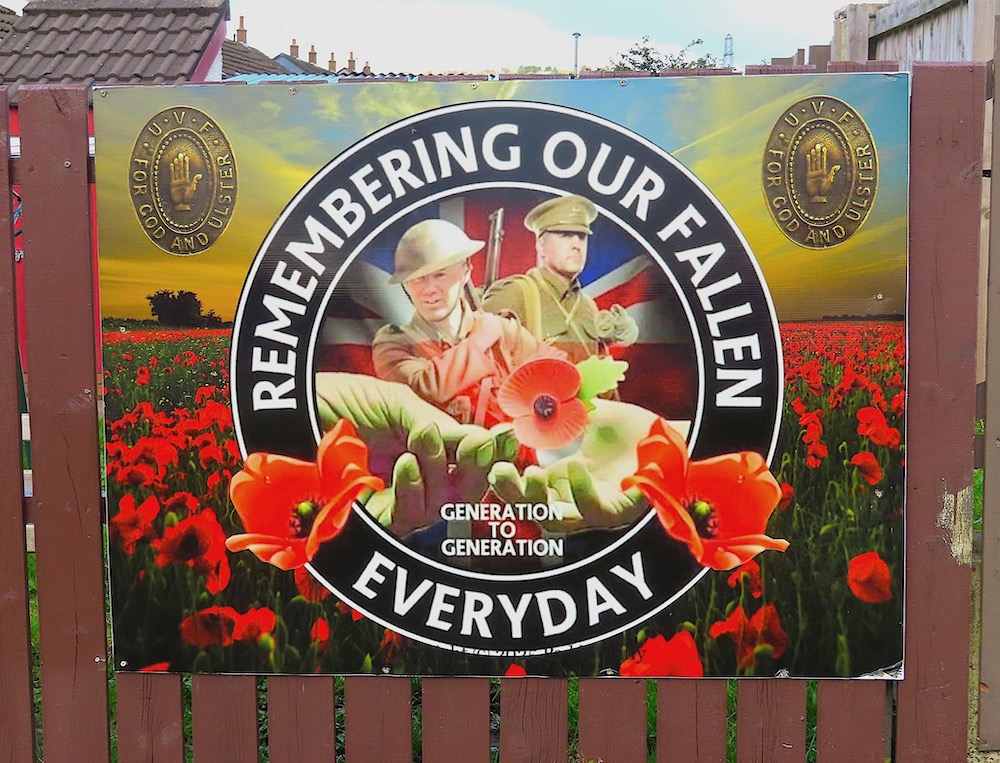
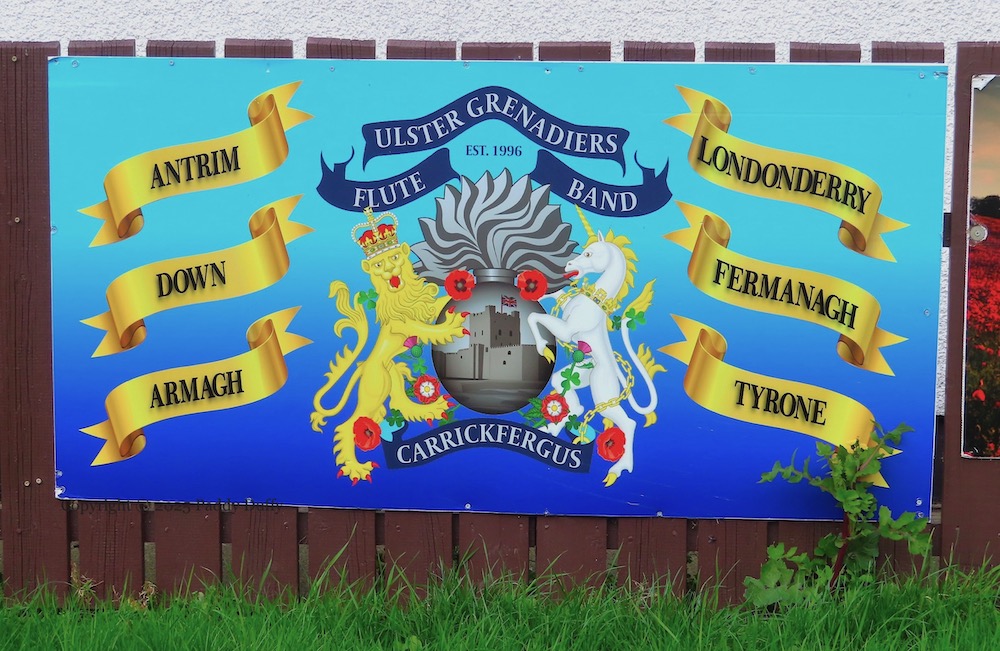
Here are two new small boards on the fence where Hawthorn Avenue and Sandes Court meet between Woodburn and Sunnylands. Above, “Remembering our fallen everyday [sic]” with images of soldiers from the World Wars and UVF emblems in the corners. Below, an Ulster Grenadiers flute band (Fb) board, similar to the large board mounted last year (2024) in St Bride’s Street – see Never Forget, Always Remember.
The main board, on the gable beyond – “Loyalist Woodburn celebrates 100th anniversary Northern Ireland” – and Captain Sir Tom Moore remain as in 2022’s entry – see Maintain The Union.
This entry updates 2023’s Harryville Says No with images of two additional boards/plaques erected by the 12th Battalion Royal Irish Rifles Memorial Association (Fb), “in honour of the men from Harryville [Ballymena] who made the ultimate sacrifice during the Battle Of The Somme from 1st July to 18th November 1916”.
“Remembering 57386 Sergeant John McNabney, formerly of No 9 Larne Street, 36th Divisional signal company, awarded the distinguished conduct medal, military medal with bar, and mentioned in despatches.” McNabney’s career and many decorations are described in Ballymena Guardian | Your Lurgan.
This is a printed version Wilfrid Spender’s report of the first day of the Battle Of The Somme, replacing a previously painted instance that was in the same style as the adjacent mural.
“‘I am not an Ulsterman but yesterday the First of July, as I followed their amazing attack, I felt that I would rather be an Ulsterman than anything else in the world. My pen cannot describe adequately the hundreds of heroic acts I witnessed, the Ulster Volunteer Force, from which the Division was made, has won a name that equals any in history. Their devotion deserves the gratitude of The British Empire’ – Captain Wilfrid [not “Wilfred”] Spender, The Somme 1916″
Spender’s words are superimposed upon JC Beadle’s Attack Of The 36th Division (see Over The Top).