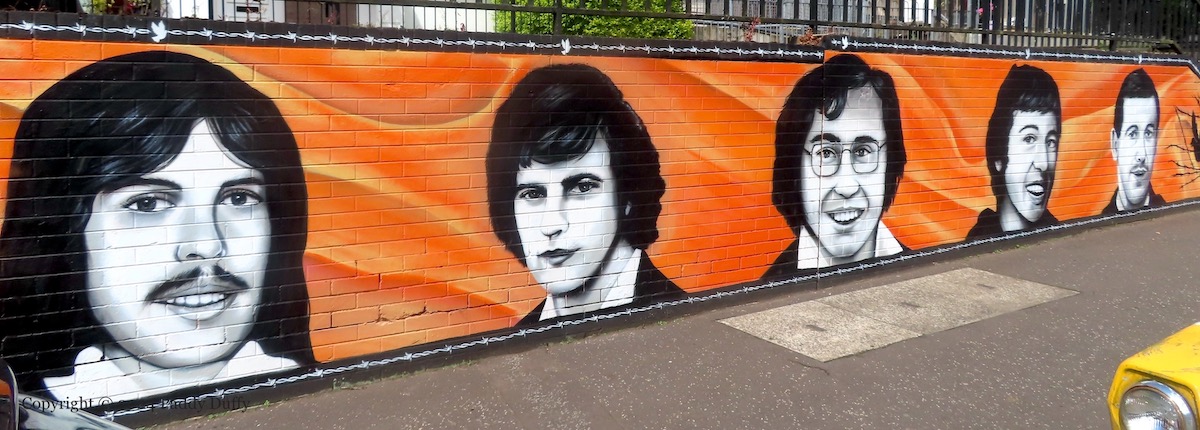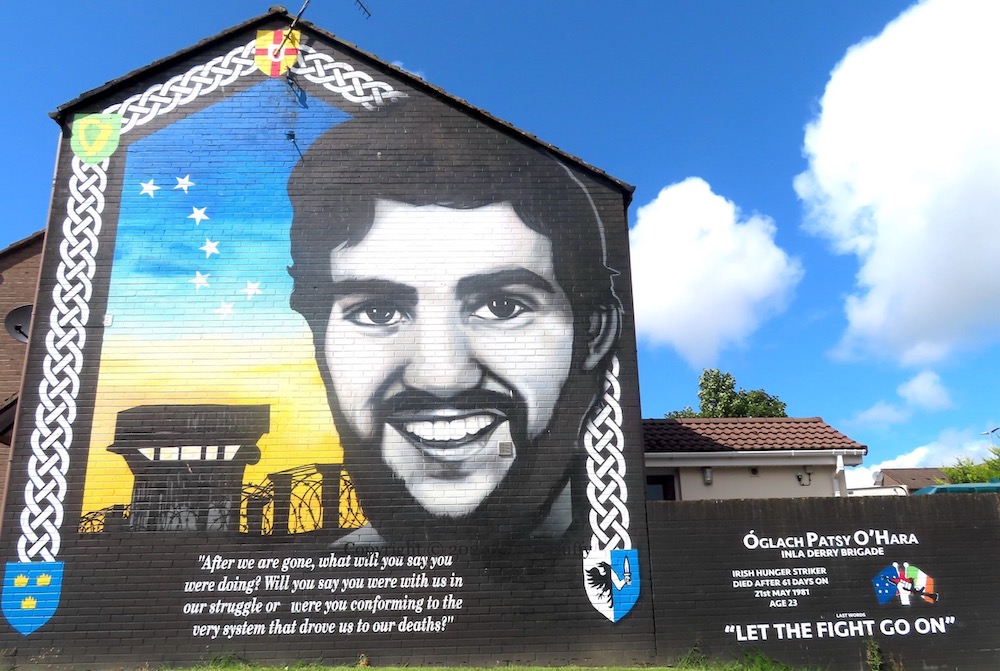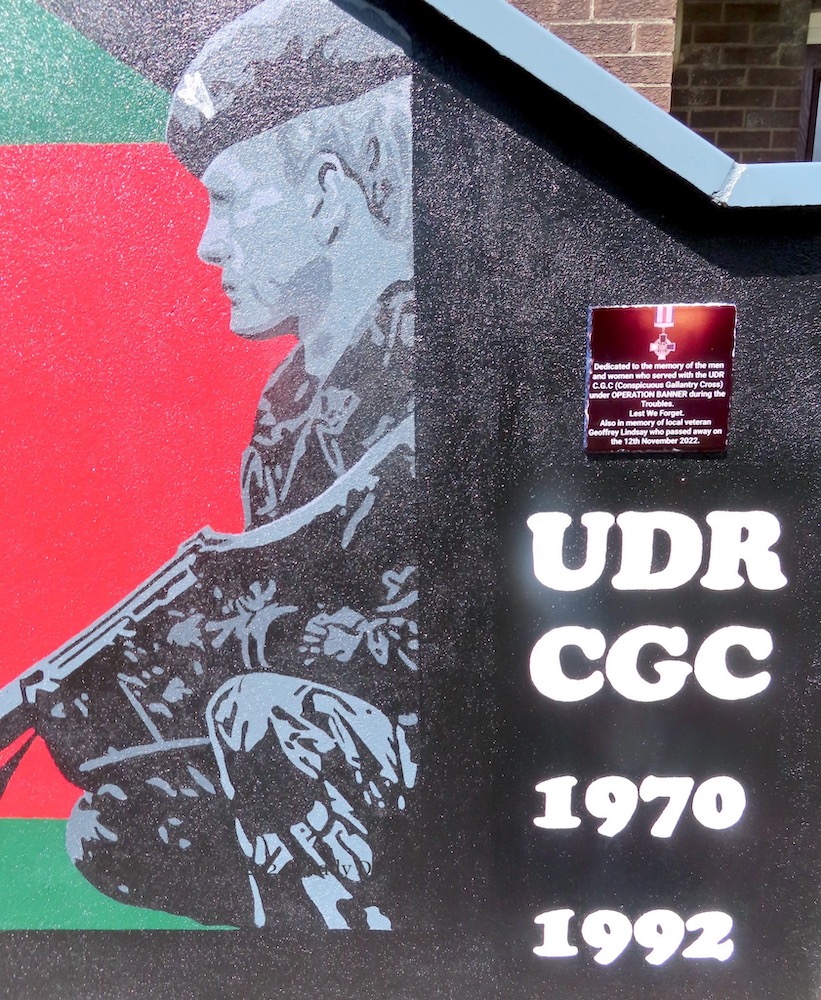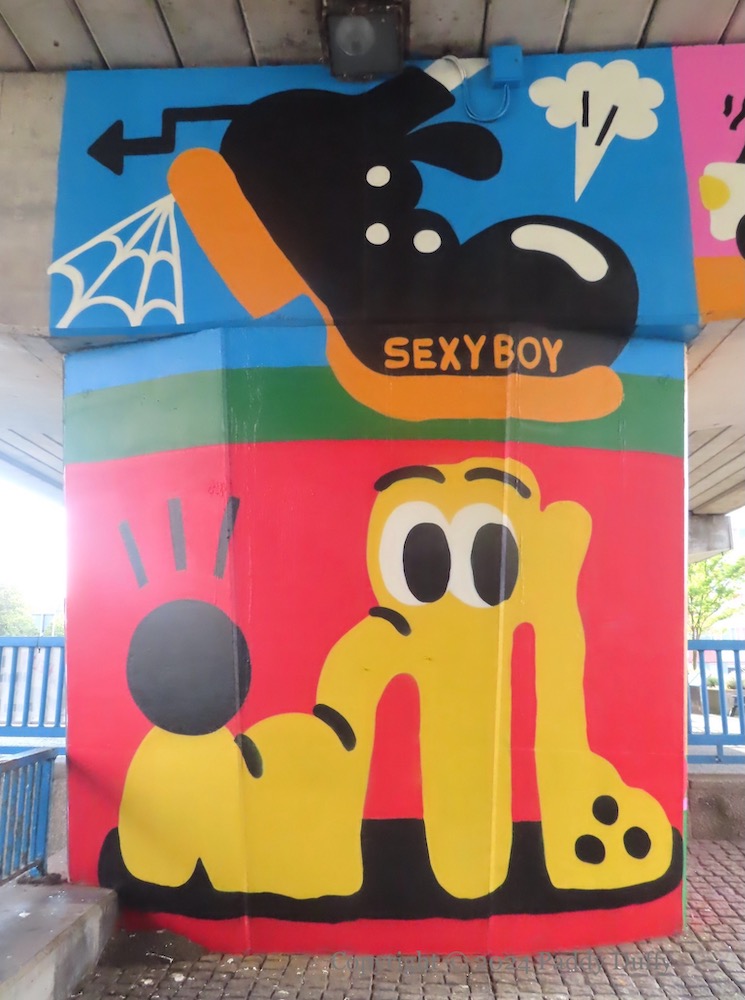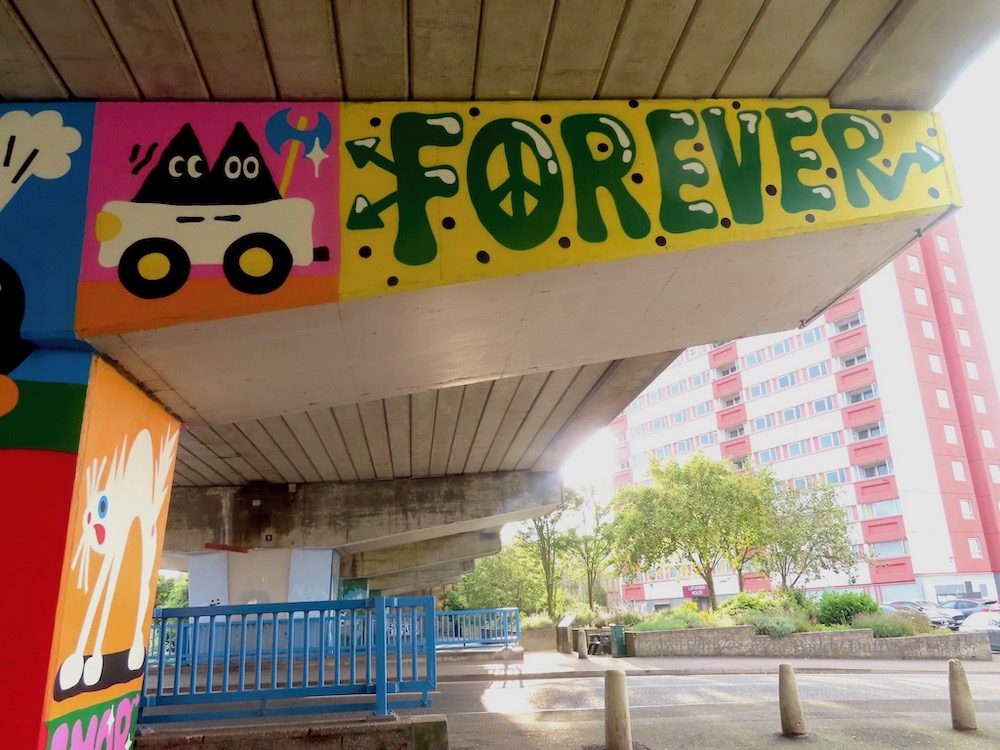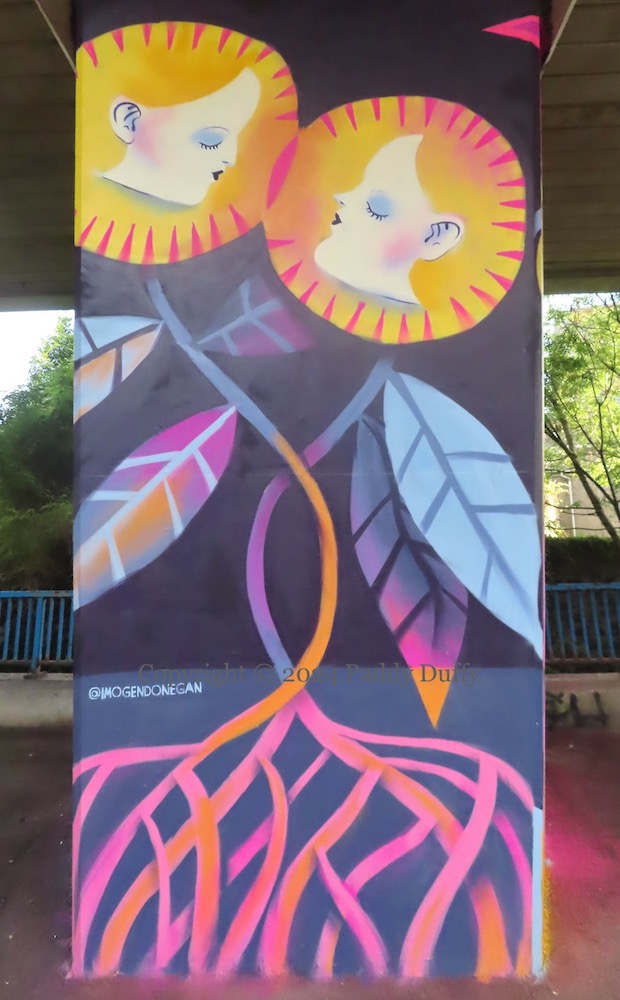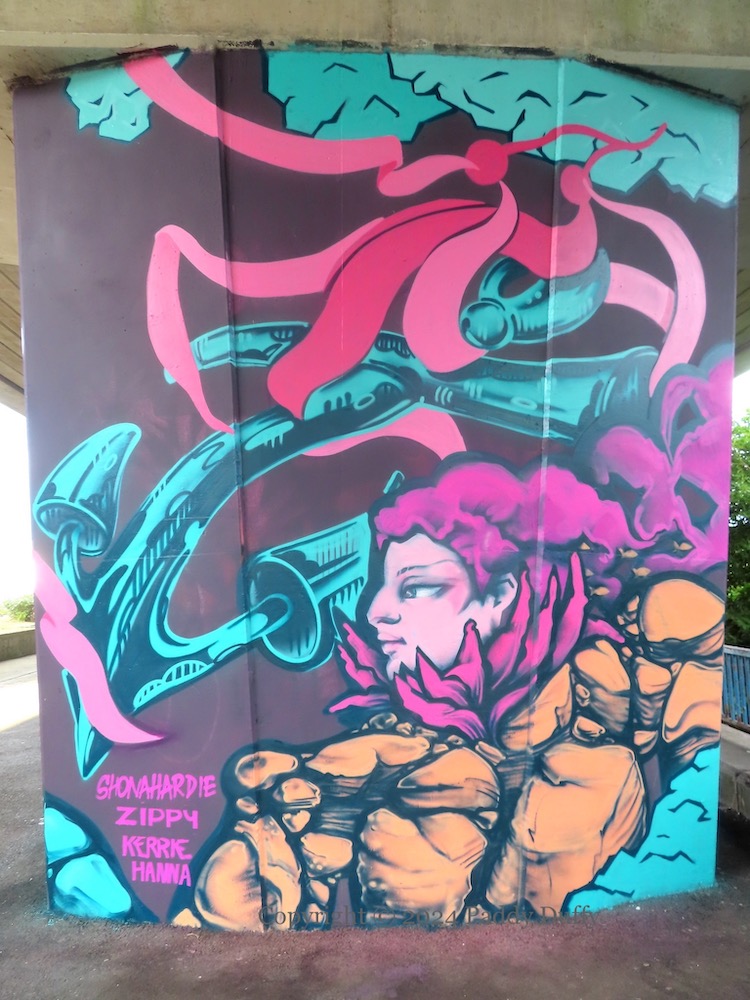
This piece shows children and young people playing and relaxing in safety, joined together in a series of cogs. It is perhaps related to the former Streetreach mural.
Pearl Street, in the Willowfield area of east Belfast.
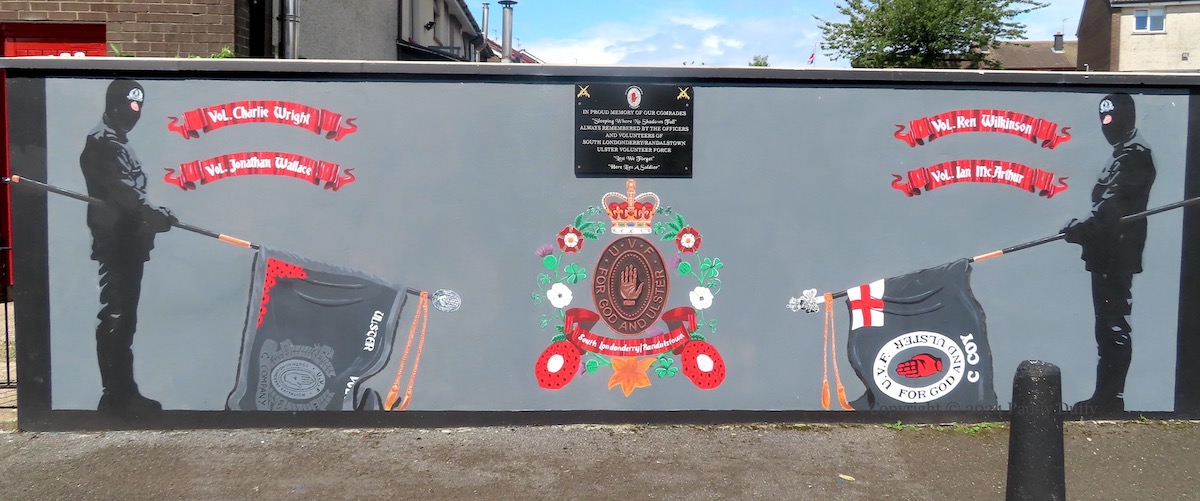
The UVF mural in Carlingford Street, east Belfast, that the one shown here replaces was controversial at the time (2013) because of its proposed inclusion of two hooded gunmen in fatigues firing into the air. In response to the concerns expressed, the final version put both figures in WWI uniforms and had only one firing into the air – the other gazed downward in prayer – and the modern UVF was referenced only in the forms of the towers and cages of Long Kesh and of a roll of honour. (See Years Of Sacrifice for both the draft and final murals.)
The cages are retained in this new board but the depiction of violence is more explicit here than in the proposed mural a decade ago: at the centre of this piece is a hooded gunman carrying an assault rifle.
For the wider context of re-imaging and re-re-imaging (that is, the disappearance and return of PUL hooded gunmen), see Visual History 11.)
Long Kesh’s cages are also included in a Shankill board to Stevie McCrea – A True Soldier Of Ulster.
From the info board (barely visible but mostly out of shot to the right):
“This mural is dedicated to the men and women of Willowfield. In 1912 the 3rd Home Rule bill was introduced and passed by Parliament, and although defeated 3 times by the house of Lords it was sent for Royal assent. On 9th April 1912 over 200,000 unionists attended a rally at Balmoral including the Orange Order and Unionist Clubs which had marched from the city centre. Here they were addressed by among others, Sir Edward Carson, leader of the Irish Unionist Party. On 28th September nearly 500,000 men and women signed the Ulster Covenant. Factories and the Shipyard in Belfast were idle and silent, allowing their workers the opportunity to attend church and then to congregate at the City Hall. 3,242 men and women from Willowfield signed the Covenant, some in their own blood. They then formed into the 2nd Willowfield Battalion of the East Belfast Regiment U.V.F. commanded by Dr. William Gibson. They drilled and trained in the Willowfield Unionist Club that was situated about half a mile from this spot. With the onset of WW1 in 1914, these same volunteers stood to the fore to defend the Empire as the 8th battalion (East Belfast) in the 36th Ulster Division. Many did not return but their bravery and honour will forever be remembered.”
Ormeau bridge (Street View) is a stone arch bridge between the Ormeau and Stranmillis embankments of the Lagan river, designed by Charles Lanyon and opened in 1863.
This mural of the bridge is by London artist DanK (ig), commissioned by the Lower Ormeau Traders’ Association using a Vibrant Business Destinations grant from the Council, funded by the Department For Communities ‘Revitalisation’ programme (of these, only Vibrant Businesses (web) appears to have an on-line presence). The mural will be officially launched today (Saturday March 16th) as part of a Spring Festival between noon and three. (Belfast Media)
In University Street, south Belfast, looking away from the bridge.
“Down the Woodstock” and “Up the Cregagh”. The two roads run into each other, heading north-south between Albert Bridge and Lisnabreeny in east Belfast. The Woodstock Road shops are getting a number of new streetart pieces thanks to a consortium of local businesses, including the two shown here.
The racing trap is by Visual Waste (ig) ((with support from Decowell Restoration (web), Bethany Fruit (web) and Astrl Fibres (ig)) in Willowfield Gardens and the (painted) signage by unknown artists in Oberon Street.
There is already a large mural reading “Up The Cregagh” on the road.
As a tribute to “the influence the local record shops had on the Belfast hip-hop and breakdancing scenes of the 80s” FGB (ig) and Katriona Designs (ig) have painted track-suited pensioners with a dual turntable setup (“Spin-A-Disc” (Technic?) and “Pensioneer” (Pioneer) brands) in Ardgowan Street at the Woodstock Road.
Also included below are two small pieces in Glendower Street, of a ‘Dolphin Lamp Standard’ lamp-post (such as can be seen on the Queen’s Bridge) and a fox.
The launch event for the Painting For Palestine project (Fb) took place on March 3rd. A large paper Palestinian flag (with the cartoon character of resistance Handala (WP) on it) was used as a cover over the mural of three children – Irish, Palestinian, and South African – and unveiled by local children who had worked on the piece.
For the ten pieces linked by Alareer’s poem on a red ribbon, see Tell My Story.
Downshire Bridge over “The Cut” through the centre of Banbridge town (created in 1834; here is a NLI image from the 1900s), is locally known as “Jingler’s Bridge” on account of one or more of the sellers on the bridge jingling their coins (Geograph), perhaps among them this apple-seller, painted by Friz (ig) on the northern side of The Cut/Bridge Street.
Downshire Bridge is perhaps named for the 3rd (Arthur Hill) or 4th (Arthur Wills Hill) Marquess Of Downshire (Lord Belmont).
For the launch of the murals painted in the Painting For Palestine project (Fb) a red ribbon with the words from Palestinian writer Refaat Alareer’s poem “If I Must Die” was added to the ten consecutive panels below the ‘republican museum’ panel.
If I must die, you must live to tell my story to sell my things to buy a piece of cloth and some strings, (make it white with a long tail) so that a child, somewhere in Gaza while looking heaven in the eye awaiting his dad who left in a blaze —
and bade no one farewell not even to his flesh not even to himself — sees the kite, my kite you made, flying up above and thinks for a moment an angel is there bringing back love If I must die let it bring hope let it be a tale