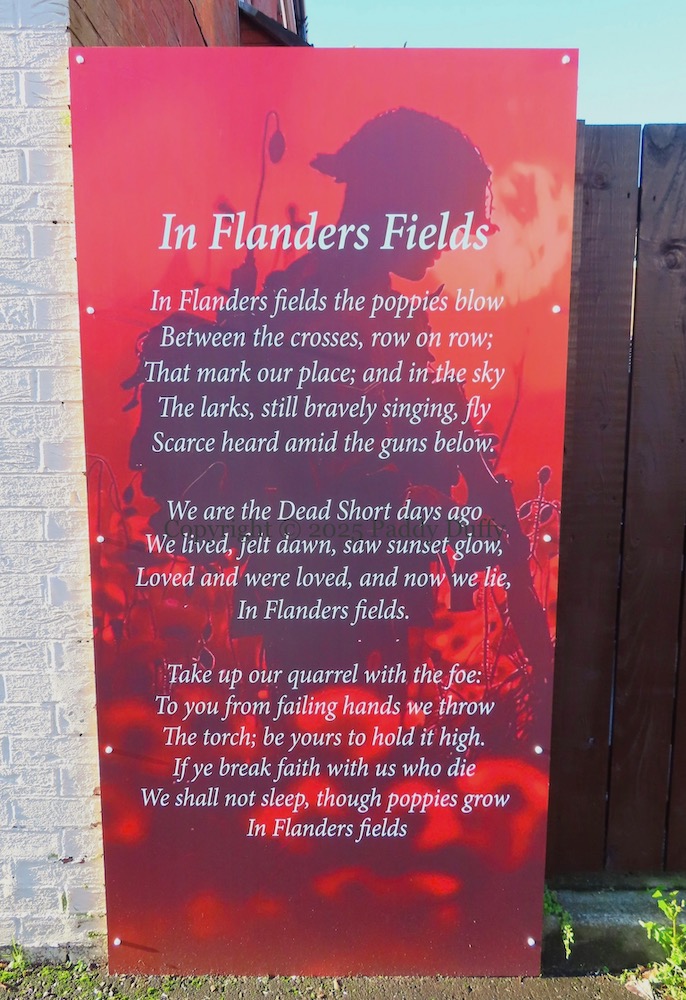
The memorial garden in Barrington Gardens at long last appears to be finished. The house on the corner of Donegall Road was knocked down in 2012 or 2013 and work began converting the waste ground into a memorial to local Great War casualties in late November 2023. See this entry for images from both November 2023 and October 2024.
Since 2024, three pillars have been added below the main board, one each for the 10th (Irish) Division, 36th (Ulster) Division, and 16th (Irish Division) – for the service of the three divisions, see The Cost Of War, We Are The Dead, and (for the particular story of John Meeke and Willie Redmond) Comrades In Arms – and an iron bench to the 36th has been placed below the crests of the YCV, Inniskilling Fusiliers, Royal Irish Fusiliers, and the Royal Irish Rifles on the side-wall to the left.
Silhouetted graveside mourners appear on either side of the main board and in the gates to the garden
Love’s 1967 album ‘Forever Changes’ (listen on youtube) features the faces of the five band-members pressed together into the shape of a heart, or Africa. The bottom face was originally drawn (by Bob Pepper) without a smile (WP).
By Graffic (ig) on Hollywood Road, east Belfast, on the shutters of the Bill Harris hair salon.
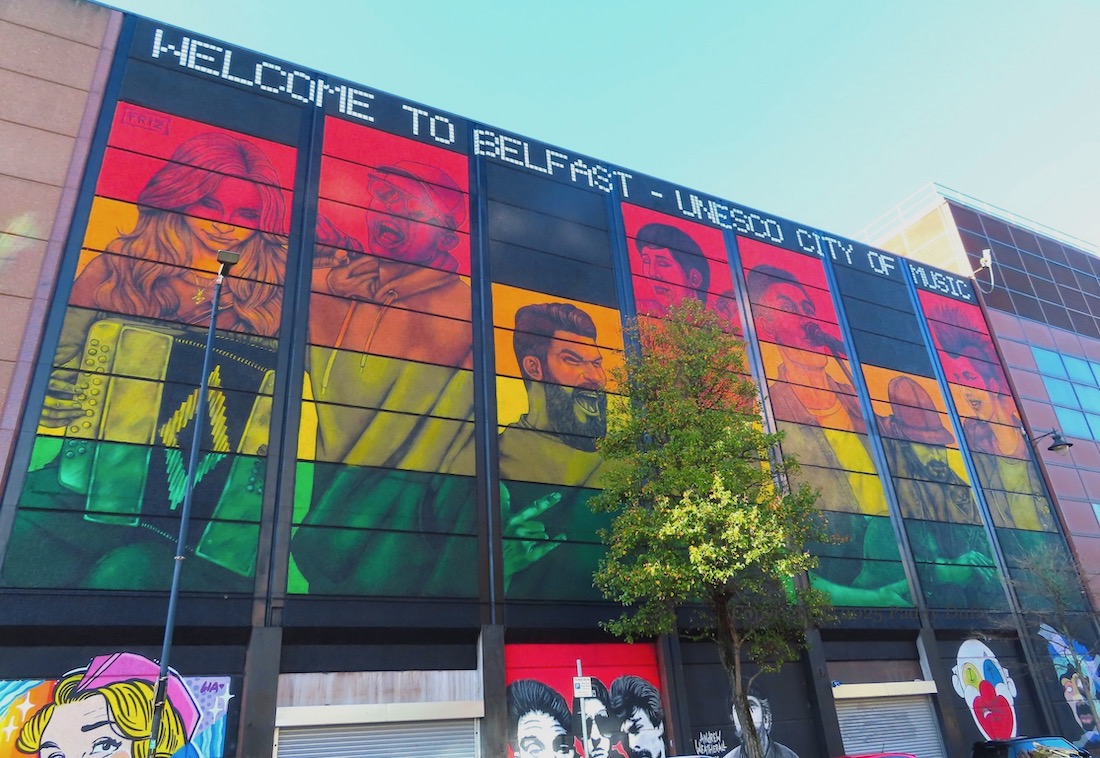
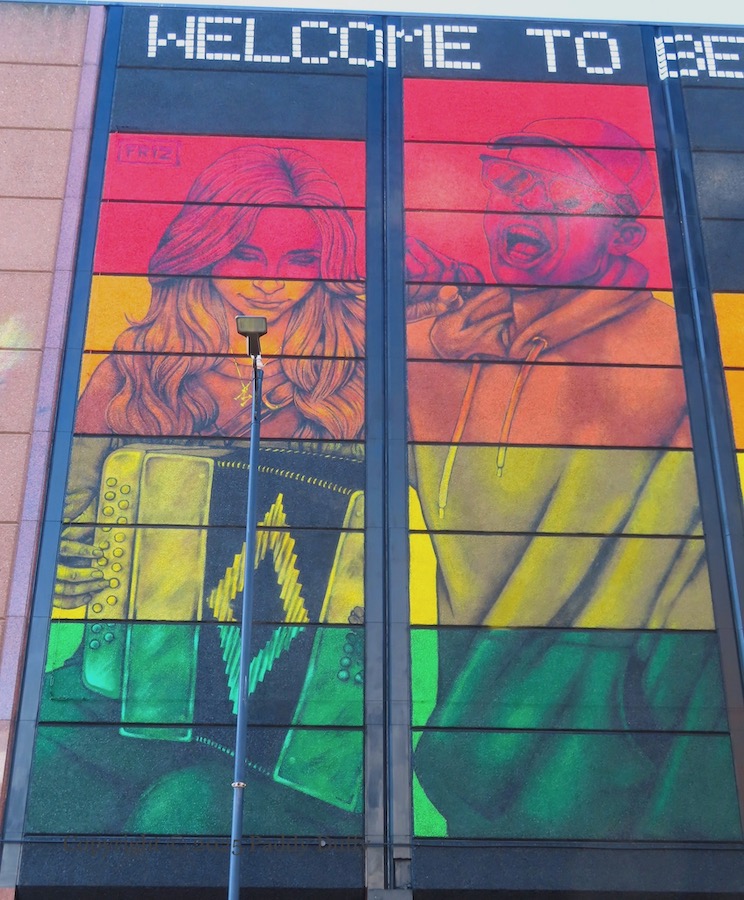
This is new street art by Friz (web) and KVLR (web) and Rob Hilken (web) in Bank Square, presenting a contemporary take on the Belfast coat of arms – the original can be seen in this City Council page.
Belfast became a city in 1888 and from that time onward the sea-horse on the right – both officially and in the new piece – wears around its neck a “mural crown”, a crown that looks like the walls of a city.
The wolf in the official coat of arms is “gorged and chained”. In the new art, the only sign of the wolf’s chain is the metal zipper slider on its tracksuit.
(An 1892 book (archive.org) claims that the chained wolf, while itself a familiar image in heraldry and civic arms, is borrowed specifically from the Chichester coat of arms in tribute to Arthur Chichester, prosecutor of the Nine Years’ War against the O’Neills in Ulster and subsequently Lord Deputy Of Ireland and developer of the village of Belfast into a town (DIB | WP), but we can find no other source to this effect nor any image of the Chichester arms that includes supporters.)
“Mary Ann McCracken (1770-1866) Abolitionist, educator, social reformer and businesswoman. Sheas Mary Ann an fód ar son na mbocht, na mban, na bpáıstí agus ar son sıúd a bhí faoı dhaoırse. [Mary Ann stood up for the poor, women, children, and for those who were enslaved.]”
“Mary Ann McCracken’s feminist ideals and commitment to the principles of Equality, Liberty, Fraternity applying equally to the Rights of Woman defined her participation in the United Irish Movement.” For McCracken’s connection to the 1798 Rebellion, see These Are Times That Try Men’s Souls.
The statue was unveiled in the grounds of Belfast City hall together with a statue to Winifred Carney on International Women’s Day (March 8th) 2024; both statues were produced by Ralf and Naomi Sander (BCC).
A statue to Winifred Carney was unveiled, along with another to Mary Ann McCracken, in the grounds of Belfast City Hall on Friday, March 8th (BCC). At her left hand is a typewriter. Carney was a qualified secretary and typist, and became secretary of the Irish Textile Workers’ Union in 1912, in which position she met James Connolly, who was secretary of the Belfast branch of the ITGWU. The 1913 manifesto addressed ‘To The Linen Slaves Of Belfast’ (marxists.org), exhorting “our toiling sisters” in the mills to join the organisation, was signed by Carney, Connolly, and Ellen Gordon.
Her uniform, and the amorphous pistol (or holster?) in her right hand, refer to her membership of Cumann Na mBan and participation in the Easter Rising of 1916. Carney was in the GPO when it was taken over and was among those who surrendered at the end; during the occupation she typed up dispatches from the Moore Street headquarters. A News Letter editorial described the statue as smuggling terrorists onto the grounds of city hall.
“Winifred Carney, born in Bangor, was a suffragist and a committed trade unionist. She was an organiser in the Irish Textile Workers’ Union and became James Connolly’s personal secretary, political confidante and friend. In 1913, She and Connolly wrote the Irish Textile Workers’ Union manifesto entitled ‘To the Linen Slaves of Belfast’. It was a time when Belfast workers, mostly women and children, were working long hours in horrific conditions, barefoot and hungry. “D’oıbrıgh Winnie ar son oıbrıthe Bhéal Feırste, go háırıthe ar son na mban agus na bpáıstí a bhíodh ag obaır sna muılte ar fud na cathrach. “Many Belfast mills are slaughterhouses for the women and penitentiaries for the children.” Chomh maıth leıs an obaır a rınne sí ar son na gceardchumann, ba Phoblachtánach í Winnie a bhí ına ball de Chumann na mBan agus d’Arm Cathartha na hÉıreann. As an officer in the Irish Citizen Army, Winnie was present with Connolly in the Dublin General Post Office during the 1916 Easter Rising and has since become known as ‘the typist with the Webley’. Carney stood as a Sınn Féın candidate in the 1918 elections, but in an ‘unwinnable’ seat. She retained her commitment to socialism and in 1924, Winifred joined the Northern Ireland Labour Party. Here she met her future husband, George McBride, like her a committed socialist. George was a Protestant from Shankill Road who fought at The Battle of the Somme with the 36th (Ulster) Division. Tá Winnie curtha ı Reılıg Bhaıle an Mhuılınn ar Bhóthar na bhFál ın ıarthar Bhéal Feırste.”
Boombox-head, computer-head, and light-bulb-head are having a good time in this new piece by Leo Boyd (web) on the Cupar Way war-wall (or: “peace” line), riffing on the vintage Keith Haring piece, included below.
This is an old piece by Friz (web) on the T13 building between the Titanic centre and the H&W cranes, originally a warehouse, then an indoor skydiving venue, and most recently an “urban sport park”.
Various street artists and writers painted the underpass at the end of Kyle Street that goes into Victoria Park (Belfast City Council). Here (top to bottom) is work by Friz (web), emic (web), GWELO, Wee Nuls (web), NOYS (ig), Rob Hilken (web), BORE, FGB (web), Imogen Donegan (ig), Jam (ig) + GoodRobottt (ig), Danni Simpson (web) + Karl Fenz (web)
With support from the Eastside Partnership (web), Connswater Greenway (web), and National Trust (web).