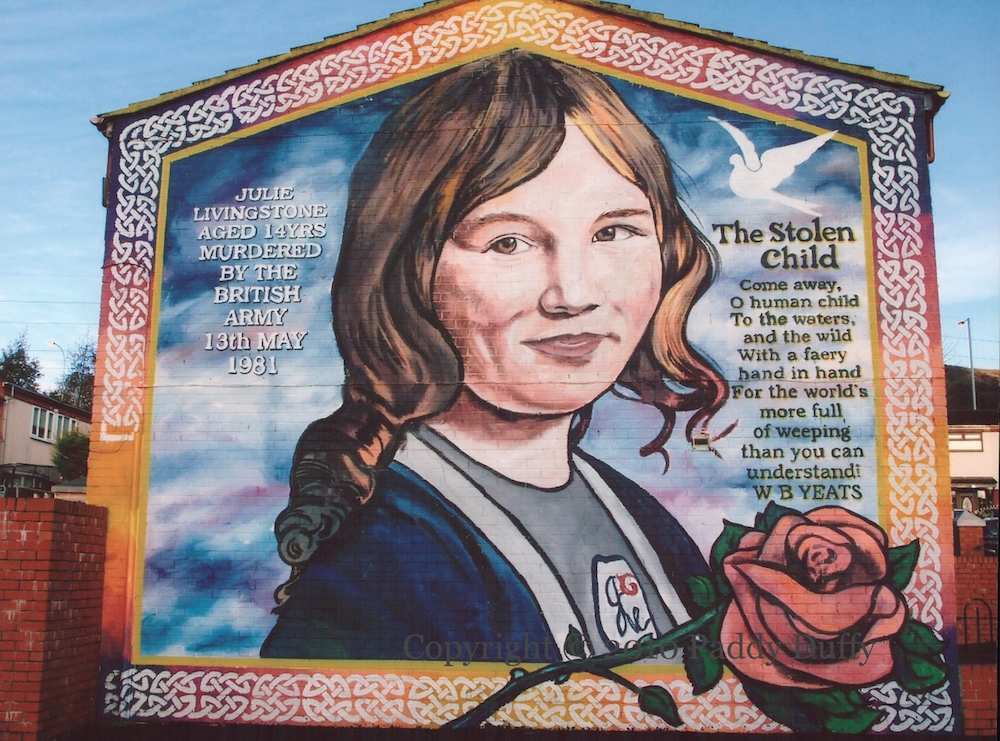
The Stolen Child

“Julie Livingstone aged 14 yrs. Murdered by the British Army 13th May 1981.” “The Stolen Child – Come away, O human child/To the waters and the wild/With a faery hand in hand/For the world’s more full of weeping/Than you can understand! – WB Yeats.” Livingstone was killed by a plastic bullet.

There is also a stone and plaque near the spot she was struck, on the Stewartstown Road.

Glenveagh Drive, Lenadoon, west Belfast

Click image to enlarge
Copyright © 2010 Paddy Duffy
T00539
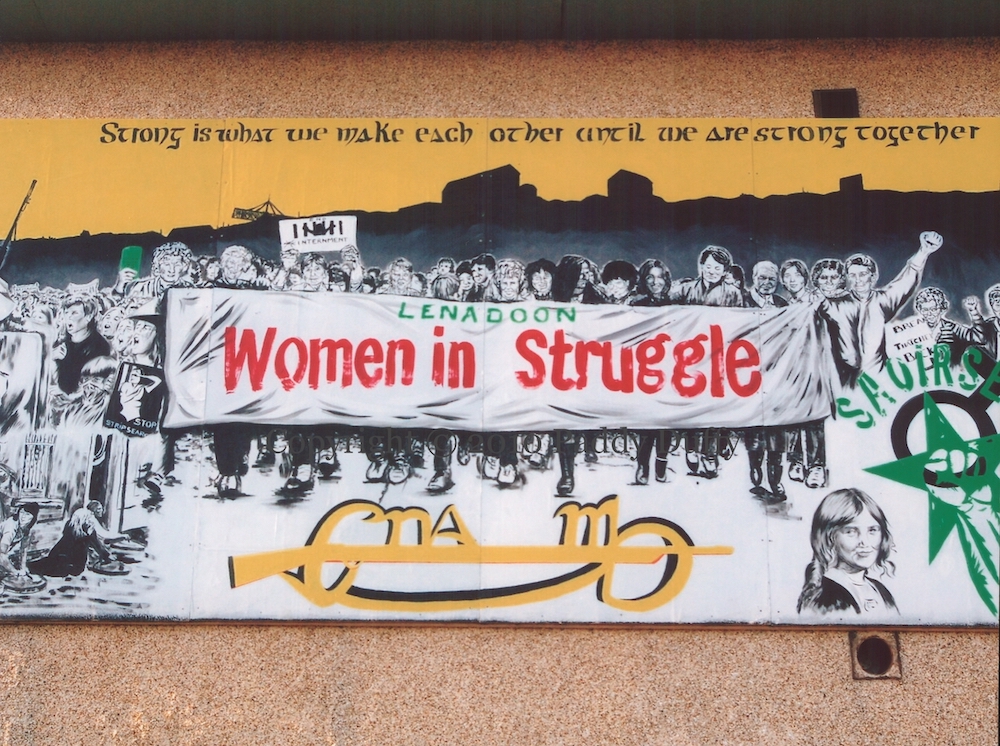
Lenadoon Women In Struggle

“Strong is what we make each other until we are strong together.” Women in struggle, (clockwise) banging binlids, undergoing strip searches, protesting internment, victims of plastic bullets (Julie Livingstone), fighting in Cumann Na mBan.

On the right are the astrological symbol for woman and the republican symbol of “Saoirse” with the green star and fist.

Dungloe Crescent, Lenadoon, west Belfast

Click image to enlarge
Copyright © 2010 Paddy Duffy
T00538

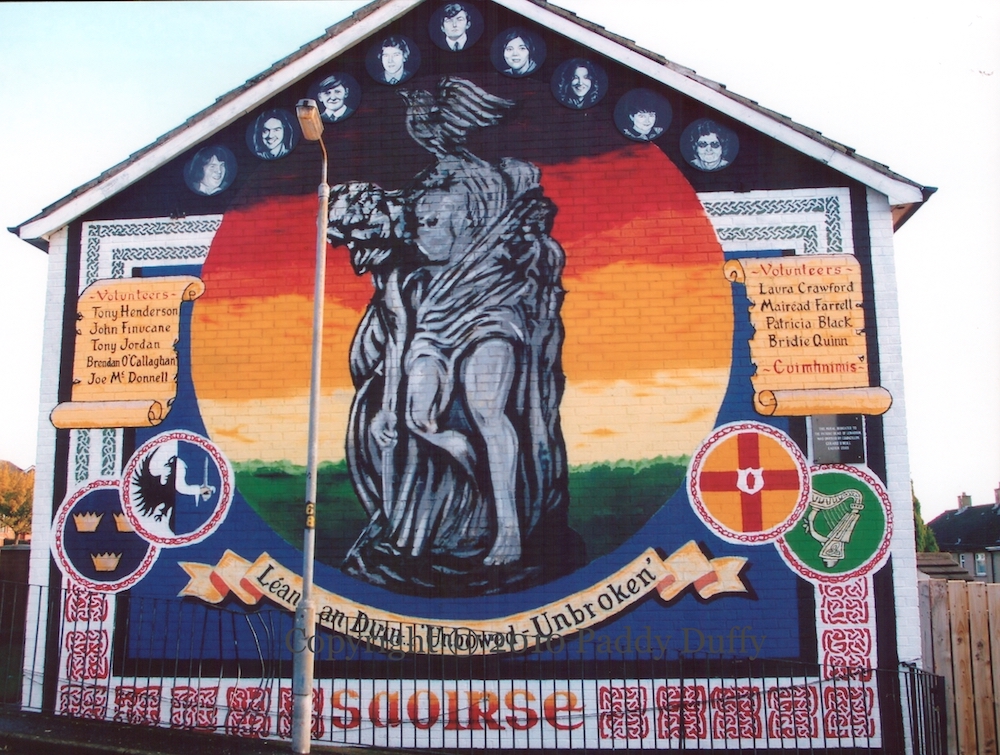
Léana An Dúın – Unbowed Unbroken

The main Lenadoon mural is refreshed and more portraits and a plaque added (on the right). The dying Cú Chulaınn (as portrayed in bronze by Oliver Sheppard, in a statue installed in the GPO in 1935) is used as a symbol for the locals from Lenadoon (including IRA volunteers) who fought for freedom (“saoırse”). They are listed on the scrolls to each side and in the portraits in the apex: Tony Henderson, John Finucane, Brendan O’Callaghan, Joe McDonnell, Laura Crawford, Maıréad Farrell, Patricia Black, Bridie Quinn (previously listed as Bridie O’Neill).

For the previous version (though without the three faces it initially had, of O’Callaghan, McDonnell, and Farrell) see M01934.

Lenadoon Avenue, Lenadoon, west Belfast

Click image to enlarge
Copyright © 2010 Paddy Duffy
T00537

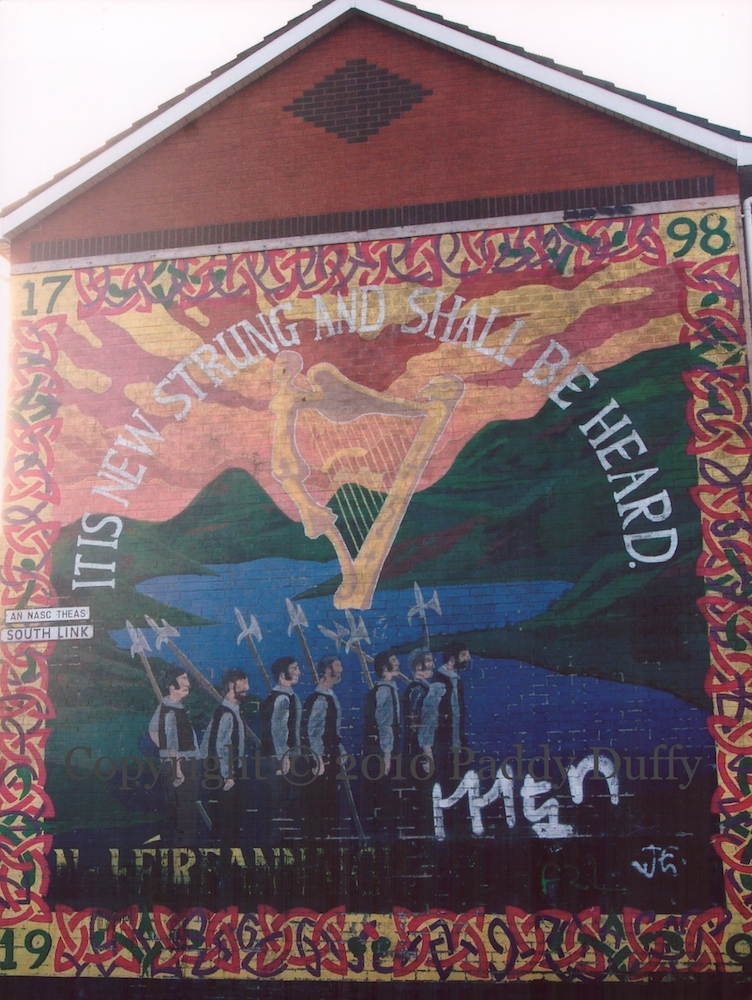
It Is New Strung And Shall Be Heard

Andrea Redmond painted this mural in Andersonstown for the 200th anniversary of the 1798 rebellion by Na hÉıreannaıgh Aontaıthe (the United Irishmen), who used a harp – specifically a Maid Of Erin harp – as their emblem. To the right, out of shot, are the words Liberté, Égalité, Fraternité.

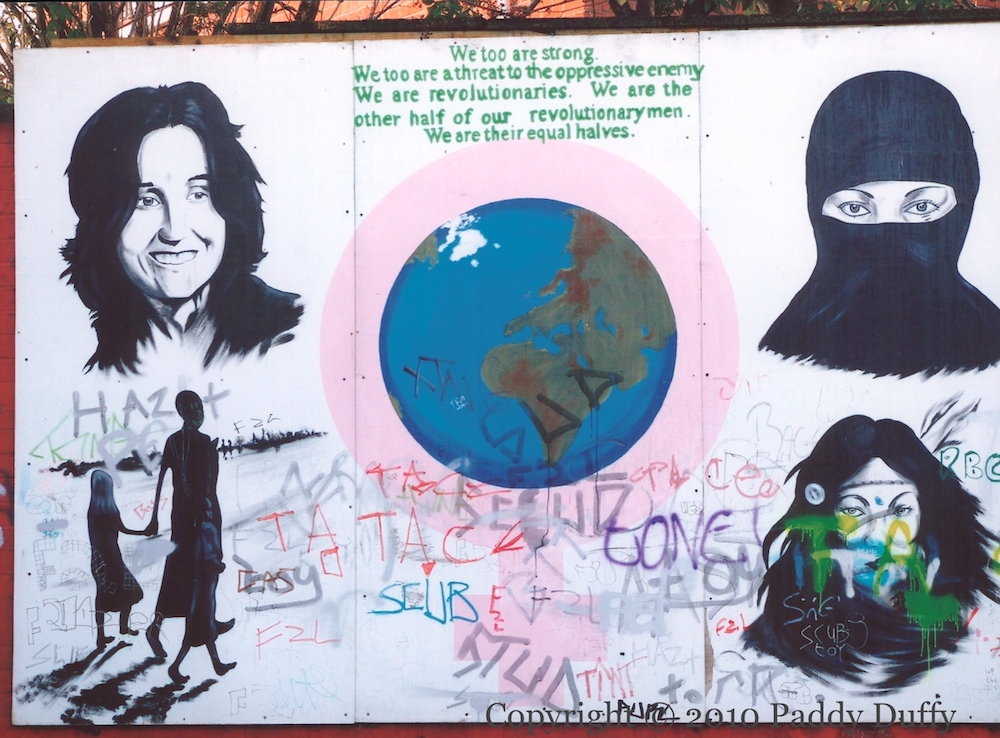
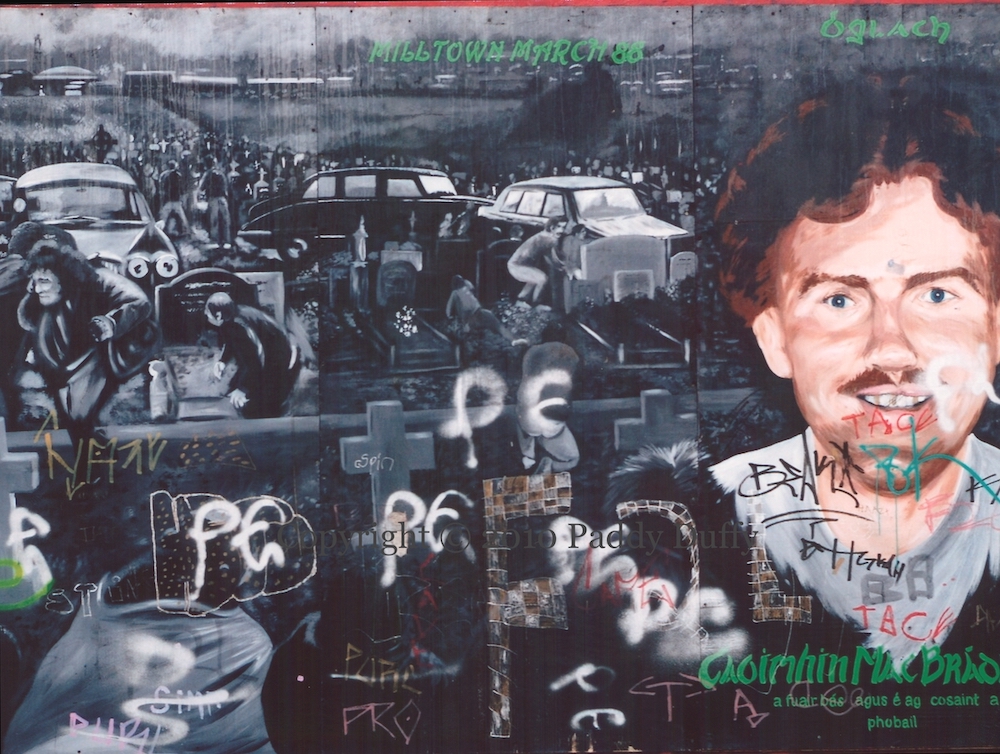
The mural is in decent shape despite being twelve years old, except for the graffiti at the bottom. The graffiti on the two boards to the side is more obscuring.

The first is devoted to the role of women in global struggles: “We too are strong. We too are a threat to the oppressive enemy. We are revolutionaries. We are the other half of our revolutionary men. We are their equal halves.” The IRA’s Maıréad Farrell is in the top left.

The second commemorates “Óglach Coımhín Mac Brádaıgh a fuaır bás agus é ag cosaınt a phobaıl.” [Volunteer Coımhín Mac Brádaıgh, who died while defending his people.] Mac Brádaıgh was killed pursuing loyalist gunman Michael Stone, who was attacking the funeral of the Gibraltar 3 (including Farrel), in Milltown Cemetery, on March 16th, 1988.

South Link, Andersonstown, west Belfast

Click image to enlarge
Copyright © 2010 Paddy Duffy
T00531 T00533 T00534 [T00535]

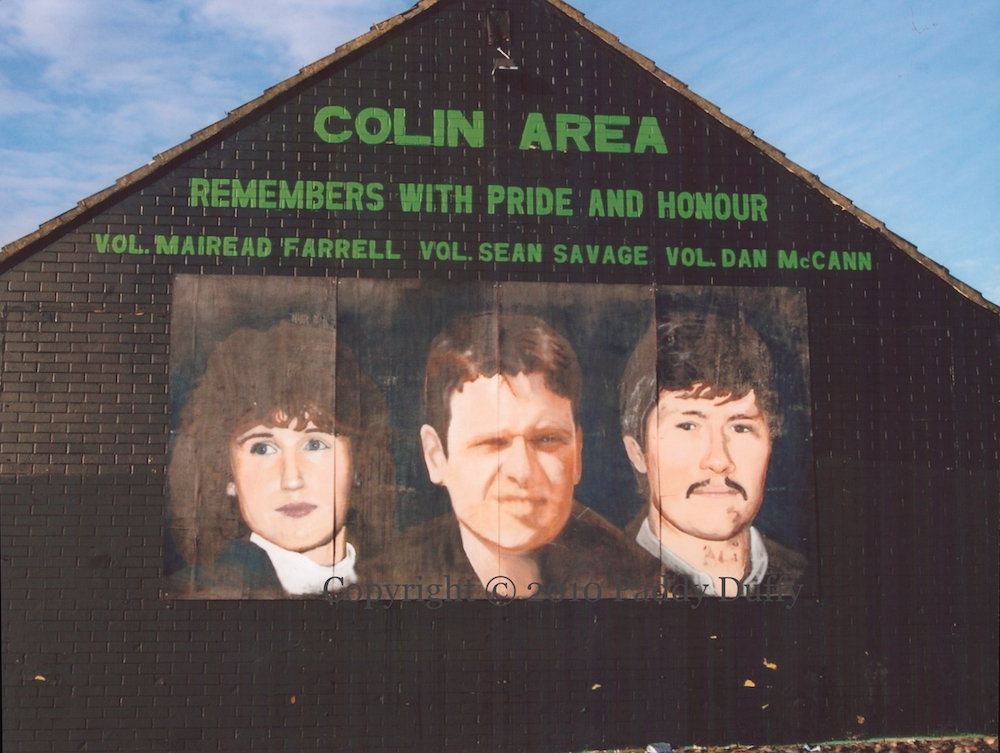
Colin Area Remembers

“Colin area remembers with pride and honour, [IRA] Vol. Maıréad Farrell, Vol. Sean Savage, Vol. Dan McCann.” The Gibraltar 3 were killed by SAS soldiers in 1988.

There was originally a board below the portraits with a quote from Farrell “Everyone tells me I’m a feminist. All I know is that I’m just as good as others, and that especially means men. I am definitely a socialist and I’m definitely a Republican. I believe in a united socialist country, definitely socialist. Capitalism can offer our people nothing and yet that’s the main interest of the British in Ireland – Oglach [sic] Maıréad Farrell.”

Painted by Rısteard Ó Murchú.

Jasmine Corner, Twinbrook

Click image to enlarge
Copyright © 2010 Paddy Duffy
T00532

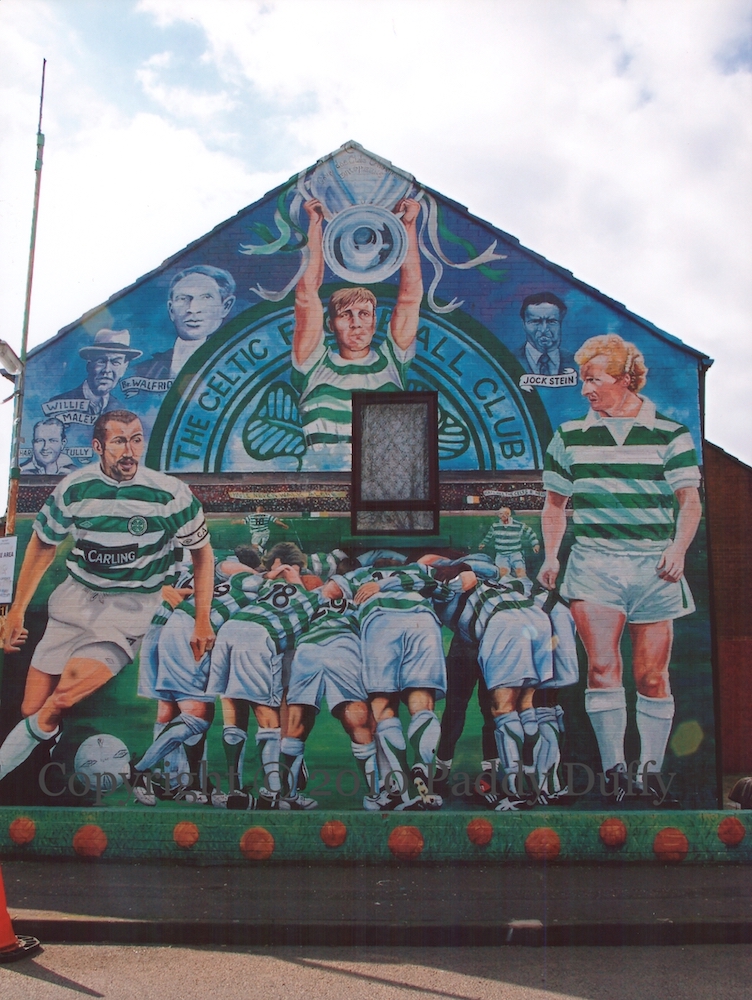
The Celtic Football Club

Glasgow Celtic football club was founded in 1888 by Brother Walfrid who is partially obscured here by a leaf to the left of centre. Joining him in the apex are (from left to right) Charlie Tully (of Belfast and Glasgow Celtic), Willie Maley (the first manager), [Wilfrid], Billy McNeil lifting the European Cup in 1967, Jock Stein (player 1951-1957 and manager 1965-1978). On the field are former players Henrik Larsson (1997-2004) and Jimmy Johnstone (1962-1965) on either side of the team “doing the huddle”.

Friendly Street, Markets, south Belfast

Click image to enlarge
Copyright © 2010 Paddy Duffy
T00530 [T00576]

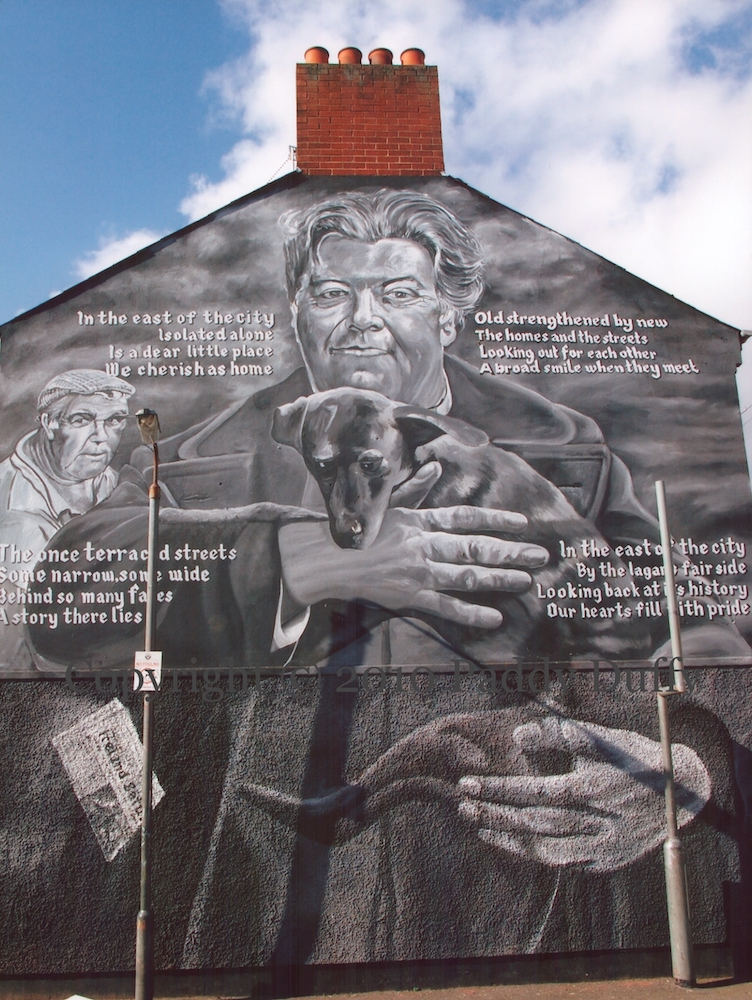
Place Of Pride

An owner, with Ireland’s Saturday Night (which ceased publication in 2008) tucked in his coat pocket, shows off his greyhound.

The words of the poem read,

“In the east of the city, isolated alone, is a dear little place we like to call home.

Old strengthened by new, the homes and the streets, looking out for each other, a broad smile when they meet

The once terraced streets, some narrow, some wide, behind so many faces a story there lies

In the east of the city by the Lagan’s fair side, looking back at its history our hearts fill with pride.”

Edgar Street, Short Strand, east Belfast

Click image to enlarge
Copyright © 2010 Paddy Duffy
T00529 [T00573]

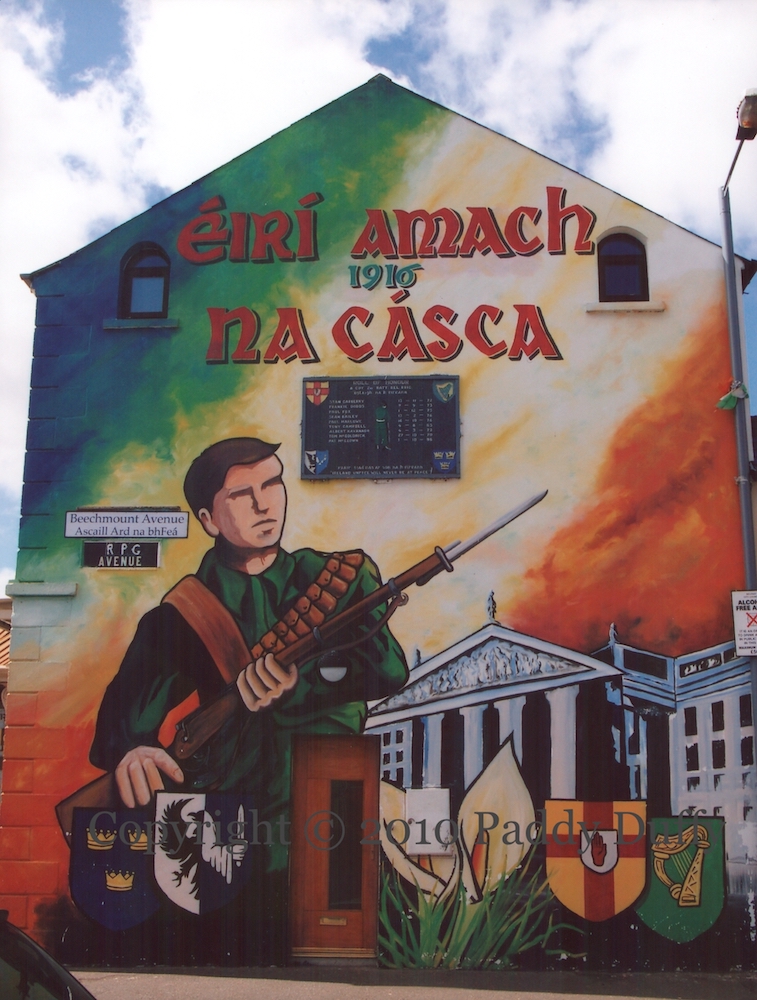
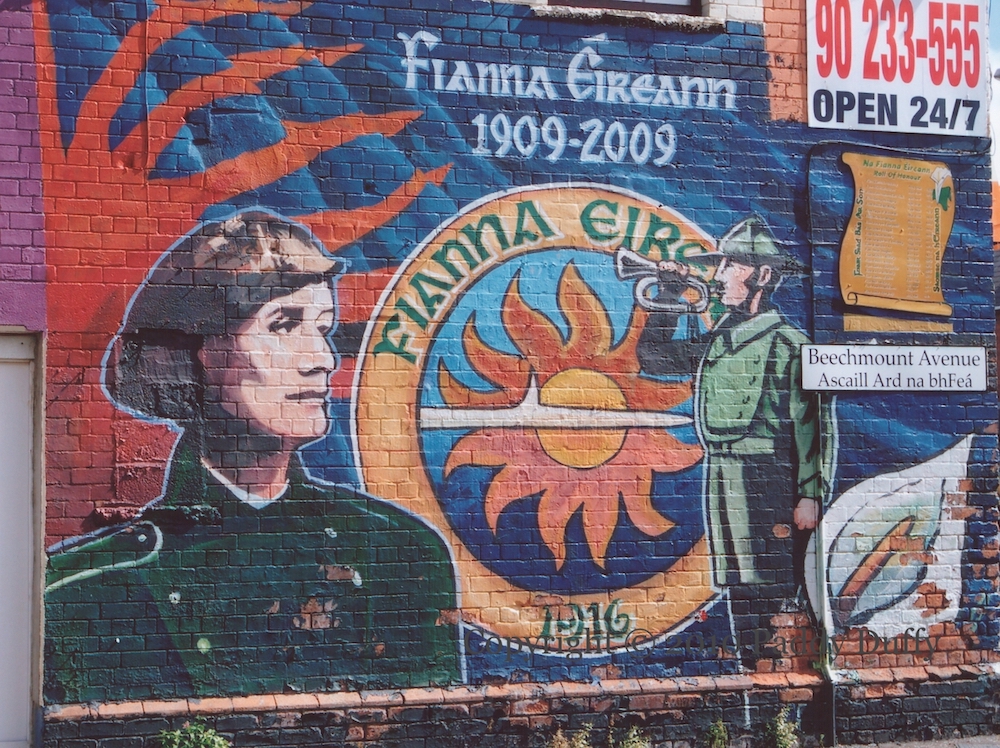
Éırí Amach Na Casca

The Éırí Amach Na Cásca 1916 [Easter Rising 1916] mural is repainted (by DD and Seany McVeigh) due to the new doorway. Compare to the previous version. (See also the IRA plaque.)

Beechmount Avenue/Ascaıll Ard Na bhFeá/RPG Avenue, Beechmount, west Belfast

Click image to enlarge
Copyright © 2010 Paddy Duffy
T00525

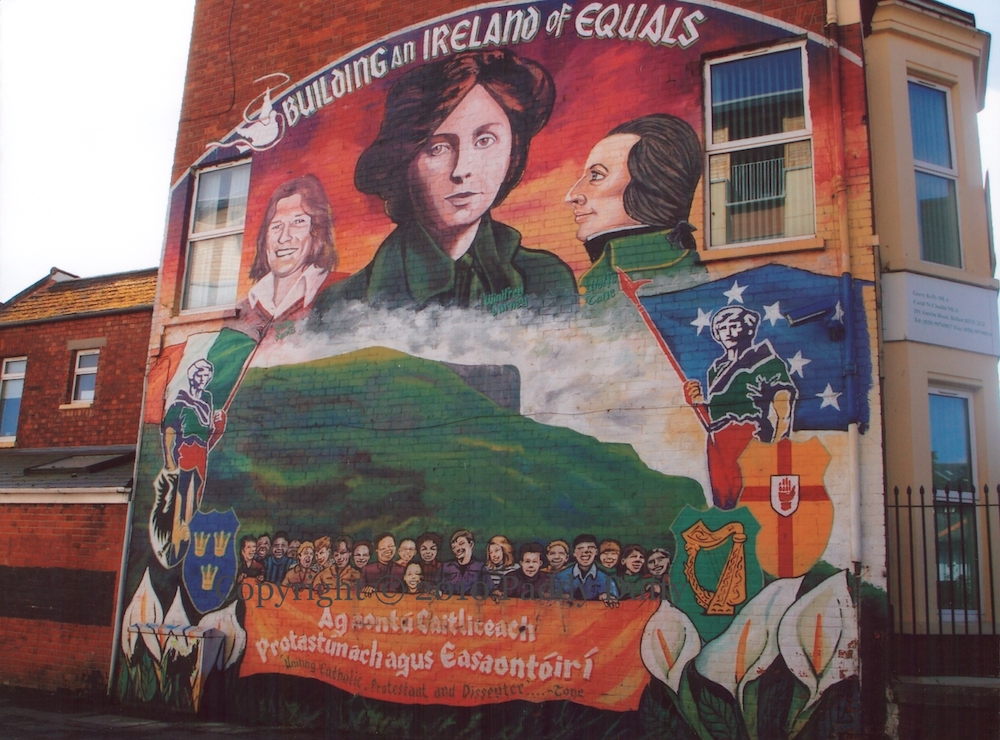
Building An Ireland Of Equals

The aspect of Cave Hill commonly known as Napoleon’s Nose is shown sheltering the people of Newington, surrounded by heroes and emblems of the past – Bobby Sands, Wolfe Tone, and in the centre, Winifred Carney. This republican mural is both internally directed (at Newington and the New Lodge) and externally, being on the main Antrim Road (Oceanic avenue, on the side of the Sinn Féin office) which is a main artery between the city and points north.

“Ag aontú Caıtlıceach, Protastúnach agus Easaontóırí.” – “Uniting Catholic, Protestant, and Dissenter.” In An Argument On Behalf Of The Catholics Of Ireland (1791), Wolfe Tone of the United Irishmen wrote, “To subvert the tyranny of our execrable government, to break the connection with England, the never-failing source of all our political evils, and to assert the independence of my country, these were my objects. To unite the whole people of Ireland, to abolish the memory of past dissensions, and to substitute the common name of Irishman, in place of the denominations of Protestant, Catholic and Dissenter, these were my means.”

Click image to enlarge
Copyright © 2010 Paddy Duffy
T00523 [T00526]