The mural shown above celebrates (men’s) Gaelic games in County Antrim (tw) and at two local clubs: Naomh Gall (tw | web), founded in Clonard Street in 1910, and Naomh Pól (tw | Fb) in Hawthorn Street – the site of the mural – in 1941.
Before playing in the Falls Park as part of Féıle in August, Irish-language rap group Kneecap (web) revealed a mural in Hawthorn Street showing a PSNI land-rover on fire next to the phrase “Níl fáılte roımh an RUC [The RUC is not welcome]”.
Outraged responses to the mural have come from all quarters. The line comes from their song C.E.A.R.T.A. (youtube), about making sure the police don’t find the satirically enormous array of drugs – “cóc, speed, Es, agus moll marıjuana” to name only a few – they hope to take at a party: “Seans ar bıth go bhfaıghıdh sıad mo mhála MD/Mar tá cóısır ann anocht ‘s níl fáılte roımh an RUC”.
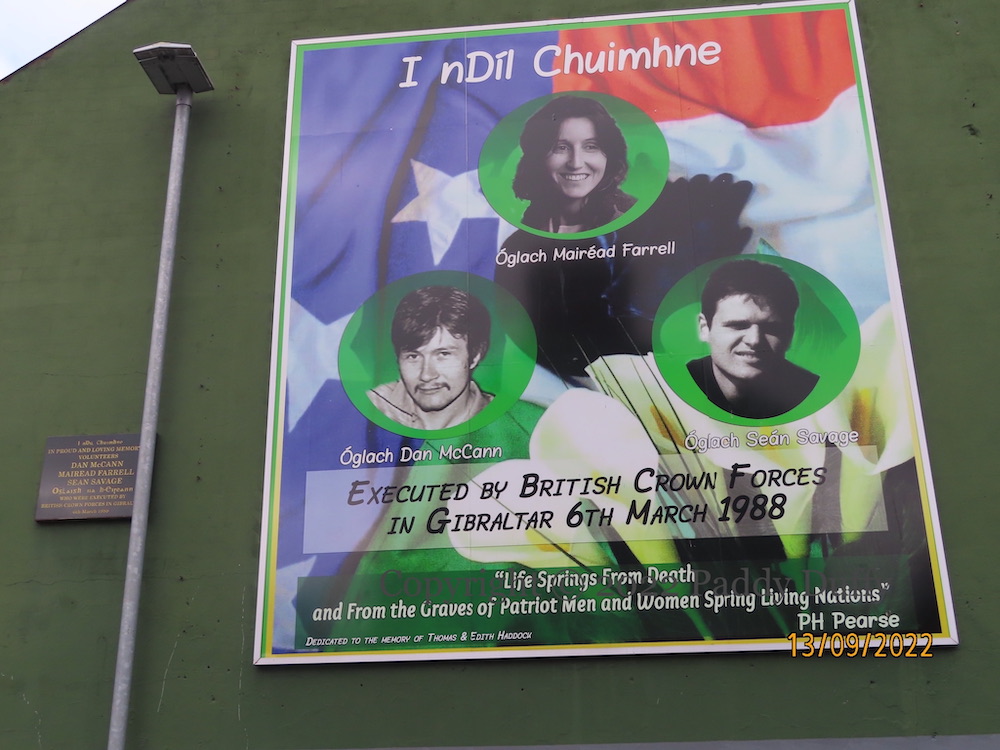
The new replacement board commemorating the Gibraltar 3 (Maıréad Farrell, Dan McCann, and Seán Savage “executed by British crown forces 6th March 1988) uses words from Pearse’s oration at the funeral of O’Donovan Rossa. Not the more common “the fools, the fools …” but “Life springs from death and from the graves of patriot men and women spring living nations” (used previously in Strabane in 1990 – M00860). The board is “dedicated to the memory of Thomas and Edith Haddock”.
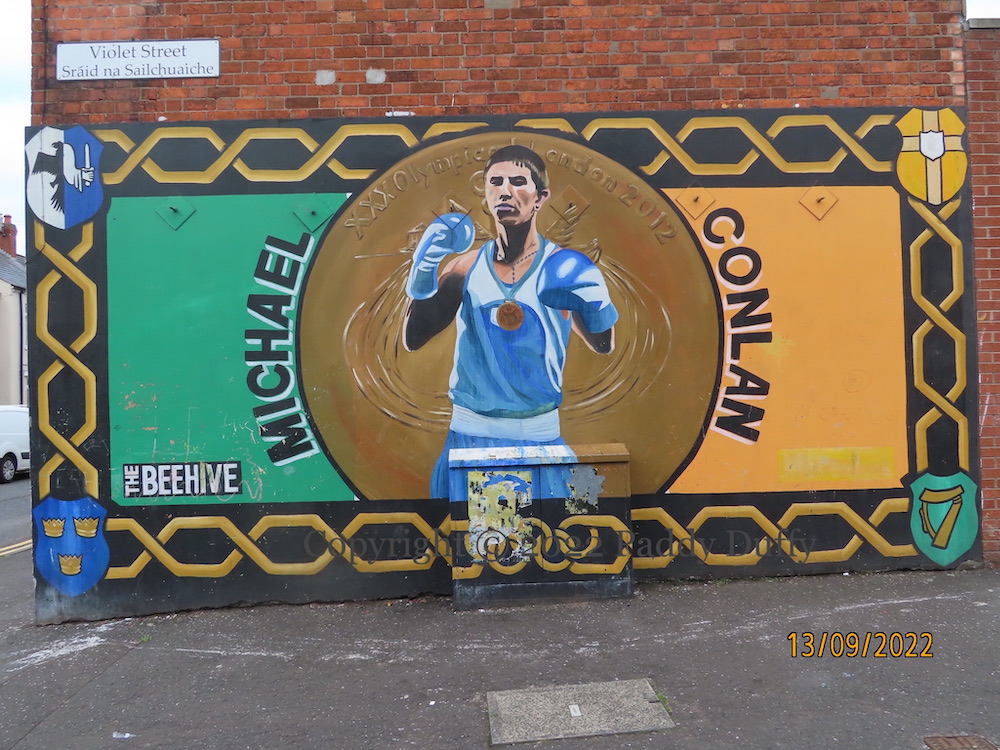
Michael Conlan won bronze in boxing at the 2012 Olympics. Boxing is organized on an all-island basis (WP), though at the Olympics boxers can choose to fight for either Ireland or GBNI. At London 2012, Ireland won four medals in boxing. The other winners were Paddy Barnes (bronze), Katie Taylor (gold) and John Joe Nevin (silver).
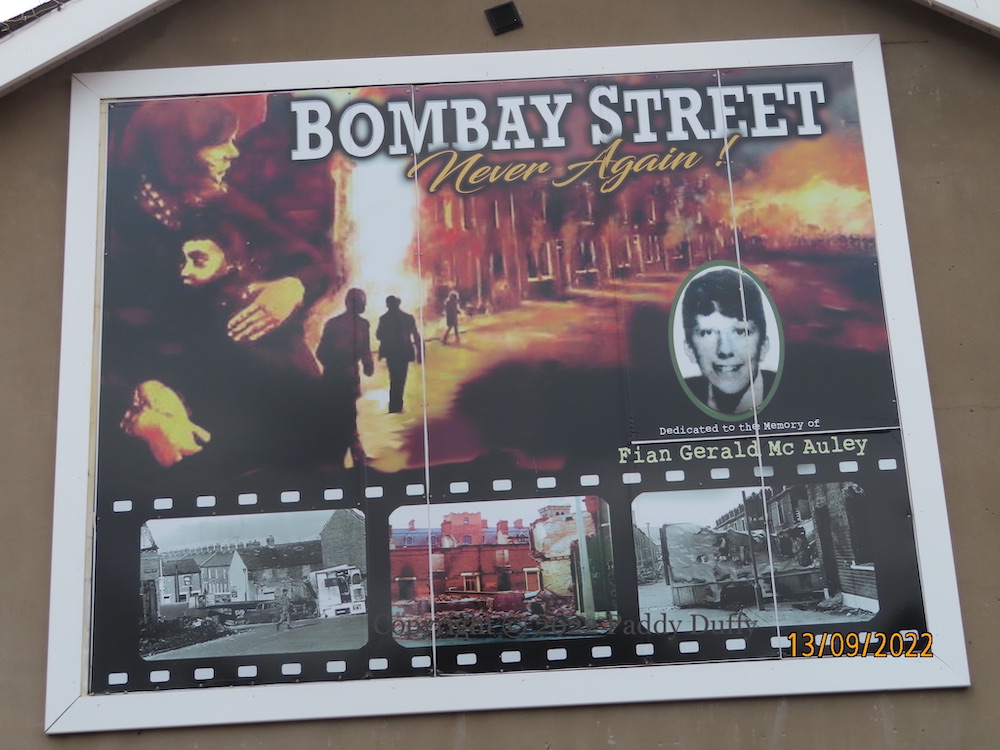
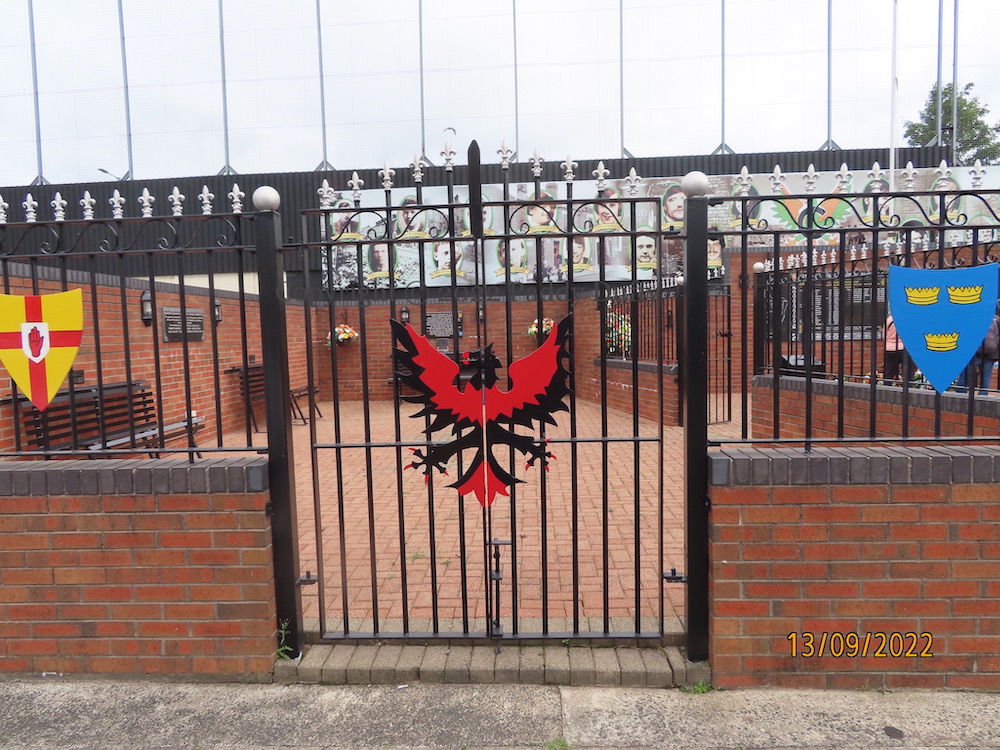
15 year-old Fıan Gerald McAuley was the first member of the IRA to die in the Troubles. He was shot in Waterville Street by a loyalist sniper while helping people move from burned-out homes in Bombay Street, along which the “peace” line separating the Falls and Shankill now runs, overlooking the Clonard Memorial Garden, site of the service for the 50th anniversary of McAuley’s death.
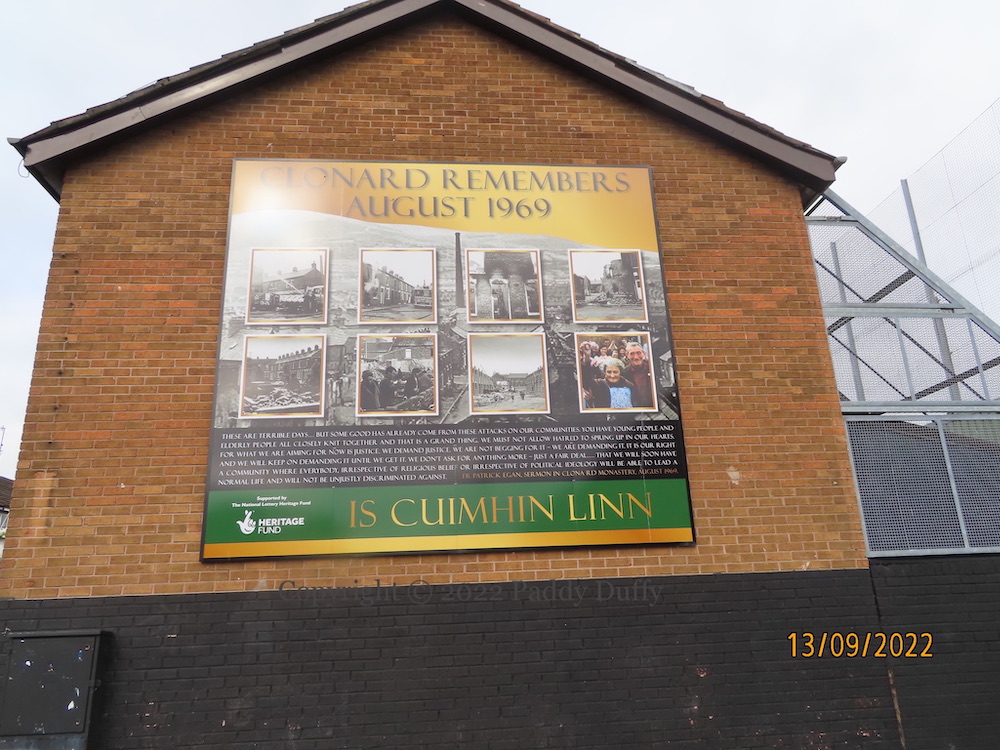
“Is cuımhın lınn.” To commemorate the beginning of the Troubles, a series of events was organised by the Belfast 1969 Pogroms Commemoration Committee, in Clonard, Falls, and Ardoyne, including a photographic exhibition, documentary screenings, panel discussions, a play, a mass, and murals (Irish News), including The Pogrom Of August 1969 and the one above, in Bombay Street, which used to run between the Shankill and Falls but after the riots and burnings of August 1969 was split in two by a so-called “peace” line.
“These are terrible days … but some good has already come from these attacks on our communities. You have young people and elderly people all closely knit together and that is a grand thing. We must not allow hatred to spring up in our hearts. For what we are aiming for now is justice. We demand justice. We are not begging for it – we are demanding it. It is our right and we will keep on demanding it until we get it. We don’t ask for anything more – just a fair deal … that we will soon have a community where everybody, irrespective of religious belief or irrespective of political ideology will be able to lead a normal life and will not be unjustly discriminated against.” – Fr Patrick Egan, sermon in Clonard Monastery, August 1969 (youtube).
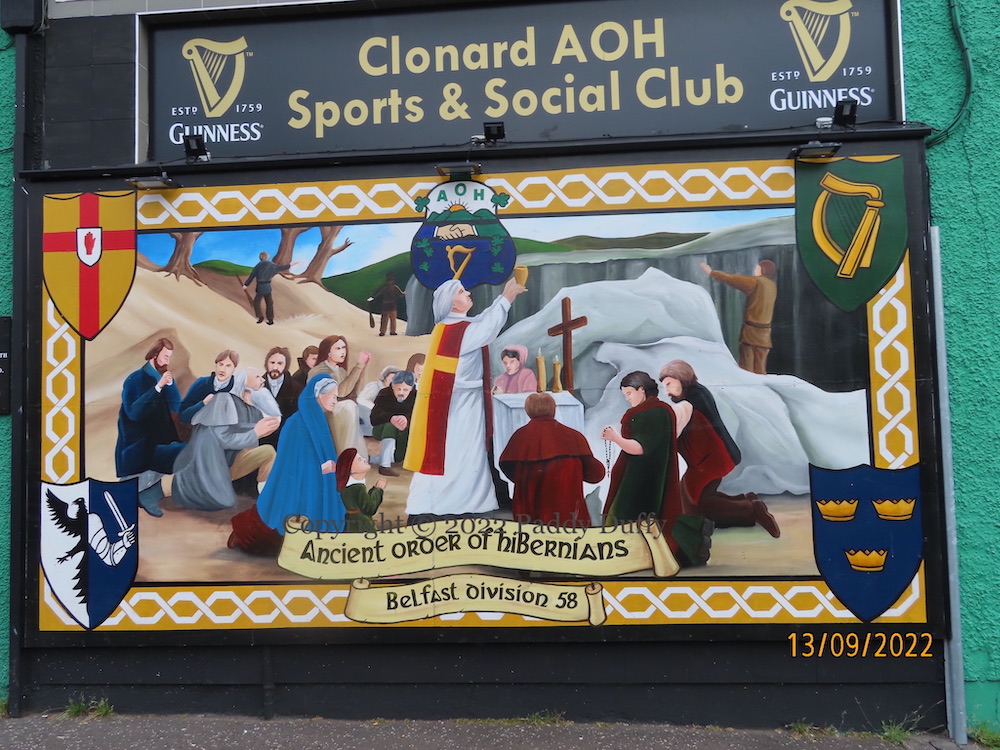
A Penal law of 1695 forbade the practice of Catholicism and “dissenter” forms of Protestantism –anything other than Anglicism, forcing people and priests to worship in secret. Although the precise date of the founding of the Ancient Order Of Hibernians is shrouded by the existence of various other Catholic fraternal and defensive organisations such as St Patrick’s Fraternal Society and the Ribbonmen – the AOH history page gives 1838 in Pennsylvania – the order traces its roots back to Penal times and in particular to the Defenders in 1784, which arose to protect Catholics from the (Protestant) Peep-O-Day Boys and in defiance of Penal laws forbidding Catholics to bear arms (WP). The Belfast division (58) of the AOH is in Clonard Street.
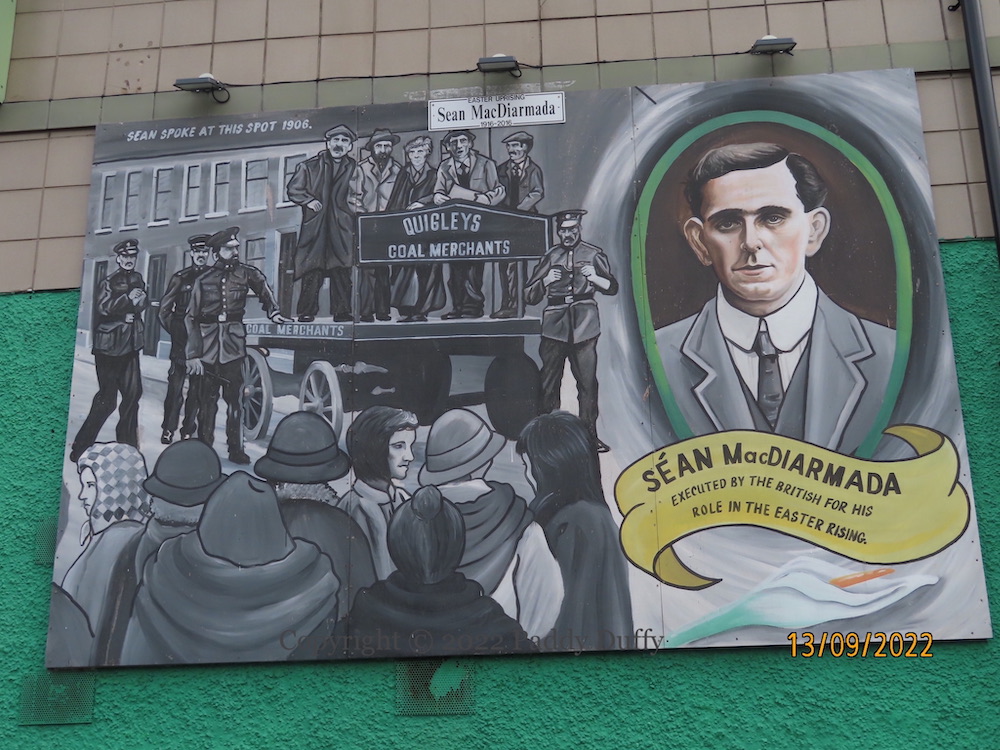
Seán Mac Dıarmada was born in Leitrim, left for Glasgow at age 15, but after two years returned to Belfast in 1905 (working on the trams) and – according to the new mural above – spoke from the back of a coal lorry in Clonard Street, outside the Clonard branch of the Ancient Order Of Hibernians. Mac Dıarmada was for a short time an AOH member, before moving on to the Irish Republican Brotherhood and Irish Volunteers, which led to his participation in the 1916 Easter Rising and execution on May 12th of that year.
The title of this post is historian F.X. Martin’s assessment of Mac Dıarmada, quoted in a pamphlet on Mac Dıarmada from the National Library Of Ireland, which includes reproductions of letters from and about Mac Dıarmada. The NLI made more letters available today (2016-02-08). (See also this Irish Times write-up).
Norah McCabe was shot in the back of the head by a plastic bullet fired from an RUC land rover at around 7:45 a.m. on July 9th, 1981, the day after hunger striker Joe McDonnell died. (Danny Barrett would be killed by a British Army sniper in the evening.) The new boards were mounted to coincide with the fortieth anniversary of McCabe’s death. In 1981, a mural was painted at the same spot (in the old Linden Street) to protest the use of plastic bullets: see Plastic Death.
“Norah McCabe, 1947-1981, murdered by an RUC plastic bullet on 9th July 1981, aged 33 years.” With a poem “Peace” by daughter Áıne McCabe, who was three months old when her mother was killed (Irish News).