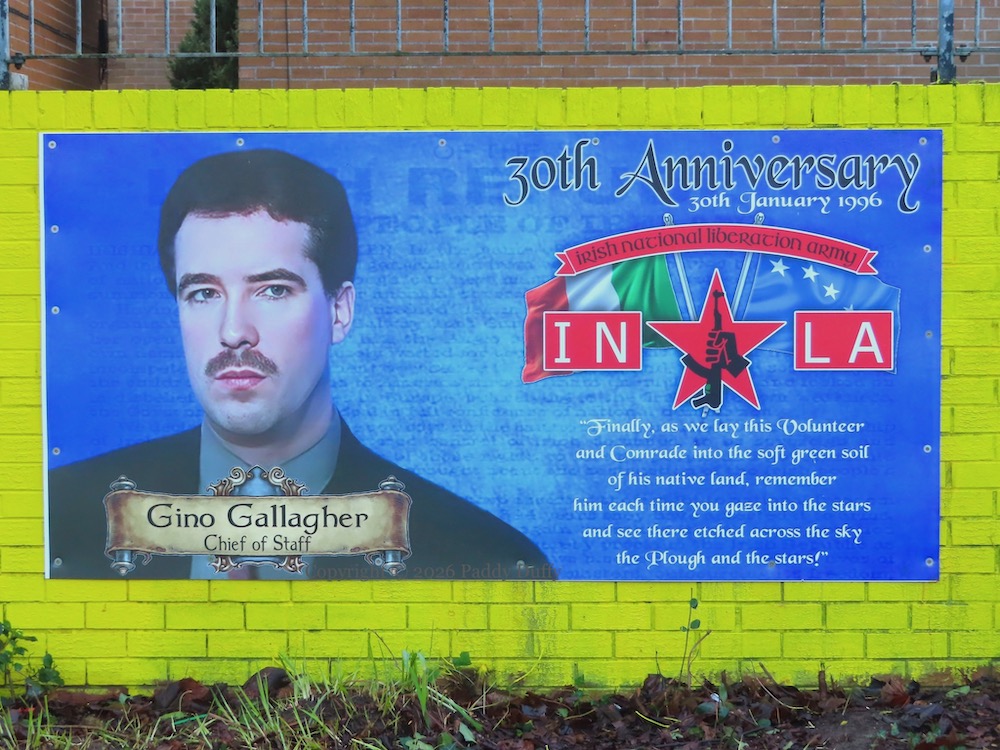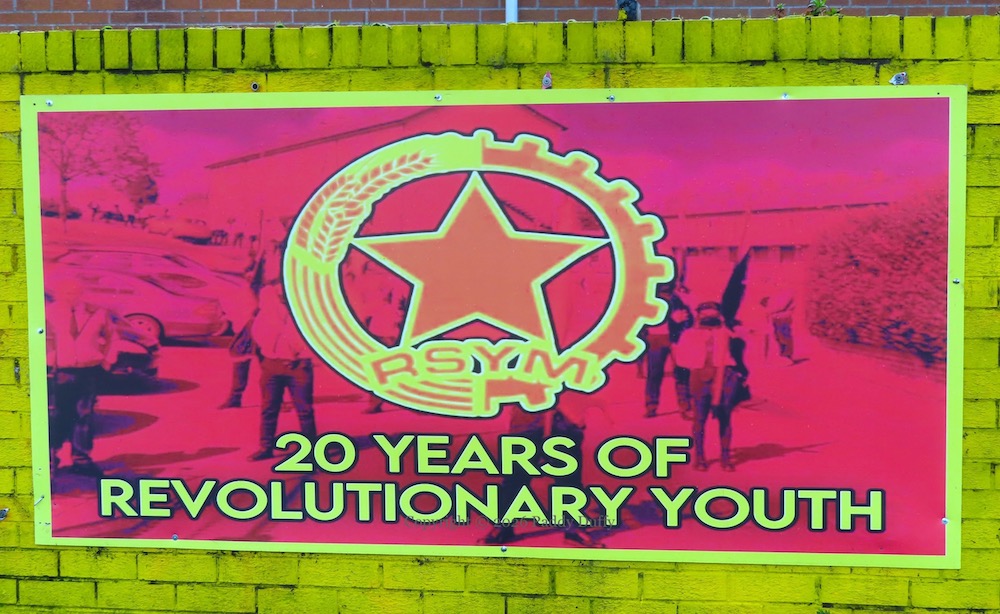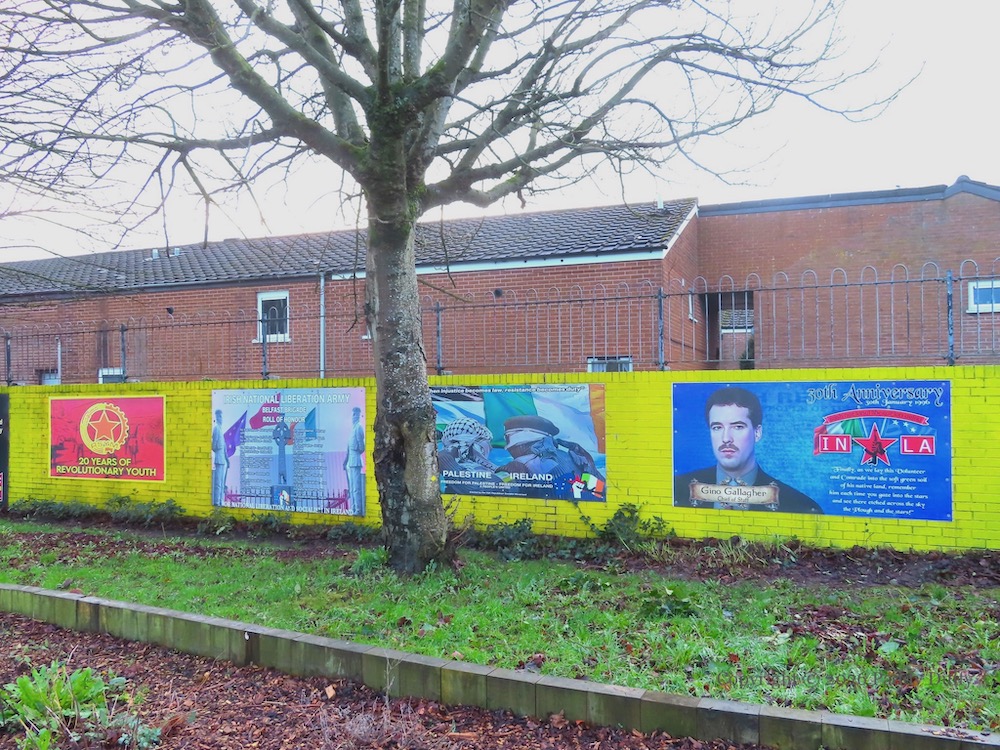
Here are IRSP (web) and RNU (Fb) signs side-by-side in Bishop Street, Derry, both employing the idea of ’empowerment’. Above: “Empower your community – Join the IRSP, the party of Connolly and Costello”; below: “RNU for the community – support, empower & prosper”.
The United Kingdom Of Great Britain And Ireland was created in 1801, a reaction to the 1798 Rebellion, led by (amongst others) Wolfe Tone and Henry Joy McCracken, who were founding members of the Society Of United Irishmen in 1791 in Belfast.
In this mural, Tone and McCracken on the left gaze across the “centuries of resistance” from 1798 to 1916 Rising revolutionaries Countess Markievicz and James Connolly, and beyond to Troubles-era figures Maıréad Farrell, Bobby Sands, and Máıre Drumm.
Around the same time as this mural was painted, a Féıle exhibition called ‘Vibrant Colours, Violent Past’ included A Panorama Of Republicanism which contains dozens of figures but again chooses 1798/Tone, 1916/Connolly, and the Troubles/Martin McGuinness as the pivotal moments and figures.
“Comóradh Éırí Amach Na Cásca Bhéal Feırste/Belfast Easter Commemoration. This is the traditional place where on Easter Sunday Belfast republicans gather to honour Ireland’s patriot dead on their way to Milltown Cemetery.” “Honour Ireland’s patriot dead – wear an Easter lily.” “Unbowed, unbroken.”
Michael Devine was the last of the 1981 hunger-strikers to die, on August 20th, 1981, and although the strike was not called off until October 3rd, his death now marks the end of the strike for commemorative purposes. The 44th annual national commemoration of the strike will take place this year on the 24th, “assembling at Dunville Park” in west Belfast.
Beechmount Street, west Belfast. The MLK tarp goes back to 2014.
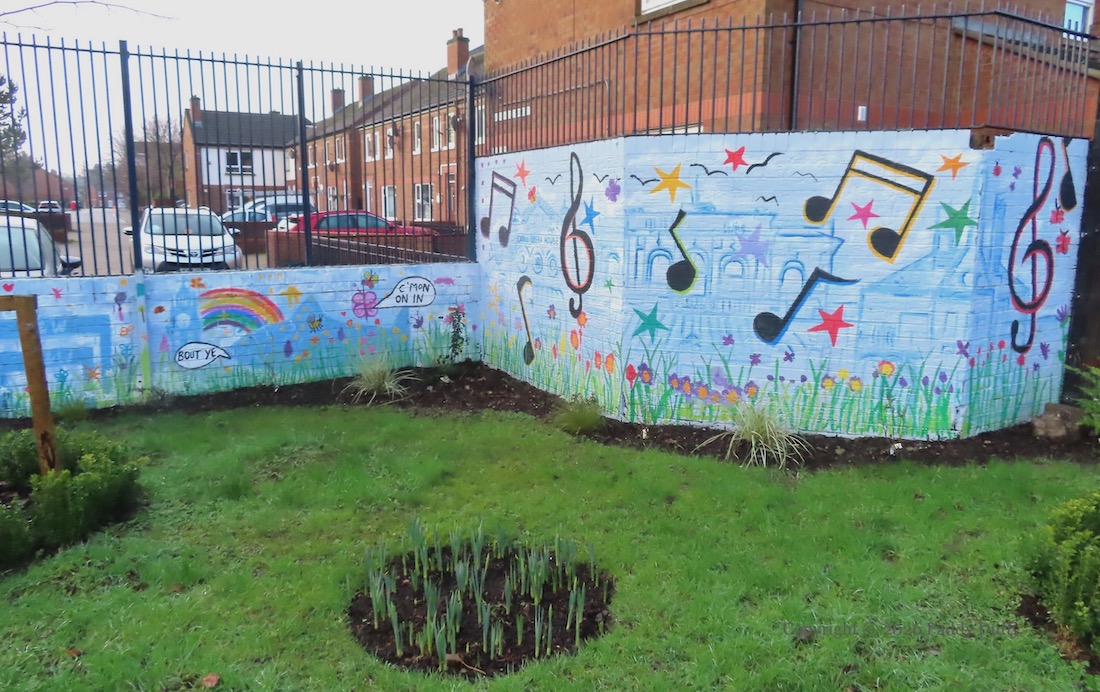
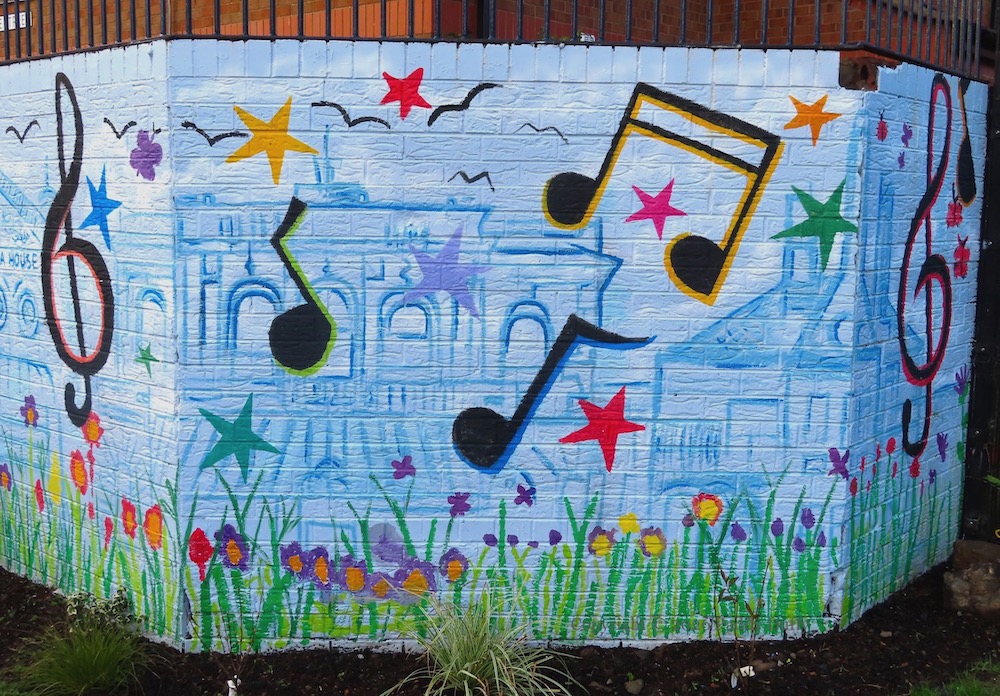
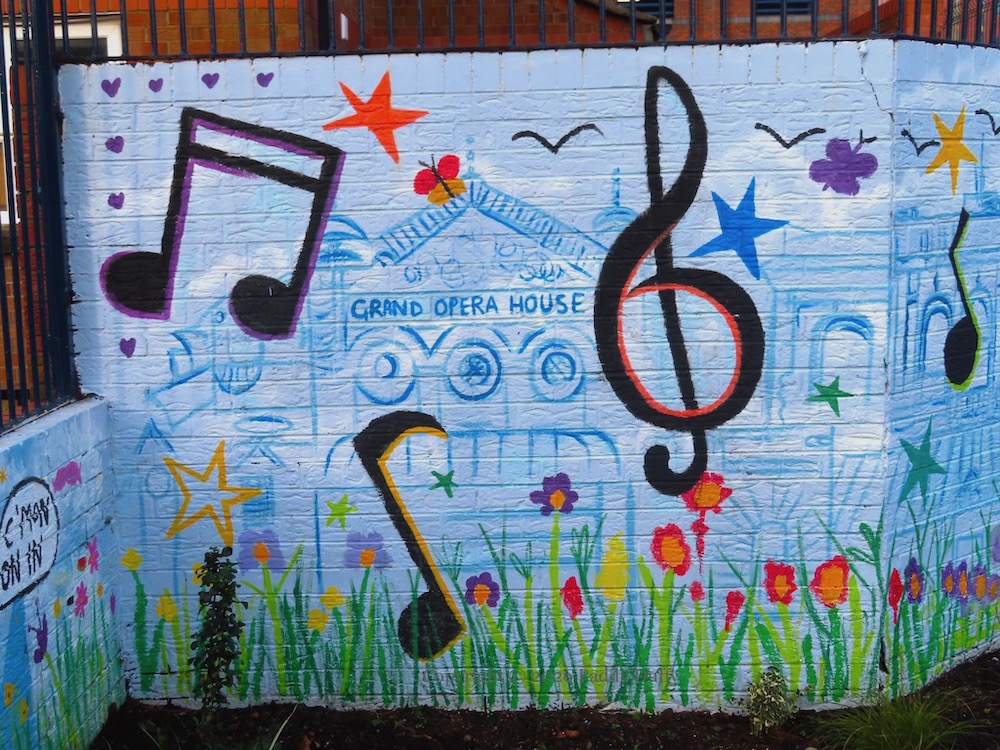
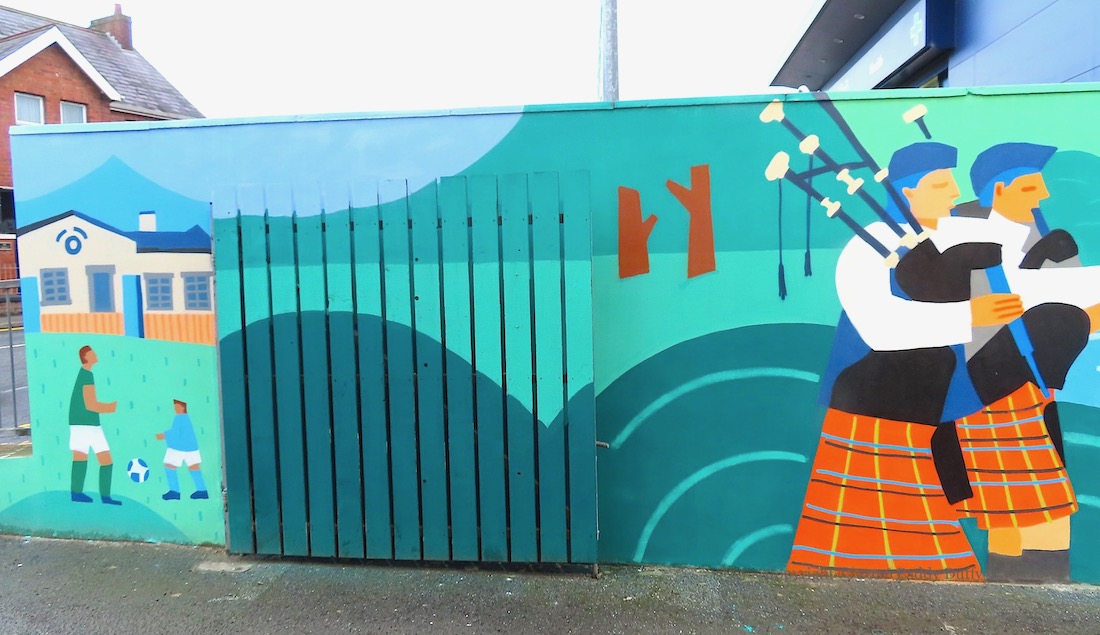
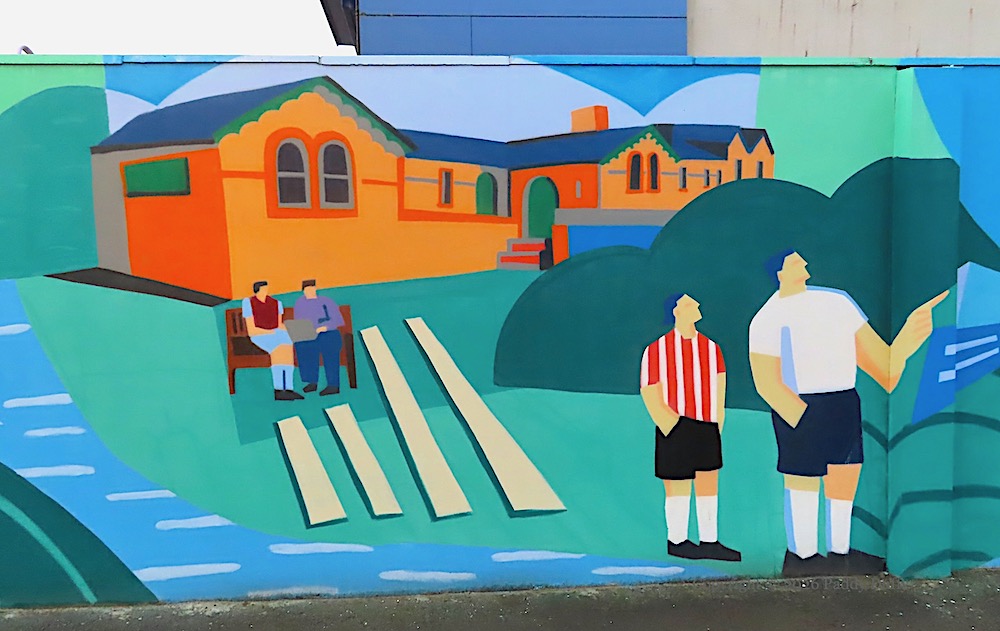
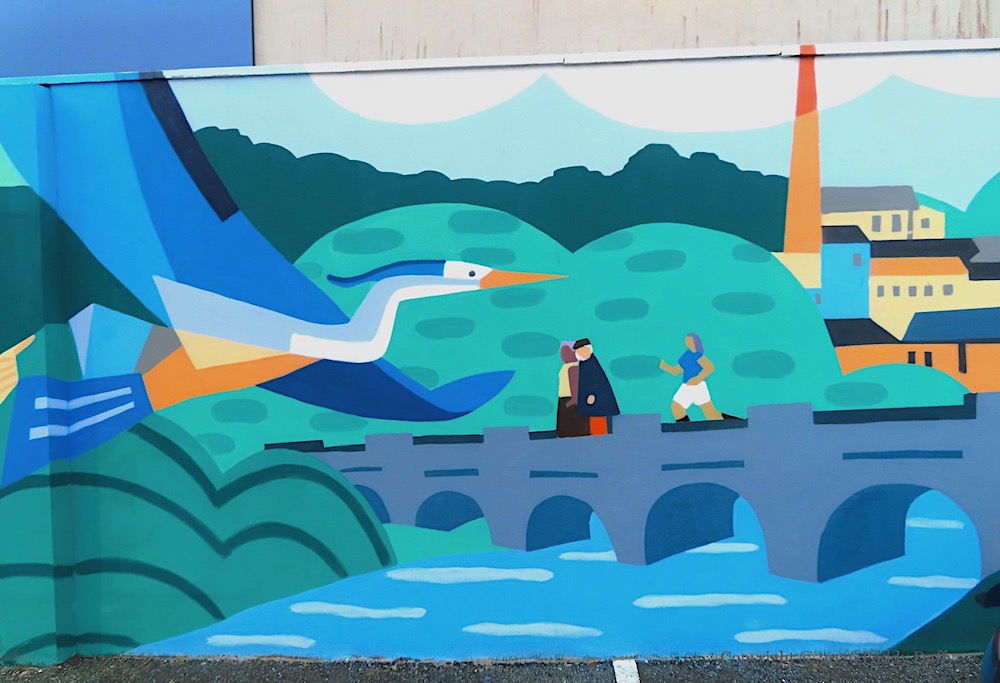
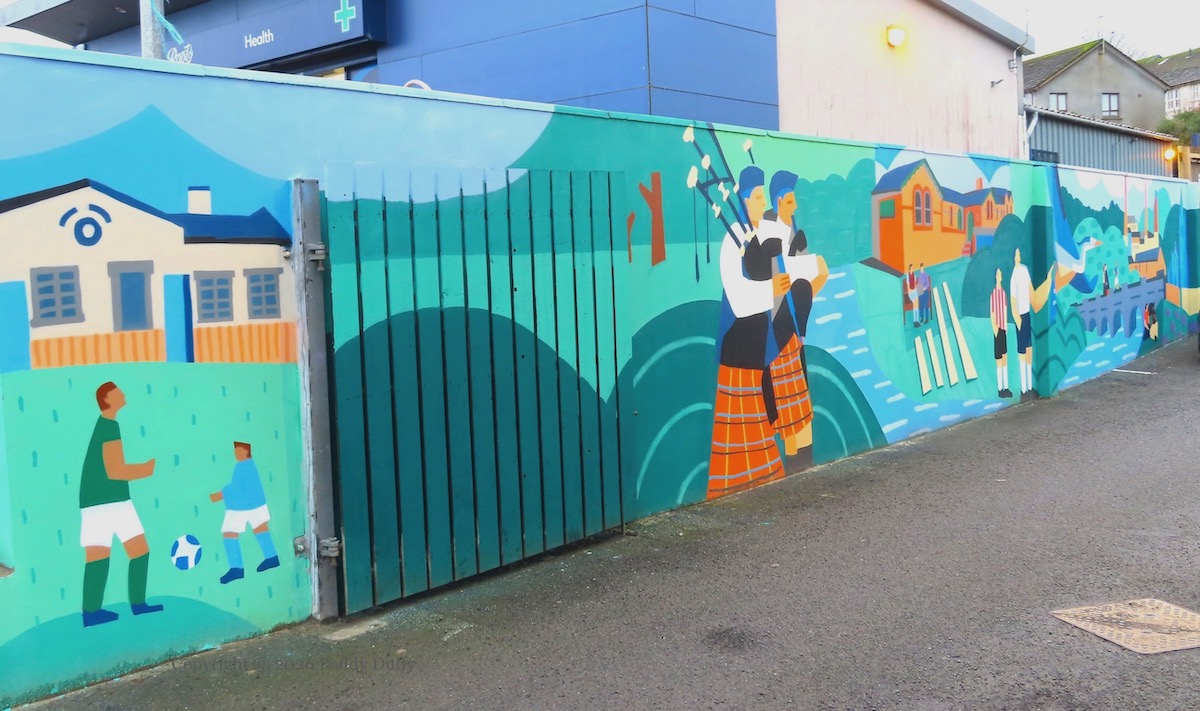
This mural celebrates the Irish-language institutions in west Belfast. From left to right, the buildings by the loch are: Gaeltacht Bhóthar Seoıghe, Bunscoıl Phobal Feırste, Raıdıó Fáılte, An Chultúrlann, Teach Ard Na bhFeá, Coláıste Feırste, and Áras Na bhFál. In a sense they are all ripples from the initial drop that was the Shaw’s Road Gaeltacht, established in 1969 and which led quickly to the bunscoıl in 1971 (WP). The NVTv documentary about the Shaw’s Road gaeltacht borrows its title from the slogan motivating the early efforts, “Ná habaır é, déan é” [Don’t say it, do it] – the bunscoıl was not officially recognised until 1985.
Among the pioneers (“ceannródaıthe”) of those early ventures were the Mac Seáın family, who grew up in a house adjacent to the wall on which the new mural is painted: “Tógadh Séamus Mac Seáın, Seán Mac Seáın, agus Caıtlín Mıstéıl (née Mhıc Sheáın) sa teach seo. Bhí an trıúr seo ı measc na gceannródaıthe a bhunaıgh Gaeltacht Bhóthar Seoıghe.”
The mural was commissioned by Spórtlann Na hÉıreann’s Irish-language heritage project “Gael Staır” (Meon Eıle | Belfast Media), with support from Mary’s Gift (Belfast Media), and painted by Aodán Ó Manacháın (Fb). It was unveiled Sunday 10th.
Tourists from various countries – shown above are Brazil, Canada, France, Spain, the Netherlands, Italy, New Zealand, German, the United States – can now sign the Cupar Way war wall in a specially-designated panel for their country; guests from other nations will have to continue defacing the wall wherever they can find a spot, whether or not it is covered in art.
Above, a recruitment tarp for the Blues And Royals flute band (Fb).
Below, (and on the wall above the flute band’s tarp) a NI Centenary board using the St Patrick’s saltire in the background. The saltire is an Anglo symbol of Ireland and was included in the Union Flag when the union was between Britain and Ireland and thus – like the word “Ulster” – has been reduced to signifying Northern Ireland after partition.
Above and immediately below are two new paste-ups by Leo Boyd which attempt – by example and by reverse-psychology – to turn the hoarding around the War Memorial building in Waring Street into a paste-up gallery (similar to the new “legal wall” for graffiti and street-art in Little Patrick Street – see First!).
The third image is of a Boyd paste-up already on the wall, mixing the police land-rover (see Off The Edge for an index) with the cat looming over city hall (see Belfast Kitty Hall). The final stencil is by French artist MDLF (ig).
ADW’s (web) popular piece Deep Love, originally painted for HTN 2017, was repainted back in May, after he painted a piece in Union Street for HTN 2025.
Féıle An Phobaıl (web) is now headquartered in the renovated (BCC) St Comgall’s on Divis Street in Ionad Eileen Howell, and during this year’s (2025) festival is home to an exhibition called “Vibrant Colours, Violent Past”, the centrepiece of which is a 20-foot-long panoramic history of republicanism, with Wolfe Tone, James Connolly, and Martin McGuinness as pivotal figures.
A leaflet distributed at the launch (on August 1st) explained the genesis of the project, as follows:
“A few years ago I met a great friend of Ireland and art collector Darius Anderson from California who was here on a trip with his wife Wendy and hoping to see some new work by Irish artists, not only work destined for gallery walls but having been fortunate to be included on one of local guide Dee Morgan’s tours he developed a love for and focus on our world-recognised mural art tradition.
“Then last year on another trip here I was able to introduce Darius to my life-long friends and probably the most prolific contributors to our local landscape.
“From a casual meeting alongside Marty and Micky at work repainting the Vol. Kieran Doherty mural in Andersonstown came an inspired suggestion that we accept a challenge from him to tell our story graphically on a canvas rather than the usual brick wall, not just on canvas to hang on a wall in his gallery in L.A. but a canvas to cover the entire wall 20ft x 7ft!
“Excited by our positive response Darius wondered could we invite some loyalist artist/activist to contribute a similar large canvas celebrating the history of the British, Unionist, Loyalist community here.
“That was last July. This exhibition is a result of that meeting but also a chance for the public to remind themselves of our often colourful and unfortunately violent past. – Danny D, Muralist/Activist”
“History is like a rearview mirror! You must always check back but you must keep focused on the road ahead, otherwise you are going to crash!” (Similar wording was used in a piece – Painting From The Same Palette – painted by Danny D and Mark Ervine in 2008.)
The exhibition was launched on August 1st and also included four display boards featuring murals by Danny D (CNR) and Dee Craig (PUL) (Fb).
Jim McCabe, “life-long campaigner for truth and justice” after his wife Norah was killed by a plastic bullet in 1981, returns to the “International Wall” (Visual History) on Divis Street. The original mural – from a few months after his death in January 2023 – was replaced by A Window To A Free Country, one of the Palestinian-inspired murals. This new version replaces The Land Is Ours.
“In memory of all the innocent victims murdered and seriously injured by British Crown forces.”
The image above is from August 2nd; the images below are from July.