This is a printed version Wilfrid Spender’s report of the first day of the Battle Of The Somme, replacing a previously painted instance that was in the same style as the adjacent mural.
“‘I am not an Ulsterman but yesterday the First of July, as I followed their amazing attack, I felt that I would rather be an Ulsterman than anything else in the world. My pen cannot describe adequately the hundreds of heroic acts I witnessed, the Ulster Volunteer Force, from which the Division was made, has won a name that equals any in history. Their devotion deserves the gratitude of The British Empire’ – Captain Wilfrid [not “Wilfred”] Spender, The Somme 1916″
Spender’s words are superimposed upon JC Beadle’s Attack Of The 36th Division (see Over The Top).
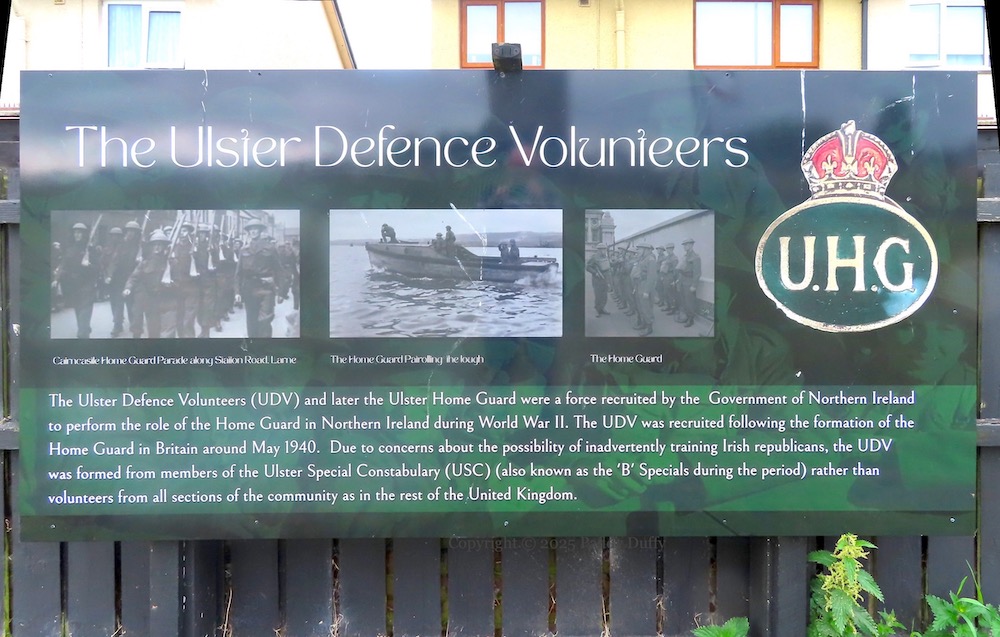
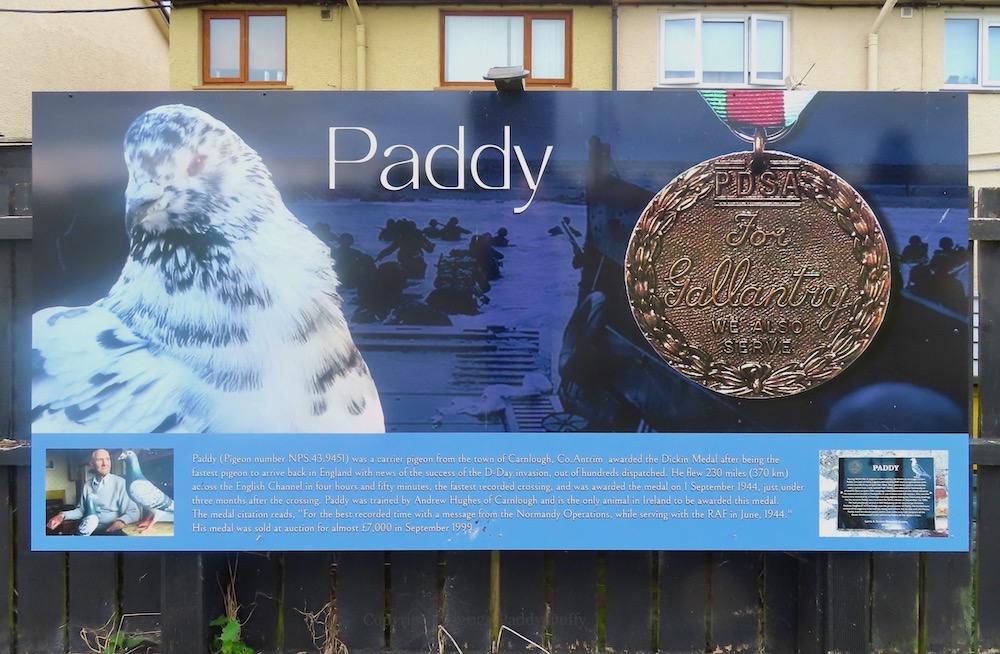
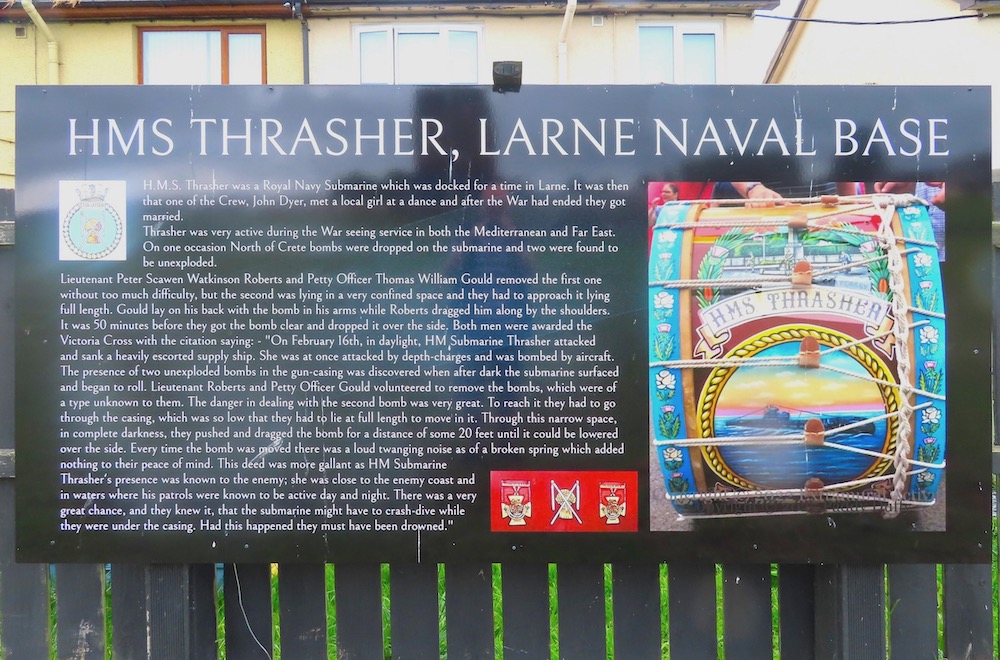
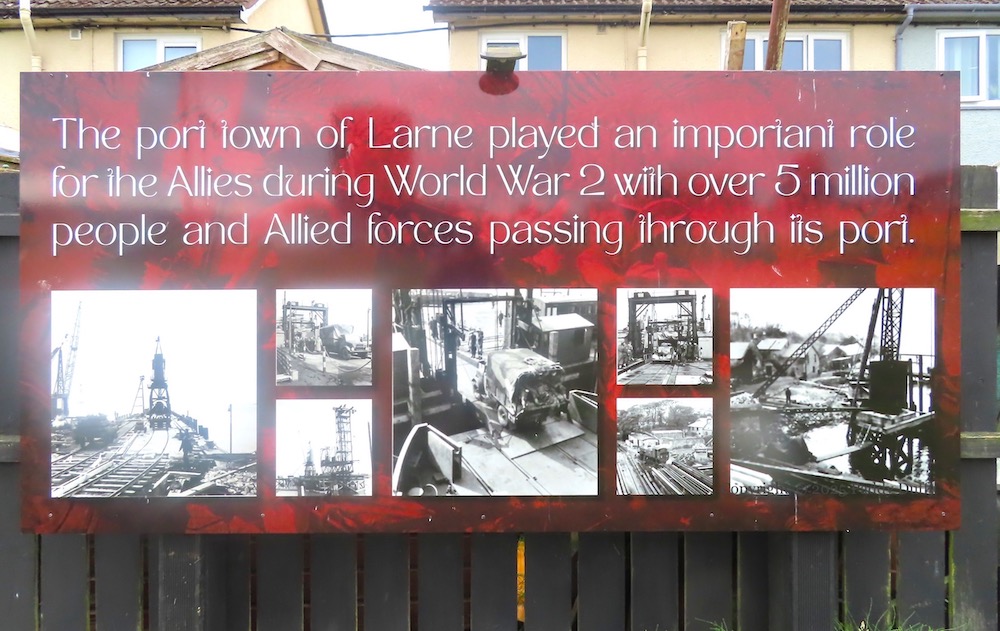
This is a series of ten boards in Craigyhill, Larne about WWII. (It replaces a set of twelve UDA boards – see The Loyalist Executioner.)
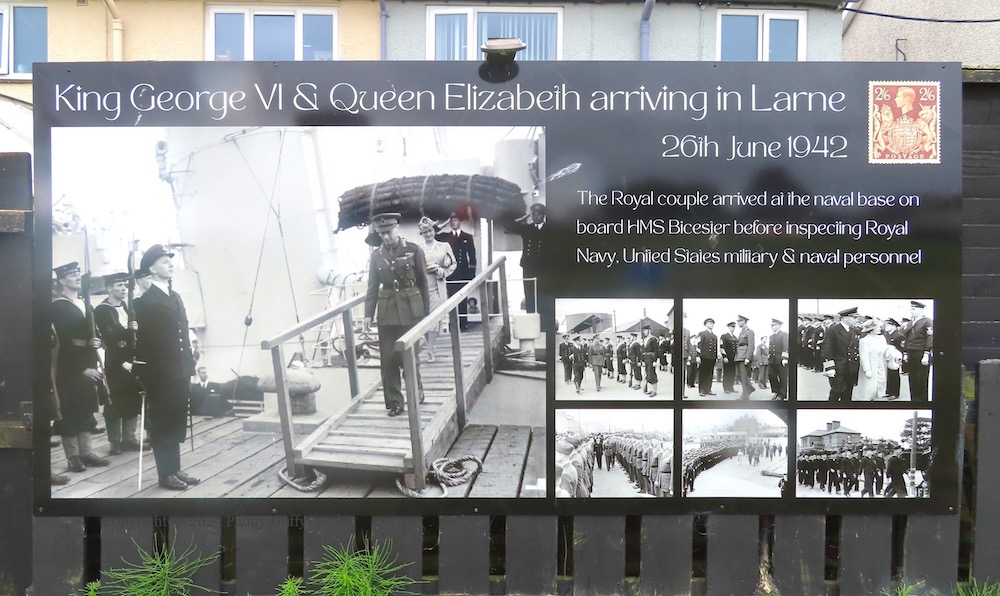
From left to right (top to bottom) their subjects are: the Ulster Defence Volunteers/Ulster Home Guard, formed from the B Specials; Paddy the pigeon; submarine HMS Thrasher (using an image from the Seosamh Mac Coılle collection); HMS Larne, a minesweeper built in Renfrew, Scotland; the port of Larne through which passed “over 5 million people and Allied forces”; Kilwaughter Castle, a training ground for UK and American troops; the royal visit of King George VI and Queen Elizabeth in June 1942; James Stuart Steele of Ballycarry, who served in both WWI and WWII; the Larne Spitfire, one of seventeen spitfires funded by a Belfast Telegraph fund-raising drive (Wartime NI | see also the Ballymena spitfire in Per Ardua Ad Astra); local casualties of WWII – “In remembrance of those from town of Larne that paid the supreme sacrifice during the Second World War”.
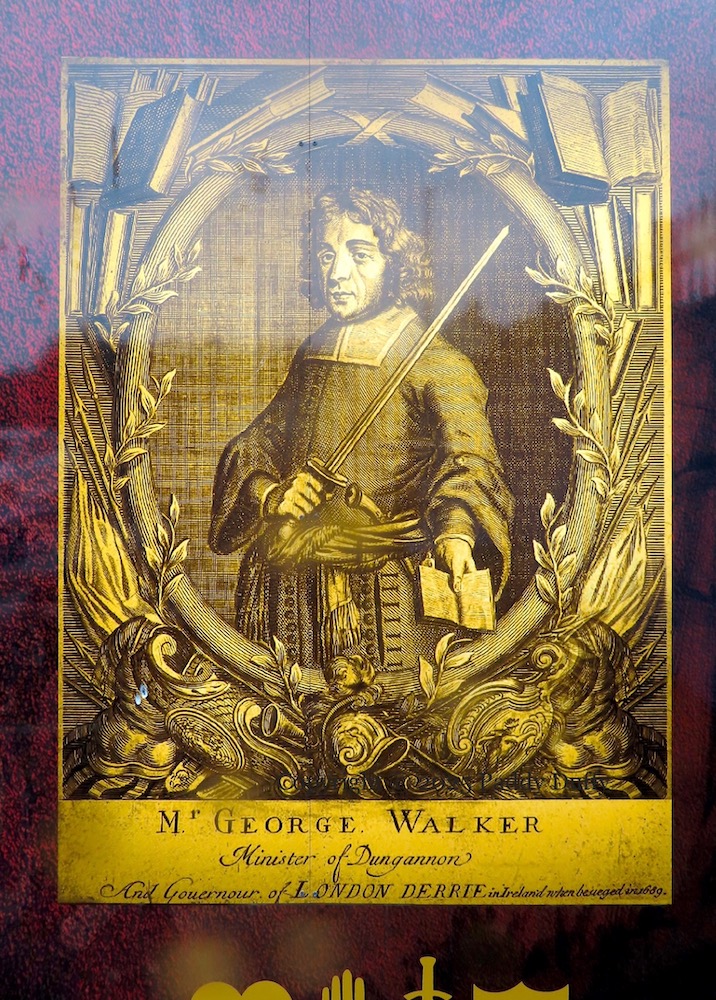
“Mr George Walker, Minister of Dungannon and Gouernour of London Derrie in Ireland when besieged in 1689.” Walker evacuated from Dungannon after Lundy’s troops pulled out and became joint governor of Derry after Lundy’s authority collapsed, first with Henry Baker and later with John Mitchelburne.
Walker put himself at the centre of his own “True Account Of The Siege Of London-Derry” (which can be read at archive.org) and drew criticism for minimising the role of Presbyterians (Walker was Anglican/CoI).
After the siege, Walker went on a victory tour of Scotland and England; while in London, he argued against a Derry trial for Lundy, on the ground that Lundy still had support there. He returned to Ireland in time to greet William III in June 1690 when William travelled from Carrickfergus to Belfast (see June 14th, 1690) and he went south with William to the Boyne, where he was shot and killed. (DIB | DIB | WP)
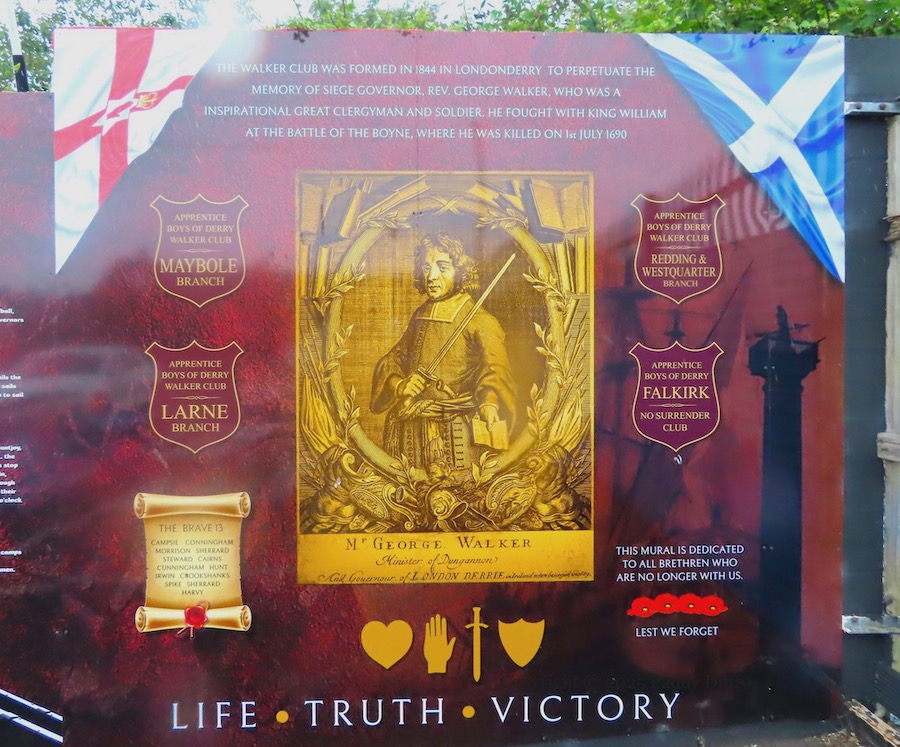
“The Walker Club was formed in 1844 in Londonderry to perpetuate the memory of siege governor, Rev. George Walker, who was a[n] inspirational great clergyman and soldier. He fought with King William at the Battle of the Boyne, where he was killed on 1st July 1690.”
The image of Walker is a line-engraving by John Savage, viewable at Sinclair Genealogy. “Life, truth, victory” is a translation of Londonderry’s Latin motto “Vita, veritas, victoria”.
These new boards are at the Rangers Supporters’ Club (Fb) in Boyne Square/Greenland, Larne.
“North Down Defenders flute band [Fb], est. 2004. In memorium [sic] T. Mercer, R. Shaw, K. Shaw, G. Shaw, D. Shaw, A. Johnston, P. Magee, S. Stewart, J. Mills.”
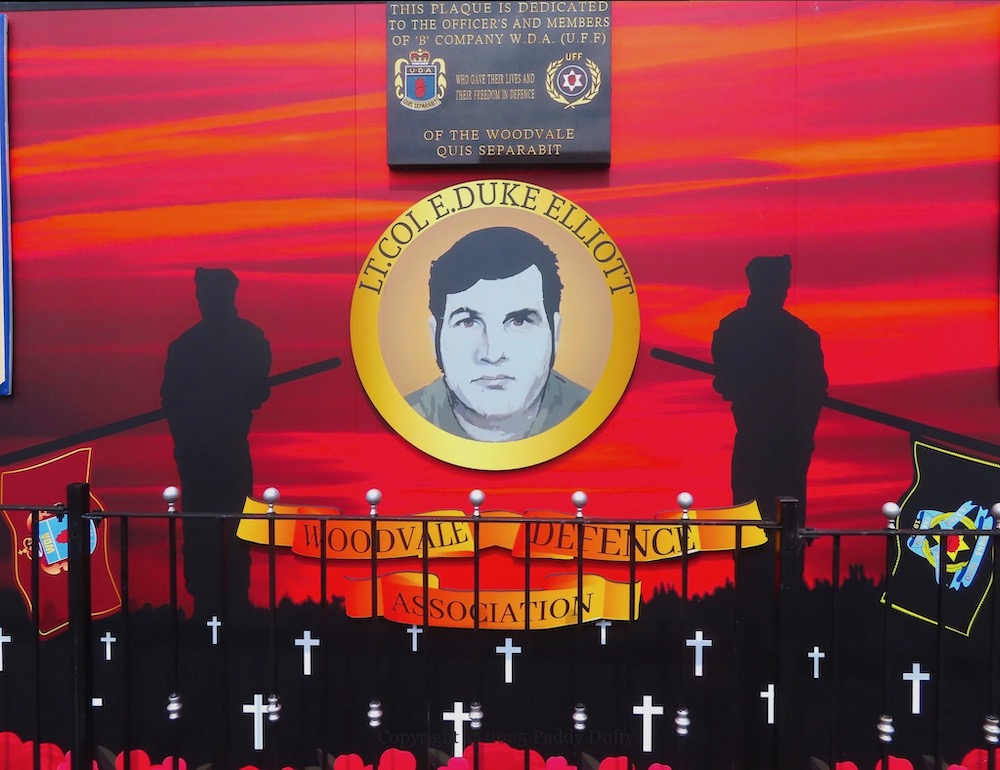
The previous tribute to Duke Elliott was installed in 2013 as the houses in Columbia Street were being rebuilt. Ernie “Duke” Elliott came from the Woodvale area (Leopold Street) and was a founder member of the Woodvale Defence Association in 1971, which was later folded into the UDA. He was also a Marxist. He was killed at age 28 in a pub brawl in December 1972 in a dispute over weapons (WP | Tele | Watching The Door).
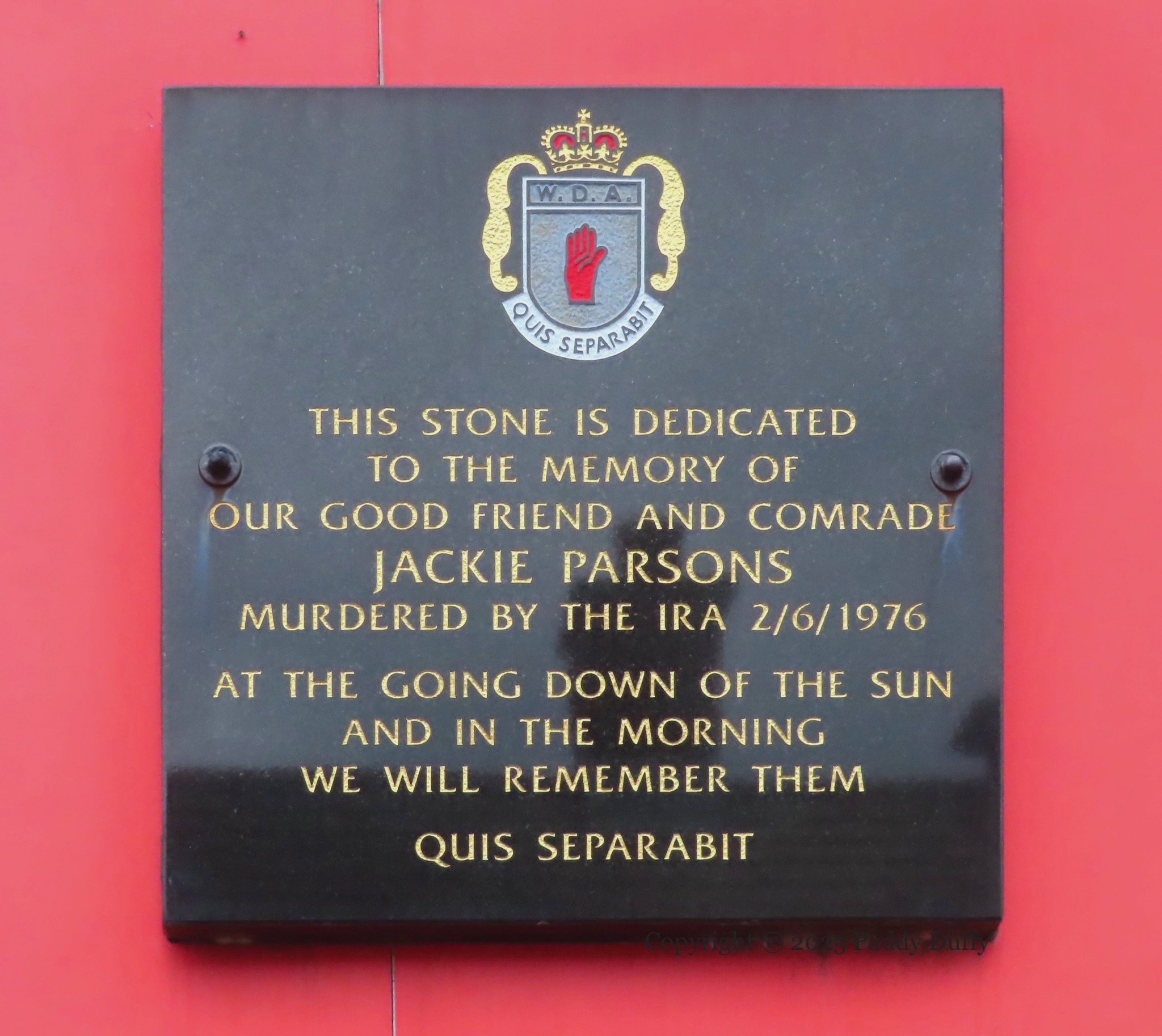
The plaque “dedicated to the officers and members of ‘B’ Company WDA (UFF)” has been retained. Also included is an image of the plaque that was added (c. 2022) to the main mural, commemorating Jackie Parsons.
Ohio Street, Woodvale, west Belfast
Buster Adams, Noel Clements, Tommy Aiken, Allistair Cousins, Billy Andrews, Irene Craig, Davy Armstrong, Drew Crawford, Fred Bailie, John Crossett, Wilbur Barnes, Tommy Dinsmore, Mark Barr, Jimmy Dowie, Sam Black, Tony Duff, Tommy Black, Ray Dummigan, Tommy Boyd, Tom Edgar, Davy Bryson, Ernie Elliot, Jimmy Carberry, Brian Faulkner // Billy Fenton, Tommy Hill, Hedgie Ferguson, Trevor Hill, Billy Gardner, Keek Holmes, Lewis Gilbert, Tommy Howells, Billy Graham, Bertie Howells, Travis Grey, Jim Hutchinson, Dennis Grey, Geordie Johnston, Geordie Hall, Tom Johnston, Jimmy Hall, Maurice Kavanagh, Stephen Hamilton, John Kennedy, Bobby Harvey, John Kiltie, Billy Higginson
Geordie King, Lee McKeag, Hugh Linton, Betty McMillan, Billy Little, Bob McMillan, Harry Lockhart, Robert McMillan, Rab Lockhart, Norman McMillan, Drew McAllister, George McMurray, William McBride, Jimmy Millar, Bobby McCade, Archie Millar, Tommy McCormick, Victor Moody, Joe McCann, Wesley Morrison, John McCrea, Graham Murdock // Jonny Nelson, Tommy Totten, Freddie Parkinson, Billy Thompson, David Parker, Phillip Thompson, Jackie Parsons, Mark Turner, Bobby Patterson, Jimmy Welshman, Ned Pollock, Lou West, Charlie Quinn, Stanley West, Ray Riley, Cecil Williamson, Jackie Robinson, Silver Wilson, George Selby, Tucker Yates, Sammy Swain, Sandy Wright
“1st Shankill Somme Association [Fb] roll of honour. In memory of our esteemed past members. Lest we forget.” The Association celebrated its twenty-fifth anniversary in February of this year (2025) and celebrated with a march from the leisure centre up to the garden of reflection next to the Shankill graveyard (Fb). The new retrospective board above shows members of the Association at trips to various WWI landmarks across the years.
Also included is an image of the roll of honour to the left of the main memorial, which now has some new names and is topped by a tribute to Queen Elizabeth II. For Joe Coggle see S Company, C Company.
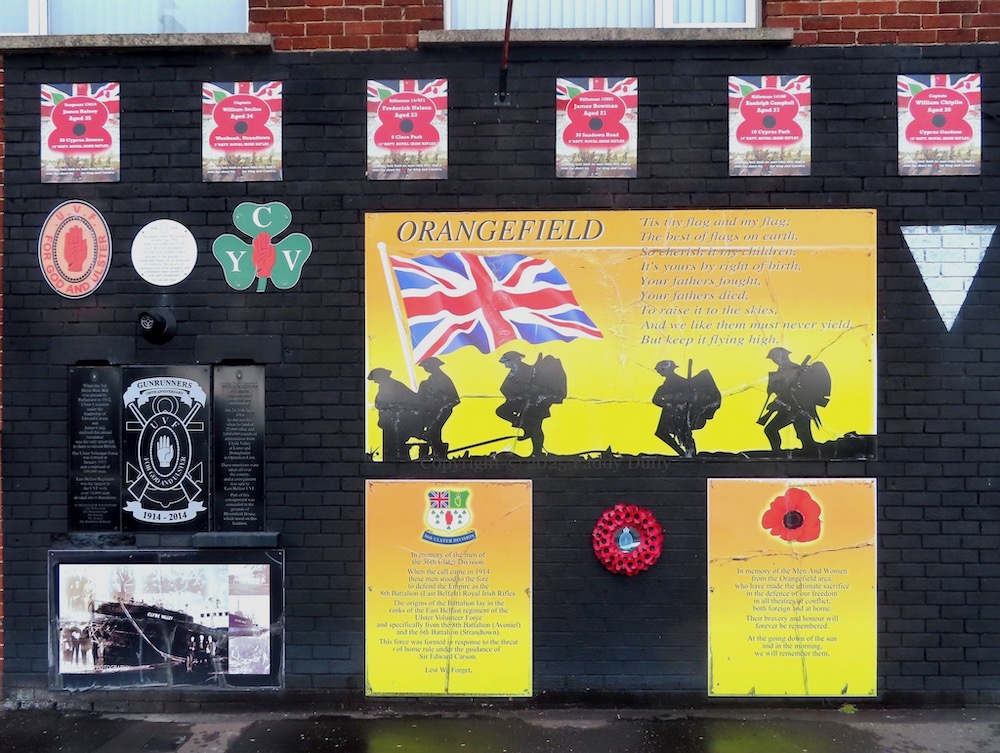
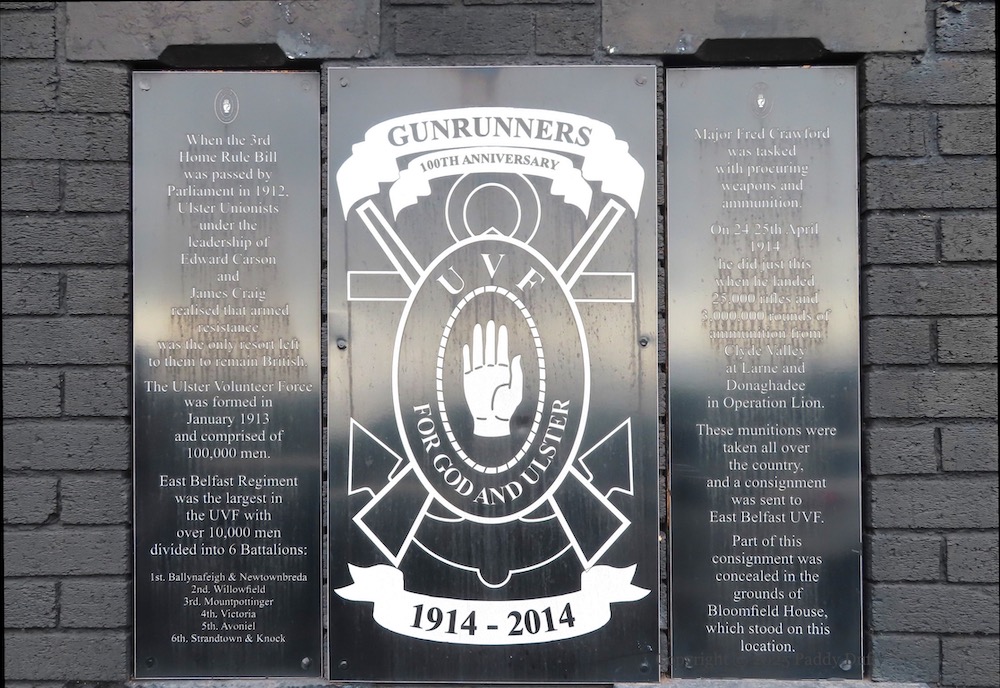
The image above shows a unified and wider view of the two pieces seen previously in Bloomfield House and In All Theatres Of Conflict: on the left, a board marking the centenary of the Ulster Volunteers’ ‘Larne Gun-Running’; on the right, a board commemorating the casualties from the 36th (Ulster) Division in WWI; above them both are small boards from the ‘Poppy Trail’ collection of deceased locals.
Charles Thomson was born in Maghera in 1729 and moved to North America in 1739. He served as the secretary of the Continental Congress and signed the Declaration Of Independence. He helped design both the front and back of the nation’s Great Seal in 1782. (WP)
He is honoured in his home town by the board shown here. Thomson’s design for the reverse of the seal – the all-seeing eye over an unfinished pyramid (WP) – appears in the eagle’s left-hand wing, and his preliminary sketch, with wing-tips pointed downward (WP), in the right-hand wing.
Text of the information panel: “The Final Design of the Great Seal – June 20, 1782. On June 13, 1782, Congress asked Charles Thomson to come up with a suitable design for America’s Great Seal. With the reports and drawings of the three committees before him, he set to work. Thomson had served the past eight years as the Secretary of the Continental Congress where he acquired a reputation for fairness, truth, and integrity. Well-versed in the classics, he was once a Latin master the Academy of Philadelphia. Although today he is not a well-known founder, Charles Thomson was at the heart of the American Revolution. Thomson incorporated symbolic elements from all three committees with ideas of his own to create a bold and elegant design. He made a sketch and wrote a description of his preliminary design. For the front of the Great Seal, Thomson drew an American bald eagle and for the centrepiece he a [sic] placed the shield upon the eagle’s breast. Thomson envisioned an eagle “on the wing and rising.” In the eagle’s right talon is an olive branch. In its left, a tightly drawn bundle of arrows. Thomson said these symbols represent “the power of peace and war.” In the eagle’s beak, he placed a scroll with the first committee’s motto: E Pluribus Unum ‘Out of Many, One’. For the crest above the eagle’s head, Thomson used the radiant constellation of thirteen stars suggested by the second committee. He described the light rays as “breaking through a cloud.” For the reverse side of the Great Seal, Thomson used Barton’s (third committee) suggestion: an unfinished pyramid with the eye of Providence in its zenith, but added a triangle around the eye (like the first committee did). He also created two new mottos: Novus Ordo Seclorum ‘A New Order of the Ages’ and Annuit Coeptis ‘Providence has Favoured Our Undertakings’. After consulting with William Baron, the position of the eagle was changed to “displayed” (wings spread with tips up) and the chevrons on the shield were changed to the vertical stripes we see today.”
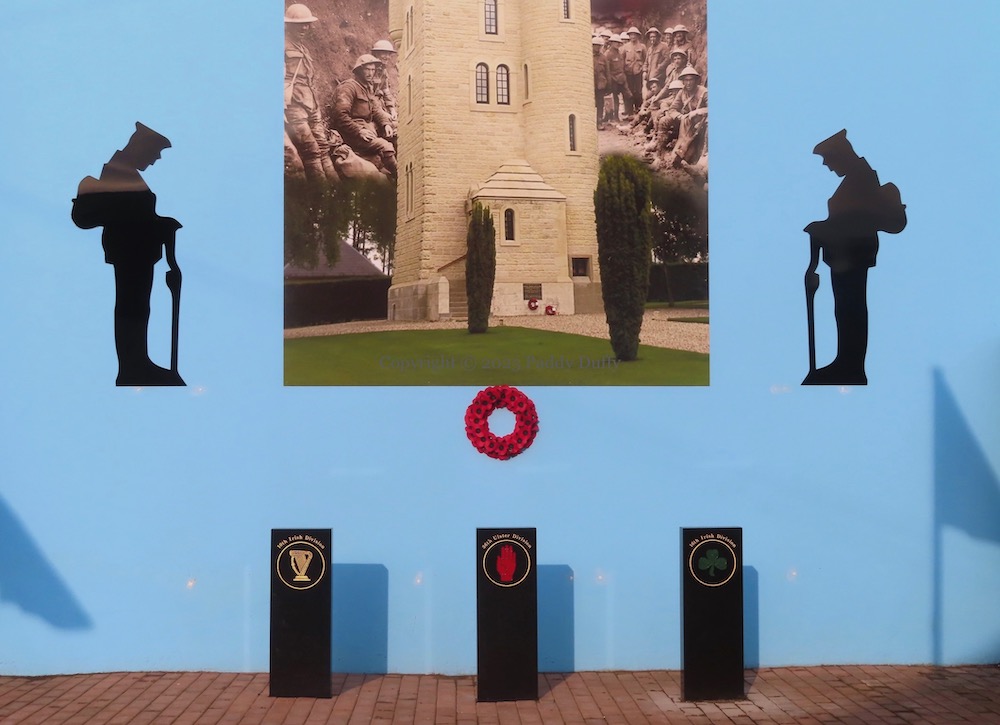
The memorial garden in Barrington Gardens at long last appears to be finished. The house on the corner of Donegall Road was knocked down in 2012 or 2013 and work began converting the waste ground into a memorial to local Great War casualties in late November 2023. See this entry for images from both November 2023 and October 2024.
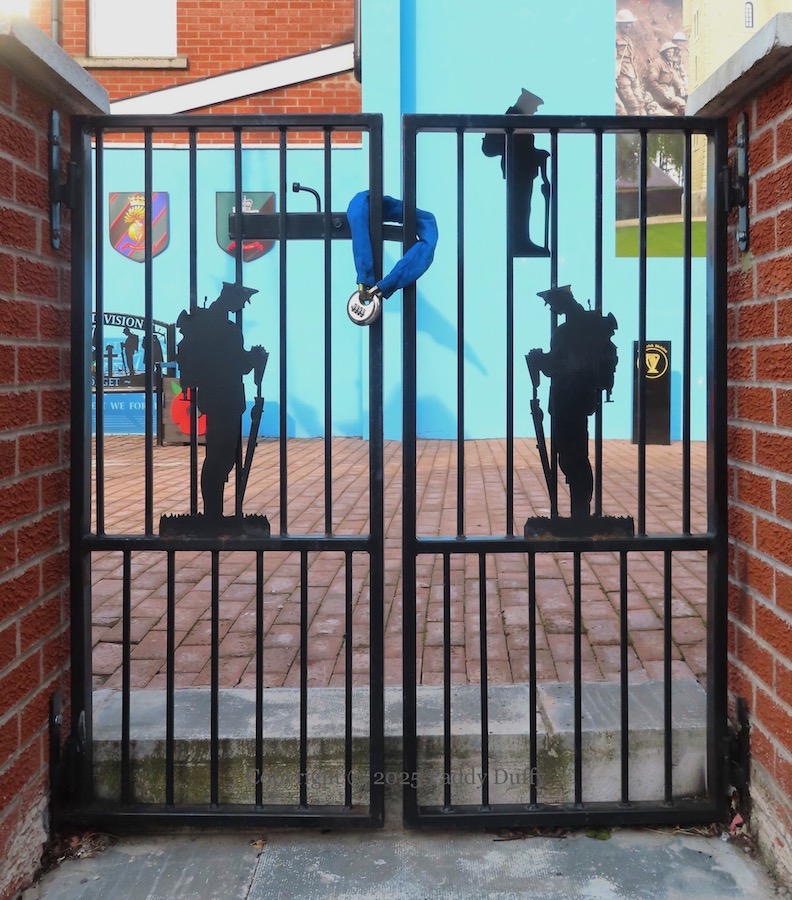
Since 2024, three pillars have been added below the main board, one each for the 10th (Irish) Division, 36th (Ulster) Division, and 16th (Irish Division) – for the service of the three divisions, see The Cost Of War, We Are The Dead, and (for the particular story of John Meeke and Willie Redmond) Comrades In Arms – and an iron bench to the 36th has been placed below the crests of the YCV, Inniskilling Fusiliers, Royal Irish Fusiliers, and the Royal Irish Rifles on the side-wall to the left.
Silhouetted graveside mourners appear on either side of the main board and in the gates to the garden
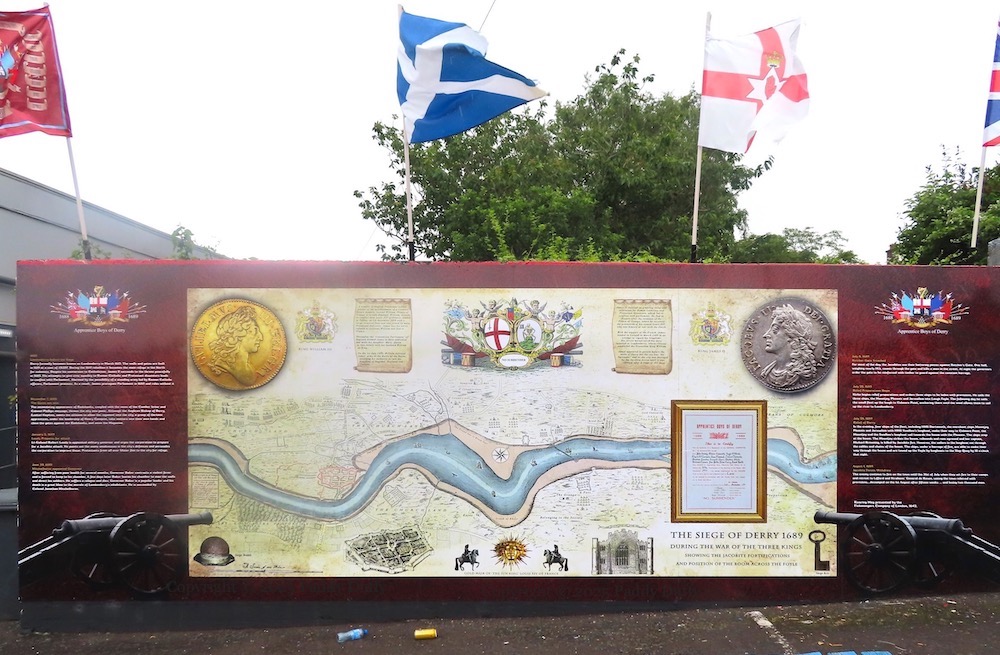
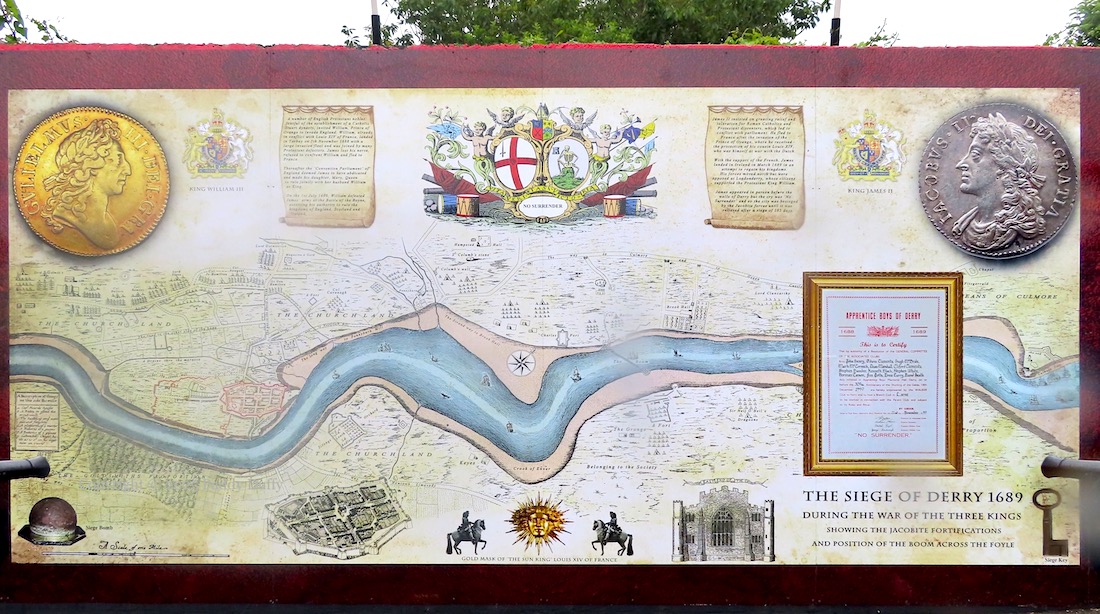
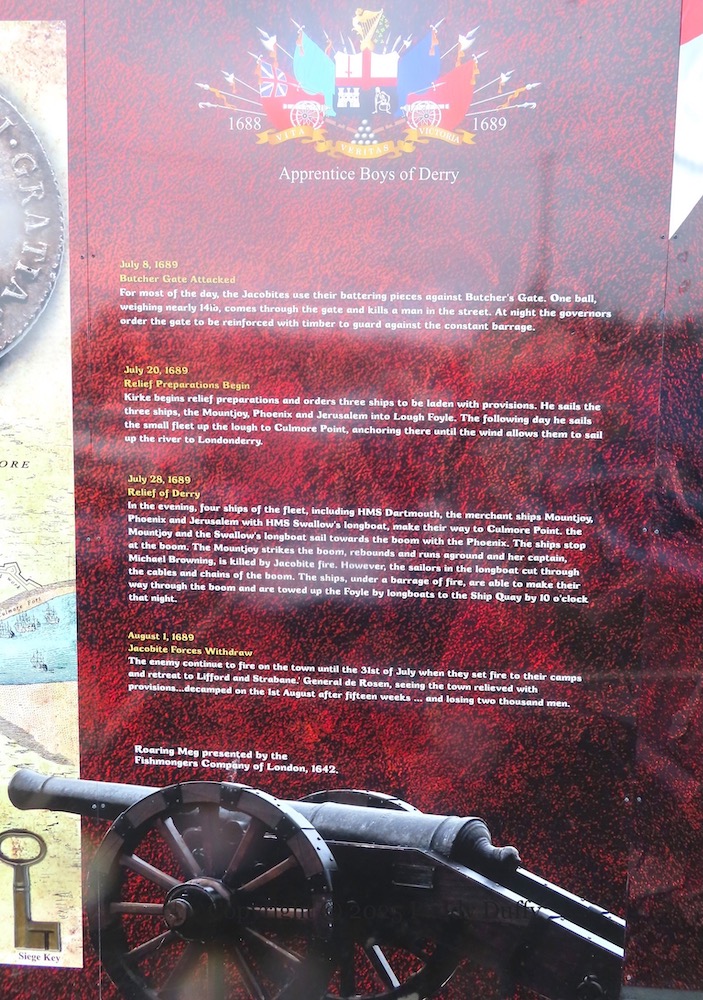
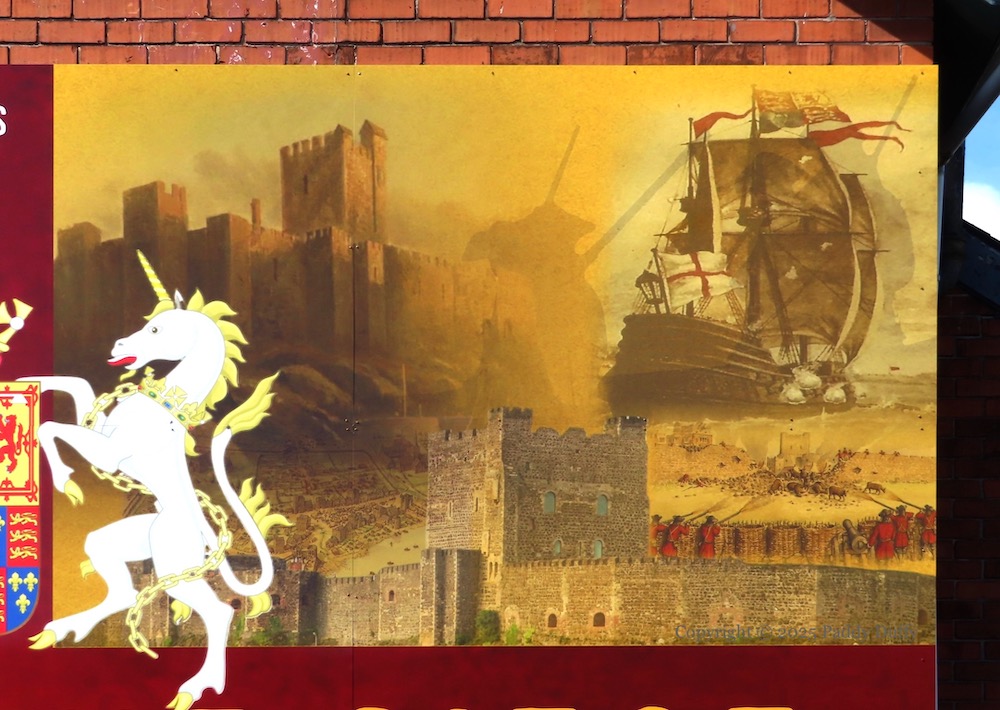
English forces under Kirke came to the aid of the besieged Protestants in Derry, “breaking the boom” across the Foyle and ending the siege at the end of July, 1689. The next wave of forces sailed for Belfast Lough, and together with the troops from Derry, set siege on August 20th to a garrison of Jacobite forces stationed in Carrickfergus castle, who soon began to run low on gunpowder, and surrendered. (WP | NIWorld)
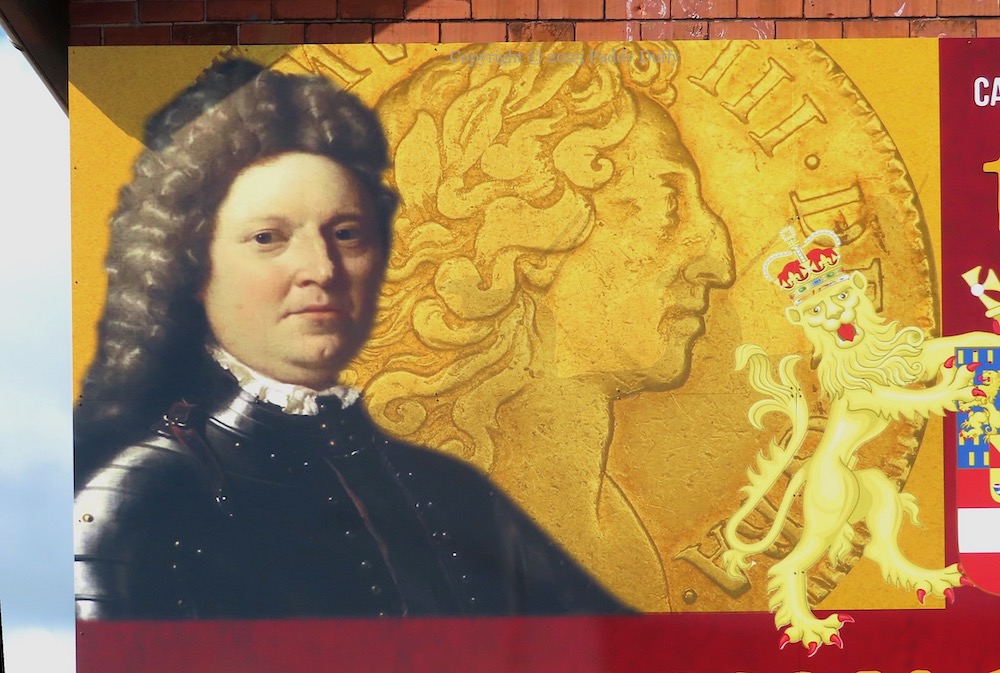
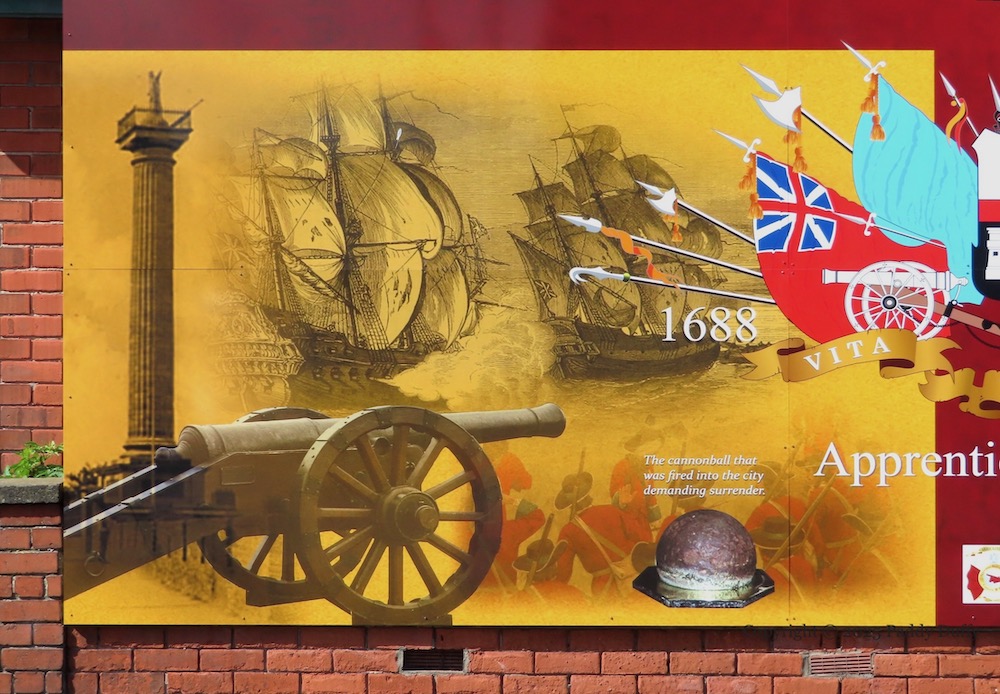
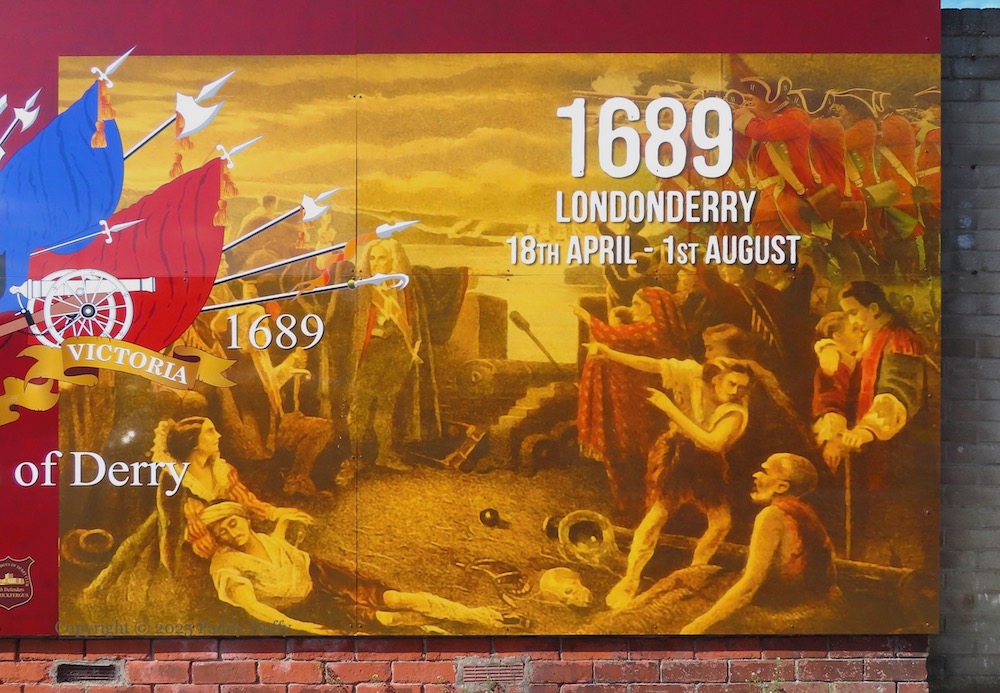
This new board in Davy’s Street, Carrickfergus, focuses mostly on the siege of Derry, though gives the dates of the Carrickfergus siege at the top. Schomberg appears in the top-left quadrant of the board – he would go on to die on at the Boyne in 1690; in the top-right is the Carrickfergus castle and the Mountjoy; in the bottom-left are Walker’s statue and the canon ‘Roaring Meg’; bottom-right is a painting of the Derry inhabitants celebrating the end of the siege; top-centre is the coat of arms of William and Mary; and bottom-centre is the Londonderry coat of arms.