“”The cause of labour is the cause of Ireland, and the cause of Ireland is the cause of labour” – James Connolly”. From The Irish Flag, 1916.
The renovation and expansion of Áras Uí Chonghaile (web) was officially opened in 2019 and included “a bespoke corten steel extension that has an intricate perforated image of Connolly’s face” (RIBAJ).
Falls Road, west Belfast, a short distance from the house in which Connolly lived for a time – see the Peter Moloney collection.
This is Wee Nuls’s (web | ig) street art celebrating the success of the ‘menstruation matters’ (ig) campaign for free period products and the passage of the Period Products Bill.
After Britain’s declaration of war against France in 1793, the United Irishmen – who hoped for French support for a rebellion in Ireland – could no longer meet openly. In Belfast, meetings were held at Dr [Benjamin] Franklin’s tavern, also called “Peggy Barclay’s” after its owner, under the guise of a social group called the Muddlers’ Club.
The true nature of the group was betrayed to the authorities in 1796 by Isabella “Belle” Martin, a serving girl in the tavern (Romanticsm Anthology | Belfast Entries | Belfast Media | Joe Baker). As the text in the Peter Strain mural above concludes, “Half a dozen of them saw the inside of a Scottish prison as a result” and the club dissolved. (The text surrounding Martin’s profile is from Glenn Patterson’s book, A Mill For Grinding Old People Young – this was the name of Peggy Barclay’s inn when she left the city centre for the Buttermilk Loney (now Skegoniell Avenue) on the Shore Road in north Belfast.
The tavern, in Sugarhouse Entry, later become a hotel before eventually being destroyed in the WWII blitz. Sugarhouse Entry still exists but has been impassable since 1972 when it was closed off as part of the “ring of steel” securing Belfast city centre (DC Tours).
Belfast’s first maternity hospital – the Humane Female Society For The Relief Of Lying-In Women – was in Donegall Street, perhaps in the building that sat over the Exchange Place entry, from 1794 to 1830, when it moved to Clifton Street (Mcafee). It was run entirely by women (info board in I Was Sick And Ye Visited Me).
The illustration is by Peter Strain (web) in Exchange Place.
“Where is our Alternative Ulster? – download paused.” Alternative Ulster was a fanzine (Fb | Musical Revolutions) and later a magazine (Issuu) and radio show covering the Belfast music and arts scene until March 2012; the name was then used for the Stiff Little Fingers’ song (youtube) in 1978.
By Verz (Fb) and Belfast One (web) in Fountain Street, Belfast.
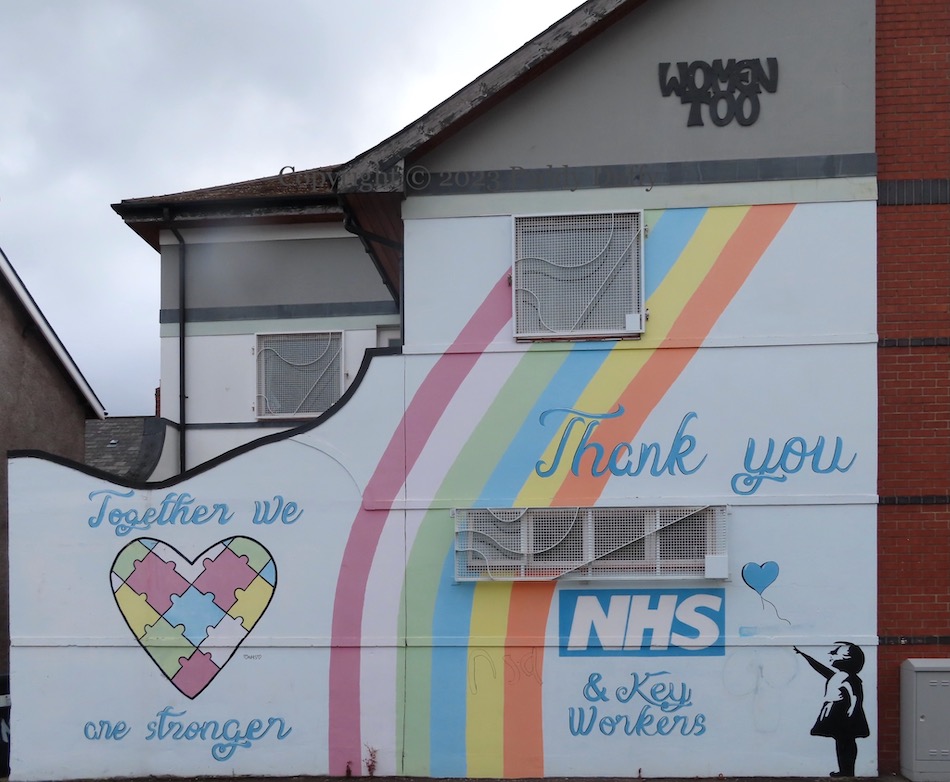
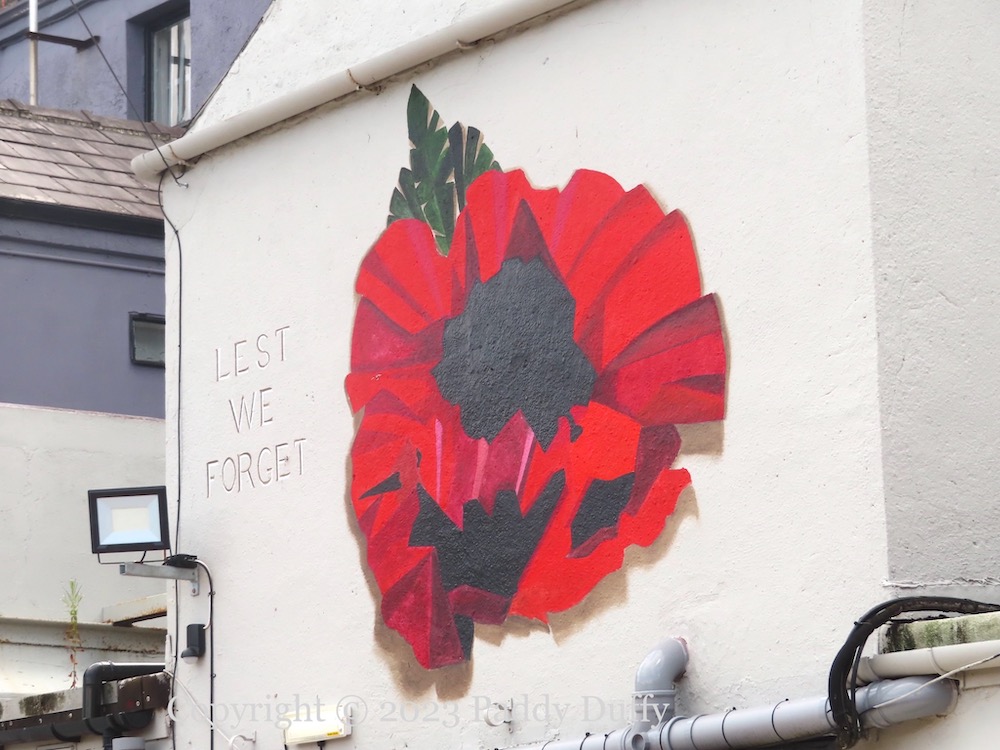
Side by side in Erskine Park, Ballyclare: a memorial to the 36th (Ulster) Division of the World War of 1914-1918 and “Thank you NHS and all key workers” of the global pandemic, 2020-2023.
This anti-drugs mural in Granton Park, Tullycarnet — “Build a better future for our children – teach them to say No” — replaces a UDA mural – see Release The Political Hostages.
“Make drugs history – cleaner communities now.” This is an anti-drugs board in the Tullycarnet estate. In both its title and various elements, the board references the television show Shameless, which was set on a Manchester housing estate and ended on May 28, 2013, after eleven seasons (WP). Black-and-white images from the estate, and other Belfast landmarks, are featured at the top.
The plaque below reads: “Shameful mural. This mural was officially unveiled on 15th June 2009 by First Minister Peter Robinson. This mural was created by young people from Tullycarnet to highlight that drug and alcohol use should not be normalized by communities.”
In a letter in 1859 to Dr Richard Madden, a fellow abolitionist (and historian of the United Irishmen), Mary Ann McCracken wrote, “America, considered the land of the great, the brave, may more properly be styled the land of the tyrant and the Slave.” (McNeill)
Also given an abolitionist bent are some lines from section 16 of Louis MacNeice’s Autumn Journal, describing Belfast as “A city built on mud; / A culture built upon profit; / Free speech nipped in the bud, / The minority always guilty. [Why should I want to go back / To you, Ireland, my Ireland? / The blots on the page are so black / They cannot be covered with shamrock. / I hate your grandiose airs / Your sob-stuff, your laugh and your swagger, / Your assumption that everyone cares / Who is the king of your castle. / Castles are out of date, / The tide flows round the children’s sandy-fancy; / Put up what flag you like, it’s too late / To save your soul with bunting.]
On the left: “Tír gan teanga, tír gan anam. #AchtAnoıs”. The quote (“a country with language [is] a country without a soul”) is widely attributed to Patrick Pearse. For the campaign to pass an Irish-language act, see An Lá Dearg.
On the right: “Enjoy Paddy Irish whiskey at Madden’s Bar, inspired by the man himself, Paddy Flaherty. Craıc agus ceol.”