The Great Hunger

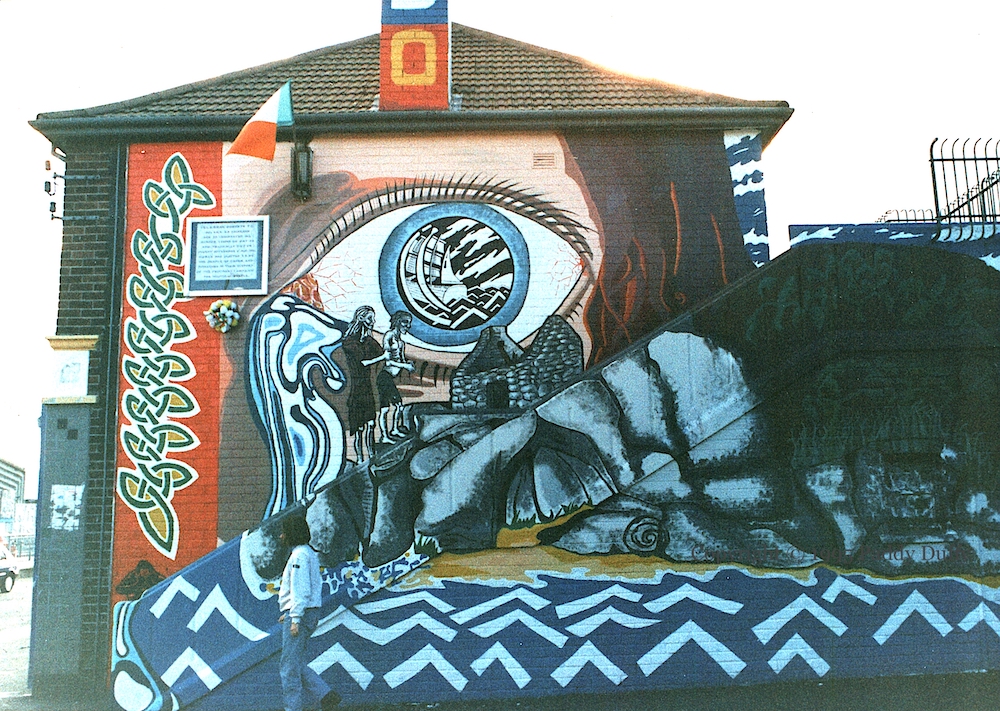
A tearful eye beholds both the Great Hunger, which claimed one million lives, and, within the eye itself, the wave of emigration which took more than a million others away from Ireland.

This is one of about nine murals painted in 1995 on the Great Hunger (Visual History). The number “150” appears on the chimney and would last until 2008 and beyond.

There are two side-walls out of frame to the right, going around a corner. The first gives a list of the artists in Irish (“[Dón]al Ó Dalaıḋ, [Cıa]rán [Mac] Taírnan [sic], Brían Ó Lúaın, […]rán Ó hÉır, […]áın Mac Pháıl, [perhaps one more]” (Donal Daly, Ciaran McKernan, Brian O’Loan, […] O’Hare, […] McFall. Daly, McKernan, and O’Loan would paint the History Is Written By The Winners mural in 1996) and the second reads “Dedicated to those who died in the Great Hunger” with a Celtic cross and some knotwork.

There is also a plaque to local man Kieran Doherty, reading “Vol. Kieran Doherty T.D. Óglaıgh Na hÉıreann. Age 25. Commenced his hunger strike on May 22 and tragically died on Sunday afternoon 2 Aug 1981. Kieran was elected T.D. by the people of Cavan And Monaghan in their support of the prisoners’ campaign for political status.” This plaque would be retained when this wall became a memorial mural to Doherty in 2001.

Slemish Way, Andersonstown, west Belfast

Click image to enlarge
Copyright © 1995 Paddy Duffy
T00156 [T00208]
Weary People, What Reap Ye?

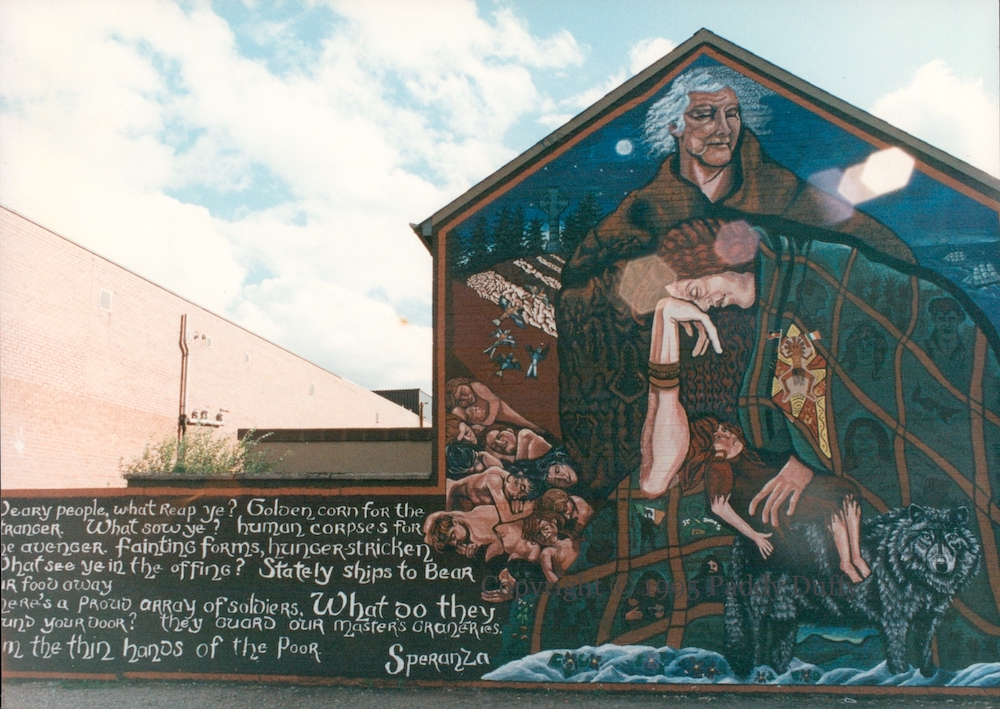
“Weary people, what reap ye? Golden corn for the stranger.
What sow ye? human corpses that wait for the avenger.
Fainting forms, hunger–stricken, what see you in the offing?
Stately ships to bear our food away, [amid the stranger’s scoffing].
There’s a proud array of soldiers — what do they round your door?
They guard our masters’ granaries from the thin hands of the poor. – Speranza”

The poetry is the first few lines of The Famine Year by “Speranza”, i.e. Lady Jane Wilde, mother of Oscar.

In the centre an aboriginal figure holds the flags of Ireland and of the Native Australians.

This is one of about nine murals painted in 1995 on the Great Hunger (Visual History).

“Painted by Síle Na Gıg & St James Youth Aug 95” in St James’s Crescent/Donegall Road, west Belfast.

Click image to enlarge
Copyright © 1995 Paddy Duffy
T00155 [T00206]

Foundation Stones

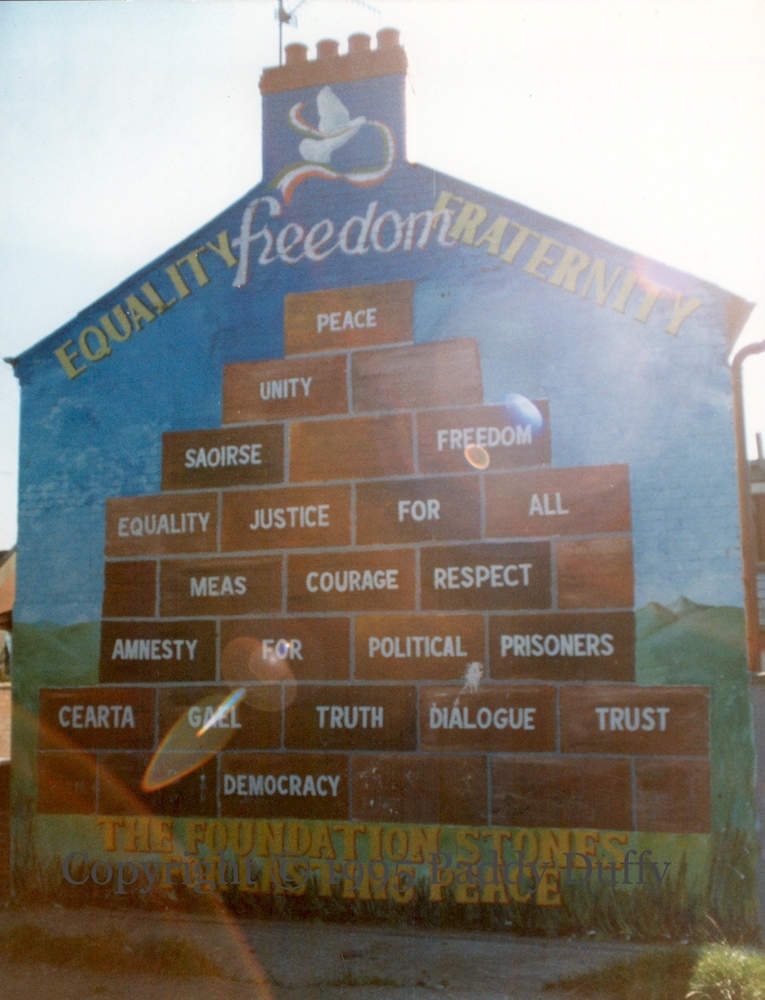
“Equality, freedom, fraternity – peace, unity, saoırse, freedom, equality, justice for all, meas, courage, respect, amnesty for political prisoners, cearta Gael, truth, dialogue, trust, democracy – the foundation stones for lasting peace.”

Amnesty for political prisoners and Irish-language rights are the concrete goals among many vague concepts being sought in the peace process – represented by the dove carrying a tricoloured ribbon on the chimney. Fág Ár Sraıdeanna adds collusion, RUC disbandment, and ending the Unionist veto.

Falls Road at the top of Fallswater Street.

Click image to enlarge
Copyright © 1994 Paddy Duffy (undated image)
T00110

The Spirit Of Freedom

A smiling Bobby Sands on the side of the Sınn Féın offices on the Falls Road, (also the west Belfast office of An Phoblacht/Republican News), with his famous statement that “Everyone, republican or otherwise, has his [here: “his/her”] own [particular] part to play” (and the lark with its “spirit of freedom“). This version was painted by Mo Chara Kelly in 1989, and an image of Sands has been on the wall continuously since then.

Sevastopol Street, west Belfast

Click image to enlarge
Copyright © 1990 Paddy Duffy
T00089

Free Ireland

Manacles “Made in Britain” constrain the republican desire for a united Ireland, contrary to the burning GPO and rising phoenix.

“Numerous foreign groups and delegations visited Ballymurphy and west Belfast during the troubles. I remember one meeting I was at in Conway Mill, I picked up a pamphlet with a drawing of a manacled fist. The caption read “Made in the USA.” So I just took the image and changed the slogan to “Made in Britain”.” (Painting My Community/An Pobal A Phéınteáıl – English-language version available for free)

The plaque – which pre-dates this mural – is to local (A Company 2nd Battalion) IRA volunteers Stan Carberry, Frankie Dodds, Paul Fox, Sean Bailey, Paul Marlowe, and Tony Campbell. “Fuaır sıad bás ar son na hÉıreann”, “Ireland unfree will never be at peace”. (See the Peter Moloney Collection.)

Painted by Mo Chara Kelly in Beechmount Avenue/RPG Avenue.

Click image to enlarge
Copyright © 1990 Paddy Duffy
T00097 T00098

Beıdh An Bua Agaınn

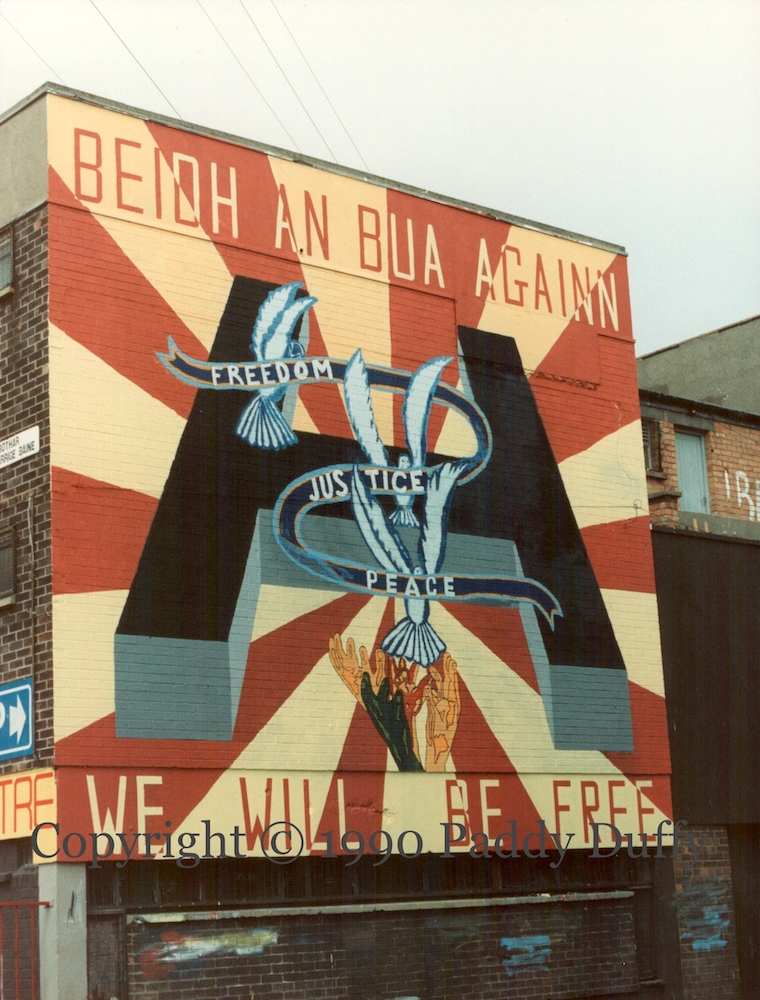
“Beıdh an bua agaınn” [victory will be ours] is a slogan that Mo Chara Kelly saw inside a cell in the H-Blocks. A circle of four hands – perhaps intended to be in the colours of humankind – releases three doves: “freedom, justice, peace”. “We will be free.”

Painted by Mo Chara Kelly at the top of the Whiterock Road, west Belfast.

Click image to enlarge
Copyright © 1990 Paddy Duffy
T00095

Oppose Censorship

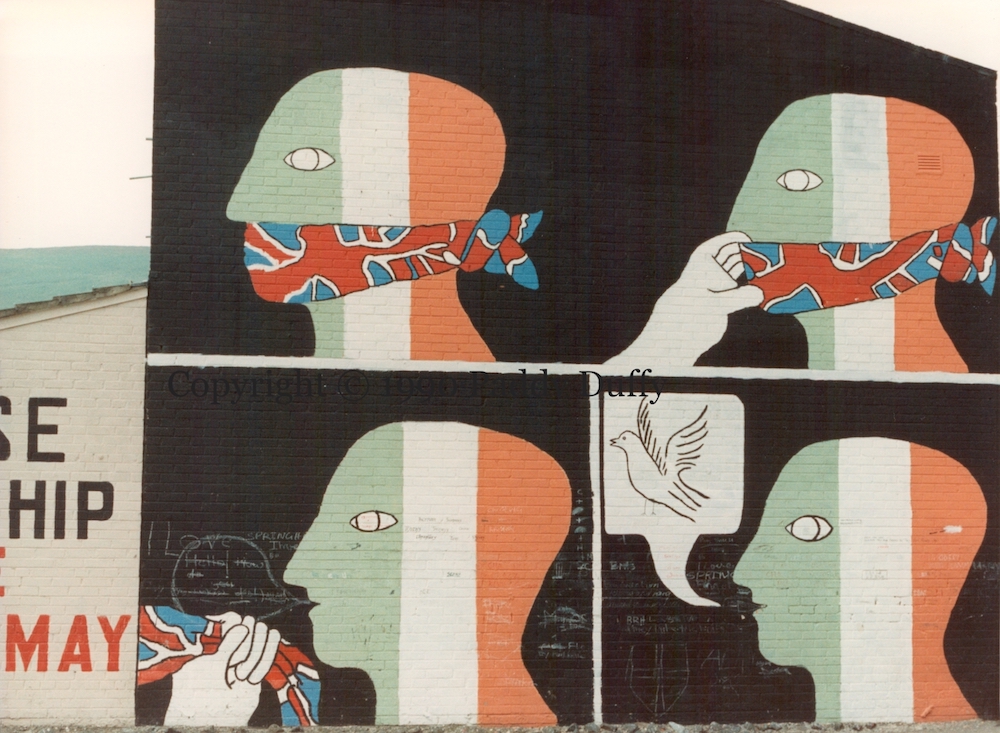
A Cormac cartoon protesting British censorship of Sınn Féın is rendered as a mural by Mo Chara Kelly. The broadcasting Ban was put in place in 1988, disallowing Sınn Féın representatives from speaking in their own voice on television and radio. But if the gag of British censorship were removed, the talk is of peace (in the form of a dove) – suggesting that there is some for negotiation on the violent removal of British forces and administration.

Out of frame to the left are written “Oppose censorship” and (in red) “Vote Richard May”. Richard May ran (unsuccessfully) for election to Belfast City Council in 1989.

Springhill Avenue, west Belfast

Click image to enlarge
Copyright © 1990 Paddy Duffy
T00083

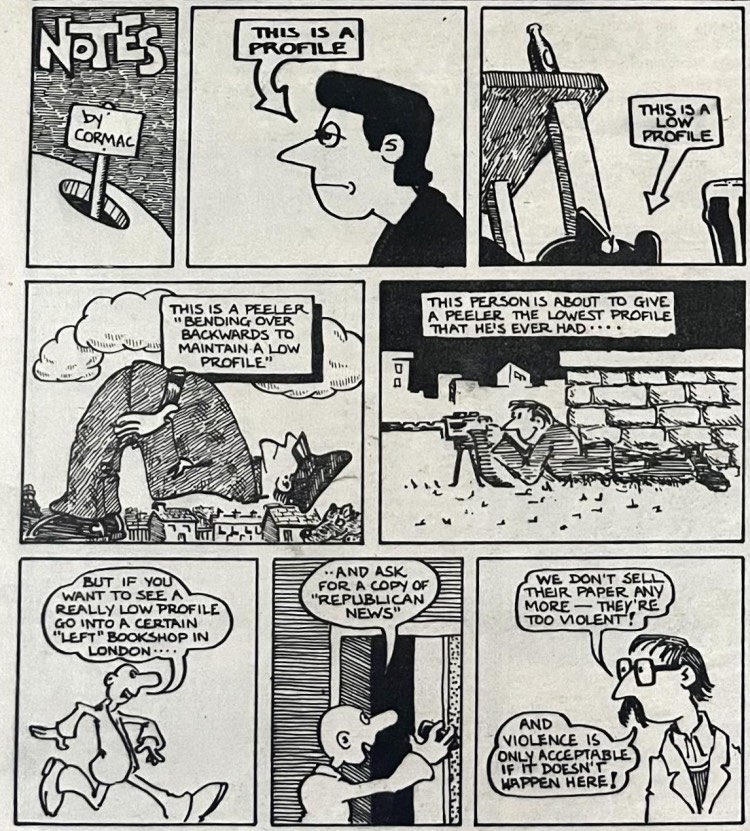
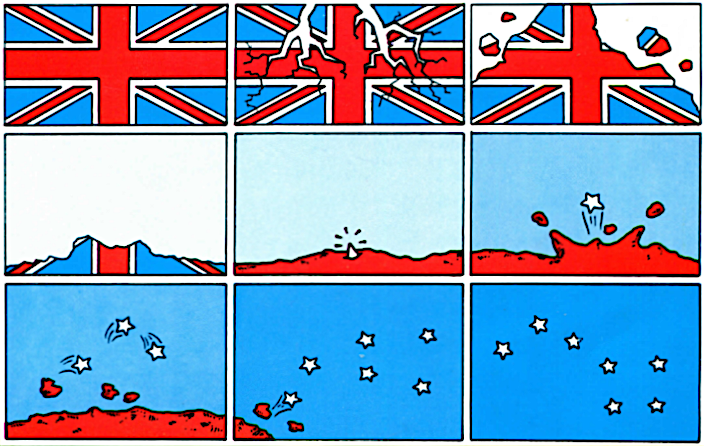
Notes For A History Of Ireland

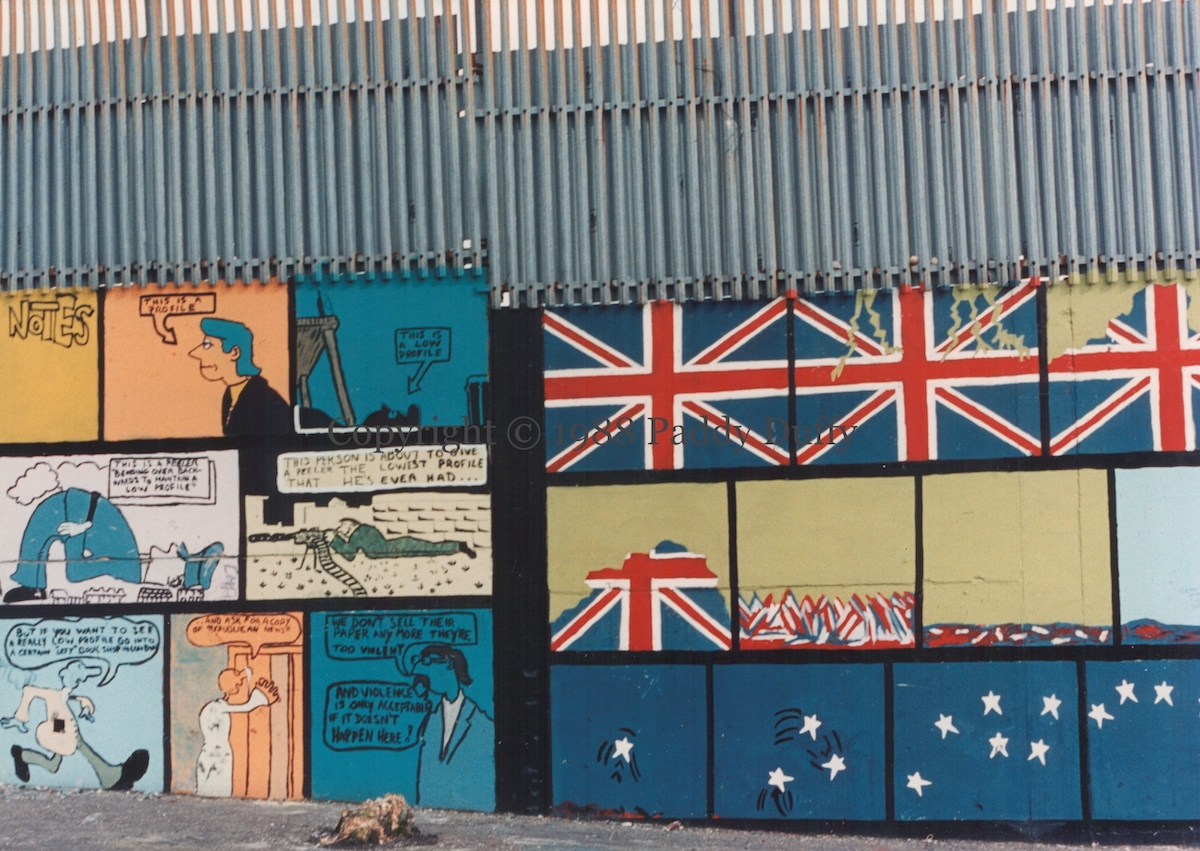
These two pieces are both by cartoonist “Cormac” (Brian Moore), as reproduced on the wall of Corry’s Timber at the top of Springhill Avenue, west Belfast, by Mo Chara Kelly.

Cormac produced cartoons for Resistance Comics, Republican News (and then An Phoblacht/Republican News), Socialist Challenge (and then Socialist Action), and Fortnight. His “Notes (For A History Of Ireland)” appeared in RN and AP/RN for about 30 years.

The mural on the left reproduces a cartoon from February 1979, combining hatred of the “Britz” and RUC with criticism of a left-leaning London bookshop that no longer stocks the paper because “violence is only acceptable if it doesn’t happen here”.

The other is an eleven-panel version of the nine-panel image that appeared on the cover of the 1982 collection Cormac Strikes Back, showing the Union Flag crumbling and the Starry Plough rising from its ashes.

Click image to enlarge
Copyright © 1988 Paddy Duffy
T00070

Long Kesh 1981

In the shadow of Long Kesh watch-towers, a blanketman draped in an Irish Tricolour is held in the arms of his father, with mother looking on, reminiscent of Michelangelo’s pietà (“pity”) in which Mary holds the body of her dead son after he has been taken down from the cross (and so it also echoes Oliver Sheppard’s statue of Cúchulaınn).

Painted by Con at the top of Donegall Road, west Belfast.

Click image to enlarge
Copyright © 1981 Paddy Duffy
T00052 [T00029]

Sacred Heart Blanketman

The image of a blanketman on all fours was also seen in Ballymurphy, Ardoyne, and Finaghy (see the 1981 CNR Murals) but in this Beechmount version, the ‘sacred heart of Jesus’ appears above the prisoner, similar to the angel on the Whiterock Road and the ‘blessed virgin Mary’ in the Rock streets.

Beechmount Drive, west Belfast

Click image to enlarge
Copyright © 1981 Paddy Duffy
T00051 [T00031]