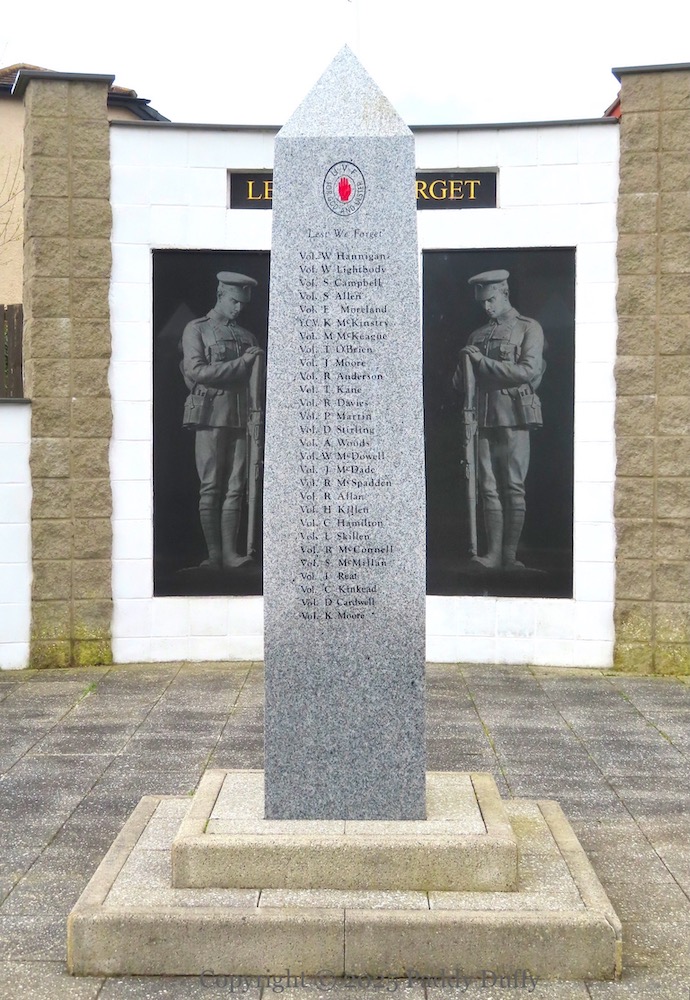
The uniforms of the graveside mourners are from WWI and the image on each side is JP Beadle’s Attack Of The Ulster Division (Royal Irish) at the Battle Of The Somme in 1916, but the names on the pillar (in the image immediately below) are from the modern UVF. Little information about any of those listed is available on-line, but ten of those listed were also on a plaque in Abbot Crescent, which was similarly in front of a 36th Division mural.
In Irish, the seven bright stars of the celestial group Ursa Major are together known as “an céachta” or “an camchéachta” – the bent plough, though the reason for the modification “bent” is unclear (Vıcıpéıd). (In other cultures they are thought of as a wagon/wain, or dipper, or the hind-quarters and tail of a bear.)
The “starry plough” flag was originally proposed in 1914 for the Irish Citizen Army and flown over the Imperial Hotel during the 1916 Rising (WP); it is now the symbol of the INLA/IRSP (web) and many current anti-Agreement groups,
The starry plough shown here, in Cliftonpark Avenue, north Belfast, has the correct number of stars – seven – but has lost its typical shape.
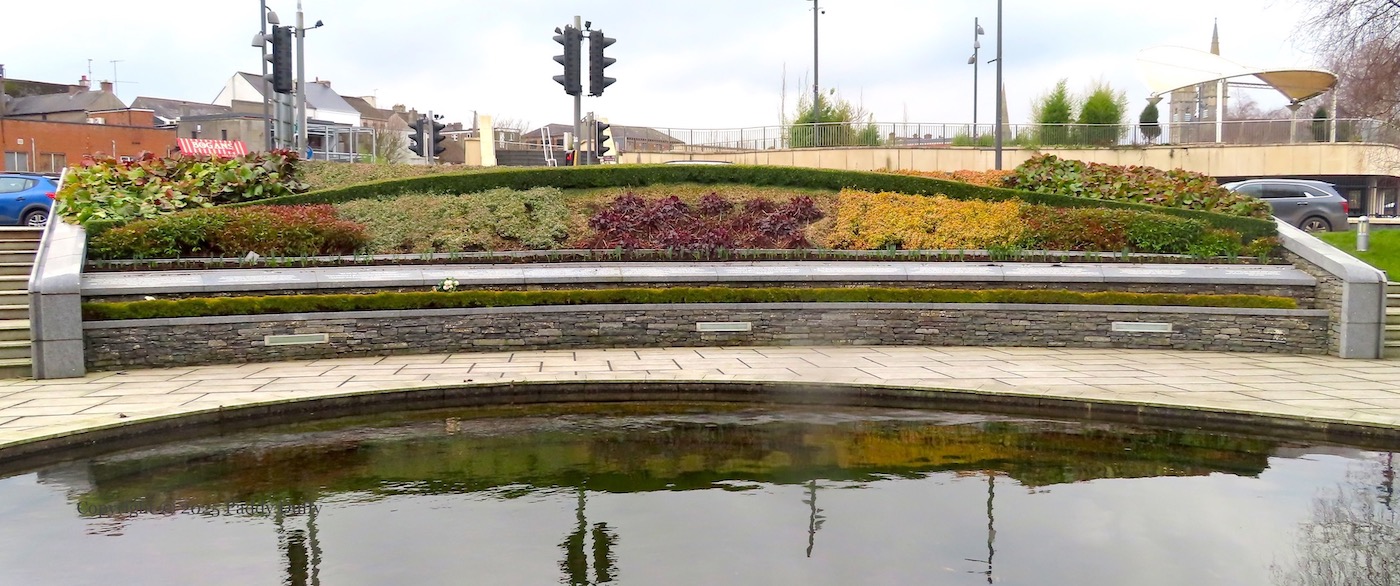
This memorial to the victims of the Omagh bombing is in a green-space along the Strule river about 300 metres (WP) from the spot where an RIRA car-bomb exploded on the afternoon of 15th of August 1998, killing twenty-nine people and injuring more than 200 others.
The garden was opened on the tenth anniversary, in 2008 (replacing a smaller obelisk). It includes 31 mirrors on poles (including a set of unborn twins in the number of deceased) which are part of a reflective system that sends sunlight towards a crystal pillar in Market Street that marks that spot of the bomb (Troubles Archive).
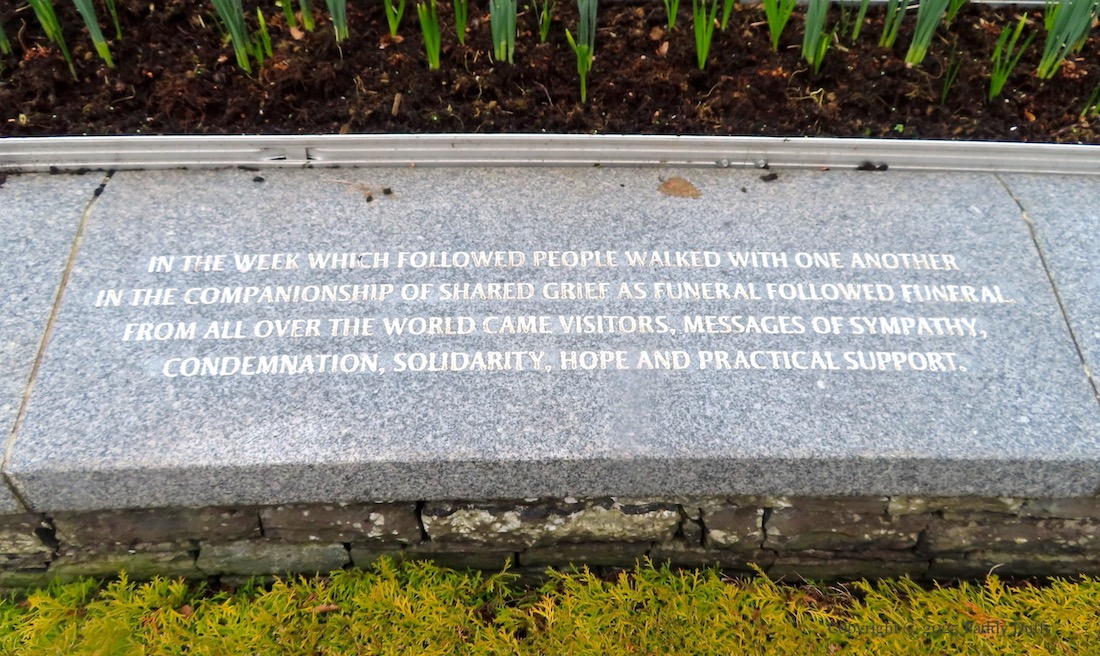
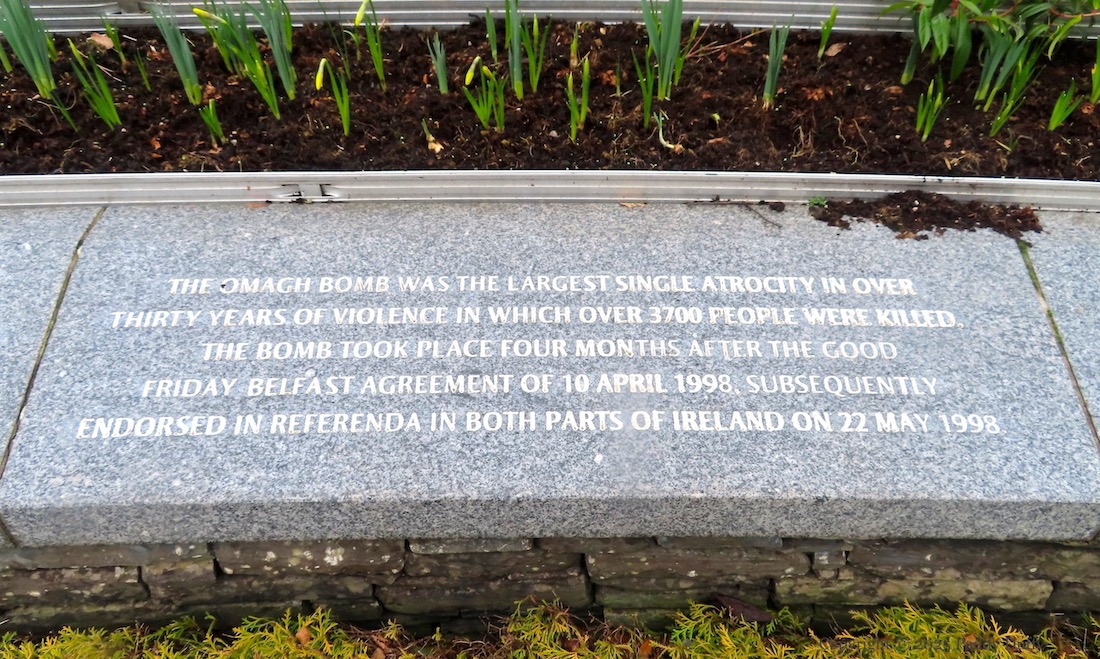
There are also a series of engraved stones on an arc around the pool that tell the story of the day and its aftermath, as well as naming the dead:
“Weather wise it was one of the best days that summer had seen. Ordinary people were doing ordinary things on an ordinary day. In one fateful moment all this was changed forever. Time stood still, futures were obliterated, loves were shattered, hearts were broken. In the carnage, emergency personnel and many ordinary people reached out, helped the injured, gave hope to the dying and held the dead. That evening a great silence descended on the town. In the week which followed the people walked with one another in the companionship or shared grief as funeral followed funeral. From all over the world came visitors, messages of sympathy, condemnation, solidarity, hope and practical support. The Omagh bomb was the largest single atrocity in over thirty years of violence in which over 3700 people were killed. The bomb took place four months after the Good Friday/Belfast Agreement of 10 April 1998, subsequently endorsed in referenda in both parts of Ireland on 22 May 1998. In the years that followed people Omagh and elsewhere sought to rebuild their lives, their families, their community, and to create a new future. Regardless of the past, every new days dawns as a gift laden with its own possibilities, as the morning sun banishes the darkness of night.”
One of the stones reads “Bear in mind these dead/Coınnıgh ı gcuımhne na maırıbh seo/Tened en cuenta a estos muertos – (John Hewitt)”; two of the victims were Spanish.
Drumragh Avenue, Omagh
“Saturday 15 August 1998 at 3.10 PM. To honour and remember the 31 men, women and children who were killed, the hundreds injured and those whose lives were changed forever in the Omagh bomb. ‘The light shines in the darkness and the darkness has not overcome it’ (John 1.5)”
“To honour and remember 31 people murdered and hundreds injured from three nations by a dissident republican terrorist car bomb. (Omagh Support And Self Help Group)”
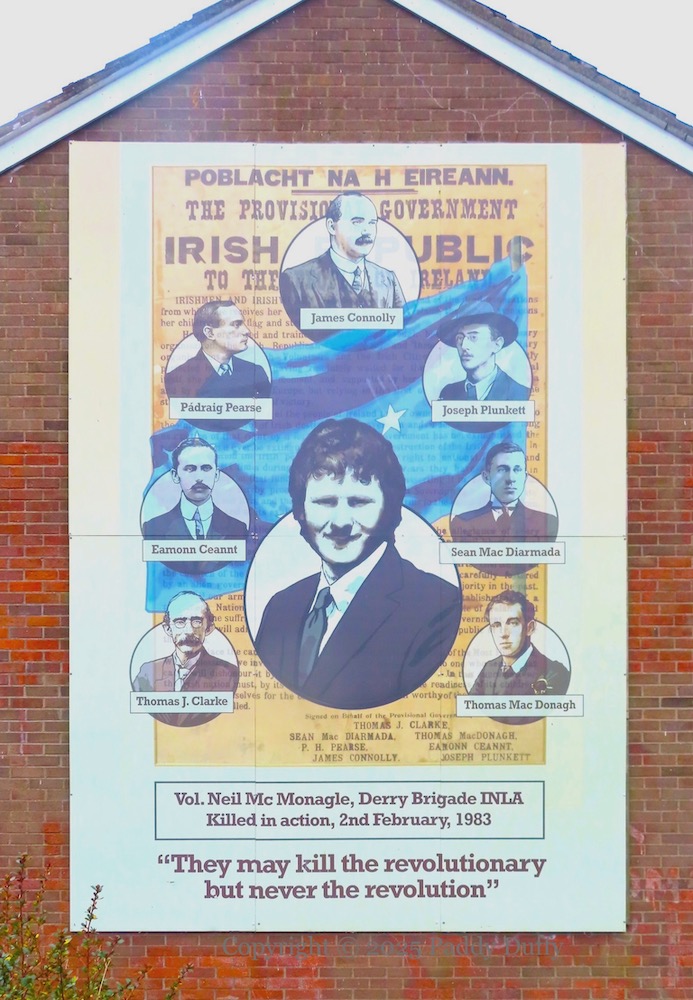
Derry IRA man Neil McMonagle is placed among the seven signatories of the proclamation of the provisional government of the Irish Republic.
The board is in Leafair Park, Derry, close to the spot where McMonagle, aged 23, along with friend Liam Duffy, were shot by undercover British soldiers (specifically Sergeant Paul Oram of 14 Intelligence Company (WP)) on February 2, 1983. McMonagle died instantly while Duffy was wounded but survived. The official account alleged that both McMonagle and Duffy were armed; locals deny this. For an account of the killing and a tribute, see these obituaries from republican publications in 1983.
“Vol Neil McMonagle, Derry Brigade INLA. Killed in action 2nd February 1983. “They may kill the revolutionary but never the revolution.””
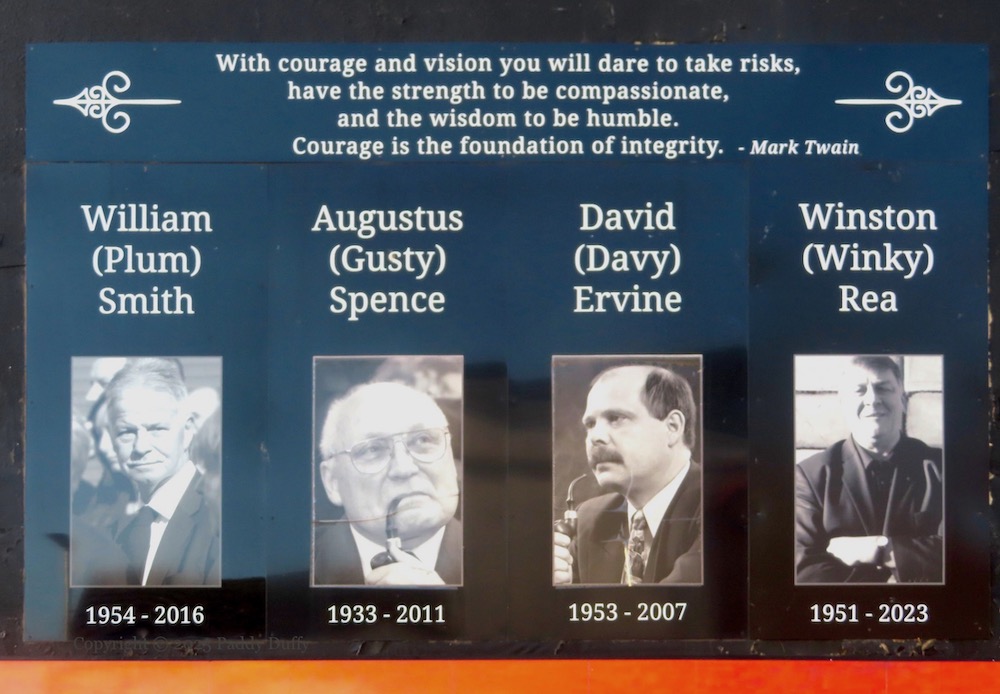
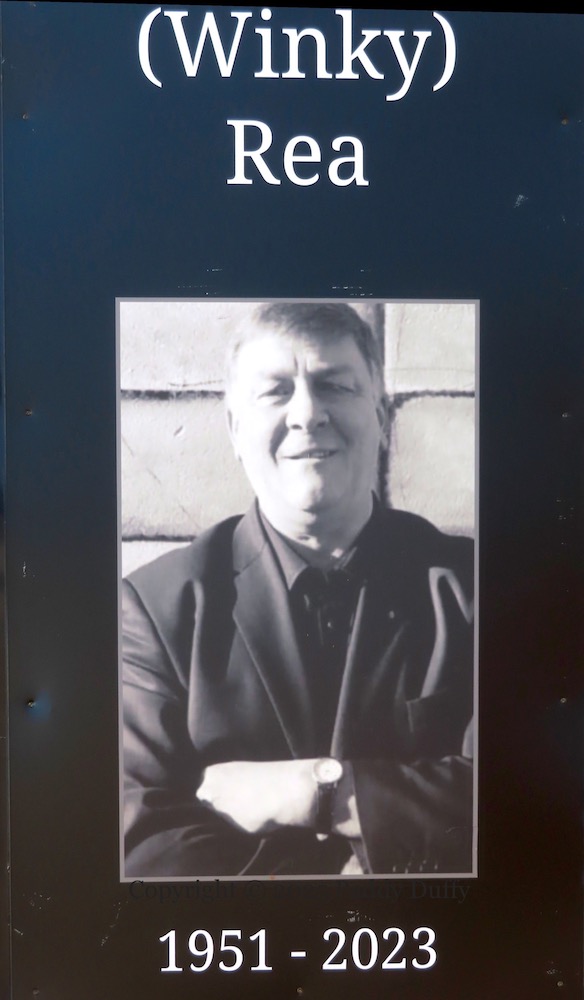
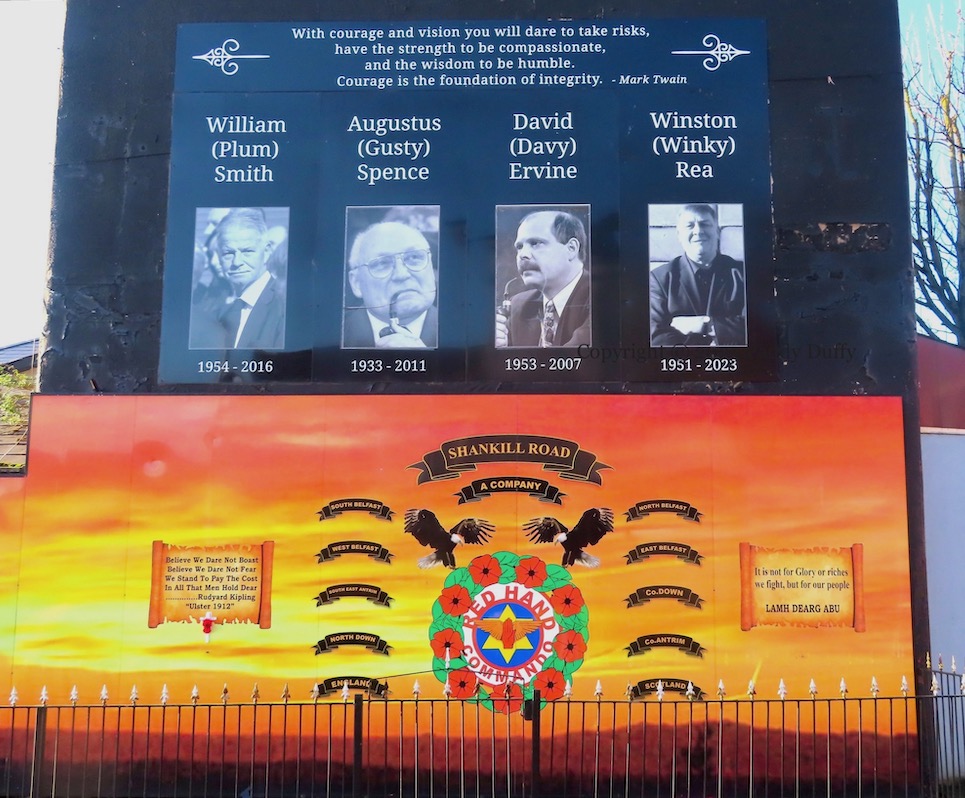
A portrait of Winston Winky/Winkie Rea has been added to the gallery above the Red Hand Commando board in the upper Shankill, taking the place of a pesudo-Mark Twain quote that has been reproduced in a horizontal format above the quartet. (See the previous iteration.)
Like the other three, Rea was a RHC (or UVF) member who then became a member of the Progressive Unionist Party (PUP). On the basis of his interview with the Boston College project, he was charged with crimes including two murders and two attempted murders (BBC | BBC). The trial was still on-going when he died in December of 2023.
“With courage and vision you will dare to take risks, have the strength to be compassionate, and the wisdom to be humble. Courage is the foundation of integrity. – Mark Twain [Keshavan Nair].”
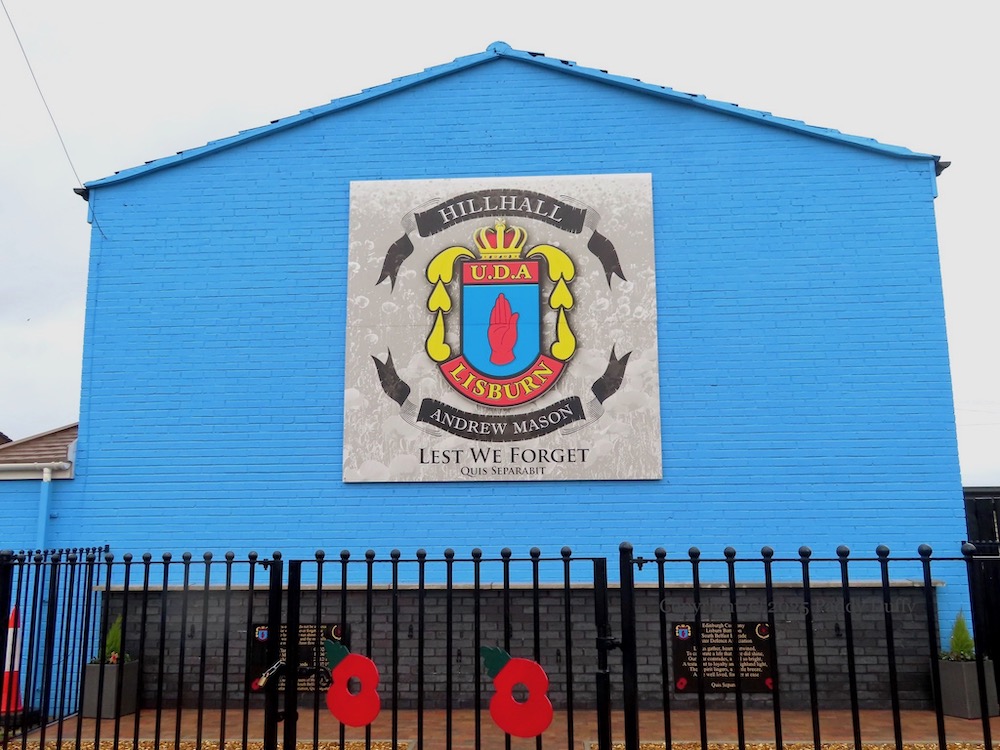
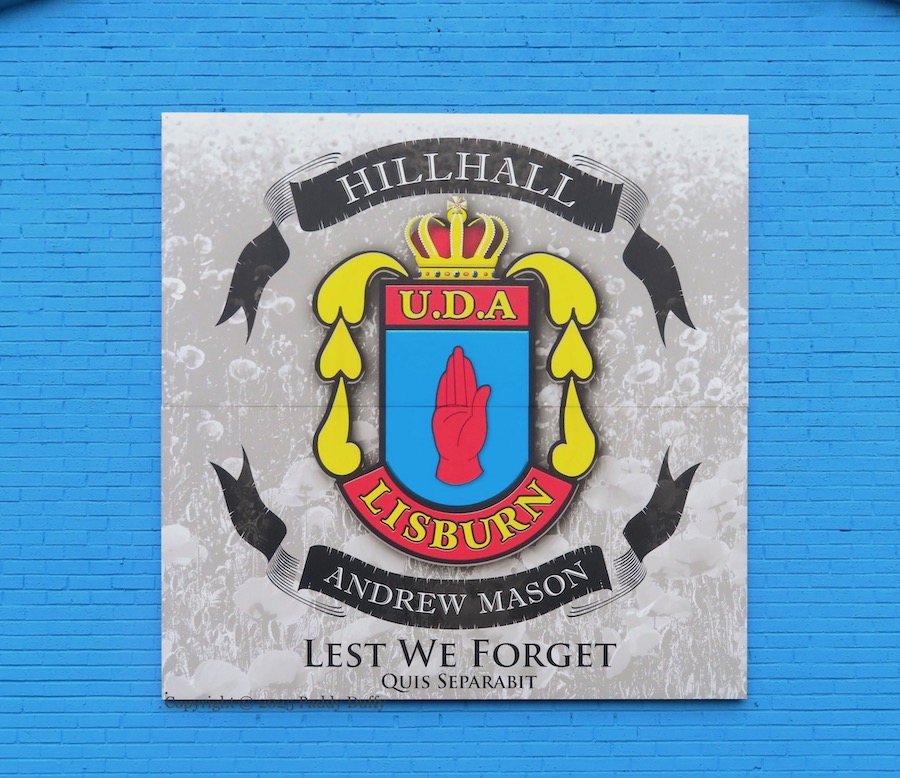
The Andrew Mason memorial garden in Hillhall, Lisburn, has been revamped, with a blue background on the gable wall, the removal of two small bronze plaques below the board (for which see the Peter Moloney Collection), a rebuilt lower wall to which two new plaques have been added, and an expanded “garden” with new fencing.
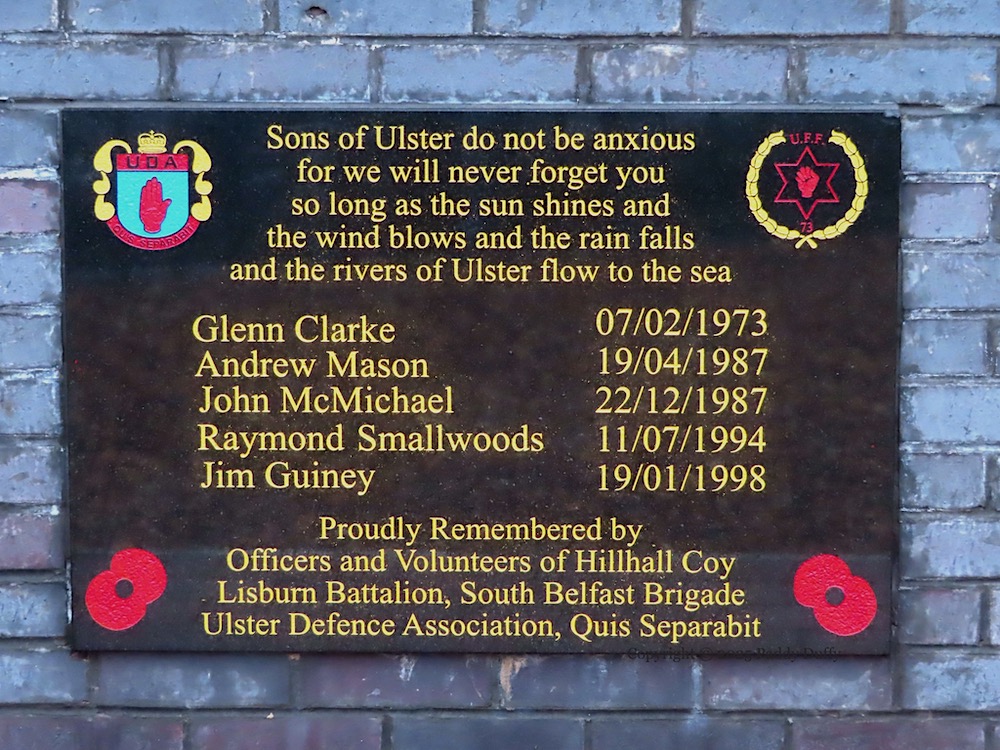
The plaque on the left a new version of the plaque to John McMichael, Raymond Smallwoods, Jim Guiney, and Mason – Glenn Clarke has been added. (Compare with 2023.)
“Sons of Ulster do not be anxious for we will never forget you as long as the sun shines and the wind blows and the rain falls and the rivers of Ulster flow to the sea. Always remembered by volunteers from Hillhall C Company.”
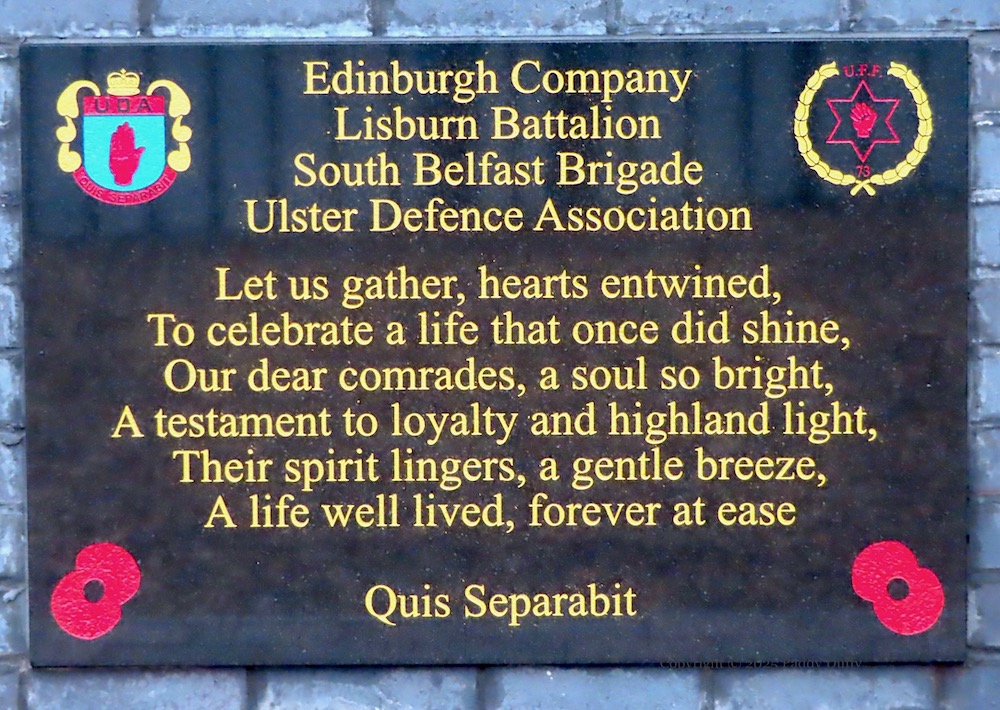
The entirely new plaque on the right reads: “Edinburgh Company, Lisburn Battalion, South Belfast Brigade, Ulster Defence Association – ‘Let us gather, hearts entwined,/To celebrate a life that once did shine,/Our dear comrades, a soul so bright,/A testament to loyalty and highland light,/Their spirit lingers, a gentle breeze,/A life well lived, forever at ease.'” “Edinburgh Company” perhaps indicates the source of the funds that made the modifications possible.
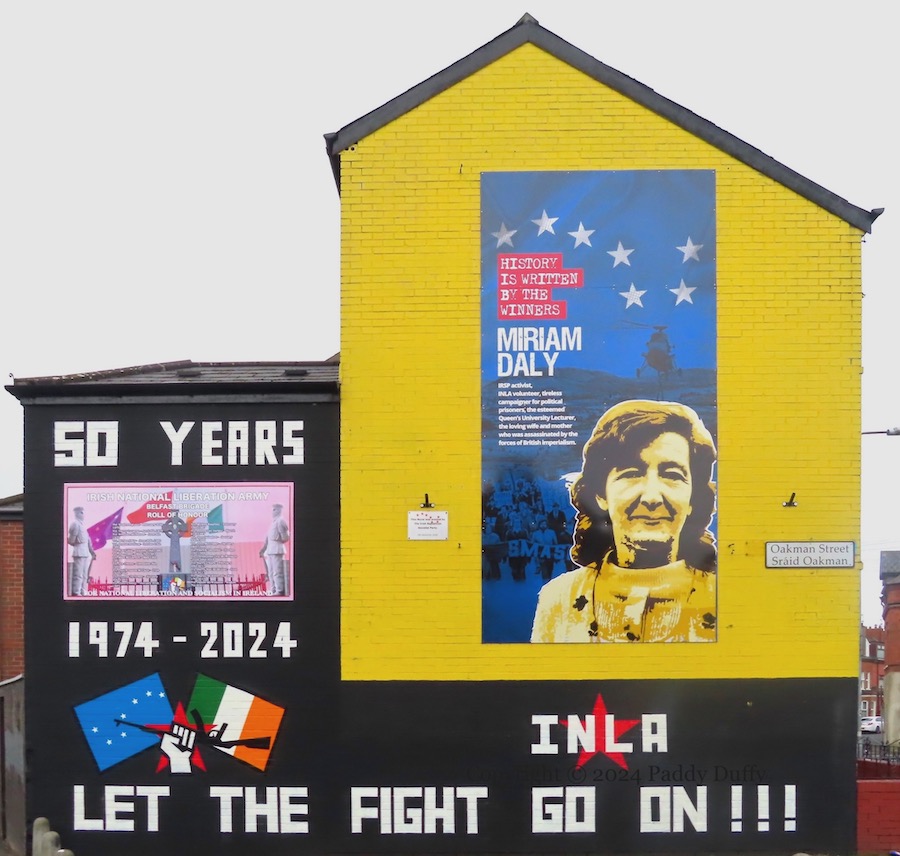
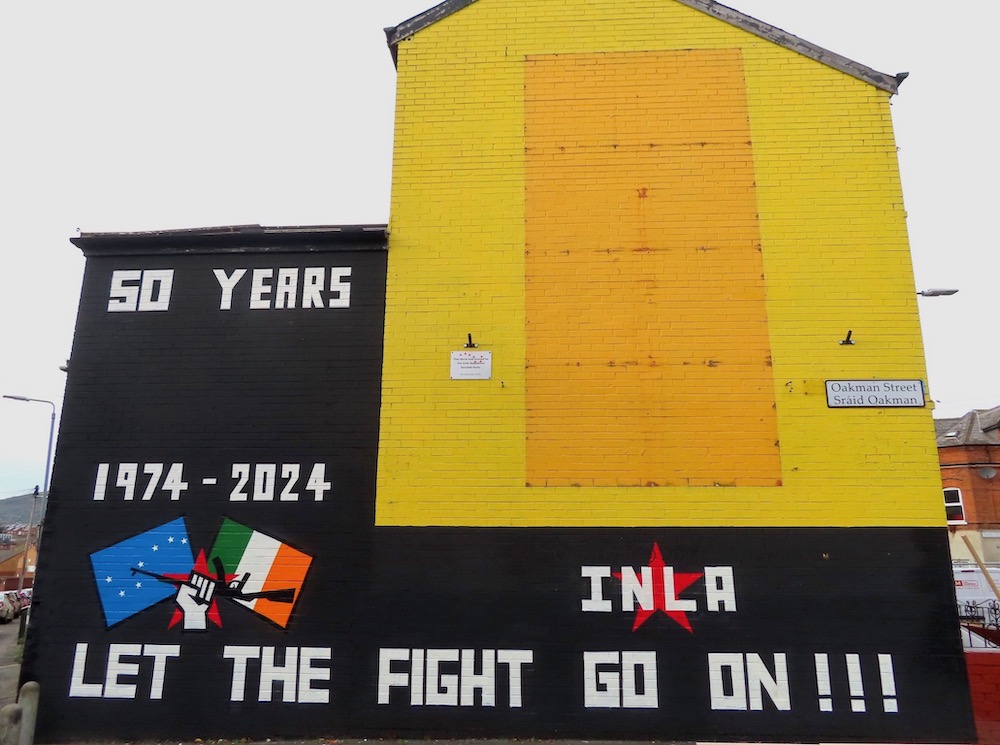
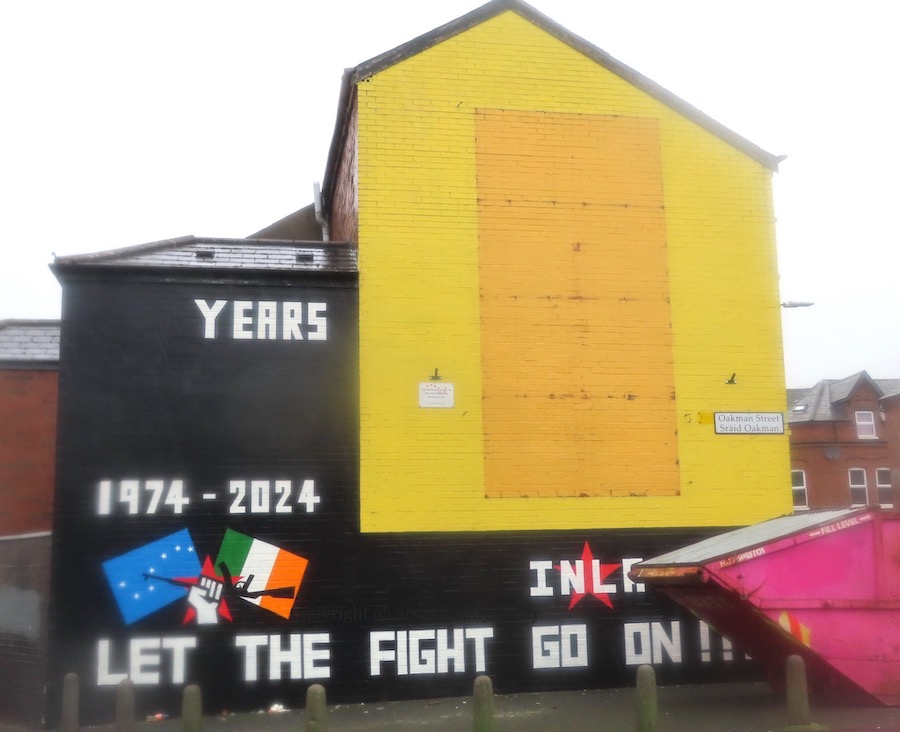
This entry updates Let The Fight Go On!!! from December 1st, which showed the new INLA 50th anniversary wall in Oakman Street but without the (pink) roll of honour on the left. Those listed in the roll of honour are: Hugh Ferguson, Danny Loughran, Brendan McNamee, Miriam Daly, Ronnie Bunting, Noel Little, Jim Power, Matt McLarnon, Joe Craven, Paul “Bonanza” McCann, Thomas “Ta” Power, John O’Reilly, Mickey Kearney, Emmanual Gargan, Gino Gallagher, John McColgan, Patrick Campbell, Christopher “Crip” McWilliams, Harry O’Hara, Barry “Bar” McMullan, Martin McElkerney, James McWilliams. The last five post-date the Agreement, starting with Patrick Campbell, who died in 1999 at the hands of drug-dealers in Dublin (Irish Times | Bel Tel).
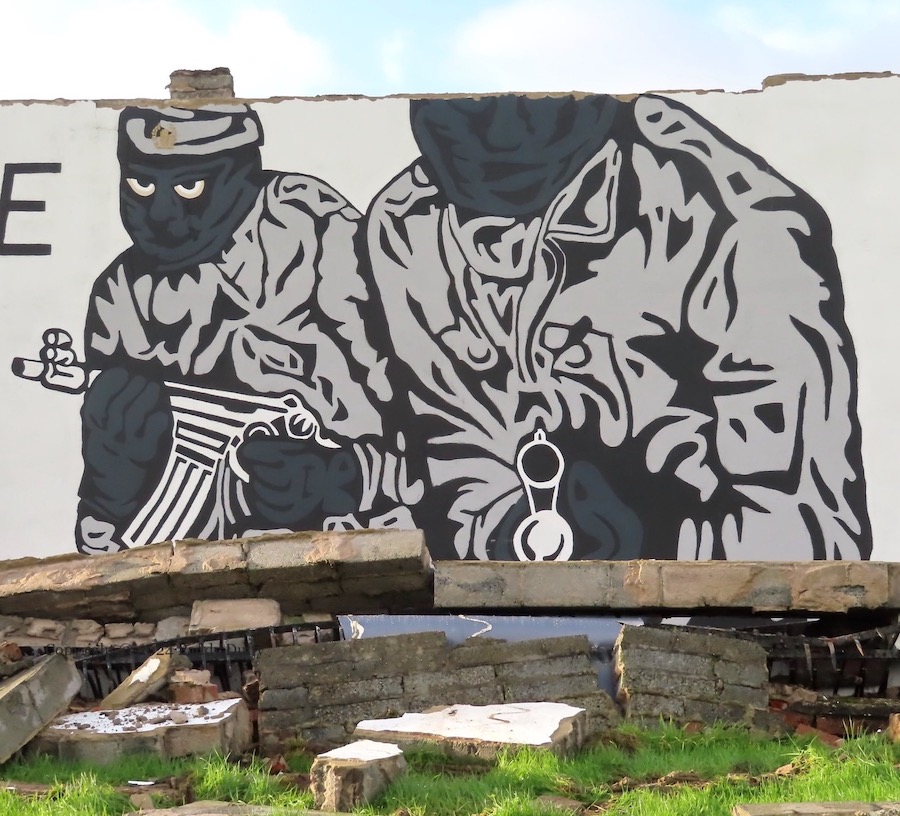
The UVF hooded gunmen mural in Mount Vernon, which “greets” drivers coming off the M2 at the Shore Road, has been damaged by Storm Darragh, which had winds of 90 m.p.h. and more, with the apex and a further 6 feet of masonry coming down. (Belfast Live gallery of NI damage | BBC gallery of UK storm damage.)
This wall is NIHE property (pdf) and the need for repair or reconstruction might delay any repainting of the mural.
The mural in this location dates back to 2001 (here are images from 2006 and 2012) and was touched up in 2022 (T01300 | X10660). The original mural – which dates back to the ceasefire era (1995) – was on a gable at the front of the estate but the entire block of houses was razed – see T00138 | D00382.
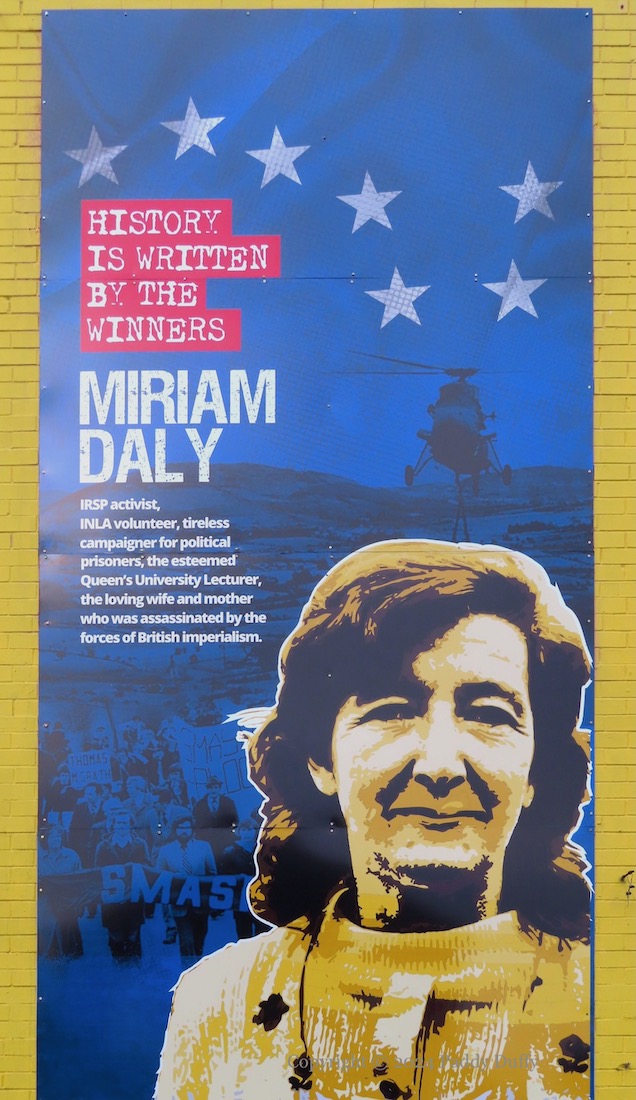
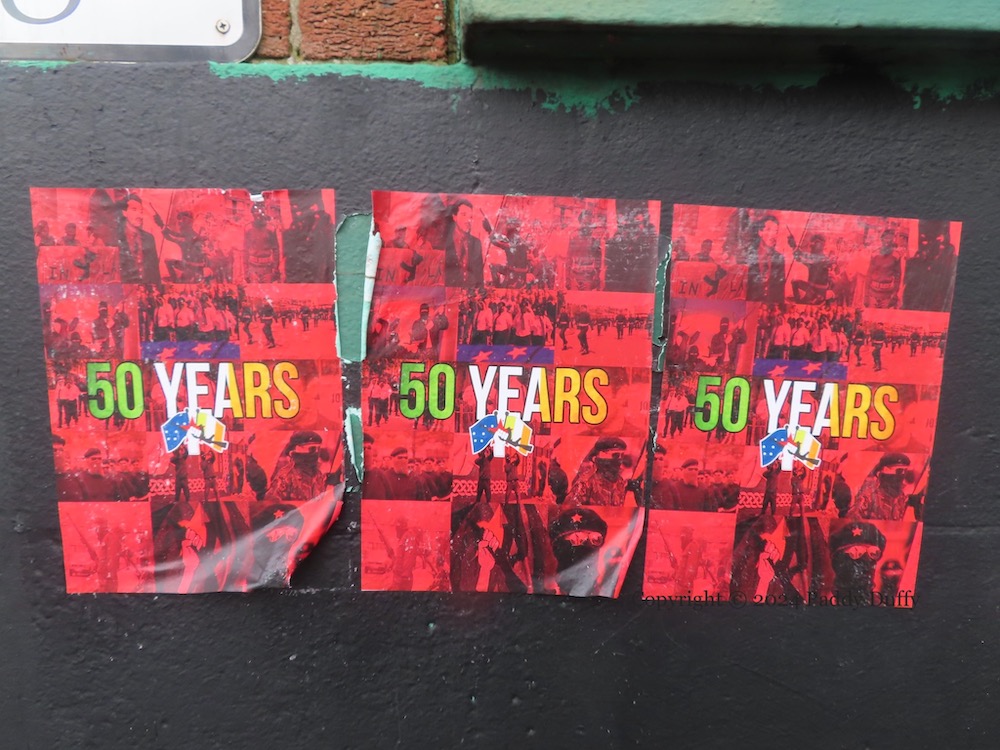
The Miriam Daly board (mounted in 2016) was temporarily taken down while the frame was painted to mark the fiftieth anniversary (“1974-2024”) of the creation of the INLA on December 8th, 1974 (WP). “Let the fight go on” are the final words of (INLA) hunger-striker Patsy O’Hara; the group officially ended its armed campaign in 2009 (BBC).
See also the fiftieth anniversary graffiti in Waterford St | mural and graffiti in the Bogside, Derry.
This is a new UDA board in Monkstown, Newtownabbey. At the top we see the emblems of “Loyalist Prisoners’ Aid” and “Ulster Defence Union” alongside the familiar UYM and UFF emblems. For the UDU, see the entry on one its earliest appearances, in a 2009 mural in the lower Shankill. Loyalist Prisoners’ Aid is a fundraising album of UDA songs (now freely available at SoNIC). (Also seen: an LPA flag flying in Newtownards in 2018.)
The photograph at the bottom (close-up below) shows the UDA marching in 1972 in North Street, Belfast city centre. (Of the buildings on the left, only the brick building housing “Castle jewellers” remains standing – Street View.) The original photograph can be seen at Alamy.
“This memorial is dedicated to the memory of the officers and members of our organisation who were murdered by the enemies of Ulster and to those who paid the supreme sacrifice whilst on active service during the present conflict. Quis separabit.” Four of the 1st battalion dead are named in the mural across Devenish Drive – see Monkstown UDA.
Ards Park, Monkstown, Newtownabbey. For the previous mural in this spot, see Murals Irlande Du Nord.












 Paddy Duffy Collection