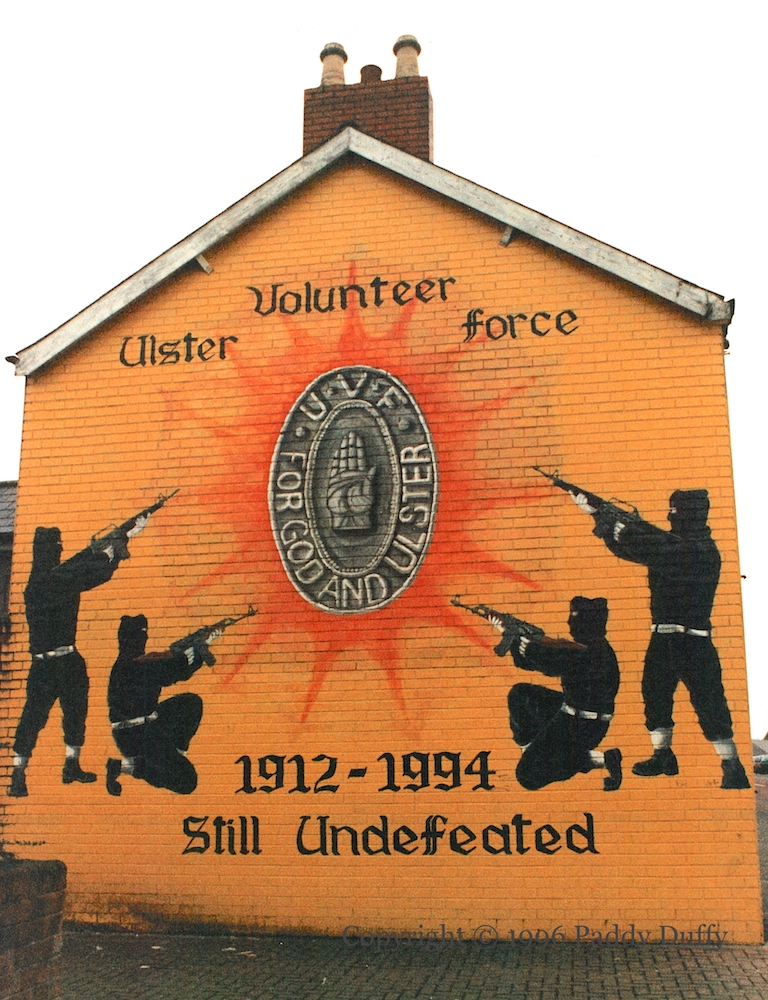
“UVF – 1912-1994 – still undefeated”. The UVF joined the ceasefire in October, 1994, and since this image is from 1996 and this mural continued to exist until 2002 (including a repainting in 2000 – see D00981) we can take it as an expression of continued readiness for armed violence, without any mention of “compromise” or of being “prepared for peace“.
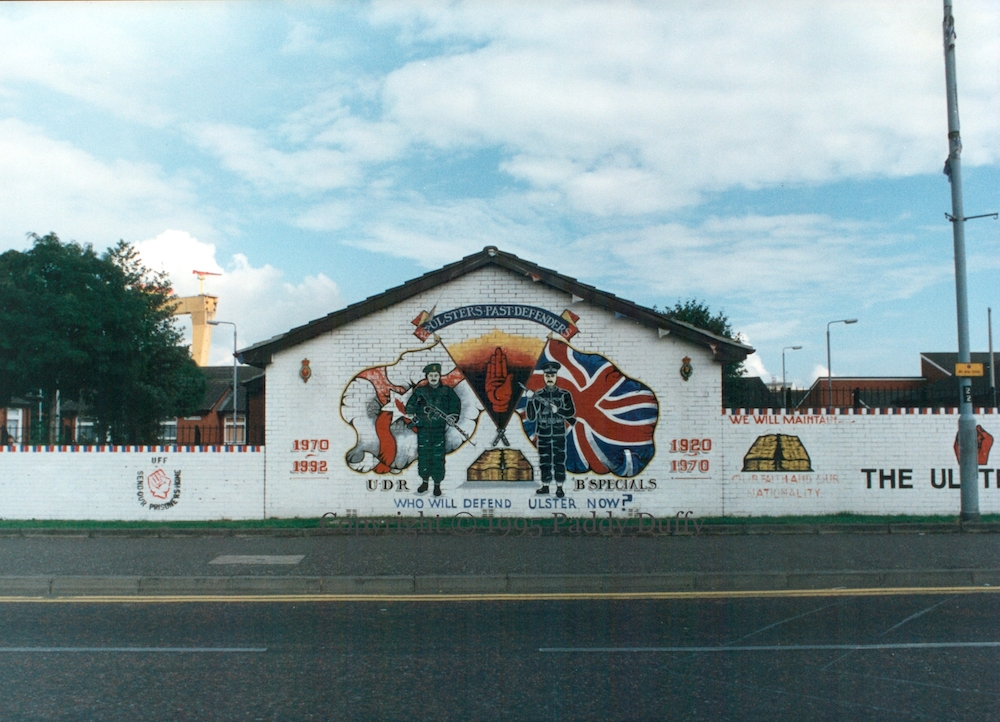
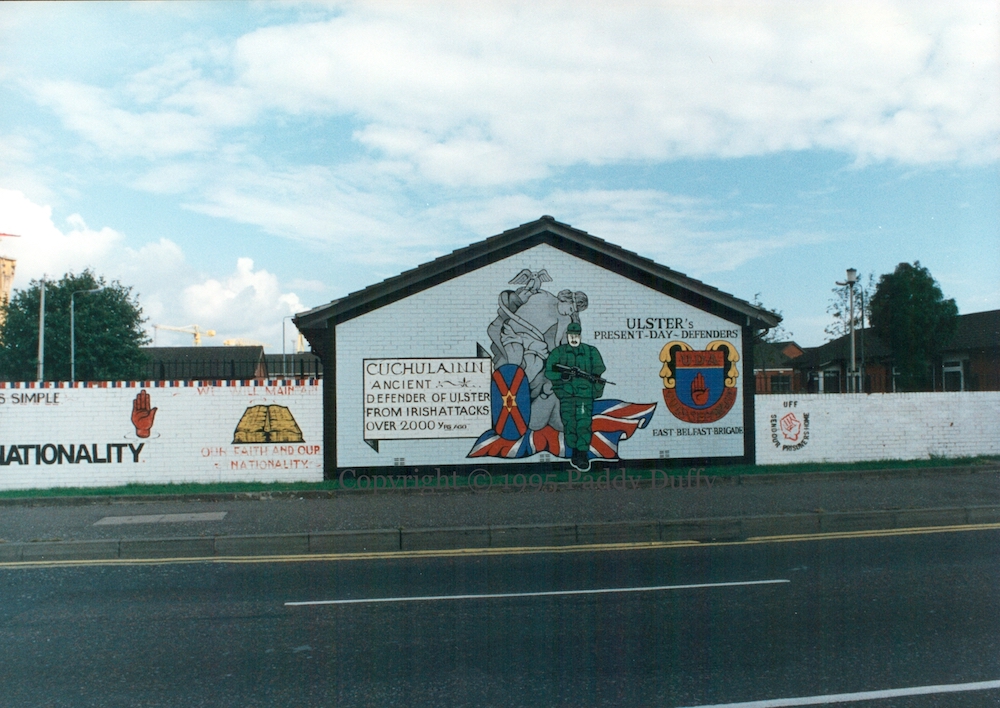
Here is a gallery of the one-storey gables along the Newtownards Road, east Belfast, that is being called “Freedom Corner”, perhaps in imitation of Free Derry Corner (Visual History).
The two low walls between the first-and-second and third-and-fourth gables are blank except for small stencils reading “Send our prisoners home” (for a close-up on shutters on the other side of the street, see the Peter Moloney Collection). The issue of POWs is a shared concern of loyalists and republicans in the (public) discussion surrounding the ceasefire and the peace process and these stencils are from 1994 or 1995. The rest of the pieces date back to 1991 (or 1992).
First is a UFF and LPA/LPOW pair. On the side-wall “Their only crime is loyalty – we forget them not”. The main wall shows a hooded volunteer and rifle, with the “U” of “UFF” wrapped in barbed wire. (The words “East Belfast Brigade” would later be added in the middle.) The quote is modelled on the Declaration of Arbroath: “For as long as one hundred of us remain alive we shall never in any way consent to submit to the rule of the Irish, for it is not for glory we fight but for freedom alone which no man loses but with his life.” (Originally, “for, as long as but a hundred of us remain alive, never will we on any conditions be brought under English rule. It is in truth not for glory, nor riches, nor honours that we are fighting, but for freedom – for that alone, which no honest man gives up but with life itself.”)
The second gable shows two figures from “Ulster’s past defenders”, the B Specials and the Ulster Defence Regiment. The UDR replaced the Specials in 1970 but in 1992 was amalgamated with the Royal Irish Rangers to become the Royal Irish Regiment. Although seven battalions of the new RIR were permanently based in Northern Ireland, the mural asks “Who will defend Ulster now?” (The answer is on the next gable.)
The third gable makes Cú Chulaınn (Visual History) – the “ancient defender of Ulster from Irish attacks over 2000 years ago” – a precursor of the UDA’s East Belfast Brigade, “Ulsters present day defenders”. The volunteer is – unusually – unmasked; it might be Ian Adamson (a civilian, but here given paramilitary gear) the UUP politician and proponent of the hypothesis that north-east Ulster was settled by settlers from Scotland – the Cruthin – who were at war with the Irish Gaels and that the Táın describes part of this conflict, with Cú Chulaınn the hero of Ulster single-handedly holding off the invaders from Connacht (WP).
This is a repainting of a 1992 mural (see M00959) and the main difference is that the shield was previously decorated with an Ulster Banner, whereas it is here decorated with the flag of the independent Northern Ireland proposed in the UDA’s policy document Common Sense, a St Patrick’s cross on a blue background with six-pointed star and red hand.
Fourth: Young Newton was a “tartan” youth gang in the early 1970s whose members joined the nascent “UYM” [Ulster Young Militants] circa 1974. The Young Newton were one of many tartan groups that joined the UYM/UDA, though the nearby Woodstock Tartan joined the Red Hand Commando.
The columns on either side are entwined with ribbons/banners reading “Our civil and religious / liberties we will maintain”, which is a paraphrase of King William III, who proclaimed as he landed in England in 1865, (in French) “the liberties of England and the Protestant religion I will maintain.”
There is a piece of “UVF” graffiti over the flag on the left. Again (as with the third gable), the flag is the flag for the independent Northern Ireland.
This is the second Bobby Sands mural on the wall of the offices of Sınn Féın and An Phoblacht/Republican News on the Falls Road. For the first, see The Spirit Of Freedom. Gone from that first mural is the lark in barbed wire, replaced by a skyline of Maze/Long Kesh watch-towers, but the smiling Sands and the quotation from him remain: “Everyone, republican or otherwise, has his [here: “his/her”] own [particular] part to play”.
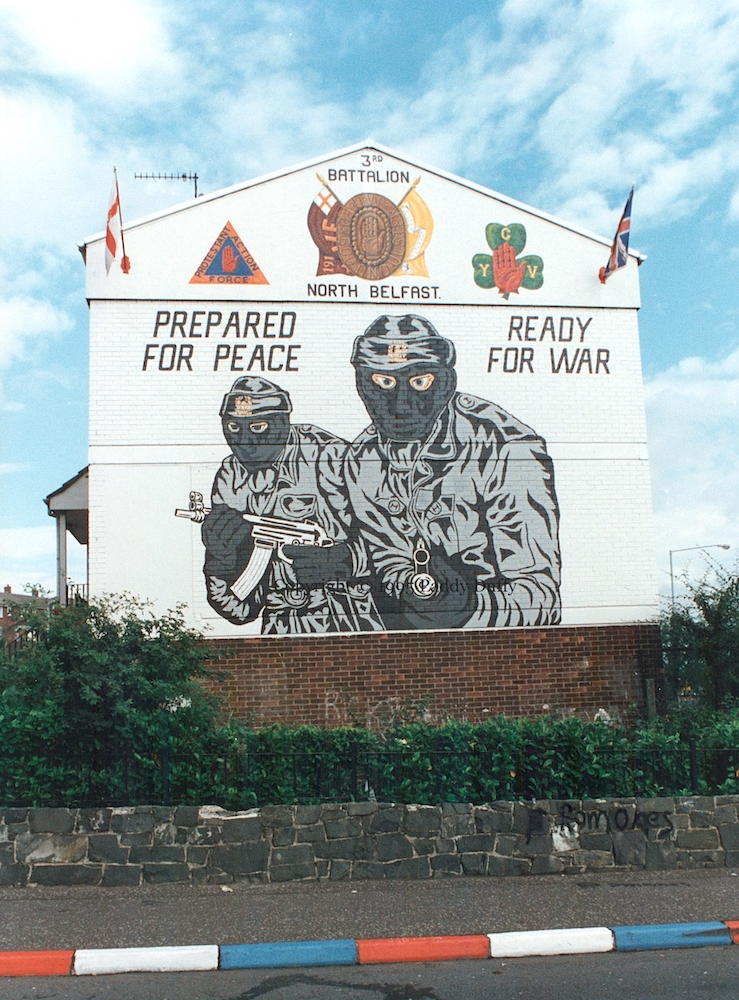
These UVF hooded gunmen are at the entrance to the Mount Vernon estate in north Belfast. The message “prepared for peace, ready for war” expresses a wary skepticism about the ceasefire. The IRA’s ceasefire began in August 1994, and the UVF’s in October.
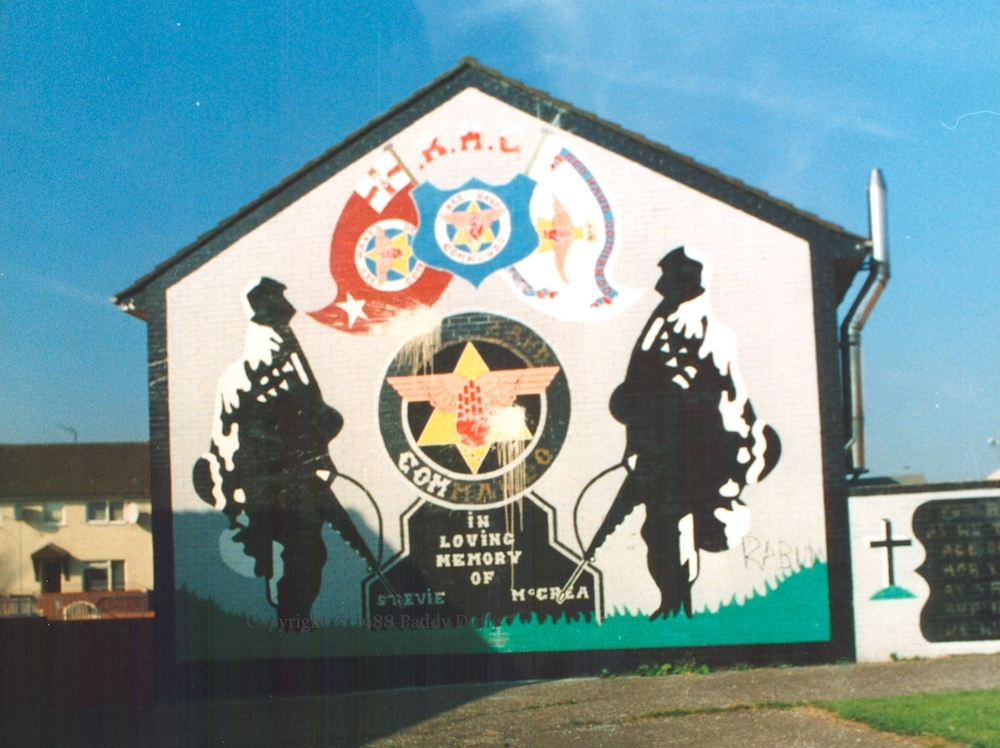
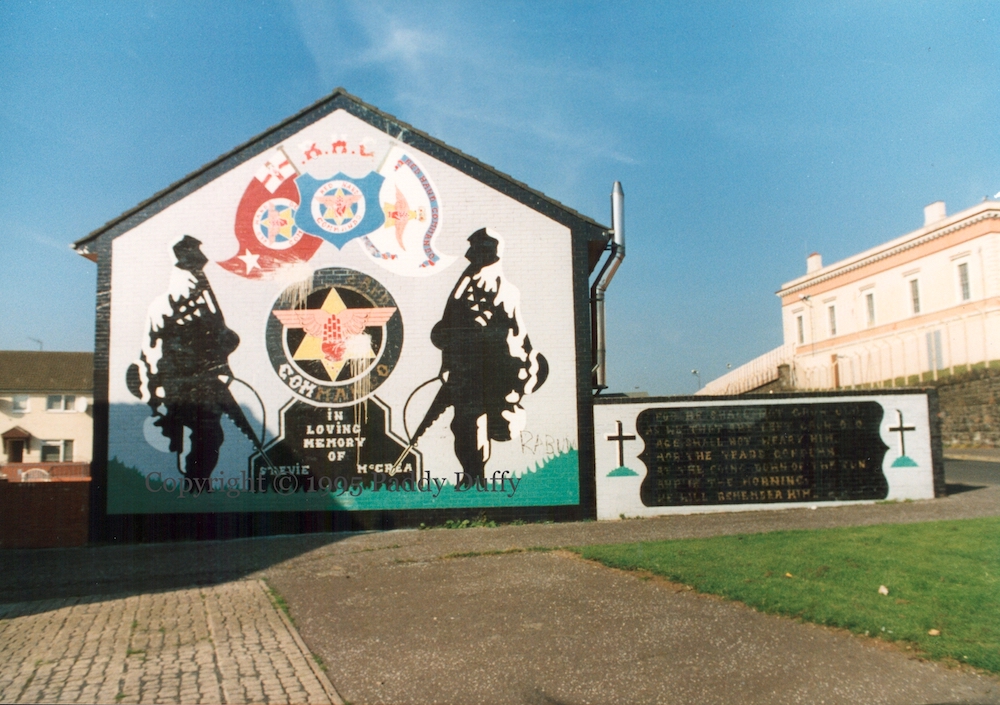
“In loving memory of Stevie McCrea”. Red Hand Commando volunteer Stevie McCrea was sentenced to 16 years for the murder of James Kerr in 1972 (Behind The Mask) and was subsequently “murdered by the enemies of Ulster” on February 18th, 1989 in an IPLO attack on the Orange Cross (WP). (The door of the club can be seen next to the mural in M00560.)
On the side-wall, Binyon’s ‘For The Fallen‘ is modified for the singular “he”: “For he shall not grow old as we that are left grow old. Age shall not weary him nor the years condemn. At the going down of the sun and in the morning, we will remember him.”
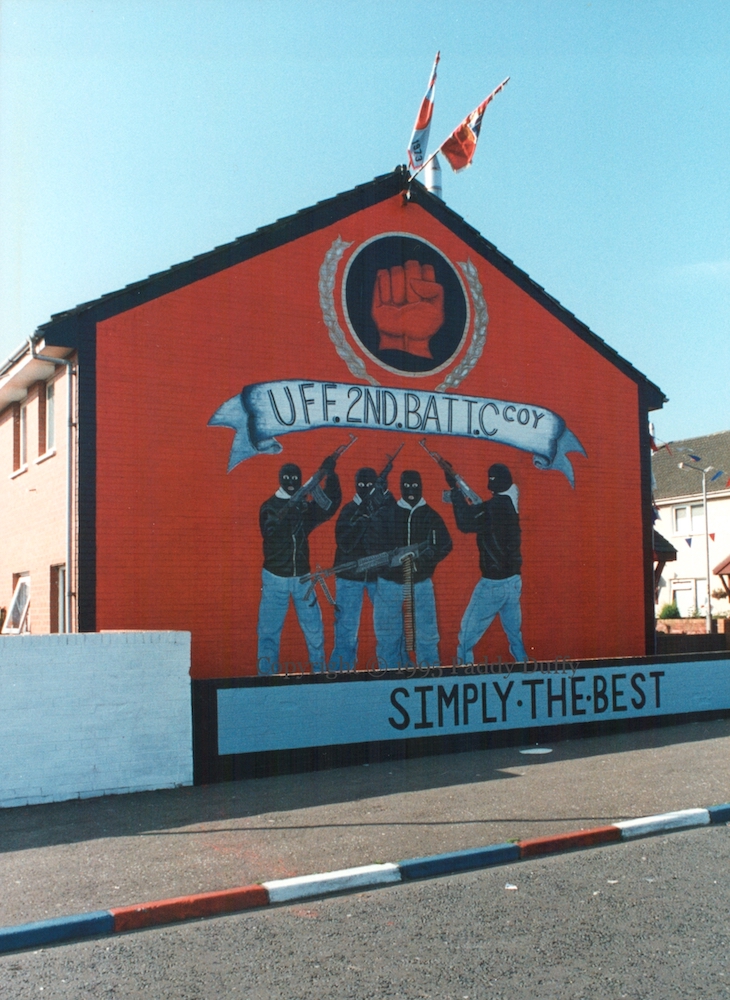
Tina Turner’s cover (youtube) of Bonnie Tyler’s song “The Best” reached #5 in the UK charts in 1989 and the phrase “simply the best” from the chorus would appear in a number of UDA murals over the years, beginning with this 1995 mural depicting hooded gunmen from the UDA/UFF’s second battalion C company.
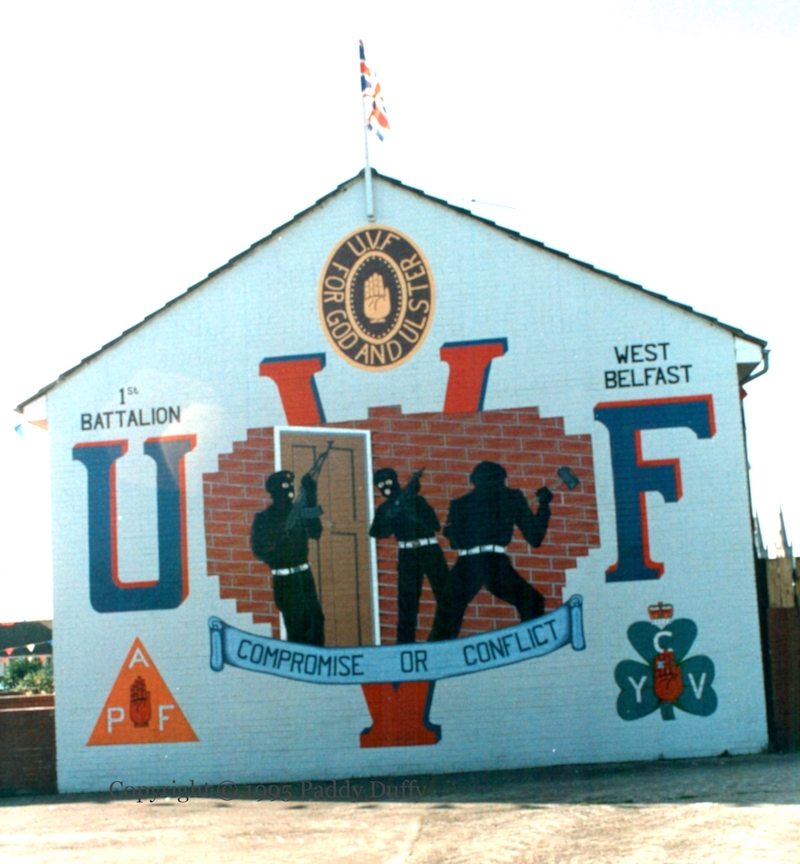
Dover Place, west Belfast. This mural would be repainted in the Adair era to include a list of mass killings of Catholics.
“Compromise” in “Compromise or conflict” hints at the potential of the peace process but loyalist muraling continues to present hooded gunmen (in this case from “1st battalion, west Belfast UVF”) engaged in physical-force activity. In the same vein, see Prepared For Peace, Ready For War.
The first appearance of Eddie The Trooper – a definite increase in the intensity of violent imagery – will be in 1996.
Later with a side-wall (to the right of image) that read simply “A. company / 1st battalion”
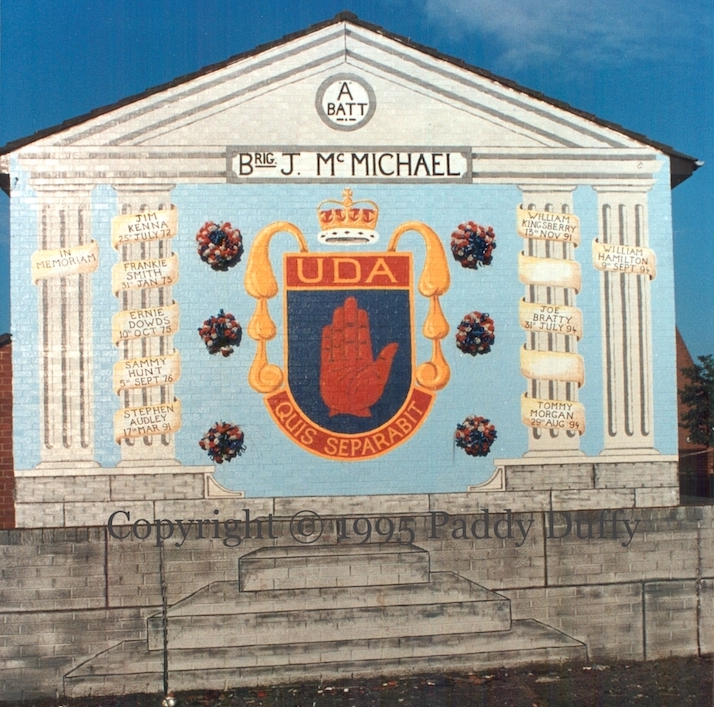
“In memoriam: Brig. J. McMichael, Jim Kenna, Frankie Smyth, Ernie Dowds, Sammy Hunt, Steven Audley, William Kingsberry, Joe Bratty, Tommy Morgan, William Hamilton”
UDA “roll of honour” mural in Rowland Way, Sandy Row, south Belfast
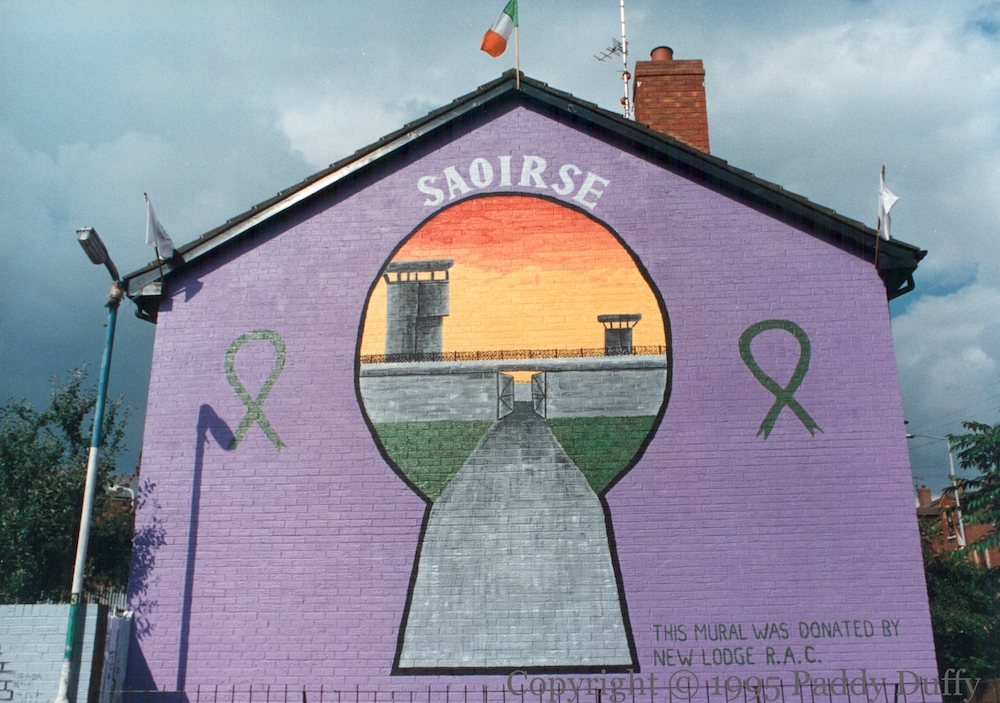
Long Kesh viewed through a keyhole, with green ribbons from the campaign to free republican prisoners. “The mural was donated by New Lodge RAC [Relatives Action Committee]”.
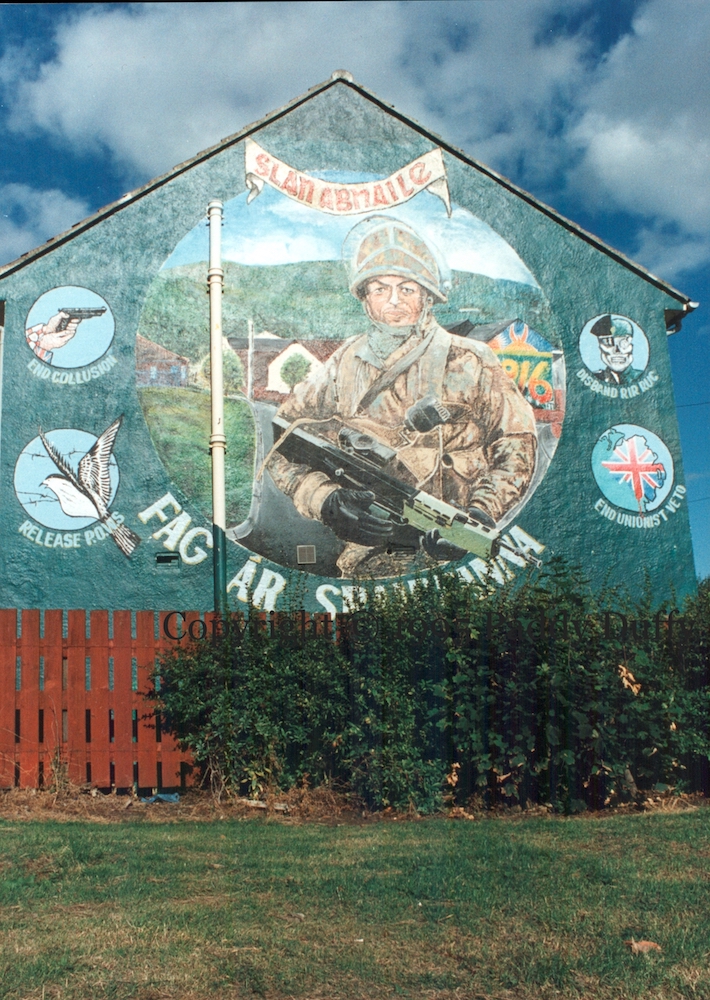
This is a mural on Whiterock Road, west Belfast, bidding “Slán Abhaıle” to a British soldier who is himself standing on Whiterock Road in front of the 1916 mural (Who Fears To Speak Of Easter Week?).
In the medallions to the left and right are four demands from during the (first) ceasefire: “End collusion, Release POWs, Disband RIR RUC, End Unionist veto”.



 Paddy Duffy Collection