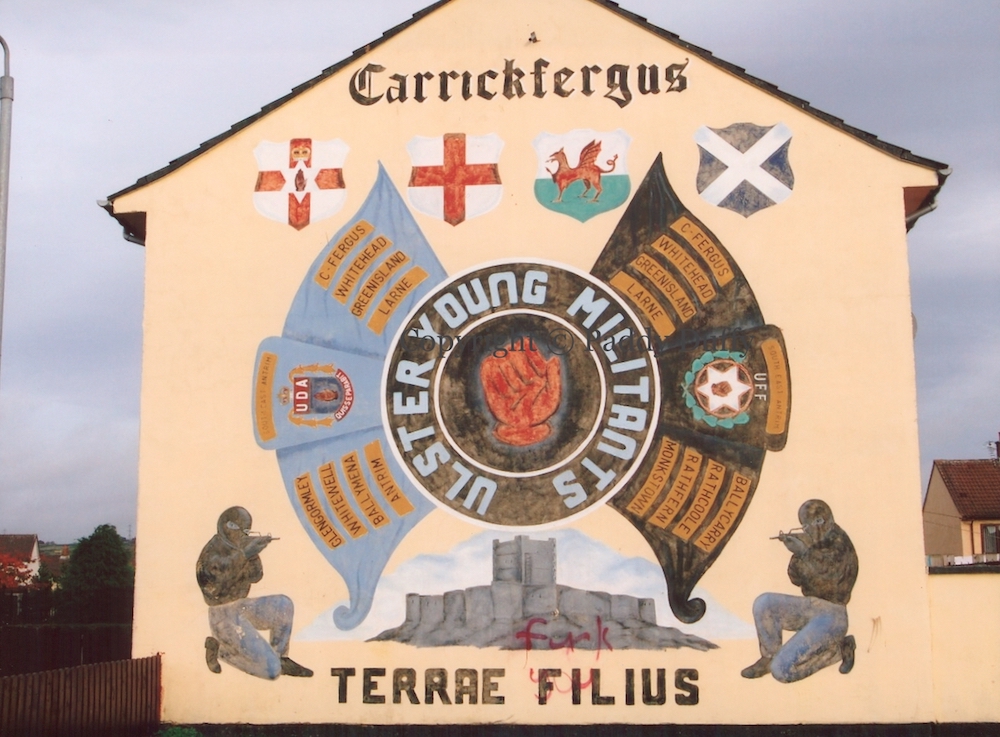
Hooded gunmen from the UDA/UFF/UYM take aim at children going to Woodlawn primary school. There are a few emblems and a quote on the side-walls to the right (out of frame), including the phrase “They rose in dark and evil days to free our native land” which comes from the song ‘The Memory Of The Dead‘, about the 1798 Rebellion, rather than the creation of the UDA in 1971.
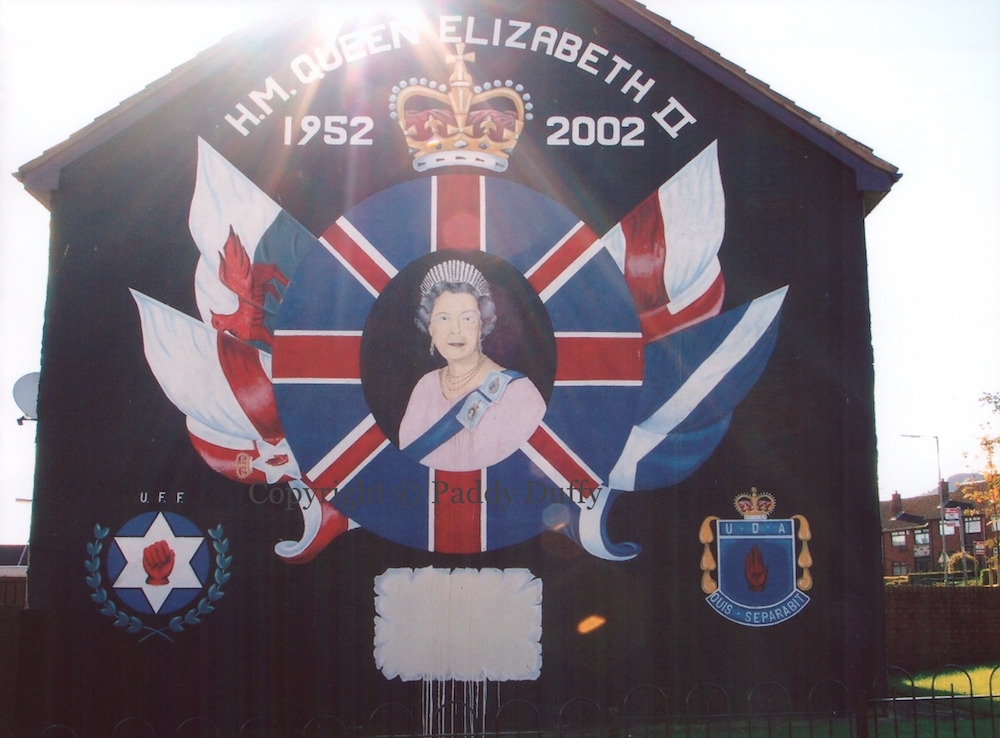
“HM Queen Elizabeth II 1952-2012”. Elizabeth Alexandra Mary Windsor acceded to the throne of the United Kingdom in 1952 (she was crowned in 1953). 2002 was her golden jubilee year. (See also Long To Reign Over Us.) The ‘sponsorship’ box read “This mural was commissioned by 1st batt A coy South East Antrim UDA UFF UYM.” but has been whited out and would later be painted over in black. It is undamaged in J1444.
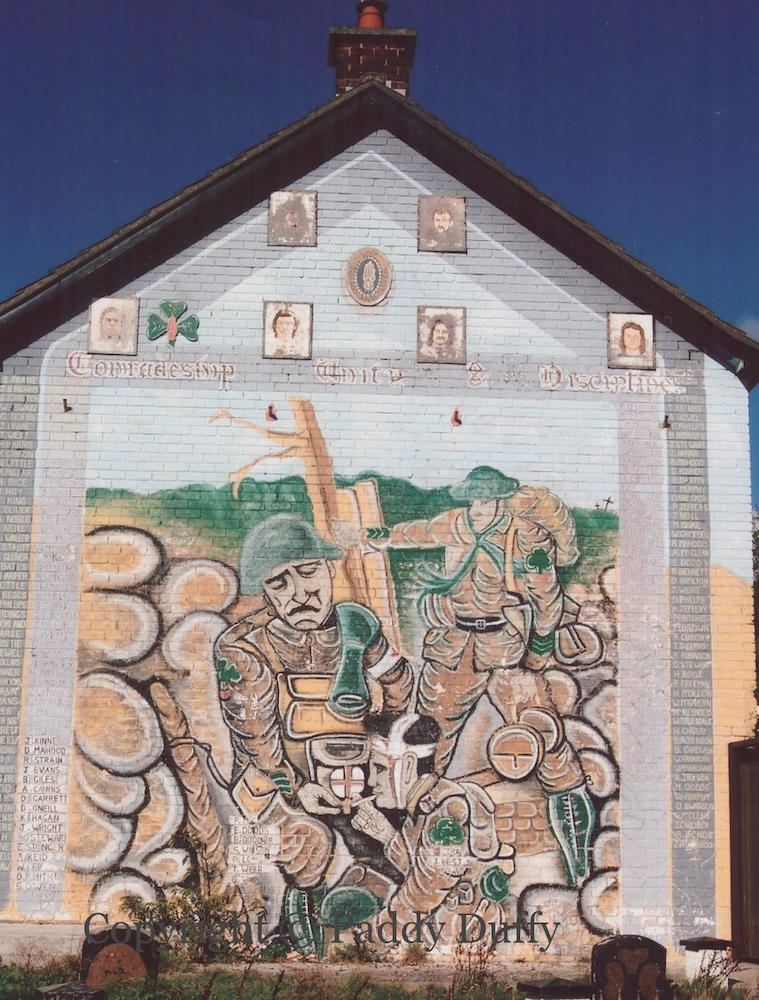
A mixture of modern and latter-day Ulster Volunteers: the names of WWI dead are listed on both sides, while six modern volunteers are portrayed above the central panel of soldiers in a trench. J1835 lists the men (in the previous version of the mural) as J. Shaw, T. Mawhinney, J. Cordner, C. Logan, S. McCrea, W. Millar.
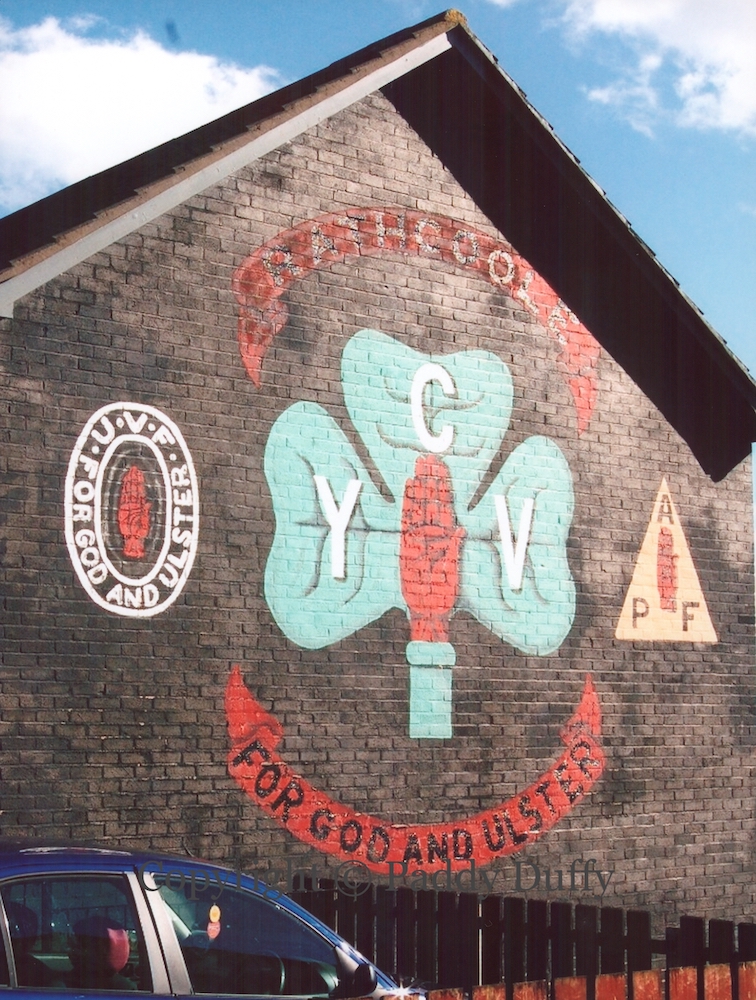
This UFF/UDA/UYM mural on Iniscairn Drive in the Rathcoole estate features a red fist (centre) and a red hand wrapped in barbed wire (apex), as well two masked figures aiming rifles.
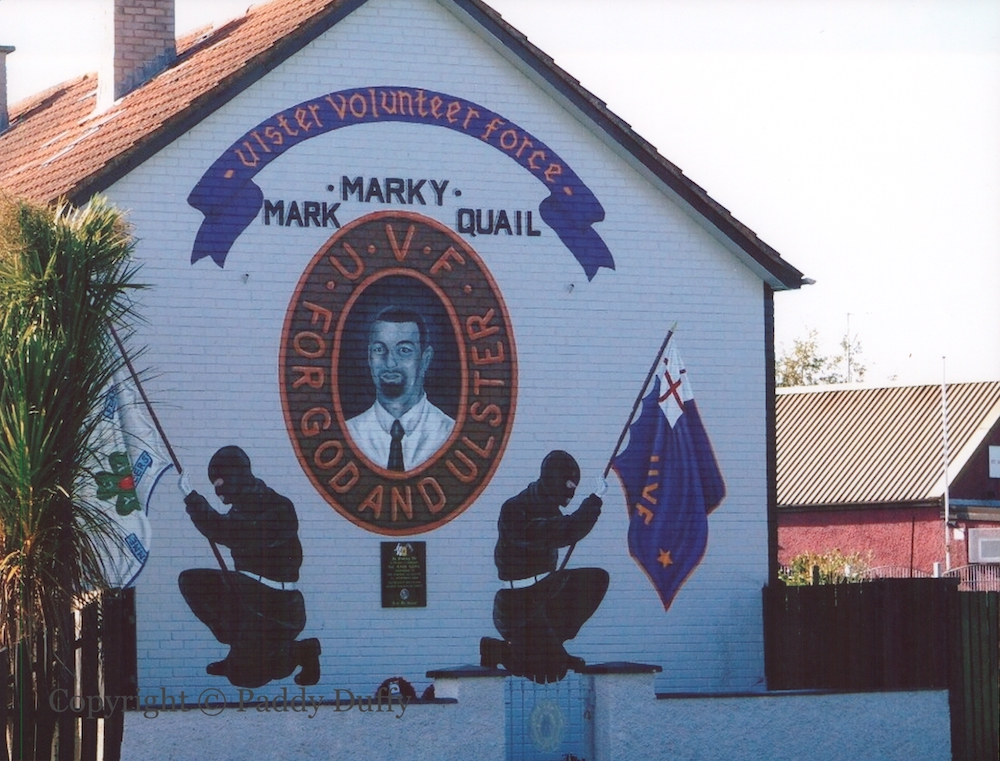
“In memory of a fallen comrade Vol. Mark Quail ‘Murdered by the enemies of Ulster’ 1st November 2000 3rd Belfast Battalion Ulster Volunteer Force. Lest we forget.” Quail was shot by the UDA in the feud (Sutton).
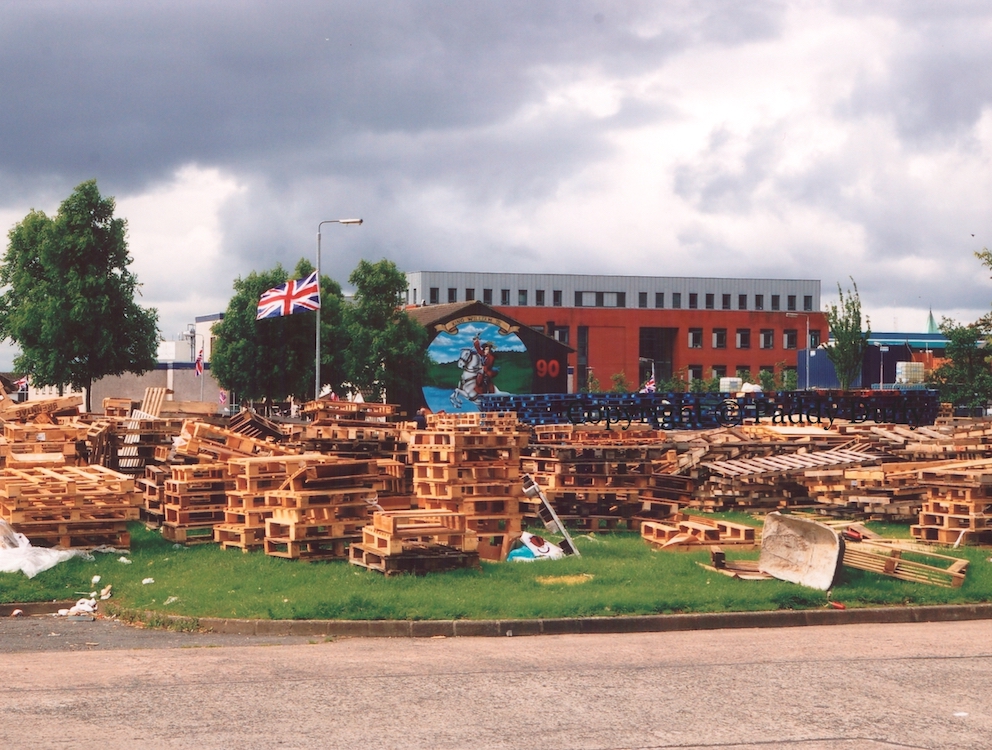
Pallets are being collection in the lower Shankill estate for the Eleventh night bonfire. In the background, King Billy is shown in a mural moving (unusually) from right to left.
A plaque reads, “This mural is dedicated to the past, present & future members of Clifton St Orange Orders from Pride Of The West flute band & Lower Shankill community. REM 1690. Officially opened by Billy Lochrie.”
Shankill Parade, lower Shankill estate, west Belfast
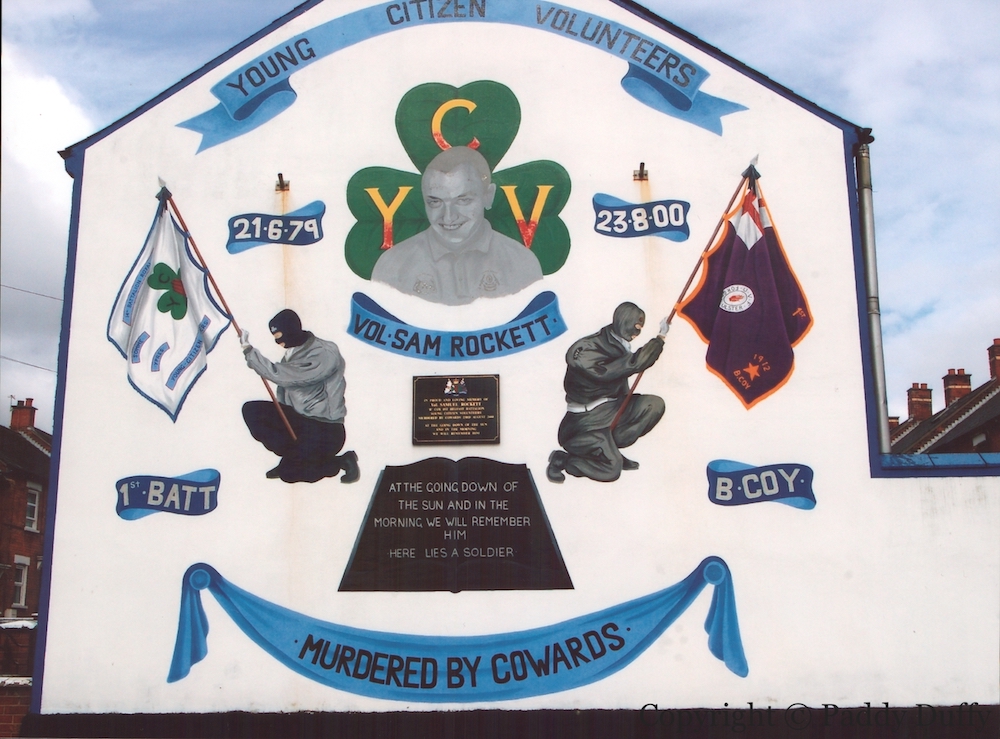
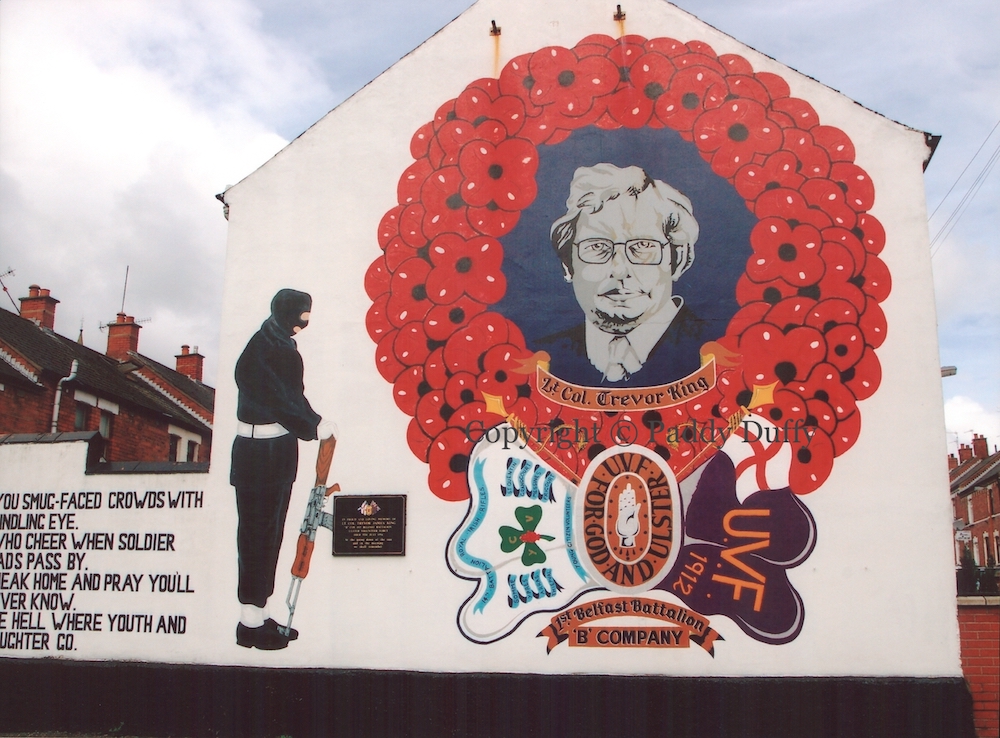
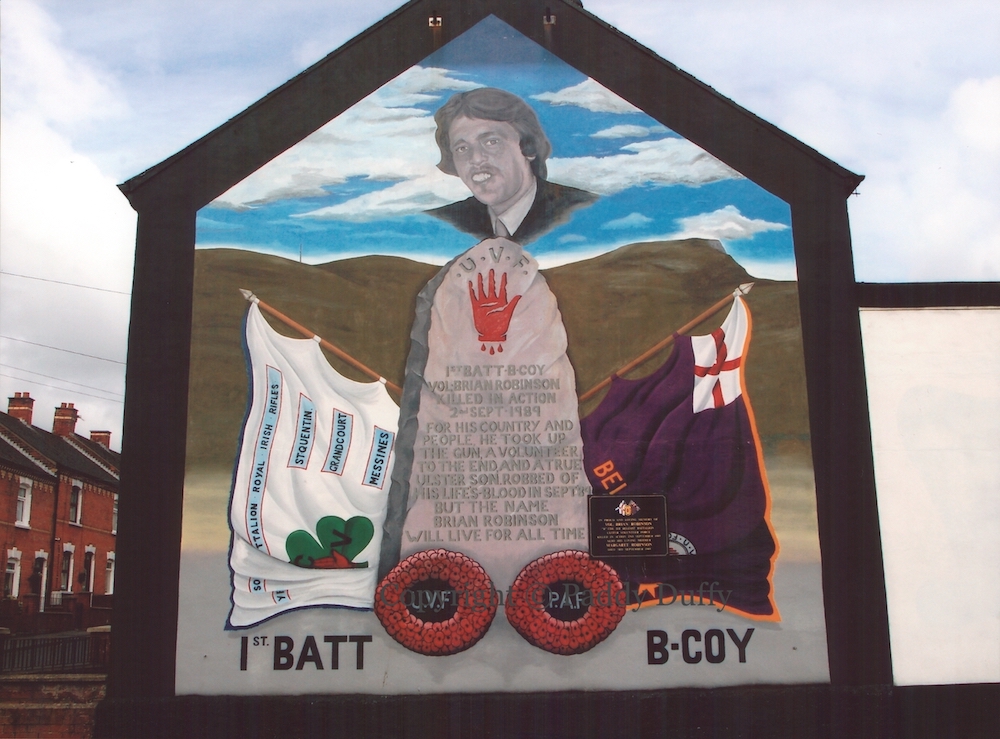
There are three murals (each with a plaque) to UVF volunteers from 1st battalion, B company, on three consecutive gables in Disraeli Street, presented here from south to north (i.e. heading towards Ohio Street).
First: “In proud and loving memory of Vol. Samuel Rockett, ‘B’ Coy 1st Belfast battalion, Young Citizen Volunteers. Murdered by cowards 23rd August 2000. ‘At the going down of the sun and in the morning we will remember them.’ ‘Here lies a soldier’”
The “cowards” in this case are the members of the UDA who killed Rockett (born June 21st, 1979) in front of his girlfriend and 18 month old child in an attack on her house in the lower Oldpark, during the feud between the UVF and UDA, sparked by Johnny Adair’s “loyalist day of culture” and removal of the UVF from the lower Shankill. In response to the purge (and attacks on the Rex bar), the UVF killed Bobby Mahood and Mr Jackie Coulter. Rockett was killed by the UDA in retaliation for their deaths; 1,000 people attended Rockett’s funeral (Irish Times). After Rockett died, the UVF killed David Greer, and the UDA then killed PUP member Bertie Rice in Tiger’s Bay on October 31st.
Second: Lt Col Trevor “Kingso” King served time for his part in the Battle At Springmartin in 1972, in which seven people, including a British soldier, died. In 1994, having been shot by the INLA and paralysed from the neck down, King took the decision to remove his own life-support (WP).
You smug-faced crowds with kindling eye Who cheer when soldier lads pass by Sneak home and pray you’ll never know The hell where youth and laughter go
Third: Brian Robinson was shot by the British Army in 1989 immediately after he had shot and killed a Catholic (Paddy McKenna) walking along Crumlin Road. This is the fifth version of the Brian Robinson mural in Disraeli Street, Belfast.
The plaque reads, “UVF 1st Batt B Coy Vol Brian Robinson killed in action 2nd Sept 1989. For his country and his people he took up the gun, a volunteer to the end and a true Ulster son. Robbed of his life’s blood in Sept ’89 but the name Brian Robinson will live for all time.
The plaque includes “Also his loving mother Margaret Robinson died 3rd September 1989”
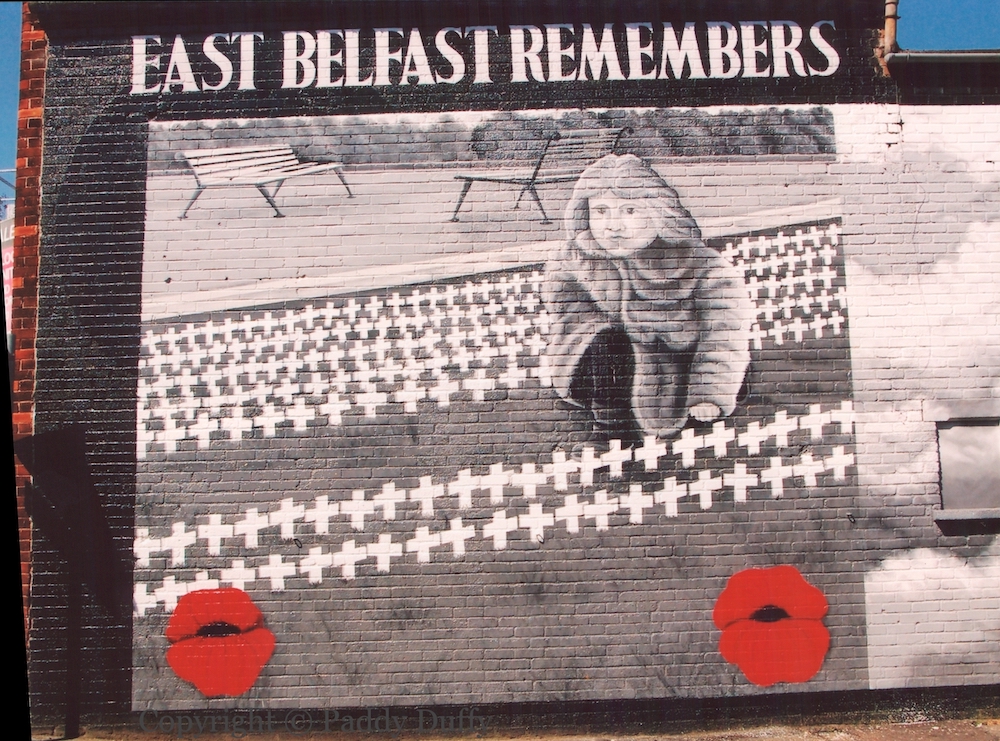
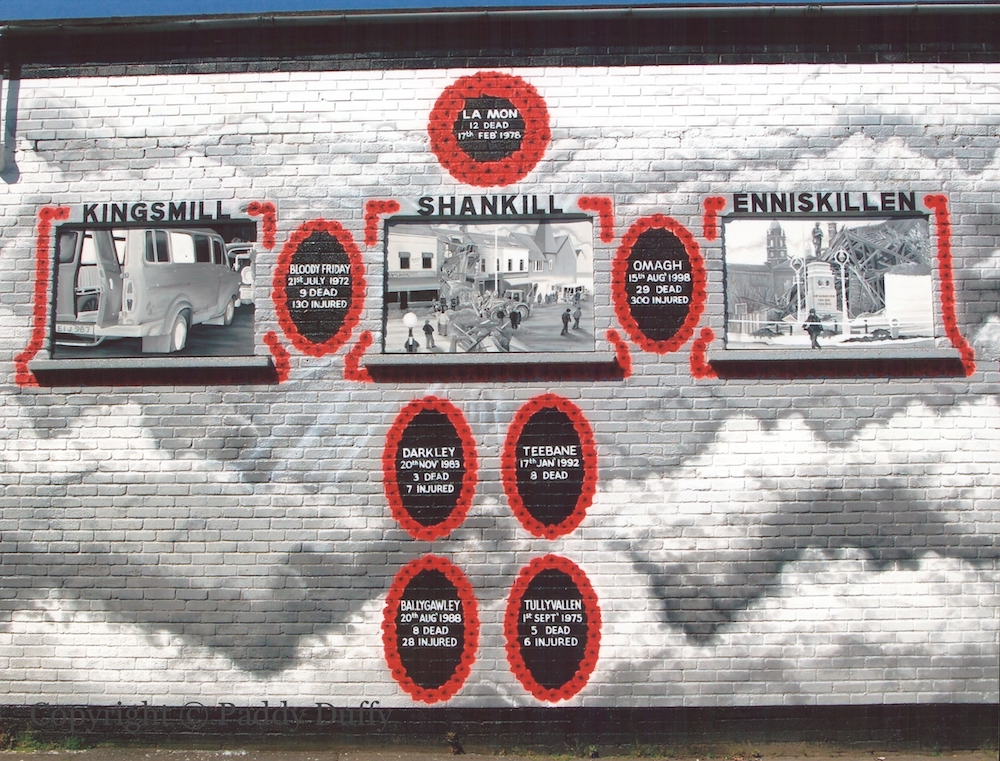
East Belfast remembers both the Great War and the victims of various attacks during the Troubles: in pictures: Kingsmill – Shankill – Enniskillen; in garlands of poppies: La Mon 12 dead 17th Feb 1978, Bloody Friday 21st July 1972 9 dead 130 injured, Omagh 15th Aug 1998 29 dead 300 injured, Darkley 20th Nov 1983 3 dead 7 injured, Teebane 17th Jan 1992 8 dead, Ballygawley 20th Aug 1988 8 dead 28 injured, Tullyvallen 1st Sept 1975 5 dead 6 injured.
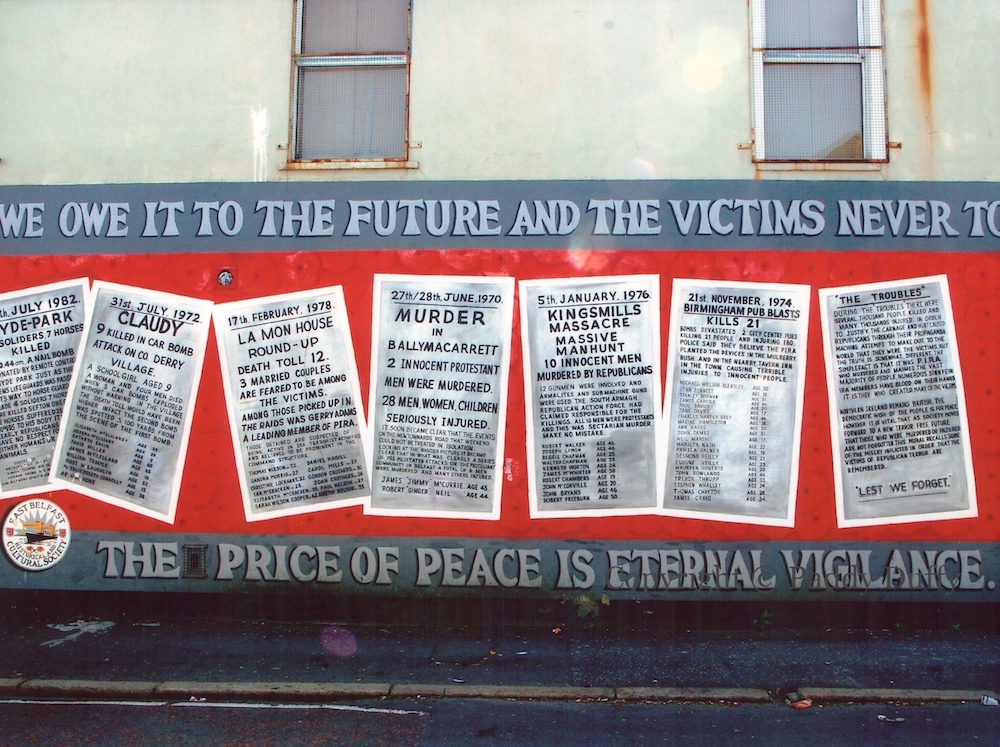
On the facing wall is a similar mural about deaths during the Troubles: “”The Troubles” – During the “Troubles” there were several thousand people killed and many thousands injured. In order to justify the carnage and hurt caused republicans through their propaganda machine attempt to make out to the world that they were the victims, but the truth is somewhat different. The simple fact is that it was PIRA who murdered and maimed the vast majority of people[.] [N]umerous Sinn Fein-IRA members have blood on their hands[.] It is they who created many of the victims. Northern Ireland remains British. The democratic wish of the people is for peace. However[,] it is vital that as society moves forward to a new terror[-]free future that those who were murdered or injured are not forgotten. This mural recalls some of the misery inflicted[,] in order that the victims of republican terror are not forgotten. “Lest we forget.”” “We owe it to the future and the victims never to forget the past – the price of peace is eternal vigilence.”
Individual panels recount the deaths at Hyde Park, Claudy, La Mon House, Ballymacarrett, Kingsmills [Kingsmill], and Birmingham.
Sponsored by the East Belfast Historical And Cultural Society – see Visual History 10.
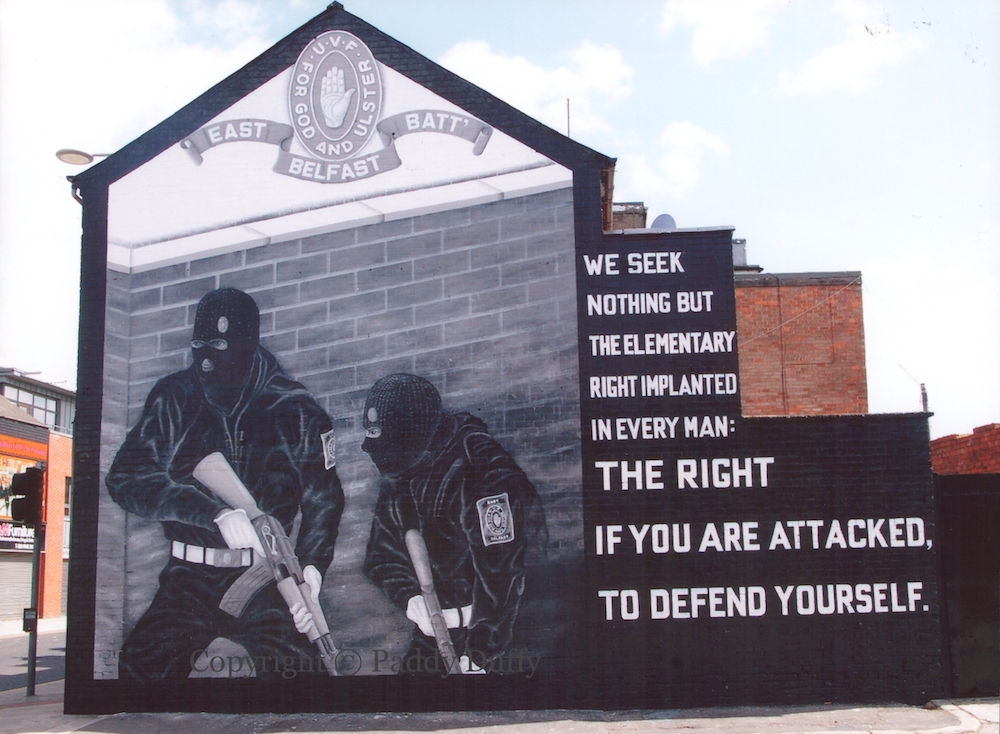
“We seek nothing but the elementary right implanted in every man: the right if you are attacked, to defend yourself.” Hooded gunmen return to east Belfast, replacing a mural for the Glentoran Community Trust.
It’s not clear who the UVF felt attacked by in 2011; it is possible that this mural is also about local muscle-flexing in addition to sectarian politics or attention from the police.
Newtownards Road at the old Bright Street, east Belfast