Róısín Dubh

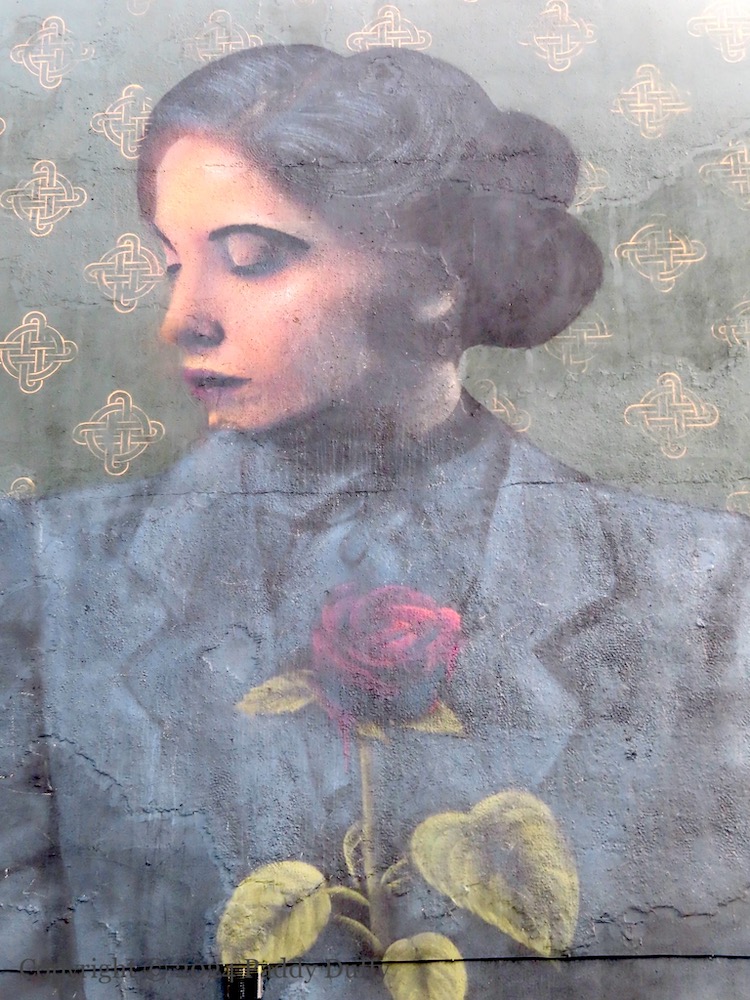
“A Róısín, ná bíodh brón ort fé’r éırigh dhuıt”/Róısín, be not sad about what has happened to you”. The song ‘Róısín Dubh’ [usually translated as ‘Dark Rosaleen’] is a love song to Ireland, in which the infatuated singer recounts the lengths he would go to on her behalf (song (youtube): Muıreann Nıc Amhlaoıbh | Caıtlín Maude | poem/lyrics in English: Mangan | Kinsella at WP).

This new piece in the New Lodge, north Belfast, was painted (presumably) by emic (ig), (presumably) under the same auspices as, and as a thematic complement to, the project we reported on in Communities In Transition. The lack of explicitly nationalist or republican signifiers is perhaps necessary if the piece is to be funded by Communities In Transition, while the cultural reference is perhaps necessary if the art is to survive on what has for the past dozen years been an anti-Agreement wall – see Damn Your Concessions, England and Unbowed, Unbroken. Another emic piece, in Creggan, Derry, has been marked with republican graffiti – see Stand Up And Speak Out. This very skilful piece walks a very fine line very precisely.

Click image to enlarge
Copyright © 2024 Paddy Duffy
T04303 T04302cr
North Down UVF

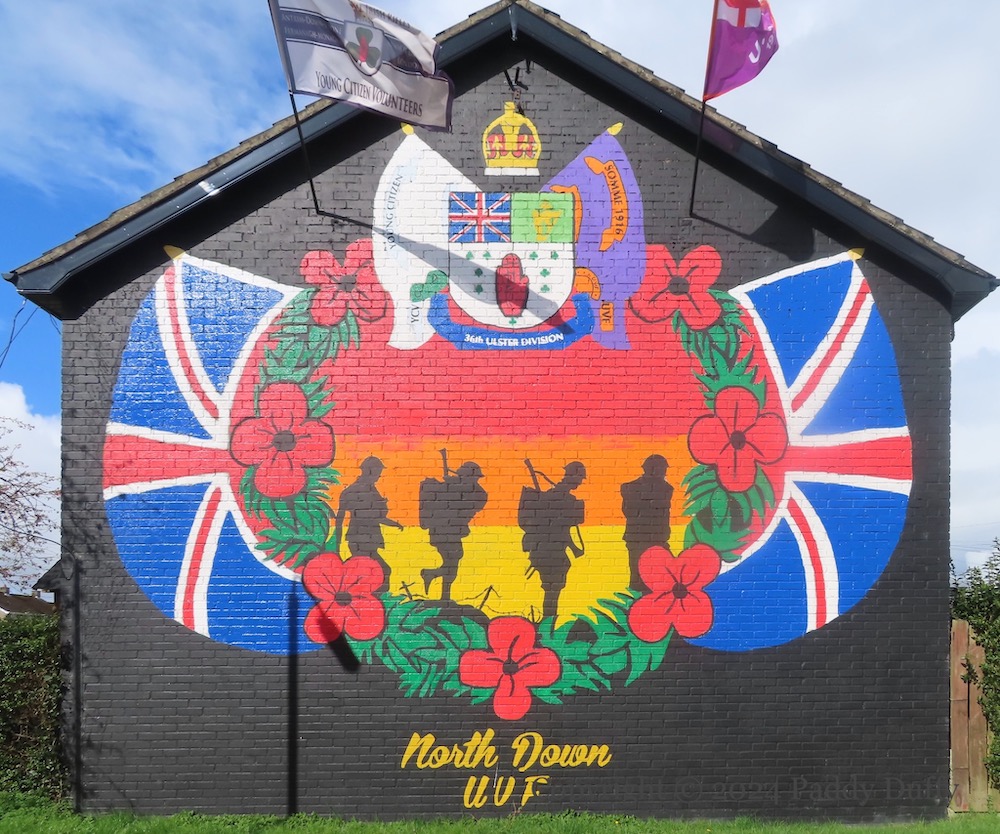
Each quadrant of Down (north, south, east, west) gave rise to a battalion of Ulster Volunteers, and North Down comprised 15 companies, almost doubling the typical British-Army size of eight companies (History Ireland; see also another History Ireland article on the initially sporadic development of the Volunteers out of Unionist Clubs).

Upon the outbreak of the Great War, the Down volunteers joined the 13th battalion of the Royal Irish Rifles, which were assigned to the 108th brigade of the 36th Division of the British Army.

The mural shown in this entry is a recent repainting; the previous version was painted in 2017 (and originally c. 2007 – see M03697).

See also: Only A Few Minutes – a memorial mural to Bangor native James Samuel Davidson, of the 108th and a North Down volunteer.

Clandeboye Road, at the bottom of the Kilcooley estate.

Click image to enlarge
Copyright © 2024 Paddy Duffy
T04297

The Undertones

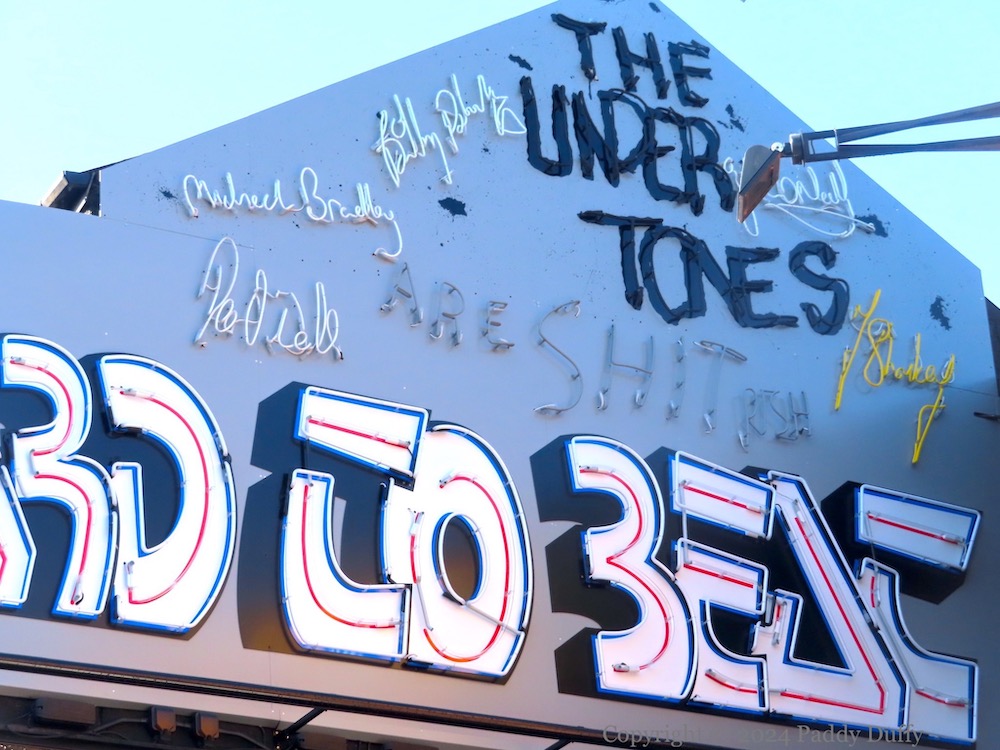
Here are images of signage in the courtyard of the Dark Horse (web) in tribute to Derry band The Undertones, whose 1978 single ‘Teenage Kicks’ begins with the line “Teenage dreams, so hard to beat …” . The sign uses the same font as the original writing by TDS under the Bridge End flyover that was put up when John Peel died, in 2004, (see J2426), and restored in 2015 (see Teenage Dreams Never Die). The signatures, from left to right, are of band members Dee O’Neill, Michael Bradley, Billy Doherty, John O’Neill, F[eargal] Sharkey.

The wide shot shows ‘Teenage dreams’ at the very top of the wall, above the cycle telling the story of the Conservative Party leadership contests involving Liz Truss and Rishi Sunak (see Ship Of Fools) (plus Nigel Farage presiding over Sweet Rockall), and on the bottom level, the open windows of Belfast Stripped Bare (the Undertones are referenced in the Snow Patrol panel, third from the right in the top row – see Teenage Dreams for a close-up) plus, on the right, six of the panels from the series The Friend At Hand. All of the painted pieces are by Ciaran Gallagher

See also The Undertones in Derry: The Punk Of The Parish | Creggan Is My Home

Bonus image, last below: Belfast punk band Stiff Little Fingers on the opposite wall in the courtyard.

Click image to enlarge
Copyright © 2024 Paddy Duffy
T04267 T04266 [T04268] T04269

The Last Viking

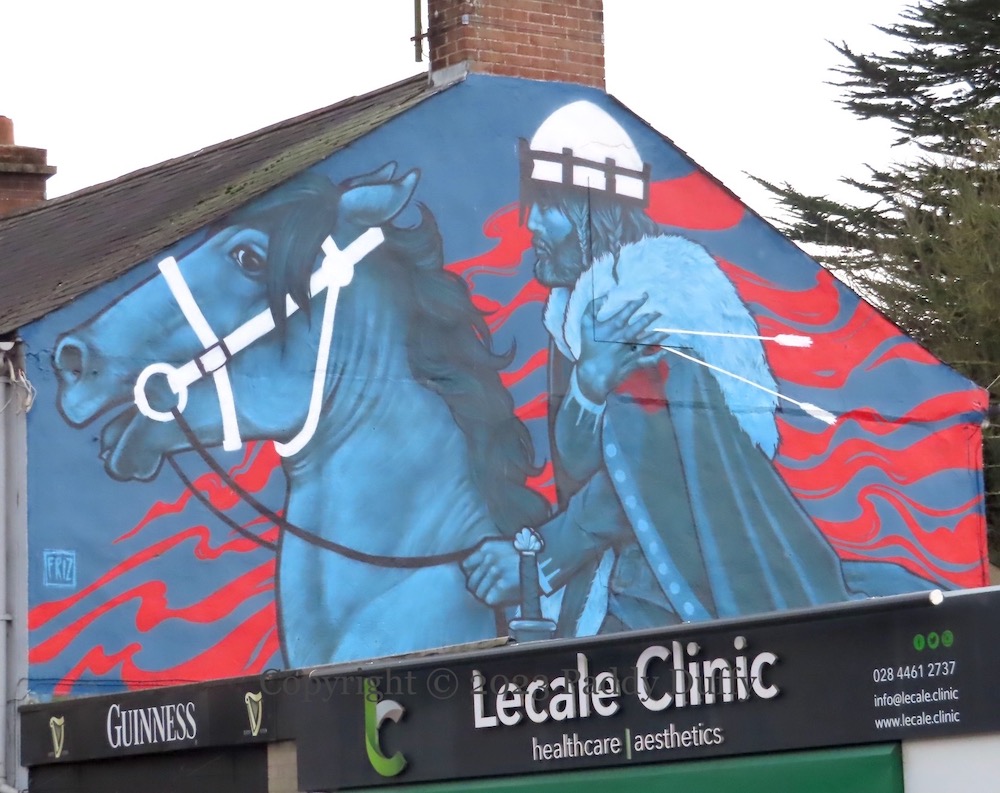
Magnús Óláfsson – Magnus Barelegs – was king of Norway from 1093 to 1103 and raided settlements in Ireland, Scotland, Wales, the isle of Man, and Sweden. During a second campaign around the Irish Sea he was killed somewhere near the River Quoile, which flows through Downpatrick, and was buried close to St Patrick’s church. (WP) The Magnus Viking Association (Fb) hosts an annual Magnus Viking festival.

The mural is by friz (web) in Church Street, Downpatrick.

Click image to enlarge
Copyright © 2023 Paddy Duffy
T02230 [T02229] Down Community Arts Downpatrick Town Committee Newry Mourne and Down District Council Down News

1916 Battle Of The Somme

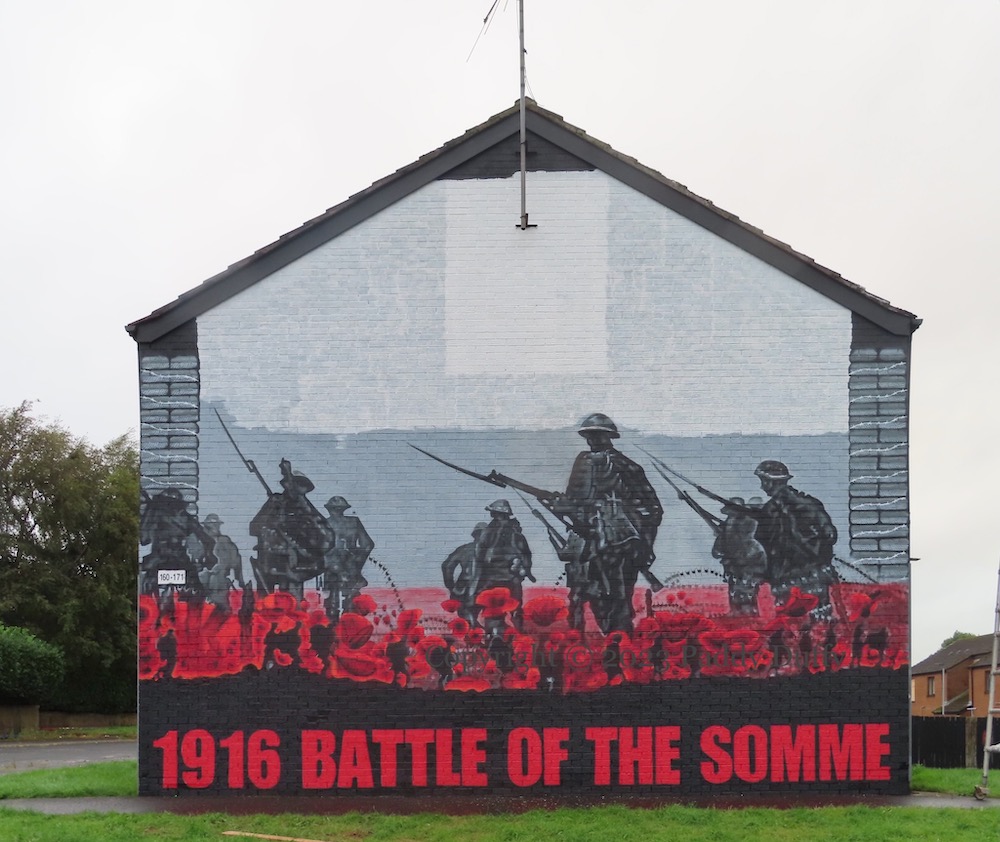
153 men of the 12th Battalion Royal Irish Rifles (which included men from Ballymena and other Central Antrim Volunteers) died on the first day of the Battle Of The Somme, July 1st, 1916, as they and the 9th Royal Irish Fusiliers attempted to take German trenches near Beaucourt railway station (Royal Irish). According to the account of the movements of the 12th Royal Irish Rifles by Des Blackadder on the Great War Forum, “they were cut down like corn before a scythe”. In all, more than 2,000 men from the 36th Division were killed that day (WP).

The new mural in Drumtara, Ballymena, was painted by Craig Gilmore, who also did the recent tribute to Elizabeth II (see The Crown) (Ballymena Guardian article on the mural, also by Blackadder). The cut-outs (in the third image) are on a wall at the bottom of the estate; the machine-gunner is unusual.

Click image to enlarge
Copyright © 2024/2023 Paddy Duffy
T03897 T03349 [T03348] T02490

Pádraıc Fıacc

Patrick O’Connor was born on this day in 1924 on the lower Falls but after his father emigrated he spent his early years – until age 5 – with his grandparents in East Street in the Markets. It was as a high-schooler in New York that he adopted the name Pádraıc Fıacc (“fiach dubh” is “raven”) and began writing poetry. He settled in Glengormley upon his second and final return; it is not clear that he ever saw East Street lined with British Army soldiers, as shown in the mural above. He wrote of his early life in ‘First Movement’:

Low clouds, yellow in a mist wind
Sift on far-off Ards
Drift hazily …
I was born on such a morning
Smelling of the bone yards
The smoking chimneys over the slate top roofs
The wayward storm birds
And to the east where morning is, the sea
And to the west where evening is, the sea
Threatening with danger
And it would always darken suddenly

Some of Fıacc’s poems are in the TroublesArchive. He was interviewed by NVTv’s Bernard Conlon (Vimeo); he also appears in a reception in Belfast City Hall (youtube).

Lower Stanfield St, Markets, south Belfast

Click image to enlarge
Copyright © 2024 Paddy Duffy
T03892 [T03893]

A True Red

Here is a 2014 mural in the Markets area of south Belfast celebrating the achievements of local boy George McMullen, who played youth football for St. Malachy’s and St. Matthew’s before joining Cliftonville in 2011 age 20.

On the left is the familiar Cliftonville huddle (see previously: The Red Army). The two poses in the centre and on the left are reproductions of Belfast Telegraph images. The first is from Cliftonville’s 2013 Dankse Bank Irish League-clinching win over Linfield, which the Reds won with a McMullen penalty in the dying seconds; the second in from the same moment in the 2014 campaign: Chris Curran has just scored to put the Reds two-nil up in a game against Portadown that would win them the League for the second year in succession.

Other Cliftonville players have been featured in murals: Joe The Goal in Ardyone and Rory Donnelly in the Bone.

Lower Stanfield St, Markets, south Belfast

Click image to enlarge
Copyright © 2024 Paddy Duffy
T03891

At The Eleventh Hour

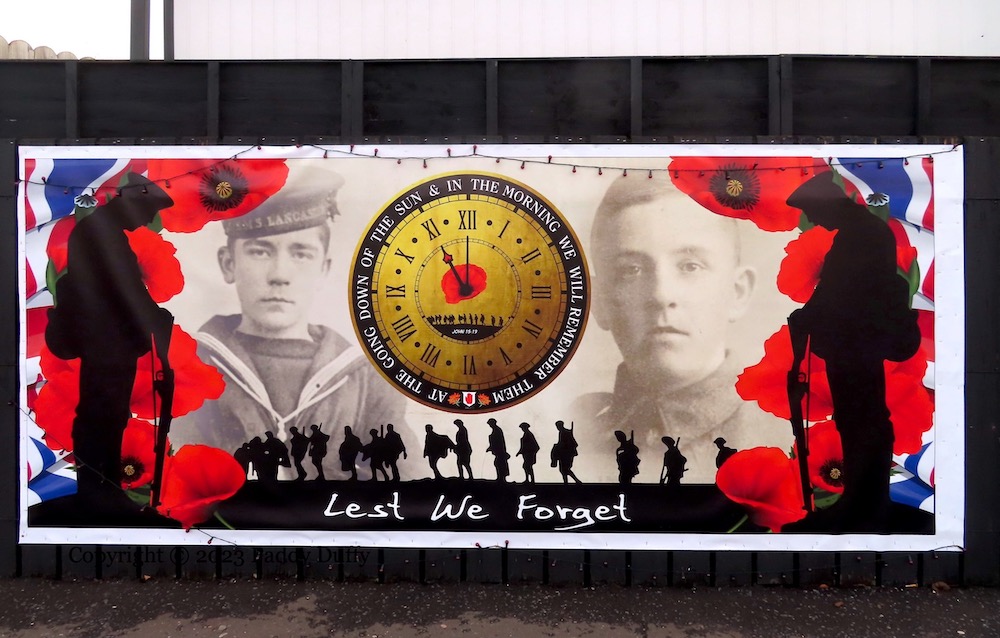
The portrait on the right is probably William McFadzean, familiar from murals such as in the Caw, Londonderry, and in Cregagh, Belfast (though the photo is unknown). The face on the left is John Travers “Jack” Cornwell, “the boy hero of Jutland”, who was awarded the VC for staying at his post as a sight-setter on the HMS Chester (the picture is from an earlier posting, on the HMS Lancaster) when it was hit by German light cruisers on May 31st, 1916. Cornwell died from shrapnel wounds on June 2nd (Mary Evans).

It’s not clear why Cornwell is included here, as he was from, and is buried in, east London, rather than Belfast or Ireland, and does not seem to be associated with the 36th Division. Please get in touch if you can explain his inclusion here. See also: Battle Of Jutland and HMS Caroline.

Dee Street, east Belfast, on the fence seen previously in My God-Given Right To Rule.

Click image to enlarge
Copyright © 2024 Paddy Duffy
T03875 T03876 at the going down of the sun and in the morning we will remember them royal irish rifles lest we forget

The Scots In Ulster

The name “Ulster-Scots” refers to the emigrants to North America from Ulster that had previously come from Scotland and the English borders, and most of the Ulster-Scots murals in the 2000s focused on emigration to America and on US Presidents with Scotch-Irish heritage (see the Visual History page of Ulster-Scots murals).

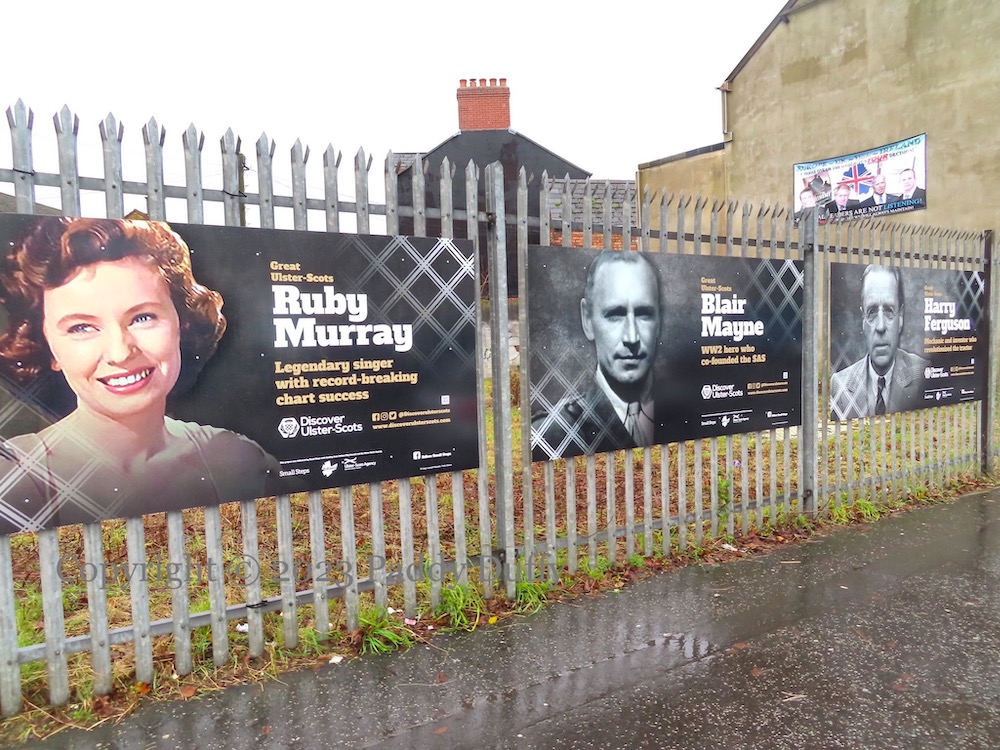
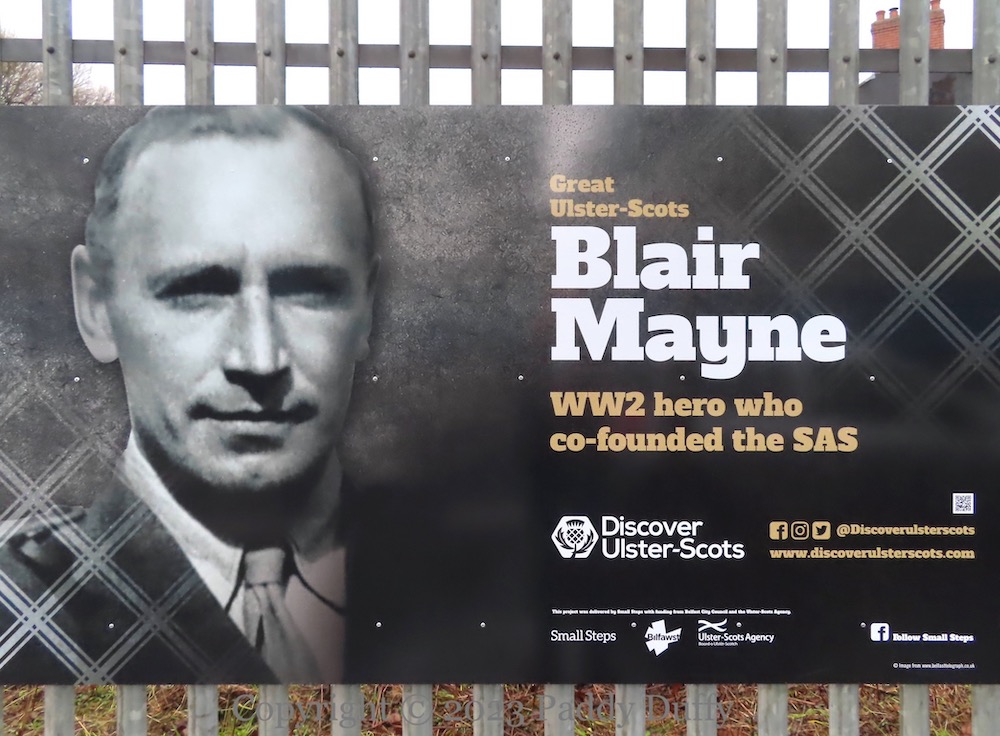
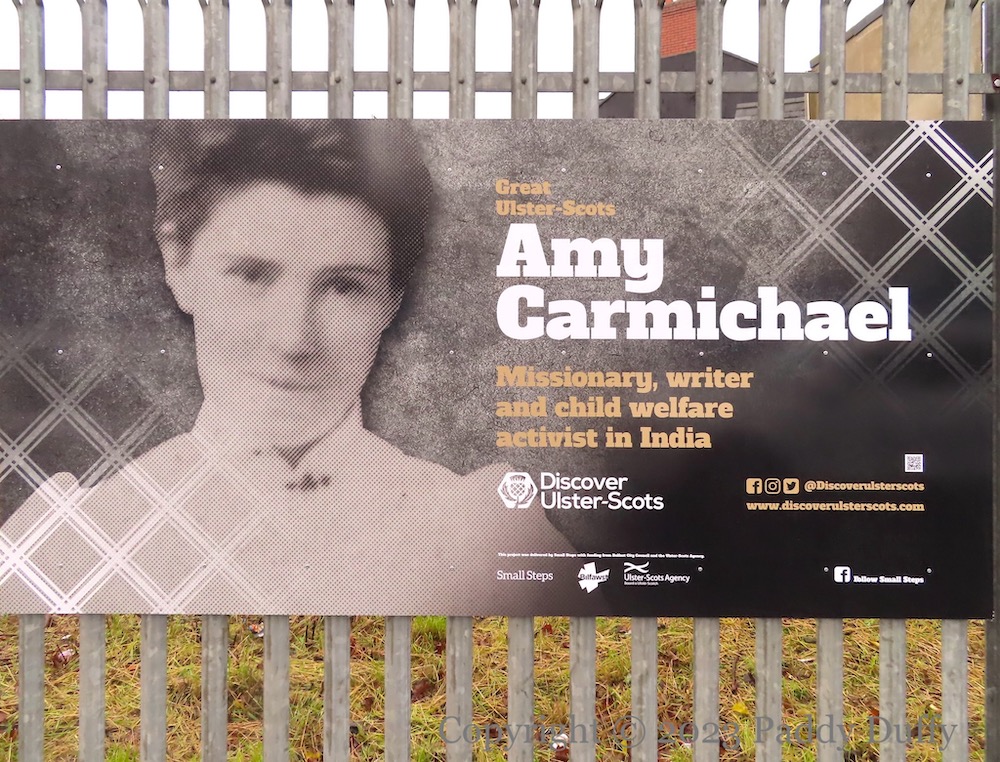
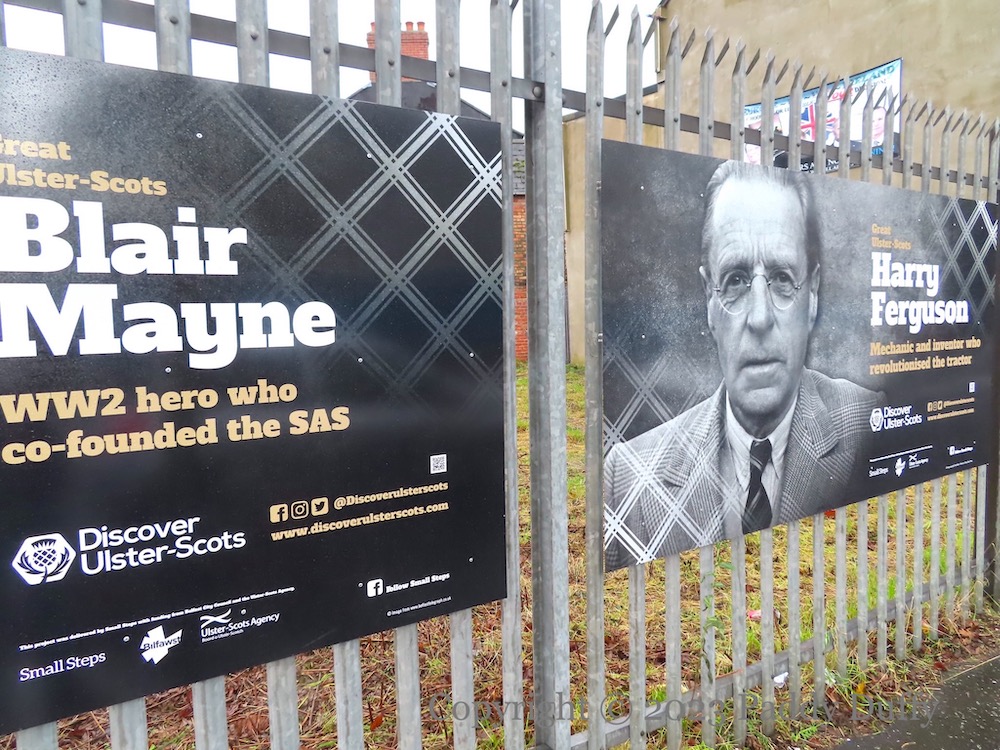
In 2017, a series of boards along York Street focused on industrialists in Northern Ireland with Scottish backgrounds: 13 panels in five posts: one | two | three | four | five. And this new collection of “Ulster-Scots” luminaries (which is 100 paces away) likewise presents figures who are associated with Northern Ireland rather than America. Modern folk such as those portrayed in these new boards presumably have Scottish heritage rather than Scotch-Irish. (The title of this entry – The Scots In Ulster – comes from a Discover Ulster Scots poster about the Scots who came to Ulster in the 1600s, regardless of whether or not they or their descendants later moved to America.)

From left to right, the people shown are as follows. (Links are to previous entries in the Extramural collection.)

Mountcollyer: motorcyclist Rex McCandless, author CS Lewis, physicist John Stewart Bell, song-writer Jimmy Kennedy, medical inventor Frank Pantridge

York Rd: snooker player Alex Higgins, singer Ruby Murray, soldier Blair Mayne, agricultural inventor Harry Ferguson, missionary Amy Carmichael

For the political tarp on the gable in the background, see Choose One Or The Other.

Click image to enlarge
Copyright © 2023 Paddy Duffy
T03832 T03834 T03833 T03837 T03836 T03835 T03838

Dorn San Aer

“Dorn san aer do na Gaeıl [a fist in the air for the Irish] Rónán Mac Aodha Bhuí 1970-2023”. Mac Aodha Bhuí joined Ráıdió Na Gaeltachta in the 1990s but was best known for his Rónán Beo@3 programme (which is inscribed on the ring on the first), which began in 2006. He was a passionate advocate for the Irish language. He died this past September after a four-year battle with cancer. (RTÉ | Irish Times | Donegal Daily)

The official launch of the mural will be at 2 p.m. on Friday (December 1st). Update: by the time of the launch a photograph of Mac Aodha Bhuí was added.

Click image to enlarge
T03680 [T03679] T03882
Copyright © 2023 Paddy Duffy
Fallswater St