The (colour) RNU phoenix and the Craigavon 2 “Free The Innocent” tarp have been joined by a Cogús fist grasping a strand of barbed wire – Cogús (Fb) is (was?) the prisoners’ welfare arm of the RNU.
A succession of Irish rebels is shown in this new mural in Andersonstown, west Belfast. It begins (top left) with the rebellion of 1798 and then to the Easter Rising of 1916 at the GPO in Dublin. In the lower left, a pious Padraıg Pearse awaits his execution with rosary beads in hand. There are then shown female figures from Cumann Na mBán and the IRA (see previously: United Irishwomen, Do You Care? and Mothering Sunday In Beechmount), and then Maıréad Farrell in Armagh Women’s Prison (for the original, see Prison Walls). In the bottom right corner there is a blanketman. The busts of Bobby Sands and Joe McDonnell float above the GPO and the last verse of Sands’s The Rhythm Of Timeform the epigraph: “It lights the dark of this prison cell, it thunders forth its might, it is the undauntable thought, my friend, the thought that says, “I’m right”.
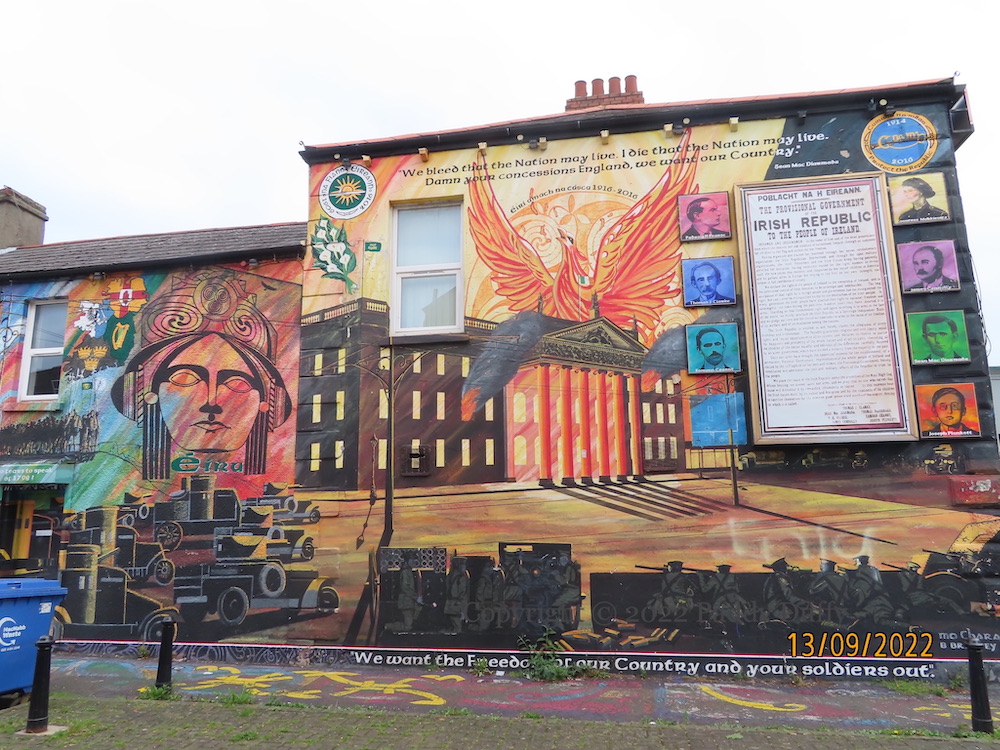
On the side wall, “Ag fíorú na poblachta” means “Realising the republic”. It celebrates the centenary (“Céad Blıaın 1916 – 2016”) of the Easter Rising and shows a copy of the proclamation of the republic and an Easter lily. The next wall over (see below) shows portraits of the seven signatories to the Proclamation: Joseph Plunkett, Sean Mac Dıarmada, Thomas Clarke, James Connolly, Patrick Pearse, Eamonn Ceannt, and Thomas McDonagh.
The Republican Network For Unity (RNU) affirm their solidarity with Palestine over the recent deaths during the March Of Return (see also His Land, His Legs, His Life) with a board showing an Israeli hand smothering a Palestinian face. Here is the RNU’s statement on the deaths in Gaza at the time.
Arrayed against the forces of the British Army (which are shown in armoured cars and in sniping positions in the foreground of the mural, along the whole length of the wall) are various symbols of Irish nationalism: Oliver Sheppard‘s 1911 statue of Cú Chulaınn dying; the pikemen of the 1798 Rebellion (featured yesterday: Éırí Amach 1798); the four provinces of Ireland; Érıu the mythological queen of Ireland/Éıre as designed by Richard J King/Rísteard Ó Cíonga; Easter lilies; the emblems of Na Fıanna Éıreann and Cumann Na mBan on either side of a quote from (The Mainspring) Sean MacDiarmada “We bleed that the nation may live; I die that the nation may live. Damn your concessions, England: we want our country”; a phoenix rising from the flames of the burning Dublin GPO (inspired by Norman Teeling’s 1998 painting The GPO Burns In Dublin); the GPO flying an ‘Irish Republic’ flag; portraits of signatories and other rebels — (left) Padraig H. Pearse, Thomas J Clarke, Eamonn Ceannt, Thomas MacDonagh, (right) Countess Markievicz, James Connolly, Sean MacDiarmada, Thomas Plunkett; the declaration of independence, placed over the advertising box of AA Accountants – see the in-progress shot below. For more work-in-progess images, see yesterday’s post, Éırí Amach 1798. At the very bottom is a quote from the mother of Gerard ‘Mo Chara’ Kelly, Harriet Kelly: “We want the freedom of our country and your soldiers out.”
There was originally a memorial to Bobby Sands and painted crests of the four provinces below this phoenix emerging from the flames – see M01001 from 1991. It was originally painted by Mo Chara Kelly in 1987.
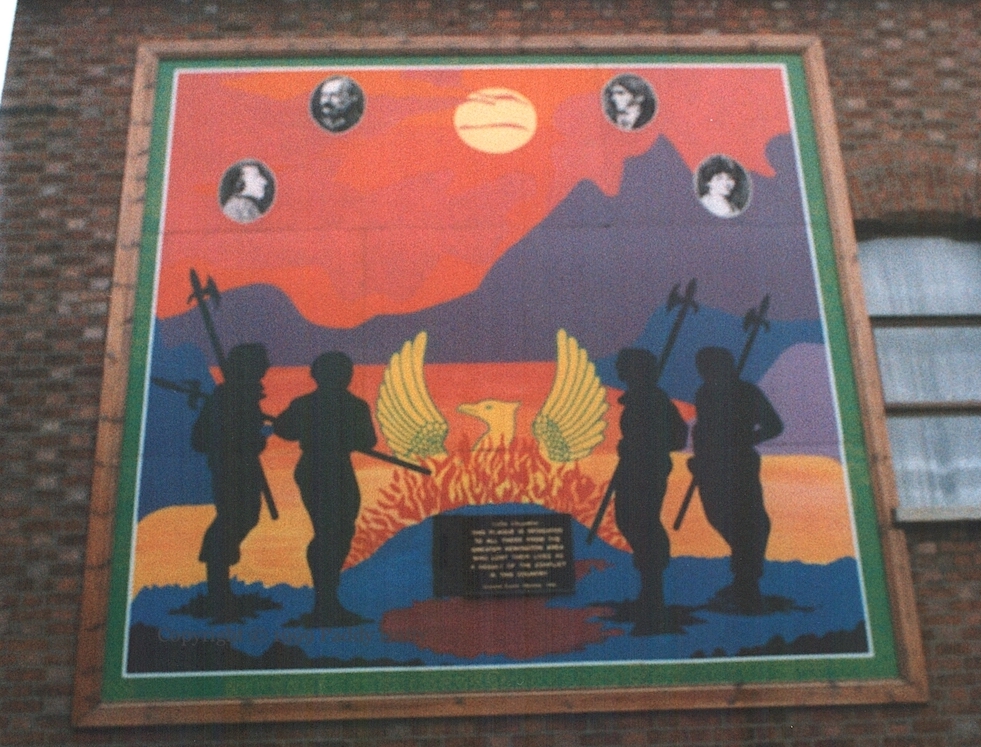
“I ndıl chuımhne – this plaque is dedicated to all those from the greater Newington area who lost their lives as a result of the conflict in this country.” Pikemen from the 1798 uprising stand on either side of a phoenix, with portraits above of Wolfe Tone, James Connolly, Henry Joy McCracken, and Mary Ann McCracken.
Manacles “Made in Britain” constrain the republican desire for a united Ireland, contrary to the burning GPO and rising phoenix.
“Numerous foreign groups and delegations visited Ballymurphy and west Belfast during the troubles. I remember one meeting I was at in Conway Mill, I picked up a pamphlet with a drawing of a manacled fist. The caption read “Made in the USA.” So I just took the image and changed the slogan to “Made in Britain”.” (Painting My Community/An Pobal A Phéınteáıl – English-language version available for free)
The plaque – which pre-dates this mural – is to local (A Company 2nd Battalion) IRA volunteers Stan Carberry, Frankie Dodds, Paul Fox, Sean Bailey, Paul Marlowe, and Tony Campbell. “Fuaır sıad bás ar son na hÉıreann”, “Ireland unfree will never be at peace”. (See the Peter Moloney Collection.)
Painted by Mo Chara Kelly in Beechmount Avenue/RPG Avenue.
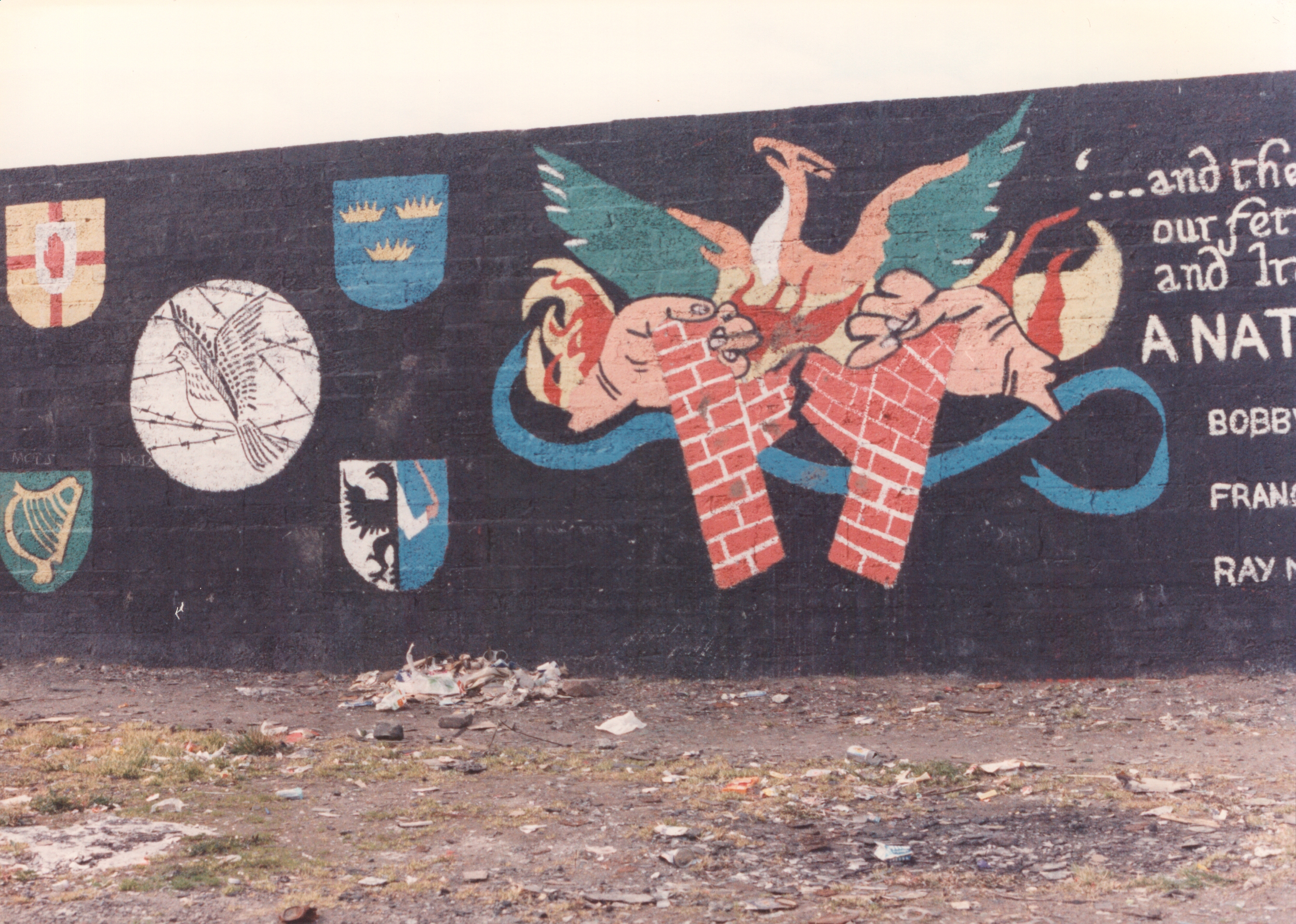
A phoenix rises from a pair of disembodied hands tearing apart an “H” made of brick, illustrating the lines (out of view to the right) “… and then I prayed I yet might see/our fetters rent in twain/and Ireland long a province be/a nation once again”. Also on the right are the names of six hunger strikers: Bobby Sands MP, Francis Hughes, Ray McCreesh, Patsy O’Hara, Joe McDonnell, Martin Hurson. On the left are the lark in barbed wire, and the shields of the four provinces.
The first names of the ten deceased 1981 hunger-strikers — Bobby, Francis, Patsy, Raymond, Joe, Martin, Kiersn, Tom, Micky, Kevin — appear on a ribbon held by a tricoloured phoenix against a sunburst, flanked by Starry Plough and Tricolour and volunteers firing a final salute.
“The people arose in ’69, they will do it again at any time”, “Maggie Thatcher think again, don’t let our brave men die in vain.” “Done by Beechmount youth against H Block & Armagh.”
The two tones of black suggest that the mural was painted using household paints contributed by local residents.








 Paddy Duffy Collection