
UDA mural in Avoniel Road showing two hooded gunmen kneel on a free-floating Northern Ireland. Avoniel Road and Dee Street would fall within the territory of 2nd battalion, east Belfast.
Click image to enlarge
Copyright © 2000 Paddy Duffy
T00434
UDA mural in Avoniel Road showing two hooded gunmen kneel on a free-floating Northern Ireland. Avoniel Road and Dee Street would fall within the territory of 2nd battalion, east Belfast.
Click image to enlarge
Copyright © 2000 Paddy Duffy
T00434

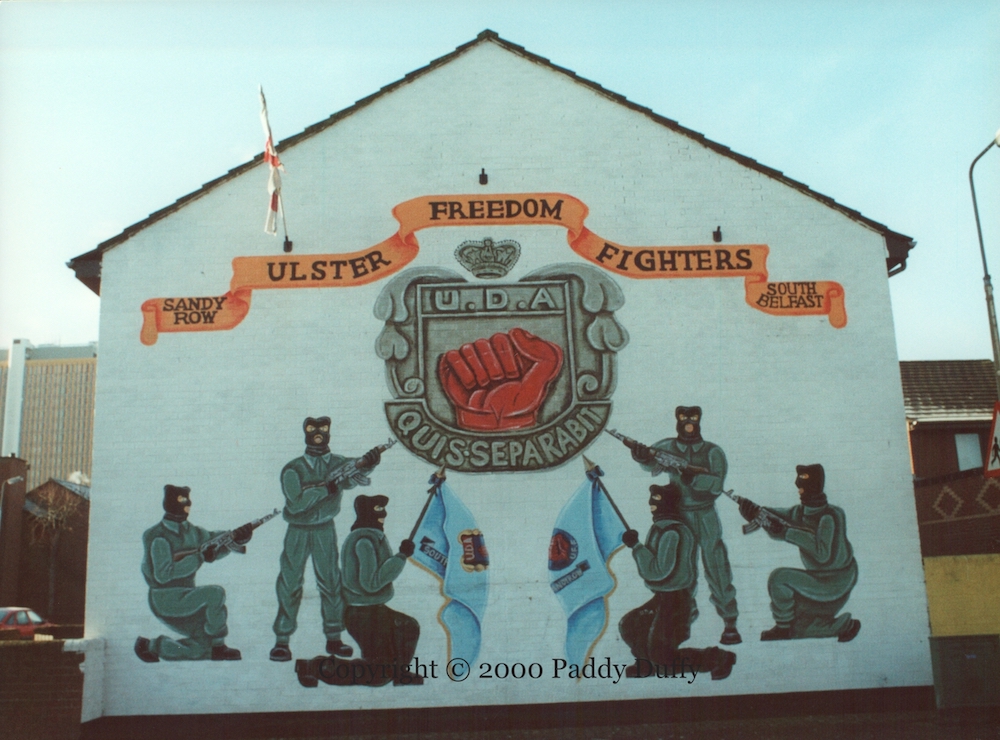
“Free our prisoners o[f] w[ar]”, specifically prisoners from the South Belfast UFF/UDA. This pair of smaller murals is in the garden next to St Alban’s, and the gable mural is across the road.
Blythe Street, south Belfast

Click image to enlarge
Copyright © 2000 Paddy Duffy (no date given)
T01177 T01186 T01185
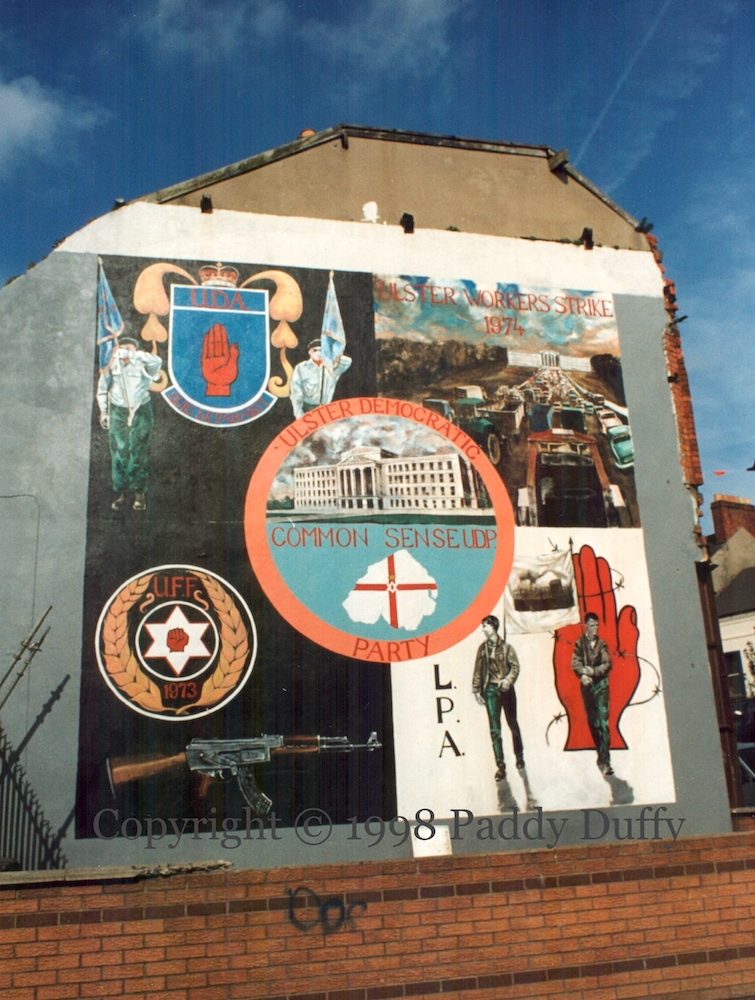
The Ulster Democratic Party (UDP) was the political wing of the UDA, and supported a policy of an independent Northern Ireland (as described in the policy document ‘Common Sense‘). It won a few council seats in the late 1980s and early 1990s (and dissolved in 2001) (BBC-NI).
The top-right panel is similar to this Victor Patterson photograph of the farmers’ protest at Stormont during the Ulster Workers’ Council strike that brought down the Sunningdale Agreement in 1974.
Bellevue Street, west Belfast
Click image to enlarge
Copyright © 1998 Paddy Duffy
T00260 [T00263]
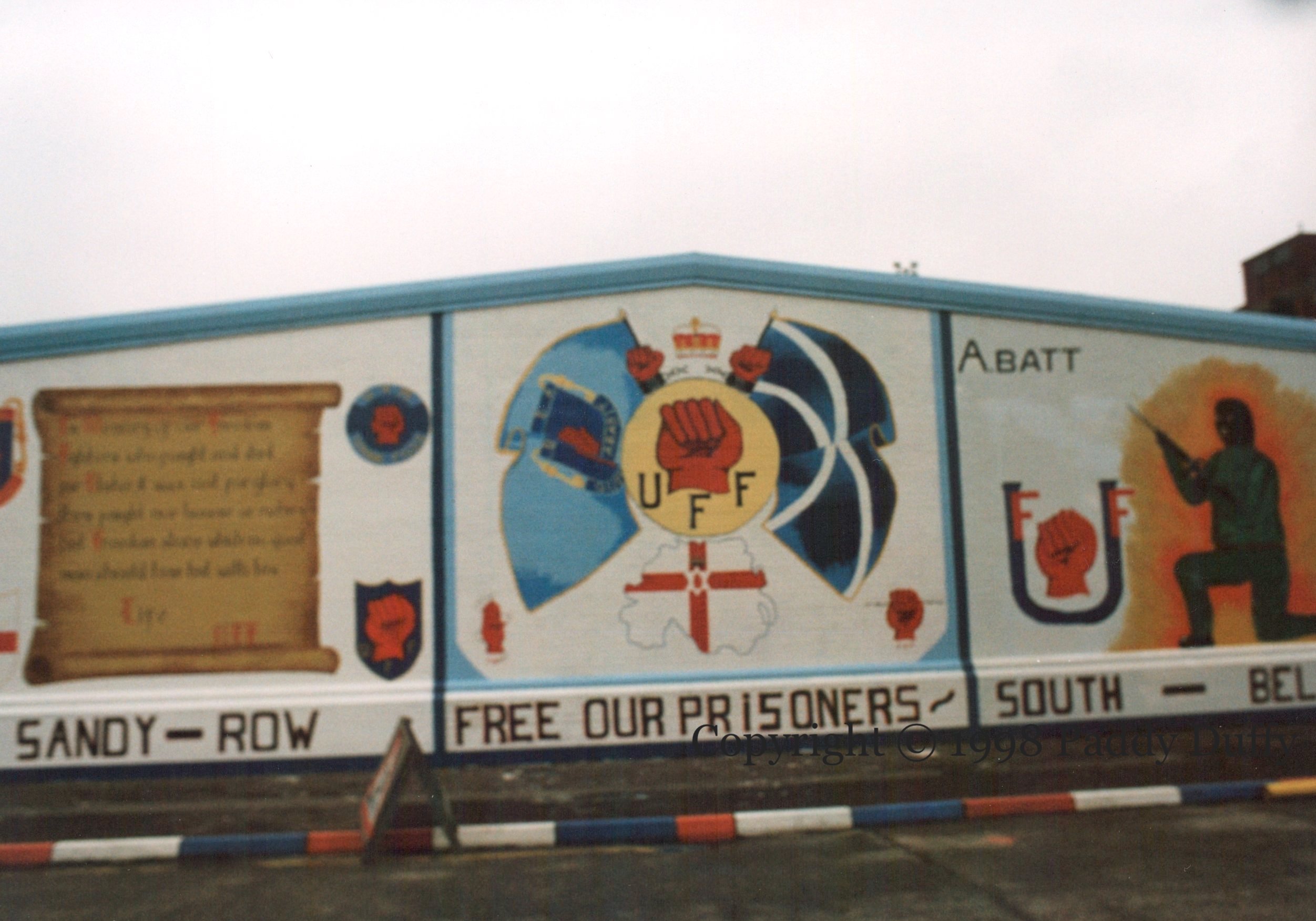
The scroll on the left between the emblems of the UDA, UYM, UFF and the Ulster banner reads, “In memory of our freedom fighters who fought and died for Ulster. It was not for glory they fought nor honour or riches but freedom alone which no good man should lose but with his life.” There is a pair of manacled red fists above the central UFF emblem, which itself rests on a free-floating outline of Northern Ireland superimposed with the Ulster banner. On the right is a crouching volunteer from A battalion, from south Belfast’s Sandy Row.
Linfield Road, south Belfast
Click image to enlarge
Copyright © 1998 Paddy Duffy
T00247

A pair of manacled red fists break free of their chains and the Maze/Long Kesh is depicted in the outline of Northern Ireland. “Free the prisoners”, “All gave some, some gave all.”
No particular paramilitary group is mentioned, though this is UDA territory.
Bellevue Street, Shankill, west Belfast
Click image to enlarge
Copyright © 1996 Paddy Duffy
T00236
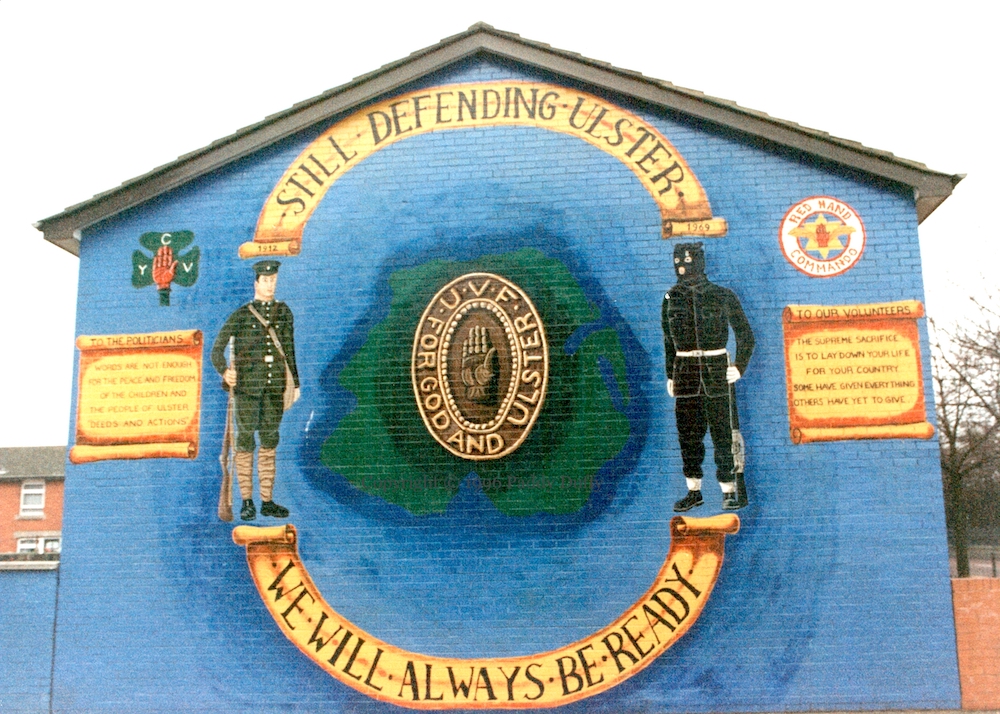
“Still defending Ulster – we will always be ready. 1912 – 1969. To the politicians: words are not enough for the peace and freedom of the children and the people of Ulster “deeds and actions”. To our volunteers: the supreme sacrifice is to lay down your life for your country. Some have given everything, others have yet to give.”
The modern volunteer, while hooded, is not in an active pose, reflecting the ceasefire. The word “to the politicians” perhaps express frustration with the peace process (and hint at the continued violence of the LVF, created after the dispute in July at Drumcree).
Kenilworth Place, east Belfast
Click image to enlarge
Copyright © 1996 Paddy Duffy
T00151
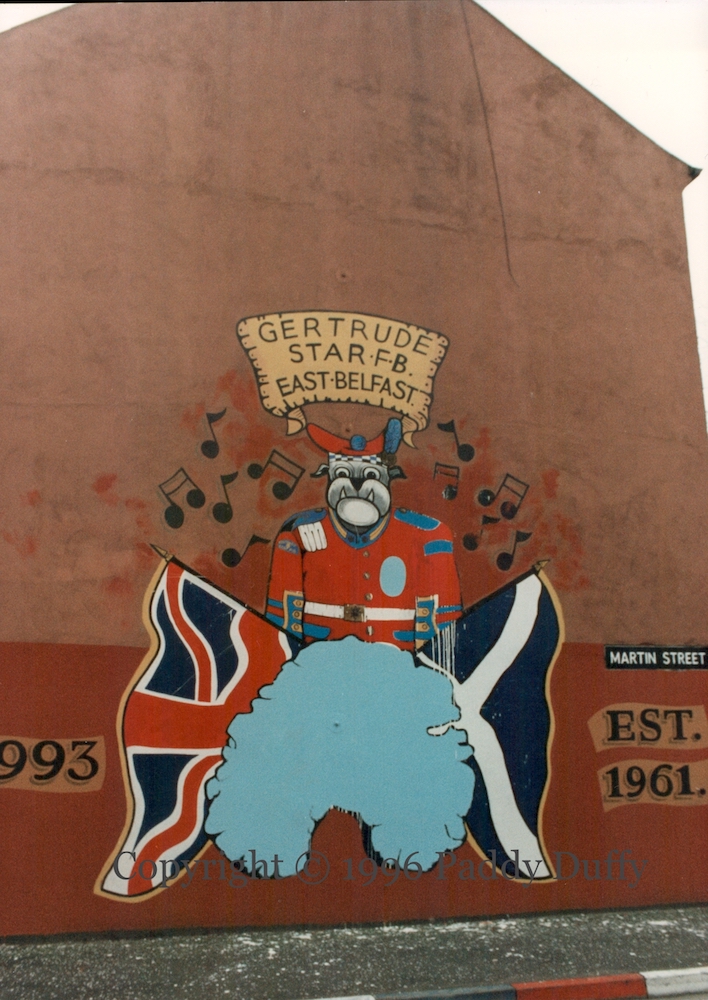
“Gertrude Star flute band [Fb], east Belfast, est. 1961.” This mural, created in “1993” (left), is probably being repaired after after being paint-bombed – see the white paint dripping down on the St Andrew’s Saltire. The interior of the “Northern Island” and Spike the bulldog’s badge have yet to be restored. For the mural in full health, see D00394.
Martin Street, east Belfast
Click image to enlarge
Copyright © 1996 Paddy Duffy
T00149
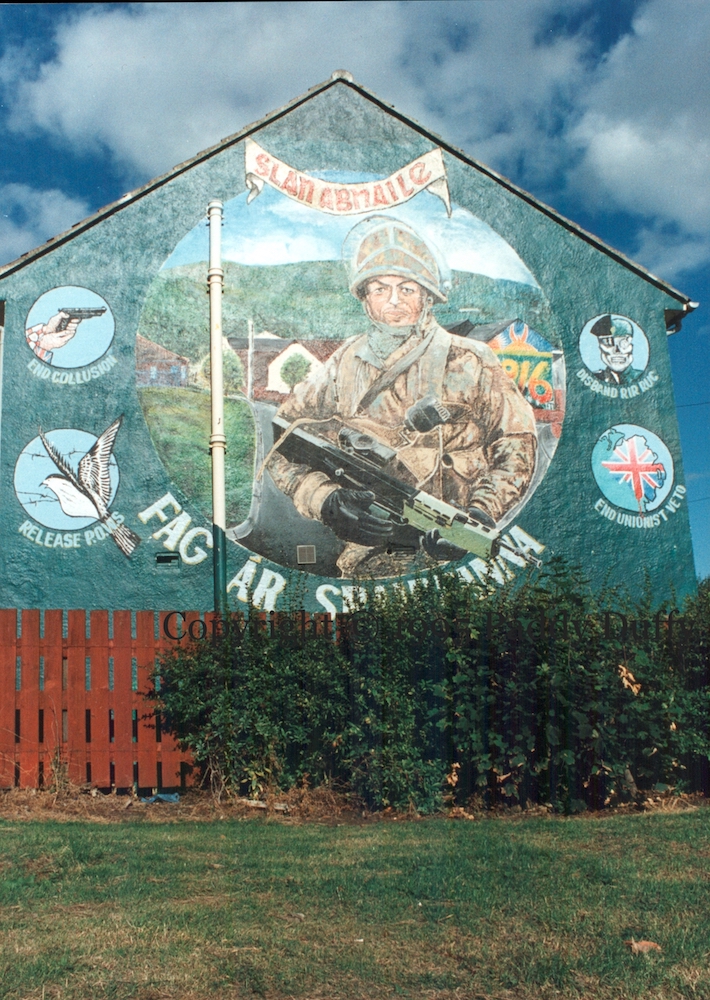
This is a mural on Whiterock Road, west Belfast, bidding “Slán Abhaıle” to a British soldier who is himself standing on Whiterock Road in front of the 1916 mural (Who Fears To Speak Of Easter Week?).
In the medallions to the left and right are four demands from during the (first) ceasefire: “End collusion, Release POWs, Disband RIR RUC, End Unionist veto”.
Click image to enlarge
Copyright © 1995 Paddy Duffy
T00105
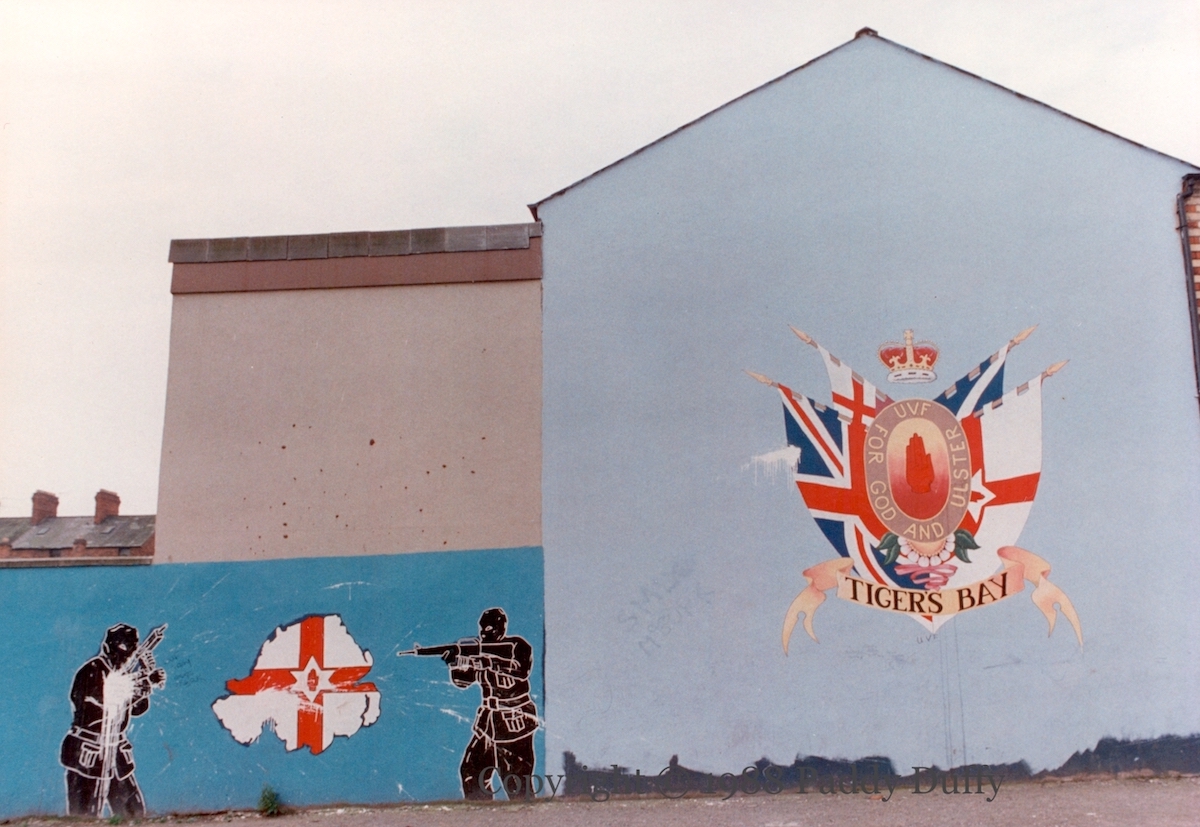
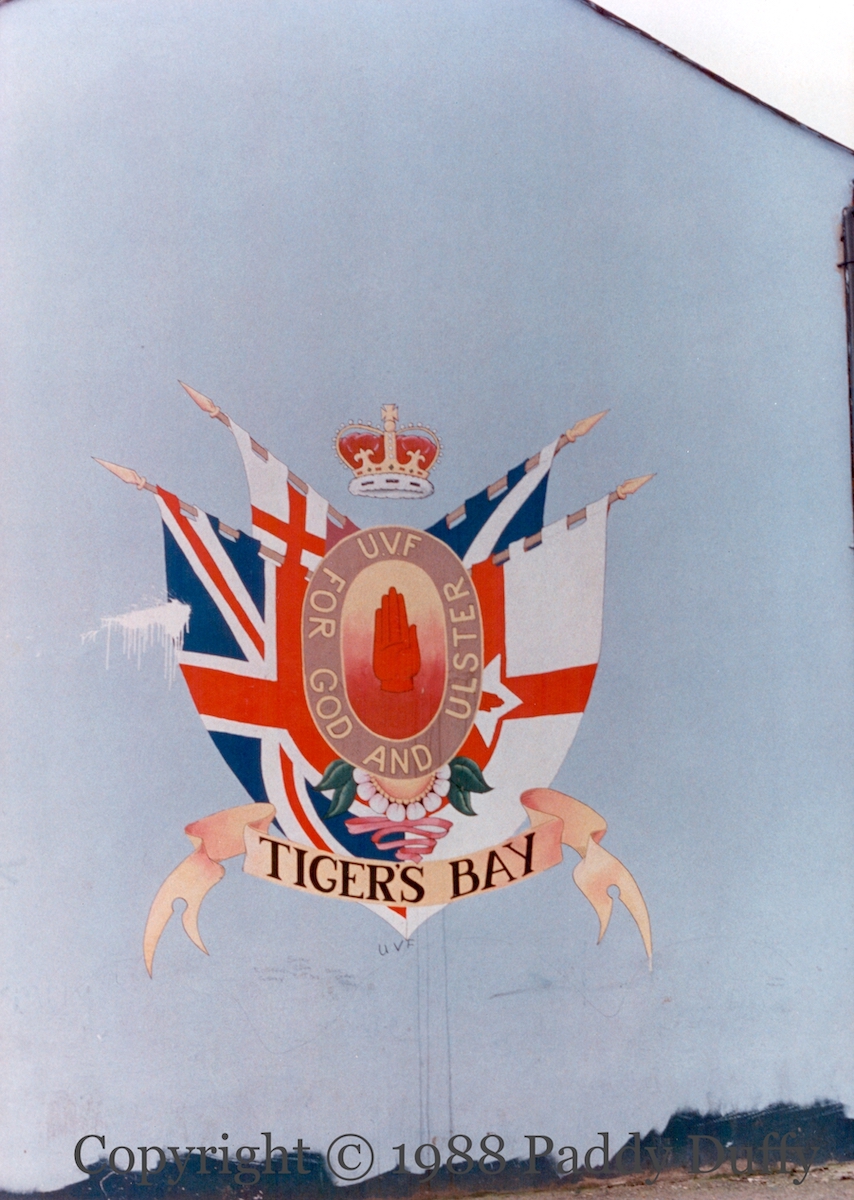
UVF volunteers in balaclavas take aim other across a free-floating Northern Ireland with an Uzi and an assault rifle. The emblem supported by flags on the right is unusual for its inclusion of a ?large daisy? and pink ribbon.
The location of this wall is unknown, which suggests the site of the Community Centre – please get in touch if you know where it was.
Tiger’s Bay, north Belfast
Click image to enlarge
Copyright © 1988 Paddy Duffy
T00226 T00125
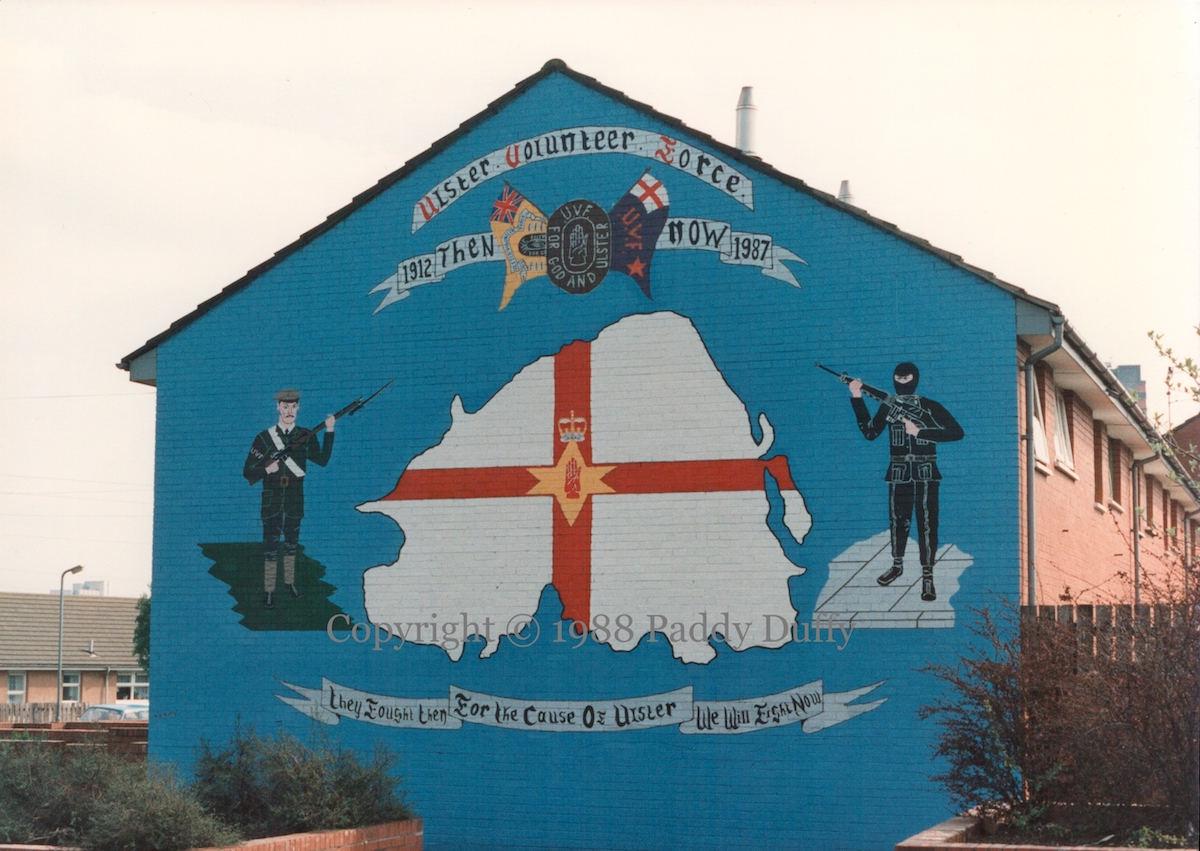
“They fought then for the cause of Ulster, we will fight now.” The 75th anniversary of the Ulster Volunteers is celebrated in this mural in Dover Place, west Belfast. On the left of the Northern Island is an Ulster Volunteer in period (1912) garb standing on a patch of ground, on the right, a modern (1987) paramilitary in hood and fatigues standing on a city footpath. The Ulster Volunteers as such did not fight for Ulster – they instead joined the British Army and fought “for King and Empire” in WWI, after which Home Rule was applied only to 26 counties of Ireland and Northern Ireland was created and remained within the UK.
See also: UVF 75th Anniversary
Click image to enlarge
Copyright © 1988 Paddy Duffy
T00126 [T00115]
 Paddy Duffy Collection