1912-1921

“When Ulster men are proudly glad of the land where they were born/And when England’s cry for help was heard we told them have no fear/For across the flanders fields we send our Ulster Volunteers.”

These are just a few lines from the song First Of July Morn and are used here to recall how the Ulster Volunteers – formed to fight against the imposition of Home Rule – became the 36th Division in WWI, and suggest that the British government should continue to support the Northern Ireland state beyond its one-hundedth anniversary and the current impasse over the NI Protocol of Brexit as a reward for loyalty.

The song’s alternate titles “England’s Treachery” or “Englishman’s Betrayal” give a better feel for the attitude of the whole thing: that England betrayed Ulster by having “sold away” the three counties of Donegal, Cavan, and Monaghan, and that “Ulster men” should “never more be led away, to fight in foreign lands/Not to die, for someone else’s cause, at an Englishman’s command” (youtube). The application to the current situation would then be that loyalism cannot rely on the good nature of the English and should ready itself for “perfidious Albion” to (try to) give away the six counties as well.

“Ballyclare says no to a Irish Sea border.” “Loyalist Ballyclare will never accept an border in the Irish Sea.” “The Belfast Agreement has been broken – the deal’s off.”

Ballynure Rd/Main Street, Ballyclare, next to The Comrades.

Click image to enlarge
Copyright © 2023 Paddy Duffy
T01807 charlie freese the broken covenant
Political Leaders Are Not Listening

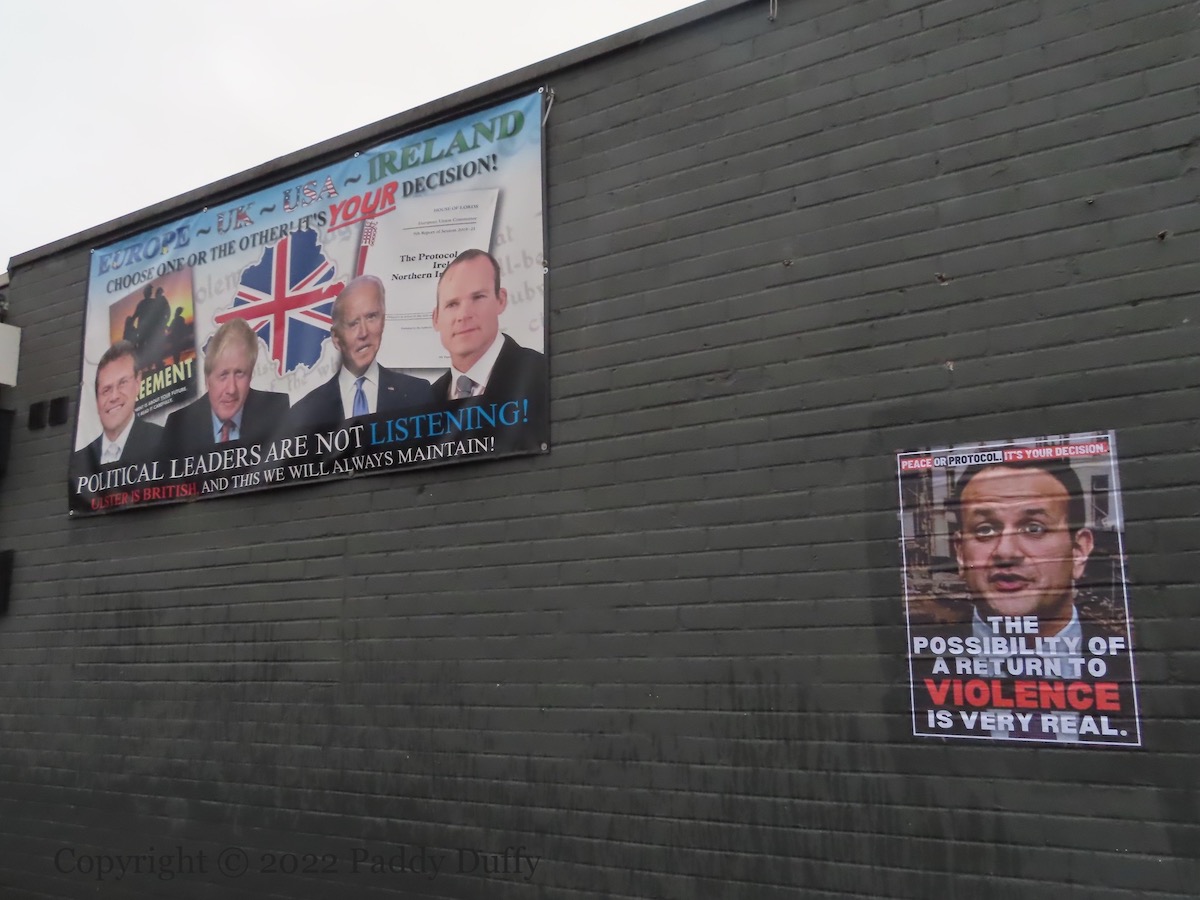
Left: After a break for the funeral of the Duke Of Edinburgh, the Loyalist Communities Council has resumed its protest of Brexit with a banner campaign (Irish News). The banner seems to be offering viewers the choice of one of four affiliations (“Europe – UK – USA – Ireland – choose one or the other! It’s your decision!) but the “correct” answer is at the bottom (and in the faded background of the Covenant): “Ulster is British and this we will always maintain!” even though “Political leaders are not listening!” (including, perhaps, Arlene Foster and the DUP.) The Belfast Agreement (Good Friday Agreement) allows people in Northern Ireland to identify themselves as Irish, British, or both.

Right: “Peace or protocol – it’s your decision”, aimed at Leo Varadkar on the day that he again became Taoiseach (Irish Times) and repeating his words back to him from a speech in 2018: “The possibility of a return to violence is very real”. At that meeting, Varadkar was anticipating violence by anti-Agreement republicans in response to customs posts on the Ireland-Northern Ireland border, and brought a newspaper describing the death of four customs officials, two lorry drivers, and three IRA volunteers at a Monaghan post in 1972 (BelTel).

The authors of this poster are not known, but the parallel statement (mutatis mutandis) would be that anti-Protocol agents – perhaps the “young loyalists” that the UVF “can no longer contain” (UK Daily; see also RTÉ from November) – might return to acts of violence such as the 1974 “Dublin & Monaghan Bombings” that killed 33 people – in the background of the poster is part of a photograph (included below) of bomb damage in Talbot Street – if the Protocol’s “Irish Sea border” is not removed.

Ballysillan Road and (below) Oakmount Drive (near Mount Vernon), north Belfast.

Click image to enlarge
Copyright © 2022 Paddy Duffy
T01656 [T01654] [T01655] T01663

Loyalist Movilla

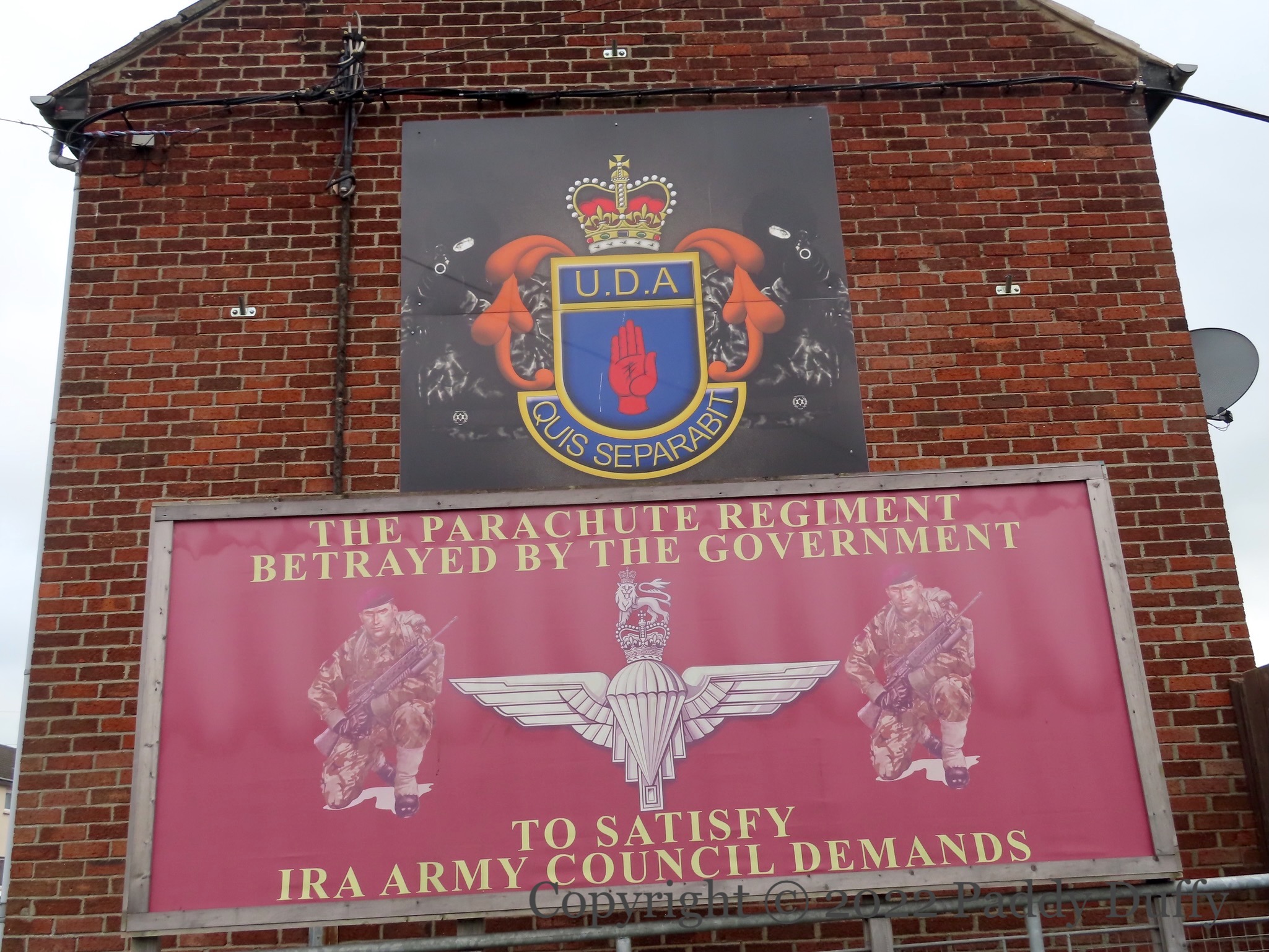
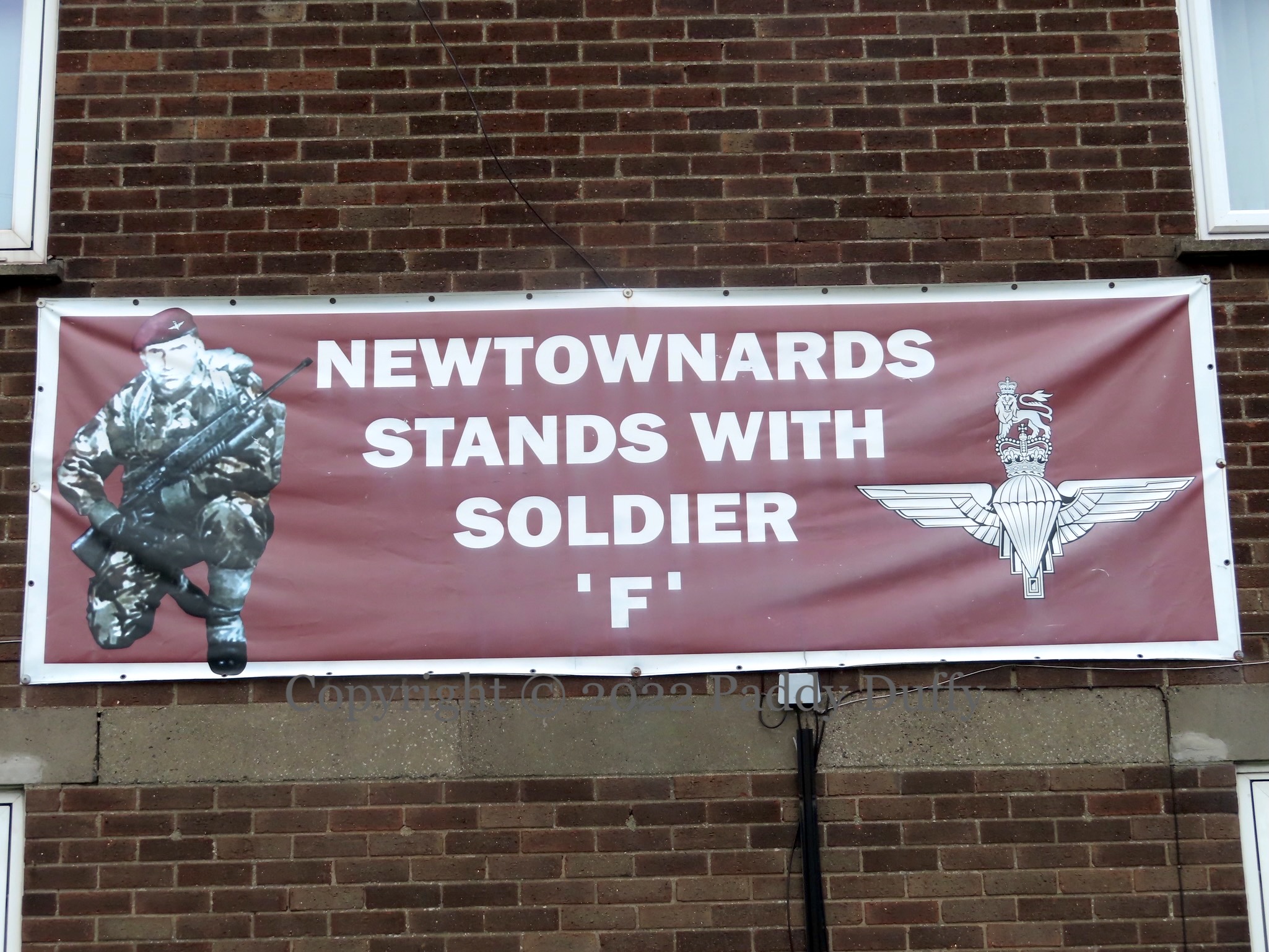
“The Parachute Regiment betrayed by the government to satisfy IRA Army Council demands.” The charges of murder and attempted murder against Soldier F were originally lodged (CNN) and pursued in 2019 (Guardian) but in 2021 the PPS decided to drop the charges. In March (2022) that decision was quashed (BelTel | Guardian). The charges against Soldier F concerned two specific victims, William McKinney and James Wray, though witness testimony involves F in at least four of the deaths (Irish Central | Village). In response to the original charges, the Movilla UDA added the framed tarp shown here to their ‘hooded gunmen’ board in Georges Street, Newtownards.

Click image to enlarge
Copyright © 2022 Paddy Duffy
T01570 T01571 T01572

Ulster Welcomes Her King & Queen

… to the state opening of the first parliament of Northern Ireland – with new prime minister James Craig – at Belfast City Hall on June 22nd, 1921. The monarchs in question are King George V and Queen Mary. Pathé has video of the royal arrival and travel to City Hall. In his speech, George appealed “to all Irishmen to pause, to stretch out the hand of forbearance and conciliation, to forgive and to forget, and to join in making for the land which they love a new era of peace, contentment, and goodwill.”

For the coat of arms, see previously The Lion And The Elk. It is not clear whom the twelve framed portraits depict. The six gentlemen in the background are the members of the original Executive Committee, which served as a cabinet to the Commons and Senate – for a full list, with offices, and the original photograph, see WP. Carson’s statue at the entrance to Stormont is on the left. The photograph of spectators at the parade (on the far left) can be seen in this News Letter article. The photograph of the royals in their carriage can be seen here and of the King inspecting the guard here.

The project was undertaken by Rathcoole Friends of the Somme (Fb), with support from the Housing Executive’s Community Cohesion unit.

See also Floreat Ultona in south Belfast.

Iniscarn Drive, Rathcoole

Click image to enlarge
Copyright © 2022 Paddy Duffy
T01322 [T01321]

Common Sense

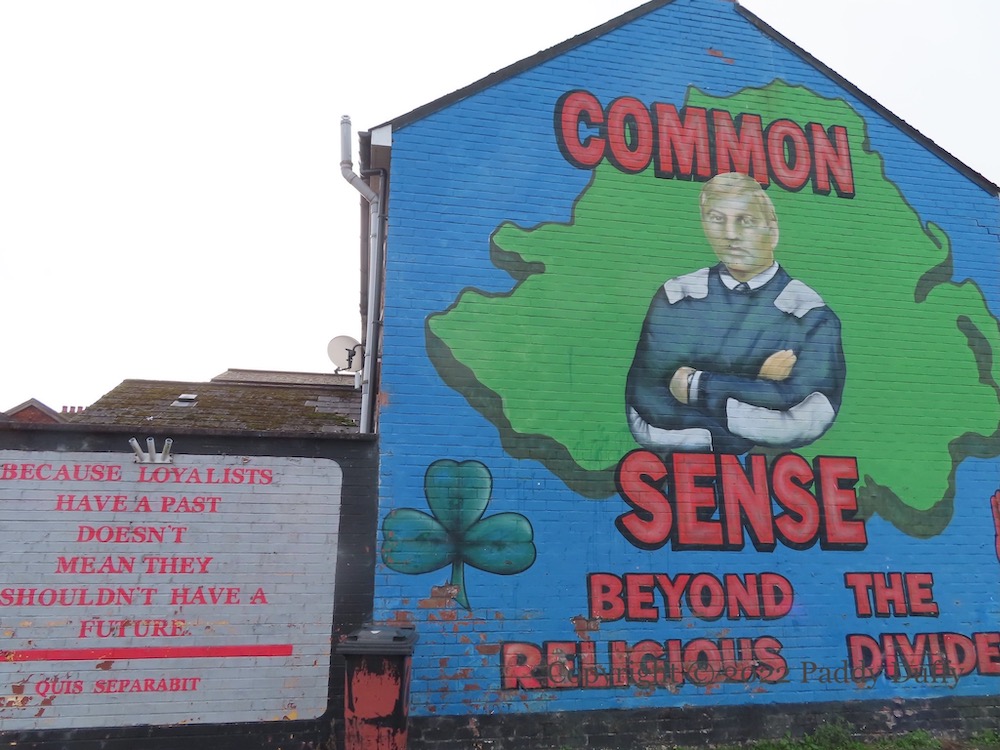
UDA commander John McMichael was also secretary of the New Ulster Political Research Group (NUPRG), a think tank of the UDA/UFF. The group argued for an independent Northern Ireland (based in part on beliefs about a separate Ulster ethnic identity – see the Visual History page on Cú Chulaınn) in two documents, 1979’s Beyond the Religious Divide and 1987’s Common Sense (available at CAIN), promoting the philosophy of ‘Ulster nationalism’, depicted here by the free-floating Northern Ireland. McMichael ran unsuccessfully for the Belfast South seat after the murder of Robert Bradford (see To Bathe The Sharp Sword Of My Word In Heaven).

The side wall reads “Because loyalists have a past doesn’t mean they shouldn’t have a future. Quis separabit.” It previously had a McMichael quote – see We Must Share The Responsibility.

Click image to enlarge
Copyright © 2022 Paddy Duffy
T01140

The Village Green

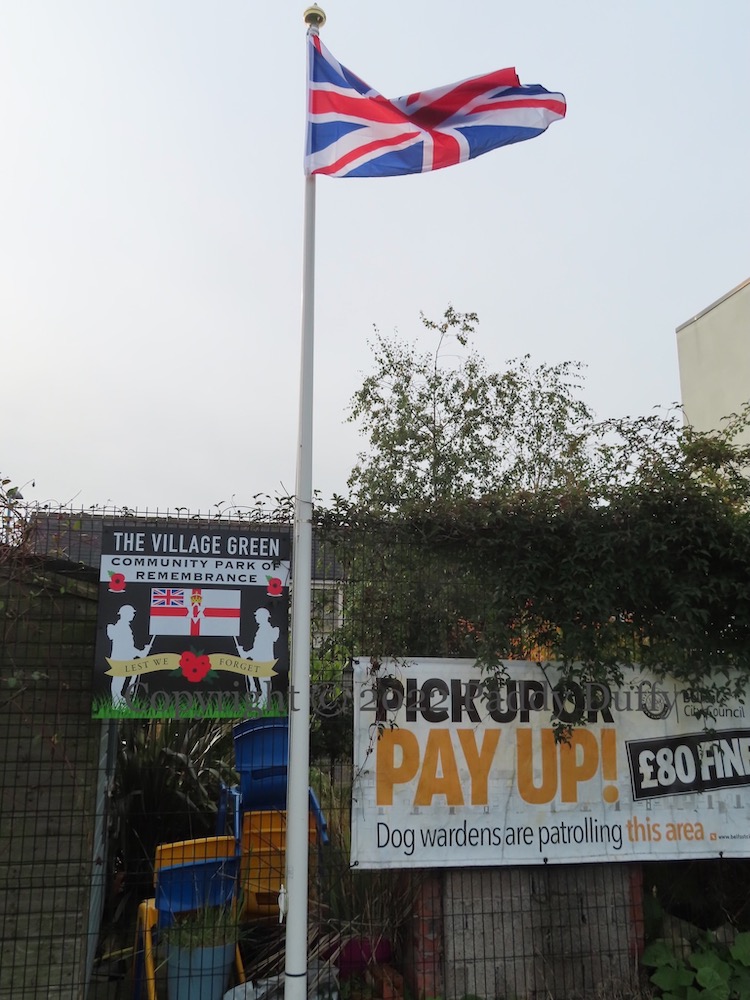
Part of the most recent development of the upper streets in the Village was not to rebuild the two rows of houses on Ebor and Nubia/Moltke streets and in their place construct a park – the Village Green – and playground. This new board on the outside railings make the park a “community park of remembrance” for WWI, showing an Ulster Banner with a Union Flag in the canton.

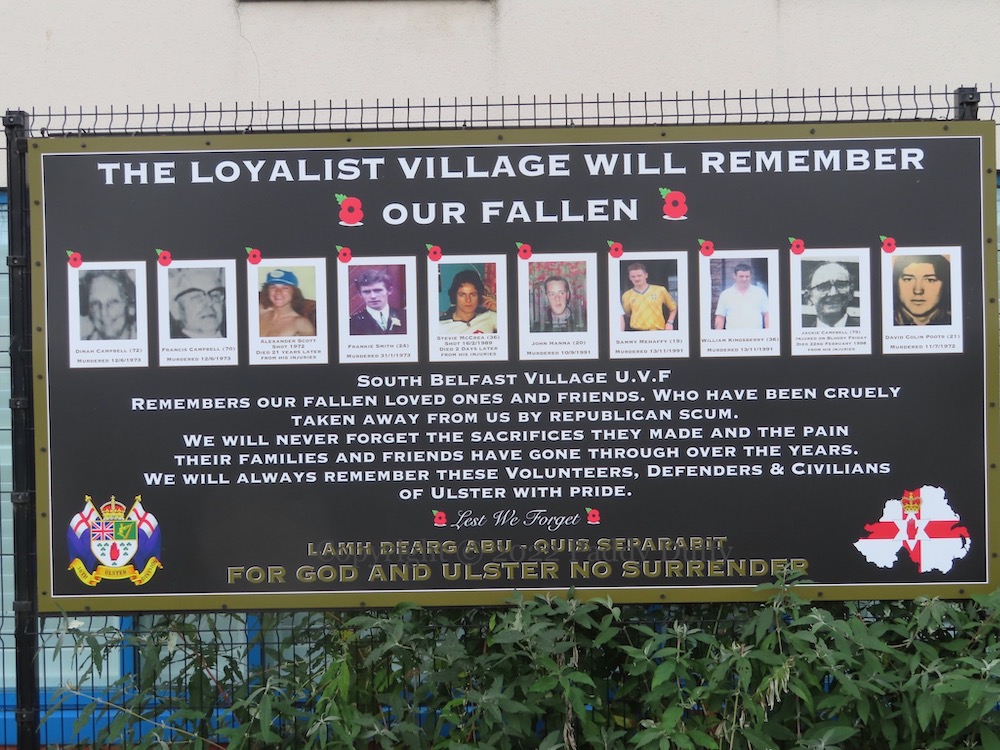
There is also a memorial to “loved ones and friends”, “volunteers, defenders & civilians” of the South Belfast UVF (though there is 36th (Ulster) Division emblem in the corner) who were “cruely taken away from us by republican scum”: Dinah Campbell, Francis Campbell, Alexander Scott, Frankie Smith, Stevie McCrea, John Hanna, Sammy Mehaffy, William Kingsberry, Jackie Campbell, David Poots.

Also in the park: Crying, Sighing, Breathlessly.

Click image to enlarge
Copyright © 2022 Paddy Duffy
T01127 [T01126] T01128

Our Wee Country

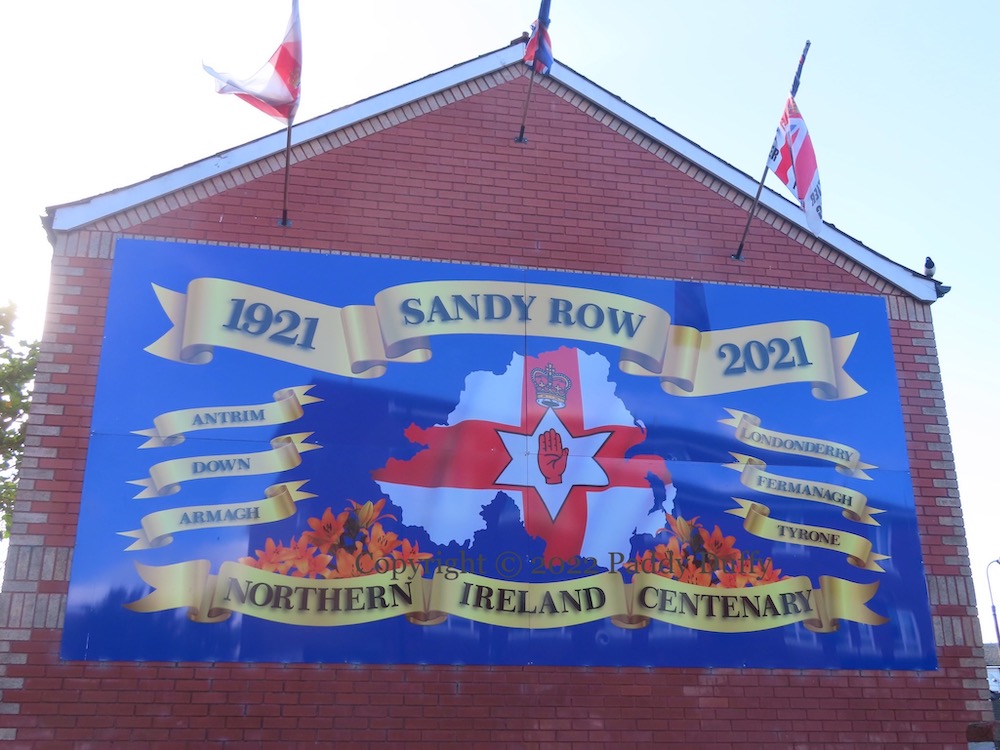
“From Sandy Row to the house of Windsor: happy diamond jubilee 1952-2012. God save the Queen.” Although the coronation was held in June 1953, Elizabeth acceded to the throne immediately upon the death of George VI, on February 6th, 1952. This board was previously on an adjacent wall but has been moved to this location (on top of the ‘Our Wee Country’ mural, replacing a damaged mosaic) to make way for the NI centenary board shown below.

The Irish Football Association (web | tw) is the governing body for Northern Irish soccer, overseeing both domestic and international events. The original Our Wee Country (fan organisation Web | tw) mural was in Carnforth Street, east Belfast.

Click image to enlarge
Copyright © 2022 Paddy Duffy
T01084 [T01083] T01085

Village UDA

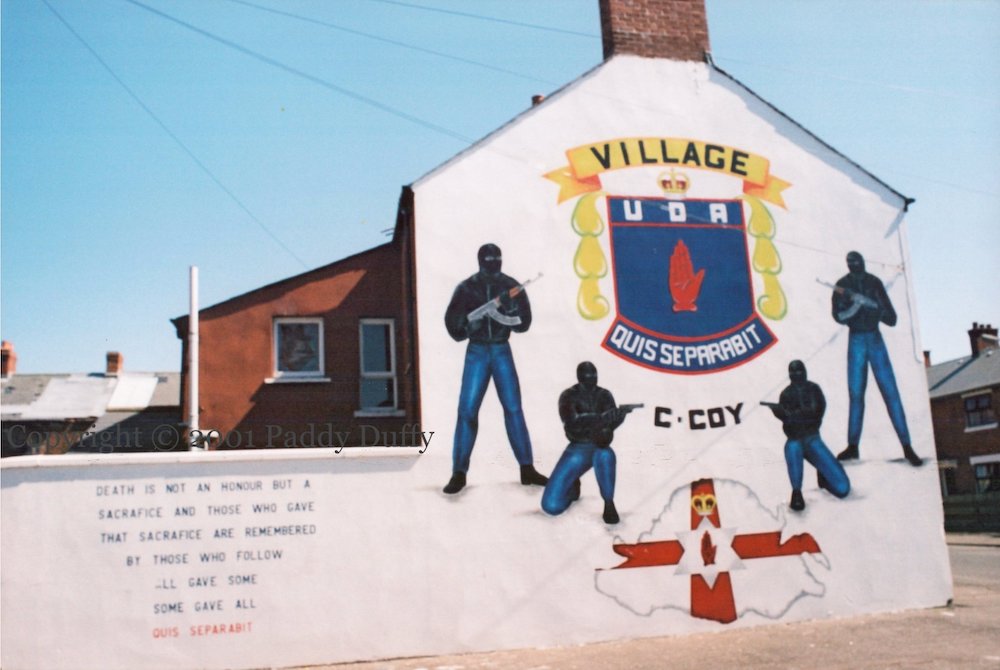
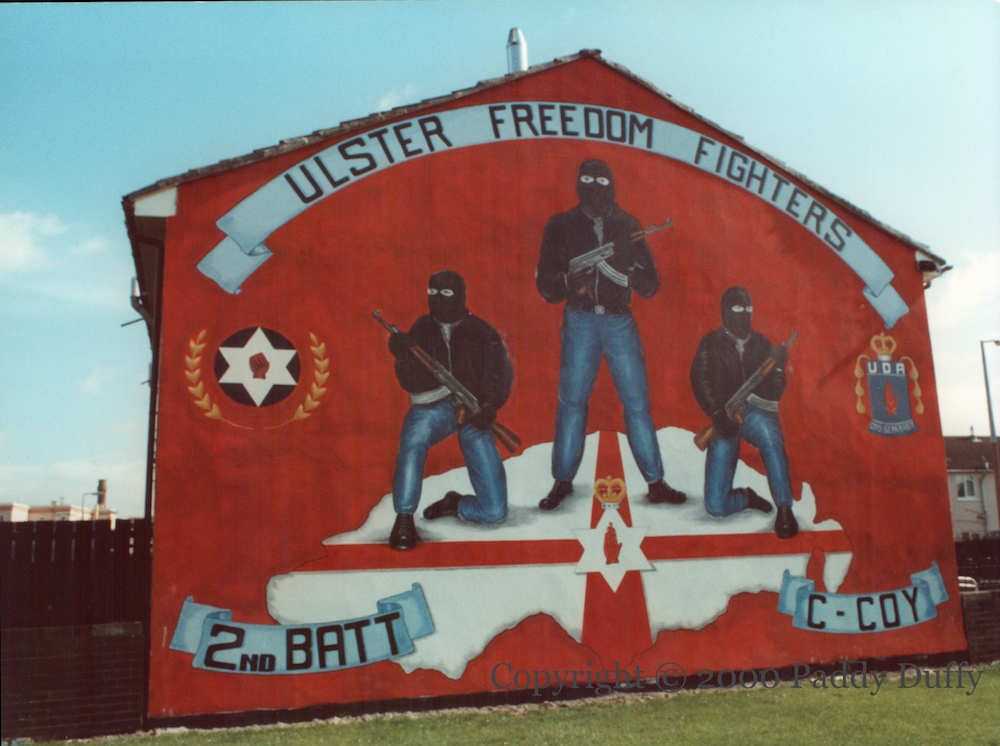
“Death is not an honour but a sacrafice [sic] and those who gave that sacrafice [sic] are remembered by those who follow. All gave some, some gave all. Quis separabit.” Village UDA C company volunteers in balaclava pose with assault rifles around an Ulster Banner in the shape of Northern Ireland.

Rockview Street, south Belfast

Click image to enlarge
Copyright © 2001 Paddy Duffy (no date given)
T00789

Champions Of Ulster

Cú Chulaınn (or, as here, Cuchulainn) is usually shown dying, in the pose made famous by Oliver Sheppard in his statue that was installed in the General Post Office in Dublin in 1935. (See the Visual History page about Cú Chulaınn in murals.) Here, however, he is a living warrior (carrying a sword and a shield emblazoned with the crest of Northern Ireland) as an analogue to loyalist paramilitaries and prisoners of war (“LPOW” on the right).

Lincoln Court, Londonderry

Click image to enlarge
Copyright © 2000 Paddy Duffy (no date given)
T01194