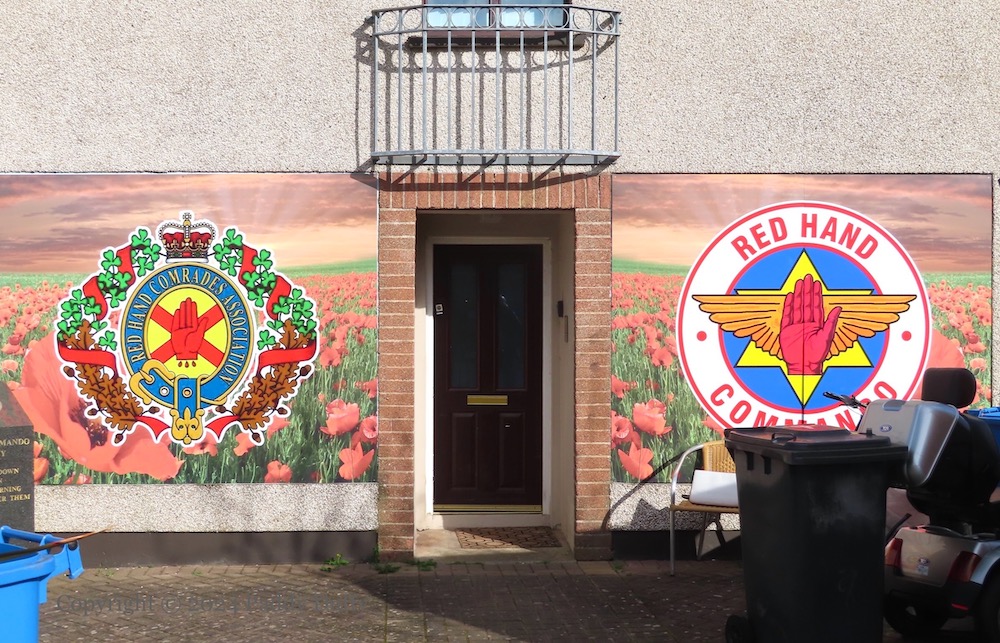
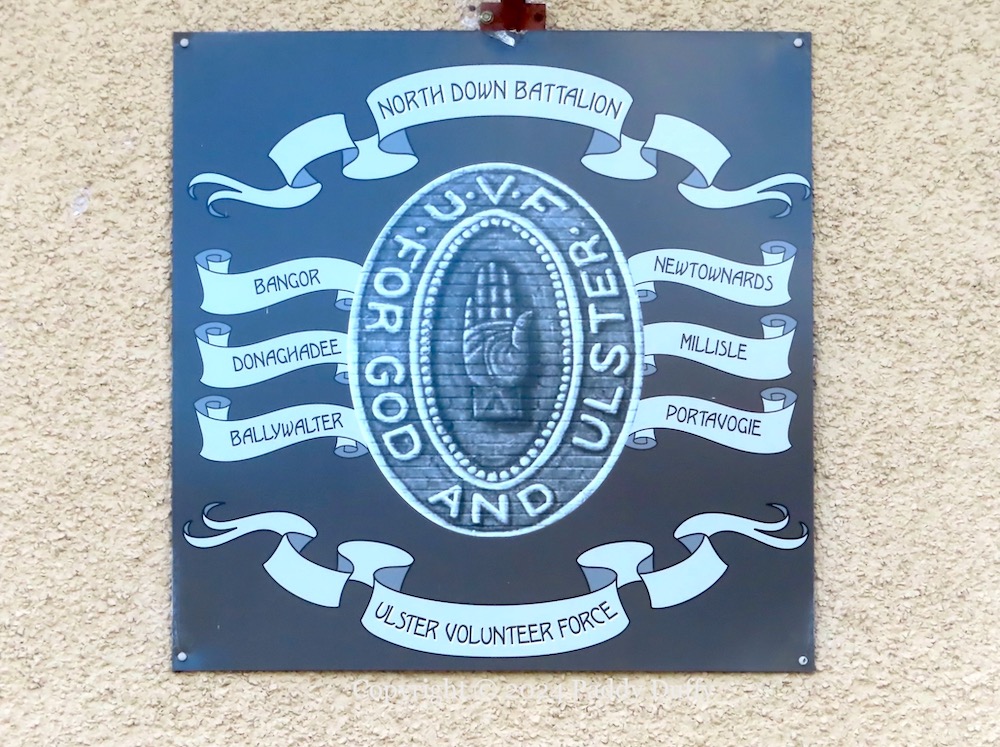
These are the boards at the chip shop (formerly a Spar and before that a Mace) in the centre of the Mourneview estate, Lurgan.
Above, and in detail below, are the pieces from the front of the shop, in Pollock Drive. Anti-clockwise from bottom-left:
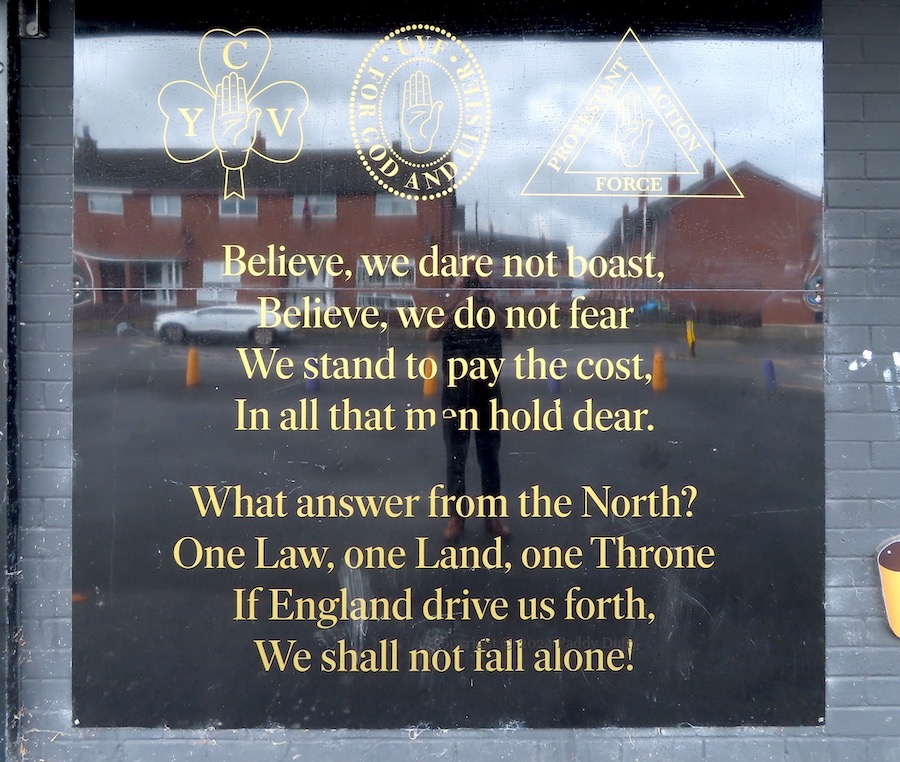
First: “Believe, we dare not boast,/Believe, we do not fear/We stand to pay the cost,/In all that men hold dear.//What answer from the North?/One Law, one Land, one Throne/If England drive us forth,/We shall not fall alone!” Kipling’s poem Ulster.
Next (tall piece): A company, 1st battalion, Mid Ulster brigade UVF – Lurgan as well as Broxburn (outside Edinburgh) and Thornliebank (near Glasgow).
Next: PAF plus (out of frame in the wide shot) “When injustice becomes law resistance becomes duty.” The same panel was seen in Ballyclare, though for the 1st East Antrim battalion rather than the Mid Ulster brigade.
Above: A tribute to the Ulster Volunteers from the area: the 9th battalion Royal Irish Fusiliers joined the 108th brigade in the 36th (Ulster) Division; the 5th battalion joined the 31st brigade and the 10th (Irish) Division. This board goes back to (at least) 2011.
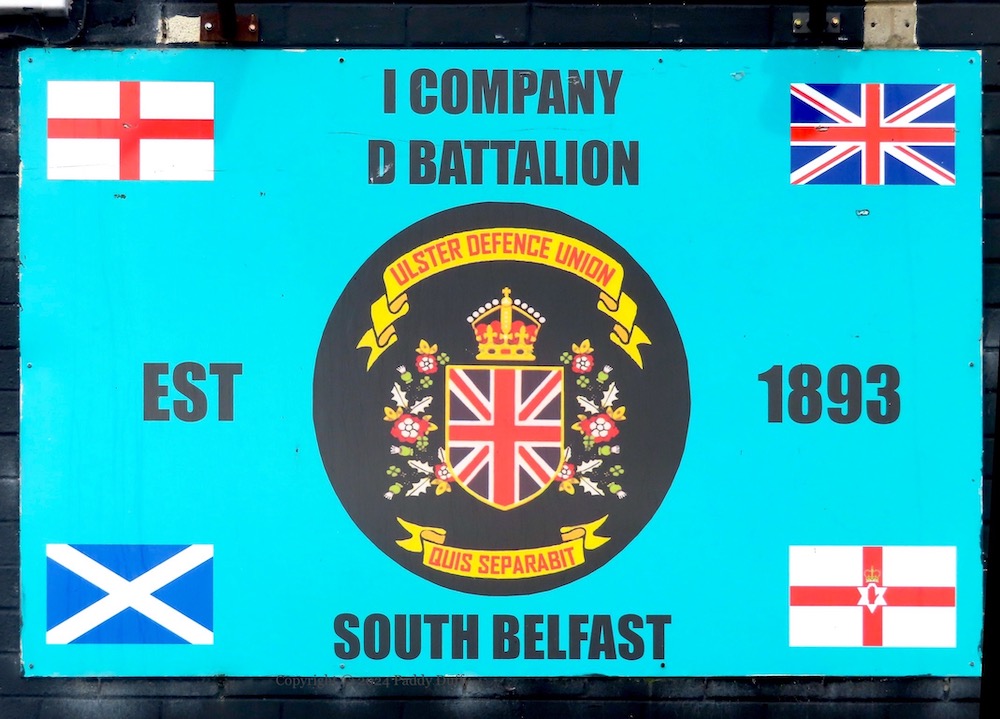
Finally (top left), a UDU/UDA board, to 1 company, D battalion, South Belfast. All of the remaining pieces are UVF/PAF.
Around the corner, in Mourne Road, a gallery of photographs of the Craigavon Protestant Boys (Fb) past and present, with a plaque in memory of Victor Stewart. “Our only crime is loyalty.”
In the adjacent Spelga Park: “Unbowed & unbroken – our only crime is loyalty – Mourneview/Gret estate bonfire” with an unusual combination of shamrock and Orange lily.
William III is the only member of the (Dutch) House Of Orange to rule the UK, as his marriage to Mary did not produce any offspring, and the crown passed to Mary’s sister Anne after both Mary (1694) and William (1702) had died (WP). Queen Elizabeth II was from the Saxe-Coburg And Gotha ‘house’ (changed during the Great War to “Windsor”) via her great-great-grandfather Prince Albert (of Victoria & Albert) but she symbolises Orangism to Northern Irish Protestants and in the portrait shown here she wears an orange jacket and an orange hat which has a band of orange lilies; the portrait is framed by a Union Flag and two clusters of orange lilies.
The plaque on the right reads “This mural is a tribute to her majesty Queen Elizabeth II. Funded by the loyal people of Portadown. To God be the glory.”
On this day 334 years ago (in the Julian calendar, which would be June 24th in the Gregorian), King William III landed at Carrickfergus and began his journey, via Belfast and Lisburn, to the Boyne river (outside Drogheda) where he successfully led his forces against those of James II.
After landing in Carrick, William rode by horse to Whitehouse, half-way to Belfast, where he met his commander-in-chief, the Duke Of Schomberg, who had been in Ireland since the previous August and laid siege to, and taken, the Jacobite garrison in Carrickfergus, making William’s landing there possible (WP).
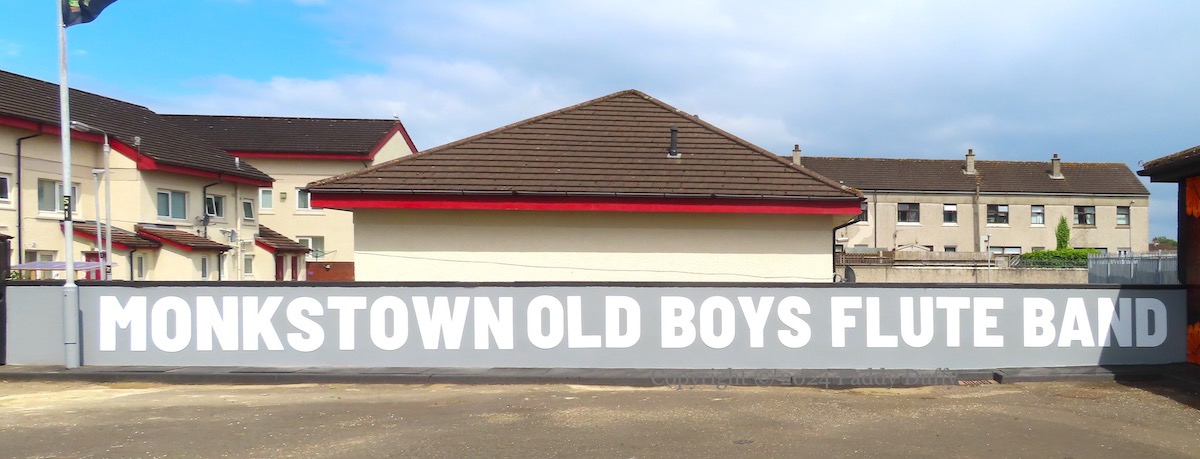
This new large board at Monkstown Old Boys (Fb) celebrates William’s landing and journey to Whitehouse, which is the point closest to Monkstown.
The image reproduced in the centre of the board (see below; a crisper version can be found at Orange Heritage) shows William meeting Schomberg at the eponymous White House, where Glas Na mBradán (the Salmons’ Stream) made a small port. Dalaradia has a 3-D flyover of what the White House and surrounding area might have looked like at the time. The remains of the White House have been restored and now house an interpretive centre (Bangor Historical Society | Causeway Coastal Route).
[The following text appears to be an excerpted and slightly modified version of a page at Orange Heritage.]
“King William was in Ulster from Saturday, June 14th, 1690 until Thursday, June 26th, only 12 days, yet he left behind a legend full of proud memories. For his part he liked what he saw. “This country is worth fighting for,” he said.
“His departure from London had been held up by parliamentary business till the end of May, when he announced that he could wait no longer and adjourned Parliament.
“Early in the morning of June 4 he set out, but on June 11th he embarked on board the yacht “Mary” with a fleet escorted by Sir Cloudesley Shovell’s squadron. On June 14th the hills of Ireland came in sight and in the afternoon the fleet cast anchor off Carrickfergus. He was rowed ashore in the Rear Admiral’s barge and at about 3.30 p.m. landed at the Old Quay under the shadow of the great Norman Castle.
[The 1973 painting of the Quaker greeting William is by Thomas Everard Spence and held by Carrickfergus Council – see Art UK. The Union Flag on the right lacks the St Patrick’s Cross – this would not be added until after the 1801 Act Of Union.]
The Garrison of the Castle had drawn up a Guard of Honour and the townspeople added their applause. The chosen spokesman was a Quaker, whose principles forebade [sic] him to doff his hat, or use such titles as Sir and Majesty. He got over the difficulty by taking off his hat and laying it on a stone and then stepping forward and saying “William, thou art welcome to thy Kingdom” which pleased the King so much that he replied: “you are the best bred gentleman I have met since I came to England.”
“With these words he mounted his horse and set off for Belfast. Half-way along the shore was the little port of Whitehouse, where most of the army disembarked. The Commander-in-Chief, the Duke of Schomberg, and his senior commanders were waiting here to welcome the King. To cover the disembarkation, earthworks has [sic] been thrown up by the engineers at Fort William and garrisoned by troops ready for action.”
“Battle of the Boyne: Although the battle has been commemorated on 12th July for more than 200 years, it actually took place on 1st July according to the old Julian calendar, and on 11th July according to the Gregorian (which replaced the Julian calendar in 1752). It was the last time that two crowned Kings of England, Scotland and Ireland faced each other on the battle field.” [By the time of Britain’s adoption of the Gregorian calendar in 1752 the calendars had moved (in 1700) another day apart, making them eleven days apart at that time. However, eleven days rather than ten were added to all prior dates, even those before 1700 and further back, to yield July 12th as the date of the Battle in 1690.]
“In 1689 Parliament declared that James had abdicated by deserting his kingdom. William (reigned 1689-1702) and Mary (reigned 1689-94) were offered the throne as joint monarchs.
They accepted a Declaration of Rights (later a Bill), drawn up by a Convention of Parliament, which limited the Sovereign’s power, reaffirmed Parliament’s claim to control taxation and legislation, and provided guarantees against the abuses of power which James II and the Stuart Kings had committed.
The exclusion of James II and his heirs was extended to exclude all Roman Catholics from the throne, since ‘it hath been found by experience that it is inconsistent with the safety and welfare of this protestant kingdom to be governed by a papist prince’. The Sovereign was required in his coronation oath to swear to maintain the Protestant religion.”
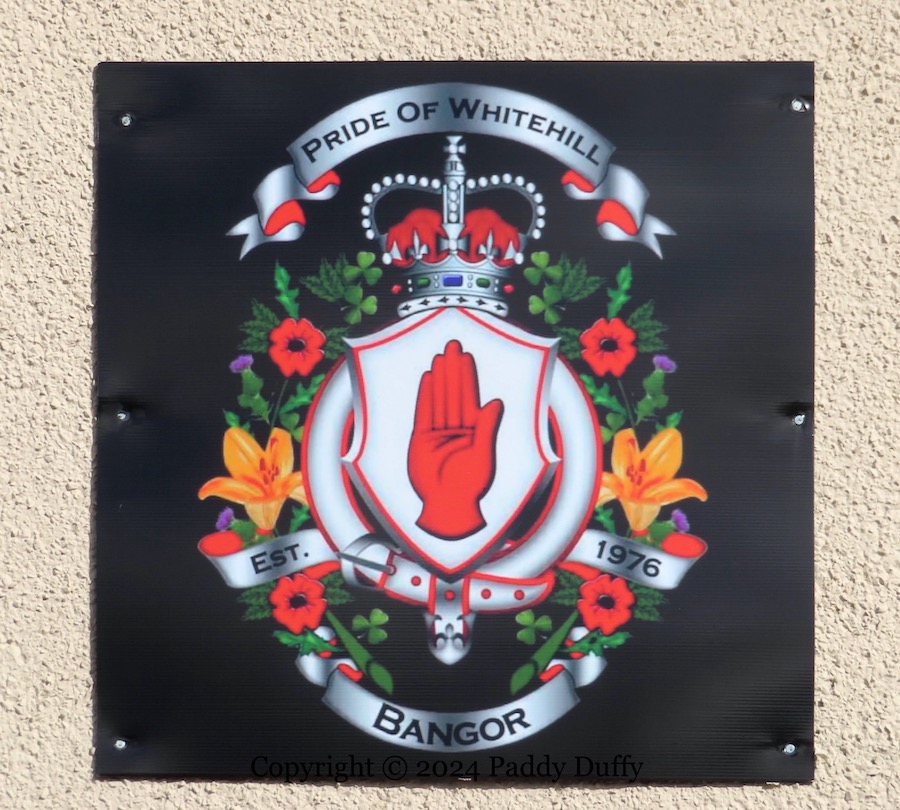
Here is a gallery of the smaller boards in the Whitehill area of Bangor – other specific pieces can be found in The Elite and Long To Reign Over Us.
The area is a UVF stronghold but split between the North Down and East Belfast battalions – see Welcome To Bowtown and North Down UVF. The very bottom of the estate is UDA – “RUFF touts” is on the border-line, Skipperstone Road.
Two flute bands are mentioned: Pride Of Whitehill (Fb) and Bangor Protestant Boys (Fb).
The plaque above – “Ormeau Road in memory [of] Fergie” – is now somewhat incongruously above painted signage for a coffee-and-donuts shop (Bunelos | web) on the Ormeau Road, a commercial road which is also at the edge of the Ballynafeigh neighbourhood.
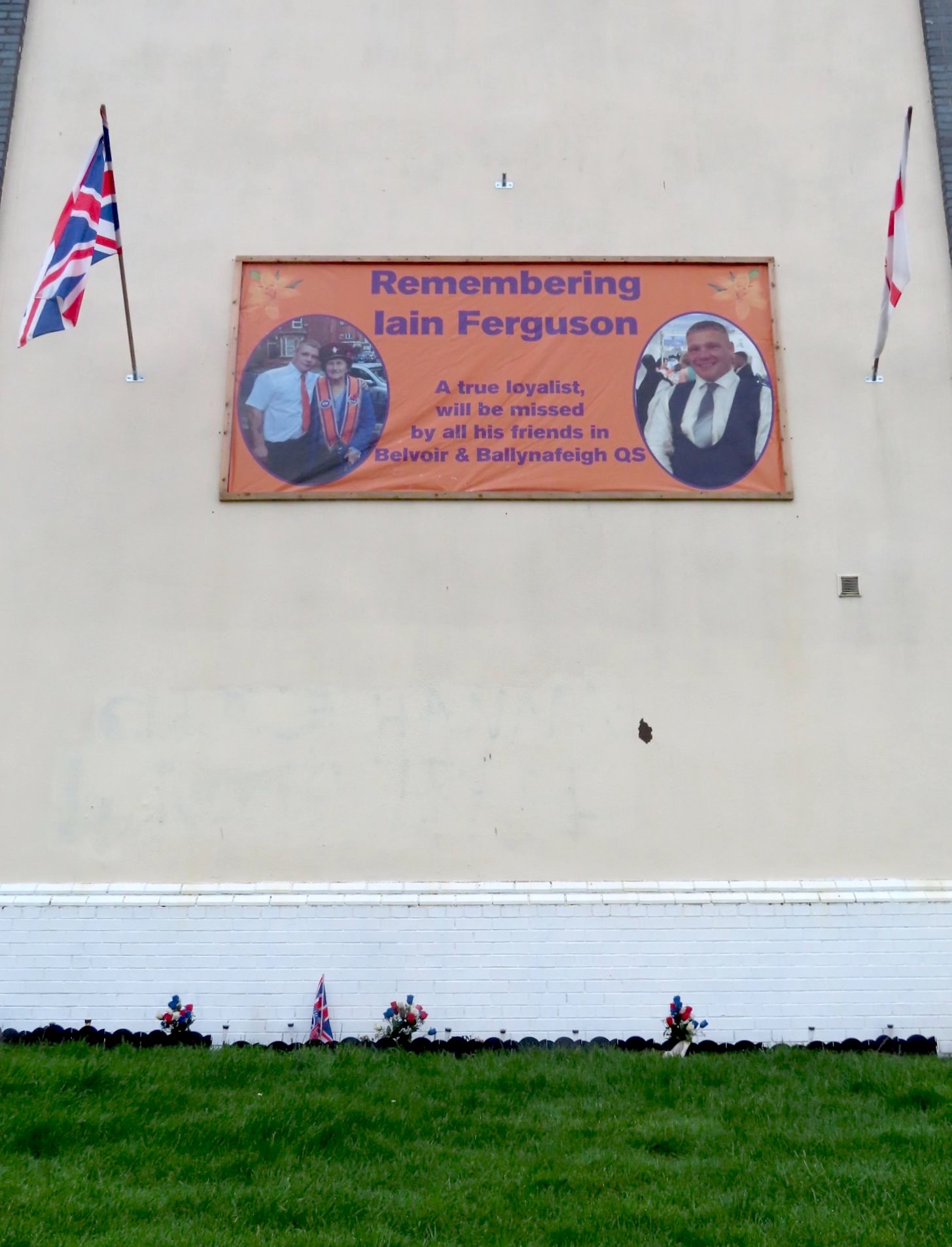
“Fergie” is perhaps Iain Ferguson, who died in 2021 (Belvoir & Ballynafeigh UPRG on Fb) and is remembered in a tarp on the side of the flats in Belvoir, shown below. (UPRG is affiliated with the UDA – hence the red hand and the six-pointed star in the plaque, alongside the flowers of the four nations – rose, shamrock, daffodil, thistle – and orange lily.)
“Always remembered by the officers and volunteers of South Londonderry/Randalstown Ulster Volunteer Force.” This memorial mural and plaque in Magherafelt names Charlie Wright, Jonathan Wallace, Ken Wilkinson, and Ian McArthur.
Of these, Wilkinson seems the most well-known, as he served as a PUP representative for the area. He commented on sectarian tensions in Randalstown in 1999 (An Phoblacht) and in Coleraine in 2009 (Irish Examiner), and spoke against sueprgrass trials in 2011 as a member of FAST (Irish Times | see previously FAST and FASTing For Human Rights And Justice); he was accused of intimidation of Catholics in Antrim in 2003 (An Phoblacht). He stood for a number of elected positions (e.g. 2013) but was unsuccessful.
Ostensibly for his stand against drug-sellers, in 2010 a pipe-bomb (BBC), and in 2011 a make-shift car-bomb (BelTel), were placed against his home and he received death threats in 2013 (politics.ie). He died in 2021 (BelTel | News Letter | Irish News).
The plaque in the memorial garden (shown below) reads, “This plaque is dedicated in memory of all of the loyalist people of Ulster who have suffered at the hands of the enemies of our land. Lest we forget.”
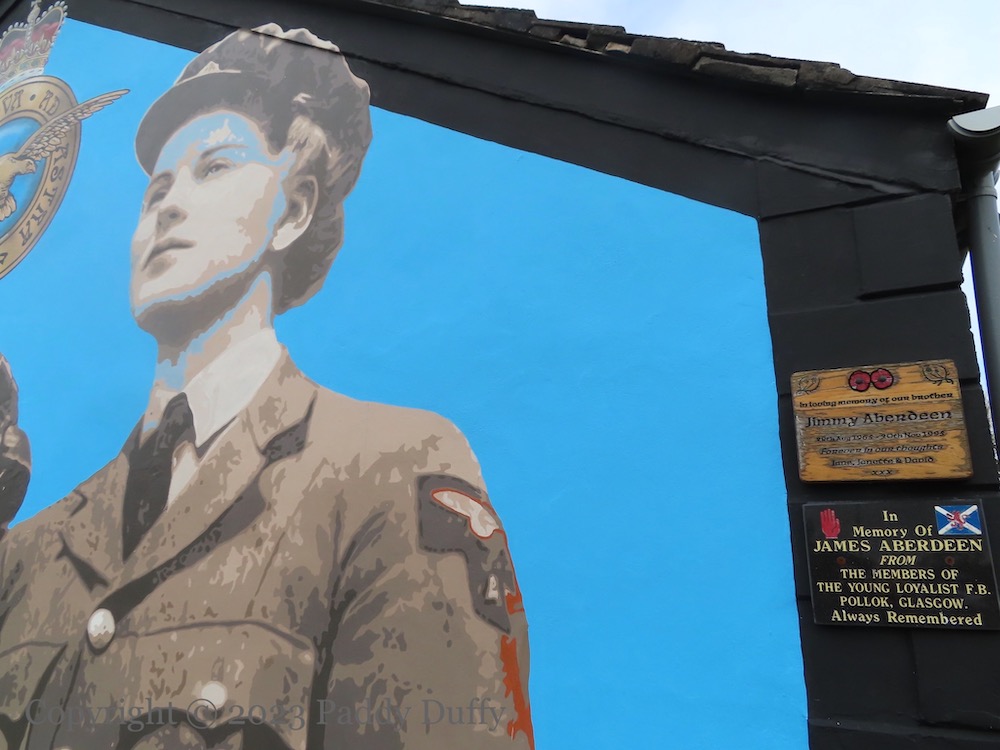
“Through adversity to the stars” – in WWII the Belfast Telegraph conducted a campaign to raise money for spitfire aircraft. 17 were purchased with the roughly 89 thousand pounds raised, and each of them was named for a city or area of Northern Ireland, including one named for Ballymena, which is the site of this new mural recalling the effort. (BelTel | NIWorld)
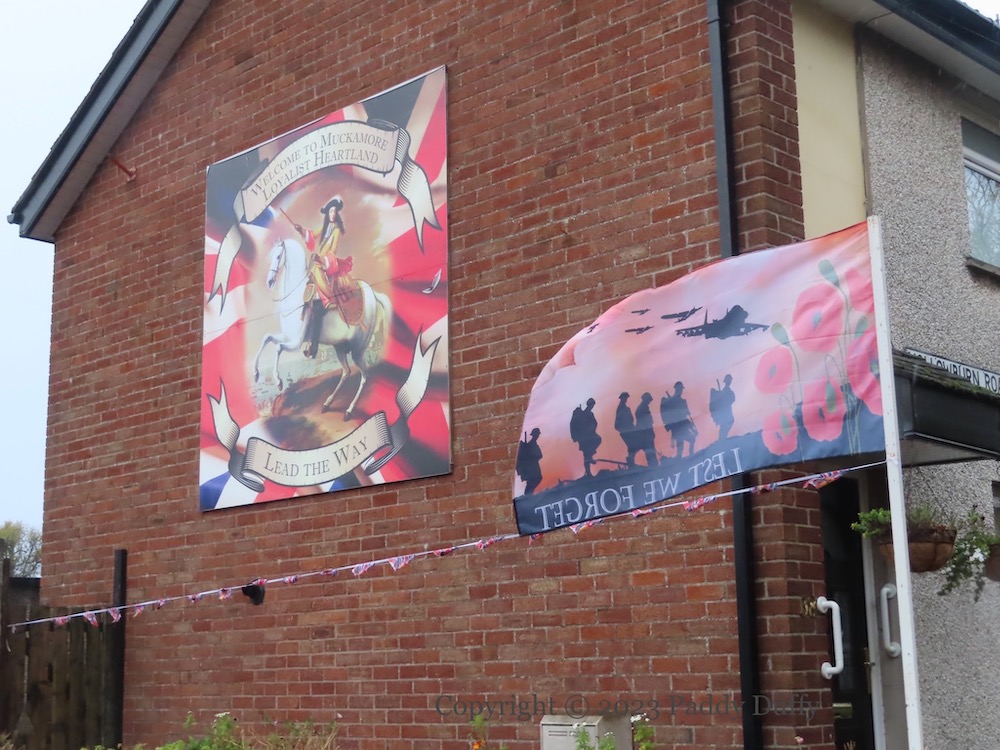
“Welcome to Muckamore, loyalist heartland – lead the way.” “In defence of our heritage and culture.”
In the Muckamore/Ballycraigy areas of Antrim the insignia of the LVF are still in place. “Lead the way” was the slogan of the LVF (see e.g. D01246 for a prominent instance in Ballycraigy). The organisation called a ceasefire and decommissioned some weapons in the years after the Agreement but persists in some form in Antrim (WP).
The Sons Of Ulster also used to use the slogan “Lead the way” (as described in J1947) but it is not present in the board shown in the recent (2022) Old Ulster’s Battle Cry.
The two boards below are on gables above Woodgreen, which is the site of the bonfire (ig) featured in the third image. They used to claim that it was the biggest bonfire (see C06695) but Craigyhill (in Larne) is more recently the tallest – see Commonwealth Handling Equipment.
There is also a memorial garden to Billy Wright in Ballycraigy – see M05203.
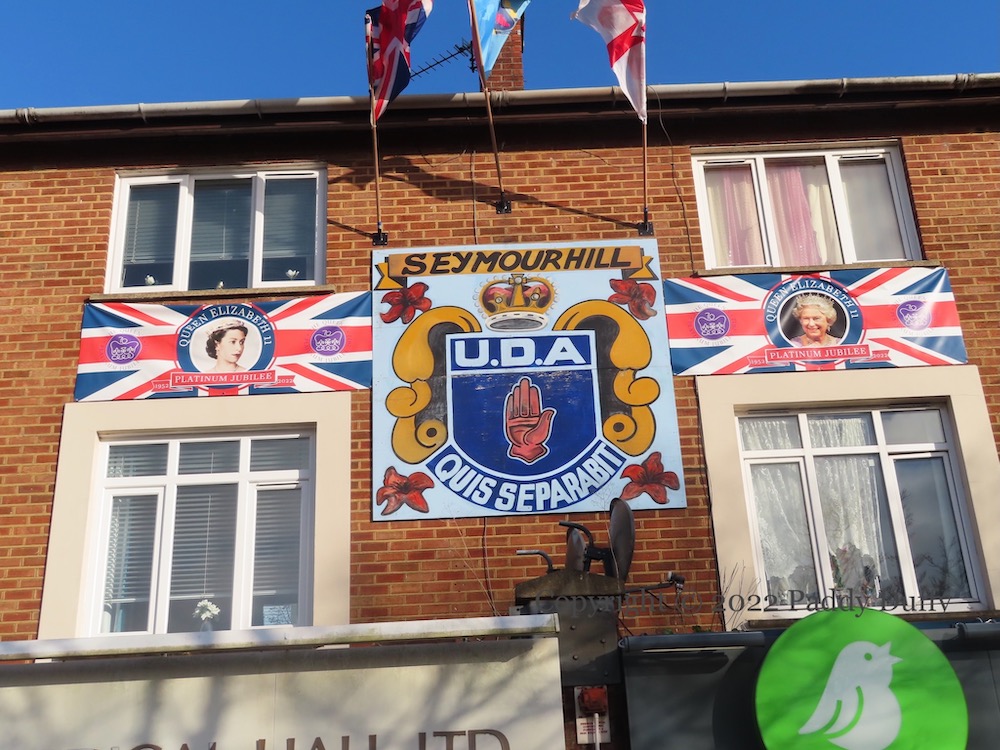
Above, a “Welcome to loyalist Seymour Hill” board with flags and poppies, and a (2021) tarp “Seymour Hill says no to the Irish Sea border”.
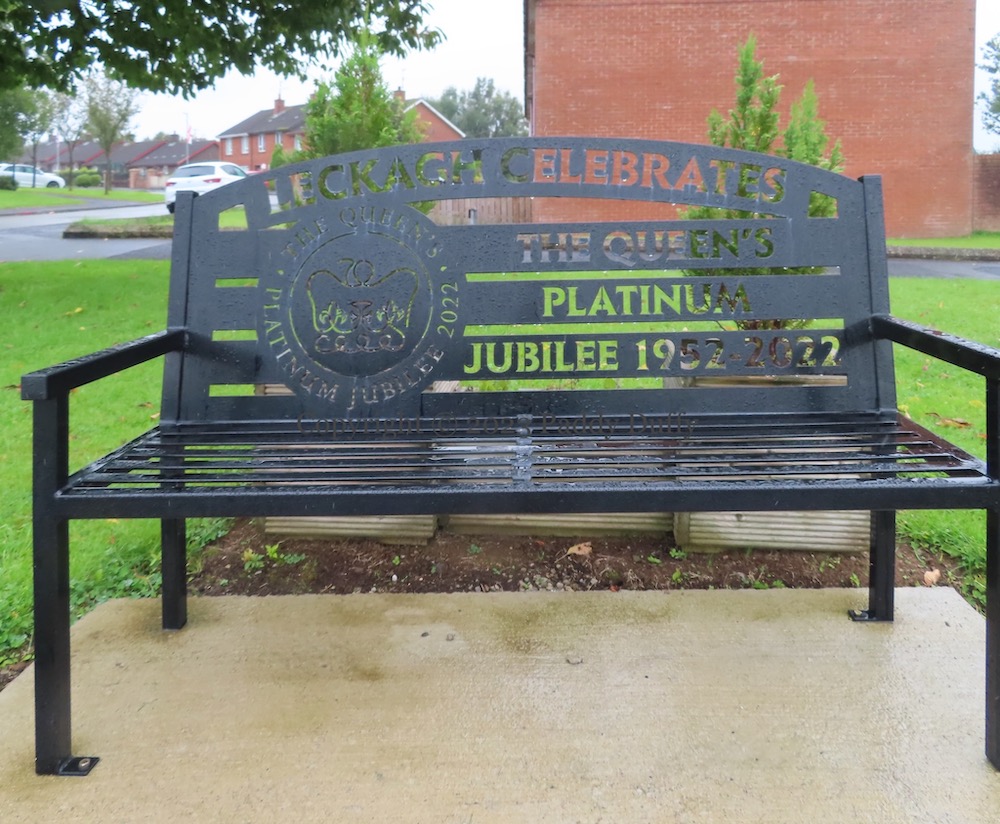
Below, Queen Elizabeth II 70th/platinum Jubilee banners remain on either side of the UDA board above the Seymour Hill shops, even after her death in September (previously there were two NI Centenary banners). There are orange lilies at the four corners of the UDA emblem.
Left: “The Annals of the Four Masters record that in 665 AD, the Battle of Farset (Belfast) took place between the County Down Dal Fiatach, self styled Ulaid, and the Pretani or Cruthin where Cathasach, son of Laircine, was slain. This was an attempt by the Dal Fiatach to encroach on the Curtain territory of Trian Congail. The “third of Congal”, which encompassed territory on both sides of the Lagan, corresponding more to less to Uppers and Lower Clandeboye, including modern Belfast. Cathasach was Congal’s grandson. The battle was the first mention of Belfast in Irish history.”
The battle scene shown is Jim Fitzpatrick’s vision of the battle of Moira (in 637), rather than “Bellum Fertsi”. The salience of this description of intra-Ulster fighting is that there is a contention that the Cruthin were Scots (Picts) thus allowing for the idea (employed especially by the UDA – see Ulster’s Defenders and Defender Of Ulster From Irish Attacks) that present-day northern Protestants have a heritage, and a history of fighting for what is roughly Co. Antrim, that pre-dates the plantations. For more information and a similar board, featuring the tower blocks of Rathcoole rather than Cuchulainn and the Battle of Moira, see Kingdom Of The Pretani. For the debate over a connection to the Picts, see WP.
The Annals date back to the 1630s though they mostly comprise a variety of earlier sources.
The image of the gentleman with the sword appears to be a stock fantasy image, used for at least two characters in Game Of Thrones fandom (Rhaegon Targaryen and Lord Cameron Umber).
Middle: 2021 was the centenary of the creation of Northern Ireland and the year in which Scottish football club Glasgow Rangers won their 55th league title. Support for the club is widespread among the PUL community in Northern Ireland; local soccer and the international team is overseen by the IFA.
Right: “Centenary of cultural expression 1921-2021. Sons Of Belfast LOL 743. Castleton Temperance LOL 867. The Memorial LOL 1197. Belfast Harbour LOL 1883. The Coote Memorial LOL 1921. Cave Hill Temperance LOL 1956.”