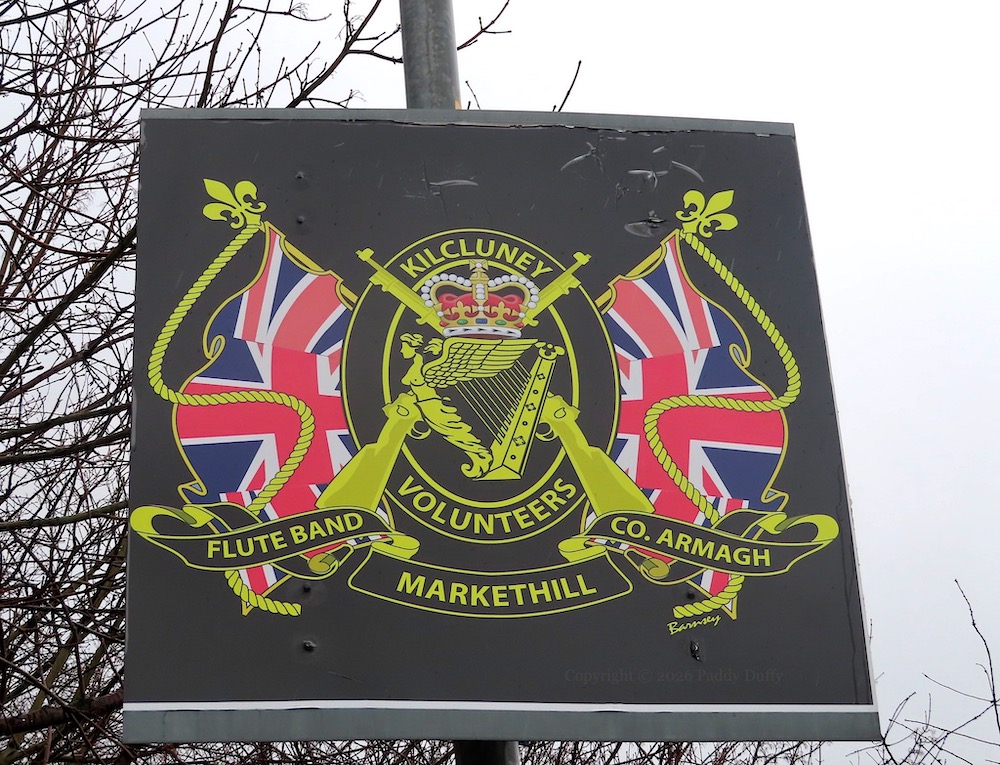
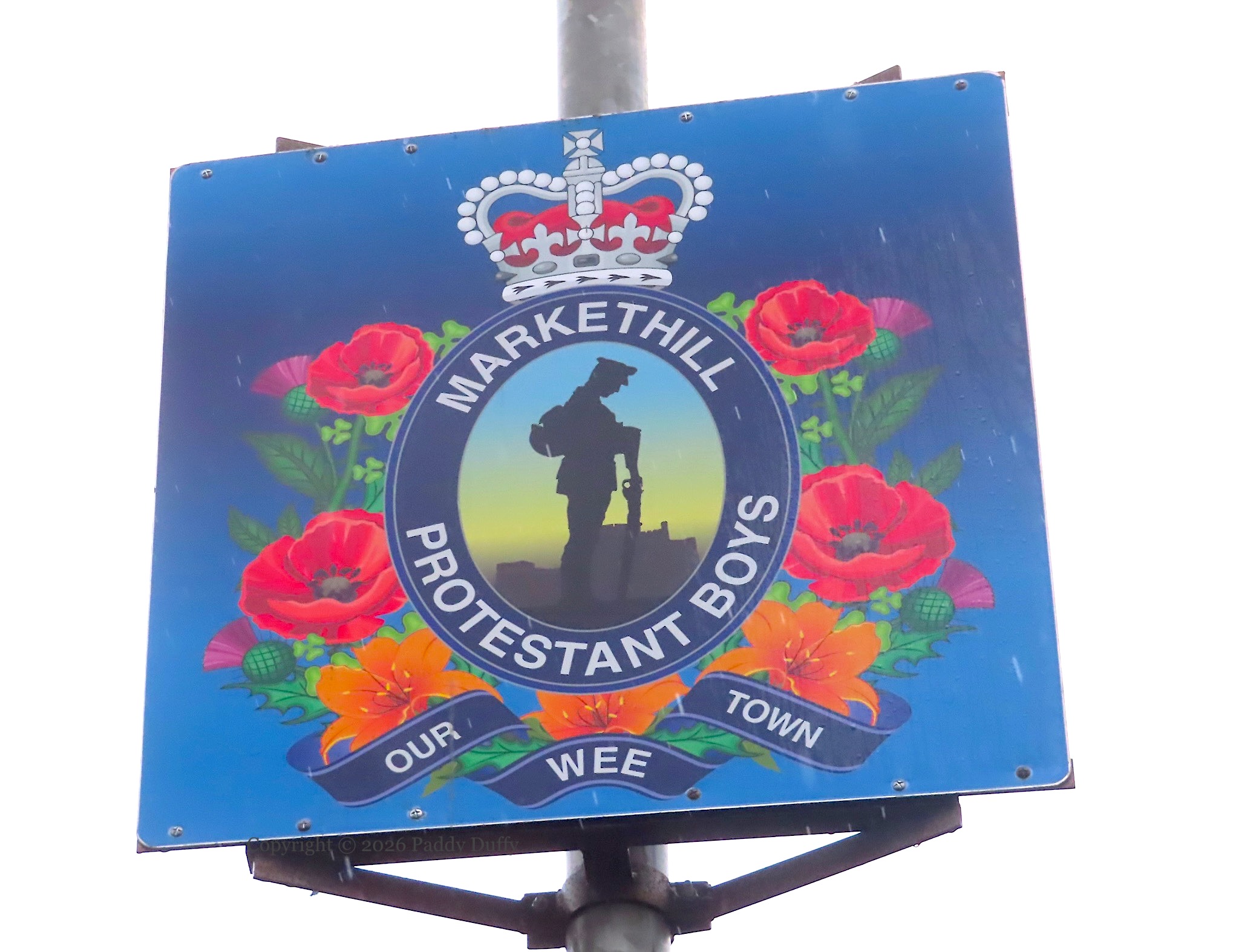
These placards for two local flute-bands are on light-poles in Markethill: above, the Kilcluney Volunteers flute band (Fb), below, the Markethill Protestant Boys (Fb). The crossed rifles and RIR emblem, and the graveside mourner and poppies, are WWI imagery; Markethill men joined the second battalion of the Armagh brigade of the Ulster Volunteers and (in the Great War) the ninth battalion of the Royal Irish Fusiliers. (See also UVF 3rd Battalion Armagh in Tandragee).
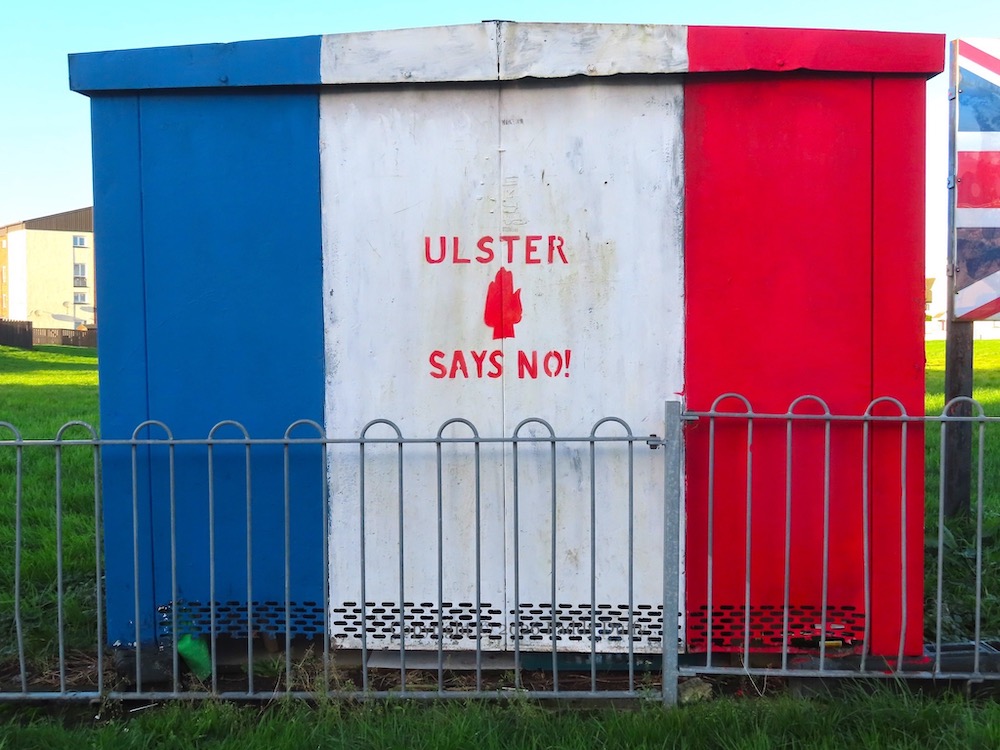
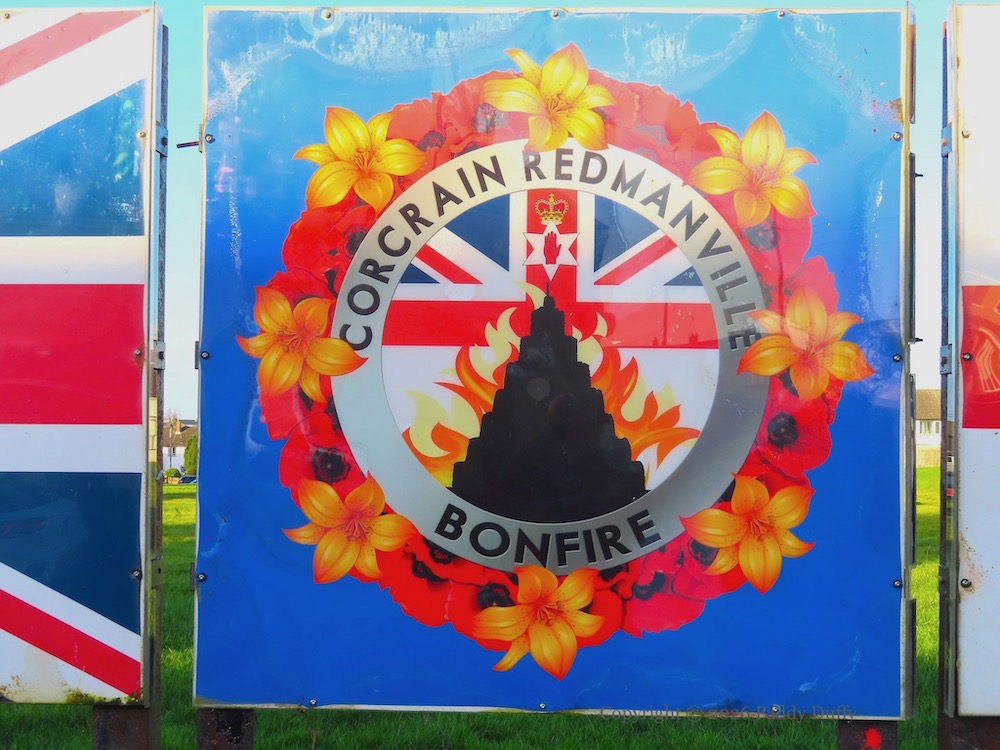
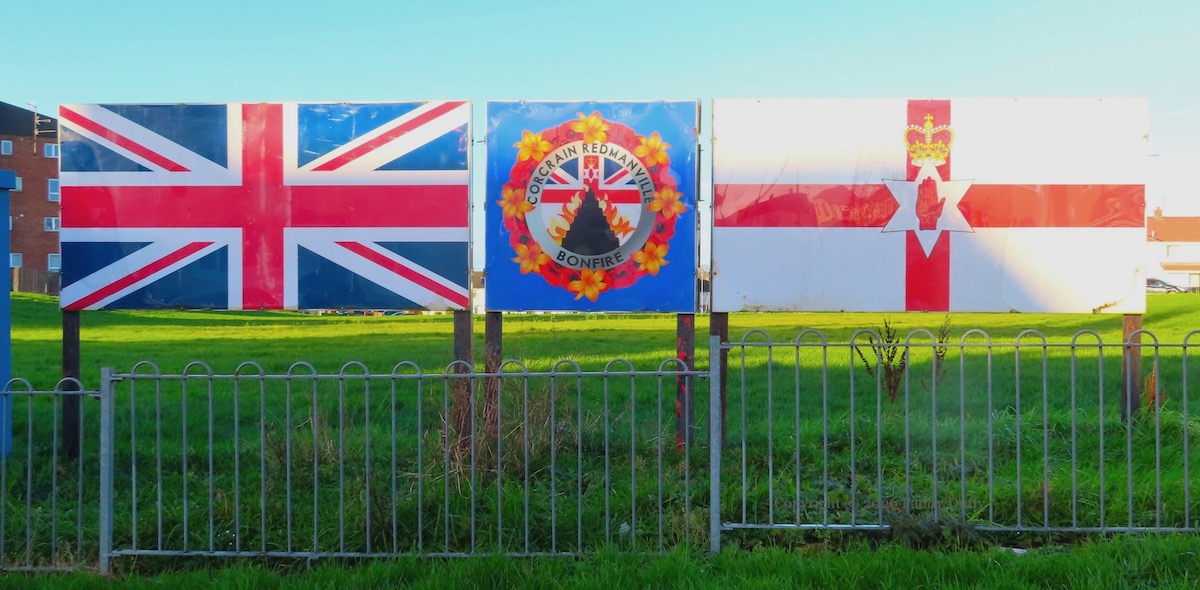
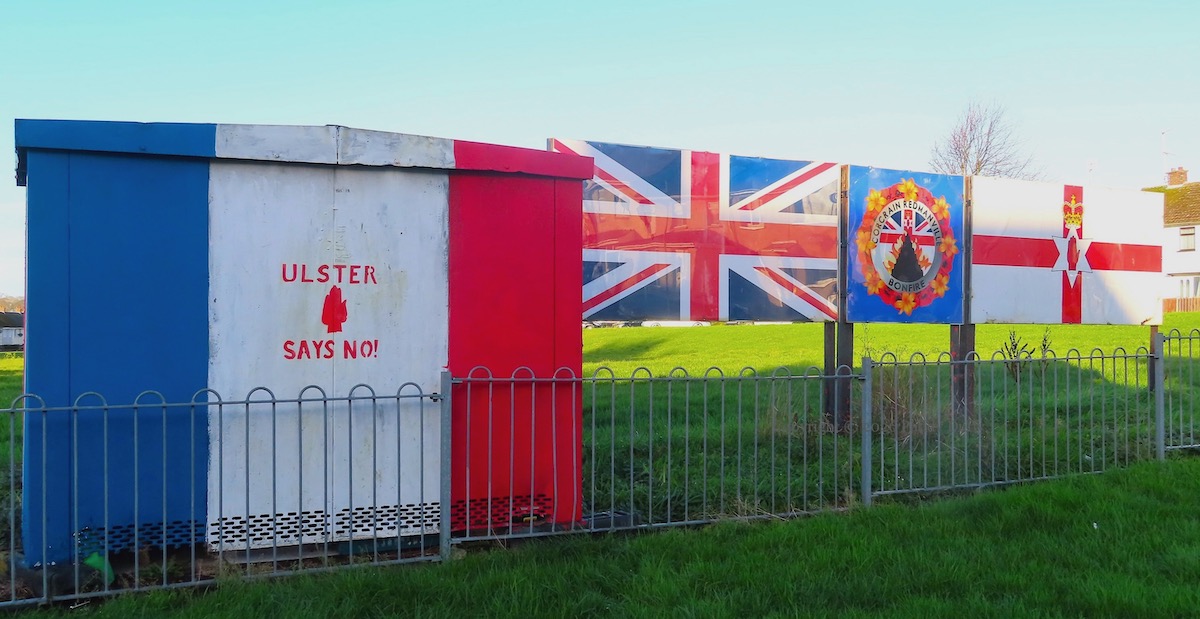
This is the scene at the Corcrain-Redmanville bonfire (Fb) site, along Drumilly Green, where the hut has been moved to the south side of the Green, to join the Union Flag and Ulster Banner.
The 2025 bonfire topped 100 feet in height (News Letter); collecting for the 2026 pyre has yet to begin.
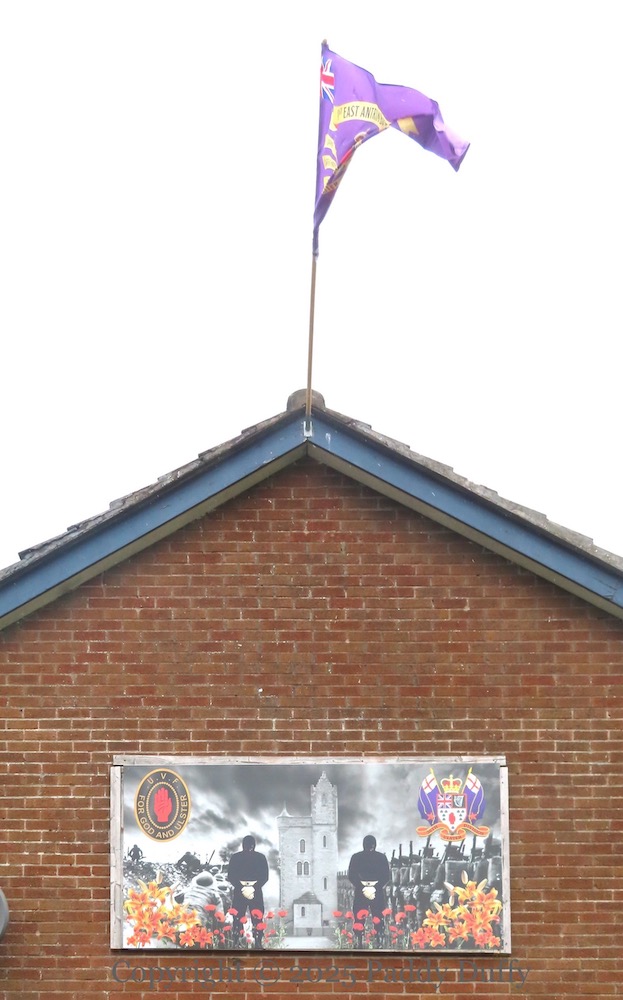
Modern UVF volunteers in balaclavas stand with heads bowed on either side of the Ulster Tower in Thiepval, standing among orange lilies and red poppies.
On the left the 10th Scottish Rifles (AWM) commence a raid, below the emblem of the Ulster Volunteer Force, and on the right, the Royal Fusiliers appear to march off to war in a press photograph (Flickr), below the emblem of the 36th (Ulster) Division.
In Grange Drive, Ballyclare, on the same as wall, and using part of the frame from, a previous UDA board: Young Guns.
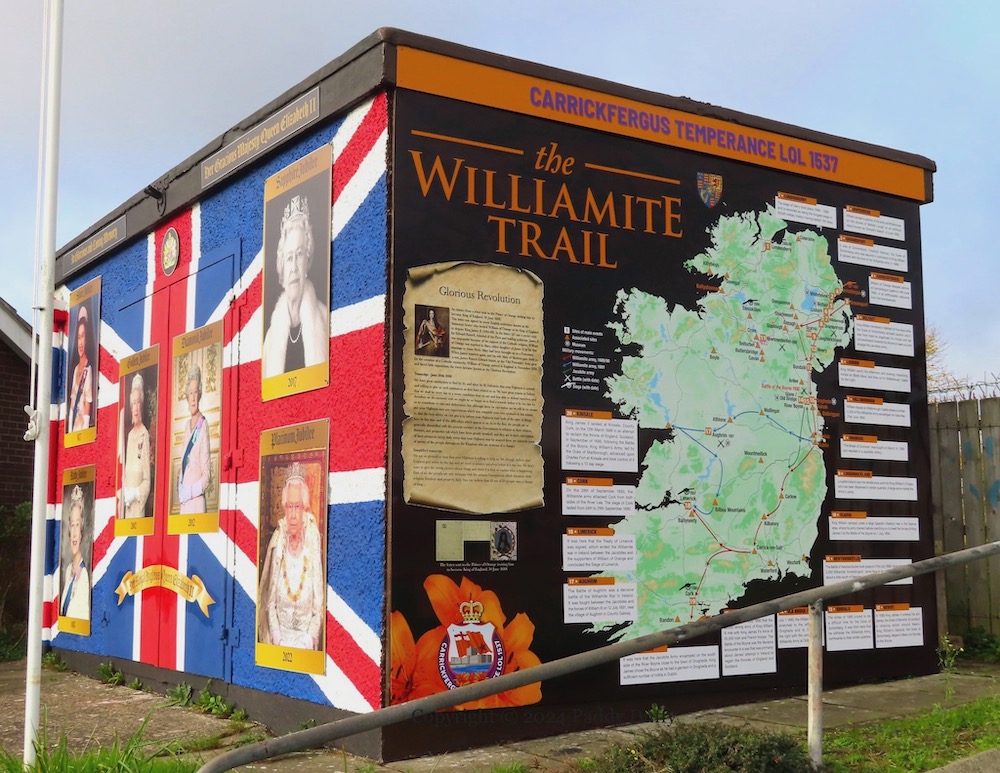
The story of William in Ireland has been a recent favourite in PUL displays (e.g. Newtownabbey | Carrickfergus | Shankill); this version is novel in adding a letter from June 30th, 1688, both in transcription and facsimile, under the heading of the “Glorious Revolution”. In it, the “Immortal Seven” tell William, the Prince Of Orange, that 95% of English people want a change in monarch. William arrived in England in November, 1688, and in Ireland in June, 1690.
The Williamite Trail (from October) joins an earlier tribute (June) to Elizabeth II on the years of her silver, ruby, gold, diamond, sapphire, and platinum jubilees (1977, 1992, 2002, 2012, 2017, and 2022).
The Ballycraigy bonfire from 2021 (Fb) is at the centre of a new free-standing board that was added this (2024) summer. Around the outside, the rose and thistle are joined by the orange lily and the poppy, rather than the shamrock and daffodil of the “four nations”.
For the similar board on the gable wall in the distance, see Lead The Way.
On the green at Hollowburn Road, in the Ballycraigy estate, Antrim.
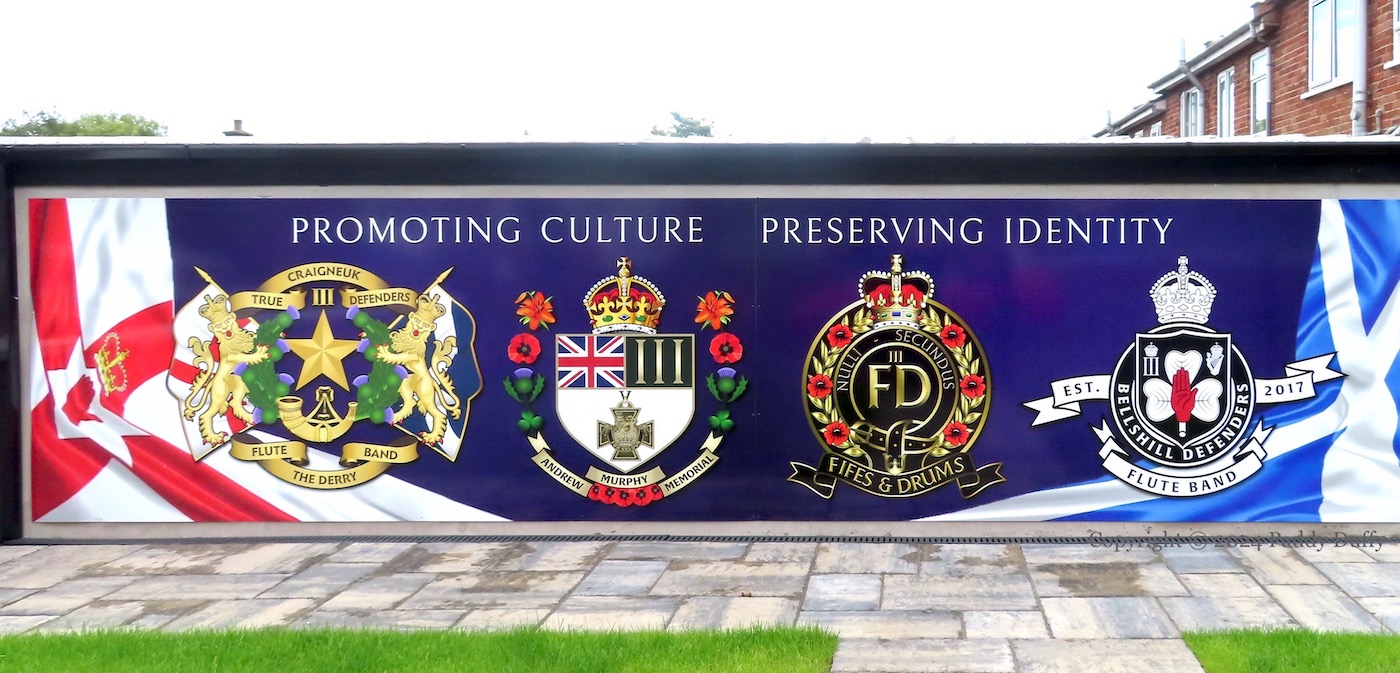
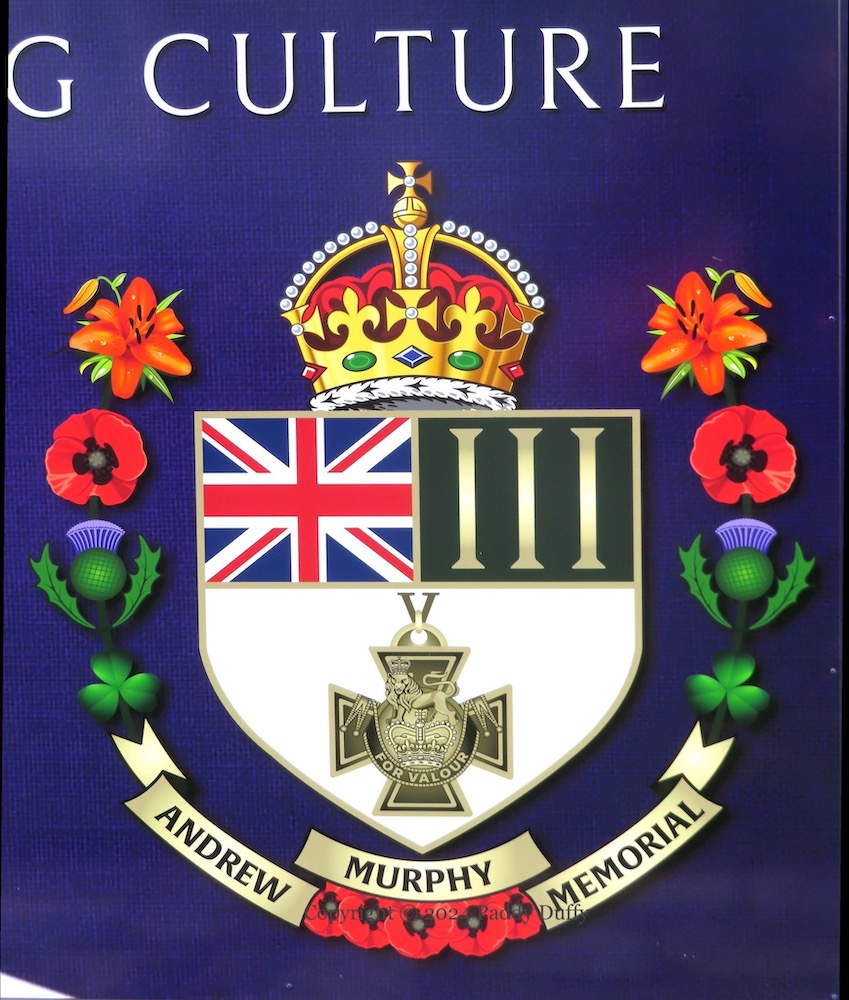
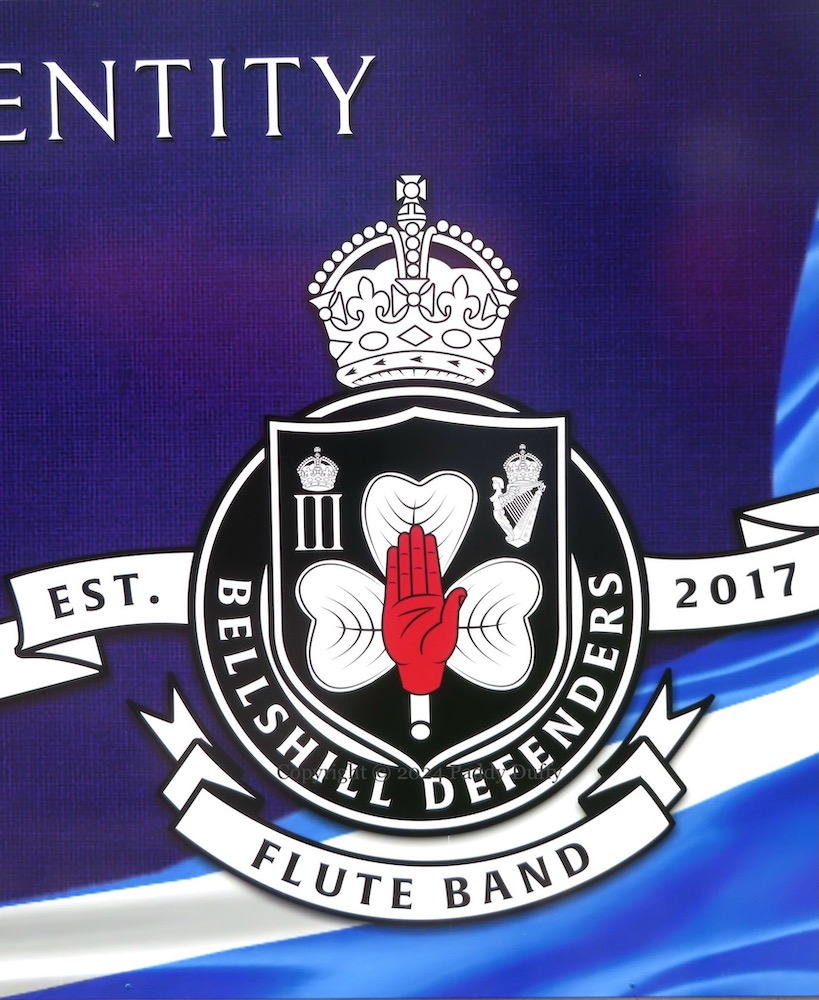
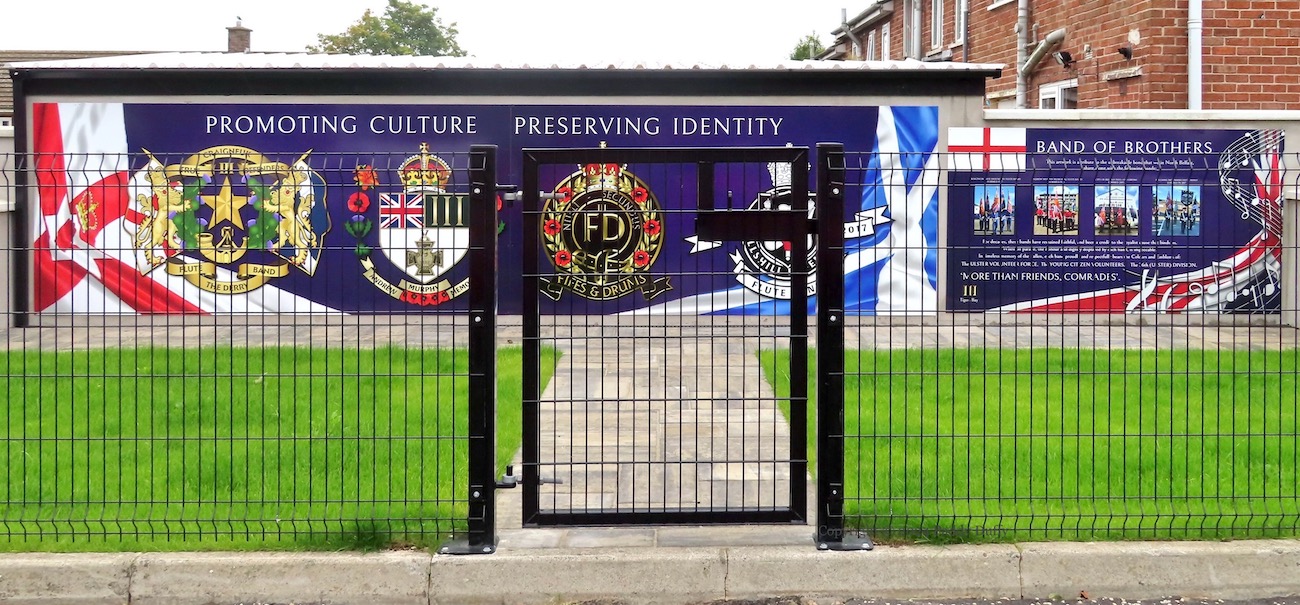
“Promoting Culture, Preserving Identity”. Here are a pair of new boards Mount Vernon Park, north Belfast, launched on August 11th, 2024, celebrating three Scottish bands and the local Fifes And Drums. Each of the bands’ emblems includes the Roman numeral “III”, which also appears in the bottom corner of the ‘Band Of Brothers’ board. It stands for the 3rd Belfast (i.e. north Belfast) battalion of the UVF, “Tiger’s Bay”. The St George’s Cross in the top-left corner and the purple background (of the ‘Band Of Brothers’ board) come from the UVF flag, which typically also has an orange star in the bottom right, here replaced by a swirling musical staff and Union Flag.
“Band Of Brothers. This artwork is a tribute to the unbreakable bond that we in North Belfast, share along with the following bands: Craigneuk [Scotland] True Defenders flute band, formed 1947 [Fb]; Andrew Murphy Memorial flute band [Scotland], formed 1988 [Fb]; City Of Belfast Fifes And Drums, formed 2003 [Fb]; Bellshill [Scotland] Defenders flute band, formed in 2017 [Fb]. For decades, these bands have remained faithful, and been a credit to the loyalist cause that binds us. When on parade, the honour and dignity displayed by each band, is impeccable. In timeless memory of the Fallen, each band proudly and respectfully bears the Colours and Emblems of: the Ulster Volunteer Force, the Young Citizen Volunteers, the 36th (Ulster) Division. ‘More than friends, comrades’.”
These are the boards at the chip shop (formerly a Spar and before that a Mace) in the centre of the Mourneview estate, Lurgan.
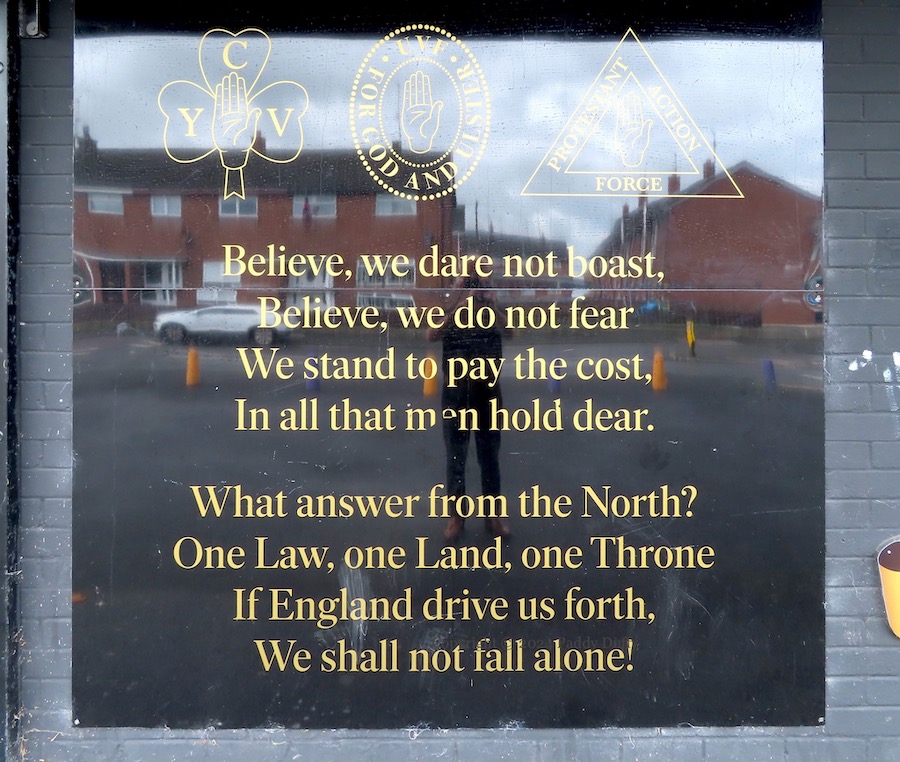
Above, and in detail below, are the pieces from the front of the shop, in Pollock Drive. Anti-clockwise from bottom-left:
First: “Believe, we dare not boast,/Believe, we do not fear/We stand to pay the cost,/In all that men hold dear.//What answer from the North?/One Law, one Land, one Throne/If England drive us forth,/We shall not fall alone!” Kipling’s poem Ulster.
Next (tall piece): A company, 1st battalion, Mid Ulster brigade UVF – Lurgan as well as Broxburn (outside Edinburgh) and Thornliebank (near Glasgow).
Next: PAF plus (out of frame in the wide shot) “When injustice becomes law resistance becomes duty.” The same panel was seen in Ballyclare, though for the 1st East Antrim battalion rather than the Mid Ulster brigade.
Above: A tribute to the Ulster Volunteers from the area: the 9th battalion Royal Irish Fusiliers joined the 108th brigade in the 36th (Ulster) Division; the 5th battalion joined the 31st brigade and the 10th (Irish) Division. This board goes back to (at least) 2011.
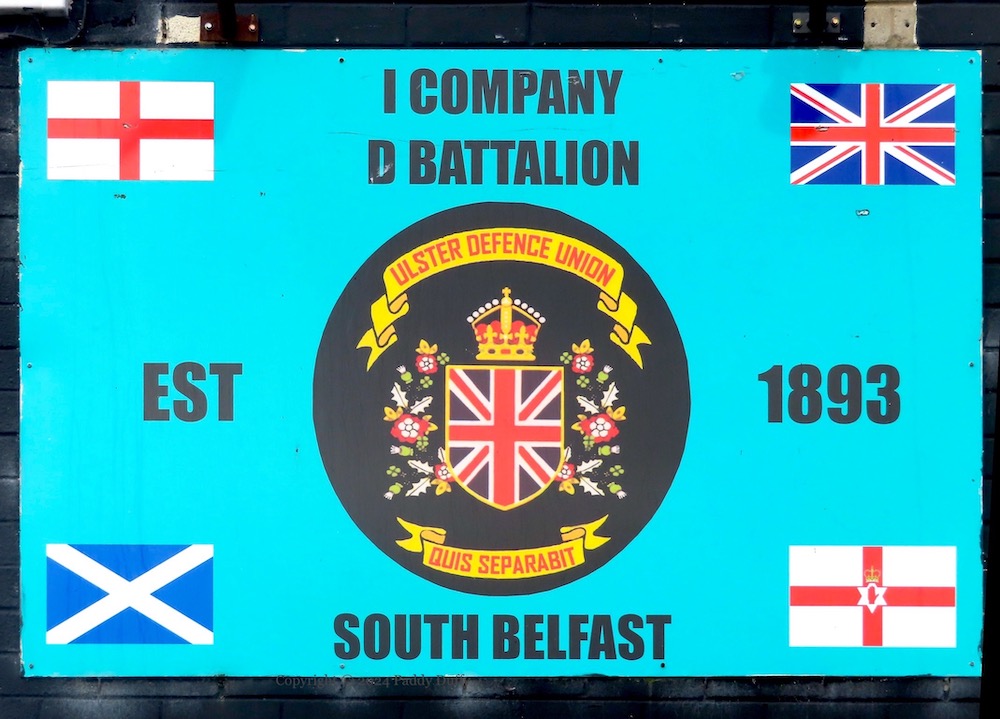
Finally (top left), a UDU/UDA board, to 1 company, D battalion, South Belfast. All of the remaining pieces are UVF/PAF.
Around the corner, in Mourne Road, a gallery of photographs of the Craigavon Protestant Boys (Fb) past and present, with a plaque in memory of Victor Stewart. “Our only crime is loyalty.”
In the adjacent Spelga Park: “Unbowed & unbroken – our only crime is loyalty – Mourneview/Gret estate bonfire” with an unusual combination of shamrock and Orange lily.
William III is the only member of the (Dutch) House Of Orange to rule the UK, as his marriage to Mary did not produce any offspring, and the crown passed to Mary’s sister Anne after both Mary (1694) and William (1702) had died (WP). Queen Elizabeth II was from the Saxe-Coburg And Gotha ‘house’ (changed during the Great War to “Windsor”) via her great-great-grandfather Prince Albert (of Victoria & Albert) but she symbolises Orangism to Northern Irish Protestants and in the portrait shown here she wears an orange jacket and an orange hat which has a band of orange lilies; the portrait is framed by a Union Flag and two clusters of orange lilies.
The plaque on the right reads “This mural is a tribute to her majesty Queen Elizabeth II. Funded by the loyal people of Portadown. To God be the glory.”
On this day 334 years ago (in the Julian calendar, which would be June 24th in the Gregorian), King William III landed at Carrickfergus and began his journey, via Belfast and Lisburn, to the Boyne river (outside Drogheda) where he successfully led his forces against those of James II.
After landing in Carrick, William rode by horse to Whitehouse, half-way to Belfast, where he met his commander-in-chief, the Duke Of Schomberg, who had been in Ireland since the previous August and laid siege to, and taken, the Jacobite garrison in Carrickfergus, making William’s landing there possible (WP).
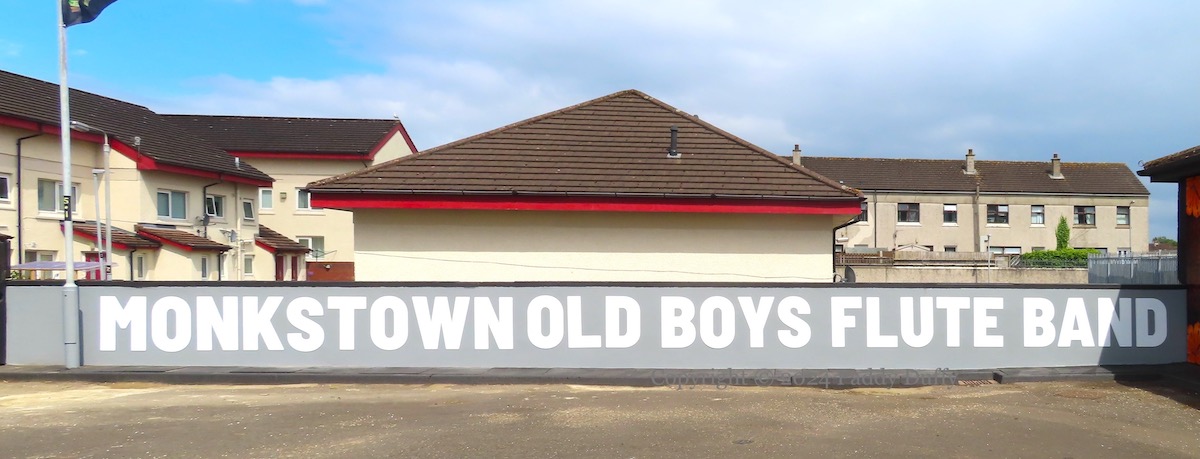
This new large board at Monkstown Old Boys (Fb) celebrates William’s landing and journey to Whitehouse, which is the point closest to Monkstown.
The image reproduced in the centre of the board (see below; a crisper version can be found at Orange Heritage) shows William meeting Schomberg at the eponymous White House, where Glas Na mBradán (the Salmons’ Stream) made a small port. Dalaradia has a 3-D flyover of what the White House and surrounding area might have looked like at the time. The remains of the White House have been restored and now house an interpretive centre (Bangor Historical Society | Causeway Coastal Route).
[The following text appears to be an excerpted and slightly modified version of a page at Orange Heritage.]
“King William was in Ulster from Saturday, June 14th, 1690 until Thursday, June 26th, only 12 days, yet he left behind a legend full of proud memories. For his part he liked what he saw. “This country is worth fighting for,” he said.
“His departure from London had been held up by parliamentary business till the end of May, when he announced that he could wait no longer and adjourned Parliament.
“Early in the morning of June 4 he set out, but on June 11th he embarked on board the yacht “Mary” with a fleet escorted by Sir Cloudesley Shovell’s squadron. On June 14th the hills of Ireland came in sight and in the afternoon the fleet cast anchor off Carrickfergus. He was rowed ashore in the Rear Admiral’s barge and at about 3.30 p.m. landed at the Old Quay under the shadow of the great Norman Castle.
[The 1973 painting of the Quaker greeting William is by Thomas Everard Spence and held by Carrickfergus Council – see Art UK. The Union Flag on the right lacks the St Patrick’s Cross – this would not be added until after the 1801 Act Of Union.]
The Garrison of the Castle had drawn up a Guard of Honour and the townspeople added their applause. The chosen spokesman was a Quaker, whose principles forebade [sic] him to doff his hat, or use such titles as Sir and Majesty. He got over the difficulty by taking off his hat and laying it on a stone and then stepping forward and saying “William, thou art welcome to thy Kingdom” which pleased the King so much that he replied: “you are the best bred gentleman I have met since I came to England.”
“With these words he mounted his horse and set off for Belfast. Half-way along the shore was the little port of Whitehouse, where most of the army disembarked. The Commander-in-Chief, the Duke of Schomberg, and his senior commanders were waiting here to welcome the King. To cover the disembarkation, earthworks has [sic] been thrown up by the engineers at Fort William and garrisoned by troops ready for action.”
“Battle of the Boyne: Although the battle has been commemorated on 12th July for more than 200 years, it actually took place on 1st July according to the old Julian calendar, and on 11th July according to the Gregorian (which replaced the Julian calendar in 1752). It was the last time that two crowned Kings of England, Scotland and Ireland faced each other on the battle field.” [By the time of Britain’s adoption of the Gregorian calendar in 1752 the calendars had moved (in 1700) another day apart, making them eleven days apart at that time. However, eleven days rather than ten were added to all prior dates, even those before 1700 and further back, to yield July 12th as the date of the Battle in 1690.]
“In 1689 Parliament declared that James had abdicated by deserting his kingdom. William (reigned 1689-1702) and Mary (reigned 1689-94) were offered the throne as joint monarchs.
They accepted a Declaration of Rights (later a Bill), drawn up by a Convention of Parliament, which limited the Sovereign’s power, reaffirmed Parliament’s claim to control taxation and legislation, and provided guarantees against the abuses of power which James II and the Stuart Kings had committed.
The exclusion of James II and his heirs was extended to exclude all Roman Catholics from the throne, since ‘it hath been found by experience that it is inconsistent with the safety and welfare of this protestant kingdom to be governed by a papist prince’. The Sovereign was required in his coronation oath to swear to maintain the Protestant religion.”
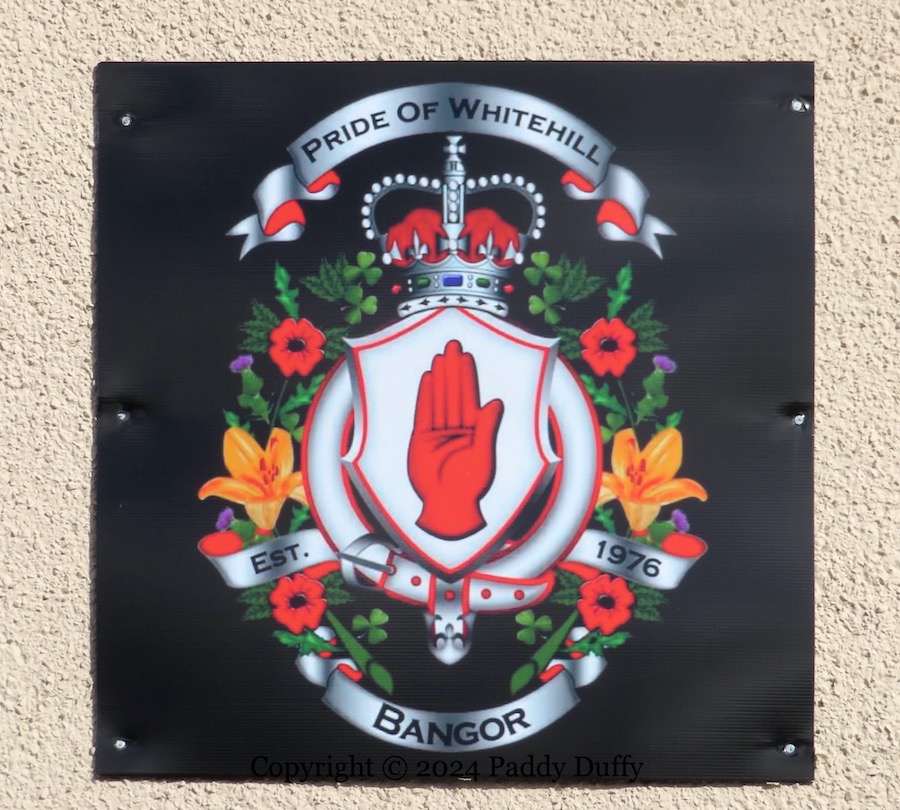
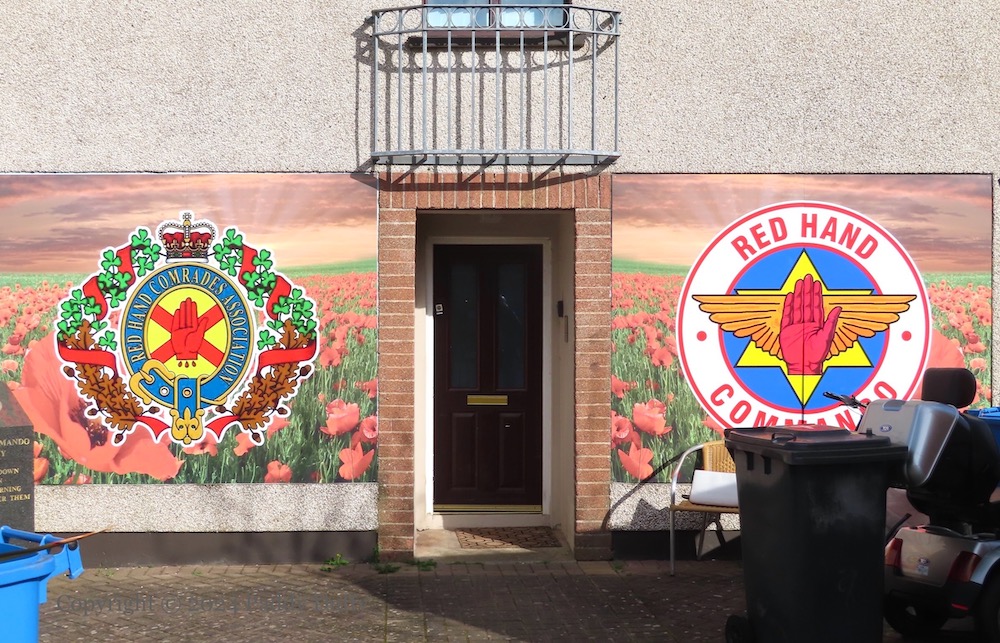
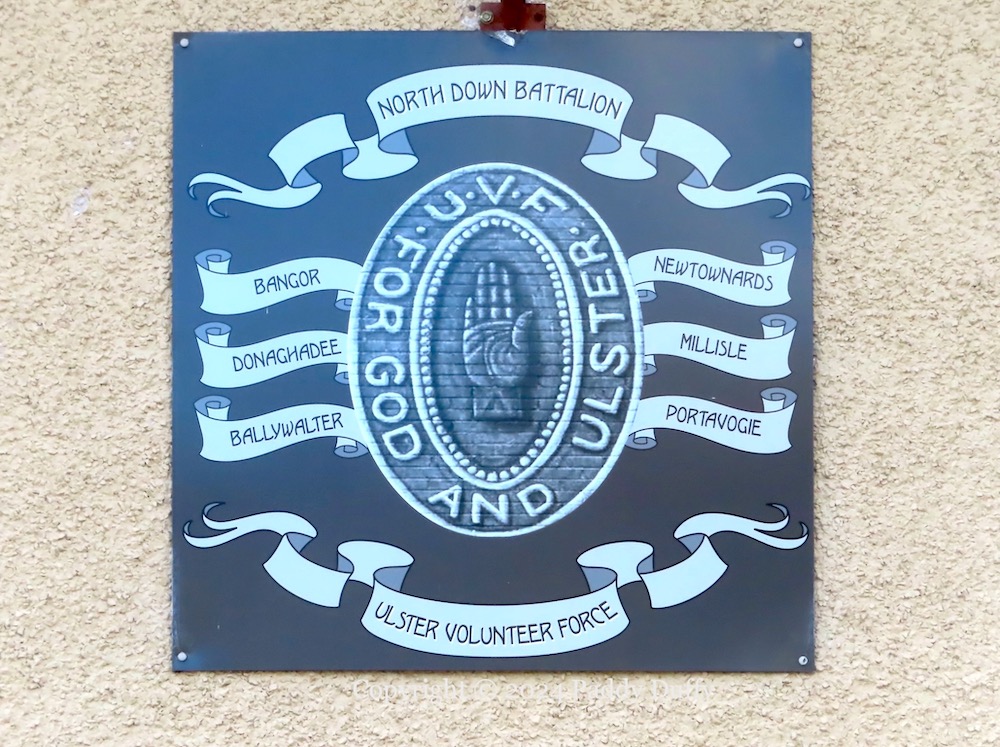
Here is a gallery of the smaller boards in the Whitehill area of Bangor – other specific pieces can be found in The Elite and Long To Reign Over Us.
The area is a UVF stronghold but split between the North Down and East Belfast battalions – see Welcome To Bowtown and North Down UVF. The very bottom of the estate is UDA – “RUFF touts” is on the border-line, Skipperstone Road.
Two flute bands are mentioned: Pride Of Whitehill (Fb) and Bangor Protestant Boys (Fb).
















 Paddy Duffy Collection