“The Irish holocaust, 1845, 1,397,740 deaths”. A family of four sits with their meagre possessions, perhaps having been evicted from their home or waiting to board a ship to America. The source of the (hyper-precise) number of deaths is unknown; deaths are roughly put at a million and emigrants at two million for the period from 1845 to 1852. The period is commonly known as “the famine” but the term is rejected by many, given the continued production and exportation of other foodstuffs, contrary to the policy enacted for the famine of 1782-1783 (History Ireland | Great Hunger Museum | NJ Schools’ Commission pdf). Hence the use of “holocaust”
This is the earliest mural depicting the Great Hunger; in 1995, for the 150th anniversary, at least nine pieces were painted on the topic in Belfast – see the Visual History page. Many of those pieces reproduced drawings from the Illustrated London News; the source of this image is unknown.
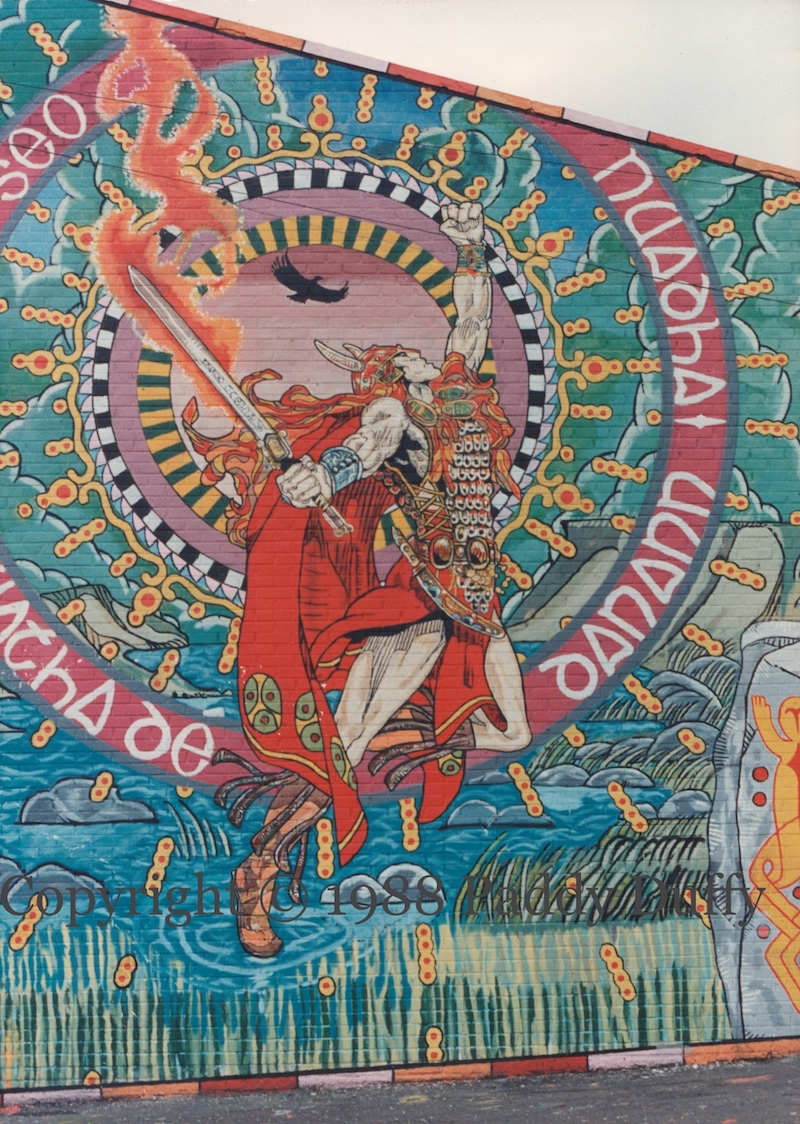
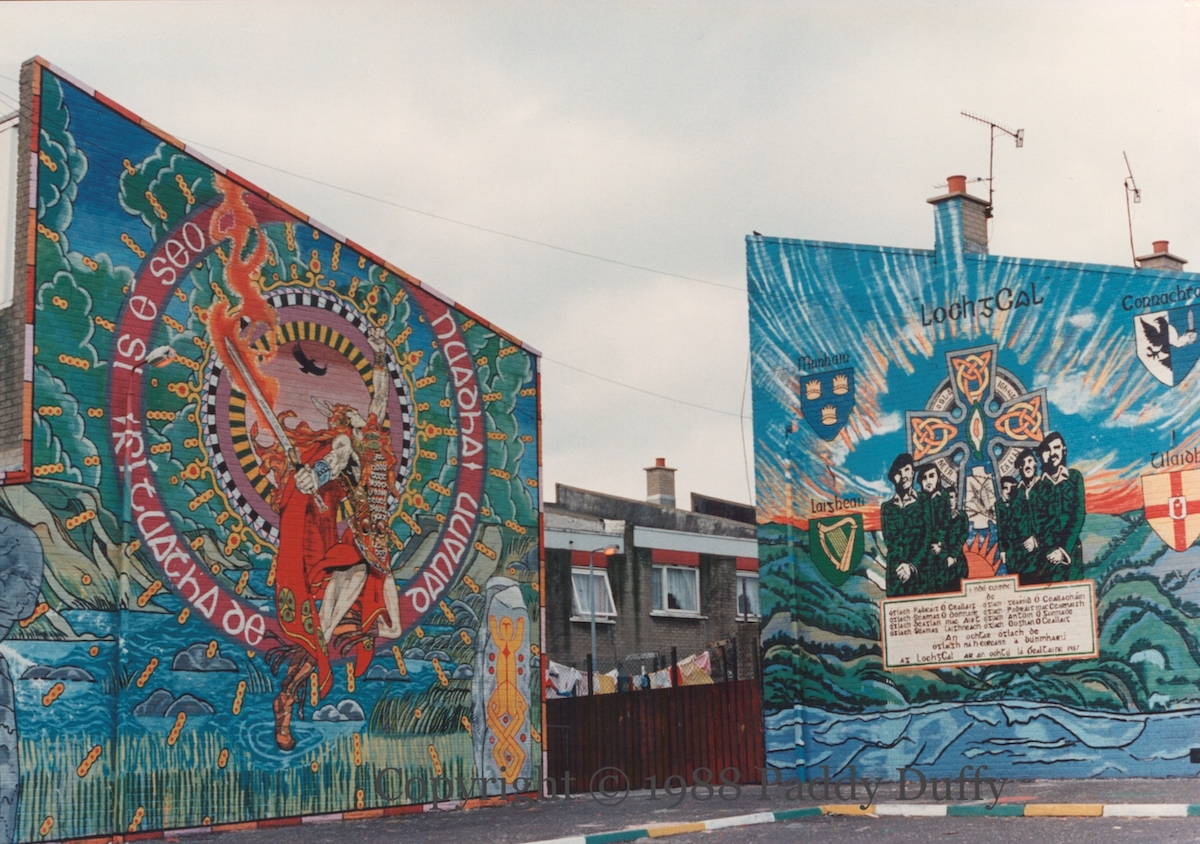
This pair of murals was painted by Mo Chara Kelly at the top of Springhill in 1987 after his release from prison. Both are inspired by the work of Jim Fitzpatrick. The central figure of the Rí Nuadha [King Nuada] mural above and immediately below comes from a painting of Fitzpatrick‘s called ‘Nuada Journeys To The Underworld’ while the background has a Fitzpatrick style and colour-scheme.
Of the myth of Nuada, Mo Chara said, “I had never heard the story of King Nuada before. Then I read the story. Wow! What a yarn! Nuada Of The Silver Arm is one of my favourite stories. As one of the Tuatha Dé Danann you had to be whole and physically perfect to hold the kingship. Nuada lost an arm in the first battle of Moy Tura and so he lost his kingship. He went into the other world, to middle earth, fought through trials and tribulations until Dıan Cécht made a silver arm for Nuada and he was restored to the kingship for another twenty years. But the moral of the story to me was that, no matter what happens, get up again and fight back. No matter how bad the situation you are in, you get back up and fight again. Do not let people isolate you. Get up and fight again. It was very inspiring!” (Painting My Community/An Pobal A Phéınteáıl – English-language version available for free.)
The Loch gCál/Loughgall mural likewise draws on Fitzpatrick for the landscape behind the Celtic cross and funeral guard in memory of the eight IRA volunteers from the East Tyrone brigade who were killed in an SAS ambush during an attack on an RUC base in May, 1987 (WP).
The names of the eight volunteers are given here in Irish and (partially) in the old script:
“I ndıl cuimh[n]e de [= ar] Óglach Pádraıg Ó Ceallaıġ [Patrick Kelly], Óglach Séamus Ó Donn[ġ]aıle [Seamus Donnelly], Óglach Deaglán Mac Aırt [Declan Arthurs], Óglach Séamus Laıghneach [Jim Lynagh], Óglach Gearóıd Ó Ceallacháın [Gerry O’Callaghan], Óglach Pádraıg Mac Cearnaıgh [Pádraıg McKearney], Óglach Antóın Ó Garmaıle [Ó Gormghaıle | Tony Gormley], Óglach Eoghan Ó Ceallaıġ [Eugene Kelly]
an ochtar óglach de óglaigh na hÉireann a dúnmharú ag Loch gCál ar an ochtú lá Bealtaine 1987.” [the eight volunteers from the Irish Volunteers [IRA] who were murdered at Loughgall on the eighth day of May, 1987]
The town (Loughgall) and the four provinces are also named in Irish. An Easter lily is at the centre of the Celtic cross in the middle of the image, above a lark in barbed wire and a gal gréıne/sunburst.
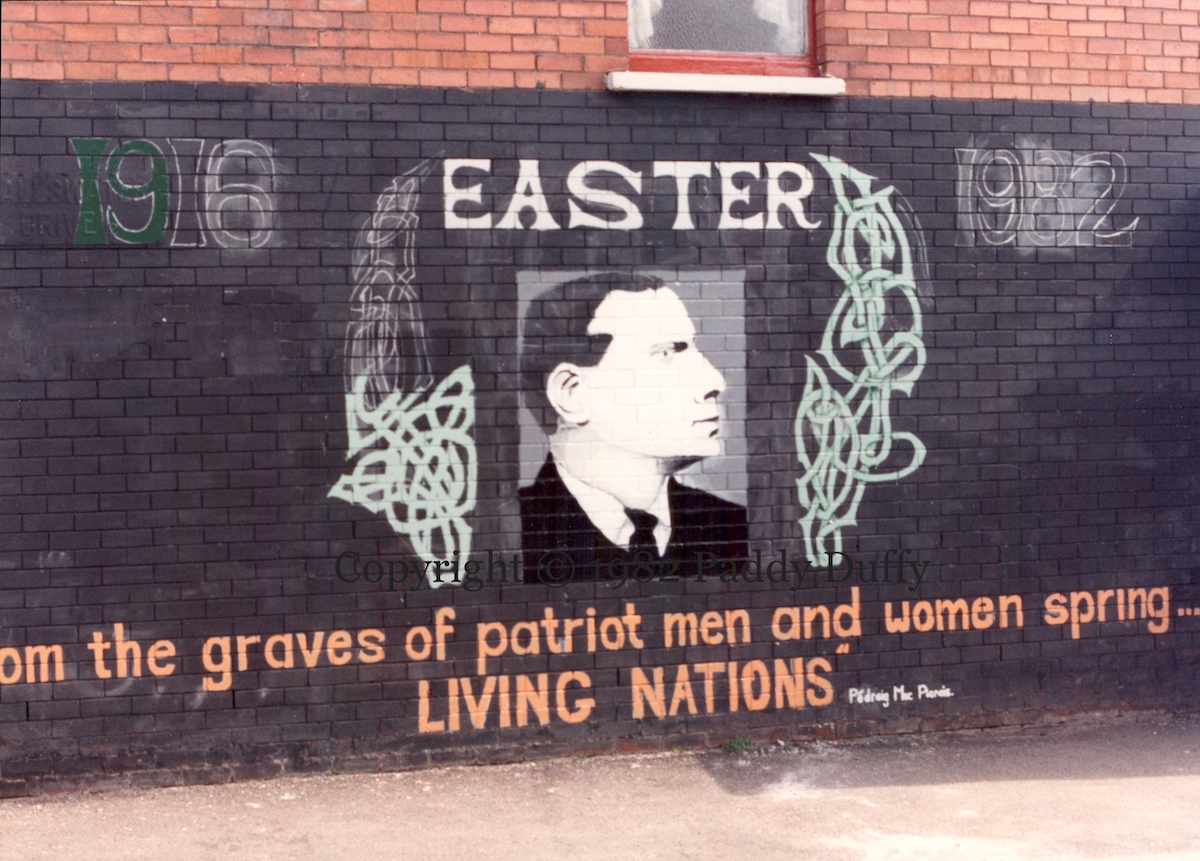
“‘From the graves of patriot men and women spring … living nations’ – Pádraıg Mac Pıaraıs”. The quote is from Pearse’s oration at the funeral of O’Donovan Rossa on August 1st, 1915 (Wikisource).
The mural is in progress for the 1982 anniversary of the Easter Rising. This image is from “April 1982” which perhaps gives it enough time to be completed by Easter Monday, which fell on the 19th.



 Paddy Duffy Collection