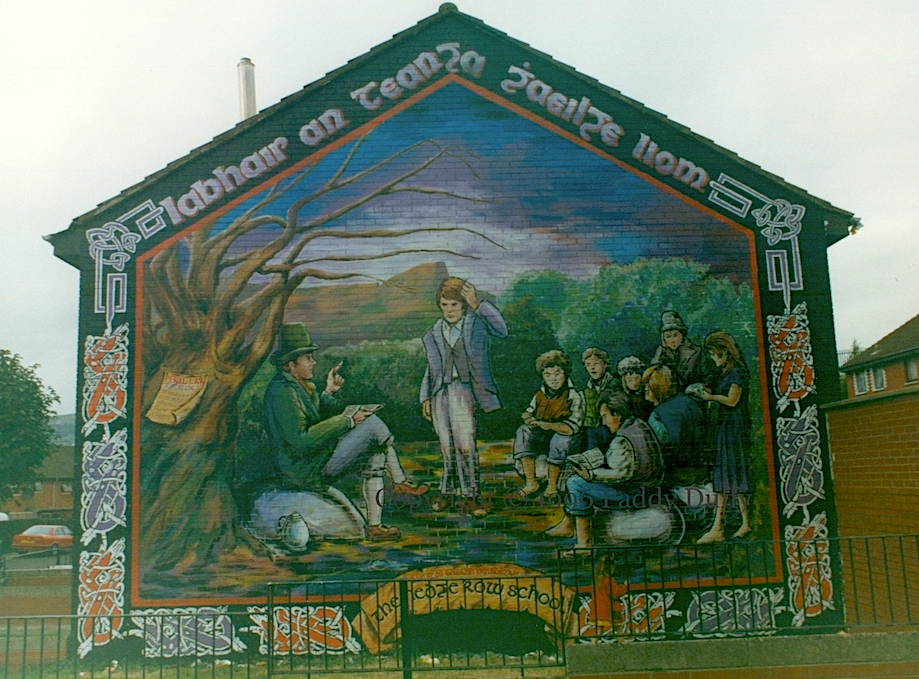
This is an in-progress image of a mural sponsored by and for the Upper Springfield Development Trust (web | until 1993 the Upper Springfield Development Forum) focusing on young people: “Mol an óıge agus tıocfaıdh sí.” (Praise youth/the young and it will flourish.”/”Youth responds to praise.”)
Catholic (and Presbyterian) education was prohibited by the penal laws (WP) and particularly the Education Act of 1695 (WP) – this is probably what’s on the notice on the left-hand tree. Schooling by Catholics (in Irish) nonetheless took place, in covert houses and outhouses, as well as in fields and hedge-rows. The Act was repealed in 1782, provided the teacher took an oath of allegiance to the Crown.
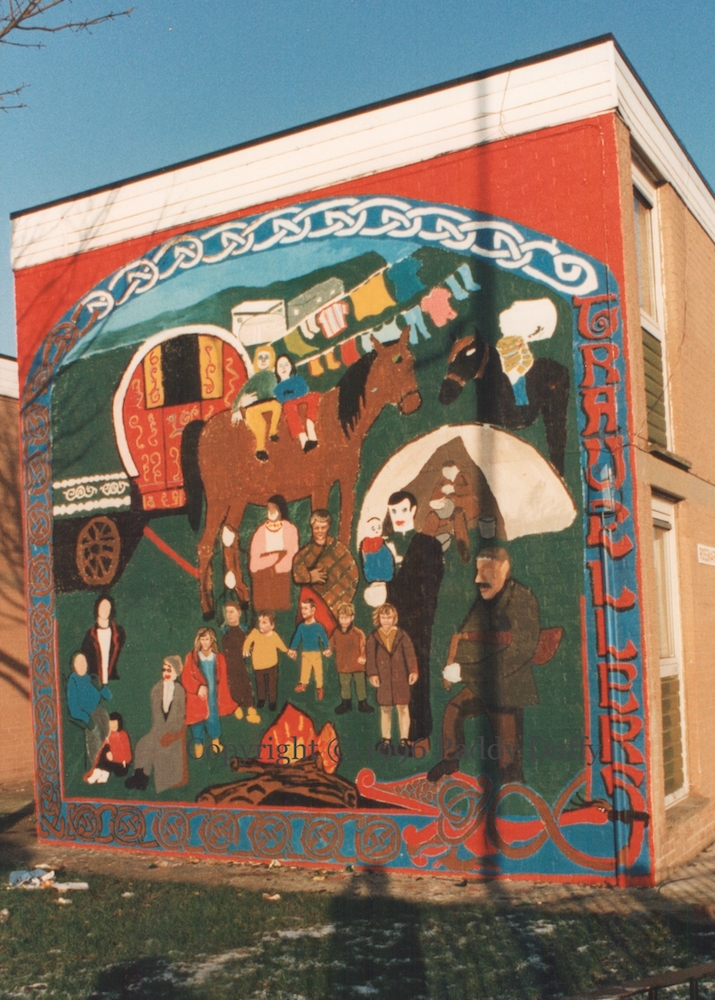
The immediate reason for this mural depicting traveller life is unknown. In 2006 (ten years after this mural) there were about 24,000 travellers living on the island of Ireland (WP | 1995 Report on travellers in Ireland (archive.org) | a good summary of the 2011 and 2016 numbers (CSO pdf).) About 2,000 were living in Northern Ireland, some at a site on the Glen Road (RTÉ has video from the site in 1987) close to this mural in Rossnareen.
This is one of about nine murals painted in 1995 for the 150th anniversary mural of An Gorta Mór/the Great Hunger (Visual History).
There is a wall to the right that reads, “There was no famine; it was genocide.” (See the Peter Moloney Collection.)
The dove on the chimney and the green ribbon below are a nod to the other main movement during this period, the release of political prisoners as a leading goal of the peace process.
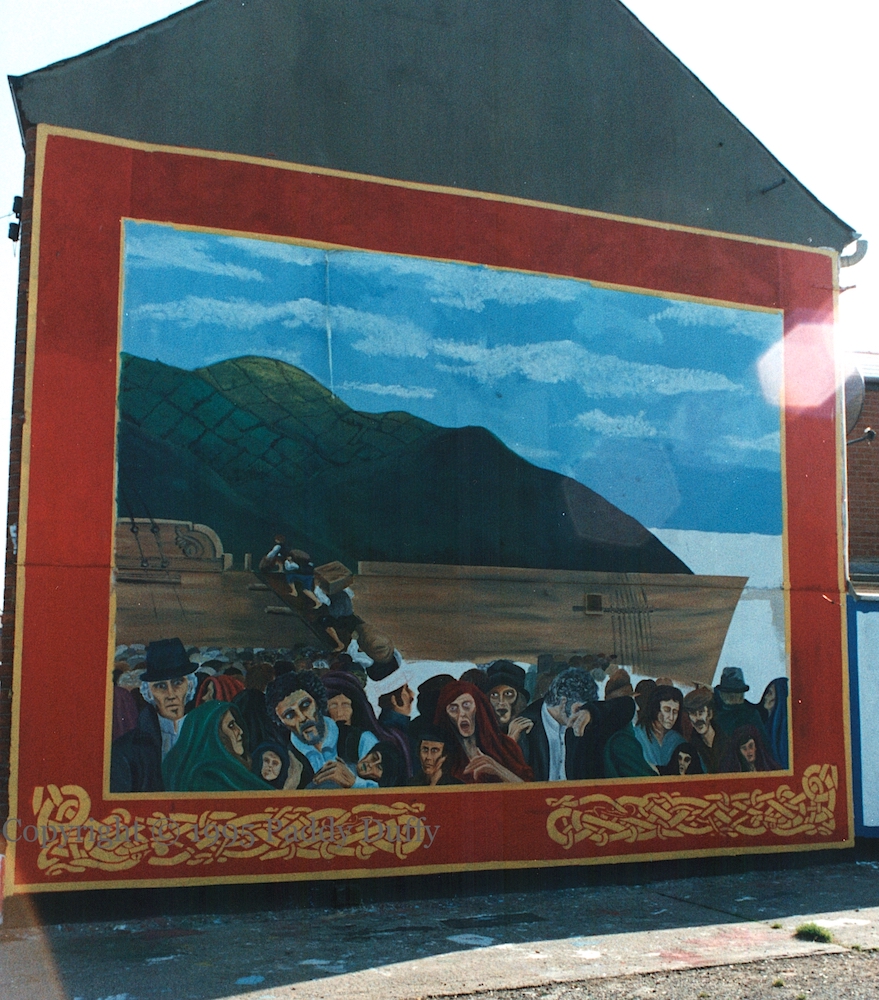
Irish people climb on-board ship in order to escape the Great Hunger. The mural is based on The Embarkation, Waterloo Docks Liverpool in the Illustrated London News. This is one of about nine murals painted in 1995 on the Great Hunger (Visual History).
“Ardoyne Fleadh Cheoıl – meon an phobaıl a thógáıl tríd an chultúr” = “building community spirit through culture”.
“Eıre [Éire] (Éıru [Érıu]), a queen of the Tuatha Dé Danann, slain at the battle of Taıltean [Taılteann] (Telltown [Teltown], Co. Meath) 1698 BC.” Érıu is placed in a neolithic setting and is releasing a dove which flies off in a trail of stars. (In the repainted version, the date given is 698.)
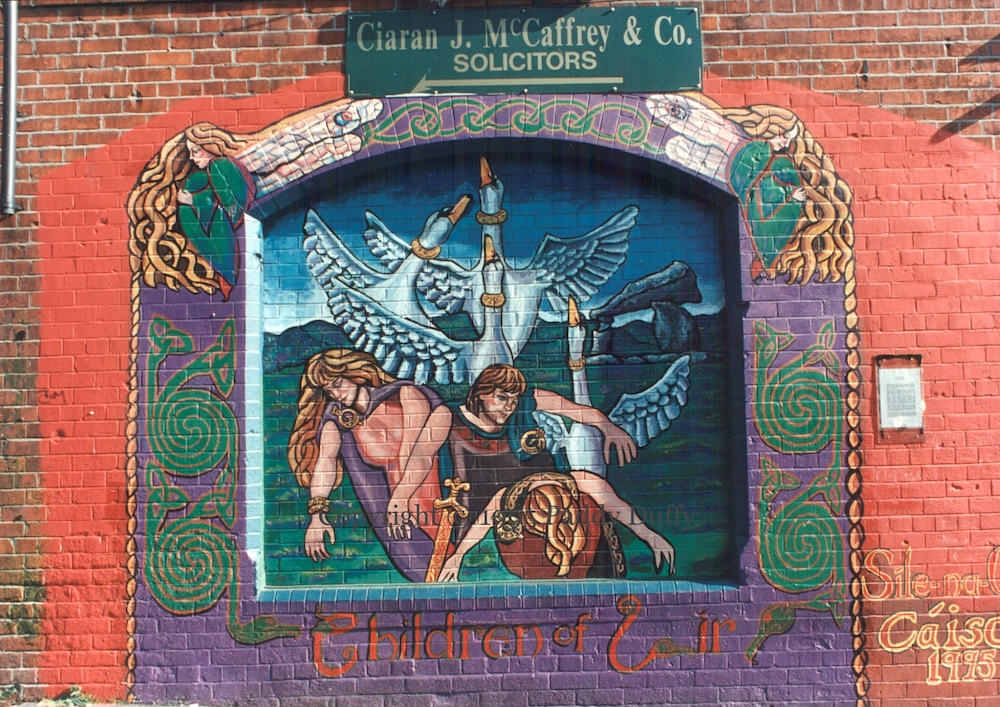
In Irish mythology, the children of Lear were turned into singing swans for 900 years by their step-mother Aoıfe. They are then restored to human form but, being 900 years old, die immediately.
“Lır” (in Irish) is the genitive of (the Irish) “Lear” and the story is often referred to in Irish as “Clann Lır“; neither “Lear” nor “Lır” is pronounced like the English “(King) Lear”.
Painted at “Cáısc [Easter] 1995” by “Síle-Na-Gıg”.
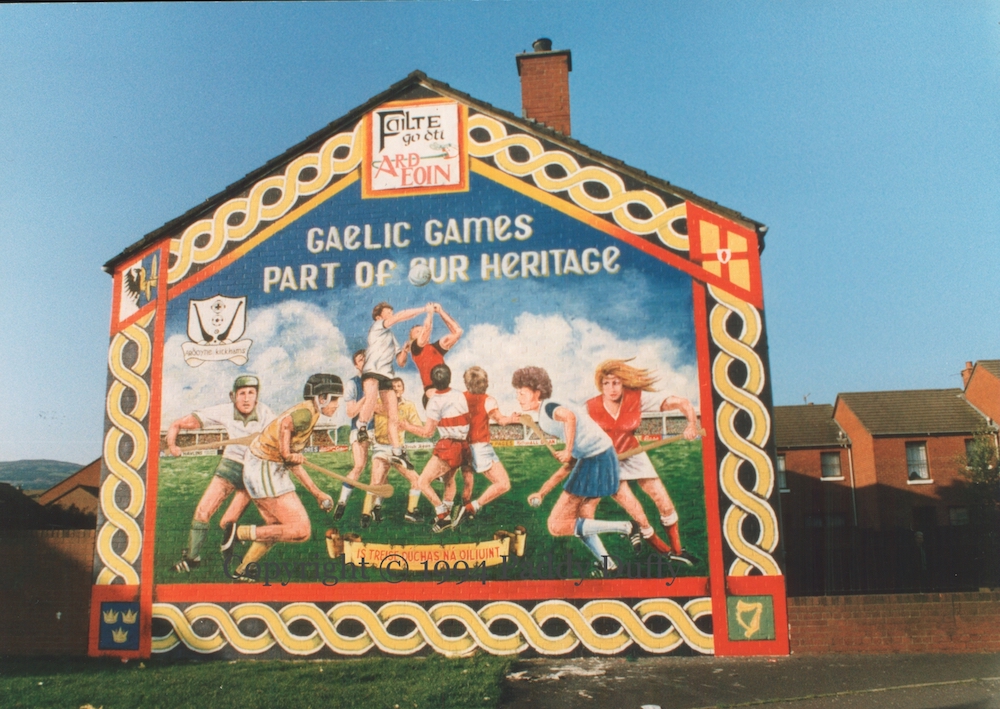
“Gaelic games – part of our heritage.” Athletes play hurling, football, and camogie and the local GAA club Ardoyne Kickhams (Fb) is celebrated. “Is treıse dúchas ná oılıuınt” means “heritage is stronger than upbringing”. “Fáılte go dtí Ard Eoın” [“Welcome to Ardoyne”] appears in the apex.
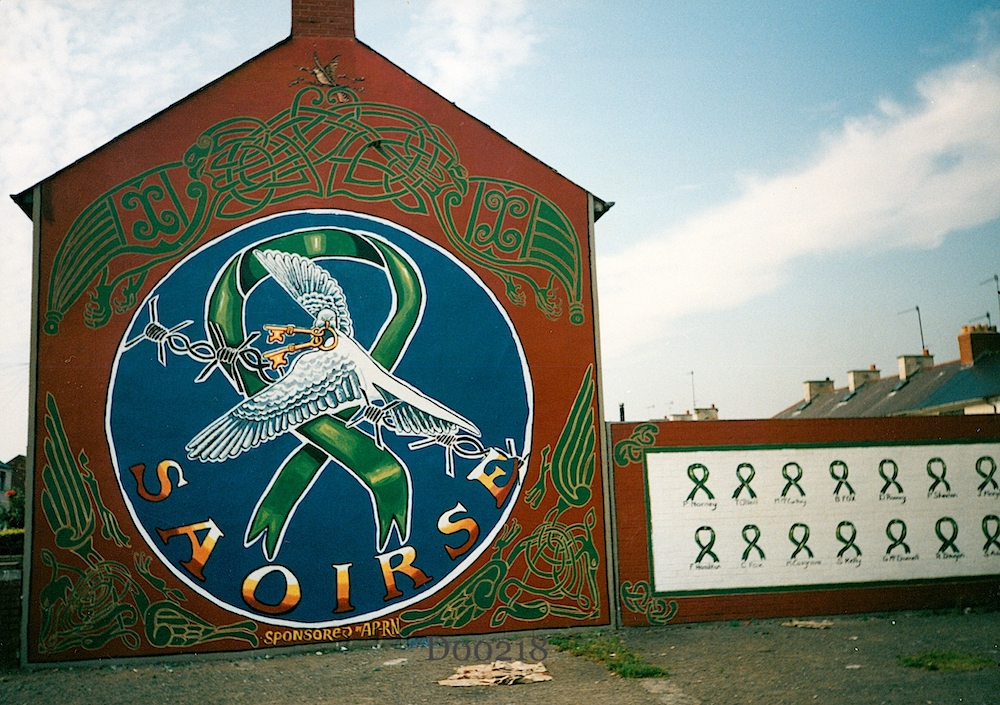
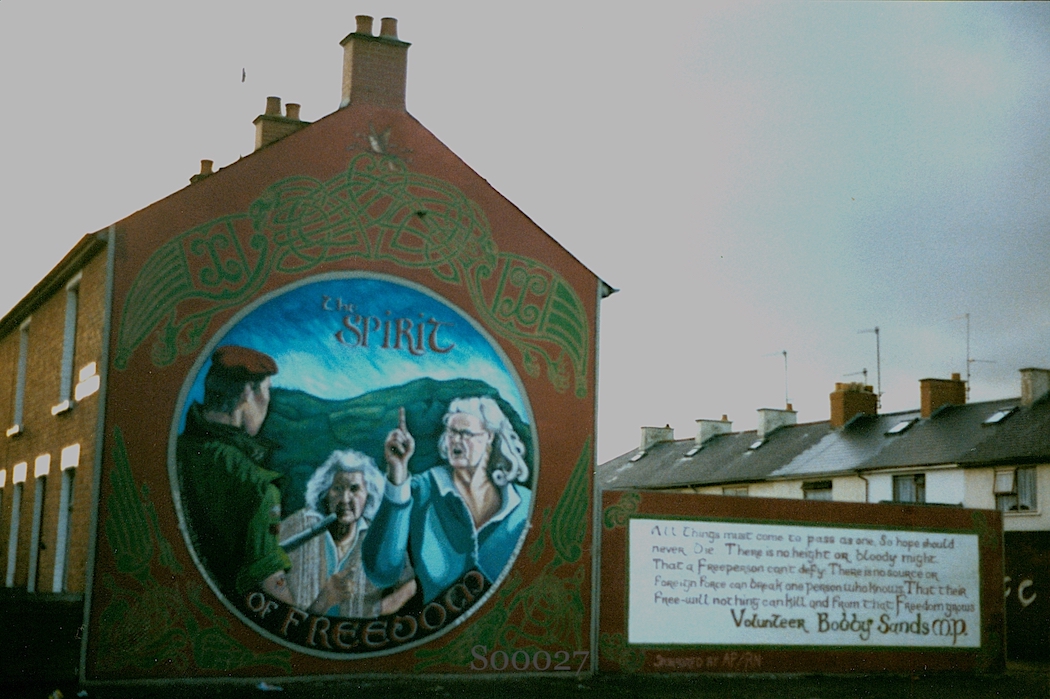
The frame of this mural in St James’s was originally painted by Andrea Redmond (Fb) in 1994 for a mural (included below) showing local pensioners remonstrating with a British Army soldier, under the title “The Spirit Of Freedom”, reproducing a photo that appeared in a French-language magazine (see below).
The central circle was repainted (again Redmond) for the 1995 “green ribbon” campaign: the dove holds the keys that will set free the republican prisoners, symbolised by the barbed wire and the lark in the apex. There was also a side-wall, showing two rows of green ribbons, each with the name of a POW (see immediately below).
“Sponsored by AP/RN” has been moved from the side-wall to the main wall.
In small letters on the part of the circle at the back of the soldier is written “This mural is dedicated to the memory of J[…] D[…] and M[…] Fitzsimons”.
On the side wall is a verse from the poem The Crime Of Castlereagh by “Volunteer Bobby Sands MP”: “All things must come to pass as one/So hope should never die/There is no height or bloody might/That a freeman can’t defy./There is no source or foreign force/Can break one man who knows,/That his free will no thing can kill/And from that freedom grows.”





 Paddy Duffy Collection