“Irish National Liberation Army, Belfast Brigade, roll of honour. For national liberation and socialism in Ireland.” With the named of 22 volunteers who died between 1975 and 2021: Ferguson, Loughran, McNamee, Daly, Bunting, Little, Power, McLarnon, Craven, McCann, Power, O’Reilly, Kearney, Gargan, Gallagher, McColgan, Campbell, McWilliams, O’Hara, McMullan, McElkerney, McWilliams.
Kickhams is the local Cumann Luthchleas Gael (GAA club) (Fb | tw), founded 1907, named for republican writer Charles Kickham. The mural shows a football, hurleys and sliotar, and a handball.
The Gibraltar Three are IRA volunteers Maıréad Farrell, Seán Savage, and Dan McCann, who were executed by British crown forces in Gibraltar on March 6th, 1988.
Along the top is written a variation on the second half of Terence MacSwiney’s famous phrase: “[It is not those who can inflict the most but] “Those that endure the most will conquer in the end”
“Mıse Éıre” [I Am Ireland]. These two murals were both in the courtyard of Millview Court, off Mountainhill Road in Ligoniel and together present the fighting spirit and the loss entailed by the Irish struggle for freedom.
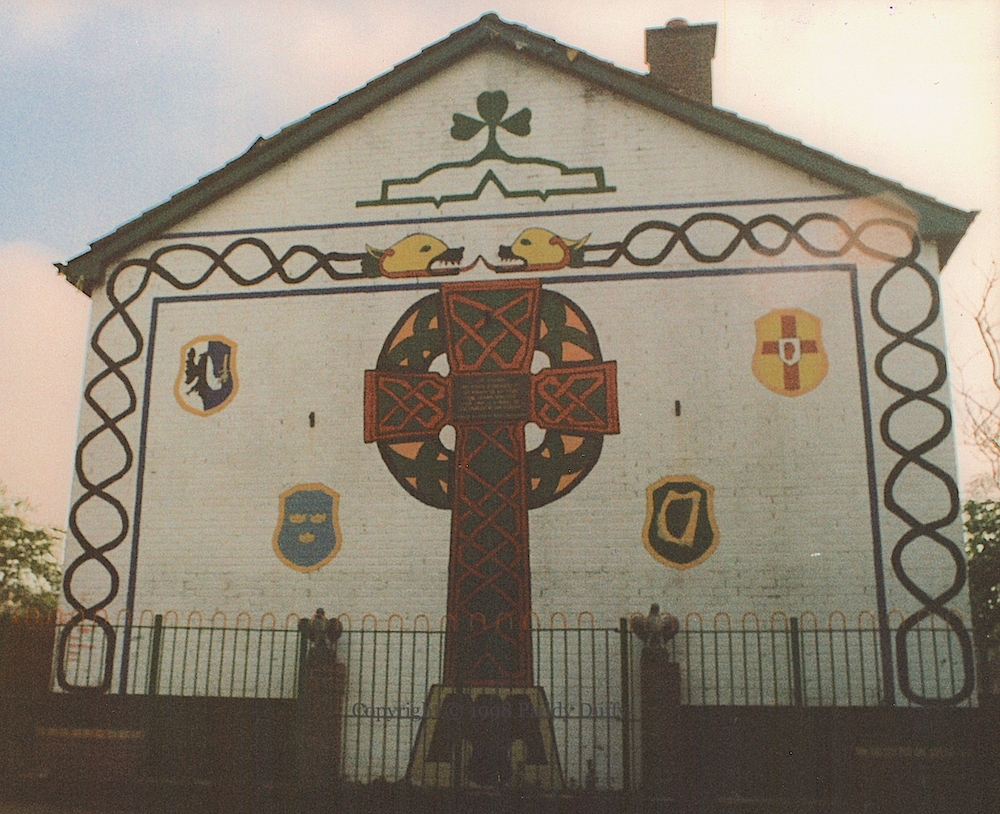
The plaque at the centre of the Celtic Cross reads “I ndıl chuımhne [in fond memory]. This plaque is dedicated to the memory of all those from Ligoniel who lost their lives as a result of the conflict in our country. A Mhuıre banríon na nGael guıgh orthu [Mary, queen of the Gael, pray for them]”
The second shows a Maid Of Erin harp – symbol of the United Irishmen – on top of a Tricolour attached to a pike, and a banner reading “Bás nó bua” [death or victory].
The main panels commemorate 25 years of “unbowed, unbroken” resistance in east Belfast (probably dating to the Battle Of St Matthew’s (WP) in 1970) with portraits of 16 deceased locals (“I measc laochra na nGael go raıbh a naınmeacha”) and two verses from Bobby Sands’s poem Weeping Winds(see below), on either side of Érıu the mythological queen of Ireland/Éıre as designed by Richard J King/Rísteard Ó Cíonga.
On the right (in the second image) is a copy of the 1916 Proclamation.
Oh, whistling winds why do you weep/When roaming free you are, Oh! Is it that your poor heart’s broke/And scattered off afar? Or is it that you bear the cries/Of people born unfree, Who like your way have no control/Or sovereign destiny?
Oh! Lonely winds that walk the night/To haunt the sinner’s soul/ Pray pity me a wretched lad/Who never will grow old. Pray pity those who lie in pain/The bondsman and the slave And whisper sweet the breath of God/Upon my humble grave.
“In proud memory of those who gave their lives for Ireland’s freedom” (and out of sight to the left) “Also to all civilians murdered by the British crown forces” (and out of sight to the right) “Also to all civilians murdered by pro-British elements”. The Celtic cross bears three republican flags: Tricolour, Sunburst, and Starry Plough.
The volunteers (and one Sınn Féın member) listed are (on the left) “Martin Forsythe, Martin Skillen, Gerard Fennell, Terence O’Neill, John Dempsey” and (on the right) “Sean McDermott, Tom Magill, Sean Savage, Kevin McCracken, Paul Best”.
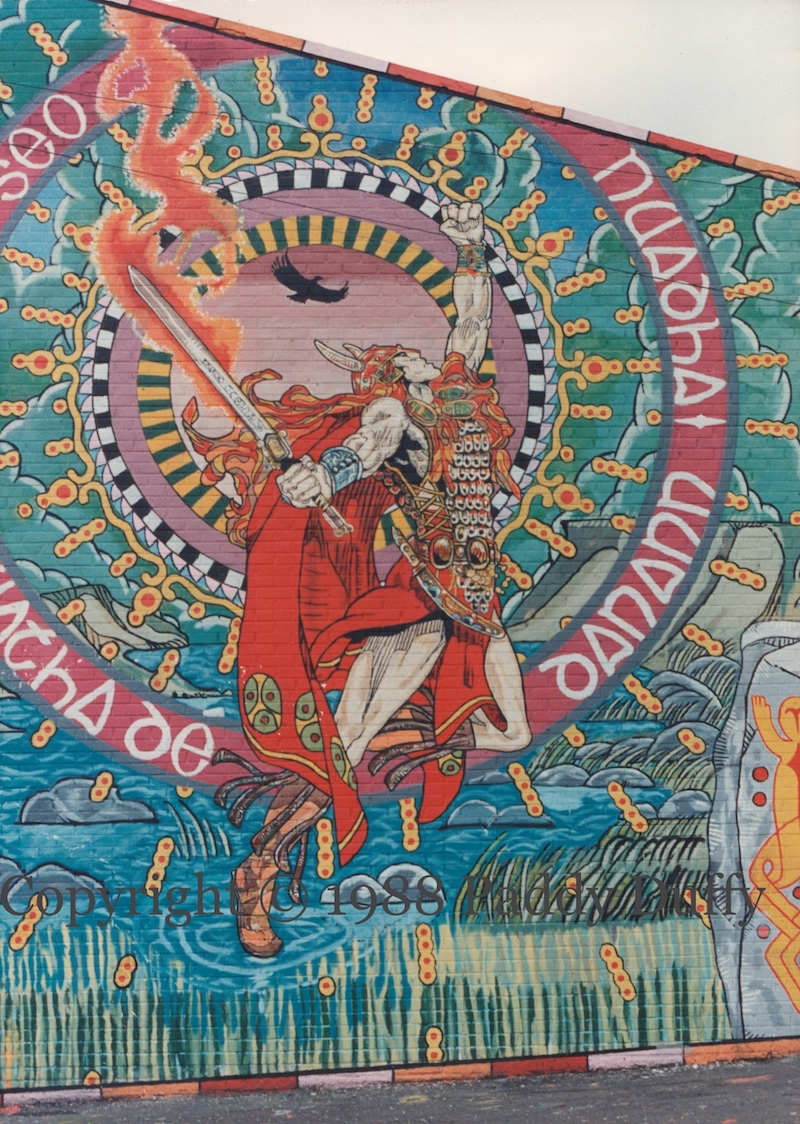
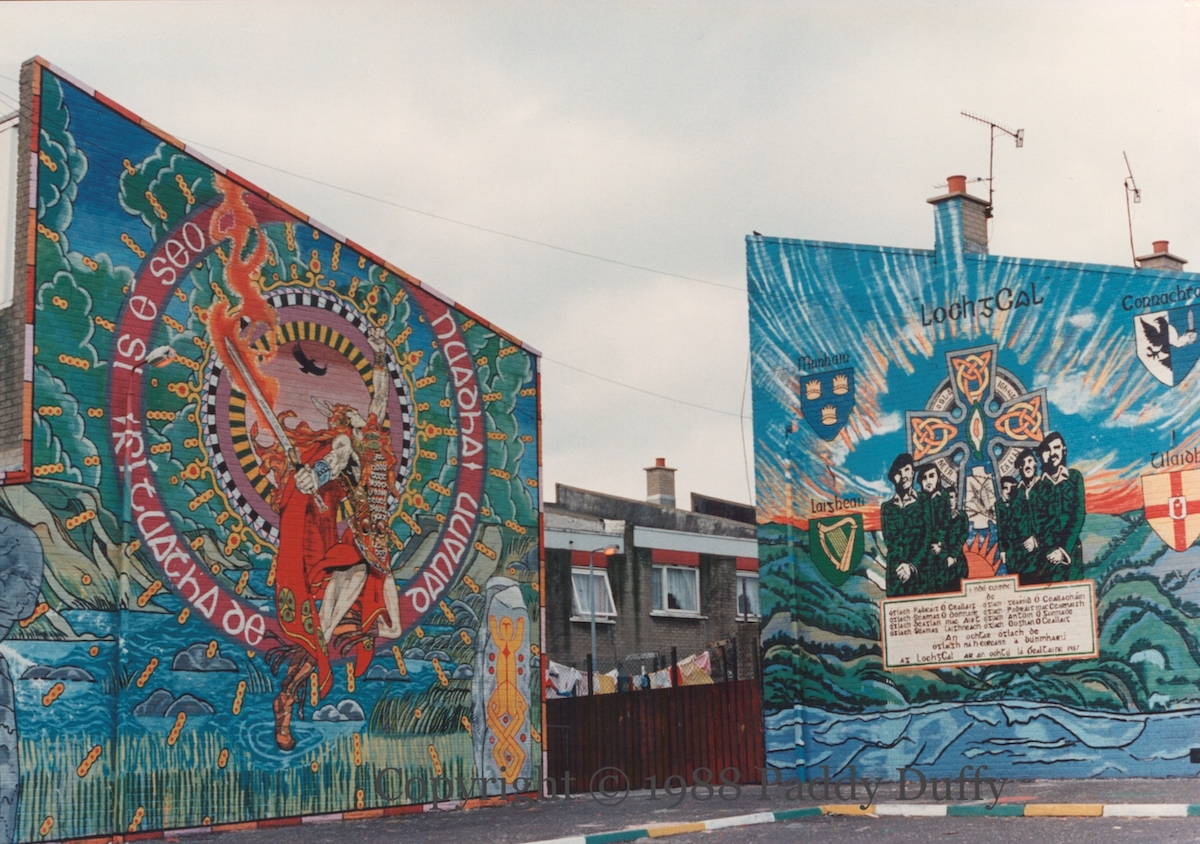
This pair of murals was painted by Mo Chara Kelly at the top of Springhill in 1987 after his release from prison. Both are inspired by the work of Jim Fitzpatrick. The central figure of the Rí Nuadha [King Nuada] mural above and immediately below comes from a painting of Fitzpatrick‘s called ‘Nuada Journeys To The Underworld’ while the background has a Fitzpatrick style and colour-scheme.
Of the myth of Nuada, Mo Chara said, “I had never heard the story of King Nuada before. Then I read the story. Wow! What a yarn! Nuada Of The Silver Arm is one of my favourite stories. As one of the Tuatha Dé Danann you had to be whole and physically perfect to hold the kingship. Nuada lost an arm in the first battle of Moy Tura and so he lost his kingship. He went into the other world, to middle earth, fought through trials and tribulations until Dıan Cécht made a silver arm for Nuada and he was restored to the kingship for another twenty years. But the moral of the story to me was that, no matter what happens, get up again and fight back. No matter how bad the situation you are in, you get back up and fight again. Do not let people isolate you. Get up and fight again. It was very inspiring!” (Painting My Community/An Pobal A Phéınteáıl – English-language version available for free.)
The Loch gCál/Loughgall mural likewise draws on Fitzpatrick for the landscape behind the Celtic cross and funeral guard in memory of the eight IRA volunteers from the East Tyrone brigade who were killed in an SAS ambush during an attack on an RUC base in May, 1987 (WP).
The names of the eight volunteers are given here in Irish and (partially) in the old script:
“I ndıl cuimh[n]e de [= ar] Óglach Pádraıg Ó Ceallaıġ [Patrick Kelly], Óglach Séamus Ó Donn[ġ]aıle [Seamus Donnelly], Óglach Deaglán Mac Aırt [Declan Arthurs], Óglach Séamus Laıghneach [Jim Lynagh], Óglach Gearóıd Ó Ceallacháın [Gerry O’Callaghan], Óglach Pádraıg Mac Cearnaıgh [Pádraıg McKearney], Óglach Antóın Ó Garmaıle [Ó Gormghaıle | Tony Gormley], Óglach Eoghan Ó Ceallaıġ [Eugene Kelly]
an ochtar óglach de óglaigh na hÉireann a dúnmharú ag Loch gCál ar an ochtú lá Bealtaine 1987.” [the eight volunteers from the Irish Volunteers [IRA] who were murdered at Loughgall on the eighth day of May, 1987]
The town (Loughgall) and the four provinces are also named in Irish. An Easter lily is at the centre of the Celtic cross in the middle of the image, above a lark in barbed wire and a gal gréıne/sunburst.






 Paddy Duffy Collection