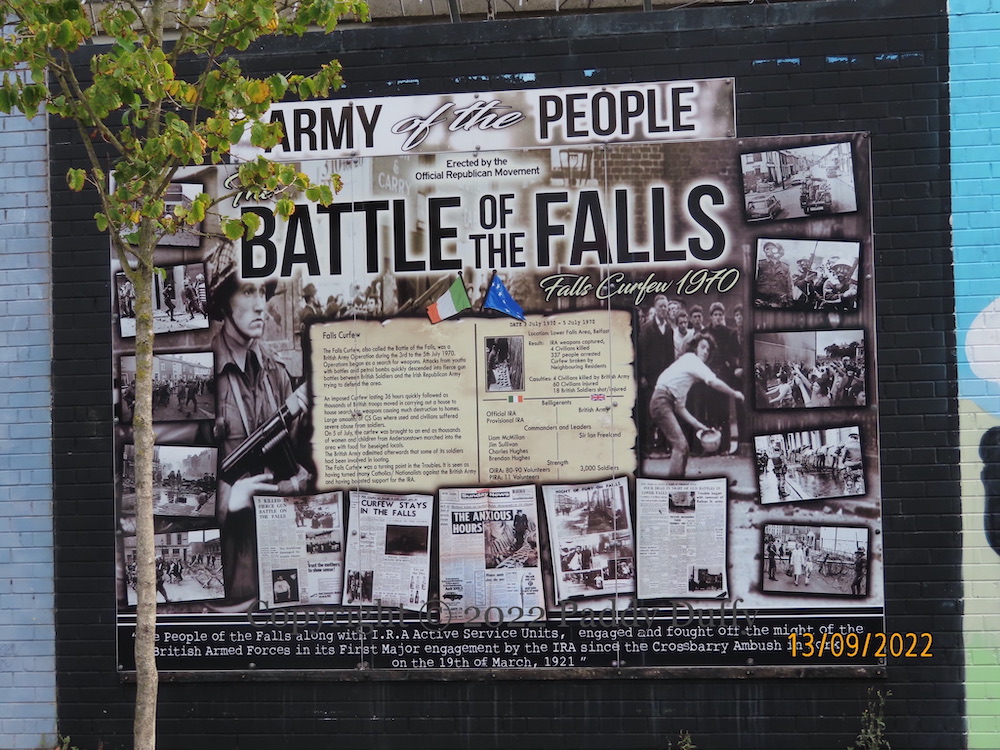
Four people were killed in the course of The Falls Curfew, the 36 hours from July 3rd to 5th in 1970 during which 3,000 houses on the lower Falls were cordoned off after a weapons search of the area devolved into a riot. The curfew ended with a march of women and children from Andersonstown bearing relief (represented in Falls Curfew 1970).
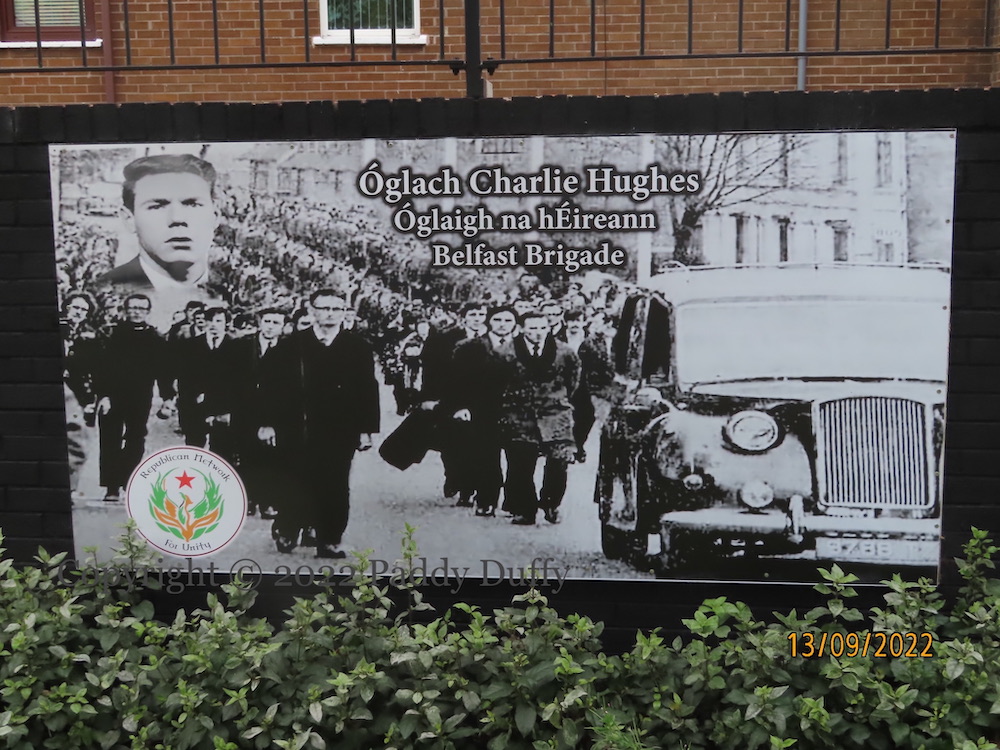
Óglach Charlie Hughes was O.C. of PIRA D Company (“the dogs”) in west Belfast. He was killed in March 1971 as part of the feud between the OIRA and the Provisionals. PIRA volunteers, including Charlie and cousin Brendan Hughes (“The Dark”), had burned down OIRA drinking den The Burning Embers, across from Charlie’s house on Balkan Street, and were moving on to The Cracked Cup on Leeson Street, but were met with gunfire. Hughes was killed later that night, after a ceasefire had been agreed, by a single shot (WP | a 2002 account by The Dark). The mural replaces the small ‘1921’ tarp (see Do Not Touch).
This is the first spot on the International Wall, Divis Street. Brendan Hughes has been included since the 2008 version (compare 2005 with 2008) but Crumlin Road hunger-striker Billy McKee is included for the first time. McKee was the first OC of the PIRA’s Belfast Brigade and arrested for possession of a handgun. The hunger strike was to secure political status for prisoners who had been convicted of crimes (WP).
“This mural is dedicated to the lives of: Billy McKee, Hunger-striker, Crumlin Road Gaol, achieved political status, 1972; Kieran Nugent, Blanketman, H-Blocks Long Kesh, fought the loss of political status, 1976; Brendan Hughes, Blanketman, Hunger-striker, H-Blocks Long Kesh, 1980.”
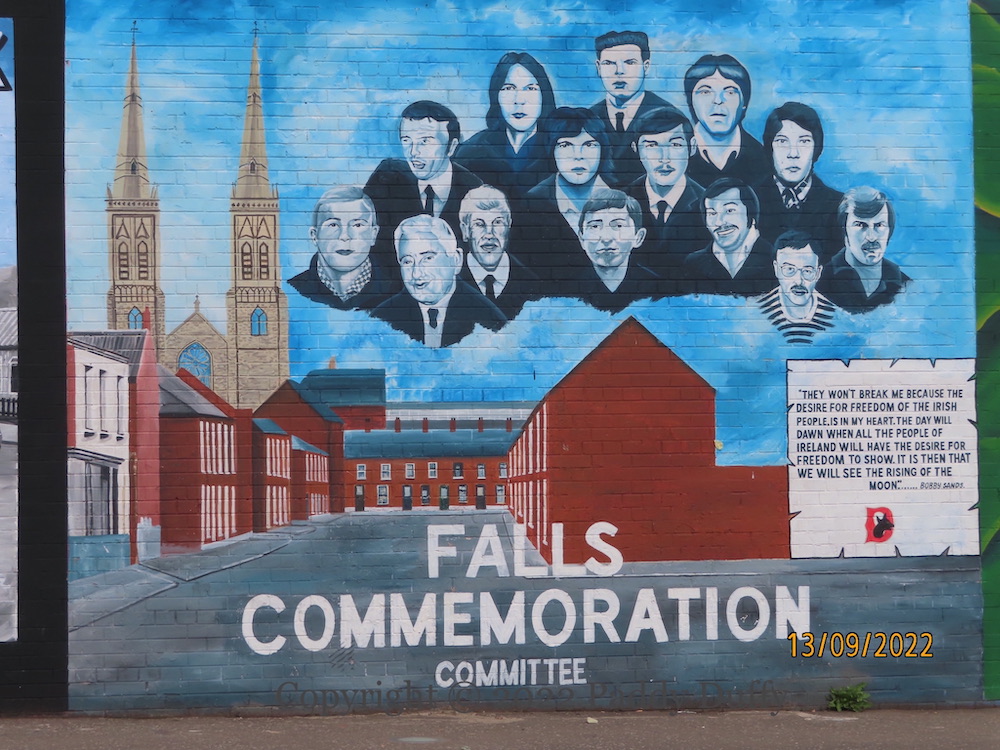
The Falls Commemoration Committee (Fb) organises an annual commemoration for IRA D company volunteers from Divis and the lower Falls (as well as special events for the fiftieth anniversary of the Falls Curfew in 2020). The fourteen local volunteers are portrayed in a group above St Peter’s. They include the five volunteers who died in 1972 and were depicted in a mural previously at this spot.
“‘They won’t break me because the desire for [freedom and the] freedom of the Irish people is in my heart. The day will dawn when all the people of Ireland will have the desire for freedom to show. It is then that we will see the rising of the moon’ – Bobby Sands [March 17th, 1981]” Originally in Irish: “Ní bhrısfıdh sıad mé mar tá an fonn saoırse, agus saoırse mhuıntır na hÉıreann, ı mo chroí. Tıocfaıdh lá éıgın nuaır a bheıdh an fonn saoırse seo le taıspeáınt ag daoıne go léır na hÉıreann. Ansın tchífıdh [chífidh] muıd éırí na gealaí.”
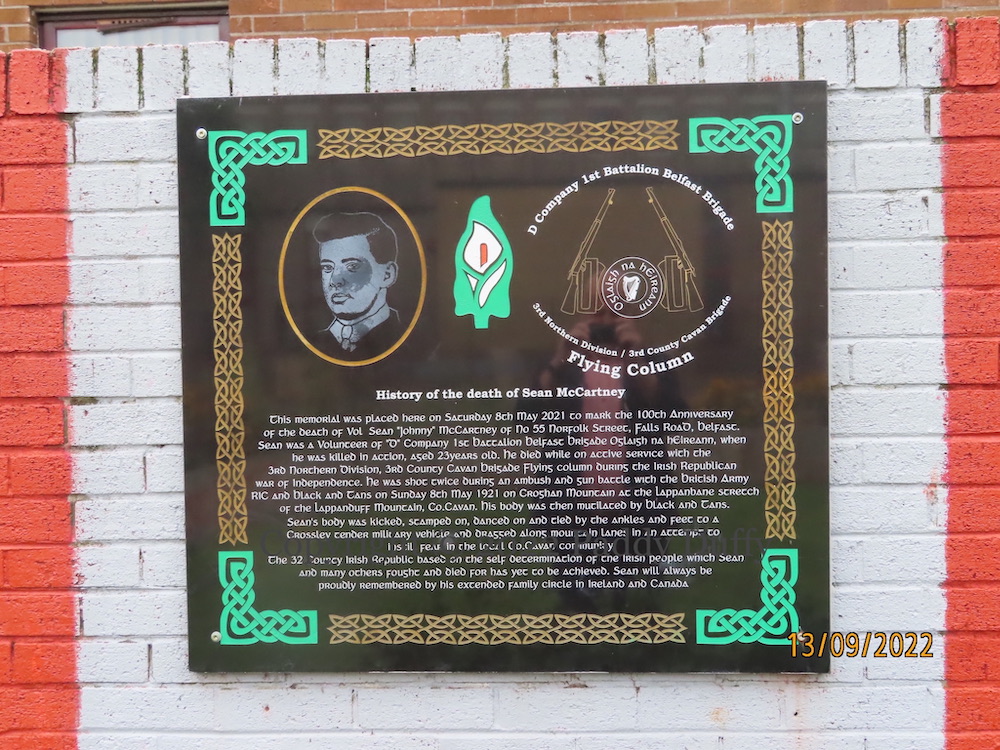
“History of the death of Sean McCartney. This memorial was placed here on Saturday 8th May 2021 to mark the 100th anniversary of the death of Vol Sean “Johnny” McCartney of no. 55 Norfolk Street, Falls Road, Belfast. Sean was a volunteer of “D” Company 1st battalion Belfast Brigade Oglaigh na hEireann, when he was killed in action, aged 23 years old. He died while on active service with the 3rd Northern Division, 3rd County Cavan Brigade flying column during the Irish Republican War of Independence. He was shot twice during an ambush and gun battle with the British Army RIC and Black and Tans on Sunday 8th May 1921 on Croghan Mountain at the Lappanbane stretch of the Lappanduff Mountain, Co. Cavan. His body was then mutilated by the Black and Tans. Sean’s body was kicked, stamped on, danced on and tied by the ankles and feet to a Crossley Tender military vehicle and dragged along mountain lanes in an attempt to instill fear in the local Co. Cavan community. The 32 county Irish republic based on the self determination of the Irish people which Sean and many others fought and died for has yet to be achieved. Sean will always be proudly remembered by his extended family circle in Ireland and Canada.” McCartney is buried in Milltown cemetery.
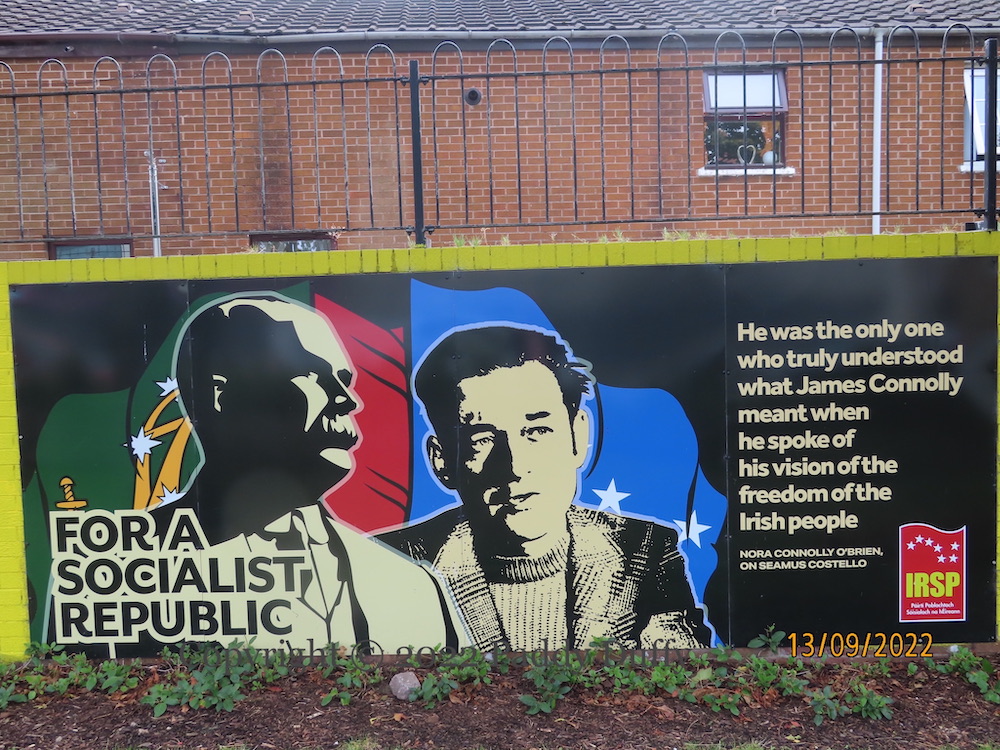
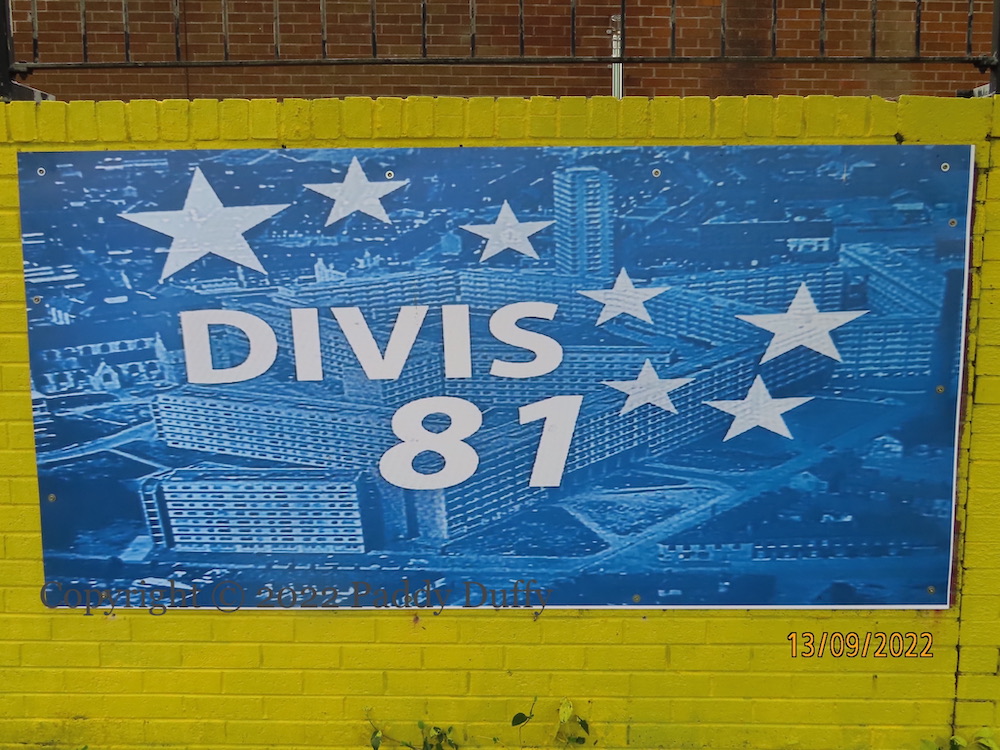
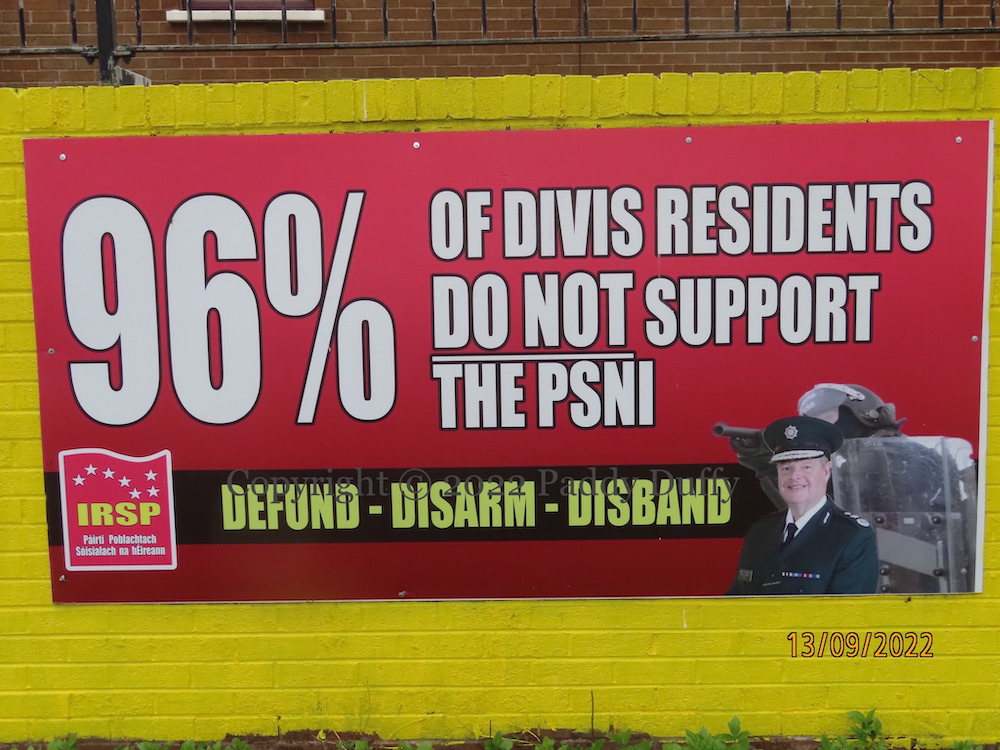
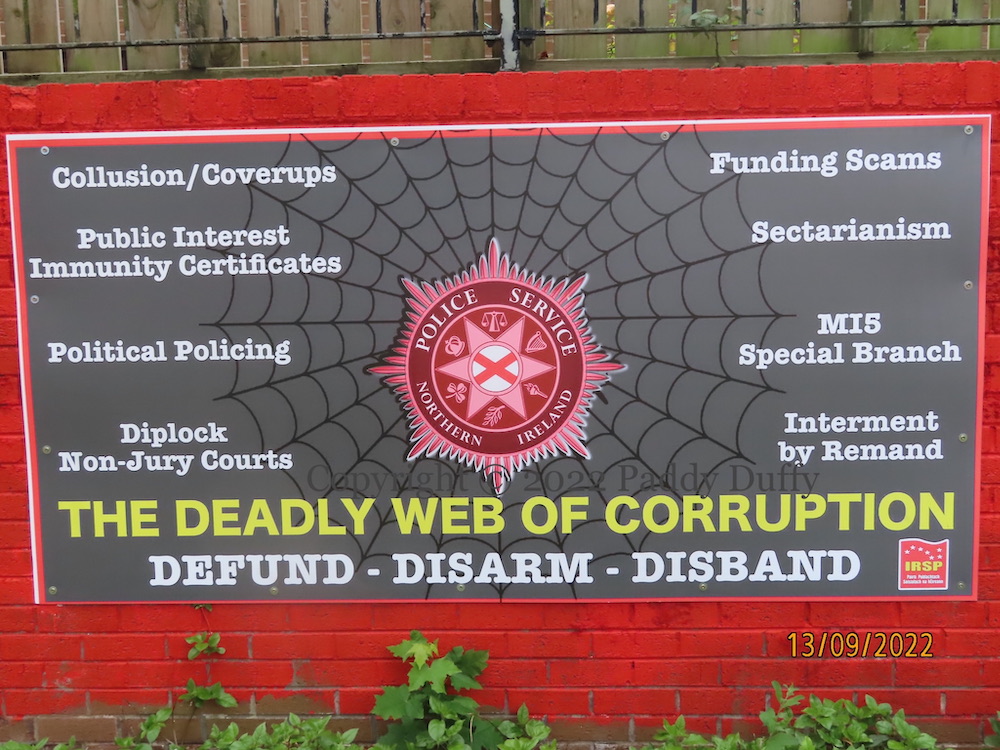
Here is a gallery of the republican boards along the low wall just east of the Falls garden of remembrance. From right to left: James Connolly and Seamus Costello; Divis 81; anti-PSNI; “web of corruption”; Charlie Hughes (killed in 1971 the feud with the OIRA); the Falls Curfew featuring Máıre Drumm; Billy McKee, Alec Murphy, and Brendan Hughes; the Falls Road Massacre 1920; Kieran Abram – Abram was knocked to the ground in the early hours of July 5th, 1992, and kicked to death by loyalists in running battles with nationalists on North Howard Street, near the old British Army sangar. Four people were convicted of manslaughter in the case (Judiciary NI).
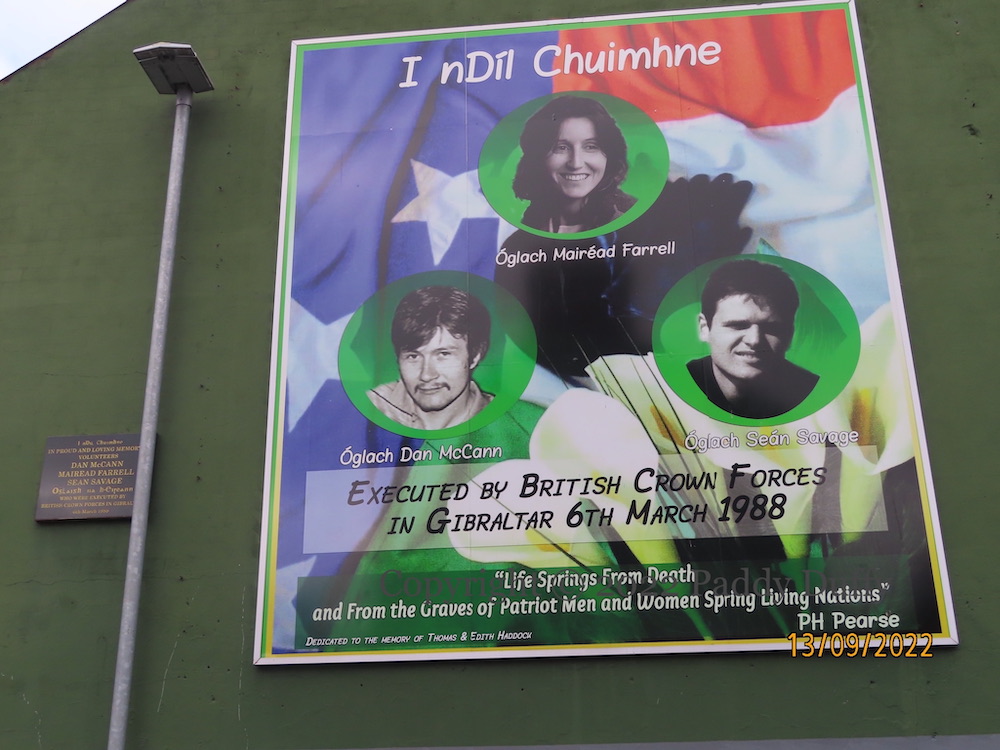
The new replacement board commemorating the Gibraltar 3 (Maıréad Farrell, Dan McCann, and Seán Savage “executed by British crown forces 6th March 1988) uses words from Pearse’s oration at the funeral of O’Donovan Rossa. Not the more common “the fools, the fools …” but “Life springs from death and from the graves of patriot men and women spring living nations” (used previously in Strabane in 1990 – M00860). The board is “dedicated to the memory of Thomas and Edith Haddock”.
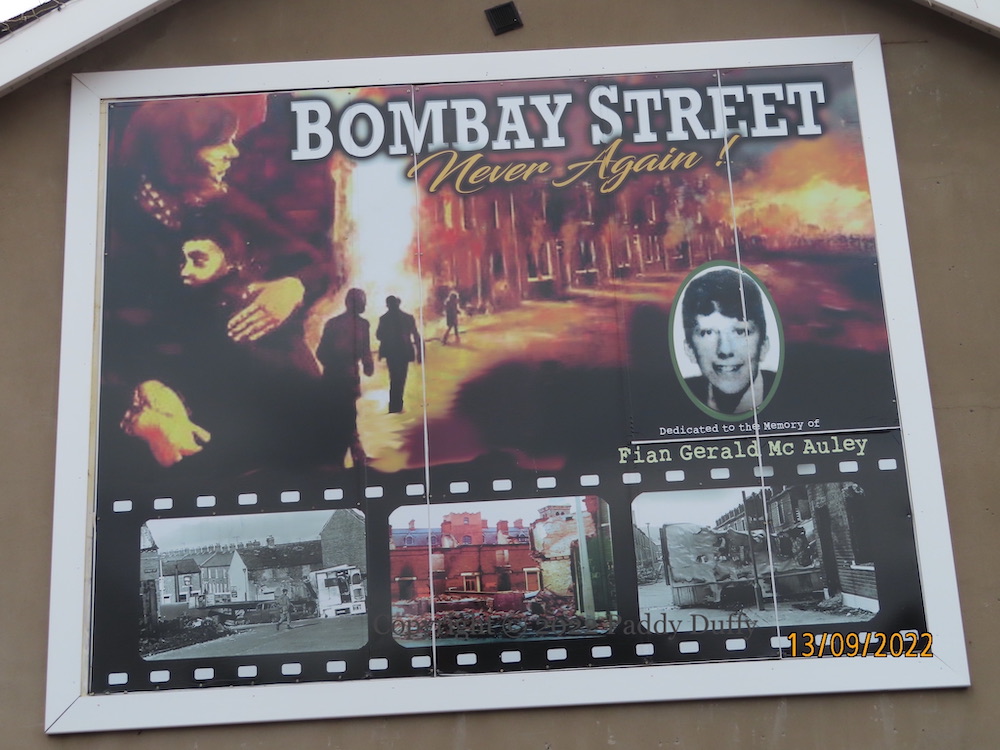
15 year-old Fıan Gerald McAuley was the first member of the IRA to die in the Troubles. He was shot in Waterville Street by a loyalist sniper while helping people move from burned-out homes in Bombay Street, along which the “peace” line separating the Falls and Shankill now runs, overlooking the Clonard Memorial Garden, site of the service for the 50th anniversary of McAuley’s death.
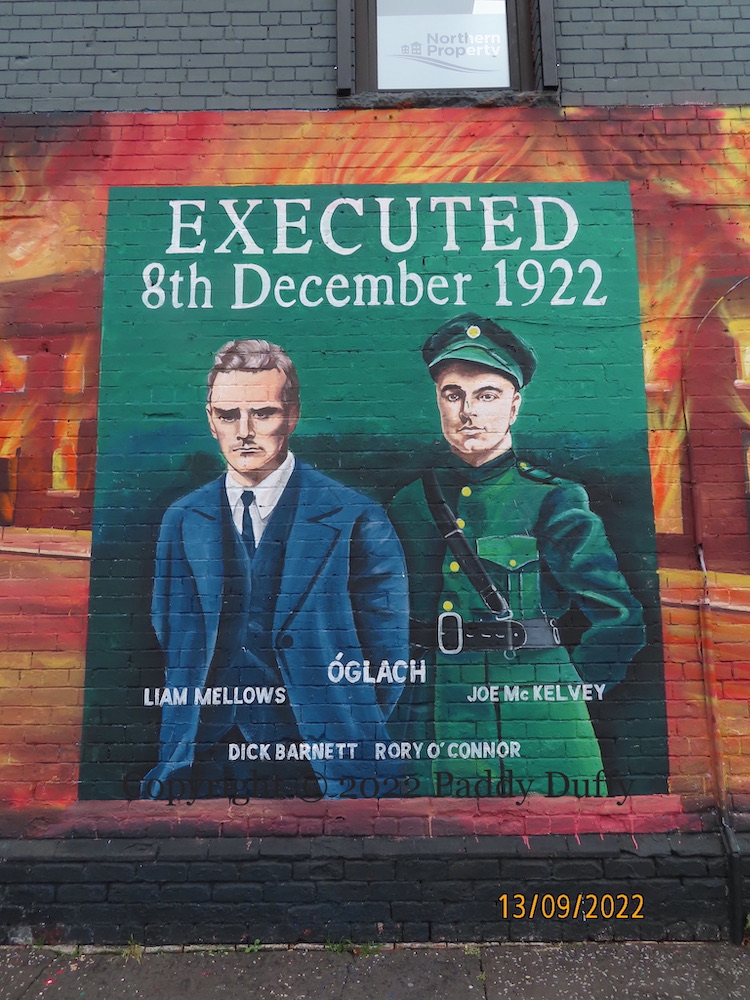
On October 18th, 1922, the third Dáıl/second Provisional Government Of Southern Ireland approved – in the absence of anti-Treaty members – a bill entitled the “Army Emergency Powers Resolution” which introduced martial law, including martial courts with the death penalty for anyone found in possession of an illegal firearm – “illegal” meaning not sanctioned by the nascent pro-Treaty Free State. Under these powers, seven IRA volunteers were executed on November 17th and 19th, followed on the 24th by Erskine Childers (a member of the team that negotiated the Treaty but subsequently against it). In response, the IRA declared that TDs who had voted for the bill were fair game, and on December 7th Seán Hales of Cork was shot and killed. In reprisal, the government ordered the execution of four more volunteers, one from each province: Liam Mellows, Joe McKelvey, Dick Barnett, Rory O’Connor. The four had been arrested five months earlier, on June 30th, 1922, at the start of the Civil War, after surrendering the Four Courts. By the end of the war, 81 executions had taken place. (An Phoblacht | Irish Times | The Irish Story | WP | WP)
For the left-hand side of the wall, on the shipyard clearings and the McMahon murders, see Belfast Butchery.




 Paddy Duffy Collection