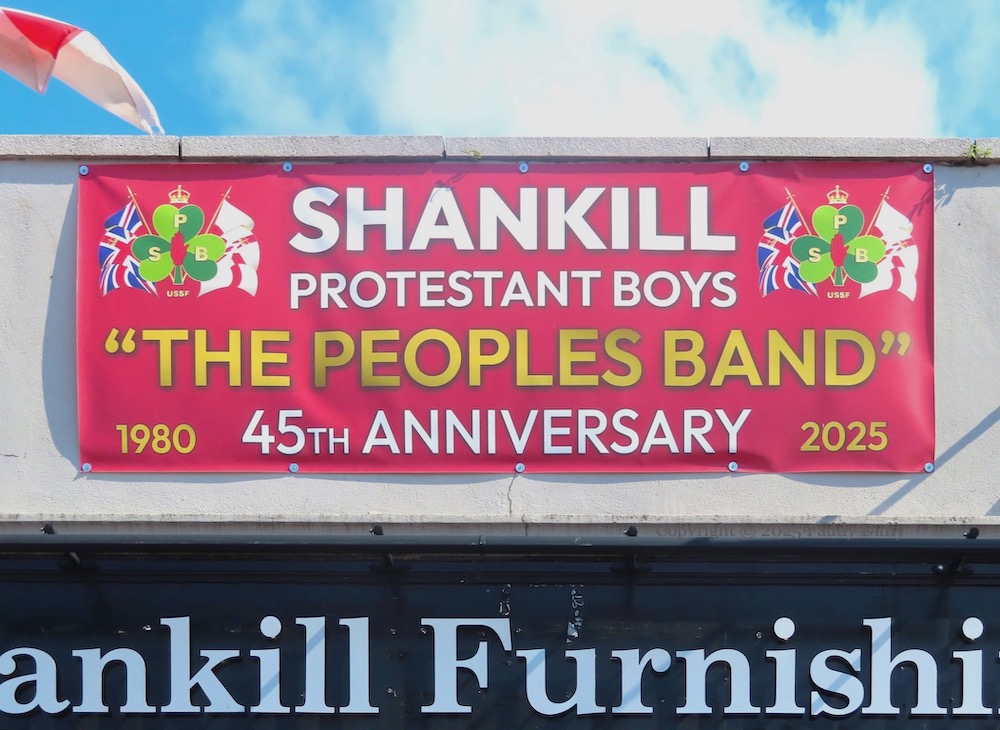
“Shankill Protestant Boys [Fb] “The People’s Band” 45th anniversary, 1980-2025.” The band held a parade on August 1st to commemorate the anniversary, with nearly forty other bands attending (Fb).
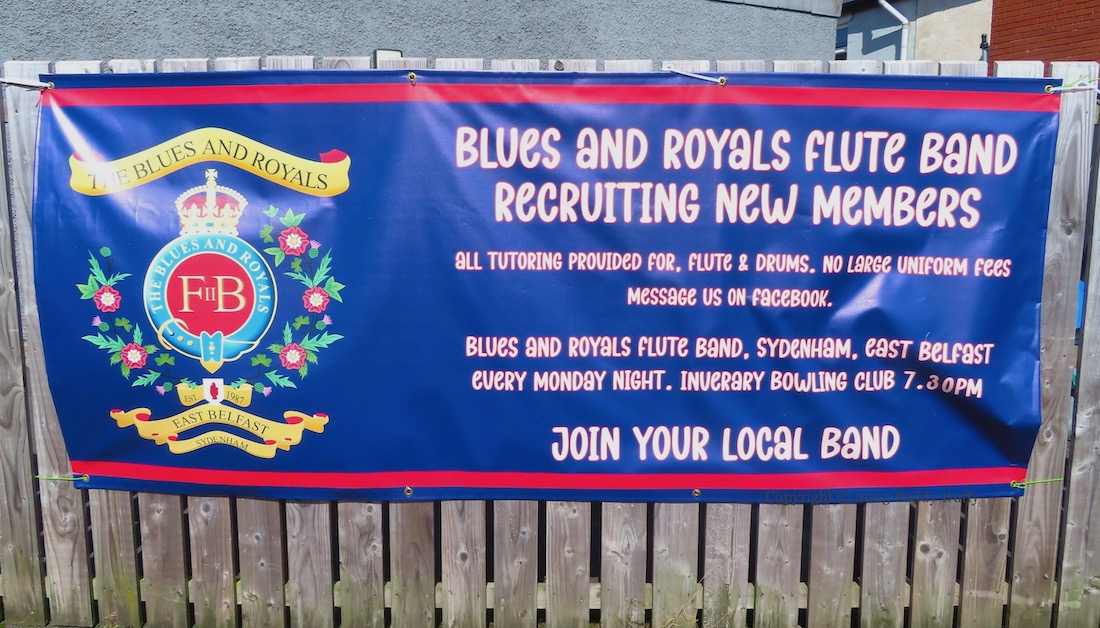
Above, a recruitment tarp for the Blues And Royals flute band (Fb).
Below, (and on the wall above the flute band’s tarp) a NI Centenary board using the St Patrick’s saltire in the background. The saltire is an Anglo symbol of Ireland and was included in the Union Flag when the union was between Britain and Ireland and thus – like the word “Ulster” – has been reduced to signifying Northern Ireland after partition.
Three plaques at the Ballynafeigh Apprentice Boys social club on Blackwood Street:
“In loving memory of Allison Jane Smith – you’re missed so much by so many who knew you in Ballynafeigh”, “Celebrating the 100th anniversary of the foundation of Northern Ireland – Northern Ireland centennial 3rd May 2021”, “In memory of all our past members”.
“North Down Defenders flute band [Fb], est. 2004. In memorium [sic] T. Mercer, R. Shaw, K. Shaw, G. Shaw, D. Shaw, A. Johnston, P. Magee, S. Stewart, J. Mills.”
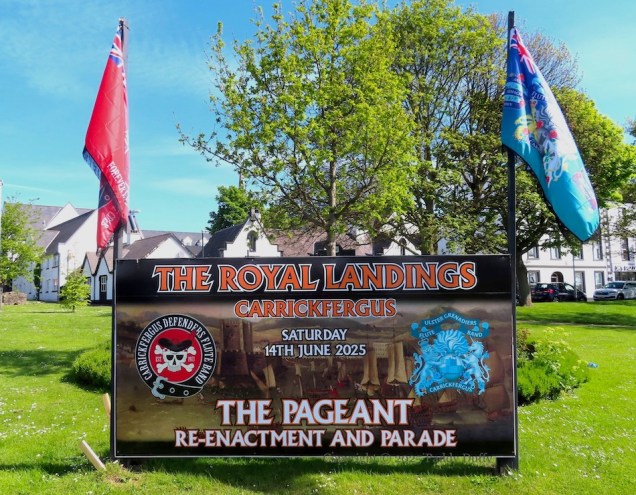
“The Royal Landing, Carrickfergus, Saturday 14th June 2025. The pageant, re-enactment, and parade.”
William III, statholder of Holland, landed at Torbay, England, in November, 1688 with 250+ ships and 30,000 men in order to overthrow the Catholic convert James II who had become king in 1685. As king of England, William was automatically made king of Ireland, but he and his forces had to go to Ireland to win the island from James and the forces loyal to him. Schomberg had already successfully besieged Carrickfergus in 1689, allowing William to land on June 14th, 1690. The image used as a background is Pocock’s oil painting of the landing, which is held by the National Maritime Museum.
The Royal Landing event involves a parade – involving the Carrickfergus Defenders flute band (Fb) and the Ulster Grenadiers flute band (Fb) – from Woodburn fields to the marina, where King Billy’s landing will be recreated (Fb).
Here are two boards in Riverside Park, Dervock, celebrating the town’s “heritage and culture”.
Above: “Kennedy Kane McArthur, Dervock born and bred. 1912 Stockholm Olympics marathon gold medal winner, new World Record.” Ken McArthur emigrated to South Africa at age 20 and ran his first marathon at 28. Four years later, he represented South Africa at the Olympics and was victorious in the marathon (WP). There is footage of the race at olympics.com. There is a display of boards honouring McArthur on an abandoned building in Dervock.
Below: “The journey of heritage and culture has shown us who we are, the memory of our past will let a new future begin.” Members of the (contemporary) Dervock flute band (Fb) stand on the Scottish St Andrew’s Saltire, above a black-and-white photograph (from NI Archive) of drumming – including Lambeg drumming (Discover Ulster Scots) – from about 1920.
The shutters of the Peppercorn café on the Woodstock Road were painted with a WWI theme back in 2015 (In Flanders Fields) and were re-painted in late 2020.
The first panel (above) shows “our wee country” – Northern Ireland, on the occasion of its centenary.
The second features the “Light Of Foot” (web) programme supporting the mental health of bandsmen in Scotland and Northern Ireland. “Marching mental health”, “It’s okay to talk”.
The final panel reproduces (in reverse direction) John Singer Sergeant’s painting Gassed – for a photographic version, also in east Belfast, see Observe The Sons Of Ulster. “Their sacrifice, our freedom.”
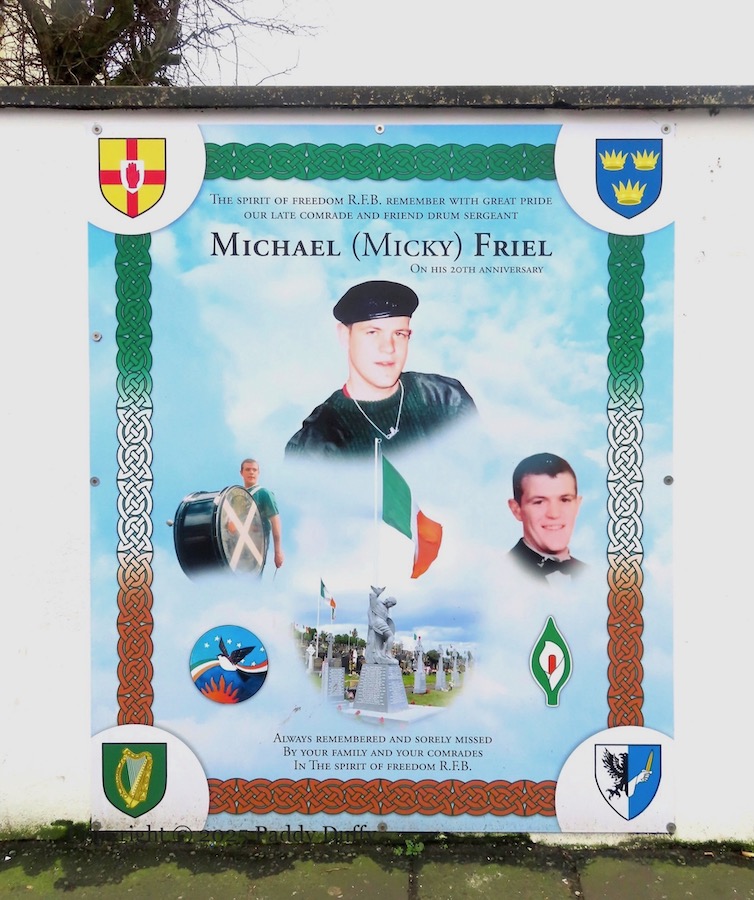
“The Spirit Of Freedom RFB remember with great pride our late comrade and friend drum sergeant Michael (Micky) Friel on his 20th anniversary. Always remembered and sorely missed by your family and your comrades in the Spirit Of Freedom RFB.” The band does not appear to have an on-line presence but there are references to the band going back to 1997 (An Phoblacht). Friel died in 2004 at age 24 (FindAGrave).
The Ulster First Flute mural in Linfield Road will be twenty-eight years old this year (2025). There is an image in the Collection from 1998 and images in the other collections from 1997, 2009, and 2018. The band formed in 1996, according to its Fb page, though at the bottom the text reads “Est. 1997”.
The festive atmosphere depicted along the bottom of the Pride Of Ballybeen flute band’s new mural, with people clapping and waving and doing cartwheels as the parade passes by, is in contrast with the regimental emblems in the upper part of the mural: we see (on the left-hand side; first close-up below) the Highlanders (“Cuidich’n Righ” is Scots Gaelic for “Help the king”) and the Irish Guards (motto “quis separabit”; 1783 is the year the Order Of St Patrick was created), and (right-hand side, second close-up below), the Royal Irish Regiment and the Logistics Corp (motto “Honi soit qui mal y pense“). These are perhaps regiments in which band-members serve or have served; the band does not have a (public) internet presence.