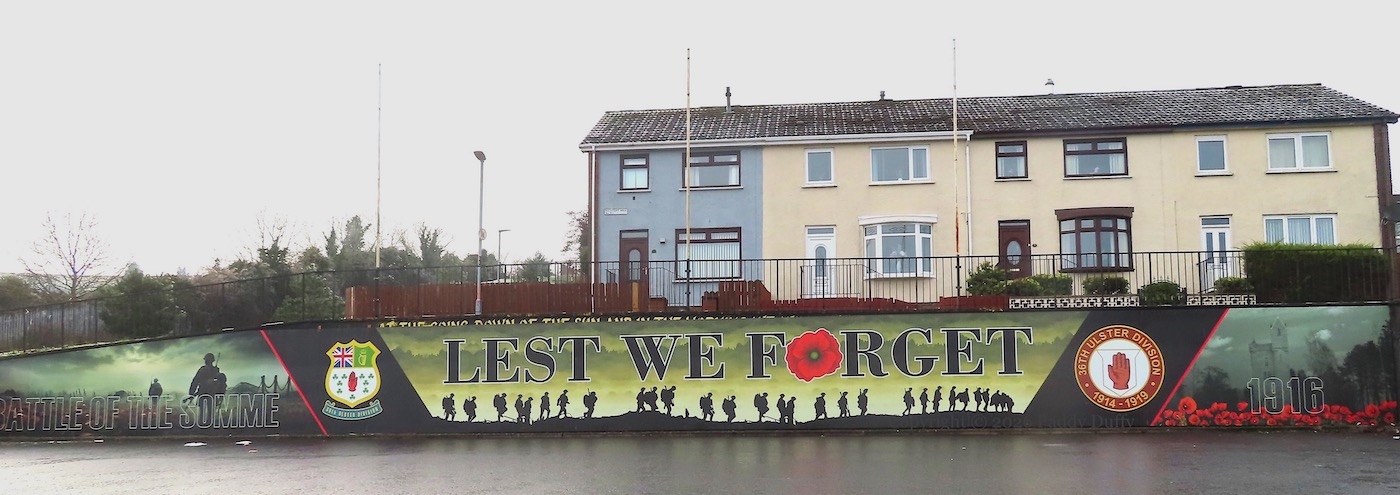
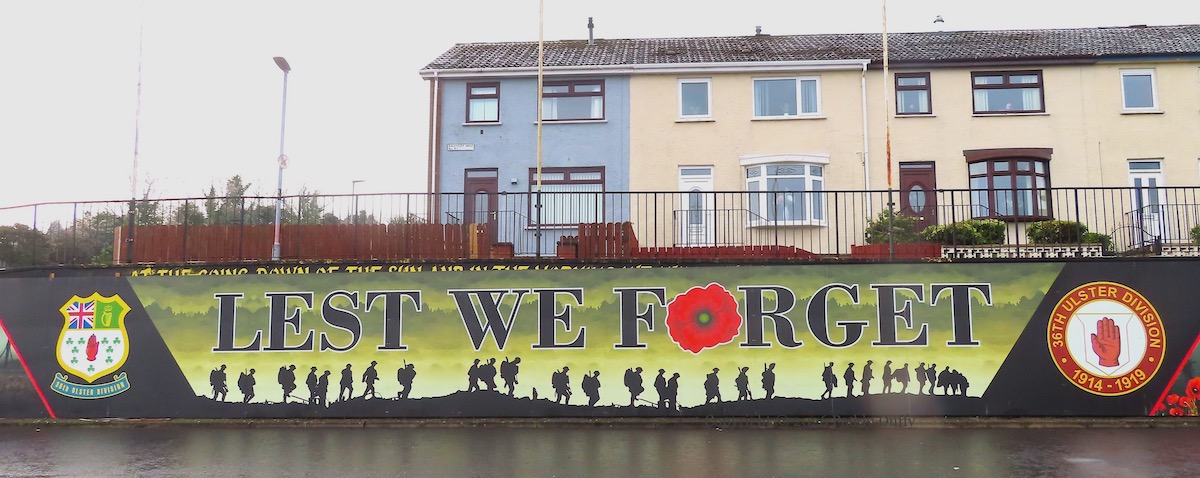
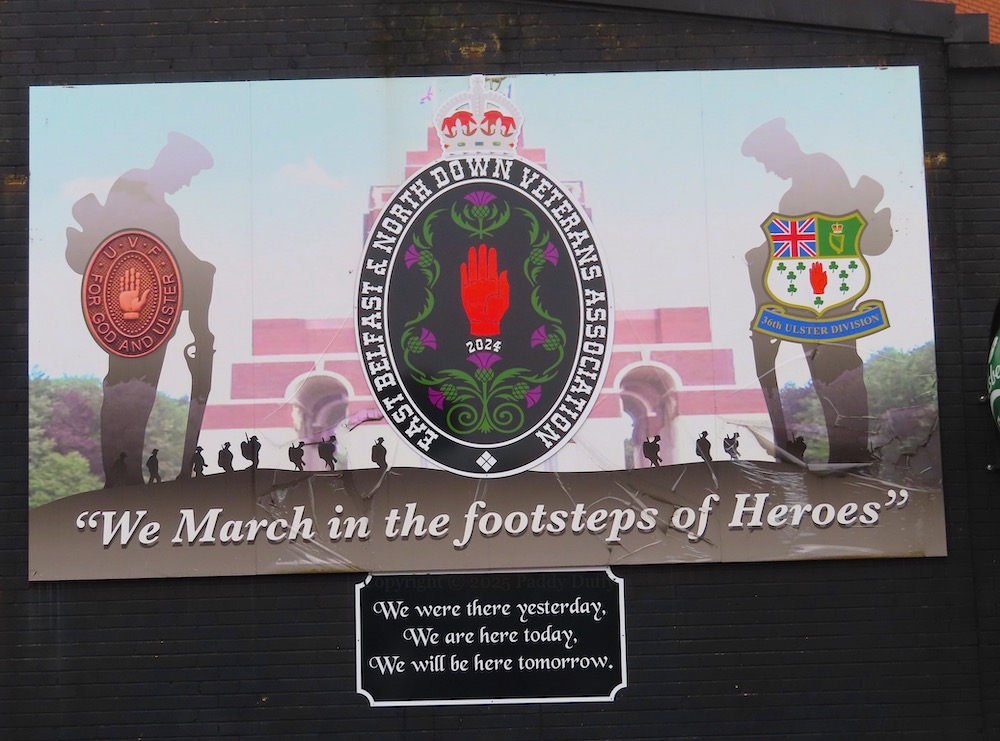
This is a new version of the board seen in 2022, in which the central emblem was of the 8th battalion of the Royal Irish Rifles, whereas it is now of the “East Belfast & North Down Veterans’ Association”.
Below, a small plaque reading “We were there yesterday, We are here today, We will be here tomorrow” has been added
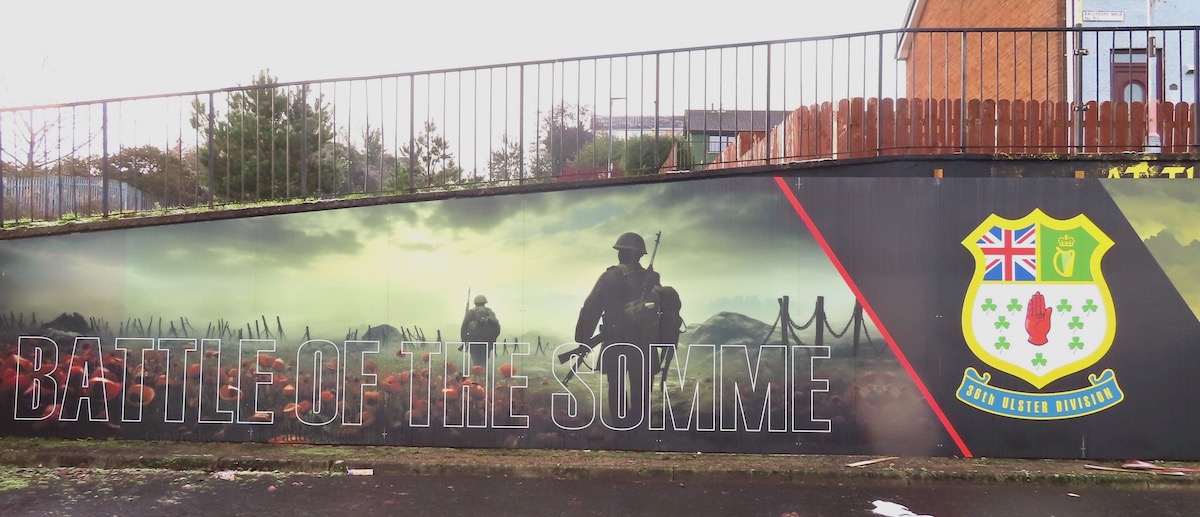
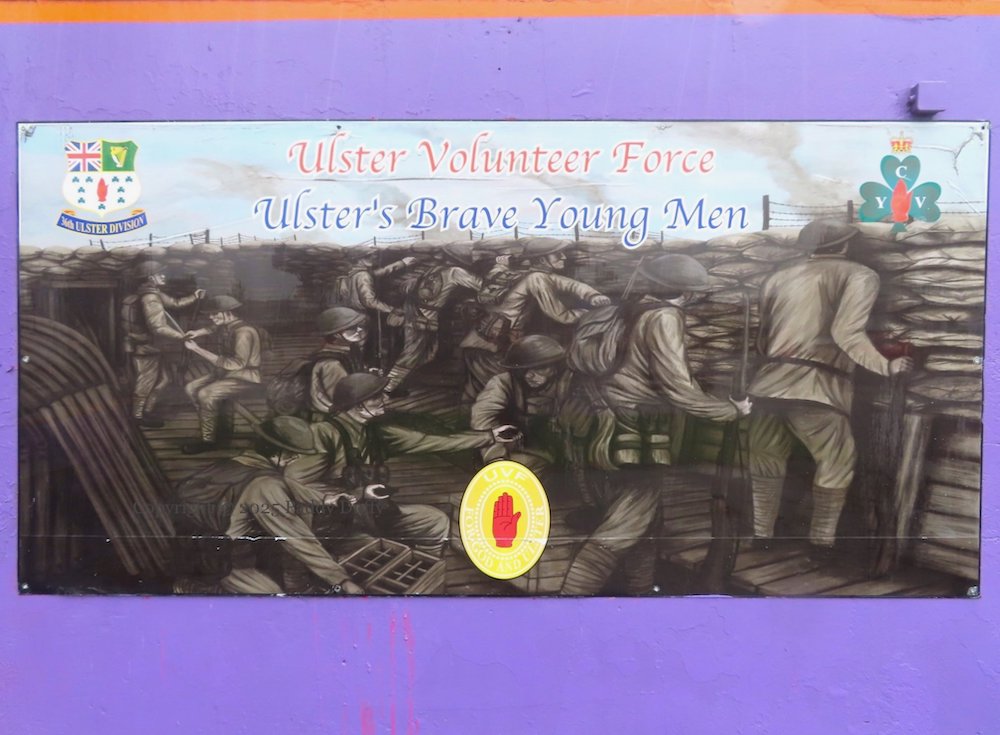
The background to the Avenue Road “Memorial to the 36th (Ulster) Division and to other men of Ulster who served in the Great War 1914 – 1918” has been repainted in the purple and orange of the UVF and the wall simplified by the removal of two smaller boards to each side of the main board (above) which shows soldiers looking out over the edge of a WWI trench. (For the the previous boards, see the Peter Moloney Collection.)
The seat is dedicated to “Jack”, an 11-year-old member of the Avenue Road Memorial flute band who died in 2019 (News Letter), with boxing gloves and emblem of the NI soccer association. 2 Timothy 4:7 says, “I have fought the good fight, I have finished the race, I have kept the faith.”
Avenue Road, Lurgan
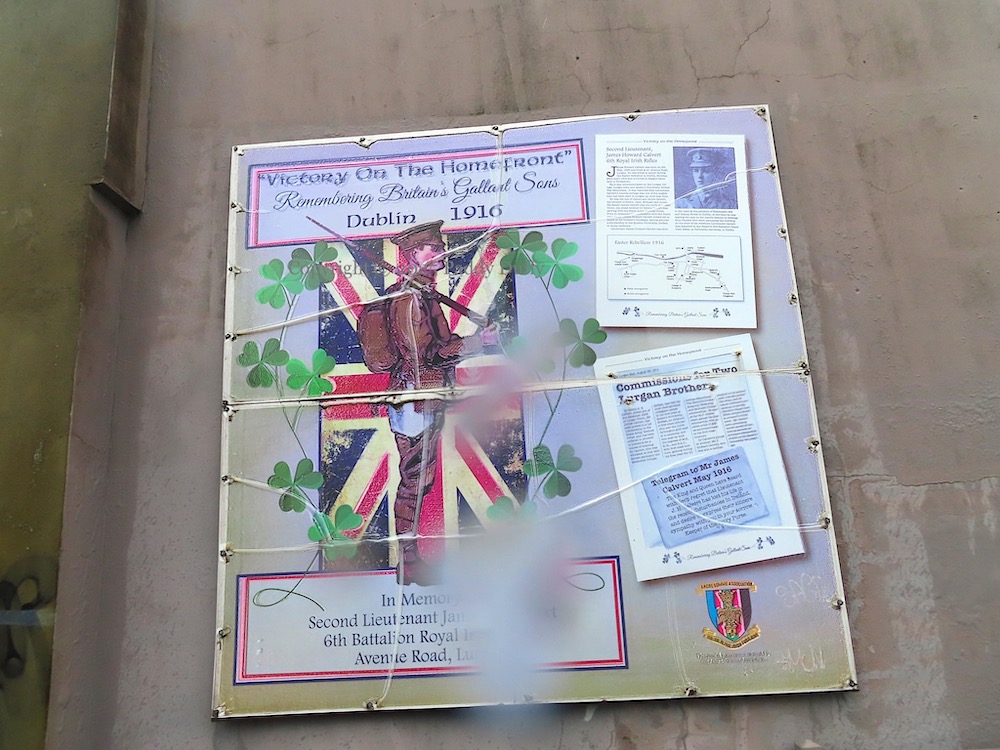
The final image is of a board in nearby King’s Park Mews to a soldier who died on “the homefront” – Dublin during the 1916 Rising – Second Lieutenant James Howard Calvert of the 6th Royal Irish Rifles.Calvert lived at 41 Avenue Road, Lurgan.
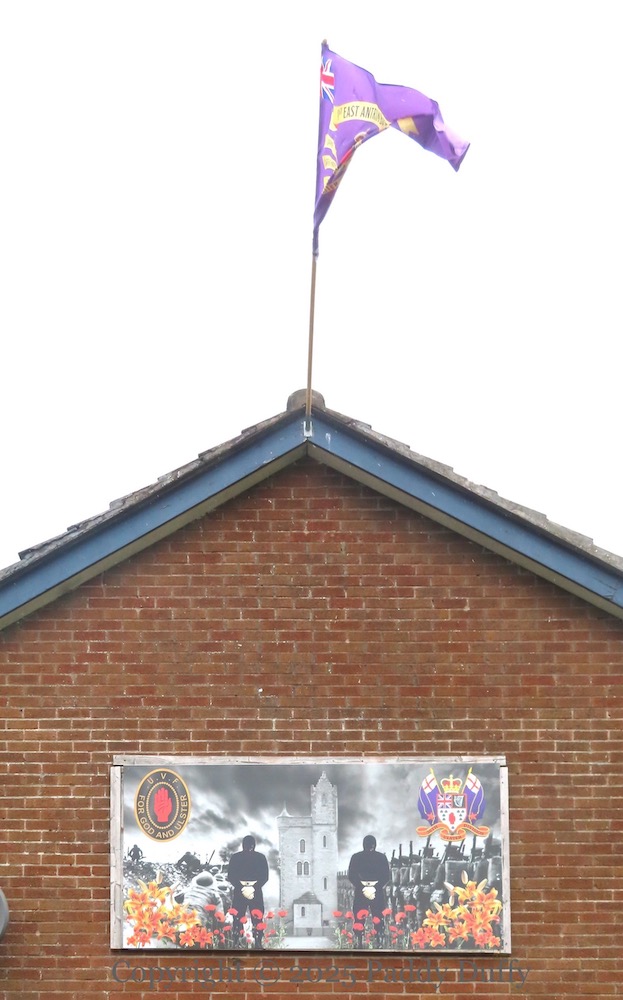
Modern UVF volunteers in balaclavas stand with heads bowed on either side of the Ulster Tower in Thiepval, standing among orange lilies and red poppies.
On the left the 10th Scottish Rifles (AWM) commence a raid, below the emblem of the Ulster Volunteer Force, and on the right, the Royal Fusiliers appear to march off to war in a press photograph (Flickr), below the emblem of the 36th (Ulster) Division.
In Grange Drive, Ballyclare, on the same as wall, and using part of the frame from, a previous UDA board: Young Guns.
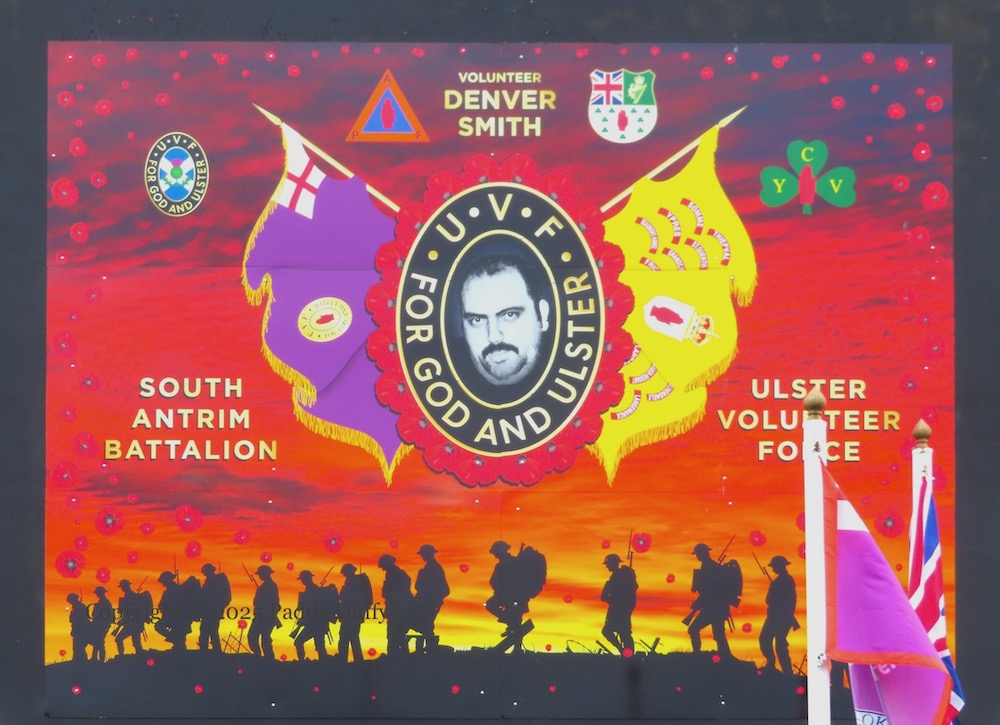
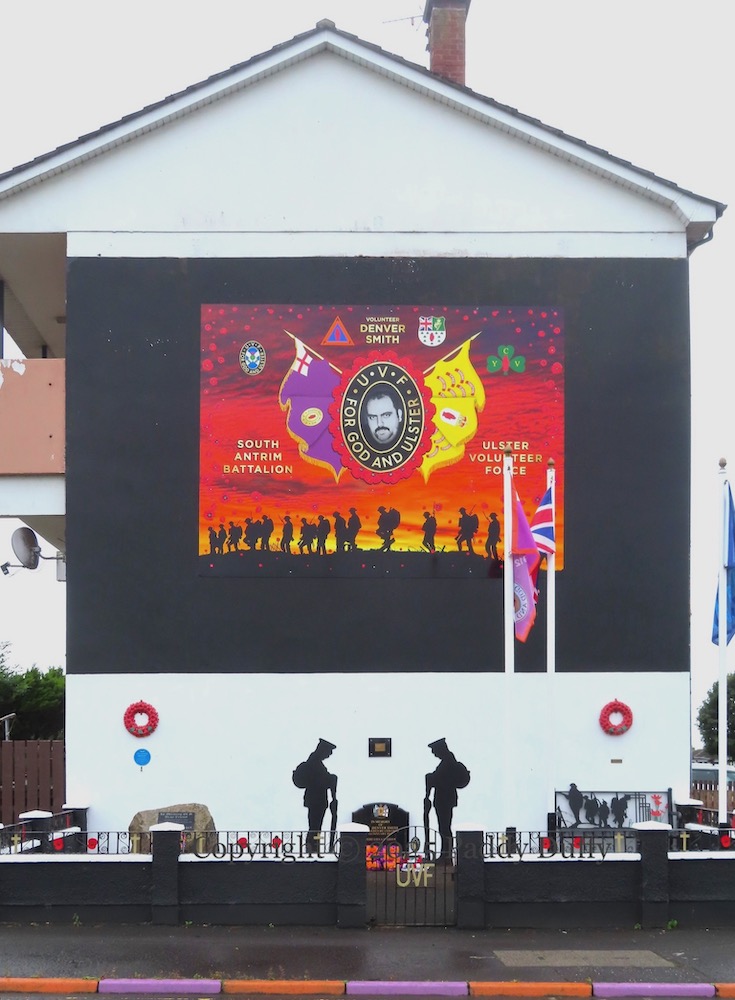
The Denver Smith mural in the Steeple, Antrim, has been replaced with the printed board (shown above and immediately below) which retains the same elements of the mural, including the WWI soldiers and the emblem of the 36th (Ulster) Division. (For information about Smith, see Here Lies A Soldier.)
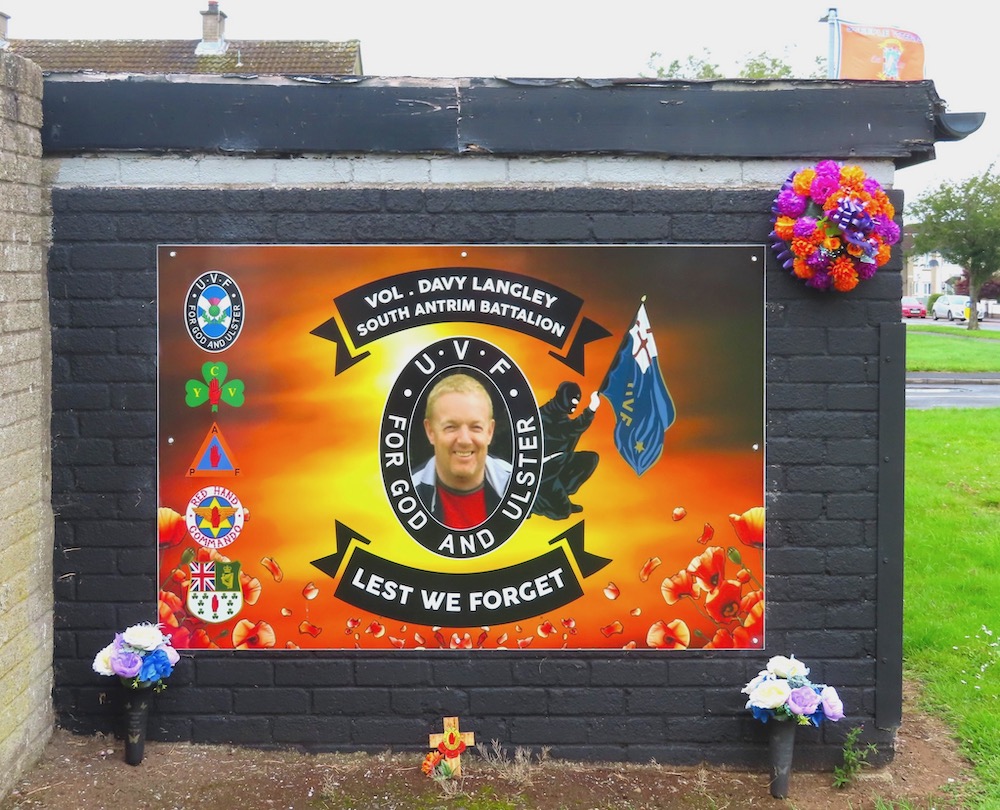
Memorial boards in the same style and palette have also been mounted on adjacent walls to two members of the modern Ulster Volunteer Force. To the left, Mark McCausland, who died in 2024 (Wray’s); the board in his memory replaces a UVF flag (seen in Pass Not This Spot In Sorrow). To the right, Davy Langley, who died in 2018 (Funeral Times); there was previously a mural to his memory in the same spot (see Ulster Volunteer Forces)
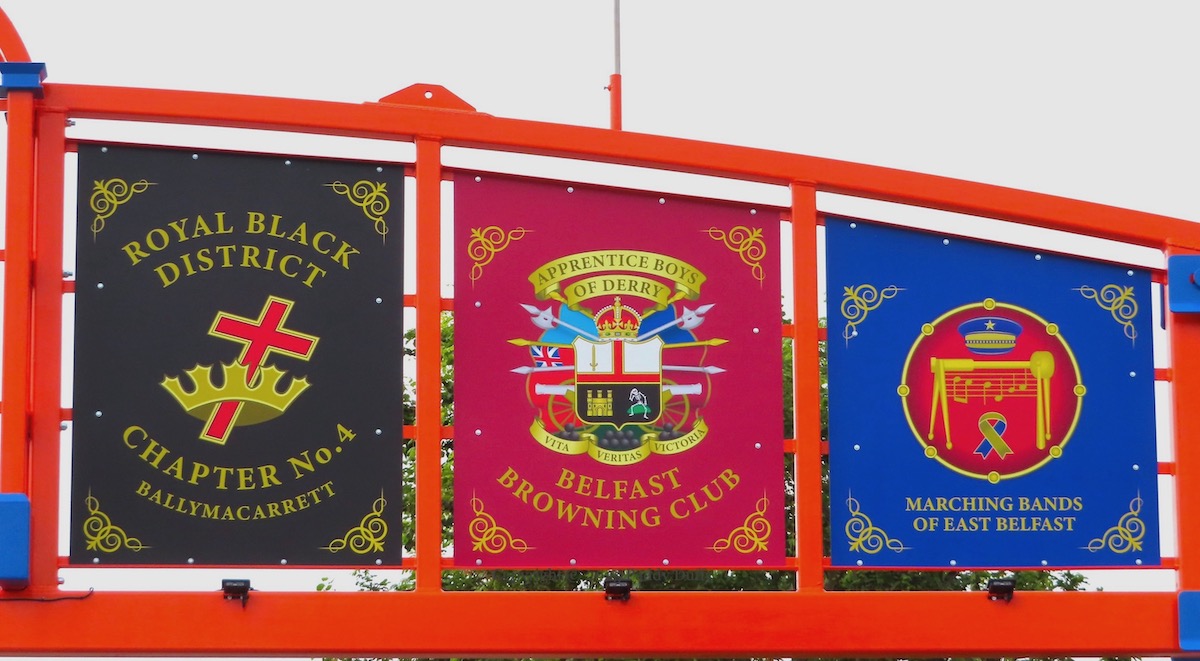
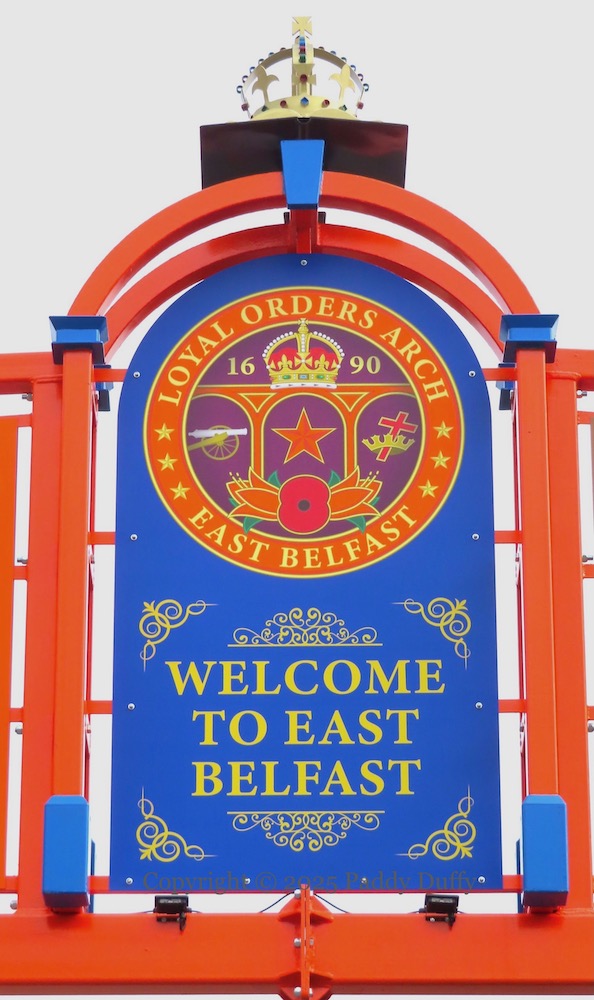
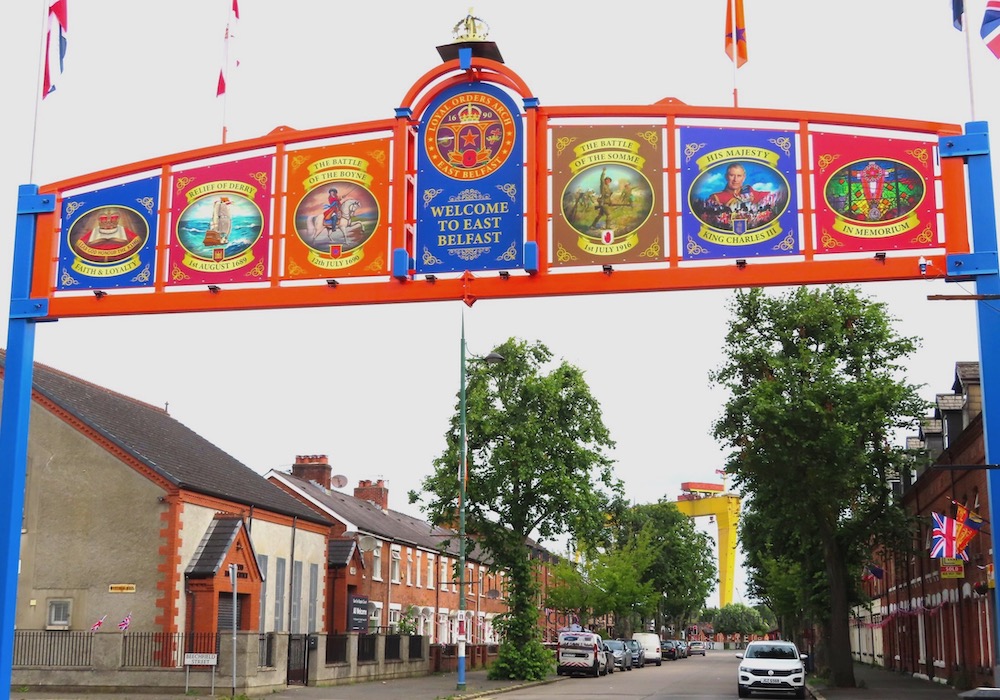
The News Letter reports that the new arch at the junction of Templemore Avenue and Beechfield Street is the first new arch in east Belfast for fifty years (News Letter). There was long ago an arch in Dee Street (Fb).
On the northern side are the emblems of local lodges – Ballymacarrett Junior District LOL No. 3, Royal Arch Purple District Chapter No. 6, Ballymacarrett District No. 2 Women’s LOL, Ballymacarrett District LOL No. 6, Royal Black District Chapter No. 4 Ballymacarrett, Apprentice Boys Of Derry Belfast Browning Club – as well as “Marching Bands of east Belfast”.
On the southern side, we see (l-r) “Faith & Loyalty”, the Relief Of Derry, the Battle Of The Boyne, JP Beadle’s painting of the 36th Division going over the top at the Battle Of The Somme, King Charles III, the stained-glass window in Schomberg House in memoriam (not: “in memorium”) murdered OO members.
The arch was officially dedicated on June 30th. Ballymacarrett Orange Hall is a bit further down Templemore Avenue, on Albertbridge Road.
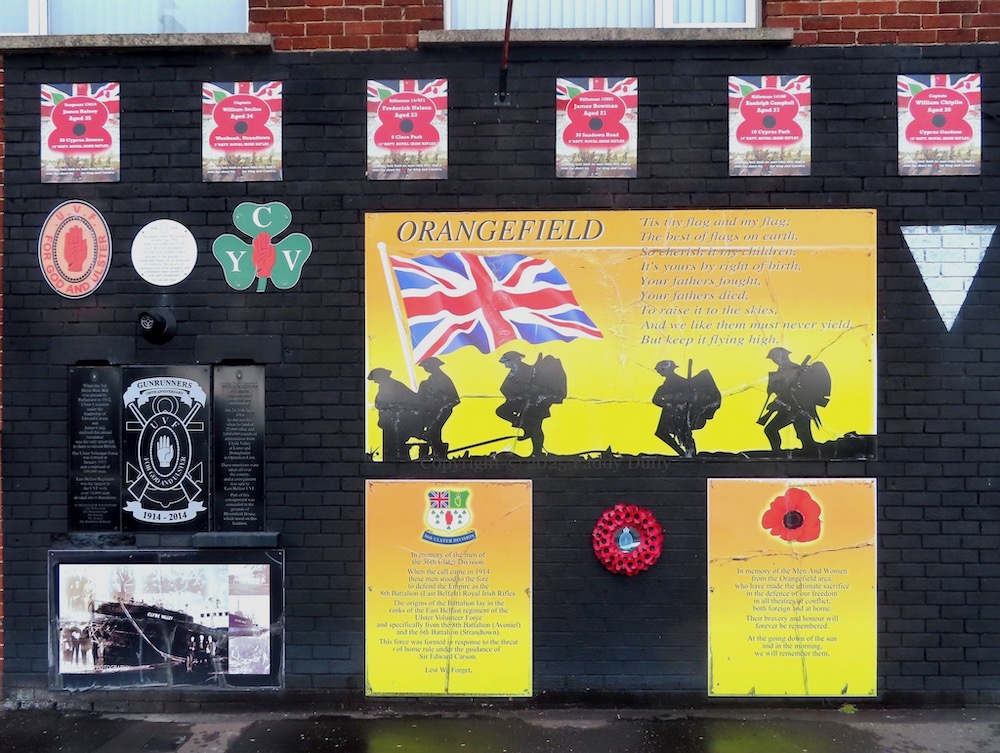
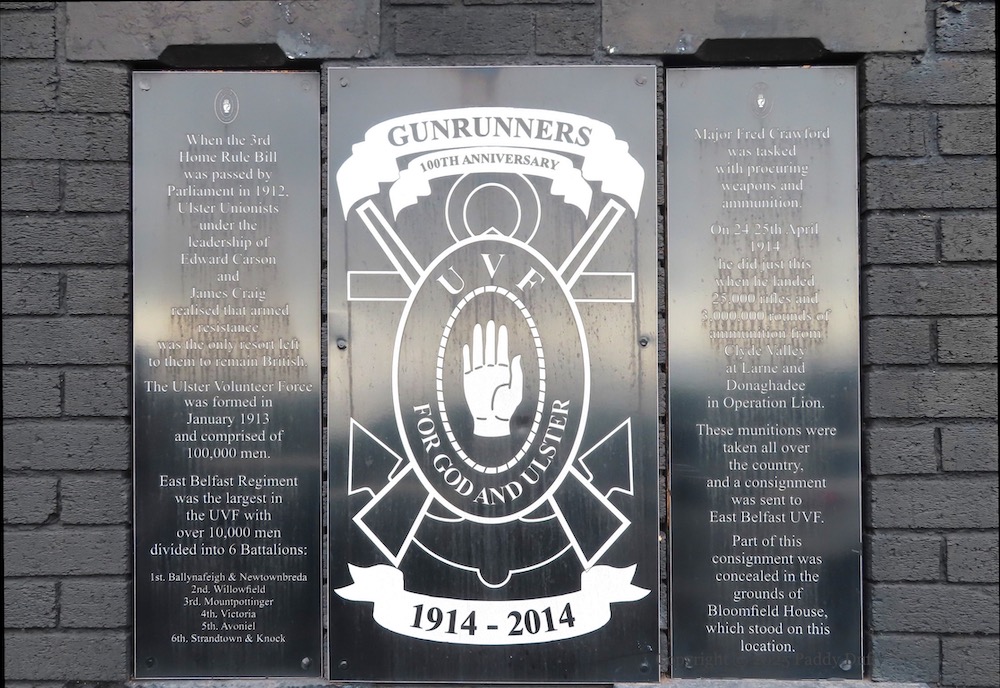
The image above shows a unified and wider view of the two pieces seen previously in Bloomfield House and In All Theatres Of Conflict: on the left, a board marking the centenary of the Ulster Volunteers’ ‘Larne Gun-Running’; on the right, a board commemorating the casualties from the 36th (Ulster) Division in WWI; above them both are small boards from the ‘Poppy Trail’ collection of deceased locals.
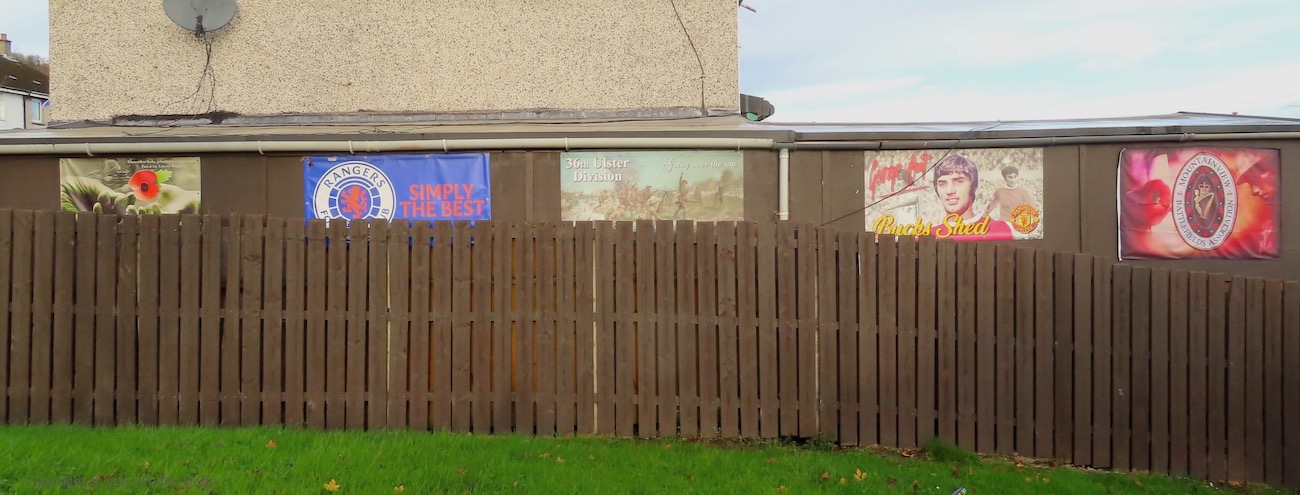
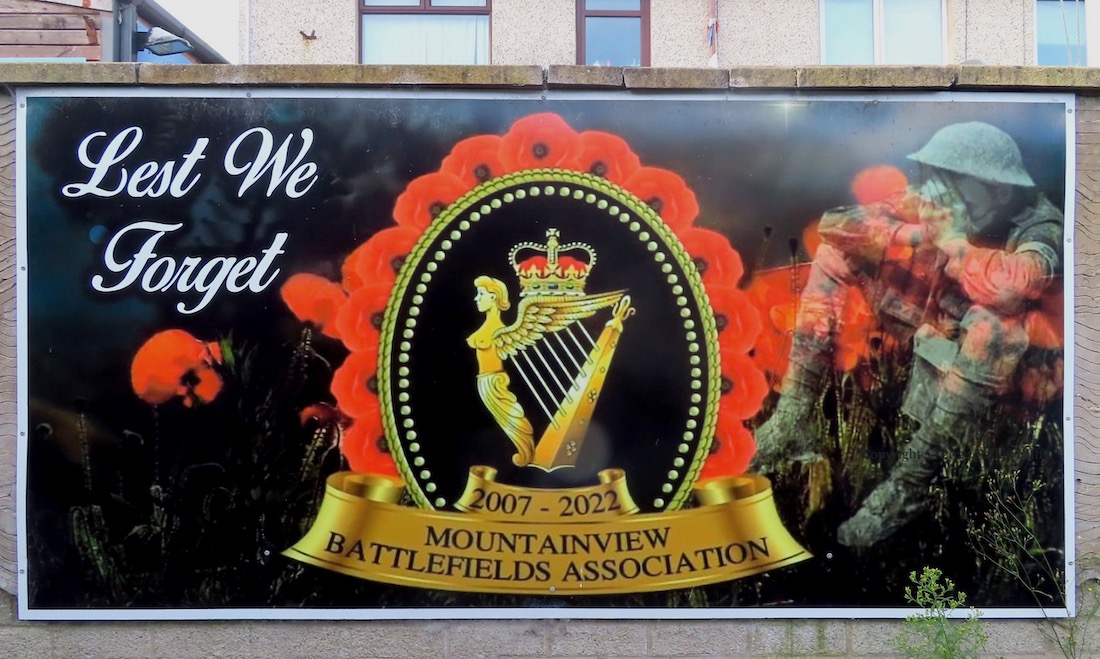
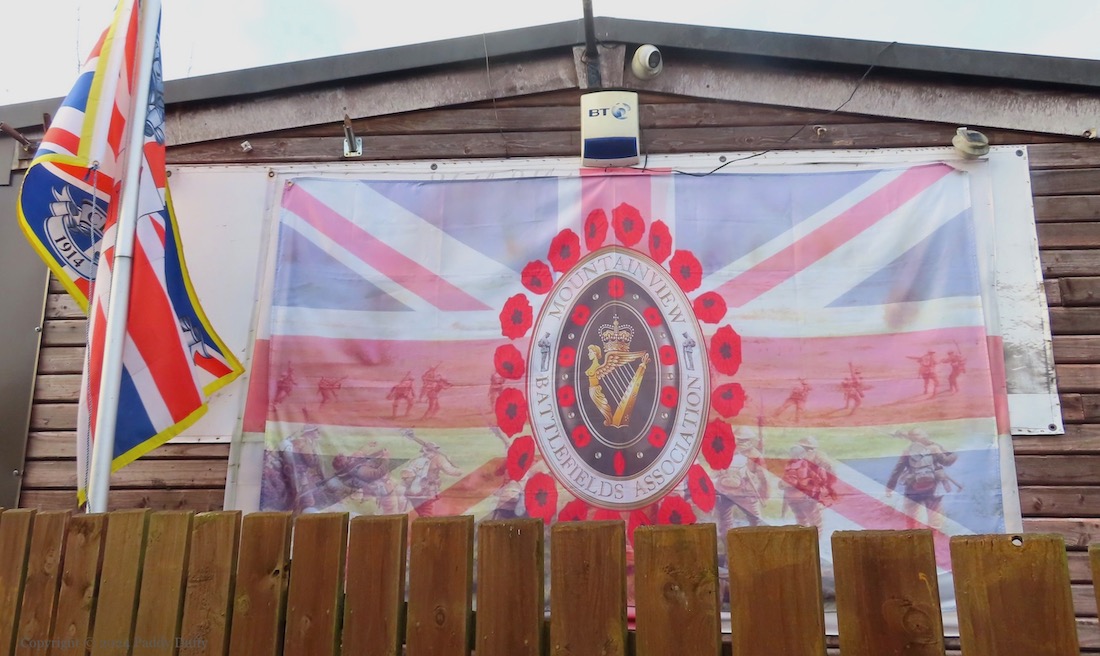
Here is a gallery of images of the boards and flags on the fencing around “Buck’s Shed” in Rathfern, Newtownabbey. The usual themes are represented: the 36th Division and WWI (Mountainview Battlefields Association Fb), the British military, Rangers FC, and George Best.
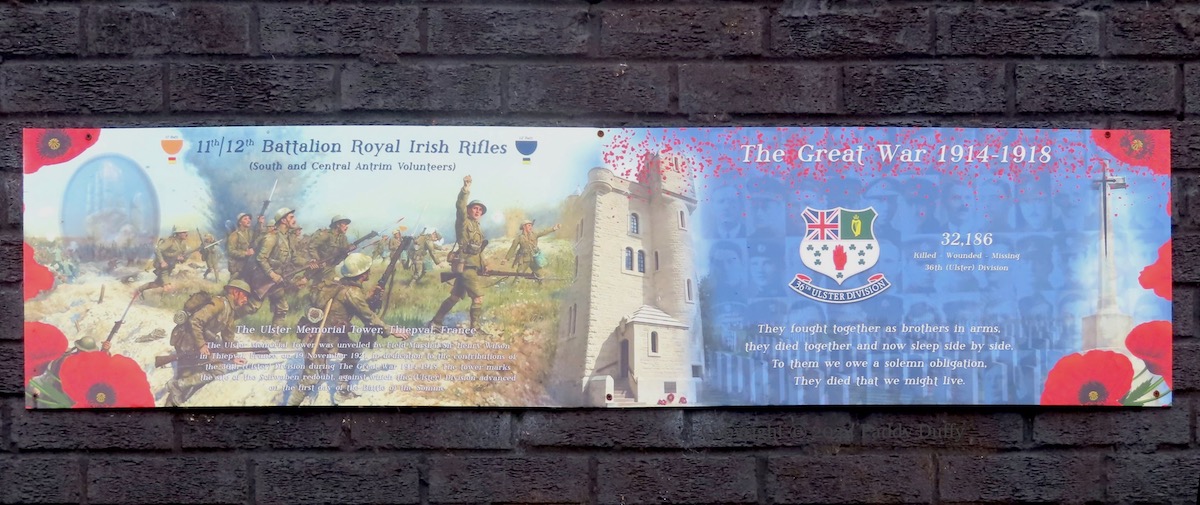
This is a smallish board in New Mossley, Newtownabbey:
On the left: “11th/12th Battalion Royal Irish Rifles (South and Central Antrim Volunteers) – The Ulster Memorial Tower, Thiepval, France. The Ulster Memorial Tower was unveiled by Field Marshall Sir Henry Wilson in Thiepval, France, on 19 November 1921, in dedication to the contributions of the 36th (Ulster) Division during The Great War 1914-1918. The tower marks the site of the Schwaben redoubt, against which the (Ulster) Division advanced on the first day of the Battle of the Somme.”
Specifically, the Central Antrim regiment (of the Ulster Volunteers) became the 12th battalion RIR, while the South Antrim regiment (of the Ulster Volunteers) became the 11th battalion RIR; both joined the 108th brigade in the 36th division.
The redoubt is also the site of the Thiepval Memorial.
JP Beadle’s painting “Battle of the Somme: Attack of the Ulster Division” hangs in Belfast City Hall (Royal Irish has a history of its purchase).
On the right: “The Great War 1914-1918. 32,186 killed, wounded, missing, 36th (Ulster) Division. They fought together as brothers in arms, they died together and now they sleep side by side. To them we owe a solemn obligation. They died that we might live.”
The sword-in-cross is a common war memorial but the one pictured is probably the Tyne Cot memorial to the Commonwealth dead of WWI (see Great War 100 Reads).
See also: The same boards (at larger size) next to the memorial garden – South And Central Antrim Volunteers. And from the historical record, True Heroes – which includes two small, painted, 36th Division boards from the street in 2009.
Compared to the image (from 2021) seen in The Sacrifice Remains The Same, a blue background and a new wall of Poppy Trail plaques (for the Poppy Trail see this 2017 entry on the board) have been added to the Cosy Somme Association’s tribute to British Army soldiers from the 36th (Ulster) Division in WWI and the modern-day Royal Irish Regiment. (See also the image in Alain Miossec’s collection from earlier this year.)
Ogilvie Street, east Belfast, with a bonus image below of the milkman just around the corner, next to Piccola Parma.
These are the boards at the chip shop (formerly a Spar and before that a Mace) in the centre of the Mourneview estate, Lurgan.
Above, and in detail below, are the pieces from the front of the shop, in Pollock Drive. Anti-clockwise from bottom-left:
First: “Believe, we dare not boast,/Believe, we do not fear/We stand to pay the cost,/In all that men hold dear.//What answer from the North?/One Law, one Land, one Throne/If England drive us forth,/We shall not fall alone!” Kipling’s poem Ulster.
Next (tall piece): A company, 1st battalion, Mid Ulster brigade UVF – Lurgan as well as Broxburn (outside Edinburgh) and Thornliebank (near Glasgow).
Next: PAF plus (out of frame in the wide shot) “When injustice becomes law resistance becomes duty.” The same panel was seen in Ballyclare, though for the 1st East Antrim battalion rather than the Mid Ulster brigade.
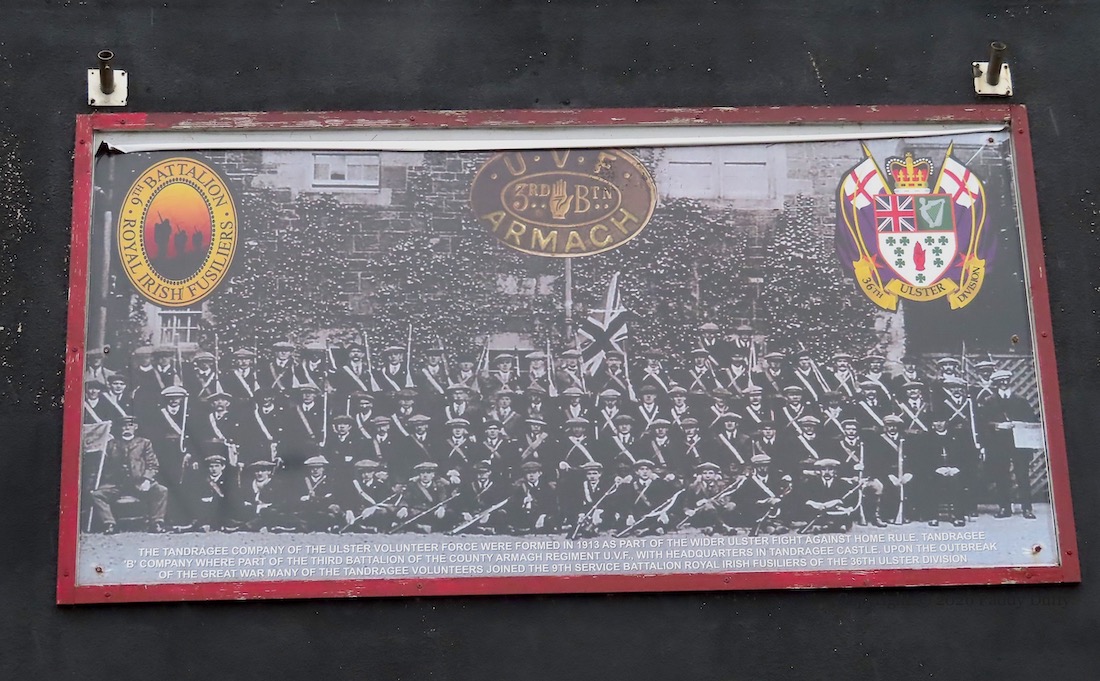
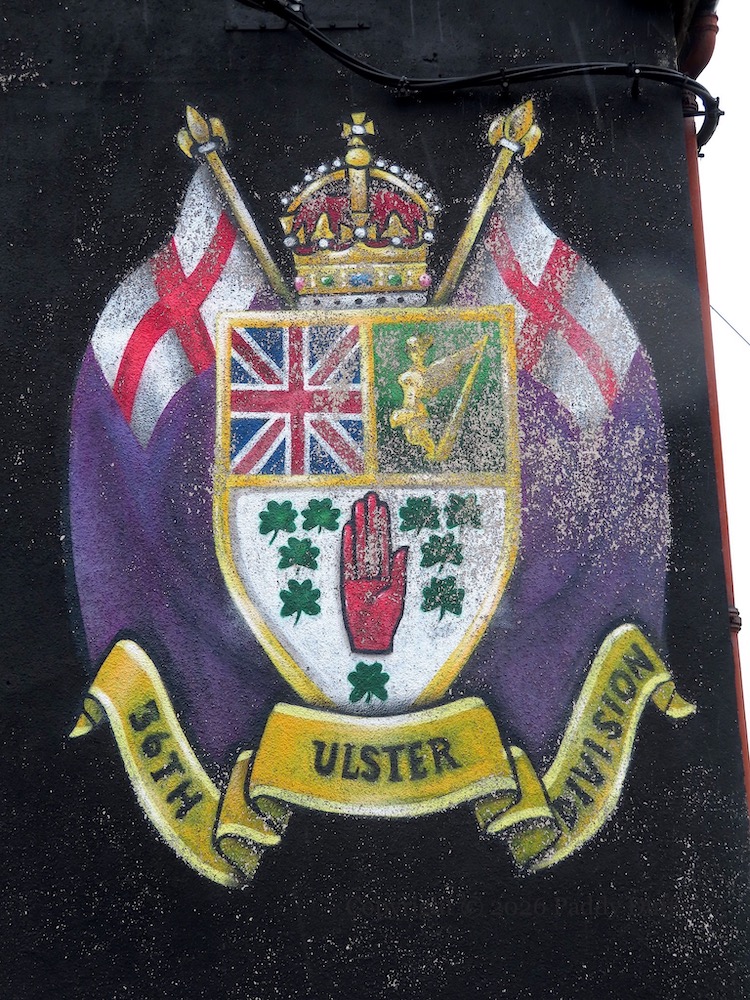
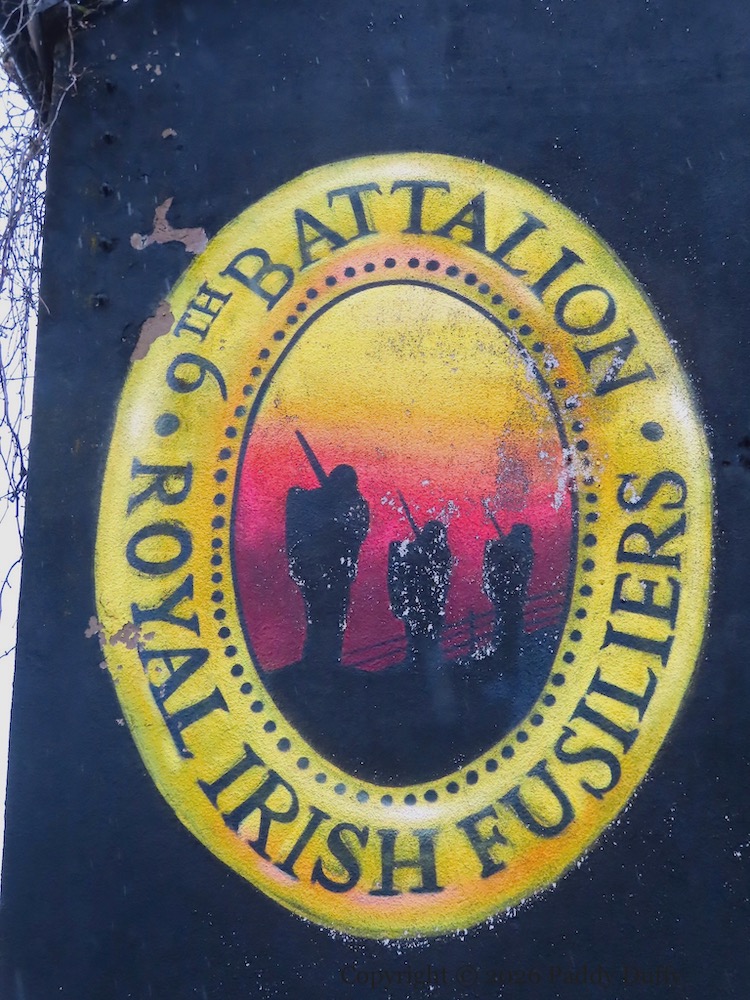
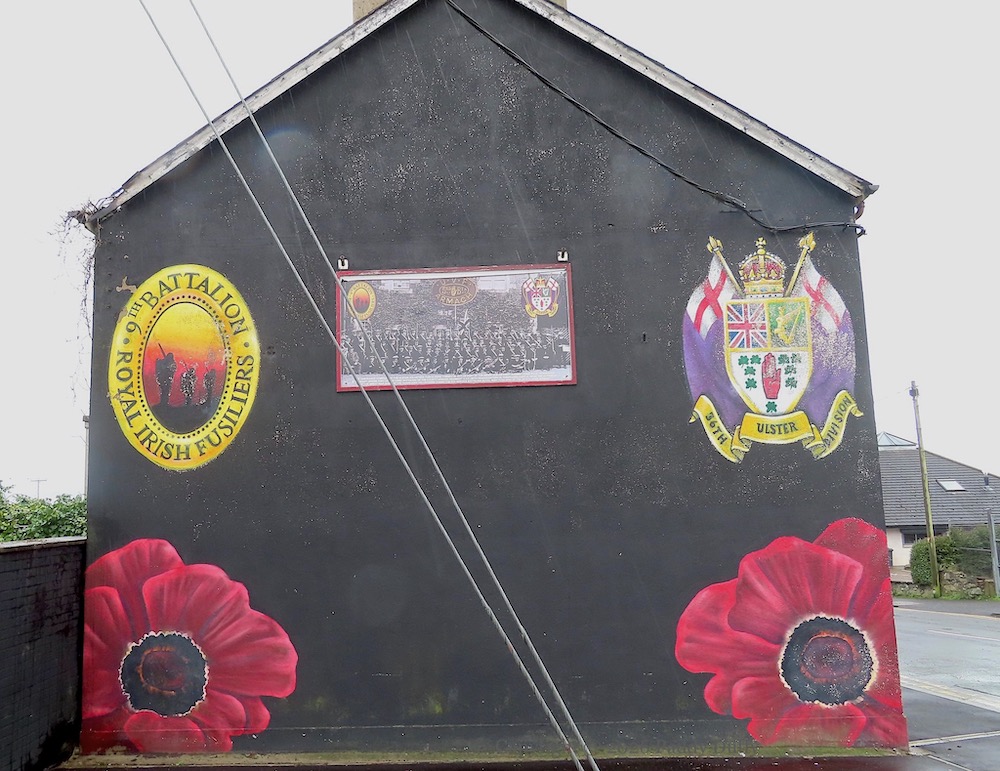
Above: A tribute to the Ulster Volunteers from the area: the 9th battalion Royal Irish Fusiliers joined the 108th brigade in the 36th (Ulster) Division; the 5th battalion joined the 31st brigade and the 10th (Irish) Division. This board goes back to (at least) 2011.
Finally (top left), a UDU/UDA board, to 1 company, D battalion, South Belfast. All of the remaining pieces are UVF/PAF.
Around the corner, in Mourne Road, a gallery of photographs of the Craigavon Protestant Boys (Fb) past and present, with a plaque in memory of Victor Stewart. “Our only crime is loyalty.”
In the adjacent Spelga Park: “Unbowed & unbroken – our only crime is loyalty – Mourneview/Gret estate bonfire” with an unusual combination of shamrock and Orange lily.