The UVF 1st East Antrim Battalion is “Still ready & willing to defend the people of Ulster against all foes” including the British government that – even as Northern Ireland marks its centenary – has “deserted” it over the NI Protocol that involves checks on goods moving between Britain and Ireland (whether north or south) but no (new) checks on goods moving between north and south (gov.uk). The “still” goes all the way back to 1912, when the British government of the day proposed (for a third time) “Home Rule” for Ireland and the Ulster Volunteers were formed – though the original “deserted” postcard and previous murals show the date as 1914.
An estimated 100,000 people congregated at Craigavon House on the 23rd of September, 1911, to hear Edward Carson’s inaugural speech as Unionist leader (McNeill Ch. 4). In his speech he said “Our demand is a simple one. We ask for no privileges, but we are determined that no one shall have privileges over us. We ask for no special rights, but we claim the same rights from the same government as every other part of the United Kingdom. We ask for nothing more; we will take nothing less”. Ten years later, in 1921, Northern Ireland was created and it has survived to reach its centenary, despite (according to this mural) “100 years of fighting a fascist republican enemy sponsored by the Irish state.”
This Monkstown mural commemorates four UDA volunteers: Malcolm Fisher, Colin Weir, Jim McClurg and William Hobbs. Hobbs and McClurg were killed when a bomb went off prematurely (CAIN’s Sutton Index 1977) ; there is no mention of the other two. Please leave a comment or send an e-mail if you have any information.
Sons Of Kai flute band (ig) re-formed in 2006 (youtube | Coin Talk) but here claims as its origin date “1972”. IWM gives the founding year as 1970, and quotes one of the founders, Bo Kerr, saying that the band was named after Danish soccer player Kai Johansen (WP), who played for Rangers from 1965-1970, and that the “tartan” gang (History Ireland) ‘Rathcoole KAI’ subsequently took its named from the band. Then (BelTel) and now (Irish News | Slugger) “KAI” is understood to stand for “Kill All Irish”. A 1982 image of the Rathcoole KAI “red devils” mural can be seen in the Ciaran McGowan collection at IWM.
The board on the left explains the composition of the Union flag as a combination of the saltire of Saint Andrew of Scotland, the cross of Saint George of England, and the saltire of Saint Patrick of Ireland. As the text notes, the saltire is much later than the saint: “The association with Saint Patrick dates from the 1780s, when the Order of Saint Patrick adopted it as an emblem. This was a chivalric order established in 1783 by George III. It is often suggested that it derives from the arms of the powerful FitzGerald dynasty [which dates to the 12th century].”
The text ends oddly: “The saltire has occasionally served unofficially to represent Northern Ireland and [has] been considered less contentious than other flags flown there.” Similar language is used on the symbols.com page for the Saltire.
The central board, shown above, shows a young Patrick (without the clerical garb in which he is often portrayed) against the backdrop of Slemish mountain, where Patrick is thought to have tended sheep as a young slave to a local chieftain, c. 401 AD and developed his Christian faith.
The board on the right shows a ship racing towards shore, superimposed over a 1659 map of Ulster by Blaeu. “The Red Hand Of Ulster: According to legend Ulster had at one time no rightful heir. It was agree that a boat race should take place and that whoever’s hand first touched the shore would become king. One contended, upon seeing that he was losing the race, cut off his hand and threw it ashore to win. O’Neill is said to have been the chieftain who cut his hand off to become the King of Ulster. The Red Hand is a key emblem of Ulster’s identity, an ancient and powerful symbol that is traditionally shown as a blood red hand.”
The colourings of the Saint Patrick profile are by children from the nearby Donegall Road Primary School.
The boards were unveiled on March 10th, 2016 by first minister Arlene Foster who remarked that the saint had become “very Gaelicised” and this — and the presence of Irish tricolours at parades — deterred unionists from celebrating “the patron saint of everybody in Northern Ireland” (Belfast Telegraph; also contains video of the launch). Anglicanism venerates saints but Presbyterianism does not, generally taking the “communion of saints” to refer to all members of the church.
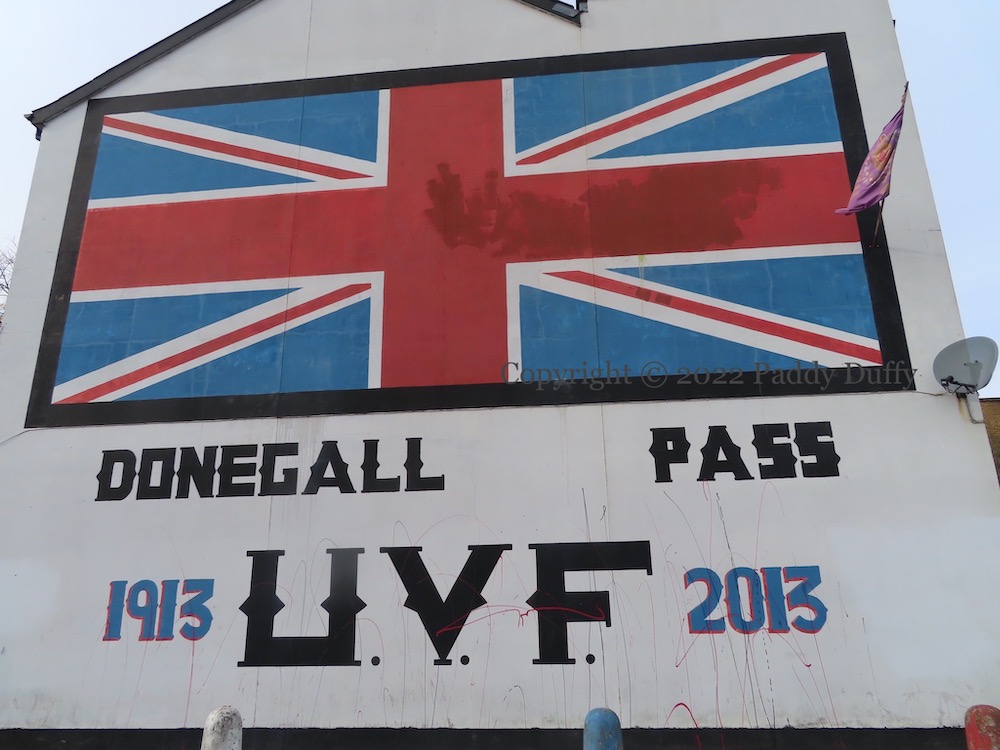
Visible from the Ormeau Road, this large union flag greets visitors to Donegall Pass in the south of the city. It asserts the presence of the UVF and connects the original Ulster Volunteer Force of 1913 to the present-day group one hundred years later: the aim of the original UVF was to resist the impending rule by Catholics under Home Rule.
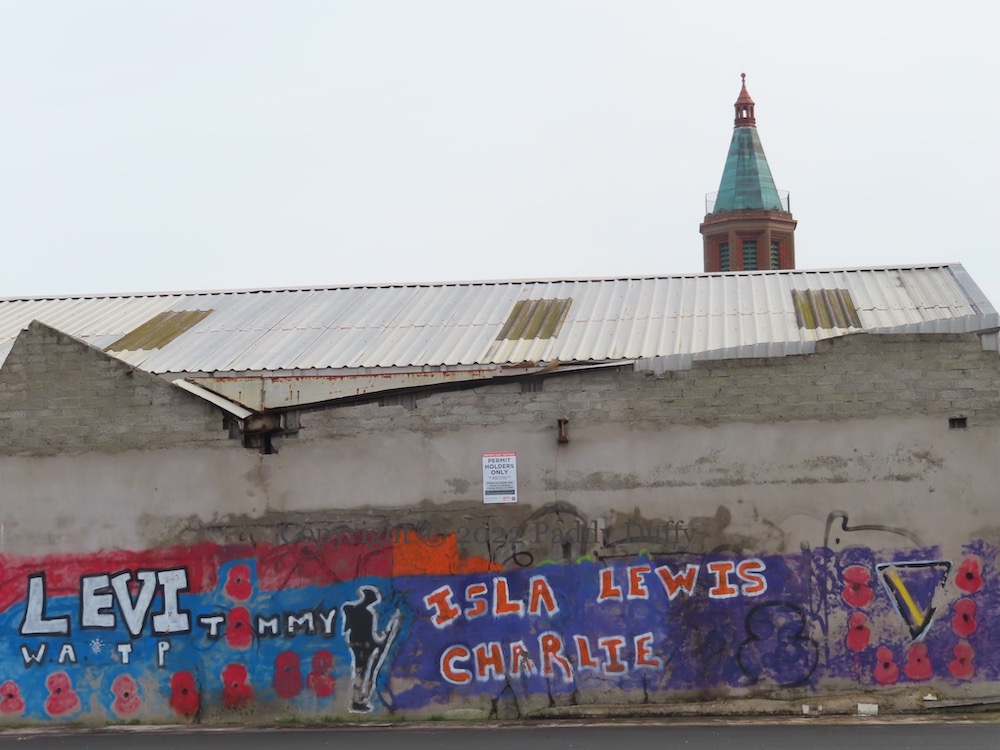
The image below is of the wall opposite, in the car-park; the names are presumably those of local children, with “WATP” [we are the people] and poppies.
South Belfast MP Robert Bradford was assassinated by the Provisional IRA in Finaghy at a meeting with constituents; the caretaker of the community centre, Ken Campbell, was also killed by the fleeing attackers. Taking place in late 1981, with the hunger strikes having ended only a month before, the killing was noted around the world and raised fears of broad civil unrest (BBC | NYTimes). The board above serves as a substitute for an earlier mural to Bradford on the adjacent gable wall.
Young Conquerors Flute Band mural in Pine Street, south Belfast, connecting the band to local soldiers who died in WWI. The two boards to either side show a photograph of the original Donegall Pass Defenders Flute Band, which lasted a short time in the 1970s before the formation of the Conquerors in 1977 (Fb). The second shows the patch of the band.
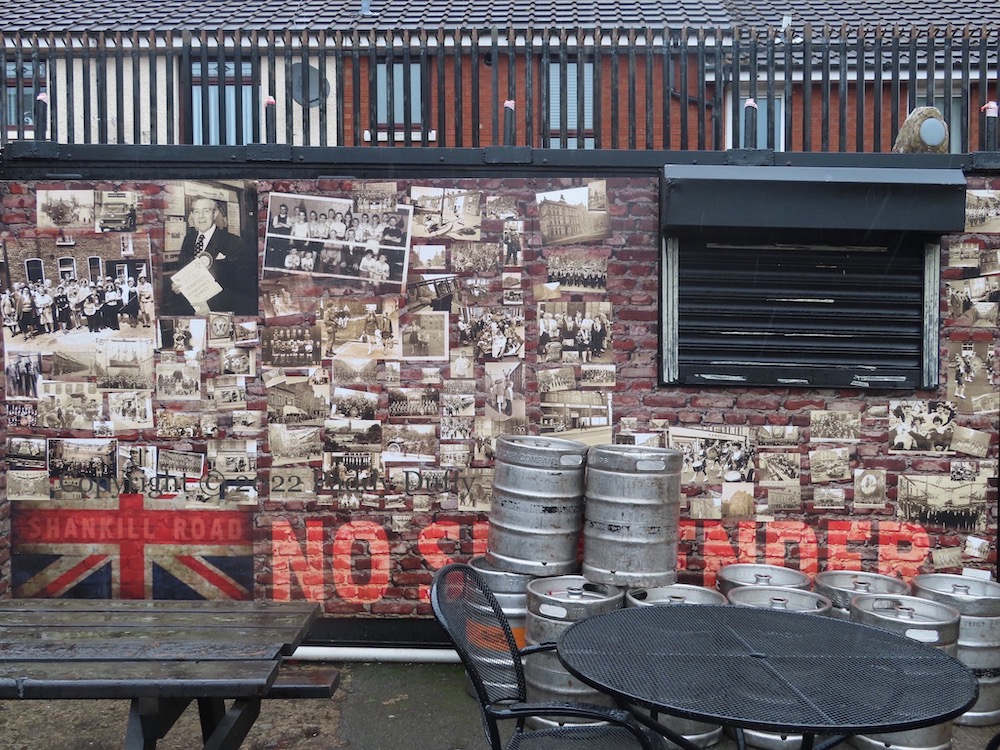
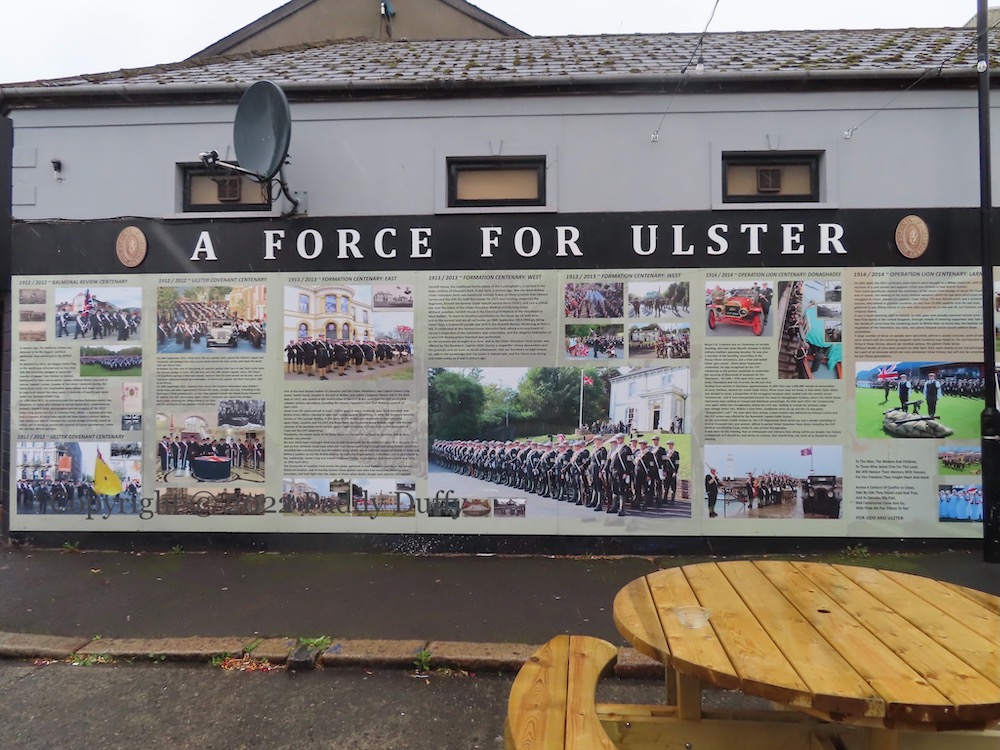
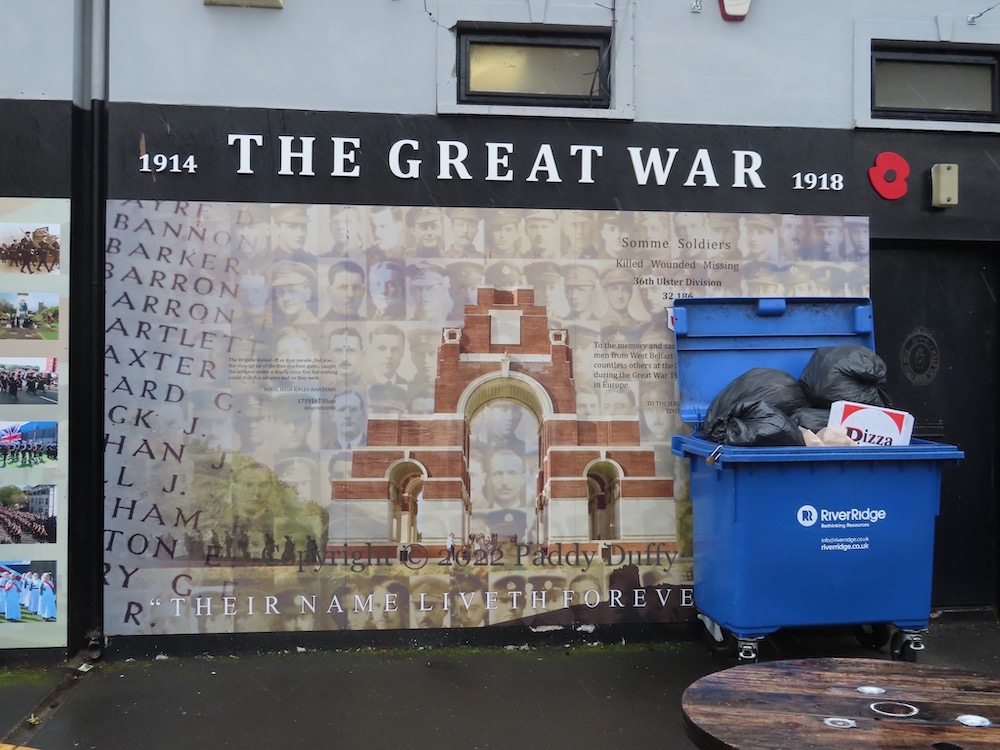
This is the scene at the Rex Bar at (the old) Moscow Street on the Shankill, including, below, three boards describing the formation of the Ulster Volunteers (‘A Force For Ulster’) and using the Thiepval Memorial To The Missing Of The Somme against a background of portraits to commemorate the losses suffered by the 36th (Ulster) Division of the British Army, which the Volunteers became, at the Somme and in other battles, mowed down by “the Hun machine guns” (‘The Great War’). 32,186 men from west Belfast were killed, wounded, or missing. “To them bravery was without limit, to us memory is without end”.
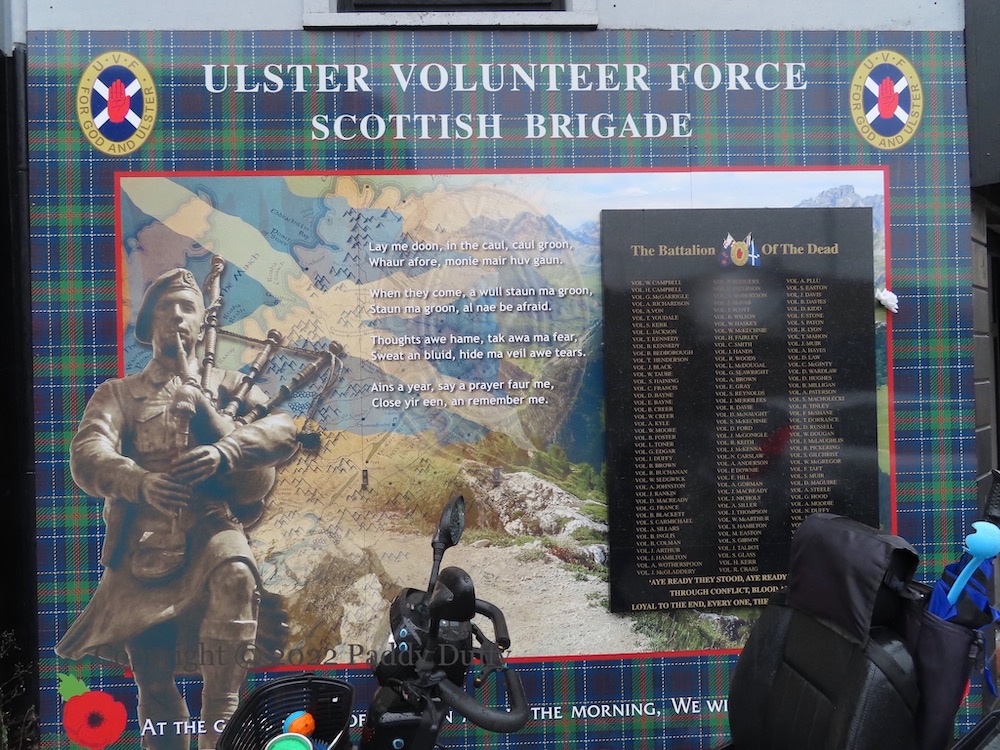
On the Shankill proper (at the newly-christened “Scots Corner”) is a board and plaque to the UVF’s “Scottish Brigade”: “Aye ready they stood, aye ready they fought, through conflict, blood and tears, loyal to the end, every one, the Scottish volunteers.” “Aye ready” was the motto of the 59th Scinde Rifles of the British Indian Army (and later of the Canadian Navy) but is best known from the label of Camp Coffee, in which a Highlander was served a cup of Camp by a Sikh servant (nowadays, they both have a cup of their own).
A Scottish soldier plays the pipes over a list of the “Battalion Of The Dead”, Scottish volunteers from the (modern) UVF. The list is led by William “Big Bill” Campbell, who has had a small plaque in his memory at this spot since (at least) 2014. Preacher and DUP politician George Seawright (see A Crown Of Life) is also included – he was born in Glasgow in 1951.
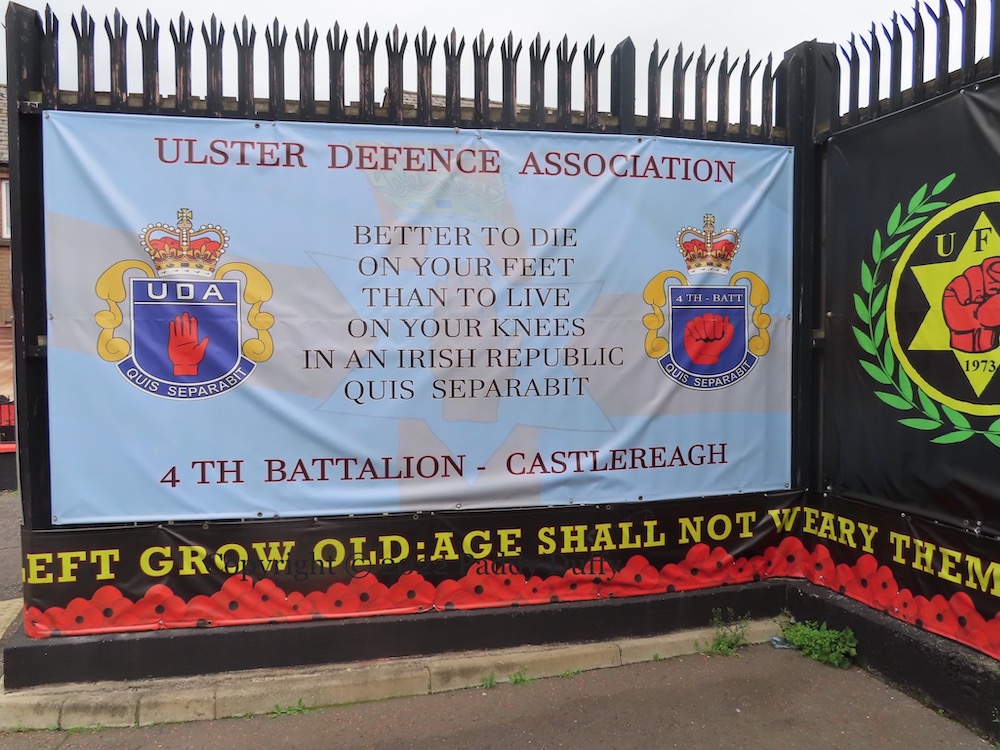
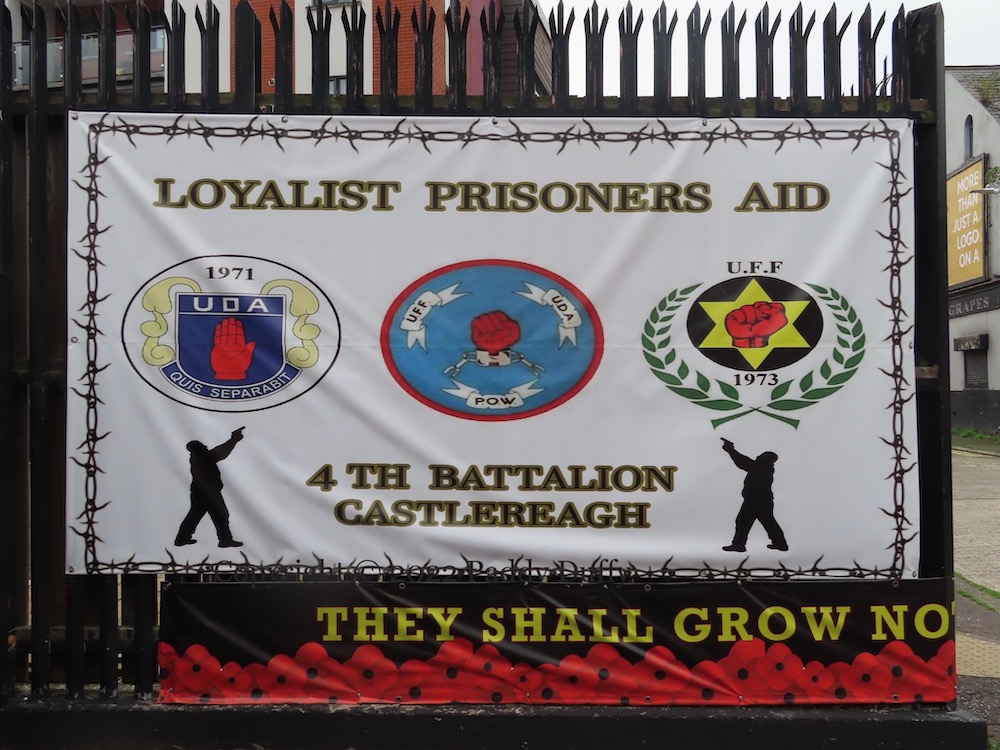
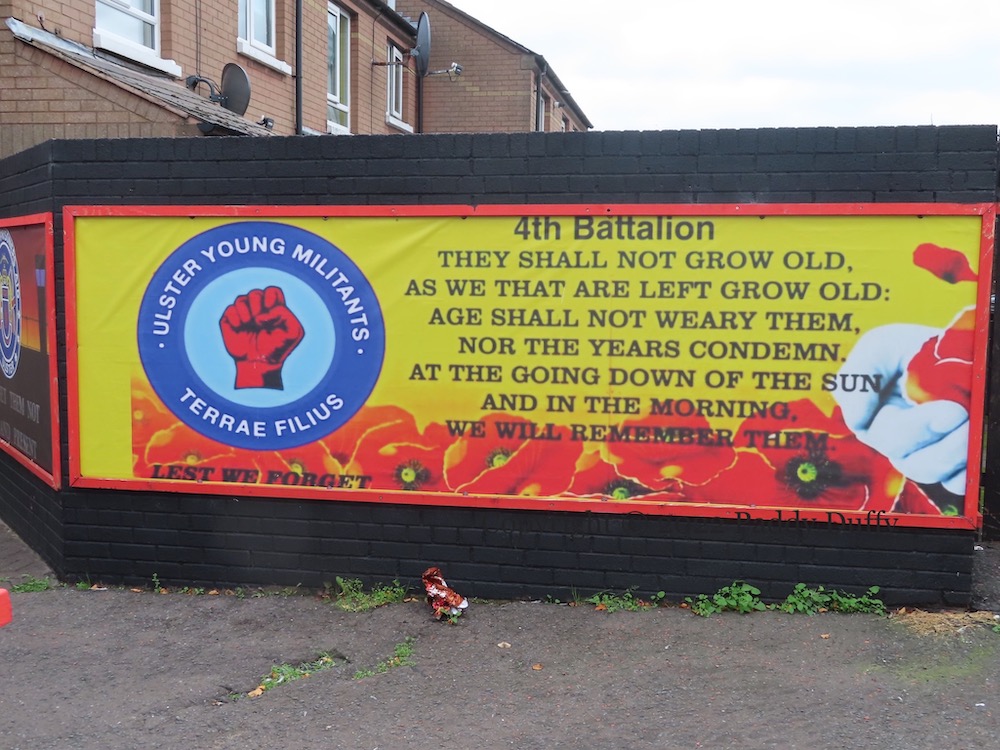
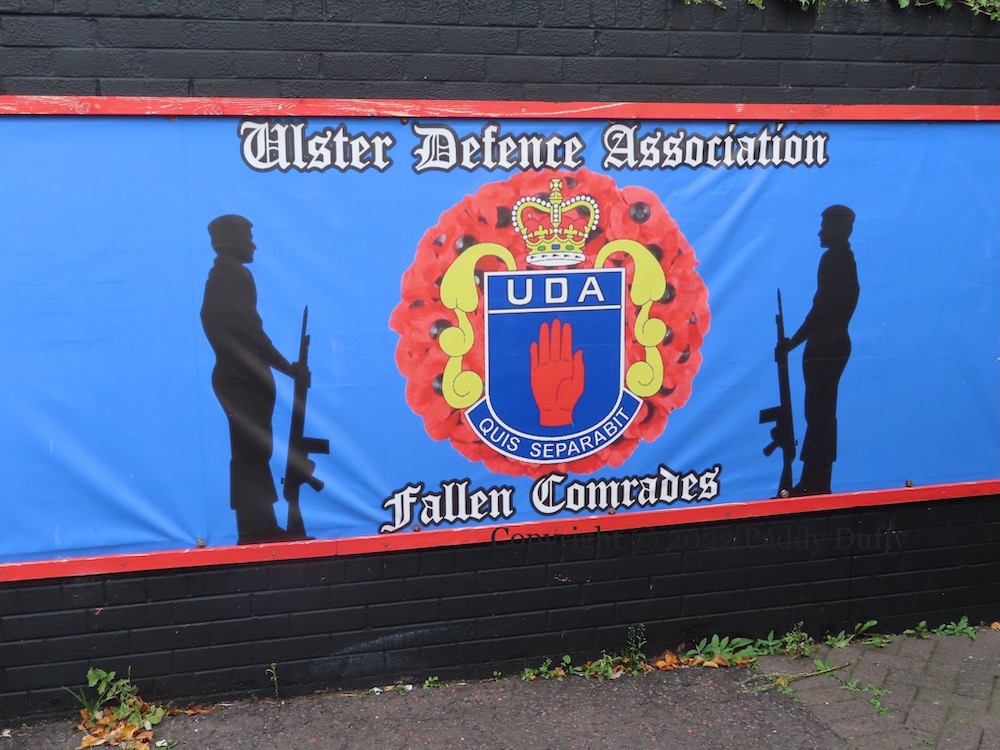
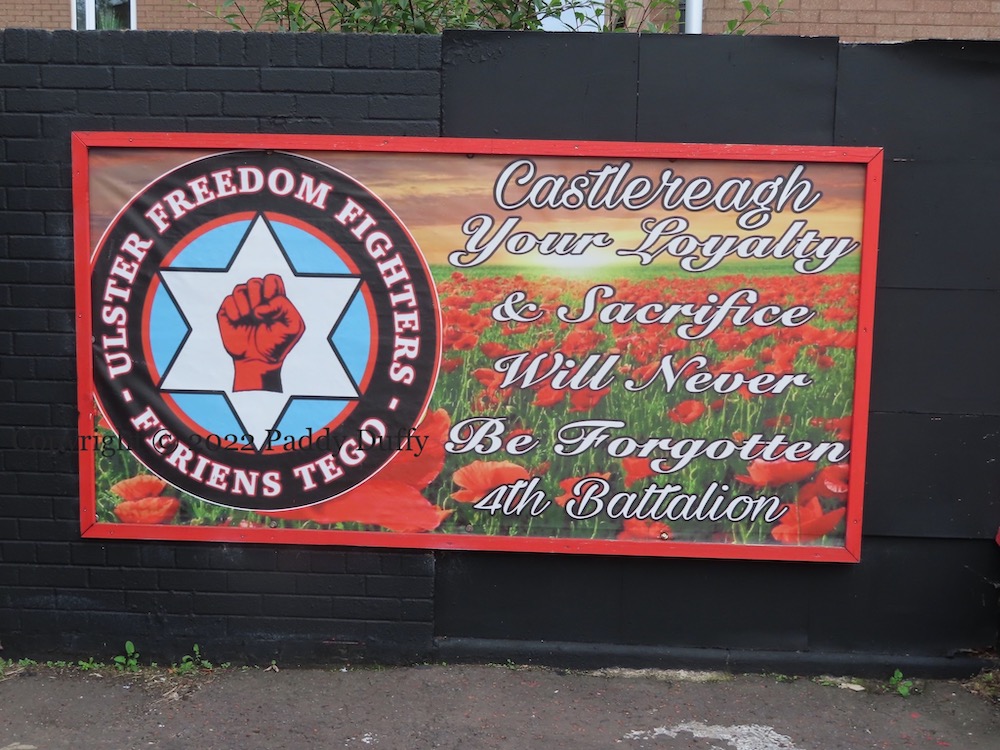
The Castlereagh (4th battalion) UDA memorial garden behind the Bunch Of Grapes has changed over the years from painted murals (M | X) to spray-painted boards (We Forget Them Not) and now again to tarps, some within red frames.
As far as content is concerned, the UFF, LPA (“We forget them not – past and present”) and UYM (“They shall not grow old etc”) remain but Tim Collins – a product of re-imaging – is out (see On That Journey). The side wall of the pub has also been employed for the first time, with more hooded gunmen (see the final image, below). Two small plaques have been added to the outsides of the memorial wall.









 Paddy Duffy Collection