William III is the only member of the (Dutch) House Of Orange to rule the UK, as his marriage to Mary did not produce any offspring, and the crown passed to Mary’s sister Anne after both Mary (1694) and William (1702) had died (WP). Queen Elizabeth II was from the Saxe-Coburg And Gotha ‘house’ (changed during the Great War to “Windsor”) via her great-great-grandfather Prince Albert (of Victoria & Albert) but she symbolises Orangism to Northern Irish Protestants and in the portrait shown here she wears an orange jacket and an orange hat which has a band of orange lilies; the portrait is framed by a Union Flag and two clusters of orange lilies.
The plaque on the right reads “This mural is a tribute to her majesty Queen Elizabeth II. Funded by the loyal people of Portadown. To God be the glory.”
This images in this entry depict, above and below the information board about the park, the World Wars installation inside the park and the banners on the fence along Derrycoole Way.
There is an annual commemoration of the fallen in the World Wars in Rathcoole each year. The monument consisting of mourning soldiers and sandbags) was created in 2020 (Fb group | News Letter) and the bench was perhaps added in 2022. Images from the 2023 ‘row on row’ commemoration can be seen at NI World. The Row On Row group (web) hope to create a permanent memorial on the spot.
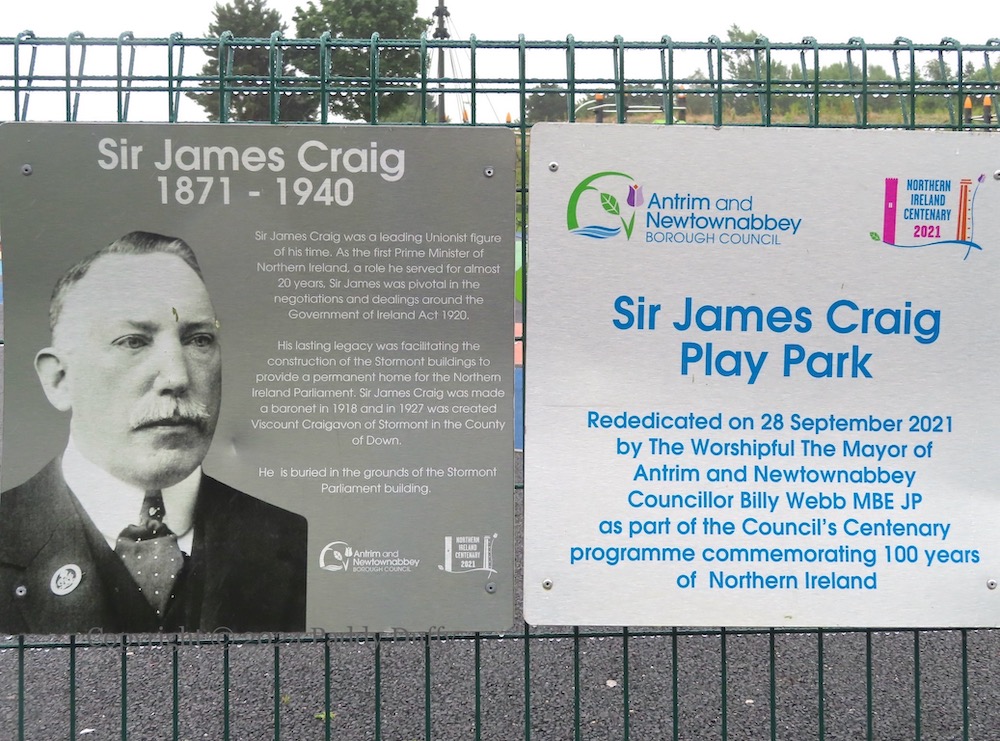
Rathcoole People’s Park was renamed the Sir James Craig Play Park by Antrim & Newtownabbey council in September, 2021, as part of the council’s celebrations of the centenary of Northern Ireland (NI World).
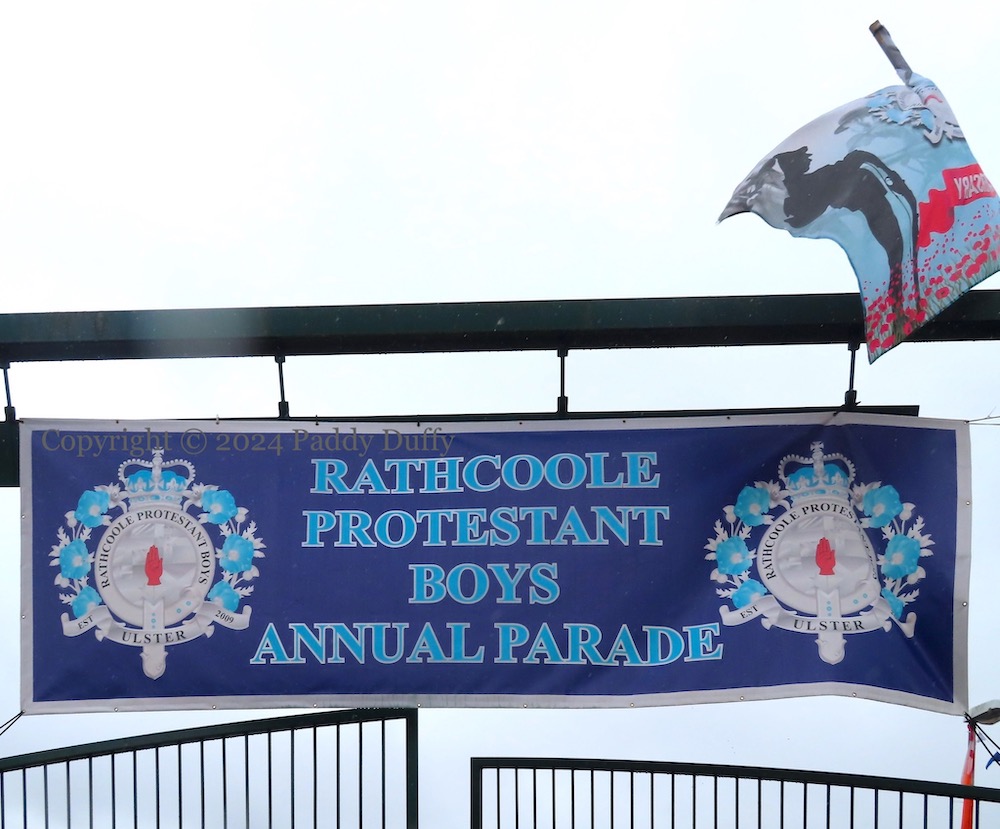
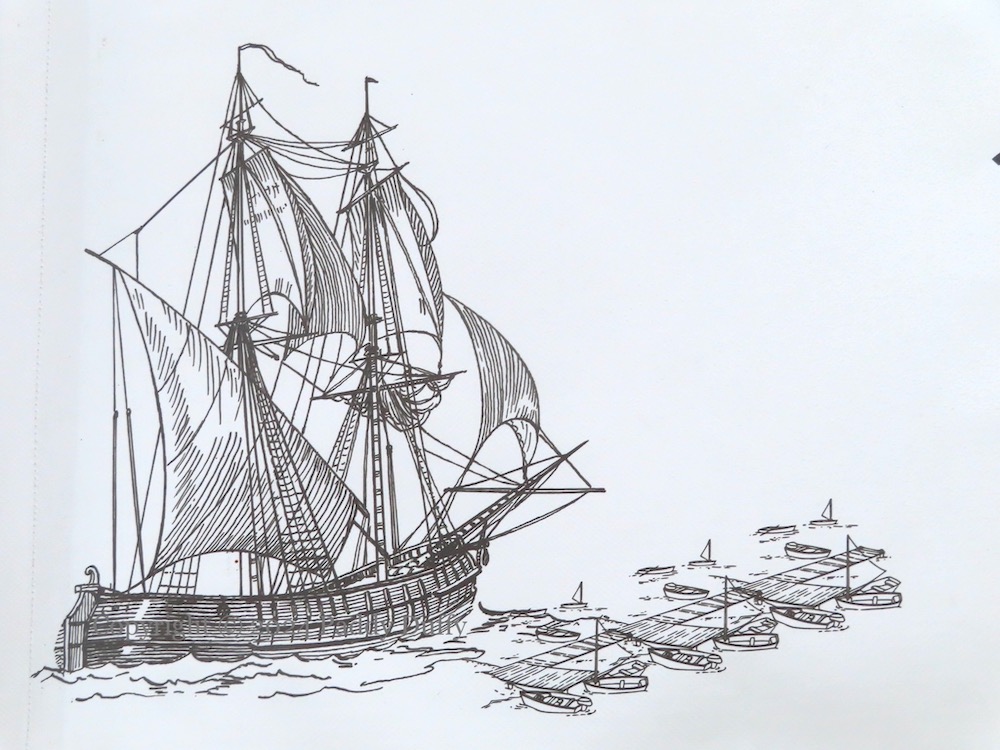
The banners on the side are from the Rathcoole Protestant Boys flute band (Fb) whose annual parade was at the end of June, and the Whitehouse Williamite Historical Society (Fb) whose fun-day on June 15th included a historical re-enactment of William’s army landing at Whitehouse. (For more on William’s connection to Whitehouse, see June 14th, 1690.)
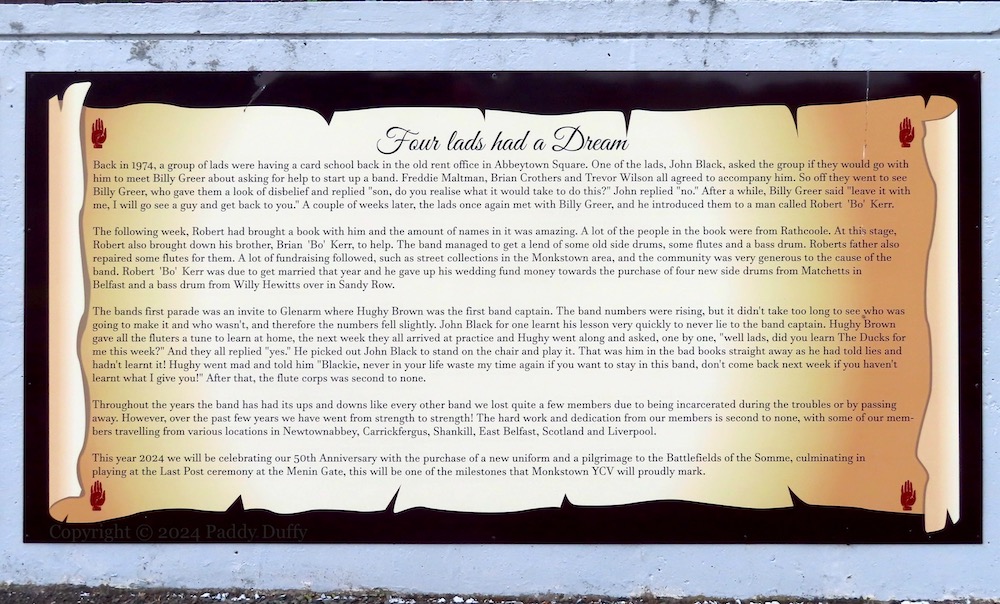
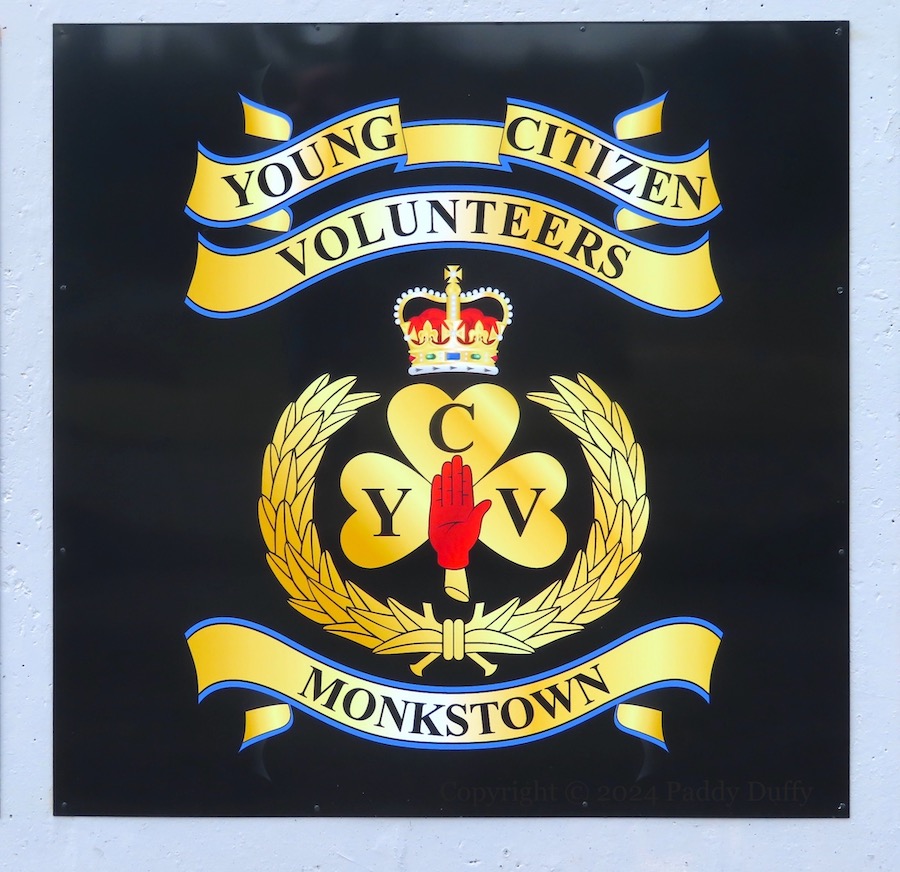
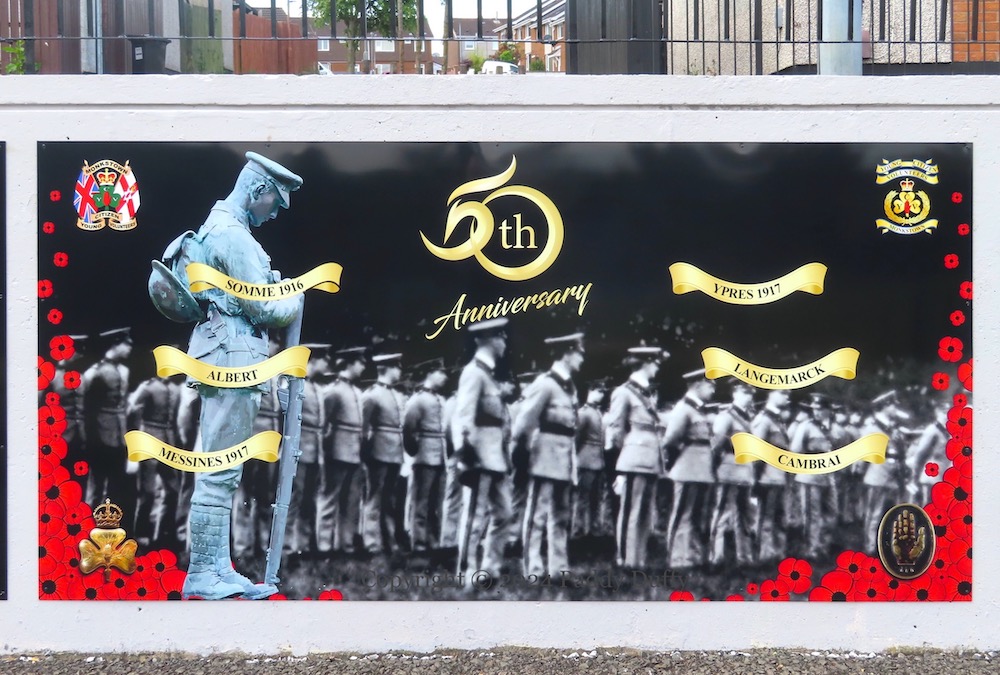
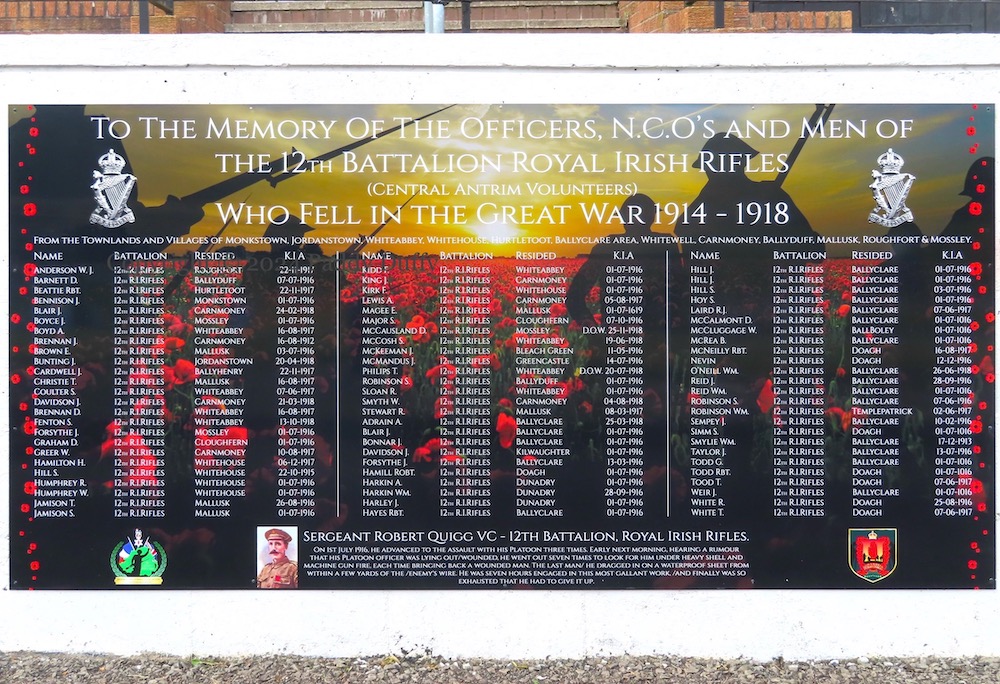
‘Four Lads Had A Dream’ is the name of Rangers song (youtube) but here the dream is not “to start a team” in Glasgow but to start a flute band in Monkstown, Newtownabbey. The result of the efforts of the four men – John Black, Freddie Maltman, Brian Crothers, Trevor Wilson – was Monkstown YCV flute band (Fb), formed in 1974 and so celebrating its fiftieth anniversary this year, 2024. To mark the occasion, the band has installed the series of boards shown here along a low wall in Cloyne Crescent; it will also visit the Somme and play at the Last Post ceremony which takes place at eight every evening at the Menin Gate (web).
The information board is transcribed (verbatim) at the bottom of this entry. A Bo Kerr from Rathcoole is also mentioned in the creation of also mentioned in the creation of the KAI tartans in Rathcoole – see the IWM link in The Famous.
The board showing words from a soldier’s diary, along with an image of soldiers marching, also appeared in the Village, south Belfast – see May I Never Hear Such Cries Again.
“Four lads had a Dream. Back in 1974, a group of lads were having a card school in the old rent office in Abbeytown Square. One of the lads, John Black, asked they group if they would go with him to meet Billy Greer about asking for help to start up a band. Freddie Maltman, Brian Crothers and Trevor Wilson all agreed to accompany him. So off they went to see Billy Greer, who gave them a look of disbelief and replied “son, do you realise what it would take to do this?” John replied “no.” After a while, Billy Greer said “leave it with me, I will go and get back to you.” A couple of weeks later, the lads once again met with Billy Greer, and he introduced them to a man named Robert ‘Bo’ Kerr.
The following week, Robert had brought a book with him and the amount of names in it was amazing. A lot of the people in the book were from Rathcoole. At this stage, Robert also brought down his brother, Brian ‘Bo’ Kerr, to help. The band managed to get a lend of some old side drums, some flutes and a bass drum. Roberts father also repaired some flutes for them. A lot of fundraising followed, such as street collections in the Monkstown area, and the community was very generous to the cause of the band. Robert ‘Bo’ Kerr was due to get married that year and he gave up his wedding fund money towards the purchase of four new side drums from Matchetts in Belfast and a bass drum from Willy Hewitts over in Sandy Row.
The bands first parade was an invite to Glenarm where Hughy Brown was the first band captain. The band numbers were rising, but it didn’t take too long to see who was going to make it and who wasn’t, and therefore the numbers fell slightly. John Black for one learnt his lessons very quickly to never lie to the band captain. Hughy Brown gave all the fluters a tune to learn at home, the next week they all arrived at practice and Hughy went along and asked, one by one, “well lads, did you learn The Ducks for me this week?” And they all replied “yes.” He picked out John Black to stand on the chair and play it. That was him in the bad books straight away as he had told lies and hadn’t learnt it! Hughy went mad and told him “Blackie, never in your life waste my time again if you want to stay in this band, don’t come back next week if you haven’t learnt what I give you!” After that, the flute corps was second to none.
Throughout the years the band has had its ups and downs like every other band we lost quite a few members due to being incarcerated during the troubles or by passing away. However, over the past few years we have went from strength to strength! The hard work and dedication from our members is second to none, with some of our members travelling from various locations in Newtownabbey, Carrickfergus, Shankill, East Belfast, Scotland and Liverpool.
This year 2024 we will be celebrating our 50th Anniversary with the purchase of a new uniform and a pilgrimage to the Battlefields of the Somme, culminating in playing at the Last Post ceremony at the Menin Gate, this will be one of the milestones that Monkstown will proudly mark.”
“The Battle Of Messines June 1917. Men from the Royal Inniskilling Fusiliers and Royal Irish Rifles celebrating their victory at Wytschaete.”
“We surge forward. Bayonets sparkle and glint. Cries and curses rent the air. Chums fall, some without a word … and others … Oh, my God! May I never hear such cries again! There goes the YCV flag tied to the muzzle of a rifle. That man had nerve! Through the road just ahead of us we had crossed the sunken road. We could see khaki figures rushing the German front line. The Inniskillings had got at them.”
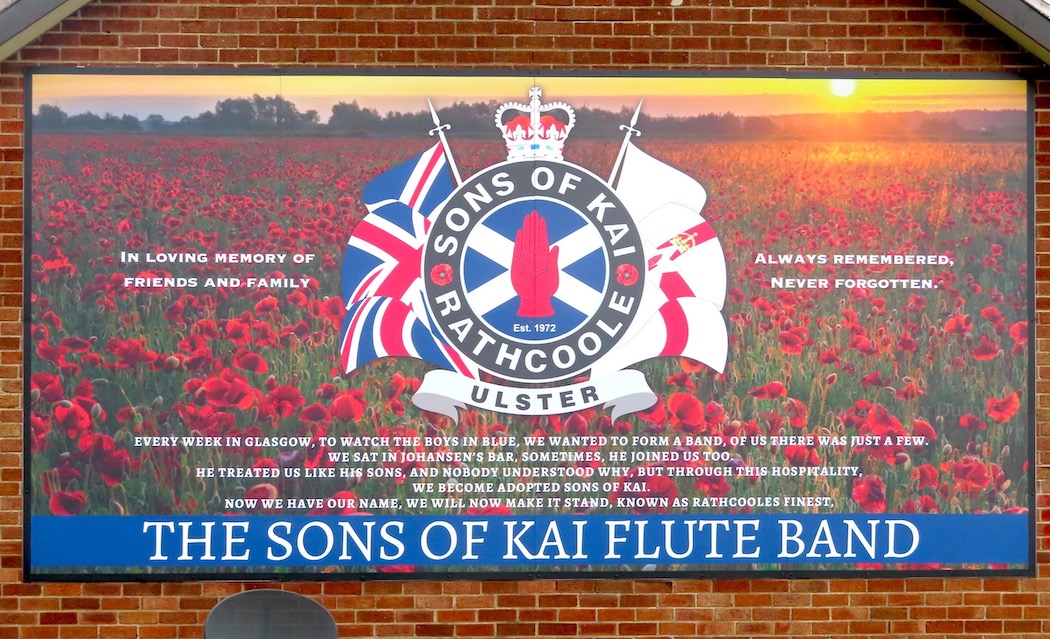
Kai Johansen was a Danish international who played for Rangers from 1965-1970, most famously scoring the only goal in the 1966 Scottish Cup final against Celtic (WP). He retired in 1970 and went on to manage two teams in South Africa, as well as owning businesses, including pubs and tanning salons, in Denmark and Scotland (Herald). The pub mentioned in the board above is perhaps “Kai Johansen’s Bar” at 564 Govan Road, Glasgow (images at Follow Follow).
“Every week in Glasgow, to watch the boys in blue/We wanted to form a band, of us there was just a few./We sat in Johansen’s bar, sometimes, he joined us too./He treated us like his sons, and nobody understood why/But through this hospitality, we become adopted sons of Kai./Now we have our name, we will now make it stand./Known as Rathecoole’s finest, the Sons Of Kai flute band.”
Unlike the book of Lamentations (see Our Homes Have Been Given To Foreigners), the book of Jeremiah contains a promise that the peoples of Judah and Israel will return from Babylonian captivity and that the palaces of Judah will be rebuilt. In the New Living Translation, Jeremiah 33 v6 is rendered as, “Nevertheless, the time will come when I will heal Jerusalem’s wounds and give it prosperity and true peace.”
In addition to the Ulster Banner and Israeli flag (in the shape of hearts) we also see the emblem of the Israeli Defence Forces (IDF) – צבא ההגנה לישראל/Tzva Hahaganah leYisrael – and below that אי כניעה or “no surrender” in Hebrew.
“We are at war and we will win” was Benjamin Netanyahu’s response to the Hamas attack of October 7th (Times Of Israel)
“It is not for riches, fame or glory that we remain in the shadows of our community , but for its protection.”
These words are echoed on the central stone in the garden of reflection, with adjacent North Down UDA roll of honour: “‘Who shall separate us?’ Right up to the present day, these words have been the inspiration and motivation of numerous men and women to serve, fight and die for the defence of their homeland, its people and its heritage. This selfless action is not for riches, fame or glory, but is freely given out of a love of freedom, commitment to the faith and culture of our nation, and a desire that all future generation in all communities can live in peace.”
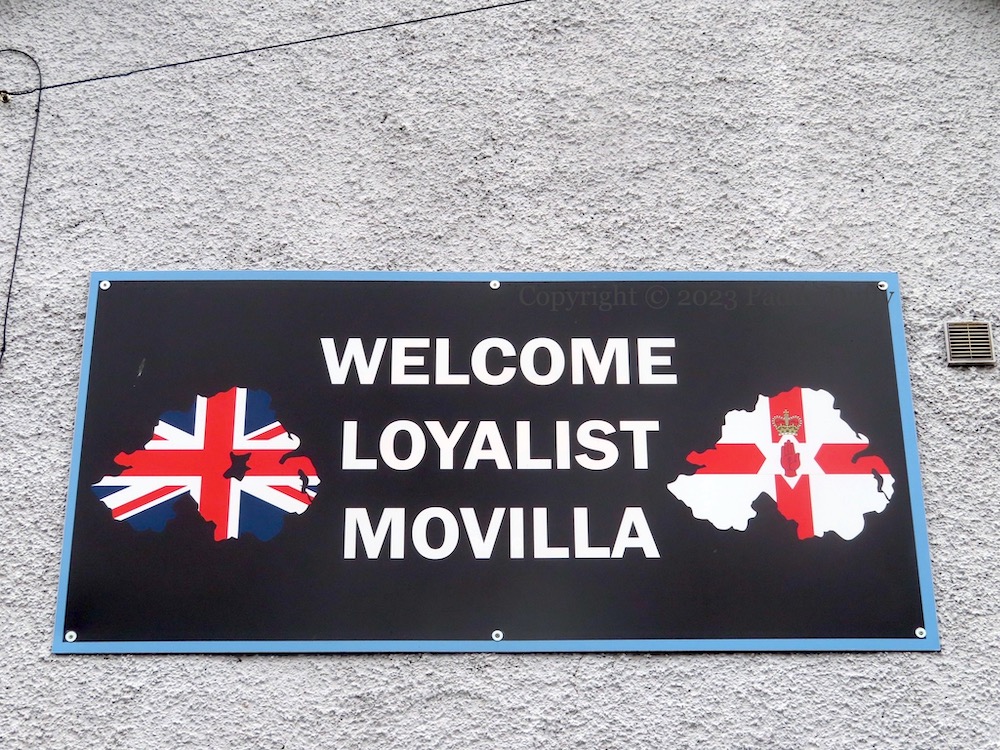
Movilla Street and Wallace’s Street, off Upper Movilla Street. “Loyalist Movilla” in Newtownards.
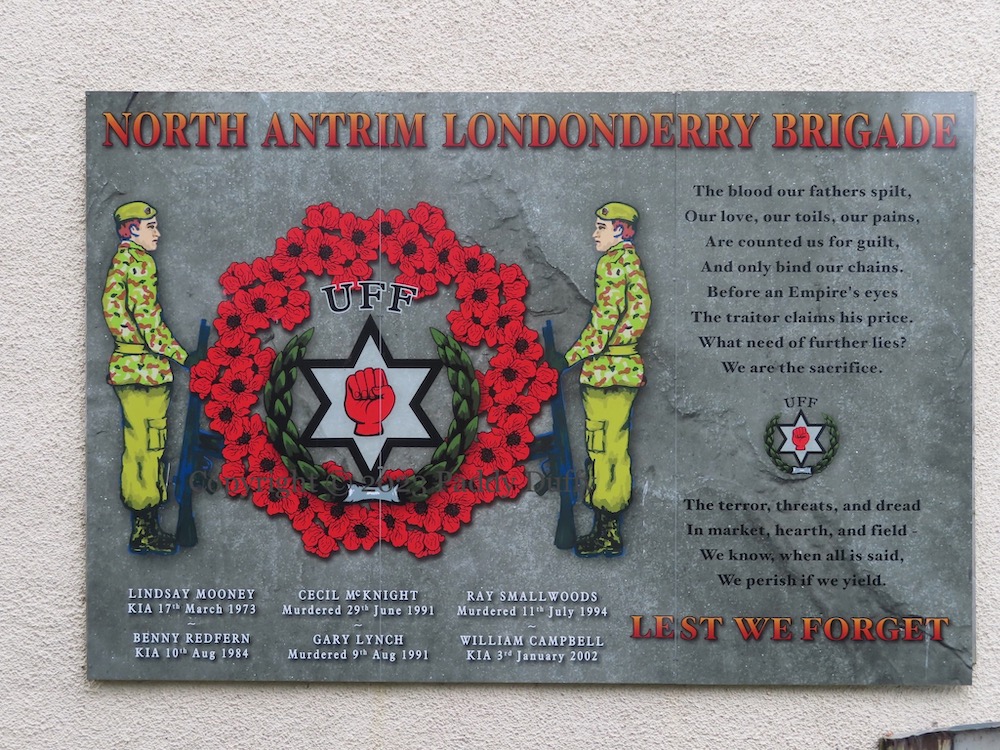
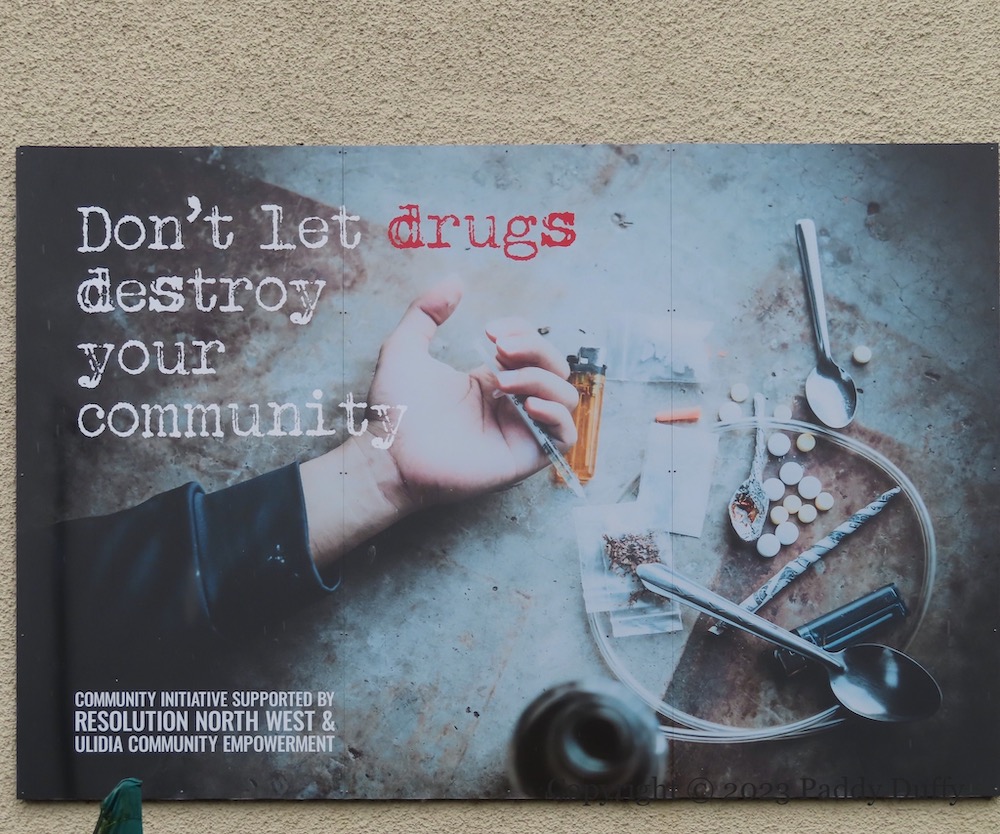
Here is a survey of the UDA boards in Carnany estate, Ballymoney. Many of these have been seen before (in Ulster’s Past Defenders, Ulster’s Present Defenders, The Terror, Threats, And Dread, and Ballymoney UDA). The anti-drugs board in the final image is new (see previously the one in Londonderry: Peace Impact Programme) and the one shown above and immediately below is an updated version of the board shown in Past, Present, For All Time. The dates given in the earlier version were 1972 and 2016; in this one, for “50 years of service”, they are 1971 and 2021. 1971 is the typical date given for the formation (in Belfast) of the the UDA; the 1972 date might have been a specific reference to the North Antrim And Londonderry brigade or the beginning of the Londonderry UDA’s actions, with bomb attacks on a factory and a pub in Donegal in October and November, 1972 (WP).
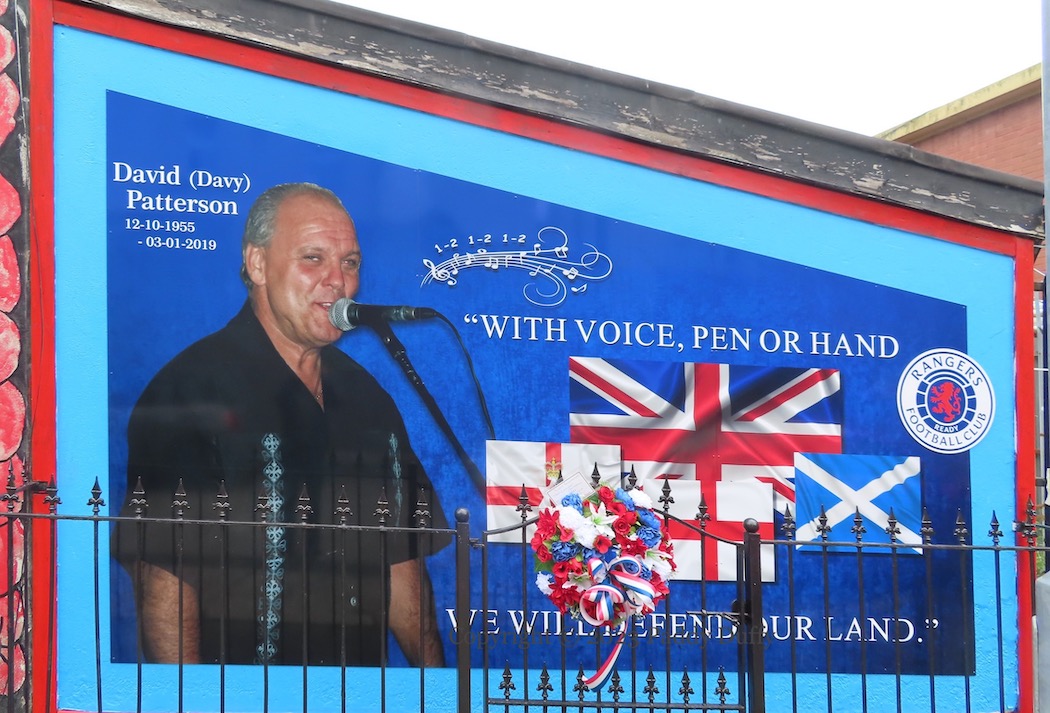
“With voice, pen or hand we will defend our land.” David (Davy) Patterson (12-10-1955 – 03-01-2019) was a member of the 1st East Belfast Rangers Supporters Club (Fb) and Albertbridge Glentoran Supporters Club (Funeral Times). This memorial board is the side-wall to the Somme Society mural (see Their Name Liveth Forevermore) and the Red Hand Commando memorial garden in Hunt Street, east Belfast.
“Always remembered by the officers and volunteers of South Londonderry/Randalstown Ulster Volunteer Force.” This memorial mural and plaque in Magherafelt names Charlie Wright, Jonathan Wallace, Ken Wilkinson, and Ian McArthur.
Of these, Wilkinson seems the most well-known, as he served as a PUP representative for the area. He commented on sectarian tensions in Randalstown in 1999 (An Phoblacht) and in Coleraine in 2009 (Irish Examiner), and spoke against sueprgrass trials in 2011 as a member of FAST (Irish Times | see previously FAST and FASTing For Human Rights And Justice); he was accused of intimidation of Catholics in Antrim in 2003 (An Phoblacht). He stood for a number of elected positions (e.g. 2013) but was unsuccessful.
Ostensibly for his stand against drug-sellers, in 2010 a pipe-bomb (BBC), and in 2011 a make-shift car-bomb (BelTel), were placed against his home and he received death threats in 2013 (politics.ie). He died in 2021 (BelTel | News Letter | Irish News).
The plaque in the memorial garden (shown below) reads, “This plaque is dedicated in memory of all of the loyalist people of Ulster who have suffered at the hands of the enemies of our land. Lest we forget.”
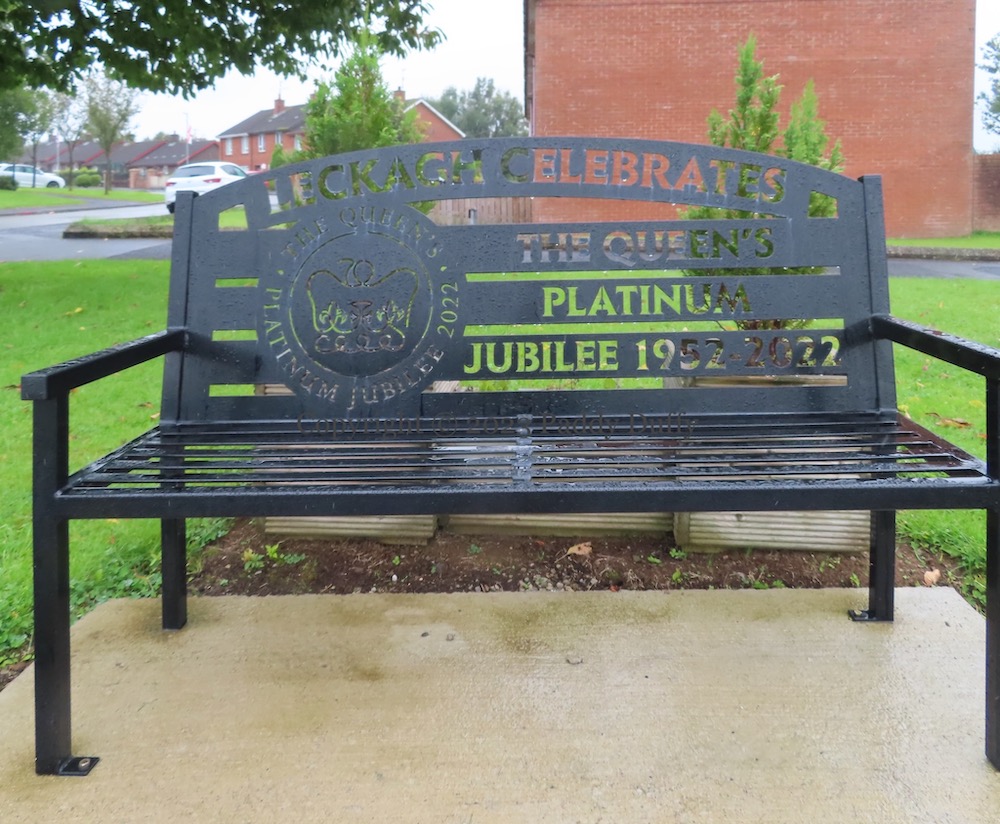
This UDA board on the eastern side of the Leckagh estate names six men who “gave everything in defence of our civil and religious liberties”: Lindsay Mooney (remembered also in the Fountain and Lincoln Court areas of Londonderry), Benny Redfern (this board replaces a board dedicated to Redfern alone), Cecil McKnight (Waterside), Gary Lynch (Waterside), Ray Smallwoods (Lisburn), William Campbell (Coleraine).
“North Antrim – Londonderry – Tyrone brigade”, “Remembered by all South Londonderry & Tyrone 6th batt.”
















 Paddy Duffy Collection