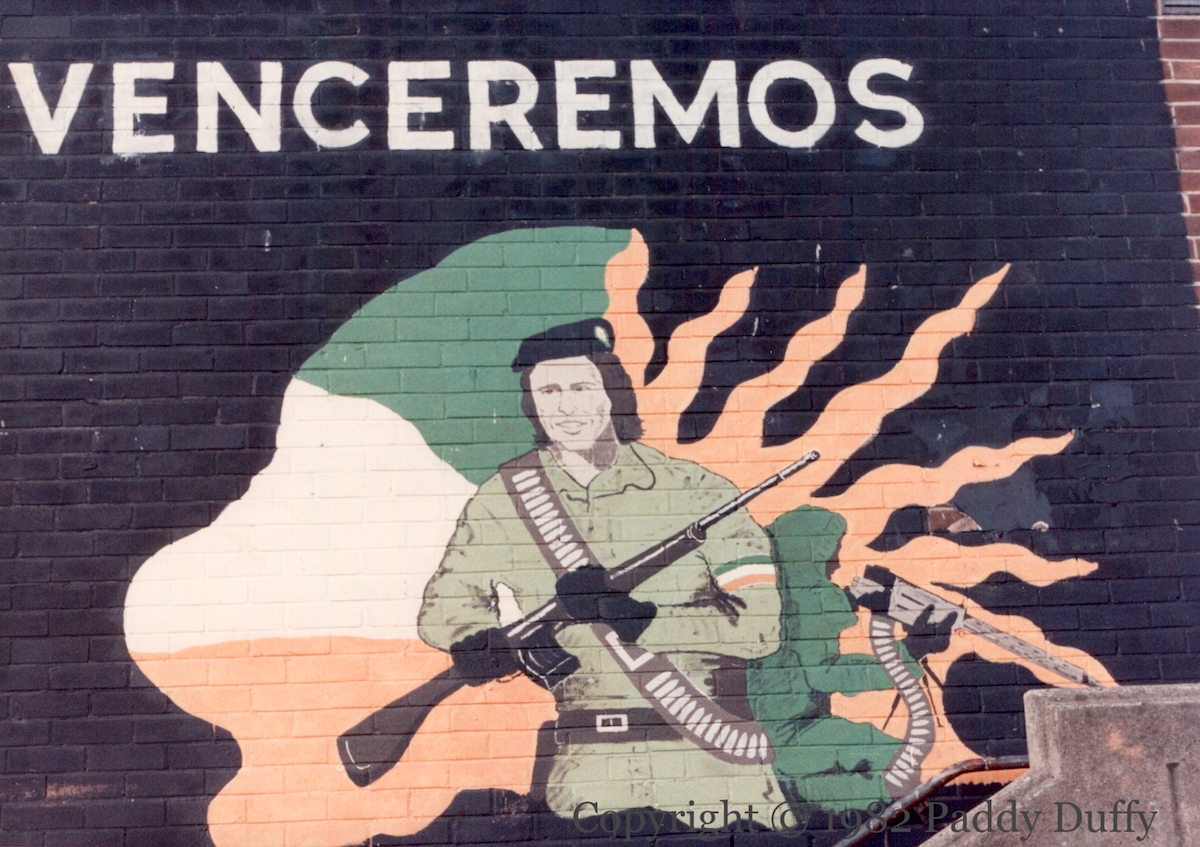
“Venceremos” is a Spanish Civil War slogan meaning “we will win (or: overcome)”, here alongside two Irish revolutionaries armed with a rifle and a machine gun, against a background of the Tricolour and sunburst flags.
Three female activists, one with a rifle, proclaim “Resistance” on the Falls Road, Belfast. The phrase is attributed to Che Guevara. The mural was commissioned by Sınn Féın’s Department Of Women’s Affairs for International Women’s Day, 1982 (March 6th). This is probably a work-in-progress image, as the words “We must grow tough, but without ever losing our tenderness” are missing from the top part of the wall and a signature – “painted by Sınn Féın Youth” – in the bottom left. Compare to the images in the Peter Moloney Collection.
This is the second mural on this wall – the first was a tribute to the first four hunger strikers to die in 1981 (see the Peter Moloney Collection). That mural was only head-high, whereas this one attempts to cover the entire wall, all the way up to the chimney – for the development of CNR muraling at this time, see Visual History 03.
In the shadow of Long Kesh watch-towers, a blanketman draped in an Irish Tricolour is held in the arms of his father, with mother looking on, reminiscent of Michelangelo’s pietà (“pity”) in which Mary holds the body of her dead son after he has been taken down from the cross (and so it also echoes Oliver Sheppard’s statue of Cúchulaınn).
Painted by Con at the top of Donegall Road, west Belfast.
The first names of the ten deceased 1981 hunger-strikers — Bobby, Francis, Patsy, Raymond, Joe, Martin, Kiersn, Tom, Micky, Kevin — appear on a ribbon held by a tricoloured phoenix against a sunburst, flanked by Starry Plough and Tricolour and volunteers firing a final salute.
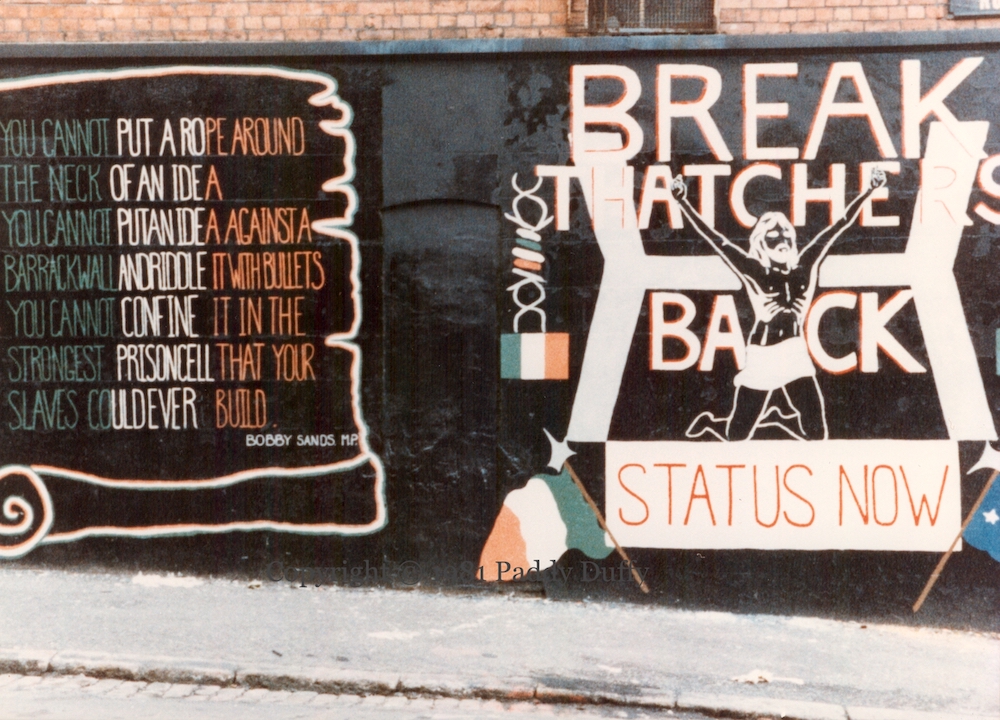
A Long Kesh/H-Block blanketman is on his knees, protesting for (political) “status now”, surrounded by barbed wire and two flags on halberds: the Irish Tricolour and the Starry Plough.
The quote on the left (in the wide-shot, below) is from Sean O’Casey, not “Bobby Sands MP”: “You cannot put a rope around the neck of an idea; you cannot put an idea up against the barrack-square wall and riddle it with bullets; you cannot confine it in the strongest prison cell that your slaves could ever build.”
(The quote is reportedly from O’Casey’s prose lament for Thomas Ashe, either the initial pamphlet in November 1917 (?entitled “The Story Of Thomas Ashe”?) or the expanded version of 1918 (entitled “The Sacrifice Of Thomas Ashe” (auction site)), though no copy of this can be found on-line, only two poems ‘Thomas Ashe’ and ‘Lament For Thomas Ashe’ (eastwallforall).
This is the second version of this mural, both from 1981. In the original – which can be seen in the Homer Sykes collection – the main panel was a large white rectangle with three volunteers with assault rifles and an RPG (and the signature in the bottom left, reading “Done by Beechmount youth against H Block”).
This version removes the gunmen and uses more of the main panel, describing “the shape of things to come” in a series of images showing of people rallying to the Irish tricolour, attacking a British soldier who falls among rubble. In the gable, the sunburst and Tricolour, with automatic rifle, remain. The words to the left read “I lie at night and try to think why / our lads in jail are prepared to die. // The British government sit back and laugh / but the people know that they are daft. // Four of our comrades have passed away / is there call for more to die[?] // O, British government use your sights / and give our lads their 5 just rights.”
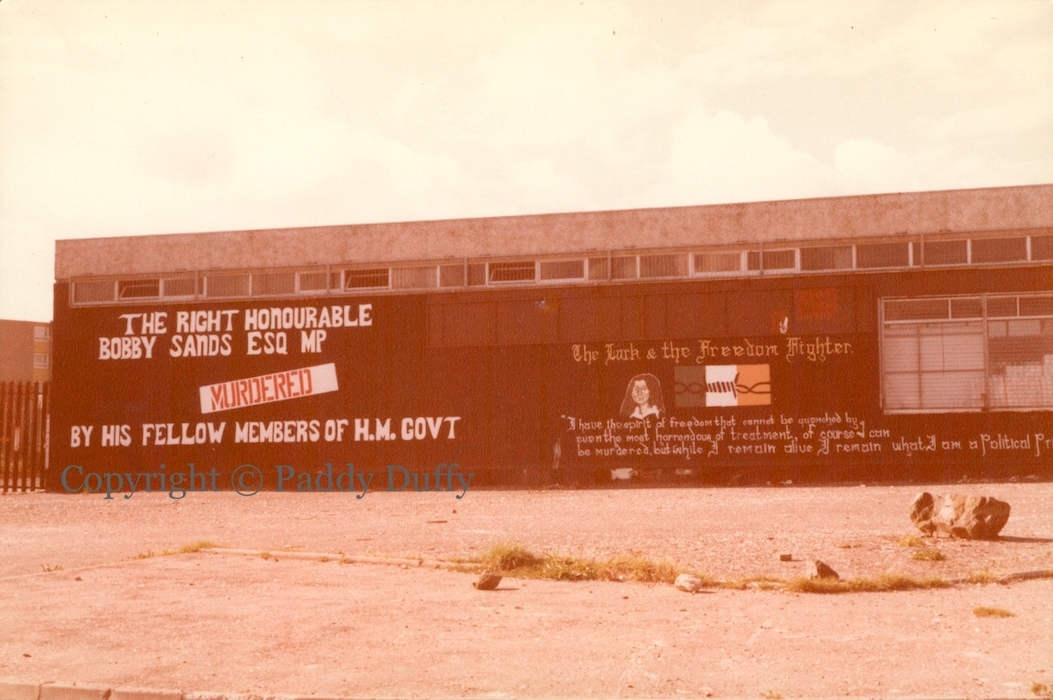
“The right honourable Bobby Sands Esq MP – Murdered by his fellow members of H.M. Govt”, “I have the spirit of freedom that cannot be quenched by even the most horrendous treatment. Of course I can be murdered, but while I remain alive, I remain what I am, a political prisoner of war, and no one can change that.” (From The Lark And The Freedom Fighter.) Barbed wire stretches over an Irish tricolour next to an image of Sands.






 Paddy Duffy Collection